
You are currently browsing the tag archive for the ‘Reconciliation’ tag.
Too many land acknowledgements are not acknowledgements anymore. They are rituals of submission with nicer stationery.
Everyone knows the form. Before the meeting, concert, lecture, school assembly, or conference begins, someone reads a solemn paragraph about the land. The tone is reverent. The words are familiar. The effect is usually deadening. Nobody is supposed to argue with it. Nobody is supposed to ask what it means in practice. The ritual is complete once the room has been morally sorted.
That is the trick.
A land acknowledgement does not merely “acknowledge land.” It often imports a political frame. It suggests that some people belong here more deeply than others, that ordinary Canadians are guests in their own country, and that citizenship itself sits under a cloud of inherited guilt.
This is why Jamil Jivani’s version is useful:
“We acknowledge that we gather here today as free men and women on land governed by private property laws. We are enthusiastic to keep this as a proud tradition in our country, and we stand firmly as people who do not believe in two-tiered citizenship.”
That works because it does what the usual version refuses to do. It acknowledges the legal and political order under which people are actually gathered.
We are not meeting in a metaphysical guilt zone. We are meeting in Canada. That means Canadian law, constitutional government, treaty obligations, private property, Crown land, Aboriginal title, reserves, statutes, courts, and civic rights that apply to citizens as citizens.
The details matter. Canada’s land regime is not one simple thing, and anyone pretending otherwise is selling you a pamphlet, not an argument. But the public square still depends on a shared legal order. It cannot survive if every gathering begins by quietly ranking people according to ancestry.
That is why the phrase “land governed by private property laws” matters. It cuts through the incense.
Private property is not just about who owns a fence line or a parcel on a title map. It is one of the civilizational tools that lets strangers live beside each other without every dispute becoming a tribal contest. It turns land into a governed reality rather than a permanent symbolic battlefield. It lets people build homes, churches, schools, businesses, farms, and community halls without having to justify their existence every time someone invokes ancestry.
The usual acknowledgement often leaves people with a vague sense that Canada is illegitimate, but without saying clearly what should follow.
Are property titles invalid? Are municipal governments illegitimate? Are homeowners merely tenants of history? Are citizens equal, or are some citizens permanently morally prior because of bloodline?
These questions are usually dodged because answering them would reveal the radicalism hiding inside the ritual.
Jivani’s version answers plainly: no two-tiered citizenship.

That is the heart of it.
A serious country can honour Indigenous history. It can recognize treaties. It can correct specific injustices where evidence and law require correction. It can admit that governments have done cruel, stupid, and destructive things. None of that requires teaching Canadians that equal citizenship is somehow morally suspect.
But that is where many modern land acknowledgements drift. They sort the room into moral categories before the event even starts. Some people are original. Some are settlers. Some have ancestral legitimacy. Others inherit suspicion. The language remains soft, but the structure underneath it is hard.
That is not reconciliation. That is caste thinking with a grant application attached.
And no, refusing that frame does not mean pretending history began yesterday. This lazy accusation needs to be retired. Canadians can know the history without accepting a ritual designed to weaken their confidence in the country they inhabit. Memory does not require self-erasure. Justice does not require permanent civic grovelling. Respect does not require pretending that liberal citizenship is some colonial inconvenience we should all feel embarrassed about.
If people want reconciliation, then do the real work. Clarify treaty obligations. Improve reserve governance. Support economic development. Fix broken service delivery. Protect individual rights. Litigate actual claims. Negotiate actual settlements.
But stop pretending that reciting inherited guilt before a PowerPoint presentation is moral courage.
The better acknowledgement is provocative because it reverses the moral pressure. Instead of forcing citizens to rehearse guilt before they proceed, it affirms the conditions that let free people gather in the first place: law, property, citizenship, and equality before the state.
That is exactly why it will irritate the professional class that treats land acknowledgements as sacred theatre. It refuses the expected posture. It does not bow. It does not mumble through a half-confession. It says, openly, that Canada is a real country, that its legal order matters, and that citizenship must not be divided into ancestral ranks.
A land acknowledgement should acknowledge reality.
That is worth saying out loud.
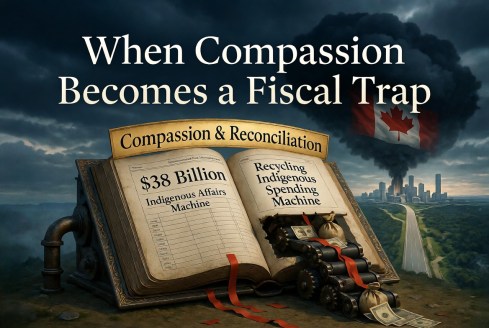
Canada’s Indigenous spending model has a problem it can no longer hide behind good intentions.
We are spending roughly $38 billion a year through core departments alone, after a decade of rapid expansion. The question is not whether that money is justified in principle. The question is whether it works.
On the outcomes that matter most—housing, child welfare, clean water reliability, and long-term economic independence—the answer is uneven at best and stagnant at worst. Progress exists. It is real. But it is not proportional to the scale of the spending. That gap between money spent and results achieved is the whole argument.
A system that cannot convert large, sustained spending into durable independence is not compassionate. It is failing.
The current model does not primarily produce independence. It manages dependency.
Spending has risen sharply, yet the Auditor General still found unsatisfactory progress on 53% of prior recommendations across core areas such as water, health access, emergency management, and socio-economic gaps. That is the mechanism in plain terms: more money flows, the system expands, compliance and administration thicken, and outcomes move slowly.
This is not just a funding shortage. It is a delivery failure.
And a delivery system that cannot convert major, repeated spending increases into reliable improvement is not neutral. It is misallocating resources at scale.
Canada is not bankrupt. But it is not insulated from fiscal reality either.
Federal spending is approaching half a trillion dollars. Debt-service costs are rising. Demographics are tightening the margin for error. You do not need a full sovereign-debt crisis for political choices to narrow. You just need pressure. A serious downturn, rising interest costs, or prolonged fiscal strain can force governments into reprioritization very quickly.
And when that happens, governments do not trim politely. They cut where they can.
That is where the current model becomes morally and fiscally dangerous at the same time. A system built on permanent federal transfers is stable only while those transfers keep flowing at politically tolerable levels. The moment that assumption weakens, those most dependent on the state become the most exposed to its limits.
That is the point too many sentimental arguments glide past. Dependency is not merely expensive. It is fragile.
A support model that only works while fiscal capacity keeps expanding is not a support model. It is a fair-weather dependency machine.
The present structure also rewards the wrong things. It rewards program expansion over completion, compliance over outcomes, announcements over maintenance, and federal management over local accountability. Money moves. Reports get written. Conditions improve, if they improve, far too slowly.
Look at drinking water. Ottawa rightly points to advisories lifted over the past decade. That progress matters. But Ottawa’s own figures also show that long-term advisories remain, and that many systems still require operational improvements before advisories can be lifted. That is not mainly a ribbon-cutting problem. It is a maintenance and systems problem. Building is politically photogenic. Sustaining is harder. The current model has often been better at funding capital headlines than at securing competent long-run operation.
The same broader pattern appears elsewhere. Indigenous children remain dramatically overrepresented in foster care. In 2021, Indigenous children made up 7.7% of children under 15, but 53.8% of children in foster care. A system that absorbs this much money and still leaves such ratios in place does not get to call itself successful because it can point to process, intent, or moral vocabulary.
If a model is expensive, underperforming, and fragile, it does not get preserved untouched. It gets triaged.
That means being willing to contemplate deep reductions—on the order of half to two-thirds over time—not as punishment, but as forced prioritization. The case is not for abandoning Indigenous communities. The case is for abandoning the fantasy that every current layer of spending is equally necessary, equally effective, or equally defensible.
Not everything should survive.
What should be protected is what is plainly essential: clean water systems with funded long-term maintenance, core health and emergency services, schooling, literacy, child protection, housing tied to credible upkeep plans, and communities that demonstrate effective local governance capacity.
What should be cut, compressed, or eliminated is the non-essential layer that accumulates in every morally protected spending regime: duplicative federal administration, consultant-driven program layers, pilot projects that never scale, compliance regimes that consume resources without clearly improving lives, and symbolic reconciliation spending detached from measurable outcomes.
If a program cannot show serious, durable improvement, it does not get to exist because it sounds compassionate in a press release.
This is where critics will predictably panic and moralize. They will say that Indigenous communities cost more to support because of historical injustice, geographic isolation, damaged infrastructure baselines, and the enduring effects of state misconduct. That is the strongest version of the opposing case, and parts of it are obviously true.
Historical injustice matters. Geographic isolation matters. Remote delivery costs are real. Weak starting conditions are real.
But that argument does not rescue the current model.
Historical injustice explains the starting line. It does not excuse a decade of rapidly expanding budgets with only partial and uneven progress. A moral claim to support is not the same thing as a proof that the delivery structure works. And after this much spending, defenders of the status quo still cannot point to outcome improvement proportionate to the scale of expenditure.
That matters because dependency wrapped in the language of reconciliation is still dependency. A model that leaves communities structurally tied to Ottawa’s fiscal condition is not empowering them. It is exposing them.
The answer, then, is not cuts for their own sake. It is reallocation.
Savings from the non-essential layer should be redirected in two directions. First, toward fiscal stabilization, because a state that loses control of its finances loses control of its choices. Second, toward connective infrastructure: roads, bridges, utilities, and other corridors that physically integrate isolated communities into provincial economies and reduce the permanent cost of remoteness.
Isolation is not an identity. It is, in significant part, an engineering and governance problem.
If you do not solve that problem, you will subsidize its consequences forever.
Historical injustice explains the starting line. It does not excuse ten years of bigger budgets with only marginal gap closure.
This is the part polite politics hates to say aloud. A country that refuses to discipline failing systems during periods of relative control increases the odds that future discipline will arrive under pressure instead. Markets impose limits. Debt-service costs impose limits. Fiscal stress imposes limits. In more extreme scenarios, countries lose the luxury of setting their own reform timetable and their own reform terms.
Better a hard reallocation now than a panicked contraction later.
Better to choose triage than to have it chosen for you.
The question is not whether Canada should support Indigenous communities. It should.
The question is whether Canada is willing to admit that the current model is not delivering enough, not fast enough, and not durably enough to justify its scale. Because the worst outcome is not reform. The worst outcome is drift: a system that consumes, reassures, and congratulates itself right up until the moment it cannot continue.
And then fails all at once.
References
- Indigenous Services Canada and Crown-Indigenous Relations and Northern Affairs Canada planned spending totals for 2025–26, approximately $38 billion combined.
- Office of the Auditor General of Canada follow-up finding that 53% of prior recommendations showed unsatisfactory progress.
- Indigenous Services Canada figures on long-term drinking water advisories, including advisories lifted and those still active.
- Statistics Canada figures showing Indigenous children as 7.7% of children under 15 but 53.8% of children in foster care in 2021.
- Federal spending and debt-pressure context from the budget and main estimates material summarized in the source text.











 bleatmop
 Mystro
 The Arbourist


 Dead Wild Roses
Your opinions…