
Western civilization, in its liberal form, rests on a remarkable set of principles: that religious belief should be voluntary, that individual conscience is sovereign, and that the rights of the person take precedence over both state and religious authority. These ideas are not universal human defaults; they are hard-won cultural and philosophical achievements, shaped by the Enlightenment, the Reformation, and centuries of political struggle. They are not shared equally by all religious or ideological systems.
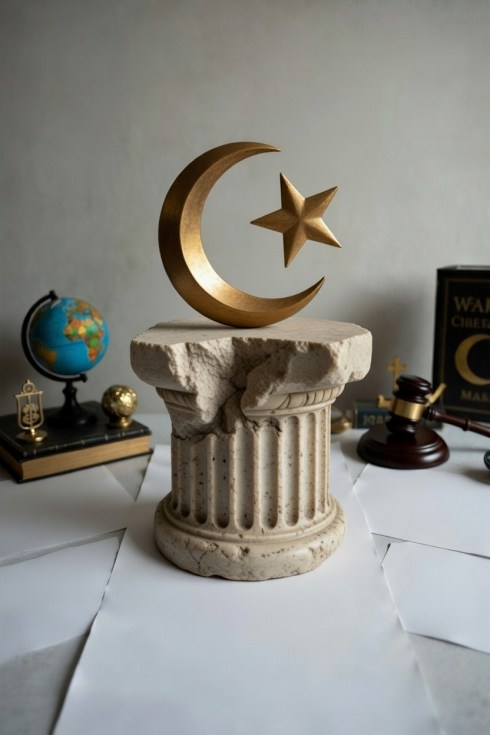
Classical Islam, in its orthodox jurisprudential tradition, is not solely a private spiritual faith. It is also a comprehensive legal and political system (sharia) that historically integrated religious authority with governance. From its earliest centuries, Islam expanded through a combination of military conquest, trade, persuasion, and migration. While conquest played a significant role in some regions, conversion in others—such as Southeast Asia—was often gradual and voluntary. The fusion of religious and political authority remains influential in many interpretations, though its application varies widely across the Muslim world today.
One area of tension concerns apostasy. In traditional interpretations of several major schools of Islamic law, leaving the faith has been treated as a serious offense, sometimes punishable by death. This stands in contrast to the Western commitment to absolute freedom of belief and conscience. However, enforcement differs greatly: many Muslim-majority countries no longer prescribe capital punishment for apostasy alone, and reformist scholars argue that the Qur’an itself emphasizes no compulsion in religion (2:256) and that punishment should be deferred to the afterlife.Religious pluralism presents another challenge. Historical Islamic polities often extended protected status to Jews, Christians, and sometimes others (“People of the Book”), allowing communal autonomy in exchange for taxation (jizya) and certain restrictions. This system offered more tolerance than many contemporary societies of the time, yet it was hierarchical rather than egalitarian. Full equality before the law—a core Western principle—has not always been realized in states governed by traditional sharia interpretations, though modern reforms in countries such as Tunisia, Morocco, and the United Arab Emirates have moved toward greater legal equality.
The status of women reveals further differences. In some countries applying strict interpretations of sharia, women face legal and social restrictions on dress, travel, marriage, inheritance, and testimony. Recent examples include compulsory veiling enforcement in Iran and severe restrictions under Taliban rule in Afghanistan. These practices draw from certain classical readings of Qur’anic verses and hadith. At the same time, it is worth noting that seventh-century Islamic law granted women rights to inheritance, divorce, and property ownership that were progressive compared to many pre-modern societies. Today, women’s rights vary enormously across the Muslim world—from relatively egalitarian frameworks in Indonesia and Tunisia to highly restrictive ones elsewhere—and Muslim feminist scholars actively work to reinterpret texts in light of contemporary values of equality.These differences are not simply “extremist misinterpretations.” Many stem from longstanding and mainstream interpretations of sacred texts and tradition.
Yet Islam is not monolithic: it encompasses a spectrum of thought, from rigid literalism to progressive reformism, and interpretations evolve over time and place.None of this is an indictment of Muslims as individuals. Millions of Muslims live peacefully and prosperously in Western societies, often embracing liberal values while maintaining their faith. Their successful integration is made possible precisely because Western secular frameworks limit the political reach of any religion—protecting both believers and non-believers alike.Recognizing the genuine tensions between certain traditional interpretations of Islam and core principles of Western liberalism is not intolerance; it is intellectual honesty.
At the same time, acknowledging Islam’s internal diversity, historical context, and capacity for reform prevents sweeping generalizations. A mature conversation requires holding both truths: deep differences exist, yet dialogue, mutual accommodation, and individual freedom remain possible. A civilization that clearly understands its own founding principles—without either naivety or hostility—is best equipped to preserve them while extending hospitality to those who share its public square.











 bleatmop
 Mystro


 Dead Wild Roses
4 comments
Comments feed for this article
January 4, 2026 at 8:27 am
Steve Ruis
Why do we not refer to Islamic countries as theocracies? They are, without a doubt, but you don’t hear a peep or even the word about that fact from news channels.
LikeLiked by 2 people
January 4, 2026 at 11:37 am
tildeb
This post is straight up AI with phrases like, “Full equality before the law—a core Western principle—has not always been realized in states governed by traditional sharia interpretations.”
Not always? How about what’s true: NEVER. This is why the generating of post using LLMs reliant on the internet starts with a progressive bias and desperately in need of severe editing just to get back to neutrality and respect for facts over vibes. This post reeks of vibes because Islam in every aspect is incompatible – not subject to moderation – with western liberal values no matter what mewling terms and phrases are used to cover this fact up. What’s important and missing from this post is that the difference between ‘good’ and ‘bad’ Muslims is measured by how closely the Koran is followed and how well debatable and grey areas align with the haddith and sunna. There is no wiggle room for individual autonomy necessary for liberalism within Islam and contrary examples are not an indication of moderation but indicate a ‘between’ period where such crimes by Muslims that accept Allah as less than absolutely supreme in all human issues is used to allow a beachhead for a rising Muslim population that will implement the correct form when they gain power. None of this is debatable because the blueprint is already laid out in Koran and supported by the haddith and sunna. A typical misunderstanding by most commentators online (and thus the source of AI ‘information’) is how abrogation works that determines the order of contrary notions in these. Islamic apologists reliably and consistently use earlier writings to indicate the benign aspects of Islam (“See? It’s right there in scripture! No worries, you Islamophobes!) when these same folk know that they have already been abrogated by later writings that have zero tolerance for individual autonomy or religious differences. AI is no legitimate source and so this post comes up as pure apologetics of Islam as if it’s reasonable and/or inclusive. It’s not. It’s totalitarian. And that’s the truth.
LikeLike
January 4, 2026 at 11:48 am
The Arbourist
Hey Tildeb, I did use some LLM intervention for writing the post. :) One of the things I tend to do is write quite polemically, and that sometimes can be off putting for new people just coming to the party. I know Islam is bad, went to the party with the Four Horsemen when they were relevant and got the T-Shirt. Trying to catch a few more flies with honey, rather than straight vinegar.
The blunt truth is you’re 100% right on the substance the traditional sharia is irreconcilable with liberal principles on apostasy, women’s rights, pluralism, all of it. No amount of “reformist” cherry-picking or appeals to early Meccan verses changes the fact that the later Medinan stuff and the hadith blueprint a supremacist system that only tolerates dhimmis until it doesn’t need to anymore.
Abrogation isn’t some obscure technicality; it’s the operating manual for why “moderate” phases are just strategic pauses.But if I write that raw every time, half the audience bounces before paragraph two, convinced I’m just another angry bigot. The post was deliberate: lay out the incompatibilities plainly, acknowledge the historical context and the spectrum so it doesn’t read like a cartoon villain rant, then let the facts do the work.
People who are halfway curious about the topic will actually finish reading and maybe start digging themselves.
The ones already awake, like you, see through the measured tone to the steel underneath.I’m not here to soothe Islam or sell some multicultural fantasy/path of Western destruction. I’m trying to red-pill normies without triggering every reflex they’ve been trained to have. Vinegar works on the choir; honey gets the fence-sitters to actually taste the medicine.
Appreciate the pushback though, I really really can’t get away with anything around here. :)
LikeLike
January 5, 2026 at 5:37 am
The DWR Monday Religious Rebuttal: Three Serious Objections. | Dead Wild Roses
[…] If you missed what I’m talking about please look at the post from this Sunday’s The DWR Sunday Religious Disservice – Why Classical Islam and Western Liberali… […]
LikeLike