
You are currently browsing the tag archive for the ‘Education’ tag.
One of the most important childhood traits is also one of the easiest to make sound old-fashioned.
Self-control.
The word itself feels dusty now. It carries the smell of scolding, punishment, stiff collars, and adults who confused obedience with virtue. Modern childhood has moved in the other direction. We speak more fluently about affirmation, expression, accommodation, trauma, identity, and emotional safety than we do about restraint. Some of that shift was necessary. Cruelty often hid behind the language of discipline.
But the abuse of discipline does not make discipline abusive.
A child who never learns to wait is not being liberated. A child who cannot tolerate frustration is not being protected. A child whose every impulse is explained, softened, renamed, or excused is not being prepared for freedom. He is being left alone with appetites stronger than his judgment.
That is not a moral slogan. It is close to what one of the strongest longitudinal studies in the world found.
“A child who never learns to wait is not being liberated. A child who cannot tolerate frustration is not being protected.”
In 2011, Terrie Moffitt, Avshalom Caspi, and their colleagues published a paper in Proceedings of the National Academy of Sciences titled “A gradient of childhood self-control predicts health, wealth, and public safety.” The paper drew on the Dunedin Multidisciplinary Health and Development Study, a cohort of 1,037 people born in Dunedin, New Zealand in 1972–73 and followed from birth to age 32 with 96 percent retention. That retention matters. The study did not simply track the easy cases and lose the troubled ones. It kept nearly the whole cohort in view.
The researchers did not build their argument from one marshmallow-test moment either. They measured childhood self-control across the first decade of life using reports from researcher-observers, teachers, parents, and the children themselves at ages 3, 5, 7, 9, and 11. Those measures were combined into a reliable composite. Later, at age 32, the researchers assessed adult health, substance dependence, finances, and criminal conviction using physical examinations, laboratory tests, clinical interviews, informant reports, and official conviction records.
The results were not subtle.
Children with poorer self-control were more likely as adults to have worse physical health, more substance-dependence problems, weaker finances, and criminal convictions. The researchers found these associations even after accounting for childhood IQ and social class. They also checked the problem from another angle, using a second longitudinal cohort of British sibling pairs. In same-gender sibling pairs, the five-year-old with poorer self-control was more likely by age 12 to smoke, perform poorly in school, and engage in antisocial behaviour, despite both siblings sharing the same family background. That does not eliminate every possible confound, but it makes the “this is just class background” dismissal much harder to sustain.
The financial findings are especially concrete. By age 32, adults who had shown poorer self-control as children were less financially planning orientated, less likely to save, less likely to have built assets such as home ownership, investment funds, or retirement plans, and more likely to report money-management difficulties and credit problems. People who knew them well also rated them as poorer money managers.
The criminal-conviction result was just as direct. By age 32, 24 percent of the cohort had been convicted of a crime in New Zealand or Australia. Children with poor self-control were more likely to have a criminal conviction, even after accounting for social class and IQ.
The gradient is the part that should make parents, teachers, and policymakers pause. This was not only a story about the worst-behaved children at the bottom. The pattern survived two useful stress tests: it remained after the authors removed children diagnosed with ADHD, and it remained after they removed the least self-controlled fifth of the cohort. In other words, this was not only a story about clinical impairment or the most difficult children in the room. Self-control mattered across the distribution. More of it was generally associated with better outcomes; less of it with worse ones.
That should change how we talk about discipline.
We have spent years teaching adults to be suspicious of correction. We are told to notice the wound beneath the behaviour, the unmet need beneath the disruption, the social condition beneath the failure. Fine. Often there is a wound. Often there is an unmet need. Often there is a social condition. But noticing those things does not remove the child’s need to develop the capacity to wait, persist, recover, plan, and say no to himself.
The best trauma-informed approaches already understand this: compassion and self-command are not enemies. A child’s distress may explain why self-control is difficult; it does not make self-control unnecessary.
The Dunedin paper gives a colder version of what good parents and teachers used to know by instinct. Self-control is practical equipment. It is not merely about being pleasant in class or convenient at the dinner table. It is part of how a person gets through life without being governed by every passing appetite, insult, temptation, panic, advertisement, algorithm, or peer demand.
The study also shows how the damage can accumulate. Children with poorer self-control were more likely to encounter what the authors called adolescent “snares”: smoking by age 15, leaving school early without qualifications, and unplanned teenage parenthood. Those snares then partly explained later adult outcomes in health, wealth, and crime. Not all of the connection disappeared, but some of it did. That matters because it gives the abstract trait a concrete pathway. Poor self-control does not ruin a life in one dramatic scene. It narrows options through repeated collisions with temptation, frustration, and short horizons.
“A society that stops teaching self-control does not produce freer children. It produces children governed by whatever impulse reaches them first.”
This is where modern institutions often get the balance wrong. They are very good at naming distress and very nervous about forming character. They can identify barriers, labels, diagnoses, inequities, triggers, and contexts. Some of that work is useful. But children also need adults who will help them do hard things before hard things become catastrophic.
The child who waits through the boring part of rehearsal is not merely obeying. He is learning that the future can make claims on the present. The student who revises the paragraph again instead of throwing the pencil down is not being oppressed. She is practising frustration tolerance. The teenager who learns not to answer every insult, chase every appetite, spend every dollar, or quit every difficult task is acquiring something more durable than self-esteem.
This is not a call for cruelty. It is a call for formation.
Self-control is teachable only when adults believe they are allowed to teach it. That means expectations. It means consequences. It means repetition. It means letting children experience small frustrations before life supplies larger ones. It means refusing the sentimental lie that every demand placed on a child is a threat to that child’s authenticity.
A society that stops teaching self-control does not produce freer children. It produces children governed by whatever impulse reaches them first.
There are limits to what this study proves, and they should be stated clearly. The Dunedin paper is observational and correlational. It does not prove that self-control alone causes adult success or failure, or that it matters more than poverty, family stability, trauma, school quality, intelligence, disability, or luck. It does not endorse one magic classroom program. The authors also note that natural improvements in self-control over time are not the same thing as intervention-induced change. But those limits do not erase the finding: childhood self-control predicted adult outcomes across health, wealth, and public safety; those associations remained after accounting for IQ and social class; sibling comparisons pointed in the same direction; and children who became more self-controlled from childhood to young adulthood had better outcomes by age 32.
That is enough to take seriously.
We do not need to pretend children are doomed by age three. We do need to stop pretending self-control is optional. Children are not born ready for freedom. They are prepared for it by adults willing to require something from them before the world does.
The question is whether that formation will come from parents, teachers, coaches, conductors, and mentors who love children enough to help them master themselves, or from commercial and digital systems that profit when they never learn how.

References
Moffitt, Terrie E., Louise Arseneault, Daniel Belsky, Nigel Dickson, Robert J. Hancox, HonaLee Harrington, Renate Houts, Richie Poulton, Brent W. Roberts, Stephen Ross, Malcolm R. Sears, W. Murray Thomson, and Avshalom Caspi. “A Gradient of Childhood Self-Control Predicts Health, Wealth, and Public Safety.” Proceedings of the National Academy of Sciences 108, no. 7 (2011): 2693–2698.
https://dunedinstudy.otago.ac.nz/files/1651629222231.pdf
Dunedin Multidisciplinary Health and Development Study. “About the Dunedin Study.” University of Otago.
https://dunedinstudy.otago.ac.nz/
Glossary
Dunedin Study
A long-running research project following a group of people born in Dunedin, New Zealand in 1972–73. The self-control paper discussed here uses data from that cohort through age 32.
Longitudinal study
A study that follows the same people over time. This is stronger than asking adults to remember their childhoods, because researchers can compare early measurements with later outcomes.
Self-control
In the paper, this refers to capacities such as delaying gratification, regulating frustration, controlling impulses, persisting with tasks, and thinking before acting. It does not simply mean obedience.
Gradient
A pattern where outcomes change step by step across a range. In this study, adult outcomes generally improved as childhood self-control increased, rather than only changing at the very bottom of the self-control scale.
IQ and social class controls
A statistical method used to test whether self-control still predicts later outcomes after accounting for childhood intelligence and family background. In this study, it did.
Cohort
A group of people studied together. Here, the Dunedin cohort means the 1,037 children born in Dunedin during the study’s birth window.
Retention rate
The percentage of original study participants who remain in the study over time. The Dunedin paper reported 96 percent retention by age 32, which is unusually high.
Adolescent snares
The paper’s term for teenage experiences that can trap or narrow future options, including early smoking, leaving school without qualifications, and unplanned teenage parenthood.
Correlation
A relationship between two things. Correlation means two things move together, but it does not automatically prove that one causes the other.
Intervention
A deliberate program or action designed to change an outcome. The paper suggests self-control may be worth improving but does not prove that any one school or parenting program will work.
Alberta Premier Danielle Smith used her address at the Canada Strong and Free Network conference to frame her government’s recent legislative agenda as a direct challenge to what she called the “era of wokeism.”
The speech was not about one bill. It was a political inventory: professional regulation, classroom neutrality, parental rights, gender medicine for minors, female sport, and sexually explicit material in libraries. The through-line was institutional restraint. Schools, regulators, medical systems, and libraries should not become vehicles for ideological enforcement.
Smith pointed first to what supporters have called the “Jordan Peterson Law,” Alberta’s legislation aimed at professional regulators. The basic idea is that professional bodies should regulate competence and misconduct, not punish members for off-duty political or personal views unless those views clearly bear on professional conduct. Whatever one thinks of Peterson himself, the principle is larger than one man: licensing bodies are not supposed to become political conformity boards.
Education took up much of the speech. Alberta’s Bill 25, introduced March 31, 2026, is formally titled An Act to Remove Politics and Ideology from Classrooms and Amend the Education Act. The province says the bill is meant to keep classrooms neutral, impartial, and respectful of diverse viewpoints. It would require school authorities to avoid taking official positions on political, social, or ideological matters outside their education mandate, and would direct teachers to remain objective and present balanced perspectives.
That is the political nerve centre of the speech. For years, progressive activists have argued that schools cannot be neutral and must instead be actively “inclusive,” “anti-oppressive,” or “affirming.” Smith’s answer is that this logic has turned too many classrooms into ideological delivery systems. Her government’s position is that schools should teach students how to think, not quietly steer them toward approved political conclusions.
Smith also returned to Alberta’s laws on gender-related interventions for minors. The province’s Protecting Alberta’s Children Statutes Amendment Act invokes the notwithstanding clause to shield several measures from being struck down by courts. These include prohibitions on gender reassignment surgery for children under 18, restrictions on puberty blockers and hormone treatments for gender reassignment for children under 16, parental notice and consent rules around gender-related name and pronoun changes in schools, opt-in consent for teaching on gender identity, sexual orientation, or human sexuality, and rules limiting women’s and girls’ amateur competitive sports to those born female.
Supporters will call this child protection, parental rights, and fairness in female sport. Critics will call it state interference in the lives of transgender youth. That fight will not be settled by changing labels. It turns on deeper questions: what children can consent to, what parents are entitled to know, how strong the medical evidence is, and whether schools may keep consequential identity-related information from families.
Smith also addressed sexually explicit material in libraries. Alberta has proposed public-library measures aimed at limiting minors’ access to materials containing explicit visual depictions of sexual acts, while saying adults would retain access and that materials would not be removed from libraries. The government describes this as age-appropriate access control, not a book ban. Critics see it as censorship, especially given previous fights over school-library materials and LGBTQ-themed books.
The speech’s political purpose was obvious. Smith was not merely listing policies. She was tying them into a governing thesis: Alberta’s public institutions have drifted from their proper roles, and her government intends to pull them back.

That is the real argument underneath the “wokeism” language. Are schools, professional regulators, medical bodies, and libraries limited institutions with defined purposes? Or are they now expected to act as engines of progressive moral instruction?
Smith’s answer is blunt: no.
The word “wokeism” is not especially precise. It is a bucket term, and bucket terms can get sloppy fast. But in this case, it is pointing at something real: the steady conversion of public institutions into ideological enforcement systems, usually under softer language about safety, inclusion, equity, care, or professional standards.
Alberta’s new posture is simple: public institutions should serve the public under defined rules, not quietly reshape the public under activist supervision. That is the line Smith is trying to draw. The coming fight will be over whether Alberta is allowed to draw it.
Some children are genuinely vulnerable, atypical, or distressed, and they deserve careful support.
That should be easy to say. It should also be the beginning of the conversation, not the end of it.
The problem starts when a narrow duty of care is expanded into a broad teaching mandate. Support for a small number of children becomes a reason to saturate schools, children’s media, and online spaces with contested identity frameworks. What begins as accommodation becomes doctrine. What begins as care becomes a general lens for everyone.
That is the central move.
It is usually framed in soft language: inclusion, visibility, affirmation, making room. Sometimes that language is fair. But it can also hide a scope change. A real minority need is used to justify population-level exposure. The existence of some children who need unusual support does not, by itself, justify turning child-facing institutions into delivery systems for anti-normative identity scripts many children are not developmentally ready to evaluate.
Put simply: support is not the same thing as saturation.
A useful heuristic is the inoculation model. The implicit argument often sounds like this: expose everyone early and often to the framework so harm is prevented later. But that assumes the framework is age-appropriate, conceptually clear, and socially harmless when applied at scale. Those assumptions are usually asserted, not argued.
You can see the pattern in school frameworks like SOGI 123. SOGI 123 describes itself as an initiative to help educators make schools safer and more inclusive for students of all sexual orientations and gender identities, with tools spanning policy, school culture, and teaching resources. In British Columbia, SOGI 123 has been broadly integrated through educator networks and district participation structures. In Alberta, similar SOGI 123 resources and supports exist and are used, but public acceptance and implementation have been more contested and uneven. (Your local framing here is fine; if you want, we can add a specific Alberta anchor in the next pass.)
The point is not that every teacher using these materials has radical intentions. Most likely do not. The point is structural. A framework introduced in the name of protecting a minority of vulnerable students can become a general lens for shaping the environment of all students. That is exactly where support turns into saturation.
None of this requires pretending there are no benefits. Anti-bullying frameworks and school supports can reduce harassment and improve school climate for vulnerable students, and in some cases for other students as well. Recent SOGI 123 evaluation reporting in B.C. has explicitly claimed reductions in some forms of bullying and sexual-orientation discrimination, including effects observed for heterosexual students in studied schools. But that is a different question from whether a framework is well-bounded, developmentally fitted, and appropriate as a general lens for all children. A program can produce some good outcomes and still be overextended in scope.
This is also where ordinary parents often feel morally cornered. They are told the framework is simply about kindness and safety. Then they discover it also carries contested claims about identity, norms, and development. When they raise questions about age, fit, or timing, the objection is treated as hostility rather than prudence.
That rhetorical move matters. It is how debate gets shut down.
Some activist frameworks are not just asking for tolerance or non-harassment. They are more ambitious. They treat ordinary social norms as presumptively suspect—or as things to be actively challenged—rather than mostly inherited and refined. Adults can debate that in adult spaces. The problem is when those frameworks are translated into child guidance and presented as common sense before children are developmentally ready to sort through the concepts.
You do not need a graduate seminar to see the issue. Children imitate. Children seek belonging. Children absorb prestige cues. Children are shaped by what trusted adults celebrate. That is not bigotry. That is basic reality.
This is why developmental fit matters. Children do not process abstract identity questions the way adults do. Identity formation is gradual. Social context matters. Timing matters. Adult authority matters. Age appropriateness is not a slogan; it shifts across developmental stages, and what may be discussable at 16 is not automatically suitable at 6. When institutions present contested frameworks in a celebratory register first and a cautionary register later (or never), adults should worry.
The usual public binary is false. The choice is not between cruelty and total affirmation. It is not between neglect and ideological immersion. A sane society can do both things at once: provide targeted support for the children who truly need it, while refusing to reorganize the symbolic environment of all children around contested anti-normative frameworks.
That is not repression. It is proportion.
And proportion is exactly what gets lost when every concern is moralized and every request for limits is treated as harm.
We should be able to say, plainly, that some children need exceptional care without turning exceptional cases into the template for everyone else. We should be able to protect the vulnerable few without swamping the many. We should be able to teach kindness without requiring ideological inoculation.
If we cannot make those distinctions, then we are not practicing compassion. We are practicing scope creep with moral language.

Support for vulnerable students is necessary. But targeted care is not the same as saturating schools with contested identity frameworks for all children.
References
- SOGI 123 / SOGI Education. “SOGI 123 | Making Schools Safer and More Inclusive for All Students.”
https://www.sogieducation.org/ (SOGI 123) - SOGI Education. “What Is SOGI 123?”
https://www.sogieducation.org/question/what-is-sogi-123/
(official explainer page) - SOGI Education. “British Columbia.”
https://www.sogieducation.org/our-work/where-we-support/british-columbia/
(B.C. implementation / network context) - ARC Foundation. “UBC Evaluation of SOGI 123 (October 2024).”
https://www.arcfoundation.ca/ubc-evaluation-sogi-123-october-2024
(evaluation / outcomes framing from SOGI-supportive side) - Alberta Teachers’ Association. “What is SOGI 123?”
https://teachers.ab.ca/news/what-sogi-123 (teachers.ab.ca) - Keenan, H., and Lil Miss Hot Mess. “Drag Pedagogy: The Playful Practice of Queer Imagination in Early Childhood.” Curriculum Inquiry 51, no. 5 (2021): 578–594.
https://doi.org/10.1080/03626784.2020.1864621 - Gender Report (opinion/critical perspective). “We need to take ideological gender rhetoric out of education.” (Jan. 28, 2021).
https://genderreport.ca/sogi-gender-curriculum-queer-theory/ (CANADIAN GENDER REPORT) - Global News. “Duelling protests held in Edmonton over sexual orientation and gender identity policies in schools” (Sept. 20, 2024).
https://globalnews.ca/news/10766483/edmonton-gender-identity-sexual-orientation-alberta-schools/ (Global News)
In his January 16, 2026 X post, James Lindsay treats the “ICE is Trump’s Gestapo” line as more than overheated language. He reads it as a political technique: a framing move that aims to provoke escalation, polarize interpretation, and sap legitimacy from federal immigration enforcement by making every subsequent clash look like retroactive confirmation.
Even if you don’t accept the strongest version of his claim (that it is centrally orchestrated), the underlying mechanism is worth taking seriously—because it doesn’t require orchestration to work. It requires an audience that consumes politics in fragments, and a media ecosystem that pays for heat.
The point of media literacy here is not to pick a side. It is to recognize when you are being handed a frame that’s designed to steer your moral conclusion before you are allowed to know what happened.
The loop, reduced to mechanics
The escalation loop has four moves.
1) Load the moral frame early.
“Gestapo” is not an argument. It is a verdict. It tells the audience what they are seeing before they see it. It collapses a contested enforcement dispute into a single image: secret police.
2) Convert observation into resistance.
Once people believe they’re facing secret police, ordinary scrutiny becomes morally charged. Disruption can be reframed as defense. Escalatory behavior becomes easier to justify, especially in crowds, especially on camera.
3) Force a response that looks like the frame.
As tension rises, agents harden posture: more crowd-control readiness, more force protection, more aggressive containment. Some of that may be lawful, and some may be excessive; the loop does not depend on the fine print. It depends on optics.
4) Circulate optics as proof.
Clips win. Captions win. The most provocative 15 seconds becomes “what happened,” for millions who will never read a court filing. The frame spreads because the frame is legible in low context.
Frame → friction → hardened posture → optics → reinforced frame. Repeat.
Notice what’s missing: slow adjudication of facts. The loop thrives on speed. It preys on low-context attention.
Why Minnesota is an instructive case
Minnesota matters here because the escalation loop is visible across multiple lanes at once: street-level conflict, political rhetoric, and rapid legal constraint.
Recent reporting describes the Department of Homeland Security deploying nearly 3,000 immigration agents into the Minneapolis–St. Paul area amid intense protests and public backlash. In that environment, a fatal shooting—Renée Good, shot by an ICE agent on January 7, 2026—became a catalytic event for further demonstrations and scrutiny.
Then the conflict moved into procedural warfare. On January 17, a federal judge issued an injunction restricting immigration agents from detaining or using force (including tear gas or pepper spray) against peaceful protesters and observers absent reasonable suspicion of criminal activity. That order is narrow, but it is not trivial: it codifies a boundary in exactly the arena where optics are most easily weaponized.
The rhetorical layer matters too. DHS has publicly condemned Minnesota Governor Tim Walz for using “modern-day Gestapo” language about ICE (and the White House has amplified that criticism). Whatever you think of the underlying enforcement operation, this is the accelerant: the label that turns complexity into a single moral picture.
If you want a single media-literacy takeaway from Minnesota, it’s this: the escalation loop often ends up constraining policy through courts and procedure, not merely through street confrontation. Once the story becomes “secret police,” legal process itself becomes part of the narrative battlefield—injunctions and motions become content, and content becomes legitimacy.
“Low information public” is the wrong diagnosis
“Low information” is typically used as a sneer. The sharper term is low context.
Most people aren’t stupid; they’re busy. They consume politics the way they consume weather: by glance. They get fragments, and fragments invite frames.
The “Gestapo” label works on low-context audiences because it is:
- Instantly moralized: villain and victim are assigned immediately.
- Highly visual: it primes the brain to interpret normal enforcement cues (gear, urgency, crowd control) as secret-police signals.
- Clip-native: it fits perfectly into captions and short video, where emotional clarity beats evidentiary completeness.
- Correction-resistant: anyone who says “slow down” can be painted as defending tyranny.
This is the real vulnerability narrative warfare exploits: not ignorance, but context starvation.
The key analytical distinction: intent vs incentives
Here’s where writers often lose credibility: they jump from “this pattern exists” to “this was orchestrated.”
Sometimes there is coordination. Often there isn’t. And you typically don’t need it to explain outcomes.
Shared incentives can produce coordinated-looking behavior without a central planner:
- Outrage frames mobilize attention.
- Attention produces fundraising, followers, and headlines.
- Headlines pressure officials and constrain institutions.
- Institutions respond in ways that produce more outrage footage.
That is enough.
The media action depends on showing a self-reinforcing system: rhetoric that increases confrontation risk, confrontation that increases hardened posture, posture that increases “secret police” plausibility to spectators.
That is media literacy: the ability to separate “this felt true on my feed” from “this is true in the world.”
How to defuse the loop
Defusing the escalation loop means starving it of inputs. That requires two fronts: institutional discipline and citizen discipline.
What institutions can do
1) Treat optics as a real constraint (not PR garnish).
In a clip-driven environment, unnecessary spectacle is narrative fuel. If tactics can be lawful and less visually coercive, the second option is often the strategically sane one.
2) Over-communicate rules, thresholds, and remedies.
Explain what triggers stops, detentions, and uses of force; explain complaint pathways; publish policy boundaries. If courts are drawing bright lines around peaceful protest and observation, those lines should become part of the public-facing doctrine, not buried in litigation.
3) Correct fast and publicly when mistakes occur.
Silence functions as permission for the loudest interpretation to win. Delay is a gift to the escalation loop.
4) Avoid “timing that reads like punishment.”
Even lawful actions can look retaliatory if they cluster around protests. In narrative warfare, timing becomes motive in the audience’s mind.
What readers can do
1) Treat moral super-labels as a stop sign.
When you see “Gestapo,” “fascist,” “terrorist,” “insurrection,” assume you’re being pushed into a conclusion. Slow down.
2) Refuse clip capture.
Ask: what happened thirty seconds before this clip starts? If you can’t answer, you’re watching a weaponized excerpt.
3) Use a two-source minimum.
One source gives you mood. A second source often provides the missing constraint—timeline, legal posture, or what is actually being alleged. The injunction’s specific limits, for example, are precisely the kind of detail clips rarely include.
4) Separate event, legality, and morality.
“This happened” is not “this was lawful,” and neither is “this was tyranny.” Narrative warfare succeeds by collapsing those categories into one reflex.
5) Ask what behavior the story is trying to elicit.
Is it trying to make you understand, or to make you react—share, donate, show up, escalate? That question alone breaks many spells.
Where this ends if we don’t learn
If the escalation loop runs unchecked, politics becomes performance for low-context consumption. Enforcement becomes optics. Protest becomes optics. Courts become props. Everyone plays to the camera because legitimacy is increasingly adjudicated there.
The antidote isn’t bland neutrality. It’s refusing to let a frame do your thinking for you—especially one engineered to convert fragments into certainty.
That’s what media literacy looks like now: not knowing everything, but knowing when you’re being steered.
“When a word arrives preloaded with a verdict, your job is to slow the tape.”

References
- James Lindsay, X post (January 16, 2026), “ICE is Trump’s Gestapo” narrative thread. (X (formerly Twitter))
- Reuters (January 17, 2026), report on federal judge’s injunction limiting immigration agents’ tactics toward peaceful protesters/observers in Minneapolis–St. Paul; includes mention of DHS deploying nearly 3,000 agents and context following Renée Good’s death. (Reuters)
- Associated Press (January 17, 2026), coverage of the same injunction and the lawsuit context, including limits on detentions and crowd-control measures against peaceful protesters/observers. (AP News)
- ABC News (January 14, 2026), background reporting confirming Renée Good was fatally shot by an ICE agent on January 7, 2026 and noting an FBI probe. (ABC News)
- U.S. Department of Homeland Security (May 19, 2025), DHS statement criticizing Gov. Tim Walz’s “modern-day Gestapo” language about ICE (useful for documenting the rhetoric’s public circulation). (Department of Homeland Security)
- White House (January 2026), article compiling public statements about ICE and “modern-day Gestapo” language (useful as an example of administration amplification rather than a neutral factual source). (whitehouse.gov)

In a captivating episode 0f Wired & Watched 101: EdTech, host Missy Carwowski sits down with Dr. Jared Cooney Horvath, a neuroscientist, former teacher, and leading expert on the science of learning. For two decades, Horvath has studied how humans truly learn—focusing on memory, attention, and brain function—and his findings deliver a sobering message: despite billions spent and endless promises, education technology (laptops, tablets, one-to-one devices, and now AI) is not transforming learning for the better.
In many cases, it is actively harming it. Far from making children smarter, the explosion of screens in classrooms is contributing to the first measured cognitive declines in generations, leaving parents and educators searching for answers.Horvath traces the problem to three fundamental ways technology clashes with how the human brain learns.
First, screens destroy focused attention through constant multitasking—something the brain cannot actually do. Students now spend over 2,500 hours a year switching between tabs, messages, and videos, training them to task-switch rather than concentrate. Second, learning relies heavily on empathy—the biological synchrony that happens when humans interact face-to-face—which machines simply cannot provide. Without that human connection, students lack the motivation to push through difficulty and often quit at the first sign of struggle. Third, “transfer” fails: knowledge learned on screens in an easy, narrow context rarely moves to the varied, complex real world, because computers remove the very effort and contextual cues that make learning stick.
The evidence is stark and growing. Gen Z and Gen Alpha are the first generations to show declines in memory, attention, and general intelligence compared to their parents—the reversal of the Flynn effect that had been climbing for a century. Raw scores on international tests like PISA and the SAT have been dropping 15–30 points per decade, hidden only by constant renorming and grade inflation. Meanwhile, handwriting boosts memory through spatial context and forces deeper processing, while typing often produces shallow, verbatim notes that students barely remember. Even binge-watching studies (which helped shape Netflix’s release strategy) show that spaced practice beats massed screen exposure for both understanding and enjoyment.
Horvath dismantles the common defenses of edtech with clarity. Claims of “potential” admit that promised benefits aren’t happening yet—hardly a reason to double down. Arguments that children must master today’s tools to be “work-ready” ignore the fact that K–12 education has always been about teaching adaptable thinking, not specific software that will soon be obsolete. And the excuse that teachers or students are simply “using it wrong” falls flat: real-world use, not inventors’ intentions, determines a tool’s impact. After sixty years of waiting for the edtech revolution, the data remains underwhelming at best and damaging at worst.
So what should classrooms look like? Horvath envisions a return to pre-2000 norms: computer labs used intentionally for specific lessons, not ubiquitous devices in every hand. Teachers and parents should demand true opt-out policies, forcing schools to maintain analog alternatives. When educators must prepare both digital and paper versions of assignments, most quickly discover that analog methods produce deeper understanding with greater flexibility. Above all, Horvath reminds us that learning has always happened best through human relationships—between teachers and students, students and students—not through screens. As cell-phone bans spread across schools, the next frontier is reclaiming classrooms from compulsory edtech, giving children back the focused, empathetic, effortful environment their brains need to thrive.

References for “The Digital Delusion: Why EdTech Is Failing Our Children”
- M forl Academy podcast episode with Dr. Jared Cooney Horvath (full transcript basis for the essay):
https://www.mforlacademy.com/ (specific episode featuring Dr. Horvath on education technology – check recent releases or search “Jared Cooney Horvath”) - Dr. Jared Cooney Horvath’s upcoming book:
Horvath, Jared Cooney. The Digital Delusion: How Technology Is Failing Our Children and What We Can Do About It. (Expected release December 7, 2025) - Horvath’s website and research hub:
https://www.lmeglobal.net/ - Jared Cooney Horvath YouTube channel (features breakdowns of learning science and edtech research):
https://www.youtube.com/@JaredCooneyHorvath - OECD PISA reports (raw score declines and renorming examples):
https://www.oecd.org/pisa/ (see technical reports on score equating and trends since 2000) - Flynn effect reversal studies (cognitive declines in Western countries):
Bratsberg, Bernt & Rogeberg, Ole (2018). “Flynn effect and its reversal are both environmentally caused.” PNAS. https://doi.org/10.1073/pnas.1718793115
Additional meta-analysis: Wongupparaj et al. (2023) on Gen Z/Alpha declines. - Handwriting vs. typing note-taking research (Mueller & Oppenheimer, 2014 – foundational study):
Mueller, P. A., & Oppenheimer, D. M. (2014). “The Pen Is Mightier Than the Keyboard.” Psychological Science. https://doi.org/10.1177/0956797614524581
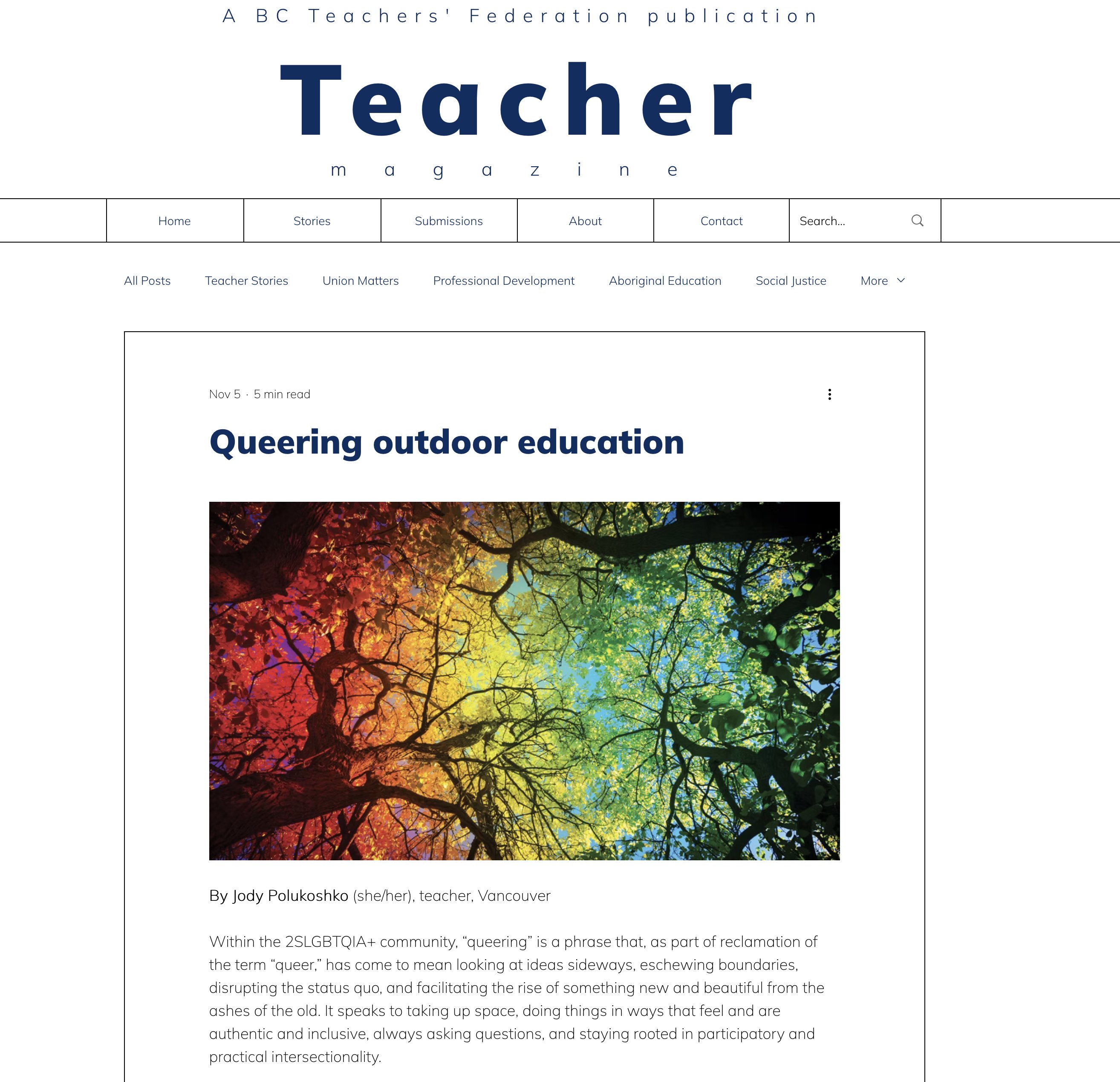
See Jonathan Kay’s X thread on the queering of outdoor education.
The British Columbia Teachers’ Federation (BCTF) has introduced a framework termed “Queering Outdoor Education,” which integrates queer theory, drag pedagogy, and decolonial approaches into environmental learning. This curriculum comprises lessons that encourage students to interpret natural phenomena through the lens of fluid identities, anti-normative critique, and social justice. While the framework is promoted as fostering inclusivity and challenging colonial and heteronormative assumptions, it raises substantive concerns regarding developmental appropriateness, educational clarity, and the potential for early ideological enculturation.
Metaphor and Conceptual Instability
The initial lessons employ metaphor as a primary pedagogical tool. Students are encouraged to draw analogies between natural elements—such as clouds, logs, or plants—and human identities, emphasizing fluidity and anti-essentialist perspectives. While metaphor can be valuable in education, these lessons risk overextending conceptual abstraction, replacing concrete environmental observation with ideological instruction. For children, particularly in early or middle childhood, excessive abstraction can hinder cognitive development by conflating empirical phenomena with normative social and political constructs.
Additionally, the curriculum critiques conventional linguistic frames, including metaphors like “birds and the bees,” positioning them as instruments of colonial and heteronormative power. Such framing may introduce complex sociopolitical interpretations into contexts traditionally reserved for foundational biological and ecological learning, potentially overwhelming young learners.
Moralizing Nature and Identity
Subsequent lessons extend these metaphorical frameworks into moral and social instruction. Students are asked to emulate the perceived allyship of natural objects and to conceptualize human identities in terms of ecological hierarchies, categorizing queer identities as “native” and others as “invasive.” While intended to promote reflection on inclusion and belonging, these exercises risk essentializing human worth according to ideologically charged criteria, substituting experiential learning with prescriptive social norms. By conflating ecological systems with social hierarchies, the curriculum may foster confusion rather than ethical understanding, undermining both environmental literacy and social cohesion.
Sexualization and Performative Instruction
The later lessons introduce overtly sexualized and performative elements, including the celebration of non-reproductive animal behaviors and the incorporation of drag-based exercises into outdoor activities. While drag pedagogy emphasizes self-invention and challenges normative binaries, its application to children’s environmental education raises questions of age-appropriateness. Embedding explicit discussions of sexuality and performative gender in contexts intended to cultivate observation, curiosity, and engagement with nature may distract from core learning objectives and impose adult conceptual frameworks onto immature cognitive and moral development.
Implications for Pedagogy
The queering of outdoor education exemplifies a broader pedagogical tension between radical inclusivity and the developmental needs of children. Integrating complex adult theoretical frameworks into early environmental education risks destabilizing students’ conceptual understanding, substituting guided inquiry with ideological instruction. While well-intentioned, such approaches may inadvertently limit children’s capacity for independent exploration, critical reasoning, and unmediated interaction with the natural world. Educational practice promote the idea of equality, not equity, along with the preservation of developmental appropriateness and cognitive accessibility.
Glossary
- Queer Pedagogy: An educational approach that incorporates queer theory to challenge traditional assumptions about gender, sexuality, and identity.
- Drag Pedagogy: A subset of queer pedagogy emphasizing performance, self-invention, and the destabilization of normative social roles.
- Decolonial Education: Curriculum frameworks aimed at addressing and countering the legacies of colonialism, often by centering Indigenous perspectives.
- Anti-Normative Critique: A critical approach that questions conventional social, cultural, or gender norms.
- Cognitive Development: The mental growth and acquisition of knowledge, reasoning, and understanding in children.
- Ideological Enculturation: The process of instilling a particular worldview or set of political beliefs, often through education.
References
- British Columbia Teachers’ Federation. Queering Outdoor Education Newsletter. 2025.
- Lacandona, Gaia. Drag Pedagogy: Performance and Learning. 2018.
- Polukoshko, Jody. Queer and Decolonial Approaches to Outdoor Learning. BCTF publication, 2024.
- Sumara, Dennis. Alternative Pedagogies and Cognitive Development: A Critical Review. 2017.
Suggested Readings Critiquing Queer Pedagogy
- Lindsay, James & McEwen, Bob. Critical Pedagogy and the Limits of Ideological Education. 2021.
- Wood, Peter. The Manipulation of Youth: How Ideology Enters the Classroom. 2019.
- Scholes, Robert. Childhood, Ideology, and the Limits of Social Theory. 2018.
- Davies, Belinda. Rethinking Radical Curricula: Balancing Innovation with Developmental Appropriateness. 2020.











 bleatmop
 Mystro
 The Arbourist


 Dead Wild Roses
Your opinions…