
You are currently browsing the category archive for the ‘Canada’ category.
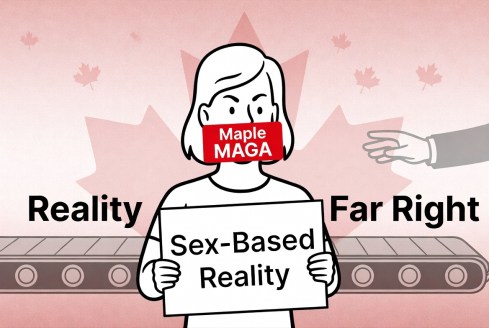
I have been called “Maple MAGA.”
It is a silly phrase, but not an innocent one. Imported American static with a Canadian toque pulled over it, the label works less as description than as sorting device: once attached, it tells the room what to do with the person before anyone has to answer what he said. That is its usefulness.
The charge, as far as I can tell, is not that I am secretly American, or that I want Donald Trump to annex the Prairies, or that I am pining for red hats on Parliament Hill. It is not that I support theocracy, oppose women’s education, or want priests running the courts.
The charge is simpler. I keep saying things that no longer sit comfortably inside the approved progressive frame.
 I defend freedom of expression, especially when the expression is rude, inconvenient, unfashionable, or badly timed. I think women and girls have sex-based rights that cannot be wished away by therapeutic language. I think female prisons should be for female prisoners. I think children should not be hurried into irreversible medical pathways to satisfy adult ideology. I think citizens should be free to read, think, doubt, argue, dissent, and change their minds without the state, the school board, the professional college, or the HR department treating their inner life as a compliance problem.
Apparently, this is enough now: not enough to make one wrong, which would require an argument; not enough to make one dangerous, which would require evidence; but enough to make one “far right,” “MAGA,” “reactionary,” “unsafe,” or whatever label is currently doing the work reasons used to do.
The insult is the visible part. Underneath it sits the relocation of the acceptable centre.
Cultures move. Language changes. Laws change. Public taste changes. Some changes are good and overdue; some are foolish; some begin as compassion and harden into coercion. There is nothing sacred about yesterday’s vocabulary merely because it is yesterday’s vocabulary, but cultural movement does not move reality.
That distinction is now being blurred. It is one thing for a society to change how it talks about sex, gender, identity, offence, harm, safety, and inclusion. It is another thing to pretend the underlying truths have changed because the approved language has changed.
A male body in a female prison does not become a female body because a policy manual has been updated. A teenage girl’s distress about her body does not become simple proof of a medical destiny because a professional association has learned a new script. A citizen’s refusal to repeat an ideological formula does not become hatred because an HR department calls the formula kindness.
The culture can change what is rewarded, what is punished, who gets invited to speak, who gets reported, who gets promoted, who gets quietly avoided, and who gets labelled a problem; it cannot change the truth.
Female prisons make the point concrete because, for most of living memory, saying that female prisons should be for female prisoners was not a right-wing position. It was barely a position at all. It sat in the background with other obvious assumptions: women’s shelters are for women, women’s sports are for women, and sex matters most in the places where privacy, vulnerability, male violence, and bodily difference are not abstractions.
“There is nothing sacred about yesterday’s vocabulary merely because it is yesterday’s vocabulary, but cultural movement does not move reality.”
Prisons are coercive institutions. Women inside them cannot simply leave, choose their neighbours, or opt out of policy experiments designed by people outside the walls. The state therefore has a heightened duty of care. Sex matters there; it matters when privacy is stripped away, when physical power is uneven, when trauma is common, and when the people affected have no meaningful escape route.
Yet once the vocabulary changes, the old safeguarding claim can be redescribed as extremism. Not because women became less vulnerable in prison, male-pattern violence disappeared, or sex stopped mattering in confined spaces; the argument is recoded because the permitted moral language changed around it.
This is the trick: move the official language, then treat unchanged reality as if it has been morally superseded.
The same pattern appears elsewhere. Free expression becomes “harm.” Privacy becomes “suspicion.” Doubt becomes “denial.” Genuine distress in young people is real, and compassion for it is necessary; but caution in youth medicine is not cruelty, and weak evidence does not become strong because the approved language insists it must. Refusing compelled belief becomes bigotry. The old liberal question — “Is this true, and may I say so?” — is replaced by a managerial one: “Does this comply with the approved moral vocabulary?”
There is a Gramscian flavour here. Gramsci understood something real about modern power: it does not operate only through police, courts, elections, and parliaments. It operates through culture; through schools, media, churches, universities, publishers, artists, professional bodies, and the people who teach society what respectable people are supposed to think.
Durable victory requires more than capturing the state; it requires shaping common sense. That is the part that feels familiar now: a workshop here, a policy update there, a glossary, a training module, a revised professional standard, a grant condition, a reputational warning. No jackboots required. Just enough pressure to teach ordinary people which sentences now come with consequences.
Most people understand the lesson. They have jobs, families, colleagues, reputations, mortgages, volunteer roles, and professional obligations. They do not want to be called hateful, unsafe, extremist, bigoted, MAGA, or far right; they do not want to become the example everyone else is warned about. So they move, or they fall silent.
Then comes the strange inversion. People who have not changed their minds are told they have moved to the far right. The old centre is renamed after the fact; positions that were once liberal, feminist, or civil-libertarian are reclassified as dangerous because the institutions around them have adopted a new script. The people did not move so much as find the centre moved around them.
That is why “Maple MAGA” is such a convenient little insult. It imports the emotional charge of American polarization and drops it onto Canadian disagreement. It lets the speaker skip the local argument: no need to examine the claim, no need to ask whether an older feminist concern might still be true, no need to wonder whether a civil-libertarian objection might have merit. The label supplies the answer before the question is allowed to form.
“Once that habit takes hold, precision disappears. These words become atmospheric; they create suspicion, not understanding, and suspicion is often all that is needed.”
This is especially poisonous in Canada, where we already borrow too many American reflexes. We take American slogans, American moral panics, American partisan categories, American racial scripts, American activist vocabulary, and American media obsessions, then pretend they map cleanly onto Canadian life. Usually they do not; but they are emotionally efficient, and that is often enough.
Once that habit takes hold, precision disappears. “MAGA” no longer means a specific American political movement. “Far right” no longer means a coherent political position. “Unsafe” no longer means a demonstrated danger. These words become atmospheric; they create suspicion, not understanding, and suspicion is often all that is needed.
A person does not have to be refuted if he has already been made socially radioactive. His argument does not have to be answered if the room has been taught to flinch before hearing it. That is the quiet power of these labels: they replace disagreement with contamination.
A free society cannot keep doing that and remain free in any serious sense. It cannot function if disagreement is treated as pollution, cannot remain liberal if every objection is recoded as harm, and cannot reason together if words are used to end thought rather than sharpen it.
Some people really are extremists. Some movements really are dangerous. Some ideas really do deserve fierce opposition; there is no virtue in pretending otherwise. But when the label comes before the argument, the argument never happens. Civic life begins to rot not when people disagree, but when they lose the habit of believing disagreement deserves an answer.
So no, I am not especially interested in proving that I am not “Maple MAGA.” The phrase is too silly to deserve that much respect. I am interested in why so many people now reach for labels instead of reasons: how free expression became suspect, how female rights became reactionary, how cognitive liberty became dangerous, and how ordinary citizens were told that standing still meant they had somehow moved to the far right.
The institutions moved the language, then pretended they had moved reality.
That is the lie at the centre of the whole exercise.
References / Further Reading
Correctional Service Canada — Commissioner’s Directive 100: Gender Diverse Offenders
Canada’s federal correctional policy on gender-diverse offenders, including placement according to gender identity or expression.
UK Ministry of Justice — New Transgender Prisoner Policy Comes Into Force
The 2023 England and Wales policy restricting placement of some transgender-identifying males in women’s prisons.
The Cass Review — Final Report
The 2024 independent review of gender identity services for children and young people in England, especially useful for the essay’s caution-in-youth-medicine point.
Ipsos Canada — Strong Majority of Canadians Continue to Support 2SLGBT+ Rights and Visibility
Useful public-opinion context showing broad support for LGBT rights alongside lower support for gender-identity-based rules in women’s sport.
Public institutions should be careful with the symbols they elevate.
A government building, school, courthouse, legislature, or public office does not belong to one faction of the public. It belongs to the whole public. That is why its official symbols should remain broad, civic, and restrained. In Canada, that means the Canadian flag and the official provincial or territorial flag.
Those flags are imperfect because the country is imperfect. No national symbol can carry every wound, achievement, grievance, regional difference, or private identity without strain. But an official flag is not supposed to say everything. It marks the common civic space where citizens disagree, argue, vote, work, worship, protest, and live together.
 Supporters of additional flags often argue that these displays are not partisan. A Pride flag, for example, may be understood as a message of welcome rather than a political demand. That argument should not be mocked. Many people look to public institutions for reassurance that they belong.
But belonging cannot depend on seeing one’s preferred symbol raised by the state.
Once public institutions begin flying non-official flags, even for sympathetic reasons, they move away from neutrality. The question is no longer whether a particular cause is worthy. Many causes are worthy. The question is whether public authority should place its symbolic weight behind some identities, causes, or movements while declining others.
That creates a problem no institution can manage fairly for long. A flag raised for one group becomes a precedent. A refusal becomes a statement. A commemoration becomes an expectation. The flagpole slowly turns from a civic symbol into a contested notice board.
Canada does not need public institutions sorting citizens by official recognition. It needs shared civic ground.
This does not prevent citizens or private organizations from displaying the symbols that matter to them. A free society should leave people room to speak, assemble, advocate, celebrate, mourn, and disagree. Civil society can be expressive because it is plural. Public institutions should be restrained because they serve everyone.
Institutional neutrality is not indifference. It is a way of keeping public authority from being captured by the pressures of the moment. It tells citizens they do not need to belong to the favoured cause of the day in order to belong in the country.
The Canadian flag and official provincial flags are broad enough for that purpose. They do not erase difference, but they refuse to make difference the first fact of public life.
Let citizens bring their arguments. Let institutions hold the common ground.
The Globe and Mail did not merely publish a bad headline. It published a small moral confession.

“SpaceX IPO makes Elon Musk the first trillionaire. Here’s how to properly hate him” was not serious analysis. It was an invitation to contempt. The newspaper later admitted the headline failed its editorial standards and replaced it. That was the right decision, but also the minimum.
The article itself may have been more nuanced than the headline. That distinction matters. But headlines are not decorative. They are the public face of an argument, the thing most readers see first, and often the only part that travels across social media. When a major Canadian newspaper packages an opinion piece as a lesson in how to “properly hate” someone, it tells us something about the institution’s instincts.
Billionaires, especially those wielding enormous cultural, economic, and political influence, deserve scrutiny. Questions about wealth concentration, government contracts, labour practices, market power, and political access are legitimate. Elon Musk is not above criticism.
But hatred is not scrutiny.
This episode reveals something important about the Overton window in Canadian legacy media. A headline encouraging readers to hate a prominent figure would normally be condemned as toxic polarization if it came from random voices online. When it appears under a respected masthead and targets the approved villain of the moment, it becomes clever commentary, at least until the backlash forces a correction.
Some will say the headline was ironic, exaggerated, or merely provocative. Fine. But institutions do not get to spend years warning the public about extremism, misinformation, online toxicity, and the collapse of civil discourse, then shrug when their own opinion pages dress contempt up as wit. Irony does not launder hatred into analysis.
Canadian media frequently complain about declining trust. This is one reason trust declines. Ordinary readers can see the double standard. They are told to be civil, careful, and responsible, while prestige outlets permit themselves moral indulgences they would condemn in others.
This is not about shielding Musk from criticism. It is about defending the line between rigorous critique and sanctioned contempt. A serious newspaper should sharpen readers’ thinking. It should not tutor them in how to hate more elegantly.
The Globe’s correction is welcome. But Canadians are entitled to ask what editorial culture allowed such a headline to go live in the first place.
If hatred is corrosive when it bubbles up from the public, it does not improve when it flows down from the opinion pages.
The government is right about one thing: children are not safe in much of online life. But that does not make every child-safety law wise, limited, or safe for a free society.
Parents have a real responsibility to monitor their children’s welfare, and that includes internet activity. Freedom does not mean abandoning children to whatever social media companies, algorithms, predators, influencers, or peer-status machines decide to push at them next. A free society still expects adults to act like adults.
But parental responsibility is not the same thing as state permissioning. Bill C-34, the federal government’s Safe Social Media Act, should be read with that distinction in mind. The issue is not whether children should be protected from online harm. They should. The issue is whether protecting them requires building the habits, infrastructure, and bureaucracy of identity-gated internet access.
That danger is sharpened by how much the bill leaves to regulation. Many of the most important questions — which services are covered, how age will be verified, what exemptions will exist, and how the new regulator will enforce compliance — are not settled in the public-facing moral language of child safety. They are pushed into future administrative machinery.
That matters. A social media ban for users under sixteen cannot enforce itself. Platforms must know who is under sixteen. To know that, they must verify age. And once age verification becomes normal, adults are pulled into the same machinery because they must prove they are not children.

Child safety should not require Canadians to trade the open internet for a permission slip.
This is where the civil-liberties danger begins. The stated aim is child safety. The operating mechanism is identity checking. Once identity checking becomes a normal condition of access, it will not stay politely confined to one narrow category of service forever.
The strongest argument for the bill is not frivolous. Social media companies have profited from addictive design, algorithmic pressure, sexualized content, bullying, and misery dressed up as engagement. Parents are right to be angry. Governments are right to ask whether platforms have been allowed to externalize too much harm onto children and families.
But good intentions do not make a bad tool harmless.
Online anonymity is not just a convenience for trolls. It matters for political dissent, unpopular opinions, whistleblowing, vulnerable people, religious minorities, abuse victims, workers criticizing employers, and ordinary citizens who do not want every thought, search, argument, or association tied back to their legal identity.
For some Canadians, anonymity is not a luxury. It is part of how they remain able to think and speak honestly. Teachers, nurses, public servants, professionals, small-business owners, and employees in ideologically narrow workplaces all understand the problem. A person can hold lawful, serious, defensible opinions and still know that one bad-faith complaint, one screenshot, or one HR process can turn ordinary dissent into a professional liability.
Canadians should not reject child protection simply because the state has chosen a bad tool. If there are unobtrusive ways to reduce children’s exposure to exploitation, addiction loops, algorithmic pressure, and adult content without creating surveillance architecture, we should pursue them. Better parental tools, device-level controls, digital literacy, stronger enforcement against predators, and less addictive platform design are all fair subjects for debate.
“Child safety is real. Identity-gated access is still a dangerous cure.”
But a checkpoint internet is not a small price to pay. It changes the relationship between citizen and screen, reader and state, speaker and regulator. Once access depends on verification, the open internet begins to look less like a public square and more like a permissioned space.
That is too much power to normalize under the language of safety.
Our rights in Canada are unlikely to be taken away all at once. They erode gradually: one safety measure, one administrative convenience, one temporary verification requirement at a time, until the extraordinary becomes ordinary and the ordinary becomes mandatory.
Then, one day, pedestrianly, Canadians may discover that freedoms they thought were secure have become permissions they must ask for.
Canada did not need less concern for possible graves at former residential schools. It needed more truth, earlier. The residential school record contains real wrongs: family separation, cultural suppression, abuse, neglect, disease, and documented deaths. But when the Kamloops announcement broke in 2021, the public story moved very quickly from ground-penetrating radar findings to language of “discovered remains” and “mass graves.” That distinction mattered. Ground-penetrating radar does not find bodies. It identifies disturbances, anomalies, and possible grave-like features that require verification.
The mechanism is familiar: narrative hardened faster than evidence. Grief became certainty. Certainty became accusation. Accusation became permission. A country already primed to view churches as historical villains suddenly had a simple moral script: children had been found, churches were responsible, rage was righteous. After that, Canada saw a wave of church fires and vandalism. A CBC investigation later reported that at least 33 Canadian churches had burned to the ground since May 2021; 24 were confirmed arsons, two were ruled accidental, and the remaining cases were suspicious or under investigation.
That caveat matters. We should not replace one sloppy narrative with another. Not every burned church was necessarily revenge for residential schools. Not every vandal was acting from the same motive. Some Indigenous leaders condemned the arsons, and some churches destroyed or damaged were themselves part of Indigenous communities. But it is also dishonest to pretend the atmosphere had nothing to do with it. The grave announcements were absorbed into a wider moral panic, and churches became symbols onto which anger could be poured.
This is the disservice. Public institutions, media, and political leaders helped sanctify a narrative before the evidence was ready to carry it. Then, when churches burned, the response was often strangely muted, hedged, or morally embarrassed. The same society that had no trouble speaking in grand certainties about historical guilt suddenly discovered nuance when actual churches were being attacked.
The answer is not denial of residential-school harms. It is truth over narrative, regardless of whose narrative is being protected. Children suffered. Families were broken. Some children died. Some claims also outran the evidence. A serious country should be able to say all of that at once. If Canada wants reconciliation rather than ritualized accusation, it has to stop treating careful factual distinctions as blasphemy. Truth does not become less necessary because the cause is emotionally powerful.
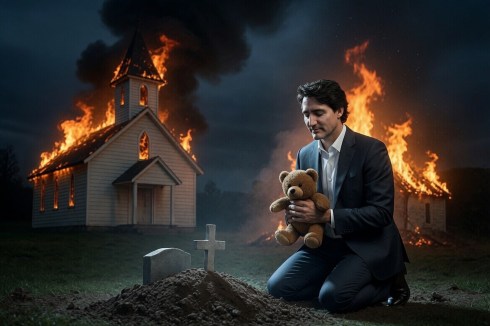
Canada needed truth, not ritual certainty. When narrative outran evidence, churches became symbols for rage.
Works Referenced
Tk’emlúps te Secwépemc. “Remains of Children of Kamloops Indian Residential School Discovered.” May 27, 2021.
https://tkemlups.ca/wp-content/uploads/05-May-27-2021-TteS-MEDIA-RELEASE.pdf
Sarah Beaulieu. “Ground-Penetrating Radar Preliminary Survey: Kamloops Indian Residential School.” Canadian Archaeological Association PDF.
https://canadianarchaeology.com/sites/default/files/page/gpr_at_kamloops_irs_sarah_beaulieu.pdf
Tk’emlúps te Secwépemc. “Media Release.” July 15, 2021.
https://tkemlups.ca/wp-content/uploads/July15_Media-Release_Final.pdf
Terry Reith, CBC News. “At least 33 Canadian churches have burned to the ground since May 2021. So far, 24 are confirmed arsons.” January 10, 2024.
https://www.cbc.ca/news/canada/edmonton/church-fires-canada-1.7055838
Angelus News. “Report: 33 churches in Canada destroyed since May 2021.” January 17, 2024.
https://angelusnews.com/news/nation/canada-churches-destroyed/
CBC News. “‘Unacceptable and wrong’: Trudeau condemns attacks on churches.” July 2, 2021.
https://www.cbc.ca/news/politics/trudeau-churches-arson-attacks-1.6088237
“The failed attempt to criminalize “denialism” should not end the argument. It should begin a more honest one.”
Canada has just been given a useful lesson in how not to defend historical truth.
A Senate committee recently amended Bill C-9, the federal government’s anti-hate bill, to include a new offence for “residential school denialism.” The amendment passed committee by a vote of 7–1, then failed in the full Senate by a vote of 41–32. The broader anti-hate bill continued, but this particular amendment was defeated.
That defeat matters, but not because the residential school system was harmless, invented, or benign. It was not. More than 150,000 First Nations, Inuit, and Métis children attended residential schools, often far from their families and communities. The National Centre for Truth and Reconciliation describes the system as explicitly designed to separate Indigenous children from their families and cultures.
The historical record is ugly: forced removal, family rupture, cultural suppression, underfunded institutions, abuse, neglect, disease, and deaths are not fringe claims. No serious account of Canadian history should pretend otherwise.
But seriousness cuts both ways. The record is not made more honest by flattening it into a morality play. Some former students did gain literacy, language skills, vocational training, religious formation, discipline, shelter, or relationships with individual staff who treated them decently. Some may have experienced school as an escape from poverty, instability, disease, or family circumstances that were already difficult. Those facts do not redeem the system. They do not cancel forced removal, cultural suppression, abuse, neglect, or death. But they do belong in the record, because truth does not improve when inconvenient evidence is treated as betrayal.
That is why criminalizing “denialism” is such a dangerous move.
What exactly would the law punish? Denying that residential schools existed? Denying that abuse occurred? Denying that children died? Questioning a specific claim about a specific site? Asking whether a radar anomaly is a confirmed grave? Objecting to the phrase “mass grave” where no excavation has confirmed one? Disputing the legal or moral use of the word genocide? Challenging a death count?
These are not all the same act, morally or historically. A liberal society should be extremely careful before treating them as if they belong in the same criminal category.
This is where the Streisand effect begins. Tell citizens that a subject is so sacred it may need criminal protection from questioning, and many will not become more trusting. They will become more curious. Worse, they will start to wonder what parts of the official story cannot survive scrutiny without a law standing guard.
Some of that suspicion will be crude, resentful, or motivated by bad faith. There are people who would like to minimize the residential school system because they do not want Canada, churches, or public institutions to bear moral responsibility for what happened.
But not all skepticism is denial. Some of it is ordinary democratic distrust, especially when public history becomes entangled with settlements, land claims, curriculum mandates, activist organizations, government funding, institutional prestige, and careers built around a particular moral narrative. Once those incentives exist, citizens are entitled to ask for precision.
Canada does not need denial. It also does not need another official morality play. It needs a deeper reckoning with the residential school period than our public institutions often seem willing to allow. That means holding several truths in view at once: the system involved coercion, assimilation, family rupture, abuse, neglect, disease, and deaths; some students also received education, training, religious formation, shelter, or stability they may not otherwise have had; some claims are well established, some are plausible but unverified, and some have been rhetorically inflated beyond the evidence.
A serious country should be able to say all of that without reaching for the Criminal Code.
The better answer is evidence: open archives, careful forensic verification, precise death counts, and honest distinctions between confirmed graves, suspected burials, cemetery sites, radar anomalies, neglect, abuse, disease, and deliberate killing. The documented record is already ugly enough. It does not need exaggeration, and it does not need state protection from hard questions.
If the story is true, it does not need blasphemy law. If parts of the story have been overstated, then criminalization only delays the reckoning Canada eventually has to have.
The state cannot protect historical truth by owning permissible memory. It can only make the eventual reckoning harder.
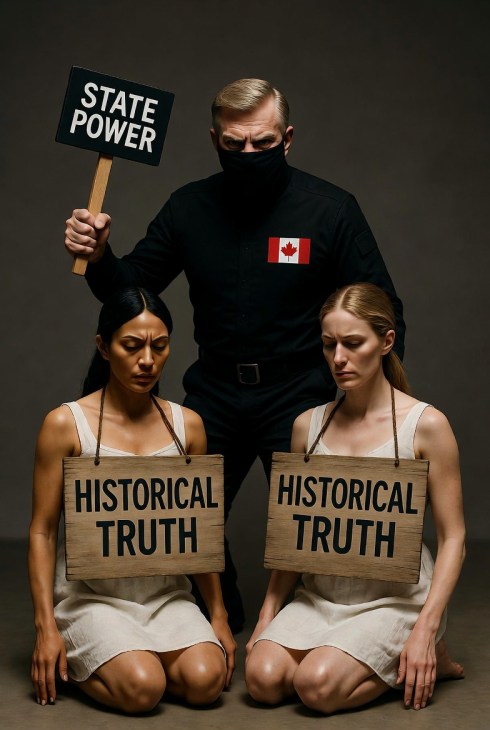
Historical truth does not become more trustworthy when the Criminal Code stands behind it.
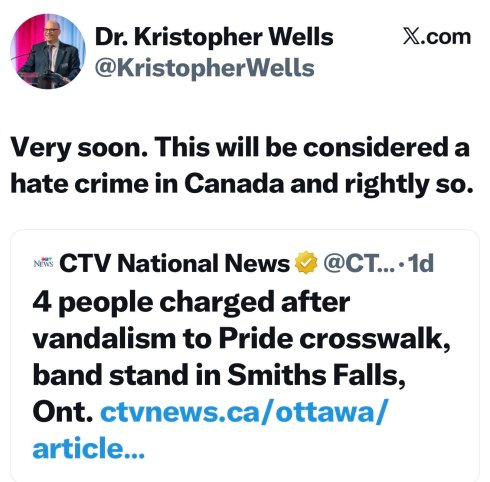
The Smiths Falls rainbow crosswalk incident is useful because it is small enough to see the pattern clearly.
Someone vandalized a municipal rainbow crosswalk. That is wrong. Public property was damaged, and ordinary criminal law already covers it: mischief, property damage, fines, restitution, cleanup. Use those tools.
The escalation is the problem. Kristopher Wells suggested this kind of vandalism should soon be treated as a hate crime, and “rightly so.” That turns damaged paint on a road into something much larger: an attack on an entire community, a public safety event, and a test of whether the state will treat disrespect toward a progressive symbol as criminal hatred.
Hate motivation can matter. A swastika on a synagogue, threats painted on a family’s home, or targeted destruction meant to intimidate a minority community is not just graffiti. The act carries a message. The law can recognize that.
But evidence has to do the work. Not activist framing, media amplification, institutional pressure, or the assumption that because a symbol represents a protected group, contempt for the symbol must be treated as hatred toward the group.
A rainbow crosswalk is not private expression. It is a public installation, approved by a municipality, painted on shared civic property, and usually funded through public money. Citizens are allowed to support it. They are also allowed to dislike it, object to it, mock it, or argue that local governments should not turn infrastructure into moral messaging.
None of that excuses vandalism. The vandal still damaged property. Charge the conduct.
The problem is what happens after the spray paint dries. Activists demand the heaviest moral and legal frame available. Police and prosecutors are pressured to read ideological meaning into the act. Media coverage turns a local property offence into a symbolic attack on “the community.” The damaged object becomes less important than the ritual around it.
That is the weaponization problem. Progressive causes increasingly try to convert contested public symbols into protected civic relics. Once that happens, the state is no longer being asked only to punish damage. It is being asked to police the meaning of disrespect.
The older liberal case for gay rights had force because it demanded equal treatment under the law: no jailing, no firing, no harassment, no denial of ordinary civic dignity. That case asked the state to stop treating gay people as legal outsiders.
This newer pattern asks the state to do something different. It asks the state to affirm symbols, language, and institutional rituals, then treat resistance as suspect. The public notices the difference, even when it lacks the vocabulary for it.
Smiths Falls should handle this as vandalism unless clear evidence of targeted intimidation, threats, organized harassment, or explicit hatred toward identifiable people emerges. If that evidence exists, bring it forward. If it does not, damaged municipal paint should not be inflated into a hate-crime drama.
A society can punish vandalism without sacralizing public symbols. It can protect actual people without letting activists turn insult, contempt, or disrespect into presumptive criminal hatred.
That distinction is not a technicality. It is one of the ways a free society keeps criminal law from becoming a tool of ideological management.











 bleatmop
 Mystro
 The Arbourist


 Dead Wild Roses
Your opinions…