
You are currently browsing the daily archive for May 3, 2026.
This Is Not a Theology Argument
There’s a version of this argument that collapses on contact.
“Christian societies succeed because Christianity is true.”
That’s not serious. It’s too broad, too easy to counter, and it drags the discussion into theology. That’s not what this is.
This is narrower.
Modern successful societies appear to rely on a set of moral assumptions that did not arise randomly—and may not sustain themselves indefinitely once detached from the structures that produced them.
Not proof, not prophecy, but rather… dependence.
Name the Structure, Not the Institution
When I refer to “Judeo-Christian ethics,” I’m not talking about the historical behavior of churches or states. That record is mixed at best and often indefensible. It doesn’t need rescuing here.
I’m pointing to a moral architecture—a cluster of ideas that shaped behavior long before belief began to fade:
- intrinsic human worth
- moral equality beyond tribe
- limits on power
- individual responsibility
- restraint
- forgiveness over vendetta
These now feel obvious.
They weren’t.
What looks like baseline morality is often inherited structure—and inheritance has a way of disguising itself as inevitability.
Christianity Is Not the Only Path—And That Matters
If the claim were simply “Judeo-Christian societies do better,” it would fail.
There are Christian-majority countries that struggle. There are secular societies that thrive. There are atrocities carried out under religious banners that no serious reader will ignore.
And then there’s Japan.
Japan is not a counterexample. It’s a correction.
It demonstrates that similar outcomes—order, trust, cohesion—can emerge from entirely different traditions. Which means the key variable isn’t Christianity itself.
It’s something deeper.
Japan suggests the underlying requirement is not a specific doctrine, but a sufficiently internalized system of obligation—whether grounded in universal dignity or social duty. The forms differ. The function is similar: behavior is constrained before enforcement becomes necessary.
Not all structures are interchangeable. But high-functioning societies tend to converge on systems that reliably produce restraint, accountability, and continuity across generations—however they justify them.
These systems are not immune to strain. Japan’s own pressures—aging demographics, declining birth rates, and shifting social norms—suggest that even deeply internalized frameworks are not static under modern conditions.
What These Systems Actually Do
Strip away the language and look at function.
These frameworks tend to produce:
- higher social trust
- delayed gratification
- stable family structures
- informal accountability
- expectations that limit the use of power
These are not abstract outcomes. They follow from repeated behaviors:
- when restraint is internalized, fewer actions require enforcement
- when accountability is expected, trust rises and transaction costs fall
- when power is seen as limited, institutions stabilize rather than dominate
Over time, these behaviors compound into systems that rely less on coercion and more on expectation.
That sounds mundane. It isn’t. It’s what makes large, complex societies livable.
None of this requires belief.
But it does require internalization.
And internalization is slow, uneven, and difficult to rebuild once it thins out.
The Enlightenment Didn’t Start From Zero
The Enlightenment didn’t sweep this away and replace it with reason.
It reorganized it.
It challenged religious authority, formalized rights, and built institutions that still define modern life. That’s real progress and it shouldn’t be minimized.
But it did not begin from moral zero.
The assumptions were already there—about equality, dignity, and limits on power. The Enlightenment clarified and extended them. It did not generate them out of nothing.
The harder question is whether reason alone can reproduce the same depth of commitment, especially when those commitments become costly.
Reason is excellent at organizing systems. It is less reliable at compelling sacrifice—and societies eventually run into situations where something has to give.
The Problem Friedrich Nietzsche Identified
Nietzsche is often invoked carelessly. This isn’t that.
His point wasn’t that religion should be preserved. It was that removing it has consequences that don’t show up immediately.
You can discard a system and keep its language for a while.
You can keep its assumptions even longer.
What you can’t do indefinitely is treat the foundation as optional while expecting the structure to remain stable.
That process doesn’t announce itself.
It drifts—and by the time it becomes obvious, it is usually well underway.
Drift Shows Up as Substitution
Drift doesn’t look like collapse.
It looks like substitution.
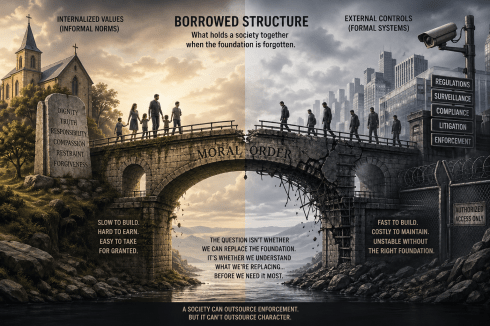
As informal norms weaken, societies compensate with formal mechanisms:
- more regulation
- more surveillance
- more litigation
- more explicit enforcement of what was once assumed
That shift isn’t inherently catastrophic. In many cases it works.
But it changes how order is maintained. It replaces internal constraint with external management—and that trade is rarely free.
You can see it at the margins: rising regulatory density, increased reliance on formal compliance systems in workplaces and institutions, growing legal mediation of disputes that were once handled informally. These trends have multiple causes, but they share a common feature—behavior that once required little enforcement now requires more of it.
The Secular Case—and Its Limit
A secular answer exists.
We can justify these norms through reason, reciprocity, and shared interest. We don’t need theology to understand cooperation or stability.
And in many cases, this works. High-trust secular societies demonstrate that norms can be transmitted without widespread religious belief.
The question is not whether this is possible.
It clearly is.
The question is whether these systems are fully self-sustaining over long time horizons, or whether they depend—quietly—on inherited assumptions that become harder to justify as those assumptions lose coherence.
That dependency is easy to miss because it feels like common sense.
It isn’t. It’s memory.
If these systems are fully self-sustaining, we would expect high-trust, high-restraint behavior to remain stable even as the underlying moral frameworks continue to thin. If they are not, the pressure will show up first at the margins—in declining informal trust, rising enforcement costs, and increasing reliance on explicit rules to maintain baseline order.
What This Argument Is—and Is Not
This is not an argument for belief.
It’s an argument against pretending we’re starting from nothing.
Societies that function well do not run on law and incentives alone. They rely on internalized limits—on what people will not do, even when they can.
Judeo-Christian ethics provided one version of that in the West. Other civilizations developed their own.
The open question is not whether we can discard those frameworks.
We already have.
The question is whether we understand what they were doing well enough to replace them—or whether we are still relying on them while insisting we are not.
The Uncomfortable Conclusion
Removing a foundation does not collapse a structure immediately.
It exposes, slowly, what the structure depended on—and whether we’ve mistaken inheritance for design.











 bleatmop
 Mystro


 Dead Wild Roses
Your opinions…