
You are currently browsing the tag archive for the ‘Tradition’ tag.
This Is Not a Theology Argument
There’s a version of this argument that collapses on contact.
“Christian societies succeed because Christianity is true.”
That’s not serious. It’s too broad, too easy to counter, and it drags the discussion into theology. That’s not what this is.
This is narrower.
Modern successful societies appear to rely on a set of moral assumptions that did not arise randomly—and may not sustain themselves indefinitely once detached from the structures that produced them.
Not proof, not prophecy, but rather… dependence.
Name the Structure, Not the Institution
When I refer to “Judeo-Christian ethics,” I’m not talking about the historical behavior of churches or states. That record is mixed at best and often indefensible. It doesn’t need rescuing here.
I’m pointing to a moral architecture—a cluster of ideas that shaped behavior long before belief began to fade:
- intrinsic human worth
- moral equality beyond tribe
- limits on power
- individual responsibility
- restraint
- forgiveness over vendetta
These now feel obvious.
They weren’t.
What looks like baseline morality is often inherited structure—and inheritance has a way of disguising itself as inevitability.
Christianity Is Not the Only Path—And That Matters
If the claim were simply “Judeo-Christian societies do better,” it would fail.
There are Christian-majority countries that struggle. There are secular societies that thrive. There are atrocities carried out under religious banners that no serious reader will ignore.
And then there’s Japan.
Japan is not a counterexample. It’s a correction.
It demonstrates that similar outcomes—order, trust, cohesion—can emerge from entirely different traditions. Which means the key variable isn’t Christianity itself.
It’s something deeper.
Japan suggests the underlying requirement is not a specific doctrine, but a sufficiently internalized system of obligation—whether grounded in universal dignity or social duty. The forms differ. The function is similar: behavior is constrained before enforcement becomes necessary.
Not all structures are interchangeable. But high-functioning societies tend to converge on systems that reliably produce restraint, accountability, and continuity across generations—however they justify them.
These systems are not immune to strain. Japan’s own pressures—aging demographics, declining birth rates, and shifting social norms—suggest that even deeply internalized frameworks are not static under modern conditions.
What These Systems Actually Do
Strip away the language and look at function.
These frameworks tend to produce:
- higher social trust
- delayed gratification
- stable family structures
- informal accountability
- expectations that limit the use of power
These are not abstract outcomes. They follow from repeated behaviors:
- when restraint is internalized, fewer actions require enforcement
- when accountability is expected, trust rises and transaction costs fall
- when power is seen as limited, institutions stabilize rather than dominate
Over time, these behaviors compound into systems that rely less on coercion and more on expectation.
That sounds mundane. It isn’t. It’s what makes large, complex societies livable.
None of this requires belief.
But it does require internalization.
And internalization is slow, uneven, and difficult to rebuild once it thins out.
The Enlightenment Didn’t Start From Zero
The Enlightenment didn’t sweep this away and replace it with reason.
It reorganized it.
It challenged religious authority, formalized rights, and built institutions that still define modern life. That’s real progress and it shouldn’t be minimized.
But it did not begin from moral zero.
The assumptions were already there—about equality, dignity, and limits on power. The Enlightenment clarified and extended them. It did not generate them out of nothing.
The harder question is whether reason alone can reproduce the same depth of commitment, especially when those commitments become costly.
Reason is excellent at organizing systems. It is less reliable at compelling sacrifice—and societies eventually run into situations where something has to give.
The Problem Friedrich Nietzsche Identified
Nietzsche is often invoked carelessly. This isn’t that.
His point wasn’t that religion should be preserved. It was that removing it has consequences that don’t show up immediately.
You can discard a system and keep its language for a while.
You can keep its assumptions even longer.
What you can’t do indefinitely is treat the foundation as optional while expecting the structure to remain stable.
That process doesn’t announce itself.
It drifts—and by the time it becomes obvious, it is usually well underway.
Drift Shows Up as Substitution
Drift doesn’t look like collapse.
It looks like substitution.
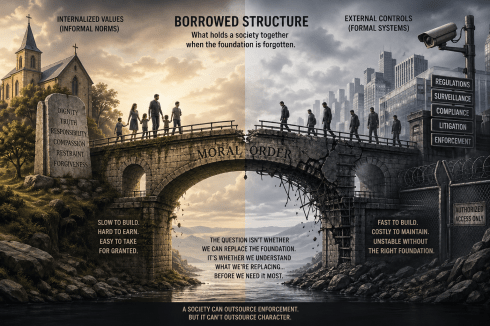
As informal norms weaken, societies compensate with formal mechanisms:
- more regulation
- more surveillance
- more litigation
- more explicit enforcement of what was once assumed
That shift isn’t inherently catastrophic. In many cases it works.
But it changes how order is maintained. It replaces internal constraint with external management—and that trade is rarely free.
You can see it at the margins: rising regulatory density, increased reliance on formal compliance systems in workplaces and institutions, growing legal mediation of disputes that were once handled informally. These trends have multiple causes, but they share a common feature—behavior that once required little enforcement now requires more of it.
The Secular Case—and Its Limit
A secular answer exists.
We can justify these norms through reason, reciprocity, and shared interest. We don’t need theology to understand cooperation or stability.
And in many cases, this works. High-trust secular societies demonstrate that norms can be transmitted without widespread religious belief.
The question is not whether this is possible.
It clearly is.
The question is whether these systems are fully self-sustaining over long time horizons, or whether they depend—quietly—on inherited assumptions that become harder to justify as those assumptions lose coherence.
That dependency is easy to miss because it feels like common sense.
It isn’t. It’s memory.
If these systems are fully self-sustaining, we would expect high-trust, high-restraint behavior to remain stable even as the underlying moral frameworks continue to thin. If they are not, the pressure will show up first at the margins—in declining informal trust, rising enforcement costs, and increasing reliance on explicit rules to maintain baseline order.
What This Argument Is—and Is Not
This is not an argument for belief.
It’s an argument against pretending we’re starting from nothing.
Societies that function well do not run on law and incentives alone. They rely on internalized limits—on what people will not do, even when they can.
Judeo-Christian ethics provided one version of that in the West. Other civilizations developed their own.
The open question is not whether we can discard those frameworks.
We already have.
The question is whether we understand what they were doing well enough to replace them—or whether we are still relying on them while insisting we are not.
The Uncomfortable Conclusion
Removing a foundation does not collapse a structure immediately.
It exposes, slowly, what the structure depended on—and whether we’ve mistaken inheritance for design.
(TL;DR) – Burke’s Reflections on the Revolution in France warned that abstract ideals, once severed from tradition, devour the civilization that birthed them. Against the arrogance of rationalist utopia, Burke offers a philosophy of gratitude: reform through inheritance, freedom through reverence, and wisdom through time.
Edmund Burke (1729–1797), the Irish-born British statesman and philosopher, published Reflections on the Revolution in France in November 1790 as an open letter to a young Frenchman. Written before the Revolution’s worst excesses, the work is less a history than a prophetic warning against uprooting inherited institutions in the name of abstract rights.
At a time when Enlightenment rationalists sought to rebuild society from first principles, Burke defended the British constitution not as perfect but as the tested fruit of centuries of moral and political experience. Against the revolutionary attempt to remake society on metaphysical blueprints, he argued that true political wisdom rests in “prescription” (inheritance), “prejudice” (habitual virtue), and the moral imagination that clothes authority in reverence and restraint. Reflections thus became the founding text of modern conservatism, grounding politics in humility before the slow wisdom of civilization (Burke 1790, 29–55).
1. The Organic Constitution versus the Mechanical State
Burke likens a healthy commonwealth to a living organism whose parts grow together over time. The British settlement of 1688, which balanced liberty and order, exemplified reform through continuity—“a deliberate election of light and reason,” not a clean slate.
The French revolutionaries, by contrast, treated the state as a machine to be disassembled and reassembled according to geometric principles. They dissolved the nobility, confiscated Church lands, and issued assignats—paper money backed only by revolutionary will. Burke foresaw that such rationalist tinkering would require force to maintain: “The age of chivalry is gone. That of sophisters, economists, and calculators has succeeded.” The predictable end, he warned, would be military dictatorship—the logic of abstraction enforced by bayonets (Burke 1790, 56–92).
2. The Danger of Metaphysical Politics
The Revolution’s fatal error, Burke argued, was to govern by “the rights of man” divorced from the concrete rights of Englishmen, Frenchmen, or any particular people. These universal abstractions ignore circumstance, manners, and the “latent wisdom” embedded in custom.
When the revolutionaries dragged Queen Marie Antoinette from Versailles to Paris in October 1789, Burke saw not merely a political humiliation but a civilizational collapse: “I thought ten thousand swords must have leaped from their scabbards to avenge even a look that threatened her with insult.” The queen, for him, symbolized a moral order that elevated society above brute appetite. Once such symbols are desecrated, civilization itself is imperiled (Burke 1790, 93–127).
3. Prescription, Prejudice, and the Moral Imagination
For Burke, rationality in politics is not the isolated reasoning of philosophers but the accumulated judgment of generations. “Prescription” gives legal and moral title to long possession; to overturn it is theft from the dead. “Prejudice,” far from being ignorance, is the pre-reflective moral instinct that makes virtue habitual—“rendering a man’s virtue his habit,” Burke wrote, “and not a series of unconnected acts.”
In his famous image of the “wardrobe of a moral imagination,” Burke insists that society requires splendid illusions—chivalry, ceremony, religion—to clothe power in dignity and soften human passions. Strip away these garments and you are left with naked force and the “swinish multitude.” Culture, in his view, is not ornament but armor for civilization (Burke 1790, 128–171).
4. Prophecy Fulfilled and the Path of Prudence
Events soon vindicated Burke’s warnings: the Reign of Terror, Napoleon’s rise, and the wars that consumed Europe. Yet Reflections is not an “I told you so” but a manual for political health. Burke accepts reform as necessary but insists that it must proceed “for the sake of preservation.” The statesman’s duty is to repair the vessel of society while it still sails, not to smash it in search of utopia.
Reverence for the past and distrust of untried theory are not cowardice but prudence—the recognition that civilization is a fragile inheritance, easily destroyed and seldom rebuilt (Burke 1790, 172–280).
5. Burke’s Enduring Lesson
Burke’s insight extends far beyond the French Revolution. His critique applies wherever abstract moralism seeks to erase inherited forms—whether through revolutionary ideology, technocratic social engineering, or the cultural purism of modern movements that prize purity over continuity. The temptation to rebuild society from scratch persists, but Burke reminds us that order is not manufactured; it is cultivated.
In an age still haunted by ideological utopias, Burke’s prudence is an act of intellectual piety: to love what we have inherited enough to reform it carefully, and to mistrust those who promise perfection by destruction.

References
Burke, Edmund. 1790. Reflections on the Revolution in France, and on the Proceedings in Certain Societies in London Relative to that Event. London: J. Dodsley.
Glossary of Key Terms
Assignats – Revolutionary paper currency secured on confiscated Church property; rapid depreciation fueled inflation.
Latent wisdom – Practical knowledge embedded in customs and institutions, inaccessible to abstract reason.
Moral imagination – The faculty that clothes abstract power in elevating symbols and sentiments.
Prejudice – Pre-reflective judgment formed by habit and tradition; for Burke, a source of social cohesion.
Prescription – Legal and moral title acquired through uninterrupted possession over time.
Swinish multitude – Derisive term for the populace once traditional restraints are removed.











 bleatmop
 Mystro


 Dead Wild Roses
Your opinions…