
You are currently browsing the tag archive for the ‘Free Speech’ tag.
Have you ever held your tongue during an otherwise friendly conversation because you could see exactly what would happen if you spoke your mind? Not because you lacked an answer, but because answering would transform the conversation into a trial of your character.
Scope note: Critical Theory is a diverse and disputed intellectual tradition. This essay offers a broad introduction to a recurring mechanism in contemporary woke politics; it does not claim that every critical theorist thinks alike or that every systemic criticism is false.
Why can saying that sex is a biological reality make you a transphobe? How can defending merit-based standards make you a racist? Why can asking that factual claims be judged by shared evidence turn you into a Western imperialist? Why can asking how 215 radar anomalies came to be reported as the remains of 215 children make you a colonialist or denialist? How can requesting concrete examples of systemic racism become proof that you are too privileged—or possess too much “false consciousness”—to recognize it?
Any of those questions may be reasonable, mistaken, or badly phrased. The tell is not whether the questioner is right. It is whether the question gets answered—or the questioner gets morally diagnosed.
“The argument ends before it begins. Instead of the claim being examined, you are.”
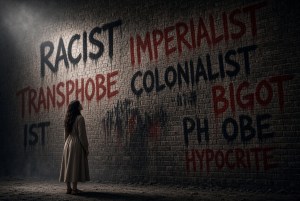
The argument ends before it begins. Instead of the claim being examined, you are.
You walk away wondering whether you really are the latest variety of “-phobe,” “-ist,” or some other socially shameful thing. Perhaps you were insensitive. Perhaps you missed something. Or perhaps you encountered a system of thought in which disagreement is not processed as information but reclassified as further evidence of your moral or ideological conditioning.
Well, dear reader, you have probably met Critical Theory without being formally introduced.
The Theory Beneath the Argument
Critical Theory emerged from the Western Marxist tradition associated with the Frankfurt School. Its foundational statement is usually traced to Max Horkheimer’s 1937 essay, Traditional and Critical Theory. We do not need the complete family tree here. The important distinction is between a theory that tries to describe and explain society and one that also intends to transform it.
The contemporary pattern did not travel unchanged from Horkheimer. It combined with later theories of power, identity, standpoint, and language before being simplified into activist practice. We are tracing that recurring logic, not claiming that every modern slogan came directly from Frankfurt in 1937.
Nor is self-sealing reasoning exclusive to the woke Left. Religious, nationalist, conspiratorial, and right-wing movements can do it as well. This essay examines the contemporary critical form because that is the form at issue here.
Critical Theory begins with a reasonable observation: societies do more than make laws. Families, schools, religions, media, professional bodies, and governments also transmit the values and categories through which people understand the world. The stronger claim is that these institutions reproduce existing power. What society calls normal, objective, reasonable, or meritorious may be the ruling order explaining itself in flattering language.
This is hegemony in plain English: power becomes secure when its assumptions feel like common sense. Social construction describes how language, customs, and institutions shape social categories. Critical consciousness is the claimed ability to recognize the power beneath those apparently natural arrangements.
These ideas are not useless. Institutions can possess blind spots. Rules written without discriminatory intent can produce unfair effects. Testimony from outsiders can expose facts that insiders overlook. A society genuinely interested in justice must be able to examine patterns extending beyond one malicious person or one explicit rule.
The trouble begins when power becomes the master explanation, and when the framework stops asking whether a particular institution is unjust and begins presuming that its apparent neutrality is how the injustice hides.
The Critical Theory Two-Step (Actually, Three Steps)
Imagine that an employer uses an examination to select applicants, and one demographic group passes at a lower rate. A serious inquiry asks whether the examination measures skills required for the job, whether applicants had equal preparation, whether discrimination affected the process, or whether another explanation better fits the evidence. The examination might be sound, biased, partly useful, or indefensible. We investigate because we do not yet know.
A critical analysis asks another legitimate question: who defined merit, and might the examination reward the experiences and expectations of the dominant group? That question can reveal something important. It becomes ideological when its answer is assumed in advance and protected from ordinary correction.
This is where the Critical Theory Two-Step begins.
Step one: disqualify the referee.
The standards normally used to settle the disagreement—objectivity, evidence, neutrality, consistent definitions, individual responsibility, and equal treatment—are redescribed as products of the dominant system. They cannot be trusted to judge that system because they help reproduce it.
Step two: put the questioner on trial.
Once common standards have been disqualified, attention shifts from the claim to the person questioning it. Why are you demanding evidence? Whose interests does your objection serve? What privilege shapes your perspective? What fragility, unconscious bias, or false consciousness prevents you from recognizing the deeper truth?
You cannot appeal to neutral standards because those standards are said to be compromised. You cannot challenge that conclusion because your challenge demonstrates how thoroughly the system has compromised you.
This is not merely an internet caricature. In a 2017 paper on feminist and critical-race philosophy classes, Alison Bailey cautions that resistance can be difficult to interpret, but calls one category “privilege-preserving epistemic pushback.” She describes it as “willful ignorance,” rather than scepticism or critical thinking, and recommends treating it as a “shadow text” alongside the assigned reading. The problem remains: the instructor using the framework decides which objection is genuine and which merely exposes the student’s privilege. Step two carries us directly into step three.
That is the deer-in-the-headlights moment. You entered expecting a discussion about whether something was true and discovered that the real proceeding concerned whether you were morally qualified to ask.
This pattern explains why neutrality becomes complicity, silence becomes violence, disagreement becomes harm, and equal treatment becomes a means of preserving inequality. These are not random contradictions. Once the system is presumed guilty, refusing the critical interpretation helps the guilty system continue.
Who Gets the Whistle?
Disqualifying neutral standards does not eliminate authority. It relocates authority.
The person with critical consciousness claims to see what ordinary consciousness cannot. Lived experience may supply the evidence, while academics and activists supply the framework explaining what that experience means. When members of the same group disagree, the dissenter can be diagnosed as having internalized the dominant ideology. The new hierarchy favours the critically conscious expert over the compromised expert, and approved lived experience over dissident lived experience.
Liberal inquiry accepts that the referee may be biased and allows everyone to challenge the calls. Ideological Critical Theory declares the rules corrupt, dismisses the referee, and then quietly hands the whistle to those who possess the correct consciousness.
The pattern now has three steps: disqualify the supposedly neutral standards, scrutinize the person who appeals to them, and transfer authority to those with critical consciousness. The referee has not disappeared. A new one has taken the whistle—and its calls are no longer open to challenge on equal terms.
The Negative Utopia
Where is this process supposed to lead?
Critical Theory can name its shiny future in moral terms: liberation, justice, equality, and freedom from domination. It is much less clear about the institutions that will produce those things. Horkheimer stated the difficulty himself. Its basic commitment was the “abolition of social injustice,” but he acknowledged that the transformed society could not be concretely known until it existed. If the concepts of the present society are part of the problem, they cannot be trusted to describe the solution.
The result is a future described by subtraction: what we have now, only without racism, sexism, hierarchy, exclusion, exploitation, oppressive norms, and unequal outcomes. Ask who will exercise authority, how competing rights will be reconciled, or what limits will bind the new institutions, and the answer often restates the wish: power will be shared, institutions equitable, and outcomes just.
This is the negative utopia. The criticism can be ruthless while the construction remains hazy. If the existing order reproduces domination, tearing it down can count as progress even when the replacement remains a hope that something better will emerge.
If reformers can name the replacement institutions, admit their trade-offs, limit their authority, and explain how their failures will be corrected, then they have answered this criticism. Their proposal must then be judged on its merits.
The existing liberal society is then compared not with another functioning society but with an imagined condition free of its imperfections. Every distance between liberal principles and liberal practice becomes another crack in the structure. Critical Theory pours itself into those cracks and freezes there, widening genuine failures into evidence that the whole arrangement is illegitimate. The new damage exposes further cracks, which invite another application of the theory.
Imagining a better society is not the problem. Liberal reform requires moral imagination. The danger begins when the imagined society is judged entirely by its intentions while the existing society is judged by every one of its failures.
This places the self-correcting mechanism in the wrong location. When the theory collides with reality, its premises rarely enter the dock. Failure is attributed to entrenched power, social conditioning, backlash, co-option, insufficient commitment, or incomplete transformation. Harmful reforms show that reform did not go far enough, resistance demonstrates false consciousness, and contrary evidence reveals who controls what counts as evidence.
The theory does not lose. Society merely proves how much more theory it requires.
That helps explain why dismantling an institution can count as progress without a workable replacement. If stability means stabilized injustice, disruption acquires moral value of its own. Revolution becomes a permanent process of identifying, delegitimizing, and breaking whatever reproduces the old society.
The Liberal Answer
Classical liberalism does not pretend that knowledge falls from the heavens untouched by human interests. Knowledge is produced by limited people inside fallible institutions. Power can distort research, experts can protect one another, and a comfortable consensus can be wrong.
The liberal answer is not an impossible view from nowhere. It is a society in which views from everywhere may collide.
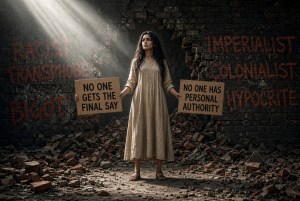
Liberal inquiry does not abolish authority; it makes authority contestable.
Jonathan Rauch condenses this system of “liberal science” into two rules: no one gets the final say, and no one has personal authority.
No one gets the final say because every public claim remains open to criticism and correction. Society needs provisional conclusions, but longevity, popularity, credentials, and institutional endorsement do not make them permanently incontestable.
No one has personal authority because identity, experience, and social position cannot settle a public claim. Experience may provide evidence others lack, and demonstrated expertise deserves serious weight. Neither lived experience nor professional status grants immunity from examination.
Free speech is therefore more than permission to say unpleasant things. It is part of liberal democracy’s error-correcting machinery. John Stuart Mill understood that a suppressed opinion might be true, partly true, or usefully wrong. Even a correct belief becomes little more than inherited prejudice when nobody is permitted to test it.
The liberal system does not guarantee that truth will win every argument. It prevents any faction from acquiring permanent authority to decide which arguments may occur.
This is the answer to the claim that knowledge is socially constructed and hegemonically reproduced. Yes, knowledge is socially produced. That does not mean it is socially determined. Reality constrains what can survive honest investigation, while open disagreement allows people with different interests and blind spots to expose one another’s errors.
We can socially decide that a red light means stop. We cannot socially decide that an unsafe bridge will remain standing. Culture creates some meanings; it does not create every fact those meanings describe.
Liberal institutions can certainly betray these principles. Universities can punish dissent, governments can conceal information, journalists can become conformist, and professional organizations can convert consensus into dogma. When that happens, the critical diagnosis earns some of its force.
The liberal remedy is more contestability: open the records, protect the dissenter, disclose the conflict, replicate the finding, permit the rival explanation, and let the argument continue. Liberal democracy can repair its cracks without declaring the entire structure fraudulent.
What to Notice Next Time
The next time a disputed claim turns into an examination of your moral character, watch for the two-step. Were the shared standards of evidence first declared compromised? Did scrutiny then move from the assertion to the identity, motives, or consciousness of the person asking about it? Who acquired the authority to interpret the dispute after the ordinary referee was dismissed?
Then ask the questions that every theory and every proposed remedy should have to survive. What evidence would prove the claim wrong? What competing explanation has been considered? What will replace the institution being dismantled? Who will exercise power afterward? How will that power be challenged and removed?
Critical Theory can identify real cracks in a liberal society. Its ideological power begins when those cracks can confirm the theory while almost nothing can disprove it.
Not every appeal to power, identity, or systemic effects completes this pattern. If an argument supplies evidence, answers objections without diagnosing the objector, specifies its remedy, and identifies what would count against it, then it remains contestable. It may be right or wrong, but it is not the closed system described here.
You are not obligated to accept that arrangement. The question itself is not evidence of guilt.

Liberal inquiry promises no final destination—only an open road on which every claim may be questioned.
Would You Like to Know More?
- The Woke Machine
How grievance becomes identity, identity becomes a special authority to know, and disagreement becomes further evidence of guilt. - The Woke Machine in the Wild
What happens when the machine escapes the seminar room: friend–enemy sorting, exception ethics, institutional conflict, and versions of the pattern on both Left and Right. - Woke for the Rest of Us
A pocket field guide for recognizing the script in real time, complete with diagnostic tests and conversational escape hatches. - When Disagreement Becomes Guilt
How a theory stops processing objections as information and begins treating them as evidence of the dissenter’s moral corruption. - The DSA’s Utopia Begins by Breaking the Society We Have
Why a movement without a credible institutional destination can still possess a revolutionary direction: dismantle the existing order first and discover what follows later. - “Hate” as a Governance Tool
How moral language can perform administrative work by reclassifying disputed arguments as harms that institutions may suppress rather than answer. - Beyond the Oppressor/Oppressed Lens
A deeper examination of the binary framework that sorts people by group power and struggles to accommodate agency, context, mixed motives, or individual responsibility. - Reading: Cynical Theories
An introduction to the postmodern knowledge principle: how suspicion of objectivity, language, and universal categories merged with an analysis centred upon power.
References
- Horkheimer, Max. Traditional and Critical Theory (1937), in Critical Theory: Selected Essays. Columbia Law School-hosted PDF: https://blogs.law.columbia.edu/critique1313/files/2019/09/Horkheimer-Traditional-and-Critical-Theory-2.pdf
- Institut für Sozialforschung. “The History of the IfS.” https://www.ifs.uni-frankfurt.de/history.html
- Stanford Encyclopedia of Philosophy. “Critical Theory (Frankfurt School).” https://plato.stanford.edu/entries/critical-theory/
- Mill, John Stuart. On Liberty (1859). https://eet.pixel-online.org/files/etranslation/original/Mill%2C%20On%20Liberty.pdf
- Rauch, Jonathan. Kindly Inquisitors: The New Attacks on Free Thought. University of Chicago Press, expanded edition, 2013.
- Rauch, Jonathan. “The Constitution of Knowledge.” National Affairs, 2021. https://nationalaffairs.com/publications/detail/the-constitution-of-knowledge
- Bailey, Alison. “Tracking Privilege-Preserving Epistemic Pushback in Feminist and Critical Race Philosophy Classes.” Hypatia 32, no. 4 (2017): 876–892. https://ir.library.illinoisstate.edu/fpphil/4/
- Crown-Indigenous Relations and Northern Affairs Canada. “Unmarked Burial Sites / Residential Schools Missing Children Community Support Fund,” June 5, 2026. https://www.rcaanc-cirnac.gc.ca/eng/1772556985244/1772557018851
On June 17, 2026, the Oxford Union debated the motion, “This House Believes the West Is Right to Be Suspicious of Islam.” The Union eventually voted against it, reportedly by 57 votes to 41. That settled the result inside the chamber. It did not settle which side made the stronger argument. (Middle East Eye)
The debate had already become a public spectacle before anyone rose to speak. It had been postponed once, prominent figures had demanded that Tommy Robinson be disinvited, and protesters gathered outside under a substantial police presence. Contemporary reporting described roughly 200 protesters and a much smaller group of Robinson supporters separated by a police cordon. Thames Valley Police later said the demonstrations passed “without significant incident,” although one person was arrested on suspicion of assault. That qualification matters. Speakers inside repeatedly called the scene a riot, spoke of attacks on police, and treated the disorder outside as evidence for their respective positions. The protest was certainly disruptive and hostile, but the more dramatic descriptions outran the police account. (Oxford Union, ITV News)
The disorder was not confined to the street. Inside, speakers were repeatedly interrupted, points of information became vehicles for heckling, personal attacks displaced argument, and several participants treated the chair’s instructions as optional. At one point, the chair explicitly rebuked “unwarranted interjections” from both sides. Having watched several Oxford Union debates, I found this one unusually contemptuous of the process it purported to defend.
That does not make it impossible to judge. It does mean that the applause, jeers, and final vote should be separated from the merits of the arguments.
What Was the Motion Actually Asking?
The word suspicious carried nearly the entire debate and was never adequately defined.
It can mean at least two very different things. One meaning is intellectual and institutional: Islamic doctrines, organizations, and political demands should receive careful scrutiny, particularly where they concern civil law, religious liberty, sex equality, free expression, or violence. The other is social and personal: Muslims should be regarded as presumptively hostile or dangerous because they are Muslims.
The first is an ordinary liberal judgment about ideas and institutions. The second is collective suspicion applied to human beings. The proposition was strongest when defending the first meaning and weakest whenever it slipped toward the second. The opposition was strongest when condemning the second and weakest when pretending that doing so had answered the first.
I therefore judged the speakers by five questions:
- Did they address Islam as a body of beliefs rather than treating Muslims as a single collective?
- Did they distinguish Islam, Islamism, Muslim-majority governments, and individual Muslims?
- Did their evidence support the level of the claim being made?
- Did they answer the strongest opposing argument?
- Did they respect the conditions that make debate possible?
The Proposition
Oliver “JL” Jones-Lyons
Jones-Lyons opened with the most useful framing available to the proposition. Islam, he argued, is not merely a set of private devotional practices. It contains political and legal claims that can conflict with equal citizenship under secular law. He pointed to jizya, apostasy, the status of non-Muslims, the operation of Sharia, and the record of Muslim-majority states. His underlying question was sound: when a religion makes claims about how the state should govern, why should those claims be exempt from the scrutiny applied to any other political programme?
His weakness was the distance between his evidence and some of his generalizations. Quoting violent passages without adequately resolving their historical and interpretive context did not establish what all Muslims believe. Practices in Muslim-majority countries are relevant, but they do not automatically reveal what Islam must produce everywhere. His assertion that Islam is uniquely totalizing also needed comparison rather than declaration.
His ceremonial roast of the opposing bench was consistent with Oxford Union tradition and relatively mild. Once the argument began, he mostly stayed on the motion. As an opening speaker, he gave his side a coherent burden and largely met his procedural responsibilities.
Tommy Robinson
Robinson’s strongest material concerned concrete moral conflicts. He asked the chamber to consider Islamic teachings and state practices involving homosexuality, adultery, apostasy, child marriage, religious minorities, and the example of Muhammad. His central contention was not merely that extremists commit atrocities, but that some of them appeal to recognized scriptures, legal schools, and episodes from Muhammad’s life. Telling the victims that the perpetrators misunderstood Islam does not, by itself, explain why those interpretations recur or why they acquire legal force in multiple countries.
This was a legitimate challenge, and the opposition never fully answered it. It showed that alternative interpretations exist, but it frequently treated the existence of a benign interpretation as proof that the harsher one was inauthentic.
Robinson nevertheless weakened his own case through overstatement. He moved too easily between sacred texts, medieval jurisprudence, contemporary governments, terrorist groups, and Muslims living in Britain. Graphic examples generated moral force, but the accumulation sometimes replaced the causal work needed to connect those examples to Islam as a whole. He also brushed aside legitimate contextual questions with some version of “argue with the countries doing it,” which answered the practical horror without answering the theological dispute.
His conduct was mixed. He began by praising the Union president for defending free speech and congratulated Aisha Khan-Aziz on her speech. He was also frequently interrupted. At the same time, he repeatedly interrupted others, declined points of information while complaining about the responses he received, and personalized his disagreement with Rees-Mogg by contrasting their constituencies and circumstances. Robinson supplied serious evidence, but delivered it in a manner that often invited heat where precision was needed.
Laurence Fox
Fox tried to rehabilitate suspicion as prudence rather than hatred. He argued that human beings routinely use suspicion to recognize danger and cited polling on British Muslim attitudes toward Sharia, religious schools, face coverings, violence in defence of religion, and depictions of Muhammad. His free-speech argument was his strongest: a liberal society has reason to resist any demand that religious prohibitions bind people who do not accept the religion.
Unfortunately, he opened by comparing the present dispute to Chamberlain’s appeasement of Hitler. The analogy inflated the conclusion before he had established the premises. His broader claim that Islam offers no possibility of peaceful coexistence was contradicted by texts and history introduced by the opposition, even if those counterexamples did not establish that Islamic history was consistently tolerant.
The threatened display of a cartoon of Muhammad was the evening’s clearest substitution of theatre for argument. Fox ultimately revealed that the envelope contained nothing, using the chamber’s tension as evidence of fear. The stunt illustrated that fear exists, but not whether it was caused by Islamic doctrine, the protesters outside, Fox’s own appetite for provocation, or some combination of the three. His sarcasm, Nazi analogy, and talk of an “oversensitive sky wizard” turned a defensible free-speech argument into a performance of contempt.
Jonathan Sacerdoti
Sacerdoti gave the proposition its strongest concrete case. He began with the Manchester Arena security guard who noticed Salman Abedi but hesitated to raise the alarm for fear of being called racist. He then traced the human cost of Islamist violence and blasphemy enforcement through Salman Rushdie, Theo van Gogh, Charlie Hebdo, Lee Rigby, terrorist attacks in Britain, the intimidation of teachers, and violence directed at Jews and apostates. He also moved beyond terrorism to the Muslim Brotherhood and its political strategy.
His most important challenge to the opposition was the asymmetry of attribution. Charitable activity by Muslims was presented as evidence of Islam’s goodness, while crimes committed by people explicitly invoking Islamic authority were declared unrelated to Islam. A fair analysis cannot accept religious causation only when the outcome is attractive.
Sacerdoti still leaned too heavily upon a catalogue of horrors. A perpetrator’s invocation of Islam is evidence of motivation, but it does not establish that his interpretation is representative, unavoidable, or doctrinally correct. Sacerdoti occasionally collapsed Islam, Islamism, and violent Muslims into one actor—“Islam” doing things—when the argument required more exact attribution.
He was more controlled than several speakers, although his questioning of whether the president remained Muslim after offering wine was a personal theological jab, and his speech was punctuated by sharp interjections. Even with those faults, he connected doctrine, political organization, intimidation, and violence more successfully than any other proposition speaker.
Leon Styles
Styles offered the cleanest liberal formulation of the proposition. Muslims, he said, are not lesser citizens and deserve no fewer rights, less dignity, or less freedom. Ideas, however, possess no right to immunity. Islam includes legal, political, and social prescriptions, and citizens have a responsibility to examine any doctrine that seeks influence over law, education, morality, or public institutions.
That distinction was the conceptual centre of the entire debate. Suspicion of an idea is not hatred of a person, and criticism of a doctrine is not persecution of its followers.
Styles’ weakness was that he sometimes changed “right to be suspicious” into “right to question.” The opposition correctly observed that having a right to scrutinize Islam does not prove that suspicion is justified. His references to Islamist terrorism and institutional reluctance to investigate grooming gangs were meant to close that gap, but the causal connection between Islam and the particular criminal networks was asserted more confidently than it was demonstrated.
His conduct also spoiled an otherwise disciplined speech. He insinuated that Abdullah al-Andalusi was a fan of Osama bin Laden, was instructed to withdraw, and then said he would leave the judgment to the audience. “That was not a genuine withdrawal; he formally retracted the accusation while preserving its insinuation.” Still, Styles stated the proposition’s defensible meaning more clearly than anyone else.
The Opposition
Aisha Khan-Aziz
Khan-Aziz opened with the opposition’s strongest moral concern: suspicion applied collectively can produce injustice. She pointed to detention without charge, anti-Muslim violence, and the fact that Muslims are the principal victims of Islamist terrorism. She also emphasized the contested character of Islam and argued that the West is not a completed or morally spotless civilization entitled to judge another from a position of innocence.
Those arguments establish the danger of collective guilt. They do not establish that Islamic doctrines or movements should escape suspicion. Her crucial move was to transform suspicion of Islam into suspicion of herself “before I even open my mouth.” That was rhetorically effective but logically evasive. Ideas can be scrutinized without assigning guilt to every person who identifies with them.
Her introduction also contained some of the debate’s clearest ad hominem attacks. She attributed Jones-Lyons’ position to resentment over Muslim candidates, called Robinson’s followers hooligans, mocked Fox’s electoral and professional failures, and treated Sacerdoti’s presence beside Robinson as morally compromising. The Union’s roast tradition explains some of the humour, but it does not excuse motive attribution offered in place of rebuttal.
Her most revealing line was directed at Robinson: without the protection of the Muslim president and mostly South Asian committee, she said, the crowd outside would have left him “quite literally cooked.” The line was meant to demonstrate Muslim generosity. Instead, it used the threat presented by a hostile crowd as a boast while arguing that suspicion was irrational. It did not justify suspicion of Muslims generally, but it inadvertently strengthened the case for vigilance toward movements that answer criticism of Islam with intimidation.
Michael Doward
Doward supplied the opposition’s most human testimony. Speaking as a Muslim from Luton, he described mosques rejecting extremists, Muslim charities serving elderly white residents, and ordinary Muslims motivated by their faith to become better neighbours, parents, doctors, nurses, and volunteers. His best point concerned asymmetric attribution: critics often blame Islam for a Muslim’s crimes while refusing to credit Islam for a Muslim’s charity.
That is a useful warning against motivated reasoning. It is not a sufficient answer to the motion. Kind Muslims and generous Islamic charities can coexist with objectionable doctrines and dangerous movements. Doward’s anecdotes rebutted a caricature of Muslims as uniformly hostile, but the motion concerned Islam.
He devoted an extraordinary amount of his speech to Robinson’s biography, credibility, residence, football associations, and account of Luton. At one point he said he did not mind “taking out” the opposing bench, later explaining that he meant defeating them in debate and withdrawing the language. The misunderstanding was avoidable. He also told the proposition that it lacked the expertise to discuss reform of Islam, a claim difficult to reconcile with a debate supposedly demonstrating Islam’s openness to criticism. Doward was sincere and occasionally moving, but he answered a social portrait with a counterportrait rather than evaluating the belief system at issue.
Arwa Elrayess
Elrayess, the Oxford Union president, delivered the opposition’s strongest speech. She placed violent Quranic passages in their immediate context, distinguished war against treaty-breakers from a universal command against unbelievers, defended non-coercion through other passages, and cited Islamic precedents for coexistence. She then moved from scripture to contemporary British Muslim attitudes, counterterrorism cooperation, and the destructive consequences of policies that treat Muslims categorically as suspects.
She also did something several opposition speakers avoided: she acknowledged serious problems within Muslim communities and the reality of the grooming-gang scandals. This made her argument more credible than a blanket denial would have been.
Her case nevertheless depended heavily upon a “not true Islam” escape hatch. Terrorists, states, and communities invoking Islamic sources were repeatedly declared mistaken or non-Muslim, while her preferred readings were treated as Islam itself. Showing that a tolerant interpretation exists is important. Showing that it is the only authentic interpretation requires much more than assertion, particularly when rival interpretations have persisted through recognized schools, institutions, and governments.
Her treatment of grooming-gang evidence also blurred categories. Statistics covering child sexual offending generally do not, by themselves, answer questions about particular forms of group-based exploitation. Class contempt may explain institutional indifference toward the victims without excluding cultural, ethnic, or religious factors among perpetrators. Multiple causes can operate at once.
Elrayess ended by returning to personal motives, portraying the proposition as wealthy men seeking to own public anger and persuade Britons that their neighbours were enemies. That was powerful advocacy, but it again answered a theory about the speakers’ intentions rather than their strongest arguments. Her speech did the most to narrow the proposition, but it did not defeat its liberal form.
Abdullah al-Andalusi
Al-Andalusi offered the opposition’s most substantial doctrinal rebuttal. He argued that religions must be judged through their teachings rather than every act committed by an adherent. He cited Quranic opposition to compulsion, Islamic limits upon killing non-combatants, historical examples of Christian critics writing under Muslim rule, and classical scholars who rejected violence against civilians. His explanation of how Osama bin Laden departed from traditional rules of war directly challenged the claim that Islamist terrorism follows straightforwardly from Islam.
This was relevant evidence. It demonstrated that peaceful and pluralistic Islamic resources are real rather than modern inventions created solely for Western audiences.
He also made several damaging detours. Beginning with Jewish criminals created a false comparison: the proposition was discussing perpetrators who invoked religious authority, not merely criminals who happened to share an identity. Attributing Muslim-world persecution of homosexual conduct to exported Victorian categories did not answer the existence of contemporary punishments defended in Islamic terms. His attempt to turn bin Laden’s “live and let live” remark into evidence for a restrained Islamic position was unnecessarily provocative and gave a mass murderer more interpretive charity than he extended to the proposition.
Al-Andalusi also accused the opposing bench of supporting ethnic cleansing, then withdrew when challenged because the people he cited were not participants in the debate. He repeatedly exceeded his time and resisted the chair’s instructions to conclude. His speech contained valuable scholarship, but its lack of discipline made the valuable parts harder to credit.
Sir Jacob Rees-Mogg
Rees-Mogg presented the opposition’s most genuinely liberal alternative. The West, he argued, should possess enough confidence in its institutions to welcome Muslim citizens without fearing Islamic conquest. Islamic civilization has contributed to Western knowledge, Britain maintains one civil law, and voluntary religious tribunals cannot supersede the courts. Equal citizenship and constitutional strength, rather than collective suspicion, were his answer.
This was an important corrective to the proposition’s occasional alarmism. A confident liberal order does not panic because some citizens hold illiberal beliefs. It protects their rights while enforcing common laws.
Confidence, however, is not evidence that institutions will always perform their stated function. The debate itself concerned examples in which fear of offence, accusations of bigotry, or political pressure may have weakened enforcement. Saying that Parliament will never enact Sharia does not answer narrower pressures involving blasphemy norms, parallel arbitration, sex equality, school policy, or selective policing. Nor do Islam’s historical contributions disprove reasons for suspicion of some Islamic doctrines. A civilization can preserve manuscripts and also enforce religious hierarchy.
Rees-Mogg began with unusual generosity toward his opponents and defended the decision to let Robinson speak. He later called the proposition cowardly, weak, “wet wipes,” and “desperate old pinkos.” The insults were delivered with comic polish, but polish does not turn contempt into argument. His closing appeal to Christianity explained his confidence in the West more than it answered the case concerning Islam.
When Disrespect Became a Method
Both sides mistreated the process, but they tended to do so differently.
The proposition relied more heavily upon provocation. Fox’s empty-envelope stunt, repeated comparisons to fascism, graphic descriptions, sarcastic interjections, and Styles’ insinuation about bin Laden were designed partly to elicit outrage. Several proposition speakers seemed intent upon demonstrating that Islam could not tolerate criticism, occasionally behaving as though making the room angry would prove the thesis.
The opposition relied more heavily upon delegitimization. Some speakers attributed the proposition’s case to racism, careerism, resentment, financial interest, ignorance, or a desire to scapegoat Muslims before fully addressing the claims being made. They repeatedly changed criticism of Islam into hostility toward Muslims, allowing the moral ugliness of collective suspicion to contaminate arguments directed at doctrine.
Both sides interrupted excessively. Speakers ignored declined points of information, used points of order to continue arguments, resisted time limits, talked over one another, and appealed to the audience while the chair attempted to restore order. The opposition cannot claim that robust criticism of Islam is welcome while people protesting the event attempt to obstruct it or speakers inside treat contrary arguments as moral contamination. The proposition cannot claim special devotion to rational inquiry while using theatrical provocation and personal insinuation as substitutes for careful attribution.
Debate requires no reverence for the ideas under examination. It does require enough procedural respect for an opponent to finish a sentence and enough intellectual charity to answer the argument actually offered.
Verdict
The opposition won the vote, 57–41. On the argument presented, however, the proposition made the stronger case.
That judgment requires a carefully limited definition of the motion. If “suspicious of Islam” means treating Muslims as presumptively dangerous, the opposition wins decisively. Collective guilt is illiberal, empirically crude, and morally indefensible. Muslims are individuals, not vessels carrying a single political programme.
If suspicion means heightened scrutiny of a powerful body of religious, legal, and political ideas, the proposition wins. Its speakers established that Islamic sources and traditions contain more than private spirituality. They include claims about law, governance, apostasy, sexuality, religious hierarchy, and the limits of expression. Those claims have not remained theoretical: they appear in states, movements, institutions, and recurring conflicts within Western societies. Not every manifestation can be dismissed as an external corruption without explaining why the corruption repeatedly speaks in Islamic terms and draws upon recognized Islamic materials.
The opposition demonstrated that Islam contains competing resources: charity, pluralism, limits on violence, respect for treaties, and peaceful civic participation. It also demonstrated that most Muslims should not be held responsible for extremists. Those are essential truths. They establish that Islam is contested and that suspicion must be discriminating. They do not establish that suspicion is unwarranted.
Leon Styles gave the proposition its clearest principle, while Jonathan Sacerdoti supplied its strongest concrete case. Arwa Elrayess was the strongest opposition speaker because she combined textual argument with contemporary evidence and acknowledged at least some internal problems. Rees-Mogg offered the most attractive political disposition—confidence rather than panic—but treated institutional confidence as though it eliminated the need for vigilance.
The proposition therefore won narrowly on substance while often losing on discipline. Its better speakers defended scrutiny of ideas without collective guilt. Its worse moments blurred that distinction and indulged provocation. The opposition was more successful rhetorically because it attached the motion to the treatment of Muslim neighbours, but too often defeated a position the proposition’s strongest speakers had explicitly disavowed.
The liberal answer is neither civilizational panic nor compulsory reassurance. Muslims are entitled to equal citizenship, religious liberty, and individual judgment. Islam is entitled to no immunity from criticism. Islamist organizations and political demands should be evaluated by the same standards applied to every other movement: one civil law, equal rights, freedom of conscience, freedom of speech, and no collective guilt.
That standard is not hostility toward Muslims. It is the standard that protects Muslims and non-Muslims alike.
Sources
“You typed it. Someone lived it.”
That is the ominous opening of an Edmonton Police Service campaign encouraging residents to report “online hate.” Perhaps this means threats, criminal harassment, incitement to violence or the wilful promotion of hatred—all matters in which the police may have a legitimate role.
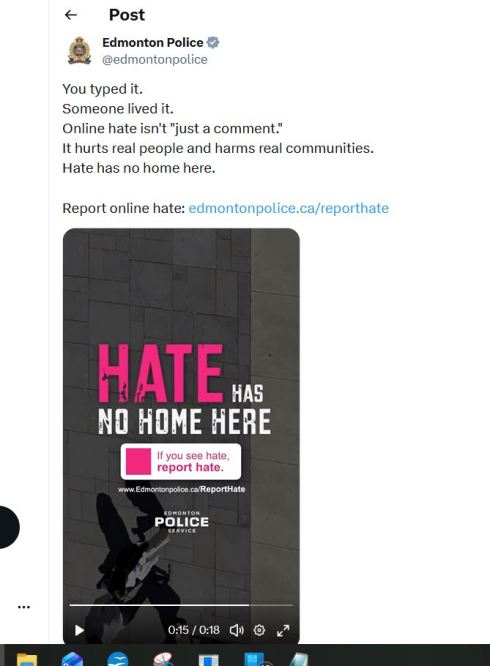
Follow the link, however, and the mandate becomes considerably broader.
EPS defines a “hate-motivated incident” as a non-criminal action motivated by bias, prejudice or hate. Its examples include insults, offensive jokes, slurs and racial comments. Reports receive a police file number, are reviewed by Hate Crime investigators and may result in contact from an investigator.
In other words, Edmonton police are inviting citizens to report one another for speech that the police themselves acknowledge may be entirely lawful.
There is a reasonable argument for recording certain non-criminal incidents. A slur painted on someone’s fence may precede vandalism or violence. A pattern of escalating behaviour may help police assess a later threat. Victims may also need information about services even when no charge is possible.
But those limited purposes do not justify a public campaign that deliberately blurs the boundary between crime and offence.
Canadian law sets a demanding threshold for criminal hate speech. Public incitement must be likely to cause a breach of the peace, while wilful promotion requires more than an ugly opinion or an offensive joke. The Supreme Court has described the legal definition of hatred as an “onerous and objective standard.” That high threshold exists because freedom of expression means very little if it protects only speech that authorities consider kind, constructive or socially beneficial.
“Hate has no home here” may be a civic aspiration, but it is not a legal standard. Hurt is real, yet hurt alone does not confer police jurisdiction.
When police encourage reports of lawful expression, they place the weight of the state behind ordinary social and political disputes. The resulting file may never produce a charge, but the knowledge that a joke, argument or unpopular opinion can reach a Hate Crime investigator is itself capable of chilling speech.
EPS should vigorously investigate threats, harassment, vandalism and criminal hate propaganda. It should also tell citizens clearly when reported conduct is not a police matter.
A free society must leave room for speech that is stupid, cruel and offensive. Such speech can be answered, condemned or ignored. It should not automatically become an entry in a police database.
The police exist to enforce the law—not to supervise Edmonton’s emotional climate.
References
- Edmonton Police Service, “Report a Hate Motivated Incident Online”:
https://www.edmontonpolice.ca/ContactEPS/ReportAHateMotivatedIncidentOnline - Edmonton Police Service, “Hate and Bias Crime”:
https://www.edmontonpolice.ca/CommunityPolicing/OrganizedCrime/HateBiasCrime - Criminal Code, section 319:
https://laws-lois.justice.gc.ca/eng/acts/c-46/section-319.html - Supreme Court of Canada, Hansman v. Neufeld, 2023 SCC 14:
https://decisions.scc-csc.ca/scc-csc/scc-csc/en/item/19911/index.do
Editors Note : This essay is a summation of recent podcast interview between Peter Boghossian and Sarah McLaughin.
Free speech is often defended too narrowly, as if it were mainly a permission slip for rude people, a tolerance ritual for offensive opinions, or a legal loophole that allows unpleasant citizens to be unpleasant in public.
That misses the deeper issue.
Free speech matters least when the opinion is popular, fashionable, institutional, or already protected by status. Those opinions usually have no trouble finding a microphone. Free speech matters most when the speaker is disliked, the claim is offensive, the argument is premature, or the government would prefer the matter not be discussed at all.
That is what makes Sarah McLaughlin’s defence of free speech useful. In her conversation with Peter Boghossian, she does not frame free speech as a favour extended to difficult people. She frames it as a limit on power.
The distinction matters because, in McLaughlin’s account, the First Amendment does not give people their speech rights. It restrains government from taking those rights away. The right comes first. The state comes second. Human beings possess speech rights by virtue of their dignity as human beings, not because a minister, judge, administrator, or police officer has granted them a temporary licence to speak.
Once that principle is reversed, free speech becomes a managed privilege. Government decides how much speech citizens may have, which topics are too dangerous, which emotions deserve protection, which claims count as misinformation, and which controversies must be moved from public argument into administrative control.
At that point, censorship does not need to announce itself as censorship. It can arrive as safety, anti-hate policy, national security, child protection, or a database entry no one tells you about.
That is one of McLaughlin’s strongest points. Censorship is not only a formal ban on a book, a newspaper, or a speech. It can also be the use of state pressure to make lawful expression risky. It can be a police visit, a record, an investigation, or the quiet creation of consequences around speech that the law has not actually made criminal.
Her example from the United Kingdom is revealing. She describes people being visited by police over legal tweets under the non-crime hate incident regime. In some cases, the person might not even know a complaint had been made, yet the incident could still be recorded in a government database and potentially become visible in employment-related contexts.
That is not the robust confidence of a free society so much as suspicion with paperwork. It also shows why “but no one was jailed” is not always a sufficient answer. A state does not have to imprison every dissenter to chill speech. It only has to teach citizens that lawful expression may bring police attention, reputational risk, bureaucratic trouble, or future consequences they cannot easily see or contest.
People learn the lesson quickly. They stop saying what they think, institutions stop asking hard questions, and the public square remains technically open while everyone gradually learns where the soft fences are.
McLaughlin’s argument is not that speech is harmless. This is important. She does not make the weak case for free speech by pretending words have no power. She concedes that speech can hurt, anger, provoke, disturb, and unsettle. But she turns that fact around: speech is powerful, and that is precisely why it must be protected. Scientific progress, political reform, religious dissent, civil rights, and moral correction all require the ability to say things that others may find offensive, dangerous, or wrong at the time.
The case for free speech is not that words are trivial. The case for free speech is that words are how free people fight without reaching for force.
This is why the claim that “speech is violence” is so corrosive. If speech becomes violence, then censorship becomes self-defence. If silence becomes violence, then compelled speech becomes moral duty. If offence becomes harm, then whoever claims injury first can demand power over the speaker.
McLaughlin rejects that collapse. Words and violence are not the same thing. A society that loses the distinction between being insulted and being assaulted has lost one of the basic habits that allows people to live together without constant coercion.
That does not mean speech has no limits. Actual threats are not mere disagreement. Incitement is not mere offensiveness. Harassment is not mere criticism. Criminal conduct does not become protected just because it has a political slogan attached to it.
McLaughlin’s approach is not anarchic. It is disciplined. Existing legal categories such as true threats and incitement to imminent lawless action matter because they are narrow. They require more than ugliness, anger, or offence. They require a serious connection to actual unlawful conduct.
That narrowness is the protection. Without it, “incitement” can become whatever makes people furious, and once that happens, the most volatile people in society get to set the boundaries of everyone else’s rights.
That is the heckler’s veto. If a mob threatens violence because someone burns a book, draws a cartoon, criticizes a religion, questions a movement, or says something politically forbidden, the proper response is not to punish the speaker for provoking the mob. The proper response is to stop the violence. Rights cannot depend on the emotional discipline of those who oppose them.
The law’s job is not to protect citizens from ever being angered. It is to prevent anger from becoming violence.
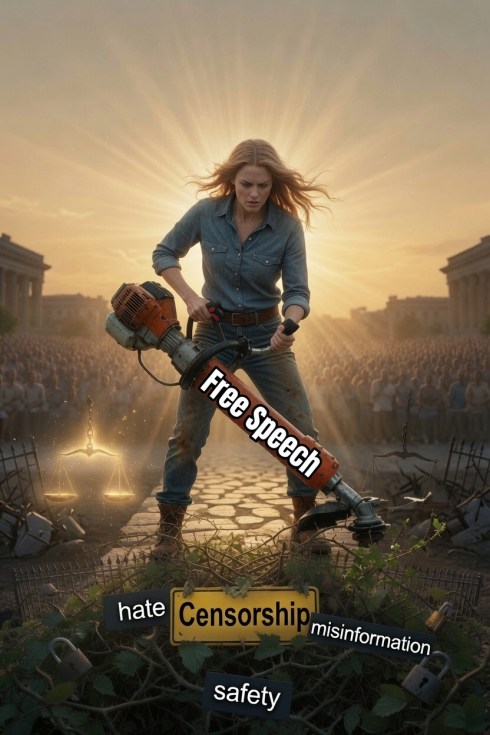
The most useful part of McLaughlin’s framework is her account of the four justifications governments use when they want to censor speech:
- Hate — the claim that some speech is too socially disruptive, cruel, or degrading to be tolerated.
- National security — the claim that dissent, protest, or criticism threatens public safety or the state itself.
- Misinformation — the claim that government must determine truth and suppress what officials judge to be false.
- Children — the claim that protecting minors justifies broad restrictions that often reach adults as well.
Each justification begins with a real concern. Hatred exists. National security threats exist. Falsehoods can cause damage. Children do need protection. But a real problem does not automatically justify broad state control over expression. The question is not whether something ugly, false, dangerous, or harmful can be identified somewhere. Of course it can. The question is whether the proposed cure gives officials power they cannot be trusted to wield honestly, narrowly, or evenly.
Who decides what counts as hate? Who decides when political criticism becomes misinformation? Who decides when national security includes criticism of government policy? Who decides what material is too harmful for children, and how many adult rights must be narrowed in the name of protecting them?
These categories expand because power has an appetite. Hate begins with threats and ends with legal speech recorded by police. National security begins with terrorism and ends with protest signs. Misinformation begins with fraud and ends with dissent from official narratives. Child protection begins with shielding minors and ends with surveillance architecture for everyone.
McLaughlin’s examples cut across partisan comfort zones. She criticizes the UK. She criticizes Hungary. She criticizes American government actions. She criticizes China’s efforts to control not only domestic speech but how the Chinese government is discussed abroad.
That matters because free speech cannot survive as a team sport. If speech rights matter only when our side is speaking, then they are not rights. They are privileges for allies. A serious free speech principle protects the person we dislike, the argument we reject, the protest we think foolish, the religious claim we find absurd, the political claim we find dangerous, and the joke we think cruel.
Not because all speech is good, but because government power becomes more dangerous when it gets to decide which speech is good enough.
The deeper defence of free speech is not merely moral. It is epistemological. Human beings are fallible. Governments are fallible. Experts are fallible. Majorities are fallible. Institutions are fallible. Every society needs some way to discover error before error becomes policy, dogma, or law.
Free speech is part of that correction mechanism. It allows citizens to test claims, challenge authority, expose dishonesty, revise beliefs, hear minority viewpoints, and discover what people actually think. Without it, bad ideas do not disappear. They go underground. Official ideas do not become truer. They become safer to repeat. Citizens do not become wiser. They become more careful.
A coerced society may look orderly from a distance, but it does not know itself.
That is why compelled speech is also a problem. Forcing people to repeat approved formulas does not produce conviction. It produces performance. It teaches people which words keep them safe. It rewards dishonesty and calls the result consensus.
A society built on forced agreement may still function for a while, but it cannot correct itself honestly.
McLaughlin’s closing point is the one free speech defenders need to remember: free speech works for everyone, but only if people are willing to protect it for everyone else.
That is the bargain. We protect the speech we hate because one day someone else may hate ours. We defend the dissenter because one day the institution may be wrong. We limit government because one day the people holding power will not be our friends.
Free speech is not a guarantee that public life will be gentle, wise, or pleasant. It is a safeguard against something worse: a society where the state decides which thoughts may be spoken, which questions may be asked, and which truths may be pursued.
Censorship does not always arrive with a censor’s stamp. Sometimes it arrives with kinder language, but that does not make it less dangerous.
Free speech is often defended badly.
Sometimes it is treated as a license to say anything without consequence. Sometimes it is reduced to personal self-expression. Sometimes it is framed as a courtesy extended to polite, harmless, approved opinions.
That misses the deeper point.
In a classically liberal society, free speech serves a practical purpose: it lets citizens search for truth, correct error, restrain power, and govern themselves.
It is not decorative. It is part of the machinery of a free society.
1. Free speech helps society find truth
Human beings are fallible.
Individuals can be wrong. Experts can be wrong. Majorities can be wrong. Governments can be wrong. Institutions can be wrong. Moral crusades can be wrong.
Free speech matters because no authority is wise enough to decide, permanently and in advance, which ideas may be questioned.
Some claims are false, foolish, dishonest, or ugly. But the answer to bad claims is usually better argument, better evidence, open criticism, and public testing.
A society that cannot question its own certainties may still call its beliefs truth, but it has stopped checking.
2. Free speech protects dissent
Free speech is easy to support when everyone agrees.
Its real test comes when speech is irritating, unpopular, offensive, inconvenient, or aimed at powerful people.
Many ideas now considered obvious were once treated as dangerous, immoral, foolish, or socially disruptive. That does not make every dissenter right. Much dissent is mistaken, partial, crankish, or premature. But we often cannot know which is which until dissent is allowed to be heard and tested.
A society that protects only approved speech protects consensus, not free speech.
Dissent needs room before it becomes respectable.
3. Free speech restrains power
Free speech allows citizens to question institutions.
What are you doing? Why are you doing it? What evidence supports it? Who benefits? Who pays? What are the tradeoffs? What are you hiding?
Those questions matter because institutions tend to protect themselves. Governments, corporations, universities, professional bodies, media organizations, activist movements, and bureaucracies all prefer deference when they have power.
Free speech keeps authority answerable to public challenge. Without it, institutions can govern through status, expertise, fear, or moral pressure instead of justification.
4. Free speech makes self-government possible
Democracy requires more than voting.
Citizens need to argue about laws, leaders, policies, institutions, values, evidence, and public priorities. If people can vote but cannot freely discuss what they are voting about, democracy becomes managed consent.
Free speech allows citizens to hear competing arguments, compare claims, criticize leaders, expose failures, and persuade one another.
It is not only an individual right. It is a condition of honest public judgment.
5. Free speech includes the right to be wrong
A meaningful free-speech principle must protect some false or mistaken speech.
If only “true” speech is protected, someone must decide what counts as true before debate even begins. That power rarely stays neutral.
This does not protect fraud, defamation, threats, perjury, direct incitement, or criminal harassment. Free speech has limits.
But contested public questions cannot be settled by official truth-arbiters. Free societies answer error through argument wherever possible, because the cure for bad speech can easily become worse than the disease.
6. Free speech protects listeners too
Free speech is not only the right to speak.
It is also the right to hear, read, compare, consider, reject, and decide.
Censorship does not only silence the speaker. It also treats the listener as too fragile, foolish, or dangerous to encounter the wrong idea.
A free citizen is not merely someone allowed to express approved thoughts. A free citizen is someone trusted to hear arguments and judge them.
7. Free speech is uncomfortable by design
Free speech requires citizens to tolerate disagreement, offence, criticism of cherished beliefs, and ideas they consider wrong or dangerous.
That discomfort is not a flaw. It is the price of living among free adults rather than under enforced consensus.
A free society does not remain peaceful because no one disagrees. It remains peaceful because disagreement can be spoken, challenged, mocked, answered, revised, and defeated without being driven underground or handed over to the state.

Free speech allows disagreement to remain public, peaceful, and answerable to reason.
In summary
Free speech is the right to speak, hear, question, criticize, argue, publish, dissent, and persuade without unlawful censorship or coercion.
Its purpose is not merely self-expression. It is the error-correction system of a free society. It helps test truth, expose mistakes, restrain power, protect dissent, and make self-government possible.
Free speech does not mean every claim is wise. It does not mean speech has no limits. It does not mean freedom from criticism, disagreement, ridicule, or consequence.
It means no authority gets final ownership of public truth.
Free speech is not a luxury for when society agrees.
It is the mechanism that allows disagreement to remain peaceful, public, and answerable to reason.
People often use the word “liberal” in confusing ways. In modern politics, “liberal” is often used as a synonym for progressive, left-wing, socially permissive, or even as an insult.
Classical liberalism means something more specific.
Classical liberalism emerged out of the long struggle against arbitrary power: absolute monarchy, inherited privilege, religious coercion, and government by decree. Thinkers such as John Locke, Adam Smith, and later John Stuart Mill helped develop many of its core ideas.
A classically liberal society is built around the moral and legal priority of the individual person. It begins with the idea that people have rights that do not come from the state, the tribe, the church, the activist class, the monarch, or the majority. Government exists to protect those rights, not to grant them as favours.
At its core, classical liberalism is about equal liberty under the rule of law. It protects life, liberty, private property, conscience, speech, due process, voluntary exchange, and the right to live without needing permission from the state or the mob.
It does not promise a perfect society. It does not promise equal outcomes. It does not promise that everyone will agree, approve of one another, or live the same way.
It promises something more modest, and more important: a shared legal order in which free people can live together despite deep disagreement.
So what does a classically liberal society look like?
1. The individual comes first
Classical liberalism begins with the individual person.
That does not mean selfishness is the highest good. It does not mean people have no duties to family, neighbours, community, or country. It means that the basic unit of moral and legal concern is the person, not the group.
You are not merely a race, sex, class, religion, sexuality, nation, tribe, caste, or political category. You are a person first.
That matters because once society treats people primarily as members of groups, it becomes easier to assign guilt, innocence, virtue, blame, privilege, or victimhood by category. Classical liberalism resists that. It insists that people should be judged as individuals.
2. Rights are not gifts from the state
In a classically liberal society, rights are not treated as permissions handed down by government.
The state does not give you freedom of speech. It is supposed to protect your freedom of speech. The state does not give you liberty. It is supposed to protect your liberty. The state does not own your life and then generously allow you to live some portion of it.
This is one of the great dividing lines between classical liberalism and more authoritarian ways of thinking.
The government is not the parent of the citizen. It is not the priest of public morality. It is not the owner of society. It is a limited institution with specific duties.
Its job is to protect rights, enforce law, defend the country, maintain public order, and adjudicate disputes.
It is necessary, but because it is dangerous, it must be limited by design. That is why classically liberal societies tend to value constitutional limits, divided powers, independent courts, free elections, and restraints on what government may do even when it has popular support.
3. Liberty means freedom under equal law
Classical liberalism is not the belief that everyone should be able to do whatever they want.
That is not liberty under law. That is the absence of law.
A free society needs law because human beings live together. Your freedom and my freedom will sometimes collide. Property disputes, contracts, crimes, injuries, fraud, violence, and negligence all require rules.
The classical liberal answer is not “no rules.” It is equal rules.
My freedom extends as far as it can without violating yours. Your freedom extends as far as it can without violating mine. The law exists to draw those boundaries as fairly and consistently as possible.
That is why classical liberalism is better understood as equal liberty under general laws, not maximum personal desire without restraint.
4. The rule of law applies to everyone
A classically liberal society is based on the rule of law.
That means the law applies to rulers and citizens alike. It applies to the rich and the poor, the popular and the unpopular, the majority and the minority, the powerful and the powerless.
No one is above the law.
But just as importantly, no one is beneath its protection.
This means there should be no special legal castes. No hereditary privileges. No racial exemptions. No religious exemptions from ordinary justice. No political favourites. No group-based immunity. No automatic moral rank assigned by identity.
Equality before the law does not mean every person has the same life, talents, wealth, history, or circumstances. It means the law sees citizens, not castes.
5. Due process protects everyone
In a free society, accusation is not conviction.
This matters enormously. A classically liberal society requires due process: fair procedures, impartial hearings, evidence, the right to respond, the right to know the accusation, and protection from arbitrary punishment.
These protections are not technicalities. They are civilizational guardrails.
The reason is simple: the state is powerful, mobs are dangerous, institutions can be cowardly, and human beings are often wrong.
Due process protects the innocent. It also protects the unpopular. And at some point, every serious dissenter may become unpopular.
A society that abandons due process because it believes it has found the “right” villains has already begun to abandon liberalism.
6. Speech and conscience must be free
Classical liberalism depends on freedom of speech, thought, conscience, religion, and association.
People must be free to argue, doubt, publish, worship, criticize, organize, persuade, offend, change their minds, and refuse to affirm what they do not believe.
This is not because every opinion is wise. Many opinions are foolish. Some are ugly. Some are wrong.
But a free society does not survive by giving authorities the power to decide which ideas may be spoken. Once that power exists, it will not always be used by people you trust.
Freedom of speech is not only a personal right. It is also how society tests ideas. Bad claims need to be challenged. Good claims need to be defended. No proposition should be protected from examination by sacred status.
“A free society does not survive by giving authorities the power to decide which ideas may be spoken.”
7. There is no final authority on truth
A classically liberal society assumes human beings are fallible.
The king can be wrong. The church can be wrong. The majority can be wrong. Experts can be wrong. Activists can be wrong. Governments can be wrong. The fashionable consensus can be wrong.
That is why truth must remain open to challenge.
Classical liberalism does not say truth is whatever anyone wants it to be. Quite the opposite. It says truth matters so much that no institution should be allowed to permanently shield its claims from scrutiny.
There should be no sacred wisdom that cannot be questioned. No political doctrine beyond criticism. No identity group whose claims become true by default. No expert class whose authority replaces public reason.
The question must always remain: is the claim true?
8. Private property protects independence
Private property is central to classical liberalism.
This is not because money is sacred or greed is good. It is because property gives people independence.
If you cannot own anything, save anything, build anything, trade anything, inherit anything, or control the fruits of your labour, then your freedom is mostly theoretical. You become dependent on whoever controls access to resources.
Private property allows people to make plans, build families, start businesses, support causes, resist pressure, and live with some degree of independence from the state and the crowd.
Voluntary exchange matters for the same reason. This is why classical liberals have generally supported relatively free markets: not because markets are flawless, but because they are the system most consistent with voluntary cooperation and dispersed power.
Markets are not magic. They require law, trust, property rights, contract enforcement, and limits on fraud and coercion. But they allow people to cooperate without needing a central authority to command every relationship.
9. Civil society matters
Classical liberalism is not just the individual and the state.
A healthy free society depends on civil society: families, friendships, churches, charities, schools, clubs, unions, businesses, neighbourhoods, choirs, sports leagues, volunteer groups, and local associations.
These institutions create trust, belonging, obligation, memory, and meaning. They do much of the work that neither the individual nor the state can do alone.
This is important because if civil society weakens, people often turn to the state to fill the gap. The state then grows larger, more intrusive, and more moralistic.
Classical liberalism needs free citizens, but it also needs strong communities. Not every human problem should become a government program. Not every disagreement should become a legal battle. Not every social failure can be solved by bureaucracy.
“Not perfection. Not utopia. A disciplined defence of freedom for imperfect human beings.”
10. Freedom requires responsibility
A classically liberal society requires self-restraint.
This is the part many people forget.
Freedom is not only a legal arrangement. It is also a civic habit. It requires people who can tolerate disagreement, accept loss, respect boundaries, honour contracts, tell the truth, raise children, keep promises, and resist the temptation to use state power against every person who offends them.
A free society cannot survive if citizens constantly demand censorship, punishment, surveillance, deplatforming, ideological conformity, or emergency powers whenever they feel threatened.
Classical liberalism requires adults who can live with the discomfort that freedom inevitably produces.
That means other people will say things you dislike. They will worship differently, vote differently, spend differently, speak differently, and make choices you would not make.
The alternative is not harmony. The alternative is power.
And once politics becomes a contest to control everyone else, liberty does not last long.

Equal liberty under the rule of law.
In summary
A classically liberal society is one built around equal individual liberty under the rule of law.
It protects life, liberty, property, conscience, speech, association, due process, and voluntary exchange. It limits government because power is dangerous. It protects dissent because human beings are fallible. It treats citizens as individuals rather than members of political castes.
It does not promise equal outcomes. It does not promise moral agreement. It does not promise a world without conflict, offence, hardship, or foolishness.
It promises something better than enforced agreement: a shared civic order where free people can argue, work, worship, trade, build, dissent, cooperate, and live together without needing permission from the state or the tribe.
That is classical liberalism.
Not perfection.
Not utopia.
A disciplined defence of freedom for imperfect human beings.
“The failed attempt to criminalize “denialism” should not end the argument. It should begin a more honest one.”
Canada has just been given a useful lesson in how not to defend historical truth.
A Senate committee recently amended Bill C-9, the federal government’s anti-hate bill, to include a new offence for “residential school denialism.” The amendment passed committee by a vote of 7–1, then failed in the full Senate by a vote of 41–32. The broader anti-hate bill continued, but this particular amendment was defeated.
That defeat matters, but not because the residential school system was harmless, invented, or benign. It was not. More than 150,000 First Nations, Inuit, and Métis children attended residential schools, often far from their families and communities. The National Centre for Truth and Reconciliation describes the system as explicitly designed to separate Indigenous children from their families and cultures.
The historical record is ugly: forced removal, family rupture, cultural suppression, underfunded institutions, abuse, neglect, disease, and deaths are not fringe claims. No serious account of Canadian history should pretend otherwise.
But seriousness cuts both ways. The record is not made more honest by flattening it into a morality play. Some former students did gain literacy, language skills, vocational training, religious formation, discipline, shelter, or relationships with individual staff who treated them decently. Some may have experienced school as an escape from poverty, instability, disease, or family circumstances that were already difficult. Those facts do not redeem the system. They do not cancel forced removal, cultural suppression, abuse, neglect, or death. But they do belong in the record, because truth does not improve when inconvenient evidence is treated as betrayal.
That is why criminalizing “denialism” is such a dangerous move.
What exactly would the law punish? Denying that residential schools existed? Denying that abuse occurred? Denying that children died? Questioning a specific claim about a specific site? Asking whether a radar anomaly is a confirmed grave? Objecting to the phrase “mass grave” where no excavation has confirmed one? Disputing the legal or moral use of the word genocide? Challenging a death count?
These are not all the same act, morally or historically. A liberal society should be extremely careful before treating them as if they belong in the same criminal category.
This is where the Streisand effect begins. Tell citizens that a subject is so sacred it may need criminal protection from questioning, and many will not become more trusting. They will become more curious. Worse, they will start to wonder what parts of the official story cannot survive scrutiny without a law standing guard.
Some of that suspicion will be crude, resentful, or motivated by bad faith. There are people who would like to minimize the residential school system because they do not want Canada, churches, or public institutions to bear moral responsibility for what happened.
But not all skepticism is denial. Some of it is ordinary democratic distrust, especially when public history becomes entangled with settlements, land claims, curriculum mandates, activist organizations, government funding, institutional prestige, and careers built around a particular moral narrative. Once those incentives exist, citizens are entitled to ask for precision.
Canada does not need denial. It also does not need another official morality play. It needs a deeper reckoning with the residential school period than our public institutions often seem willing to allow. That means holding several truths in view at once: the system involved coercion, assimilation, family rupture, abuse, neglect, disease, and deaths; some students also received education, training, religious formation, shelter, or stability they may not otherwise have had; some claims are well established, some are plausible but unverified, and some have been rhetorically inflated beyond the evidence.
A serious country should be able to say all of that without reaching for the Criminal Code.
The better answer is evidence: open archives, careful forensic verification, precise death counts, and honest distinctions between confirmed graves, suspected burials, cemetery sites, radar anomalies, neglect, abuse, disease, and deliberate killing. The documented record is already ugly enough. It does not need exaggeration, and it does not need state protection from hard questions.
If the story is true, it does not need blasphemy law. If parts of the story have been overstated, then criminalization only delays the reckoning Canada eventually has to have.
The state cannot protect historical truth by owning permissible memory. It can only make the eventual reckoning harder.
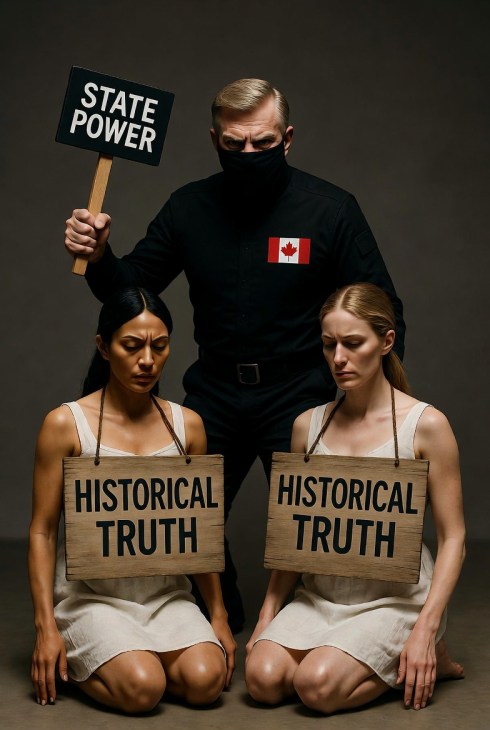
Historical truth does not become more trustworthy when the Criminal Code stands behind it.











 bleatmop
 Mystro
 The Arbourist


 Dead Wild Roses
Your opinions…