
You are currently browsing the tag archive for the ‘Freedom of Expression’ tag.
I have been a teacher for nearly twenty years, and one of the things we are purportedly supposed to teach is critical thinking. Yet I have rarely seen its meat and potatoes taught directly: how to examine a claim, distinguish evidence from inference, recognize our own incentives and ask what might prove us wrong. Epistemic hygiene seldom makes it to the table.
Knowing the difference between a transitive and intransitive verb is useful, but it does not teach someone how to interrogate their own cognition. Basic knowledge must come first because nobody can think critically about material they do not understand. After that, however, education often supplies more intricate content without spending much time on how beliefs are constructed, defended and corrected. Mastery means being able to teach the material reliably; thinking begins when you can examine its assumptions and identify what evidence would change your mind.
Genuine critical thinking—something different from applying the predetermined categories of critical theory—is harder still. On consequential subjects, truth must be extracted from incomplete evidence, interested testimony, competing interpretations and our capacity for self-deception. We are confirmation-seeking machines with an extraordinary ability to turn motivated reasoning into moral certainty.
My own intellectual progress—and I use the word progress lightly—began with enormous amounts of reading in my twenties and thirties: Noam Chomsky, Nick Turse, Chris Hedges, Naomi Klein, Arundhati Roy, Michael Moore and other writers overwhelmingly critical of the West, capitalism and American power.
Had I studied critical theory, dependency theory or post-colonialism, or grappled seriously with Derrida and Foucault? No. Nor had I read Milton Friedman or Friedrich Hayek; even now, I know much of their work through summaries rather than sustained engagement with the originals.
That was the trap. It was not that left-wing writers had gathered in a secret room and conspired to conceal their philosophical machinery. It was that the popular polemical writing I consumed rarely required me to inspect that machinery at all. Its conclusions arrived with their moral valence already installed. Capitalism was not merely an economic arrangement with strengths, failures and trade-offs; it was exploitation. Western power was not something to be judged according to particular actions and outcomes; it was presumptively imperial. Conservatives were not people advancing arguments I had considered and rejected. They were regressive people who wanted others to suffer.
I had learned the conclusion—and the moral posture that protected it—before I understood the underlying dispute. Once that posture is established, disagreement no longer arrives as information. It arrives as evidence of guilt.
Consider a question that has become common in political conversation: “Surely you oppose the genocide Israel is committing in Gaza?”
It is grammatically a question but structurally a package of conclusions. Genocide is among the worst crimes human beings can commit; therefore, any decent person must oppose it. That part is easy. The difficulty is that the sentence quietly joins this uncontested moral premise to a disputed factual and legal conclusion: that Israel’s conduct in Gaza constitutes genocide.
To pause before accepting the second proposition is not to endorse dead civilians, starvation, collective punishment or war crimes. It is to ask whether the term has been established. Genocide requires specified acts accompanied by the intent to destroy, in whole or substantial part, a protected national, ethnic, racial or religious group. At the time of writing, the International Court of Justice has not issued a final judgment on South Africa’s case against Israel.
A responsible answer might begin: “I oppose genocide without qualification. I am not yet persuaded that genocide is the legally accurate description of Israel’s conduct in Gaza.”
Yet this distinction is often where the moral mechanism activates. Why are you reluctant to condemn genocide? How can you defend what Israel is doing? What kind of person needs more evidence while children are dying? The demand for factual discrimination is recoded as moral indifference, and uncertainty becomes complicity. If the exchange deteriorates far enough, racism, fascism and comparisons to Hitler soon follow.
Notice what has disappeared. We are no longer examining conduct, casualties, official statements or evidence of intent, nor distinguishing genocide from war crimes, crimes against humanity or the legally different consequences of urban warfare. The person who questioned the premise has been placed on trial instead.
Once you have been called a racist and had your ethical character placed under suspicion, what are you supposed to do? Real conversations occur within a social fabric of friendships, workplaces, institutions and reputations. People who know little about the original dispute still understand that proximity to an alleged racist can carry costs.
The rational response is often retreat: qualify what you said, apologize for how it was received or remain silent. None of this determines whether the original claim was true.
Being told to “do the work” can operate in much the same way. There are circumstances in which nobody is obligated to provide an introductory seminar to a belligerent stranger. But when someone advances a disputed public claim, the burden of supporting it does not transfer automatically to anyone who asks for evidence. “Educate yourself” is not an argument, and a reading list assembled entirely within one intellectual tradition is not a substitute for demonstrating the claim.
The accusation creates an enormous asymmetry. It takes seconds to call someone racist, transphobic, fascist or complicit in genocide. Answering may require reconstructing what was said, the evidence behind it and the distinctions being made. By then, the accusation has travelled farther than the rebuttal ever will. Whether intended or not, the effect disciplines everyone watching: this is what happens when the approved conclusion is questioned. What has been established is the price of examining it.
Social media does not create this mechanism, but it forms an unusually effective positive feedback loop around it. Ordinary conversation contains corrective signals: tone of voice, facial expression, hesitation, familiarity and the opportunity to clarify a sentence before it hardens into a verdict. Social media amputates those cues and places the exchange before an audience.
In its place, the platforms provide numbers. Likes, reposts, replies and impressions become crude heuristics for approval and importance, neither of which should be confused with truth. A careful argument that introduces uncertainty may appear weak beside a morally certain accusation that can be understood and shared in seconds. “That claim lacks evidence” requires examination. “You are a racist” requires only allegiance.
The economic structure reinforces the tendency. X allows eligible creators to earn money from content that generates impressions and interaction. Engagement measures activity, not truth value. A correction and a furious denunciation both count; the denunciation may travel farther because anger recruits participants more efficiently than qualification. Moral certainty produces engagement, engagement produces visibility, and visibility is mistaken for consensus.
None of this means moral judgment should be banished from argument. Some propositions are morally repugnant. An argument for racial supremacy, the deliberate murder of civilians or the legal subordination of women should be examined and condemned in moral terms. Refusing to make moral distinctions would not produce intellectual neutrality. It would produce moral cowardice.
The challenge is determining whether the judgment follows from honest examination or merely records our reaction to the person making it. The tribal animal in us is never far beneath the surface. When something important to our identity is questioned, we can experience disagreement as hostility, identify an enemy and begin assembling reasons why a bad person would say such a thing. Evidence is recruited for prosecution rather than examined for understanding.
This tendency is not confined to the activist left. Conservatives, religious communities, nationalists and every other group capable of forming a moral identity can protect their conclusions in the same way. The subject here is the moral vocabulary prevalent in contemporary progressive activism, not because progressives invented tribal cognition, but because terms such as racist, transphobic, fascist and complicit in genocide have become powerful instruments for enforcing its boundaries.
Some people earn those descriptions. The obligation is to demonstrate how. What exactly did the person claim? Was the disagreement factual, definitional or moral? What evidence supports the accusation? Are we applying the same standard to our allies? What would convince us that we had judged the person unfairly?
Charity does not mean weakening the conclusion until nobody can object to it, nor does it require endless patience with someone acting dishonestly. It means identifying the strongest fair version of an argument before criticizing it, locating the actual source of disagreement and leaving open the possibility that either participant may be wrong.
That final possibility is what the prefabricated moral accusation removes. Once disagreement proves guilt, the accuser no longer needs an error-correcting mechanism. The righteous cannot learn from the wicked; they can only expose, discipline or silence them.
The alternative is less emotionally satisfying and considerably more difficult. Return to the proposition. Separate the moral premise from the factual claim. Demand evidence without pretending that evidence eliminates moral responsibility. Judge conduct when the judgment has been earned, and remain willing to correct the judgment when it has not.
A society capable of disagreement must make room for people to be mistaken without making them monsters. Otherwise, moral language ceases to guide inquiry and becomes the means by which inquiry is brought to an end.
References
- International Court of Justice. “Application of the Convention on the Prevention and Punishment of the Crime of Genocide in the Gaza Strip (South Africa v. Israel).” https://www.icj-cij.org/case/192
- United Nations Office on Genocide Prevention and the Responsibility to Protect. “Definitions of Genocide and Related Crimes.” https://www.un.org/en/node/218413
- X Help Center. “Creator Revenue Sharing.” https://help.x.com/en/using-x/creator-revenue-sharing
Free speech is often defended badly.
Sometimes it is treated as a license to say anything without consequence. Sometimes it is reduced to personal self-expression. Sometimes it is framed as a courtesy extended to polite, harmless, approved opinions.
That misses the deeper point.
In a classically liberal society, free speech serves a practical purpose: it lets citizens search for truth, correct error, restrain power, and govern themselves.
It is not decorative. It is part of the machinery of a free society.
1. Free speech helps society find truth
Human beings are fallible.
Individuals can be wrong. Experts can be wrong. Majorities can be wrong. Governments can be wrong. Institutions can be wrong. Moral crusades can be wrong.
Free speech matters because no authority is wise enough to decide, permanently and in advance, which ideas may be questioned.
Some claims are false, foolish, dishonest, or ugly. But the answer to bad claims is usually better argument, better evidence, open criticism, and public testing.
A society that cannot question its own certainties may still call its beliefs truth, but it has stopped checking.
2. Free speech protects dissent
Free speech is easy to support when everyone agrees.
Its real test comes when speech is irritating, unpopular, offensive, inconvenient, or aimed at powerful people.
Many ideas now considered obvious were once treated as dangerous, immoral, foolish, or socially disruptive. That does not make every dissenter right. Much dissent is mistaken, partial, crankish, or premature. But we often cannot know which is which until dissent is allowed to be heard and tested.
A society that protects only approved speech protects consensus, not free speech.
Dissent needs room before it becomes respectable.
3. Free speech restrains power
Free speech allows citizens to question institutions.
What are you doing? Why are you doing it? What evidence supports it? Who benefits? Who pays? What are the tradeoffs? What are you hiding?
Those questions matter because institutions tend to protect themselves. Governments, corporations, universities, professional bodies, media organizations, activist movements, and bureaucracies all prefer deference when they have power.
Free speech keeps authority answerable to public challenge. Without it, institutions can govern through status, expertise, fear, or moral pressure instead of justification.
4. Free speech makes self-government possible
Democracy requires more than voting.
Citizens need to argue about laws, leaders, policies, institutions, values, evidence, and public priorities. If people can vote but cannot freely discuss what they are voting about, democracy becomes managed consent.
Free speech allows citizens to hear competing arguments, compare claims, criticize leaders, expose failures, and persuade one another.
It is not only an individual right. It is a condition of honest public judgment.
5. Free speech includes the right to be wrong
A meaningful free-speech principle must protect some false or mistaken speech.
If only “true” speech is protected, someone must decide what counts as true before debate even begins. That power rarely stays neutral.
This does not protect fraud, defamation, threats, perjury, direct incitement, or criminal harassment. Free speech has limits.
But contested public questions cannot be settled by official truth-arbiters. Free societies answer error through argument wherever possible, because the cure for bad speech can easily become worse than the disease.
6. Free speech protects listeners too
Free speech is not only the right to speak.
It is also the right to hear, read, compare, consider, reject, and decide.
Censorship does not only silence the speaker. It also treats the listener as too fragile, foolish, or dangerous to encounter the wrong idea.
A free citizen is not merely someone allowed to express approved thoughts. A free citizen is someone trusted to hear arguments and judge them.
7. Free speech is uncomfortable by design
Free speech requires citizens to tolerate disagreement, offence, criticism of cherished beliefs, and ideas they consider wrong or dangerous.
That discomfort is not a flaw. It is the price of living among free adults rather than under enforced consensus.
A free society does not remain peaceful because no one disagrees. It remains peaceful because disagreement can be spoken, challenged, mocked, answered, revised, and defeated without being driven underground or handed over to the state.

Free speech allows disagreement to remain public, peaceful, and answerable to reason.
In summary
Free speech is the right to speak, hear, question, criticize, argue, publish, dissent, and persuade without unlawful censorship or coercion.
Its purpose is not merely self-expression. It is the error-correction system of a free society. It helps test truth, expose mistakes, restrain power, protect dissent, and make self-government possible.
Free speech does not mean every claim is wise. It does not mean speech has no limits. It does not mean freedom from criticism, disagreement, ridicule, or consequence.
It means no authority gets final ownership of public truth.
Free speech is not a luxury for when society agrees.
It is the mechanism that allows disagreement to remain peaceful, public, and answerable to reason.
 Parastoo Ahmadi sang without a hijab. For that, an Iranian court has reportedly sentenced her to seventy-four lashes, along with a two-year travel ban and a ban on artistic work.
Eight members of her musical and production team reportedly face the same punishment.
The ruling may still be appealed. That matters legally. It does not rescue the moral situation. A state has looked at a woman singing in an online performance and answered with the threat of the lash.
The official language is familiar: public decency, immoral content, religious propriety, social order. There is always a phrase ready when power wants to punish disobedience. But the facts remain plain enough. Ahmadi performed without submitting to Iran’s compulsory hijab laws, accompanied by male musicians, in a concert released online. The court treated the performance not as art, but as contamination.
That is what theocratic rule does. It turns a woman’s hair, voice, clothing, movement, and public presence into political territory.
A hijab freely chosen may be an act of faith, modesty, identity, or personal conviction. A hijab enforced by courts and police is something else. It becomes a sign of state power. Once punishment enters the picture, the language of choice disappears.
Western societies often become nervous when speaking about this. Ordinary Muslims in Canada, Britain, France, or the United States are not responsible for the crimes of the Islamic Republic. Many Muslims reject this kind of rule entirely. Many Iranian women resisting the regime come from Muslim families and communities themselves.
But that distinction cannot become an excuse for silence.
Islam as private belief is one thing. Islam as state power is another. When religious law governs women’s dress, restricts women’s voices, polices women’s bodies, and punishes public disobedience, it stands in direct conflict with the liberal inheritance the West should still be willing to defend: freedom of conscience, freedom of expression, equality before the law, and the right of the individual to live without clerical supervision.
Those values are not always honoured here. The West fails them often enough. But their failures do not make them false. Their absence is visible in places where a woman can be dragged through courts for singing.
Ahmadi’s alleged offence was not violence. It was not theft. It was not corruption. It was a performance. The regime’s response reveals the insecurity beneath the theology. A system confident in its moral authority would not need to threaten artists with flogging. A faith secure in itself would not require police, courts, and punishment to preserve public obedience.
“A hijab freely chosen belongs to the woman. A hijab enforced by courts and police belongs to the state.”
This is where polite multicultural language often fails. Respect for persons does not require respect for the laws that crush them. We can defend the dignity of peaceful Muslims while saying plainly that theocratic rule in Iran is oppressive, anti-liberal, and especially brutal toward women.
Sweeping that conflict under the multicultural rug does nothing for women like Ahmadi. It only protects the comfort of people far away from the consequences. The women living under these laws do not get the luxury of abstraction. They live with patrols, summonses, bans, fear, and the knowledge that a song can become evidence.
The phrase “Women, Life, Freedom” became powerful because it named what the regime fears most: women living as full human beings rather than managed subjects. Ahmadi’s performance belongs to that same moral territory. Under a regime like Iran’s, a woman singing uncovered is not merely performing. She is refusing.
And for that refusal, the state reaches for the lash.
Parastoo Ahmadi should be free to sing. Iranian women should be free to uncover their hair, make art, criticize their rulers, choose their faith, reject faith, and live without being disciplined by men who mistake control for morality.
A society that must threaten to whip women into obedience has already lost the argument.
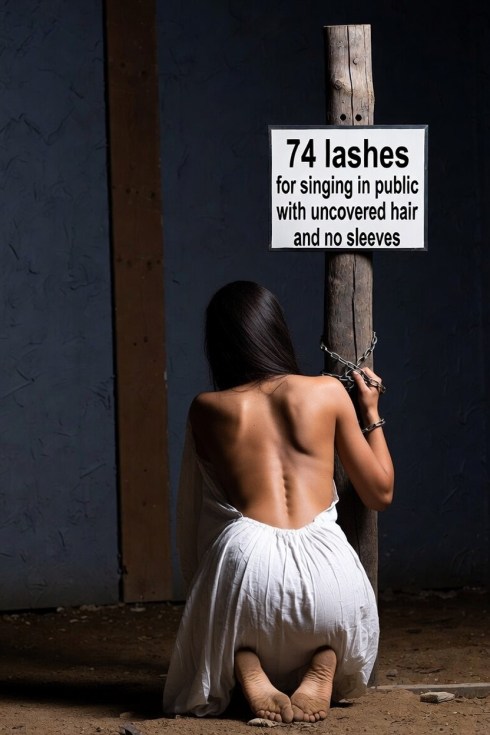
Seventy-four lashes for a song — the price of a woman’s uncovered voice in Iran.”
References
The Guardian. “Iranian star Parastoo Ahmadi reportedly sentenced to 74 lashes for singing without hijab.” June 18, 2026.
https://www.theguardian.com/world/2026/jun/18/iran-parastoo-ahmadi-74-lashes-singing-without-hijab
Radio Free Europe/Radio Liberty. “74 Lashes For A Song: Iranian Artist Sentenced For Virtual Concert.” June 2026.
https://www.rferl.org/a/iran-singer-sentence-flogging-morality-police-ban-women-life-freedom-hijab-concert-youtube/33783873.html
IranWire. “Caravanserai Concert Staff Sentenced to Flogging and Artistic Bans.” June 2026.
https://iranwire.com/en/news/153871-caravanserai-concert-staff-sentenced-to-flogging-and-artistic-bans/
Amnesty International. “Iran: New compulsory veiling law intensifies oppression of women and girls.” December 10, 2024.
https://www.amnesty.org/en/latest/news/2024/12/iran-new-compulsory-veiling-law-intensifies-oppression-of-women-and-girls/
The government is right about one thing: children are not safe in much of online life. But that does not make every child-safety law wise, limited, or safe for a free society.
Parents have a real responsibility to monitor their children’s welfare, and that includes internet activity. Freedom does not mean abandoning children to whatever social media companies, algorithms, predators, influencers, or peer-status machines decide to push at them next. A free society still expects adults to act like adults.
But parental responsibility is not the same thing as state permissioning. Bill C-34, the federal government’s Safe Social Media Act, should be read with that distinction in mind. The issue is not whether children should be protected from online harm. They should. The issue is whether protecting them requires building the habits, infrastructure, and bureaucracy of identity-gated internet access.
That danger is sharpened by how much the bill leaves to regulation. Many of the most important questions — which services are covered, how age will be verified, what exemptions will exist, and how the new regulator will enforce compliance — are not settled in the public-facing moral language of child safety. They are pushed into future administrative machinery.
That matters. A social media ban for users under sixteen cannot enforce itself. Platforms must know who is under sixteen. To know that, they must verify age. And once age verification becomes normal, adults are pulled into the same machinery because they must prove they are not children.

Child safety should not require Canadians to trade the open internet for a permission slip.
This is where the civil-liberties danger begins. The stated aim is child safety. The operating mechanism is identity checking. Once identity checking becomes a normal condition of access, it will not stay politely confined to one narrow category of service forever.
The strongest argument for the bill is not frivolous. Social media companies have profited from addictive design, algorithmic pressure, sexualized content, bullying, and misery dressed up as engagement. Parents are right to be angry. Governments are right to ask whether platforms have been allowed to externalize too much harm onto children and families.
But good intentions do not make a bad tool harmless.
Online anonymity is not just a convenience for trolls. It matters for political dissent, unpopular opinions, whistleblowing, vulnerable people, religious minorities, abuse victims, workers criticizing employers, and ordinary citizens who do not want every thought, search, argument, or association tied back to their legal identity.
For some Canadians, anonymity is not a luxury. It is part of how they remain able to think and speak honestly. Teachers, nurses, public servants, professionals, small-business owners, and employees in ideologically narrow workplaces all understand the problem. A person can hold lawful, serious, defensible opinions and still know that one bad-faith complaint, one screenshot, or one HR process can turn ordinary dissent into a professional liability.
Canadians should not reject child protection simply because the state has chosen a bad tool. If there are unobtrusive ways to reduce children’s exposure to exploitation, addiction loops, algorithmic pressure, and adult content without creating surveillance architecture, we should pursue them. Better parental tools, device-level controls, digital literacy, stronger enforcement against predators, and less addictive platform design are all fair subjects for debate.
“Child safety is real. Identity-gated access is still a dangerous cure.”
But a checkpoint internet is not a small price to pay. It changes the relationship between citizen and screen, reader and state, speaker and regulator. Once access depends on verification, the open internet begins to look less like a public square and more like a permissioned space.
That is too much power to normalize under the language of safety.
Our rights in Canada are unlikely to be taken away all at once. They erode gradually: one safety measure, one administrative convenience, one temporary verification requirement at a time, until the extraordinary becomes ordinary and the ordinary becomes mandatory.
Then, one day, pedestrianly, Canadians may discover that freedoms they thought were secure have become permissions they must ask for.
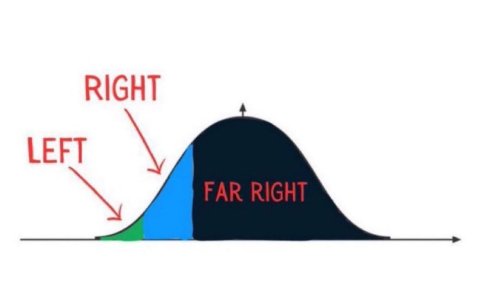
One of the most corrosive habits in current political discourse is the way plain factual claims get assigned a partisan label. Not arguments. Not policies. Facts. Or, more precisely, statements that point back to material reality, institutional limits, or ordinary human constraints. In theory, facts are supposed to discipline ideology. In practice, they are often treated as ideological aggression when they obstruct a preferred moral script.
That is what people are reaching for when they say facts are now treated as right-wing. The phrase is blunt, but it points to something real. In a growing number of disputes, especially around sex, gender, speech, and institutional policy, a person can say something materially true and be treated not as a participant in debate but as a moral suspect. The point is not answered on its merits. It is recoded as a signal of contamination. The speaker is no longer heard as describing reality. He is heard as choosing a tribe.
That shift matters because it changes the structure of argument. Once a factual claim is socially coded as “right-wing,” the burden quietly moves. The question is no longer whether the claim is true. The question becomes why you said it, what kind of person says such things, and who might feel endangered by hearing it. Motive replaces mechanism. Stigma replaces rebuttal. The claim is not refuted so much as quarantined.
You can see this clearly in disputes over sex and pronouns. For many people, saying that sex is real, binary in the ordinary human sense, and not altered by self-declaration is not an act of hostility. It is a claim about reality and a claim about language. “He” and “she” historically track male and female persons. Refusing to detach those words from sex is not, on its face, a partisan performance. It is an attempt to keep public language tethered to the material world rather than to inward identity claims.
“The disagreement is not mainly about politeness. It is about which reality gets public authority.”
That is exactly why the issue generates so much heat. The disagreement is not mainly about politeness. It is about which reality gets public authority. Does language track bodies, or does it track self-declared identity? Does a school treat sex as a stable feature of the world, or does it treat identity assertion as the governing fact? Those are not small etiquette disputes inflated by the internet. They are conflicts about ontology, law, and institutional power.
Canada now offers several live examples. Alberta’s Education Amendment Act requires parental notification when a student requests a gender identity-related preferred name or pronouns, and parental consent for students under 16 before staff may use them. The province says these changes are part of supporting families and setting clear school rules, with the remaining education amendments anticipated to take effect on September 1, 2025. Then, in late 2025, Alberta escalated further. Bill 9 invoked the notwithstanding clause to shield not only this school policy but other contested sex-and-gender measures from being struck down by the courts. That bundling matters. It shows this is no longer being treated as a narrow administrative disagreement, but as a foundational conflict over parental authority, child development, and the public meaning of sex.
Quebec presents the same fracture from the opposite direction, and it is ongoing now. Current reporting says a Montreal teacher is challenging the provincial policy that allows students 14 and older to change the name and pronouns used at school without parental consent. The teacher alleges she was required to use male pronouns at school while using female pronouns with the student’s parents. A preliminary hearing on anonymity and confidentiality was held on March 6, 2026, with the broader merits challenge still to come. Strip away the activist packaging and the conflict becomes plain: can institutional professionals be required to maintain two vocabularies of reality depending on the audience, and if they object, are they making an ethical argument or committing a moral offense?
The Barry Neufeld case in British Columbia shows the institutional end point of this logic. On February 18, 2026, the B.C. Human Rights Tribunal issued its decision and ordered substantial damages after finding that multiple publications were discriminatory, while some crossed the threshold into hate speech. That does not prove that every factual objection to gender ideology is punishable. It does show how readily dissent can be processed through systems that move from moral condemnation to formal classification. Once that line is crossed, everyone watching understands the lesson. The risk is no longer simply that you will be called wrong. The risk is that you will be treated as a public contaminant.
This is why the familiar “both sides are just choosing different facts” formula goes soft in exactly the wrong place. The conflict is not symmetrical. One side is generally making claims about bodies, language, legal authority, and institutional procedure. The other is often demanding that those things yield to identity-based recognition norms. Dignity is real and relevant. But dignity does not erase biological category, dissolve observable sex, or transmute factual disagreement into literal violence.
So when people say facts are treated as right-wing, the point is not that truth literally belongs to one side of the spectrum. The point is that in a culture saturated with moral performance, inconvenient facts are often recoded as partisan because it is easier to stigmatize them than to answer them. A factual claim that disrupts the script is no longer processed as description. It is processed as dissent. And dissent, under current conditions, is increasingly treated as a character defect.
Facts do not have a party. But when facts obstruct an ideological narrative, that narrative will often brand them right-wing and move straight to motive-policing. That is not a sign that the facts have changed. It is a sign that too much of public discourse has become allergic to reality when reality refuses to flatter the creed.
References
Government of Alberta. “Supporting Alberta students and families.”
https://www.alberta.ca/supporting-alberta-students-and-families
Government of Alberta. “Protecting youth, supporting parents, and safeguarding female sport.”
https://www.alberta.ca/protecting-youth-supporting-parents-and-safeguarding-female-sport
Global News. “Montreal teacher challenges policy for trans students to hide identity from parents.” March 6, 2026.
https://globalnews.ca/news/11719392/montreal-teacher-trans-students-challenge/
British Columbia Human Rights Tribunal. Chilliwack Teachers’ Association v. Neufeld (No. 10), 2026 BCHRT 49. February 18, 2026.
https://www.bctf.ca/docs/default-source/for-news-and-stories/49_chilliwack_teachers-_association_v_neufeld_no_10_2026_bchrt_49.pdf?sfvrsn=2d847803_1
Collin May has published a long, ambitious essay in the C2C journal (Hearts of Darkness: How the Left Uses Hate to Fuel its 21st Century Universal Imperium) on cancel culture, “hate” rhetoric, and the modern left’s moral posture. It is broader than I would write, more philosophical than most readers will tolerate, and occasionally overbuilt. But it names a pattern that matters, and one I return to often here: once “hate” becomes a universal accusation, institutions stop persuading and start policing.
May’s most useful contribution is not just the complaint (“cancel culture exists”) but the mechanism: “hate” stops being a moral description and becomes a category that pre-sorts who may be argued with and who may simply be managed.
That is the issue.
Not whether hatred exists. It does. Not whether some speech is vicious. It is. The issue is what happens when “hate” becomes the default label for disagreement, skepticism, refusal, dissent, or plain moral and factual judgments that cut against elite narratives.
At that point, the term stops describing and starts doing administrative work.
You can watch this happen across the institutions that shape public life: media, HR departments, professional bodies, universities, bureaucracies, and the expanding quasi-legal space around speech regulation. The sequence is familiar. Someone raises a concern about policy, ideology, language rules, school programming, medical ethics, public safety, immigration, religion, or sex-based rights. Instead of answering the argument, the institution reframes the speaker. Not wrong—harmful. Not questioning—spreading hate. Not participating in democratic friction—a threat to social order.
That move changes the rules of engagement. A wrong claim can be debated. A “hateful” claim can be quarantined. Once a claim is reclassified as harm rather than argument, the institutional response changes with it: less rebuttal, more restriction.
This language matters because it is not only moral language. It is managerial language. It justifies deplatforming, censorship, professional discipline, reputational destruction, and exclusion from ordinary civic legitimacy. It creates a class of people whose arguments no longer need to be answered on the merits. It also trains bystanders to confuse moral panic with moral seriousness.
May explains this through a large historical and philosophical genealogy. Fair enough. I am less interested in the full genealogy than in the practical result in front of us. In plain terms: the rhetoric of “hate” is often used to centralize authority in institutions that no longer trust the public and no longer feel obliged to reason with them.
That is one reason trust keeps collapsing.
People can live with disagreement. They can even live with policies they dislike. What they do not tolerate for long is being handled—being told their questions are illegitimate before they are heard. Once citizens conclude that institutions are using moral language as a shield against scrutiny, every future statement gets discounted. Even true statements are heard as spin.
And then the damage compounds. If “hate” is defined so broadly that it includes dissent, genuinely hateful speech becomes harder to identify and confront. The category gets inflated, politicized, and cheapened. Meanwhile, ordinary democratic disagreement becomes harder to conduct without professional or social risk.
That is not a confident free society. It is a managerial one.
Canada is not exempt. We have our own versions of this habit: speech debates reframed as safety debates, policy criticism recoded as identity harm, and public disputes (including over schools, sex-based rights, and even routine civic rituals like land acknowledgements) routed through tribunals, regulators, HR offices, and media scripts instead of open argument. The details vary by case. The mechanism does not. This tactic is not unique to one political tribe, but it is now especially entrenched in progressive-managerial institutions, which is precisely why it has so much reach.
The answer is not to deny hatred exists, or to become casual about cruelty. The answer is to recover civic discipline.
Name actual incitement when it occurs. Enforce existing laws where there are real threats, harassment, or violence. But stop using “hate” as a catch-all for disfavoured views. Stop treating condemnation as a substitute for evidence. Stop teaching institutions that the way to win an argument is to disqualify the speaker.
May quotes Pope Francis on cancel culture as something that “leaves no room.” Whether or not one follows his full historical argument, that phrase captures the operational problem.
A liberal society cannot function if citizens are only permitted to disagree inside moral boundaries drawn in advance by bureaucrats, activists, and legacy media.
The test is simple: can a claim be examined without first being moralized into silence?
If the answer is no, that is not moral confidence. It is institutional insecurity backed by power.
That is the pattern worth naming. And that is why essays like May’s, even when they overshoot, remain worth reading.

References
Collin May, “Hearts of Darkness: How the Left Uses Hate to Fuel its 21st Century Universal Imperium,” C2C Journal (February 16, 2026), https://c2cjournal.ca/2026/02/hearts-of-darkness-how-the-left-uses-hate-to-fuel-its-21st-century-universal-imperium/. (C2C Journal)
The most important part of the British Columbia Human Rights Tribunal’s decision in Chilliwack Teachers’ Association v. Neufeld (No. 10) is not the political noise around it. It is a short passage in page 19 paragraph 55. [attributed as paragraph 19, originally].
That passage matters because it appears to recode a contested idea as a condition of basic civic recognition. In plain terms, it moves from “do not discriminate against people” toward “you must affirm a specific theory to count as accepting them.”
This primer focuses on that point only. It does not attempt to relitigate the entire case.
The tribunal’s decision was issued February 18, 2026, indexed as 2026 BCHRT 49.
What this article argues in one paragraph
TL;DR: The BCHRT can punish discrimination without requiring Canadians to affirm a contested theory of sex and gender as the price of being considered non-discriminatory. Paragraph 19 matters because it blurs that line: it treats disagreement with a conceptual framework as “existential denial” of a person. That is a legal and civic problem, even for people who support anti-discrimination protections.
What this critique is not saying
Before the legal and logical analysis, a boundary line.
This critique is not saying:
- LGBTQ teachers cannot suffer real harm from public rhetoric.
- Human rights law cannot address discriminatory publications or poisoned work environments.
- Every criticism of SOGI, gender identity policy, or youth transition debates is lawful.
- Barry Neufeld’s rhetoric was prudent, fair, or wise.
The tribunal found multiple contraventions under the Code, including ss. 7(1)(a), 7(1)(b), and 13, and the decision contains detailed findings about workplace impact and discriminatory effects.
This primer makes a narrower claim:
Page 19 paragraph 55 uses an analogy that collapses the distinction between recognizing a person and affirming a contested ideological premise.
That distinction matters for free expression, legal clarity, and public trust.
The passage that changes the frame
Here is the core language from parge 19, paragraph 55 (including the definitional lead-in):
“Transpeople are, by definition, people ‘whose gender identity does not align with the sex assigned to them at birth’…”
“If a person elects not to ‘believe’ that gender identity is separate from sex assigned at birth, then they do not ‘believe’ in transpeople. This is a form of existential denial…”
“A person does not need to believe in Christianity to accept that another person is Christian. However, to accept that a person is transgender, one must accept that their gender identity is different than their sex assigned at birth.”
This is the paragraph Canadians should read for themselves.
The issue is not whether one can be civil. The issue is whether civil recognition is being redefined as mandatory assent to a disputed concept.
The core problem: equivocation on “accept” and “believe”
The tribunal’s analogy uses accept and believe as if they do the same work in both examples. They do not.
Christianity example
In the Christianity example, “accept that another person is Christian” usually means:
- acknowledging a descriptive fact about that person’s profession of faith,
- recognizing what they claim to believe,
- without requiring your own doctrinal agreement.
You can think Christianity is false and still accurately say, “Yes, that person is Christian.”
That is descriptive recognition.
Transgender example (as framed in para. 55)
In the tribunal’s wording, “accept that a person is transgender” is not left at description. It is tied to a required premise:
- that gender identity is separate from sex assigned at birth, and
- that this premise must be accepted in order to count as accepting the person at all.
That is not merely descriptive recognition. It is affirmation of a contested theory built into the definition.
That is the logical shift.
Why this matters legally and civically
A liberal legal order normally distinguishes between:
- Recognition of persons
- Protection from discrimination
- Compelled assent to contested beliefs
Paragraph 55 blurs those lines.
A person can acknowledge all of the following without contradiction:
- that someone identifies as transgender,
- that the person may experience distress, dysphoria, or social vulnerability,
- that harassment or discrimination against them is wrong,
while still disputing:
- whether sex is best described as “assigned” rather than observed,
- whether gender identity should override sex in all legal contexts,
- whether specific policies (sports, prisons, shelters, schools) should follow from that framework.
If disagreement on those latter questions is relabeled as “existential denial,” the public is no longer being asked to tolerate persons. It is being asked to affirm a framework.
That is the warning.
A concrete example most readers can use
Here is the distinction in everyday terms.
A teacher, coach, employer, or colleague can:
- treat a transgender person courteously,
- avoid harassment,
- maintain ordinary workplace civility,
- refrain from discriminatory conduct,
without conceding that sex categories disappear in every policy context.
For example, a person may choose to use a student’s preferred name in daily interaction and still argue that elite female sports should remain sex-based. A person may reject insults and harassment and still dispute whether “sex assigned at birth” is the best scientific language.
That is not incoherence. That is how pluralist societies work.
Paragraph 19 pressures this distinction by framing conceptual dissent as equivalent to non-recognition of the person.
The definitional trap in paragraph 55
Paragraph 19 does something subtle but powerful.
It defines “transpeople” using a specific conceptual framework (“gender identity” versus “sex assigned at birth”), then treats non-acceptance of that framework as non-acceptance of trans people themselves.
That is a question-begging structure:
- Premise (built into the definition): trans identity necessarily means gender identity distinct from sex assigned at birth.
- Conclusion: if you reject that premise, you deny trans people.
But the premise is precisely what is contested in public debate.
A tribunal can rule against discriminatory conduct. It can interpret the Code. It can assess workplace effects. But once it turns a contested framework into the test of whether one “accepts” a class of persons at all, it risks moving from adjudication into ideological gatekeeping.
Context matters, but it does not fix the analogy
To be fair to the decision, the tribunal is not writing in a vacuum.
The reasons frame Mr. Neufeld’s rhetoric as part of a broader pattern of statements the tribunal found denigrating, inflammatory, and connected to the work environment of LGBTQ teachers. The tribunal also found a direct connection between his public rhetoric and a school climate that felt unsafe to many LGBTQ teachers.
That context may explain the tribunal’s forceful language.
It does not solve the logic problem in paragraph 19.
Even in hard cases, legal reasoning should preserve key distinctions:
- personhood vs. theory,
- conduct vs. belief,
- discrimination vs. disagreement.
When those lines blur, institutions may satisfy partisans while losing credibility with ordinary readers who can still detect the category error.
Remedies matter too (and should be stated plainly)
This was not a symbolic ruling.
The tribunal ordered multiple remedies, including a cease-and-refrain order, $442.00 to Teacher C for lost wages/expenses, and a $750,000 global award for injury to dignity, feelings, and self-respect to be paid to the CTA for equal distribution to class members. It also ordered interest on monetary amounts as specified.
The tribunal also states that the dignity award is compensatory and “not punitive.”
Readers can disagree about the amount. They should still understand that paragraph 19 sits inside a decision with real legal and financial consequences.
Why Canadians should pay attention
Most Canadians will never read a tribunal decision. They will hear summaries.
That is why paragraph page 19 paragraph 55 deserves attention.
If public institutions begin treating disagreement with a contested theory as “existential denial,” the zone of legitimate disagreement shrinks by definition. The public is no longer told only, “Do not discriminate.” It is told, in effect, “Affirm this framework, or your dissent may be treated as denial of persons.”
That is not a stable basis for pluralism.
A rights-respecting society needs a better rule:
- protect people from discrimination,
- punish actual harassment and unlawful conduct,
- preserve space for lawful disagreement on contested concepts.
Paragraph 55, as written, weakens that line.

Glossary for readers
Page 19, Paragraph 55
A specific paragraph in the tribunal’s reasons that contains the Christianity analogy and the “existential denial” language. This primer focuses on that paragraph.
“Existential denial”
The tribunal’s phrase in para. 19 for refusing to “believe” that gender identity is separate from sex assigned at birth, which it links to not “believing in transpeople.”
Section 7(1)(a) (BC Human Rights Code)
A Code provision dealing with discriminatory publications (as applied by the tribunal in this case).
Section 7(1)(b) (BC Human Rights Code)
A Code provision dealing with publications likely to expose a person or group to hatred or contempt (the tribunal found some publications met this threshold).
Section 13 (BC Human Rights Code)
A Code provision dealing with discrimination in employment, including discriminatory work environments (the tribunal found a poisoned work environment for the class of LGBTQ teachers).
“Poisoned work environment”
A human rights / employment law concept referring to a workplace atmosphere made discriminatory through conduct, speech, or conditions connected to protected grounds.
SOGI 1 2 3
Resources discussed in the decision in connection with BC public education and inclusion policies; the tribunal notes they are resources and addresses their role in the factual background. (See source map below.)
Source map so readers can verify for themselves
Use this map to read the decision directly and check each claim the PDF is available here.
Case identification and issuance
- Paras. 1–3 (intro/citation/date/caption)
- Verified from the front matter: issued February 18, 2026, indexed as 2026 BCHRT 49.
Overview of findings and what was decided
- Paras. 4–6 (high-level findings; which Code sections were violated)
- Tribunal later reiterates finding the complaint justified in part and violations of ss. 7(1)(a), 7(1)(b), and 13.
Freedom of expression framework / limits
- Paras. 8–10 (overview-level framing)
- Also see Part VII heading “Freedom of expression and its limits” in the table of contents.
SOGI factual background
- Paras. 13–15 (background on SOGI 1 2 3 in public education)
- See TOC references to “SOGI 1 2 3 in public education” and Neufeld’s response.
The key analogy and “existential denial”
- Para. 19 (full lead-in + Christianity analogy + “existential denial” language)
This is the central paragraph for the primer.
Tribunal’s “veneer of reasonableness” concern
- Para. 55 (same paragraph; immediate context of the analogy)
Workplace impact evidence / climate findings
- Paras. 38 onward (teacher evidence and climate effects)
- Example evidence and findings on climate and workplace effects are reflected in the teacher testimony excerpts and the tribunal’s acceptance of a direct connection to unsafe school climate.
s. 13 conclusion (employment discrimination)
- Para. 82 (and surrounding paras.) / section conclusion in Part V-C
- Tribunal concludes violation of s. 13 for the class.
Remedies overview (s. 37(2))
- Paras. 99 onward (remedies discussion starts in the remedies part)
- Includes declaration, cease/refrain order, expenses, dignity award, and interest.
Cease and refrain order
- Remedies section, Part A (paras. around 100–101)
- “We order him to cease the contravention and refrain from committing the same or a similar contravention…”
Training remedy requested but declined
- Part B (ameliorative steps) (paras. around 102)
- Tribunal says it was not persuaded mandatory training would have a beneficial effect in this case.
Teacher C expenses ($442)
- Part C (expenses incurred) (paras. around 103)
- Tribunal orders $442.00 to Teacher C.
Dignity award ($750,000 global)
- Part D (compensation for injury to dignity…) (paras. around 104–111)
- Tribunal says the purpose is compensatory, not punitive; later orders $750,000 to the CTA for equal distribution to class members.
Interest orders
- Part E (Interest) (paras. around 112)
- Tribunal orders interest as set out in the Court Order Interest Act.











 bleatmop
 Mystro
 The Arbourist


 Dead Wild Roses
Your opinions…