
You are currently browsing the tag archive for the ‘Political Polarization’ tag.
Most of us were never really taught how political debate is supposed to work. We absorbed it from bad examples.
 Say the words “political debate” and many people picture television panels where two partisan performers interrupt each other until a producer cuts to commercial, or the online version: a thread full of dunks, slogans, insults, and people congratulating themselves for having exposed the other side as stupid, corrupt, dangerous, or insane. That may be what political debate often looks like now, but it is not what political conversation in a liberal democracy is for.
I am not interested in rules-lawyering everyone’s tone. People are free to be blunt, angry, sarcastic, partisan, impatient, and rude. Politics is not a finishing school, and some public arguments deserve a sharp answer. The problem is not that Canadians are sometimes impolite with one another. The deeper problem is that a more corrosive habit has been creeping into our political life: we have started evaluating the speaker before we evaluate the argument.
A claim appears, and before anyone asks whether it is true, reasonable, exaggerated, foolish, or worth answering, the person making it is sorted. Loyal or suspect. One of us or one of them. Serious citizen or coded enemy. Once that sorting happens, the argument itself begins to vanish from view, because the real work has already been done by the classification.
That is the temptation captured by the friend/enemy distinction, a phrase most famously associated with Carl Schmitt, the early twentieth-century German political theorist whose wider politics should not be sanitized or treated as a model. I am not invoking Schmitt as a guide. I am using the distinction as a warning label, because it names something liberal societies need to recognize early: the moment politics stops being a contest of judgment and becomes a test of allegiance.
In ordinary life, we all distinguish between allies, opponents, rivals, strangers, and genuine threats. Prudence is not the problem. A country should know when it is being pressured. Citizens should be able to recognize bad faith, fanaticism, corruption, and hostile interests. Liberal democracy does not require political innocence; it requires enough discipline to keep prudence from hardening into total suspicion.
The danger comes when disagreement no longer remains disagreement but becomes evidence of allegiance. The question shifts from “Is this true?” or “What evidence supports it?” to “Whose side are you on?” The person matters more than the claim, the label matters more than the reasoning, and the side-taking becomes the argument. When politics moves there, liberal democracy begins to lose the oxygen it needs to survive.
A free society depends on the possibility that fellow citizens can disagree sharply without becoming enemies of the country. It asks us to answer arguments rather than merely classify the people making them. It leaves room for someone to be wrong, irritating, partisan, badly informed, or even deeply mistaken without being treated as a contaminant in the public square.
I saw this play out recently in a small online exchange around the phrase “Maple MAGA.” There is a real criticism buried in that label. Some Canadians have been far too indulgent toward Donald Trump’s rhetoric about this country, and some have seemed more animated by American partisan identity than by Canadian sovereignty. When a Canadian cheers pressure from Washington against Canada, or treats our independence as a bargaining chip in someone else’s political theatre, that deserves a firm answer because Canada is not an accessory to American politics, not a province-in-waiting, and not for sale.
 But “Maple MAGA” often does more work than that. Instead of describing a specific position, it expands into a moral category. It gathers people in. It becomes a way of marking domestic opponents as suspect before their arguments are considered. The issue is no longer what a person actually argued about Canadian policy, economic weakness, sovereignty, or Ottawa’s failures. The issue becomes whether he has denounced the correct villain, in the correct language, with the correct visible enthusiasm.
That is where debate begins turning into a loyalty test, because there is a real difference between saying Trump’s rhetoric toward Canada was hostile and saying Canadian citizens must use a demanded label before their arguments can be taken seriously. The first is a judgment about foreign conduct. The second smuggles a test of domestic belonging into political conversation.
Once that happens, the original issue starts to disappear. Was Canada’s economic weakness caused mainly by domestic policy, American pressure, or some combination of both? Is “Maple MAGA” an accurate description of a real political tendency, or a lazy smear used to dismiss people who dislike Ottawa’s direction? Is the argument being made true, false, half-true, exaggerated, or badly framed? Those questions take patience, which is exactly why the loyalty test is so tempting.
The loyalty test asks for something much simpler. Are you one of us, or one of them? Have you said the required phrase? Have you distanced yourself enough? Have you performed the right moral posture before being allowed into the conversation? At that point, politics has slipped away from argument and into status testing.
This is not unique to one party, one movement, or one ideological tribe. Conservatives have their own shortcuts: “woke,” “globalist,” “Laurentian elite,” “anti-Canadian,” and plenty of other labels used when answering a person would take more work than sorting him. Progressives have their versions. Populists have theirs. Centrists have theirs too, though they often dress the habit up as responsible seriousness. Every faction has a vocabulary for making opponents morally inadmissible before the argument begins.
The “Maple MAGA” example is useful because it is current, Canadian, and revealing. It shows how quickly a legitimate concern can become a domestic sorting tool. Trump’s obnoxious rhetoric about Canada, along with threats of economic pressure, gave Canadians good reason to be alert. A patriotic response was necessary, because no serious country should shrug when a powerful neighbour treats its sovereignty casually. But a necessary patriotic response can still curdle into something unhealthy when an external threat becomes a way of disciplining internal dissent.
Criticism of Ottawa, Liberal policy, or the direction of the country can be made to look foreign-aligned, morally suspect, or insufficiently Canadian. A foreign politician becomes the shadow cast over every local disagreement. The moment someone criticizes domestic policy, the insinuation arrives: whose side are you really on? That is a dangerous move even when it begins from a real grievance.
A foreign leader can behave badly. A neighbouring country can apply pressure. A government can be right to resist that pressure. None of this means Canadian citizens lose the right to criticize their own government without first proving that they belong to the acceptable moral category.
Canada is not the United States, and our political culture is not yet as intensely polarized. We should be careful not to exaggerate the crisis, but that is exactly why the habit matters now. Civic decay is easier to resist while it is still forming; once it hardens into the ordinary way politics is done, people stop noticing the damage.
Liberal democracy does not require us to pretend every argument is good. Some arguments are foolish, dishonest, thin, or soaked in partisan fog. Some are recycled grievance dressed up as principle. Some deserve a brief answer and a quick dismissal. But even then, the way to answer a bad argument is to answer it: expose the error, challenge the premise, show the missing evidence, point out the contradiction, or say plainly that the argument fails.
What should not become our first move is declaring the person contaminated and treating that as a substitute for thought. Social media makes the shortcut feel righteous because contempt performs well. Sneering is easy to understand. Labels travel faster than arguments. A caricature can be shared in seconds, while a fair summary takes effort and usually wins less applause.
Anyone can dunk, sneer, caricature, and perform disgust for an approving crowd. The harder civic discipline is being able to state an opponent’s position in terms he would recognize, not because every view deserves endless patience, not because politics should become a parlour game for people with too much time and too few convictions, and not because all sides are equally right, honest, or harmless. The point is simpler than that: you cannot seriously defeat an argument you have not first understood.
If you can only answer the worst caricature of your opponent, you are not debating so much as shadowboxing. You may win applause from people who already agree with you, but you have not clarified the issue, persuaded the undecided, or improved the public conversation by one inch.
 That is one of the civic habits we are losing. We are becoming quick at identifying villains and slow at understanding claims. We know how to attach labels, detect contamination, and turn disagreement into a question of moral hygiene, while forgetting how to stay with an argument long enough to know what it actually says.
A liberal democratic citizen should be able to say: I think you are wrong, and I will answer you. I think your politics are mistaken, but I will not treat you as an enemy of the country. I think your judgment is poor, but I will not demand a ritual of denunciation before you are allowed to speak. That is not softness, weakness, or both-sides evasion; it is democratic discipline.
When Canadian debate becomes a loyalty test, we do not become more patriotic. We become easier to manipulate. Once every issue is reduced to friend or enemy, loyal or traitor, acceptable or suspect, we stop asking whether arguments are true and start asking whether people belong.
That is not how a free country reasons with itself, and a country that can no longer reason with itself will eventually be governed by fear, resentment, and whoever is most skilled at naming enemies.
Good intentions are not enough. That should be obvious, but much of our public life now behaves as if noble language can rescue bad thinking.
Before people declare what is compassionate, just, inclusive, hateful, dangerous, or necessary, they need some reliable way of knowing whether their factual claims are true. That order matters. If the tools used to find truth are broken, captured, or designed to protect a preferred belief from contradiction, then the moral conclusions built on top of those tools will inherit the damage.
This is not a left-wing or right-wing problem, though each side prefers noticing it in the other. The progressive version often begins with moral urgency. A policy is called compassionate, inclusive, or protective, and once that moral label is attached, factual objections start to look suspicious. Questions about consequences become “harm.” Questions about definitions become “erasure.” Questions about evidence become proof that the questioner is unsafe.
The conservative version has its own habits. A bad social trend gets folded too quickly into civilizational decline. One ugly example becomes proof of total collapse. A complicated institutional failure becomes evidence that the enemy planned the whole thing. The moral conclusion may contain some truth, but it arrives too early and then starts recruiting facts to serve it.
That is the trap. Once moral certainty arrives first, the mind stops investigating and starts defending.
You can see the pattern wherever institutions are rewarded for sounding virtuous before they are required to be accurate. A school board adopts fashionable language before asking whether the policy helps children. A medical system treats hesitation as cruelty before the long-term evidence is settled. A government describes economic pain in careful managerial terms while households are trying to make rent, groceries, debt, and wages fit inside the same month. The details differ, but the sequence is familiar: the moral frame arrives first, and the facts are invited in later as supporting cast.
A healthier public culture would ask plainer questions before the slogans begin. What is the claim? What evidence would show it is true? What evidence would weaken it? Who pays the cost if we are wrong? Are we counting those costs honestly, including the costs to people we do not like? Are we applying the same standard when the facts embarrass our own side?
Those questions are not glamorous. They do not fit neatly on a protest sign or a campaign graphic. They also do not offer the emotional satisfaction of instant righteousness. But they are the difference between thinking and performing.
This matters because moral language is powerful. It can move people to protect the vulnerable, correct injustice, and resist cruelty. But the same language can also be used to smuggle weak claims past scrutiny. Institutions have incentives to do this. Activists gain status from certainty. Bureaucracies protect themselves with approved vocabulary. Media outlets reward emotional clarity over careful qualification. Ordinary people learn, quickly enough, which questions are safe to ask in public and which ones are better saved for the parking lot.
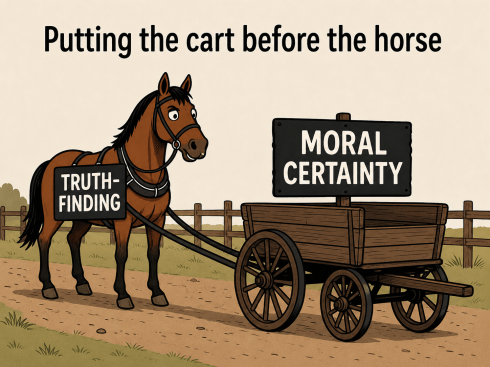
So they accept the conclusion first and hope the facts will catch up later.
They often do not.
Reality has a way of collecting unpaid debts. Bad premises eventually produce visible damage: failed policies, institutional distrust, medical scandals, economic denial, public cowardice, and citizens who no longer believe official language because they have watched it bend too many times.
The answer is not cynicism. Cynicism is often just laziness wearing a smarter jacket. The answer is better truth-finding: slower claims, clearer definitions, stronger evidence, real costs counted on both sides, and a willingness to notice when our preferred story stops matching the world.
That includes me. That includes you. That includes the people whose politics we find irritating, fashionable, smug, or deranged. Nobody gets a permanent exemption from reality because their intentions are good or their enemies are worse.
A decent society needs moral seriousness, but moral seriousness cannot mean protecting our favourite conclusions from examination. It has to mean caring enough about justice to ask whether our account of the world is actually true.
Peter Boghossian recently offered a blunt explanation for a pattern that keeps confusing otherwise sensible people: why do parts of the far left reject reforms that would plainly improve public institutions?
Because improvement is not the goal.
His point is simple and ugly. Widespread distrust is not an accidental byproduct of the project. It is the project. Once you understand that, a good deal of otherwise baffling behavior stops being baffling.
Most normal people still assume institutions are flawed but fixable. You identify the problem, apply targeted reforms, restore confidence, and move forward. That model only works if you believe the institution has legitimacy to begin with.
But if you believe the system is oppressive at the root, then reform becomes a threat. Reform stabilizes. It restores credibility. It gives ordinary people a reason to think the institution can work. That, in turn, weakens the deeper claim that the whole structure must be replaced.
That is the real pivot.
When an institution is judged illegitimate in principle, making it function better is not progress. It is betrayal.
You can see this logic across multiple domains.
Take policing. There are decades of incremental reforms aimed at reducing misconduct and increasing accountability: body cameras, improved training, procedural reforms, better supervision, smarter deployment. None of these require abolishing the institution. Yet much of the activist energy after 2020 did not center on reform but on delegitimization: defund, abolish, systemic rot. The point was not to make policing more trustworthy. The point was to make trust itself look naive.
The same pattern appears in universities. The legitimacy problem here is obvious enough that even casual observers can see it. Entire disciplines operate with strikingly narrow viewpoint diversity. The easiest possible trust-building reform would be to widen that range, even modestly. Boghossian’s line about putting “Republicans in sociology departments” works precisely because the ask is so small. If institutional credibility mattered, this would be low-hanging fruit. The refusal to do even that suggests that credibility is not the objective.
The pattern extends further than those two examples. Courts, media, bureaucracies, corporations, elections—again and again, incremental fixes are dismissed as cosmetic. The rhetoric moves quickly from flawed to structural, from structural to systemic, from systemic to irredeemable. Once that move is complete, reform itself becomes suspect. If a change makes the institution more trusted, it is condemned for helping preserve something that, in the activist imagination, deserves to fall.
There is, to be fair, a serious version of the opposing argument. Sometimes institutions really do absorb small reforms in order to preserve larger injustices. In those cases, reform can function as a pressure valve rather than a cure. That argument has force in isolated cases.
Applied universally, it hardens into dogma.
If every institution is corrupt at the root, and every reform is dismissed as insufficient by definition, then no improvement can ever count as evidence. Distrust is no longer a conclusion drawn from performance. It becomes a prior commitment. At that point, the argument stops being diagnostic and becomes theological.
What sharpens Boghossian’s observation is the context in which he made it. He was responding to a discussion about the strategic use of institutional distrust as a political weapon. That matters because the logic is no longer confined to one faction. Different actors now use different language to sell the same underlying message: the system is captured, illegitimate, beyond repair, and unworthy of loyalty. The branding varies. The effect does not.
Delegitimization replaces reform.
And when both ideological extremes converge on the claim that institutions cannot be repaired, the political center—where repair actually happens—begins to disappear. That is not a healthy equilibrium. It is unsustainable.
This also clarifies why evidence-based reform so often fails to persuade true believers. You can show improved outcomes. You can demonstrate lower abuse, better process, stronger accountability, fairer procedures. It will not matter to people whose real argument is not about performance but legitimacy. They are not asking whether the institution is getting better. They are asking whether it deserves to survive.
That distinction matters.
It means reform is still necessary, but not for the reason many assume. Reform is necessary for the persuadable public, for ordinary citizens who still want institutions that work and can still distinguish corruption from legitimacy. It is not likely to win over those already committed to collapse.
It also means the defense of institutions has to be more explicit than many liberals seem comfortable making it. Not blind loyalty. Not sentimental trust. Not a denial of failure. Something firmer than that: flawed, self-correcting institutions are worth defending because the alternatives to reform are usually far worse than reform’s imperfections.
Something always fills the vacuum.
It is rarely better.
Boghossian’s insight matters because it strips away a comforting illusion. Many people still assume everyone in public life is arguing, however bitterly, about how to make institutions function better. They are not. Some are arguing about whether those institutions deserve to exist at all.
Once you see that clearly, the repeated rejection of easy reforms stops looking irrational. It starts looking strategic.
And strategies aimed at destroying trust cannot be answered by trust alone. They have to be met with reforms that work and with the confidence to say, plainly, that imperfect institutions are still worth defending.

References
Primary source
- Peter Boghossian, X post on institutional distrust and reform. – https://x.com/peterboghossian/status/2041046766351736873?s=20
Suggested supporting references
- Pew Research Center, Public Trust in Government: 1958–2024
- National Academies of Sciences, Proactive Policing: Effects on Crime and Communities
- Cynthia Lum et al., systematic review on body-worn cameras
- Neil Gross and Solon Simmons, The Social and Political Views of American Professors
- Mitchell Langbert et al., research on faculty political imbalance











 bleatmop
 Mystro
 The Arbourist


 Dead Wild Roses
Your opinions…