
You are currently browsing the tag archive for the ‘Peter Boghossian’ tag.
Editors Note : This essay is a summation of recent podcast interview between Peter Boghossian and Sarah McLaughin.
Free speech is often defended too narrowly, as if it were mainly a permission slip for rude people, a tolerance ritual for offensive opinions, or a legal loophole that allows unpleasant citizens to be unpleasant in public.
That misses the deeper issue.
Free speech matters least when the opinion is popular, fashionable, institutional, or already protected by status. Those opinions usually have no trouble finding a microphone. Free speech matters most when the speaker is disliked, the claim is offensive, the argument is premature, or the government would prefer the matter not be discussed at all.
That is what makes Sarah McLaughlin’s defence of free speech useful. In her conversation with Peter Boghossian, she does not frame free speech as a favour extended to difficult people. She frames it as a limit on power.
The distinction matters because, in McLaughlin’s account, the First Amendment does not give people their speech rights. It restrains government from taking those rights away. The right comes first. The state comes second. Human beings possess speech rights by virtue of their dignity as human beings, not because a minister, judge, administrator, or police officer has granted them a temporary licence to speak.
Once that principle is reversed, free speech becomes a managed privilege. Government decides how much speech citizens may have, which topics are too dangerous, which emotions deserve protection, which claims count as misinformation, and which controversies must be moved from public argument into administrative control.
At that point, censorship does not need to announce itself as censorship. It can arrive as safety, anti-hate policy, national security, child protection, or a database entry no one tells you about.
That is one of McLaughlin’s strongest points. Censorship is not only a formal ban on a book, a newspaper, or a speech. It can also be the use of state pressure to make lawful expression risky. It can be a police visit, a record, an investigation, or the quiet creation of consequences around speech that the law has not actually made criminal.
Her example from the United Kingdom is revealing. She describes people being visited by police over legal tweets under the non-crime hate incident regime. In some cases, the person might not even know a complaint had been made, yet the incident could still be recorded in a government database and potentially become visible in employment-related contexts.
That is not the robust confidence of a free society so much as suspicion with paperwork. It also shows why “but no one was jailed” is not always a sufficient answer. A state does not have to imprison every dissenter to chill speech. It only has to teach citizens that lawful expression may bring police attention, reputational risk, bureaucratic trouble, or future consequences they cannot easily see or contest.
People learn the lesson quickly. They stop saying what they think, institutions stop asking hard questions, and the public square remains technically open while everyone gradually learns where the soft fences are.
McLaughlin’s argument is not that speech is harmless. This is important. She does not make the weak case for free speech by pretending words have no power. She concedes that speech can hurt, anger, provoke, disturb, and unsettle. But she turns that fact around: speech is powerful, and that is precisely why it must be protected. Scientific progress, political reform, religious dissent, civil rights, and moral correction all require the ability to say things that others may find offensive, dangerous, or wrong at the time.
The case for free speech is not that words are trivial. The case for free speech is that words are how free people fight without reaching for force.
This is why the claim that “speech is violence” is so corrosive. If speech becomes violence, then censorship becomes self-defence. If silence becomes violence, then compelled speech becomes moral duty. If offence becomes harm, then whoever claims injury first can demand power over the speaker.
McLaughlin rejects that collapse. Words and violence are not the same thing. A society that loses the distinction between being insulted and being assaulted has lost one of the basic habits that allows people to live together without constant coercion.
That does not mean speech has no limits. Actual threats are not mere disagreement. Incitement is not mere offensiveness. Harassment is not mere criticism. Criminal conduct does not become protected just because it has a political slogan attached to it.
McLaughlin’s approach is not anarchic. It is disciplined. Existing legal categories such as true threats and incitement to imminent lawless action matter because they are narrow. They require more than ugliness, anger, or offence. They require a serious connection to actual unlawful conduct.
That narrowness is the protection. Without it, “incitement” can become whatever makes people furious, and once that happens, the most volatile people in society get to set the boundaries of everyone else’s rights.
That is the heckler’s veto. If a mob threatens violence because someone burns a book, draws a cartoon, criticizes a religion, questions a movement, or says something politically forbidden, the proper response is not to punish the speaker for provoking the mob. The proper response is to stop the violence. Rights cannot depend on the emotional discipline of those who oppose them.
The law’s job is not to protect citizens from ever being angered. It is to prevent anger from becoming violence.
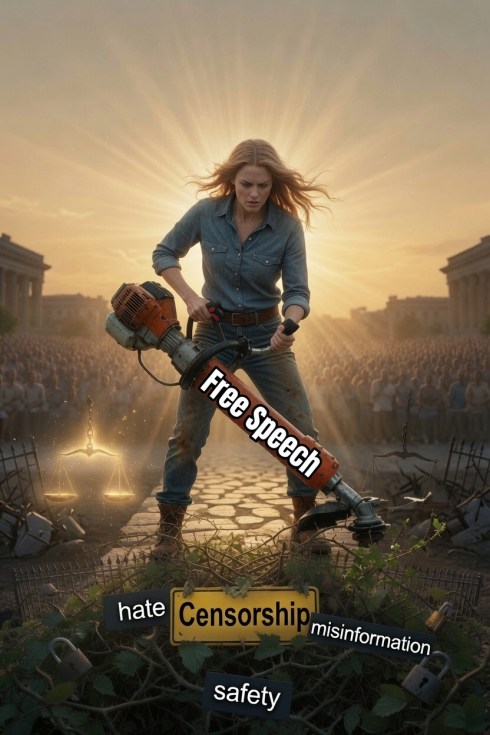
The most useful part of McLaughlin’s framework is her account of the four justifications governments use when they want to censor speech:
- Hate — the claim that some speech is too socially disruptive, cruel, or degrading to be tolerated.
- National security — the claim that dissent, protest, or criticism threatens public safety or the state itself.
- Misinformation — the claim that government must determine truth and suppress what officials judge to be false.
- Children — the claim that protecting minors justifies broad restrictions that often reach adults as well.
Each justification begins with a real concern. Hatred exists. National security threats exist. Falsehoods can cause damage. Children do need protection. But a real problem does not automatically justify broad state control over expression. The question is not whether something ugly, false, dangerous, or harmful can be identified somewhere. Of course it can. The question is whether the proposed cure gives officials power they cannot be trusted to wield honestly, narrowly, or evenly.
Who decides what counts as hate? Who decides when political criticism becomes misinformation? Who decides when national security includes criticism of government policy? Who decides what material is too harmful for children, and how many adult rights must be narrowed in the name of protecting them?
These categories expand because power has an appetite. Hate begins with threats and ends with legal speech recorded by police. National security begins with terrorism and ends with protest signs. Misinformation begins with fraud and ends with dissent from official narratives. Child protection begins with shielding minors and ends with surveillance architecture for everyone.
McLaughlin’s examples cut across partisan comfort zones. She criticizes the UK. She criticizes Hungary. She criticizes American government actions. She criticizes China’s efforts to control not only domestic speech but how the Chinese government is discussed abroad.
That matters because free speech cannot survive as a team sport. If speech rights matter only when our side is speaking, then they are not rights. They are privileges for allies. A serious free speech principle protects the person we dislike, the argument we reject, the protest we think foolish, the religious claim we find absurd, the political claim we find dangerous, and the joke we think cruel.
Not because all speech is good, but because government power becomes more dangerous when it gets to decide which speech is good enough.
The deeper defence of free speech is not merely moral. It is epistemological. Human beings are fallible. Governments are fallible. Experts are fallible. Majorities are fallible. Institutions are fallible. Every society needs some way to discover error before error becomes policy, dogma, or law.
Free speech is part of that correction mechanism. It allows citizens to test claims, challenge authority, expose dishonesty, revise beliefs, hear minority viewpoints, and discover what people actually think. Without it, bad ideas do not disappear. They go underground. Official ideas do not become truer. They become safer to repeat. Citizens do not become wiser. They become more careful.
A coerced society may look orderly from a distance, but it does not know itself.
That is why compelled speech is also a problem. Forcing people to repeat approved formulas does not produce conviction. It produces performance. It teaches people which words keep them safe. It rewards dishonesty and calls the result consensus.
A society built on forced agreement may still function for a while, but it cannot correct itself honestly.
McLaughlin’s closing point is the one free speech defenders need to remember: free speech works for everyone, but only if people are willing to protect it for everyone else.
That is the bargain. We protect the speech we hate because one day someone else may hate ours. We defend the dissenter because one day the institution may be wrong. We limit government because one day the people holding power will not be our friends.
Free speech is not a guarantee that public life will be gentle, wise, or pleasant. It is a safeguard against something worse: a society where the state decides which thoughts may be spoken, which questions may be asked, and which truths may be pursued.
Censorship does not always arrive with a censor’s stamp. Sometimes it arrives with kinder language, but that does not make it less dangerous.
Peter Boghossian recently offered a blunt explanation for a pattern that keeps confusing otherwise sensible people: why do parts of the far left reject reforms that would plainly improve public institutions?
Because improvement is not the goal.
His point is simple and ugly. Widespread distrust is not an accidental byproduct of the project. It is the project. Once you understand that, a good deal of otherwise baffling behavior stops being baffling.
Most normal people still assume institutions are flawed but fixable. You identify the problem, apply targeted reforms, restore confidence, and move forward. That model only works if you believe the institution has legitimacy to begin with.
But if you believe the system is oppressive at the root, then reform becomes a threat. Reform stabilizes. It restores credibility. It gives ordinary people a reason to think the institution can work. That, in turn, weakens the deeper claim that the whole structure must be replaced.
That is the real pivot.
When an institution is judged illegitimate in principle, making it function better is not progress. It is betrayal.
You can see this logic across multiple domains.
Take policing. There are decades of incremental reforms aimed at reducing misconduct and increasing accountability: body cameras, improved training, procedural reforms, better supervision, smarter deployment. None of these require abolishing the institution. Yet much of the activist energy after 2020 did not center on reform but on delegitimization: defund, abolish, systemic rot. The point was not to make policing more trustworthy. The point was to make trust itself look naive.
The same pattern appears in universities. The legitimacy problem here is obvious enough that even casual observers can see it. Entire disciplines operate with strikingly narrow viewpoint diversity. The easiest possible trust-building reform would be to widen that range, even modestly. Boghossian’s line about putting “Republicans in sociology departments” works precisely because the ask is so small. If institutional credibility mattered, this would be low-hanging fruit. The refusal to do even that suggests that credibility is not the objective.
The pattern extends further than those two examples. Courts, media, bureaucracies, corporations, elections—again and again, incremental fixes are dismissed as cosmetic. The rhetoric moves quickly from flawed to structural, from structural to systemic, from systemic to irredeemable. Once that move is complete, reform itself becomes suspect. If a change makes the institution more trusted, it is condemned for helping preserve something that, in the activist imagination, deserves to fall.
There is, to be fair, a serious version of the opposing argument. Sometimes institutions really do absorb small reforms in order to preserve larger injustices. In those cases, reform can function as a pressure valve rather than a cure. That argument has force in isolated cases.
Applied universally, it hardens into dogma.
If every institution is corrupt at the root, and every reform is dismissed as insufficient by definition, then no improvement can ever count as evidence. Distrust is no longer a conclusion drawn from performance. It becomes a prior commitment. At that point, the argument stops being diagnostic and becomes theological.
What sharpens Boghossian’s observation is the context in which he made it. He was responding to a discussion about the strategic use of institutional distrust as a political weapon. That matters because the logic is no longer confined to one faction. Different actors now use different language to sell the same underlying message: the system is captured, illegitimate, beyond repair, and unworthy of loyalty. The branding varies. The effect does not.
Delegitimization replaces reform.
And when both ideological extremes converge on the claim that institutions cannot be repaired, the political center—where repair actually happens—begins to disappear. That is not a healthy equilibrium. It is unsustainable.
This also clarifies why evidence-based reform so often fails to persuade true believers. You can show improved outcomes. You can demonstrate lower abuse, better process, stronger accountability, fairer procedures. It will not matter to people whose real argument is not about performance but legitimacy. They are not asking whether the institution is getting better. They are asking whether it deserves to survive.
That distinction matters.
It means reform is still necessary, but not for the reason many assume. Reform is necessary for the persuadable public, for ordinary citizens who still want institutions that work and can still distinguish corruption from legitimacy. It is not likely to win over those already committed to collapse.
It also means the defense of institutions has to be more explicit than many liberals seem comfortable making it. Not blind loyalty. Not sentimental trust. Not a denial of failure. Something firmer than that: flawed, self-correcting institutions are worth defending because the alternatives to reform are usually far worse than reform’s imperfections.
Something always fills the vacuum.
It is rarely better.
Boghossian’s insight matters because it strips away a comforting illusion. Many people still assume everyone in public life is arguing, however bitterly, about how to make institutions function better. They are not. Some are arguing about whether those institutions deserve to exist at all.
Once you see that clearly, the repeated rejection of easy reforms stops looking irrational. It starts looking strategic.
And strategies aimed at destroying trust cannot be answered by trust alone. They have to be met with reforms that work and with the confidence to say, plainly, that imperfect institutions are still worth defending.

References
Primary source
- Peter Boghossian, X post on institutional distrust and reform. – https://x.com/peterboghossian/status/2041046766351736873?s=20
Suggested supporting references
- Pew Research Center, Public Trust in Government: 1958–2024
- National Academies of Sciences, Proactive Policing: Effects on Crime and Communities
- Cynthia Lum et al., systematic review on body-worn cameras
- Neil Gross and Solon Simmons, The Social and Political Views of American Professors
- Mitchell Langbert et al., research on faculty political imbalance
The question of whether humans possess a “God-shaped hole”—a psychological and social void left by receding religious belief—touches on history, philosophy, and culture. While the topic intersects many debates, this essay focuses on how humans seek meaning, moral structure, and community, and how secular ideologies might fill the space once occupied by traditional faith.
I approach this as a cultural observer, exploring patterns rather than advocating for religious belief. The focus is empirical and interpretive: understanding how belief and moral reasoning manifest in secular societies. Mischaracterizing these dynamics risks polarizing discourse, while careful analysis may illuminate ways societies can channel human propensities constructively.
This discussion operates primarily at the conceptual level—how belief as a cognitive default shapes moral intuitions—and the psychological and cultural outcomes of this tendency, such as meaning-making, accountability, and social cohesion. Institutional or economic factors provide context but are not the central focus.
Critics may argue that humans thrive without religious scaffolding, pointing to highly secular societies with social cohesion or noting that substitutes for belief—wellness culture, fandoms, civic engagement—arise naturally rather than as direct replacements. These perspectives are valid, and the essay explores whether patterns of moral and social organization persist conceptually even as traditional faith declines.
Peter Boghossian’s Substitution Hypothesis frames belief as a cognitive default: “Belief is the default state of the human brain, and when traditional religions decline or fade in a society, other ideologies, dogmas, or delusions inevitably emerge to fill the psychological and social void” (Boghossian, 2025). Secular frameworks can replicate some religious functions: providing moral absolutes, avenues for reflection, and structures for community. Contemporary movements emphasizing systemic justice, identity, and social responsibility may fulfill these functions, echoing familiar moral architectures in secular form.
Evidence for this is nuanced. Western concepts of human dignity, long influenced by religious thought, survive in secular human rights and social equity frameworks (Siedentop, 2014). Cultural self-critique—whether through activism, accountability, or public discourse—reflects enduring moral structures (Holland, 2019). Surveys indicate declining religious affiliation alongside rising ideologies emphasizing collective responsibility (Pew Research, 2021; Gallup, 2021). Counter-evidence reminds us that many social movements were religiously inspired, and that some highly secular societies maintain cohesion without adopting comparable secular “faiths.” Correlation does not prove causation, yet patterns of moral and social organization are notable.
The Substitution Hypothesis offers a lens for exploration: humans may retain a conceptual and emotional predisposition toward belief and moral structure. Whether or not a literal “God-shaped hole” exists, secular societies appear to develop functional substitutes for faith, consciously or unconsciously. Recognizing these patterns invites reflection: can societies deliberately cultivate moral and cultural frameworks that fulfill human needs without resorting to dogmatism or ideological rigidity? The answer may guide the design of resilient and ethically coherent communities in the modern secular era.

References
- Boghossian, P. (2025). Abandoning God: The Rise of Secular Orthodoxy and Cultural Decay. Substack. https://boghossian.substack.com/p/abandoning-god-the-rise-of-secular
- Gallup. (2021). Religious affiliation in the United States. https://news.gallup.com/poll/1690/religion.aspx
- Pew Research Center. (2021). Religious Landscape Study. https://www.pewforum.org/religious-landscape-study/
- Siedentop, L. (2014). Inventing the Individual: The Origins of Western Liberalism. Harvard University Press.
- Holland, T. (2019). Dominion: How the Christian Revolution Remade the World. Basic Books.
Glossary
- God-shaped hole: A metaphor for an innate human longing for meaning, morality, and community.
- Substitution Hypothesis: The idea that secular ideologies can fill gaps left by declining religious belief, providing moral and social structures.
- Conceptual level: Pertaining to ideas, moral frameworks, and cognitive structures rather than institutions or economics.
- Pluralism: Coexistence of multiple belief systems, ideologies, or social practices in a society.
Before we can decide what is right, we must first know what is true. Yet our culture increasingly reverses this order, making moral conviction the starting point of thought rather than its conclusion. Peter Boghossian, the philosopher best known for challenging ideological thinking in academia, once argued that epistemology must precede ethics. The claim sounds abstract, but it describes a very practical problem: when we stop asking how we know, we lose the capacity to judge what’s right.
Epistemology—the study of how we know what we know—deals with questions of evidence, justification, and truth. It asks: What counts as knowledge? How do we tell when a belief is warranted? What standards should guide our acceptance of a claim? Ethics, by contrast, deals with what we should do, what is good, and what is right. The two are inseparable, but they are not interchangeable. Ethics without epistemology is like navigation without a compass: passionate, determined, and directionless.
The Missing First Question
Socrates, history’s first great epistemologist, spent his life asking not “What is right?” but “How do you know?” In dialogues like Euthyphro, he exposes the instability of moral conviction built on unexamined belief. When his interlocutor claims to know what “piety” is because the gods approve of it, Socrates presses: Do the gods love the pious because it is pious, or is it pious because the gods love it? In that moment, ethics collapses into epistemology—the question of truth must be settled before morality can stand.
This ordering of inquiry—first truth, then virtue—was not mere pedantry. Socrates saw that unexamined moral certainty leads to cruelty, because it allows one to justify any act under the banner of righteousness. He was eventually executed by men convinced they were defending moral order. His death, paradoxically, vindicated his philosophy: without the discipline of knowing, moral zealotry becomes indistinguishable from moral error.
Why Epistemology Matters
Epistemology is not a luxury for philosophers; it is the foundation of all responsible action. It demands that we distinguish between evidence and wishful thinking, between understanding and propaganda. To have a sound epistemology is to have habits of mind—skepticism, curiosity, proportion, humility—that protect us from self-deception.
When those habits decay, moral reasoning falters. Consider the Salem witch trials. The judges sincerely believed they were protecting their community from evil, yet their evidence—dreams, hearsay, spectral visions—was epistemically bankrupt. Their moral horror was real; their epistemic standards were not. The result was ethical disaster.
We see similar failures today whenever moral conviction outruns verification. A viral video circulates online; a crowd declares guilt before facts emerge. Outrage replaces investigation. The moral fervor feels righteous because it’s anchored in empathy or justice—but its epistemic foundation is sand. Ethical action requires knowing what actually happened, not what we wish had happened.
When Knowing Guides Doing
When epistemology is sound, ethics becomes coherent, fair, and humane.
Take the principle “innocent until proven guilty.” It is not primarily a moral rule; it is an epistemic one. It asserts that belief in guilt must be justified by evidence before punishment can be ethically administered. That epistemic restraint is what makes justice possible.
The same holds true in science. Before germ theory, doctors believed disease arose from “bad air,” leading them to act ethically—by their lights—yet ineffectively. Once scientific evidence clarified the true cause of infection, moral duties became clearer: sterilize instruments, wash hands, protect patients. Knowledge refined morality. Sound epistemology made better ethics possible.
John Stuart Mill saw this dynamic as essential to liberty. In On Liberty, he wrote that “he who knows only his own side of the case knows little of that.” Mill’s insight is epistemological but its consequences are ethical: humility in belief breeds tolerance in practice. A society that cultivates open inquiry and debate is not merely more intelligent—it is more moral. For Mill, the freedom to question was not just an intellectual right but a moral obligation to prevent the tyranny of false certainty.
The Modern Inversion: Ethics Before Epistemology
Boghossian’s warning is timely because modern culture tends to invert the proper order. Many moral debates now begin not with questions of truth but with declarations of allegiance—what side are you on? The epistemic virtues of skepticism, evidence, and debate are recast as moral vices: to question a prevailing narrative is “denialism,” to request evidence is “harmful,” to doubt is “bigotry.”
The result is a moral discourse unanchored from truth. People act with conviction but without comprehension, certain of their goodness yet blind to their errors. Boghossian’s point is not that ethics are unimportant but that they cannot stand alone. If we do not first establish how we know, then our “oughts” become detached from reality, and moral judgment degenerates into moral fashion.
Hannah Arendt, reflecting on the moral collapse of ordinary Germans under Nazism, described this as the banality of evil—evil committed not from monstrous intent but from thoughtlessness. For Arendt, the failure was epistemic before it was ethical: people stopped thinking critically about what was true, deferring instead to the slogans and appearances sanctioned by authority. Their moral passivity was the fruit of epistemic surrender.
This same danger confronts us whenever ideology replaces inquiry—when images and narratives dictate belief before evidence is examined. To act justly, we must first see clearly; to see clearly, we must learn how to know.
The Cave and the Shadows
Plato’s Allegory of the Cave captures the enduring tension between knowledge and morality. Prisoners, chained since birth, mistake the shadows on the wall for reality. When one escapes and sees the sunlit world, he realizes how deep the deception ran. But when he returns to free the others, they resist, preferring the comfort of illusion to the pain of enlightenment.
We are those prisoners whenever we take appearances for truth—when we confuse social consensus with knowledge or mistake moral passion for understanding. The shadows dance vividly before us in the glow of our screens, and we feel certain we are seeing the world as it is. But unless we discipline our minds—testing claims, questioning sources, distinguishing truth from spectacle—we remain captives.
The allegory endures because it teaches that the pursuit of truth is not an abstract exercise but a moral struggle. To turn toward the light is to accept the discomfort of doubt, the humility of error, and the labor of learning. That discipline is the beginning of both knowledge and virtue.
Truth as the First Kindness
Epistemology precedes ethics because truth precedes goodness. To act ethically without first grounding oneself in what is true is to risk doing harm in the name of good. Socrates taught us to ask how we know; Mill reminded us to hear the other side; Arendt warned us what happens when we stop thinking; and Boghossian calls us back to the first principle that makes all ethics possible: the honest pursuit of truth.
In an age that rewards outrage over understanding, defending epistemology may seem quaint. Yet it is precisely our only defense against the moral chaos of a world that feels right but knows nothing.
Before we can do good, we must first be willing to know.
Truth, as it turns out, is the first kindness we owe one another.

References
- Arendt, H. (1963). Eichmann in Jerusalem: A Report on the Banality of Evil. New York: Viking Press.
- Boghossian, P. (2013). A Manual for Creating Atheists. Durham, NC: Pitchstone Publishing.
- Boghossian, P. (2006). “Epistemic Rules.” The Journal of Philosophy, 103(12), 593–608.
- Mill, J. S. (1859). On Liberty. London: John W. Parker and Son.
- Plato. (c. 380 BCE). The Republic, Book VII (The Allegory of the Cave). Translated by Allan Bloom, Basic Books, 1968.
- Plato. (c. 399 BCE). Euthyphro. In The Dialogues of Plato, translated by G.M.A. Grube. Hackett, 1981.
- Salem Witch Trials documentary sources: Salem Witch Trials: Documentary Archive and Transcription Project. University of Virginia, 2020.
- Socratic method reference: Vlastos, G. (1991). Socratic Studies. Cambridge University Press.
Author’s Reflection:
This piece was drafted with the aid of AI tools, which accelerated research and organization. Still, every idea here has been examined, rewritten, and affirmed through my own reasoning. Since the essay itself argues that epistemology must precede ethics, it seemed right to disclose the epistemic means by which it was written.
Important debates that people need to hear.
Do you listen to podcasts? I highly recommend you add Conversations with Peter Boghossian to your list. Smart people talking, almost every episode – you can’t help but have some of it rub off on you. :)
We’ve been fighting the post modern bullshit for so long, we forget about the sanctioned evil that is happening right now that isn’t cloaking itself in progressive language and false virtue. Listen to Yasmine Mohammed tell her story about becoming an unperson as she was enslaved into the ‘religion’ we know as Islam.
We end up hurting the most vulnerable people in society when we turn away from empirical evidence and the real world. Listen and enumerate the damage being done to children in the name of ‘combating systemic racism’.











 bleatmop
 Mystro


 Dead Wild Roses
Your opinions…