
You are currently browsing the tag archive for the ‘Identity Politics’ tag.
One key idea behind activist-left identity politics is the ladder of oppression: the more marginalized identity categories a person can claim, the more moral and political weight their speech is assumed to carry.
 The theory has an old philosophical root. In the master/slave dialectic, the subordinate person is said to understand both worlds: his own condition and the world of the master who rules over him. The master, by contrast, often knows only his own comfort, his own assumptions, and the social order that flatters him. From this comes the later activist claim that oppressed people possess a clearer or “truer” insight into reality because they see power from below.
There is a partial truth here. People who live under a system often notice things the comfortable miss. A disabled person may see barriers others walk past. A woman may notice male behaviour men excuse or ignore. A racial minority may recognize social patterns the majority experiences only as normal background noise. Lived experience can expose blind spots.
The problem comes when this insight hardens into hierarchy.
Instead of treating experience as evidence to consider, activist politics often treats identity as authority. The more oppression factors a person can claim — race, sex, gender identity, sexuality, disability, poverty, colonial history — the higher they stand on the moral ladder. Their narrative is then “centred,” while those lower on the ladder are expected to listen, defer, apologize, or stay quiet.
At that point, argument has been replaced by ranking. A weak claim from the approved identity can be protected from criticism, while a strong claim from the wrong identity can be dismissed as privilege, fragility, or harm.
Lived experience matters, but it does not make someone automatically right. Suffering can reveal truths, but it can also narrow vision, sharpen resentment, or turn personal pain into bad policy.
A serious society listens to experience without making identity a substitute for reason. The question still has to be: is the claim true?
Public institutions should be careful with the symbols they elevate.
A government building, school, courthouse, legislature, or public office does not belong to one faction of the public. It belongs to the whole public. That is why its official symbols should remain broad, civic, and restrained. In Canada, that means the Canadian flag and the official provincial or territorial flag.
Those flags are imperfect because the country is imperfect. No national symbol can carry every wound, achievement, grievance, regional difference, or private identity without strain. But an official flag is not supposed to say everything. It marks the common civic space where citizens disagree, argue, vote, work, worship, protest, and live together.
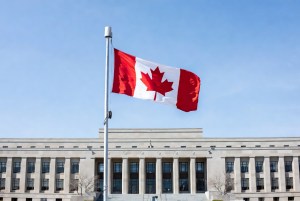 Supporters of additional flags often argue that these displays are not partisan. A Pride flag, for example, may be understood as a message of welcome rather than a political demand. That argument should not be mocked. Many people look to public institutions for reassurance that they belong.
But belonging cannot depend on seeing one’s preferred symbol raised by the state.
Once public institutions begin flying non-official flags, even for sympathetic reasons, they move away from neutrality. The question is no longer whether a particular cause is worthy. Many causes are worthy. The question is whether public authority should place its symbolic weight behind some identities, causes, or movements while declining others.
That creates a problem no institution can manage fairly for long. A flag raised for one group becomes a precedent. A refusal becomes a statement. A commemoration becomes an expectation. The flagpole slowly turns from a civic symbol into a contested notice board.
Canada does not need public institutions sorting citizens by official recognition. It needs shared civic ground.
This does not prevent citizens or private organizations from displaying the symbols that matter to them. A free society should leave people room to speak, assemble, advocate, celebrate, mourn, and disagree. Civil society can be expressive because it is plural. Public institutions should be restrained because they serve everyone.
Institutional neutrality is not indifference. It is a way of keeping public authority from being captured by the pressures of the moment. It tells citizens they do not need to belong to the favoured cause of the day in order to belong in the country.
The Canadian flag and official provincial flags are broad enough for that purpose. They do not erase difference, but they refuse to make difference the first fact of public life.
Let citizens bring their arguments. Let institutions hold the common ground.
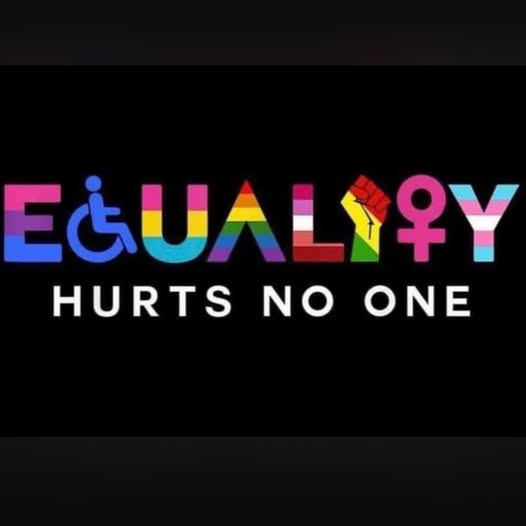
There’s a reason this image works. It uses a word almost everyone agrees with—equality—and then quietly fills that word with something else. The result is not an argument. It’s a substitution.
Look at it closely. The word “EQUALITY” is rendered in bright, appealing colors, layered with symbols of recognizable identity categories: disability, sexuality, gender, race, activism. Beneath it, the slogan: “hurts no one.” At the level of feeling, this is uncontroversial. Of course equality hurts no one. That’s the point of the concept. Equal treatment under the same rules is the baseline promise of any liberal order. But that is not what the image is actually depicting. The text says equality. The visual payload says something else entirely.
Equality, properly understood, is individual and procedural. It asks a simple question: are the same rules being applied to each person, regardless of who they are? It does not guarantee equal outcomes. It does not engineer results. It does not sort people into categories and adjust treatment accordingly. It holds the line at equal standing before the law and equal access to opportunity. That is why it is durable. It does not require constant intervention or measurement. It does not need to know who you are in order to decide how you should be treated.
The imagery in this poster points in a different direction. It is not concerned with individuals. It is concerned with groups. Each symbol represents a category that, within contemporary political frameworks, is treated as requiring not just equal treatment, but differential treatment in order to achieve parity of outcomes. That is the logic behind quotas, preferences, representational mandates, and a wide range of institutional policies now grouped under the umbrella of equity. That distinction matters. Because once you move from equal treatment to managed outcomes, you have to start making choices about who gets what, and why.
This is where the slogan “hurts no one” stops doing honest work. Equality, in the classical sense, really does not hurt anyone. It simply refuses to privilege or penalize based on identity. Equity, by contrast, is not costless. It reallocates opportunities. It lowers or shifts standards in some contexts. It elevates some groups explicitly. That may be justified in specific cases, but it is not neutral, and it is not universally painless. Someone is always paying the adjustment.
The poster resolves this tension through a familiar rhetorical move. It collapses the distinction. By wrapping equity-coded symbols inside the word equality, it invites the viewer to endorse a more controversial framework under the banner of a universally accepted one. The move is subtle enough that many people will not notice it, but strong enough that disagreement can be framed as opposition to “equality” itself. That is not clarification. It is camouflage.
The poster says equality. It is not. And pretending otherwise is not harmless, no matter how bright the colors or how reassuring the slogan.
You can see the tell in the composition. If the message were truly about equality in the classical sense, the image would not need to foreground identity categories at all. It would not need symbols. It would not need color-coding. The entire point of equality is that the categories do not matter when rules are applied. Here, the categories are the point. They are not incidental. They are doing the conceptual work.
None of this means the concerns associated with those categories are trivial or illegitimate. Some are serious. Some are contested. Some are overextended. All of them deserve to be argued on their own terms. But that argument has to be made honestly. It cannot be smuggled in under a word that already carries broad moral agreement.
This is the broader pattern. Take a term with a stable, widely accepted meaning. Expand or alter the underlying concept. Keep the original word. Let the new meaning ride on the old legitimacy. If challenged, collapse the distinction and accuse critics of opposing the original value. It is effective. It is also corrosive.
Words are not decoration. They are load-bearing. If we stop distinguishing between equality and equity, we lose the ability to argue about either of them clearly. And when that happens, policy follows confusion. Decisions get made without admitting what is being traded off, or who is being prioritized. That is not a small failure. It is how serious disagreements get papered over until they break.
The woke left speaks endlessly about colonization, erasure, and the violence of imposing alien categories onto other peoples. Then, on gender, it does exactly that. “Two-spirit” is not a generic synonym for nonbinary or trans. It was coined in a specific Indigenous context, for Indigenous people, to describe realities bound up with particular nations, ceremonial roles, and community obligations. The same is true of hijra, fa’afafine, bissu, and similar roles elsewhere. These are not free-floating proof texts for Western activists. They are culturally embedded forms of life. To strip them out of their own cosmologies and social structures, then redeploy them as evidence for a universal modern gender framework, is not solidarity. It is appropriation with moral vanity attached.
“The people most fluent in the language of decolonization cannot stop subordinating Indigenous meaning to Western identity fashion.”
The same pattern appears in history. Joan of Arc, Chevalier d’Eon, Herculine Barbin, and other ambiguous or unusual figures are routinely conscripted into a modern trans genealogy, as if the past existed chiefly to validate present slogans. But this is not historical recovery. It is retrospective annexation. These people lived inside worlds structured by religion, law, custom, sex, status, and necessity in ways that do not map cleanly onto 21st-century identity language. To force modern labels onto them is not to “see” them at last. It is to erase the terms on which they actually understood themselves. The activist flatters himself that he is rescuing the past from ignorance. In reality he is recolonizing it.
That is the real irony. The people most eager to denounce Western universalism cannot stop universalizing their own categories. The people most fluent in the language of decolonization cannot stop subordinating Indigenous meaning to Western identity fashion. The people most obsessed with “listening to lived experience” routinely ignore living communities when those communities resist being folded into the approved script. This is not liberation. It is a familiar imperial habit in progressive costume: take what is particular, local, sacred, and historically bounded, flatten it into an abstract category, and then call the theft inclusion.

John of Arc
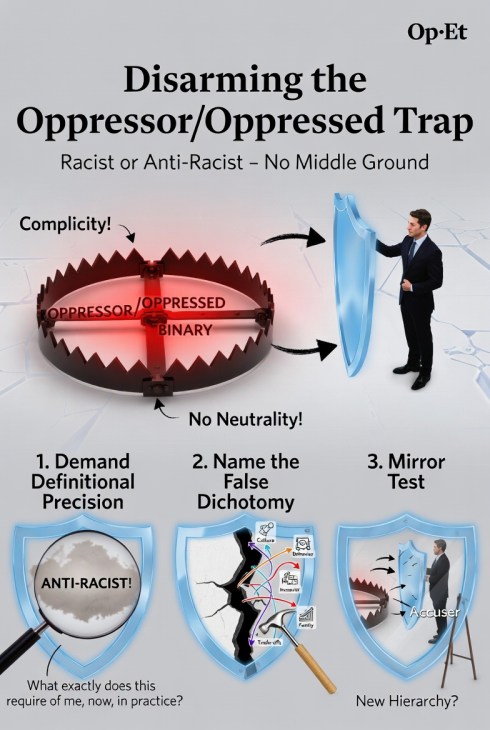
One of the most manipulative habits in contemporary politics is the oppressor/oppressed binary. It takes a complicated society, flattens it into a morality play, and assigns everyone a role before the argument even begins. You are not allowed to be a citizen, a skeptic, or simply a person trying to judge a claim on its merits. You must be either a resister of oppression or an accomplice to it. There is no middle ground. There is no neutrality. There is only confession or guilt.
This is the logic behind slogans like Ibram X. Kendi’s claim that the opposite of racist is not “not racist,” but “anti-racist.” It sounds brave and morally serious. In practice, it is a trap. It abolishes the possibility that a person can reject racism while also rejecting activist dogma, racial essentialism, or race-based policy. Once the slogan is accepted, disagreement itself becomes incriminating. Silence is violence. Skepticism is fragility. Restraint is complicity. The argument is rigged before it starts.
That is what makes the framework so effective. It does not persuade. It corners. It takes a difficult moral and empirical question and turns it into a loyalty test. Once that move is made, debate stops being a search for truth and becomes a public sorting ritual. On affirmative action, immigration, policing, school curricula, crime, history, or speech, the details matter less than whether you submit to the script. You are not judged by the quality of your reasoning. You are judged by whether you have signalled the right side.
The first way to break the trap is to demand definitional precision. Ask the simplest possible question: what, exactly, does “anti-racist” require of me here, now, in practice? What specific belief, action, or policy would prove that I am not complicit? Force the slogan to cash itself out. This matters because many activist terms draw their power from strategic vagueness. They sound morally elevated precisely because they are never pinned down. Once pinned down, they often expand into endless duties of confession, endorsement, and ideological retraining. When the standard can never be met, the point is no longer moral clarity. The point is obedience.
The second move is to name the false dichotomy. Calmly, but without apology. The binary assumes that every disparity is evidence of oppression and that every refusal to endorse the preferred remedy is therefore collaboration with injustice. But reality does not work that way. Human beings are not made of one motive. Institutions do not produce one kind of outcome. Policies have trade-offs. Causes are mixed. Incentives matter. Culture matters. History matters. Family structure matters. Behaviour matters. Human variation matters. A worldview that permits only one explanation is not morally deep. It is intellectually cheap.
“The point is no longer moral clarity. The point is obedience.”
Complexity starts to look like cowardice. Nuance starts to look like betrayal. Evidence that cuts against the preferred story is dismissed as harm. The framework protects itself the way bad frameworks always do: by treating every challenge as proof that the challenge was necessary.
The third move is the mirror test. If disagreement with your theory makes someone morally tainted, what exactly are you doing to dissenters? If refusal to use your language, endorse your policies, or accept your metaphysics makes a person an oppressor, then you have not abolished domination. You have redistributed it. You have built a new moral hierarchy with yourself at the top and everyone insufficiently converted beneath you. The names have changed. The structure has not.
This is why the binary feels so powerful. It flatters the speaker while shaming the listener. It offers moral clarity without the inconvenience of evidence. It turns political disagreement into a purity test and ordinary citizens into suspects. That is intoxicating, especially for people who enjoy the feeling of righteousness more than the discipline of thought.
Racism is real. Injustice is real. But so is the danger of any framework that treats disagreement as guilt and complexity as sin. Liberalism was built on the harder truth that citizens will differ, causes will be mixed, and power must be restrained even when exercised in the name of virtue. The oppressor/oppressed binary rejects that discipline. It wants a world of permanent accusation, permanent sorting, and permanent moral theatre.
Do not argue inside that trap. Do not accept the role of defendant in someone else’s catechism. Ask for definitions. Expose the binary. Turn the logic back on itself. The moment a moral framework abolishes the right to dissent, it has stopped being a tool of justice and become a costume for power.
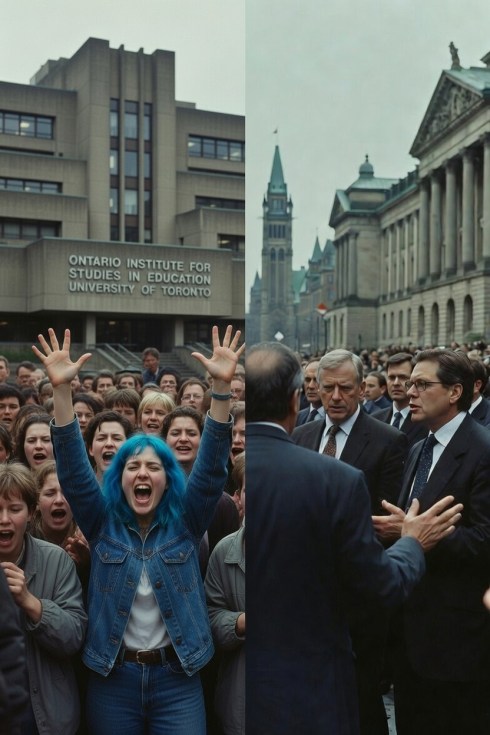
The Ontario Institute for Studies in Education at the University of Toronto is hosting its 13th annual decolonizing conference from March 12 to 14, 2026. The title tells you plenty: Colonial Ruptures: Unmasking Ongoing Coloniality and Fostering Counter Insurgency, Resistance and Liberatory Possibilities. The event materials describe a gathering of scholars, activists, educators, artists, Elders, and community leaders committed to critical reflection, collective action, and “decolonial futures.” They speak of resisting “global capital extractivism and supremacist thinking,” rejecting “colonial binaries,” and advancing liberatory possibilities. This is not an outside caricature. It is the institution describing itself.
That matters because OISE is not a fringe collective borrowing university space for a weekend. It is one of the country’s most influential faculties of education, and CIARS is one of its public-facing centres. A conference like this does not define every part of OISE, but it does reveal a real moral and intellectual current inside one of Canada’s most important teacher-forming institutions. When an institution like that adopts the language of rupture, insurgency, resistance, and decolonial struggle, critics are entitled to ask a basic question: is this education in the ordinary civic sense, or ideological formation dressed in educational language?
To be fair, proponents would say the purpose is not social fragmentation but repair. They would say decolonizing education means confronting historical blind spots, taking Indigenous and anti-racist perspectives seriously, and widening the moral vocabulary of the classroom. Fine. That case should be acknowledged. But public language still matters. When a flagship faculty of education foregrounds coloniality, rupture, counter-insurgency, and resistance, it signals something more than curricular broadening. It signals an adversarial posture, even when softened by the language of care, solidarity, and reimagined futures.
That is the real concern. The problem is not that Canada’s injustices are being taught. A serious country should teach its history honestly. The problem is that teacher formation may be drifting toward a framework in which critique stops being a tool of civic improvement and becomes the default grammar through which the society itself is read. In theory, decolonial approaches and core educational goals can coexist. In practice, the public-facing language here suggests a hierarchy of concerns in which ideological critique increasingly outranks institutional competence, shared citizenship, and academic pluralism.
“What the public sees is not repair but drift: a professional class fluent in rupture and resistance while the country struggles to do ordinary things well.”
People notice that shift because they are already living inside a country under strain. Canada has struggled with weak productivity for years. The OECD’s 2025 survey says the outlook was worsened by trade uncertainty and tariffs, projects a decline in GDP from the second quarter of 2025 because of falling exports to the United States, and devotes sustained attention to the problem of raising business-sector productivity. Housing is worse. CMHC said in 2025 that restoring affordability to 2019 levels would require roughly 430,000 to 480,000 new housing units per year until 2035, about double the recent pace. That is not ideological spin. It is the national housing agency saying the country is not building nearly enough homes.
So people look around and see weak productivity, punishing housing costs, trade pressure, strained public capacity, and thinning civic confidence. Then they watch elite educational institutions pour moral energy into conferences on colonial rupture and liberatory counter-insurgency. The disconnect is hard to miss. Citizens who want functional schools, affordable homes, competent government, and some residue of common national identity are told, again and again, that the deeper task is deconstruction. Not reform. Not competence. Deconstruction.
That is one reason disillusionment has grown. The problem is not honest history. It is not the inclusion of neglected perspectives. The problem is that “decolonizing” has become, in practice, a legitimating language for ideological sorting. It shifts attention away from what institutions are for and toward the moral drama of permanent critique. In education, that is a serious danger. A teacher should be equipped to help students read, write, reason, deliberate, and live with others in a shared society. If the training environment increasingly teaches that the shared society itself is morally suspect at the root, the civic consequences are unlikely to be good.
Canada does not need amnesia. It does not need self-flattery either. But it also does not need a professional class trained to interpret the country chiefly through the grammar of oppression, rupture, and resistance. A society held together by trust, inheritance, and common rules cannot sustain indefinite elite suspicion toward its own foundations. If public institutions want to recover legitimacy, they will have to rediscover a language of citizenship, competence, pluralism, and shared belonging. Until then, more Canadians will keep feeling that the country they were told to love is being taught to despise itself.
References
OISE / CIARS conference page
https://www.oise.utoronto.ca/ciars/ciars-2026-xiii-decolonizing-conference-1
OISE / SJE newsletter page on the conference
https://www.oise.utoronto.ca/sje/newsletter/march-2026/CIARS-newsletter-conference
OISE February 2026 conference notice
https://www.oise.utoronto.ca/home/sje/newsletter/february-2026/CIARS-conference
CIARS centre page
https://www.oise.utoronto.ca/ciars
CMHC housing supply report page
https://www.cmhc-schl.gc.ca/professionals/housing-markets-data-and-research/housing-research/research-reports/accelerate-supply/canadas-housing-supply-shortages-a-new-framework
CMHC housing supply gap explainer
https://www.cmhc-schl.gc.ca/observer/2025/updating-canada-housing-supply-shortages-new-housing-supply-gap-estimates
CMHC news release on housing supply gaps
https://www.cmhc-schl.gc.ca/media-newsroom/news-releases/2025/cmhc-releases-latest-housing-supply-gaps-report
OECD Economic Survey of Canada 2025
https://www.oecd.org/en/publications/2025/05/oecd-economic-surveys-canada-2025_ee18a269.html
OECD full report
https://www.oecd.org/en/publications/2025/05/oecd-economic-surveys-canada-2025_ee18a269/full-report.html
OECD chapter on raising business-sector productivity
https://www.oecd.org/en/publications/2025/05/oecd-economic-surveys-canada-2025_ee18a269/full-report/raising-business-sector-productivity_443bcd88.html
Glossary
Decolonizing
A broad academic and political term for efforts to challenge ideas, institutions, and practices seen as shaped by colonial power.
Coloniality
The claim that power structures formed under colonial rule can persist long after formal colonial administration ends.
Counter-insurgency
Traditionally, efforts to resist or suppress insurgent movements. In academic settings it is often used metaphorically, which is part of why it sounds so militant.
Colonial binaries
Simple oppositions said to come out of colonial thinking, such as colonizer/colonized or civilized/uncivilized.
Liberatory
A term used to describe ideas or practices aimed at freeing people from oppression or domination.
Extractivism
An economic model focused on intensive resource extraction, usually criticized for environmental damage or unequal power.
Academic pluralism
The principle that higher education should make room for genuine intellectual diversity rather than one dominant ideological framework.
Civic order
The shared rules, institutions, and habits that allow people with real differences to live together in one political community.
Collin May has published a long, ambitious essay in the C2C journal (Hearts of Darkness: How the Left Uses Hate to Fuel its 21st Century Universal Imperium) on cancel culture, “hate” rhetoric, and the modern left’s moral posture. It is broader than I would write, more philosophical than most readers will tolerate, and occasionally overbuilt. But it names a pattern that matters, and one I return to often here: once “hate” becomes a universal accusation, institutions stop persuading and start policing.
May’s most useful contribution is not just the complaint (“cancel culture exists”) but the mechanism: “hate” stops being a moral description and becomes a category that pre-sorts who may be argued with and who may simply be managed.
That is the issue.
Not whether hatred exists. It does. Not whether some speech is vicious. It is. The issue is what happens when “hate” becomes the default label for disagreement, skepticism, refusal, dissent, or plain moral and factual judgments that cut against elite narratives.
At that point, the term stops describing and starts doing administrative work.
You can watch this happen across the institutions that shape public life: media, HR departments, professional bodies, universities, bureaucracies, and the expanding quasi-legal space around speech regulation. The sequence is familiar. Someone raises a concern about policy, ideology, language rules, school programming, medical ethics, public safety, immigration, religion, or sex-based rights. Instead of answering the argument, the institution reframes the speaker. Not wrong—harmful. Not questioning—spreading hate. Not participating in democratic friction—a threat to social order.
That move changes the rules of engagement. A wrong claim can be debated. A “hateful” claim can be quarantined. Once a claim is reclassified as harm rather than argument, the institutional response changes with it: less rebuttal, more restriction.
This language matters because it is not only moral language. It is managerial language. It justifies deplatforming, censorship, professional discipline, reputational destruction, and exclusion from ordinary civic legitimacy. It creates a class of people whose arguments no longer need to be answered on the merits. It also trains bystanders to confuse moral panic with moral seriousness.
May explains this through a large historical and philosophical genealogy. Fair enough. I am less interested in the full genealogy than in the practical result in front of us. In plain terms: the rhetoric of “hate” is often used to centralize authority in institutions that no longer trust the public and no longer feel obliged to reason with them.
That is one reason trust keeps collapsing.
People can live with disagreement. They can even live with policies they dislike. What they do not tolerate for long is being handled—being told their questions are illegitimate before they are heard. Once citizens conclude that institutions are using moral language as a shield against scrutiny, every future statement gets discounted. Even true statements are heard as spin.
And then the damage compounds. If “hate” is defined so broadly that it includes dissent, genuinely hateful speech becomes harder to identify and confront. The category gets inflated, politicized, and cheapened. Meanwhile, ordinary democratic disagreement becomes harder to conduct without professional or social risk.
That is not a confident free society. It is a managerial one.
Canada is not exempt. We have our own versions of this habit: speech debates reframed as safety debates, policy criticism recoded as identity harm, and public disputes (including over schools, sex-based rights, and even routine civic rituals like land acknowledgements) routed through tribunals, regulators, HR offices, and media scripts instead of open argument. The details vary by case. The mechanism does not. This tactic is not unique to one political tribe, but it is now especially entrenched in progressive-managerial institutions, which is precisely why it has so much reach.
The answer is not to deny hatred exists, or to become casual about cruelty. The answer is to recover civic discipline.
Name actual incitement when it occurs. Enforce existing laws where there are real threats, harassment, or violence. But stop using “hate” as a catch-all for disfavoured views. Stop treating condemnation as a substitute for evidence. Stop teaching institutions that the way to win an argument is to disqualify the speaker.
May quotes Pope Francis on cancel culture as something that “leaves no room.” Whether or not one follows his full historical argument, that phrase captures the operational problem.
A liberal society cannot function if citizens are only permitted to disagree inside moral boundaries drawn in advance by bureaucrats, activists, and legacy media.
The test is simple: can a claim be examined without first being moralized into silence?
If the answer is no, that is not moral confidence. It is institutional insecurity backed by power.
That is the pattern worth naming. And that is why essays like May’s, even when they overshoot, remain worth reading.

References
Collin May, “Hearts of Darkness: How the Left Uses Hate to Fuel its 21st Century Universal Imperium,” C2C Journal (February 16, 2026), https://c2cjournal.ca/2026/02/hearts-of-darkness-how-the-left-uses-hate-to-fuel-its-21st-century-universal-imperium/. (C2C Journal)











 bleatmop
 Mystro
 The Arbourist


 Dead Wild Roses
Your opinions…