
You are currently browsing the tag archive for the ‘Islam’ tag.
On June 17, 2026, the Oxford Union debated the motion, “This House Believes the West Is Right to Be Suspicious of Islam.” The Union eventually voted against it, reportedly by 57 votes to 41. That settled the result inside the chamber. It did not settle which side made the stronger argument. (Middle East Eye)
The debate had already become a public spectacle before anyone rose to speak. It had been postponed once, prominent figures had demanded that Tommy Robinson be disinvited, and protesters gathered outside under a substantial police presence. Contemporary reporting described roughly 200 protesters and a much smaller group of Robinson supporters separated by a police cordon. Thames Valley Police later said the demonstrations passed “without significant incident,” although one person was arrested on suspicion of assault. That qualification matters. Speakers inside repeatedly called the scene a riot, spoke of attacks on police, and treated the disorder outside as evidence for their respective positions. The protest was certainly disruptive and hostile, but the more dramatic descriptions outran the police account. (Oxford Union, ITV News)
The disorder was not confined to the street. Inside, speakers were repeatedly interrupted, points of information became vehicles for heckling, personal attacks displaced argument, and several participants treated the chair’s instructions as optional. At one point, the chair explicitly rebuked “unwarranted interjections” from both sides. Having watched several Oxford Union debates, I found this one unusually contemptuous of the process it purported to defend.
That does not make it impossible to judge. It does mean that the applause, jeers, and final vote should be separated from the merits of the arguments.
What Was the Motion Actually Asking?
The word suspicious carried nearly the entire debate and was never adequately defined.
It can mean at least two very different things. One meaning is intellectual and institutional: Islamic doctrines, organizations, and political demands should receive careful scrutiny, particularly where they concern civil law, religious liberty, sex equality, free expression, or violence. The other is social and personal: Muslims should be regarded as presumptively hostile or dangerous because they are Muslims.
The first is an ordinary liberal judgment about ideas and institutions. The second is collective suspicion applied to human beings. The proposition was strongest when defending the first meaning and weakest whenever it slipped toward the second. The opposition was strongest when condemning the second and weakest when pretending that doing so had answered the first.
I therefore judged the speakers by five questions:
- Did they address Islam as a body of beliefs rather than treating Muslims as a single collective?
- Did they distinguish Islam, Islamism, Muslim-majority governments, and individual Muslims?
- Did their evidence support the level of the claim being made?
- Did they answer the strongest opposing argument?
- Did they respect the conditions that make debate possible?
The Proposition
Oliver “JL” Jones-Lyons
Jones-Lyons opened with the most useful framing available to the proposition. Islam, he argued, is not merely a set of private devotional practices. It contains political and legal claims that can conflict with equal citizenship under secular law. He pointed to jizya, apostasy, the status of non-Muslims, the operation of Sharia, and the record of Muslim-majority states. His underlying question was sound: when a religion makes claims about how the state should govern, why should those claims be exempt from the scrutiny applied to any other political programme?
His weakness was the distance between his evidence and some of his generalizations. Quoting violent passages without adequately resolving their historical and interpretive context did not establish what all Muslims believe. Practices in Muslim-majority countries are relevant, but they do not automatically reveal what Islam must produce everywhere. His assertion that Islam is uniquely totalizing also needed comparison rather than declaration.
His ceremonial roast of the opposing bench was consistent with Oxford Union tradition and relatively mild. Once the argument began, he mostly stayed on the motion. As an opening speaker, he gave his side a coherent burden and largely met his procedural responsibilities.
Tommy Robinson
Robinson’s strongest material concerned concrete moral conflicts. He asked the chamber to consider Islamic teachings and state practices involving homosexuality, adultery, apostasy, child marriage, religious minorities, and the example of Muhammad. His central contention was not merely that extremists commit atrocities, but that some of them appeal to recognized scriptures, legal schools, and episodes from Muhammad’s life. Telling the victims that the perpetrators misunderstood Islam does not, by itself, explain why those interpretations recur or why they acquire legal force in multiple countries.
This was a legitimate challenge, and the opposition never fully answered it. It showed that alternative interpretations exist, but it frequently treated the existence of a benign interpretation as proof that the harsher one was inauthentic.
Robinson nevertheless weakened his own case through overstatement. He moved too easily between sacred texts, medieval jurisprudence, contemporary governments, terrorist groups, and Muslims living in Britain. Graphic examples generated moral force, but the accumulation sometimes replaced the causal work needed to connect those examples to Islam as a whole. He also brushed aside legitimate contextual questions with some version of “argue with the countries doing it,” which answered the practical horror without answering the theological dispute.
His conduct was mixed. He began by praising the Union president for defending free speech and congratulated Aisha Khan-Aziz on her speech. He was also frequently interrupted. At the same time, he repeatedly interrupted others, declined points of information while complaining about the responses he received, and personalized his disagreement with Rees-Mogg by contrasting their constituencies and circumstances. Robinson supplied serious evidence, but delivered it in a manner that often invited heat where precision was needed.
Laurence Fox
Fox tried to rehabilitate suspicion as prudence rather than hatred. He argued that human beings routinely use suspicion to recognize danger and cited polling on British Muslim attitudes toward Sharia, religious schools, face coverings, violence in defence of religion, and depictions of Muhammad. His free-speech argument was his strongest: a liberal society has reason to resist any demand that religious prohibitions bind people who do not accept the religion.
Unfortunately, he opened by comparing the present dispute to Chamberlain’s appeasement of Hitler. The analogy inflated the conclusion before he had established the premises. His broader claim that Islam offers no possibility of peaceful coexistence was contradicted by texts and history introduced by the opposition, even if those counterexamples did not establish that Islamic history was consistently tolerant.
The threatened display of a cartoon of Muhammad was the evening’s clearest substitution of theatre for argument. Fox ultimately revealed that the envelope contained nothing, using the chamber’s tension as evidence of fear. The stunt illustrated that fear exists, but not whether it was caused by Islamic doctrine, the protesters outside, Fox’s own appetite for provocation, or some combination of the three. His sarcasm, Nazi analogy, and talk of an “oversensitive sky wizard” turned a defensible free-speech argument into a performance of contempt.
Jonathan Sacerdoti
Sacerdoti gave the proposition its strongest concrete case. He began with the Manchester Arena security guard who noticed Salman Abedi but hesitated to raise the alarm for fear of being called racist. He then traced the human cost of Islamist violence and blasphemy enforcement through Salman Rushdie, Theo van Gogh, Charlie Hebdo, Lee Rigby, terrorist attacks in Britain, the intimidation of teachers, and violence directed at Jews and apostates. He also moved beyond terrorism to the Muslim Brotherhood and its political strategy.
His most important challenge to the opposition was the asymmetry of attribution. Charitable activity by Muslims was presented as evidence of Islam’s goodness, while crimes committed by people explicitly invoking Islamic authority were declared unrelated to Islam. A fair analysis cannot accept religious causation only when the outcome is attractive.
Sacerdoti still leaned too heavily upon a catalogue of horrors. A perpetrator’s invocation of Islam is evidence of motivation, but it does not establish that his interpretation is representative, unavoidable, or doctrinally correct. Sacerdoti occasionally collapsed Islam, Islamism, and violent Muslims into one actor—“Islam” doing things—when the argument required more exact attribution.
He was more controlled than several speakers, although his questioning of whether the president remained Muslim after offering wine was a personal theological jab, and his speech was punctuated by sharp interjections. Even with those faults, he connected doctrine, political organization, intimidation, and violence more successfully than any other proposition speaker.
Leon Styles
Styles offered the cleanest liberal formulation of the proposition. Muslims, he said, are not lesser citizens and deserve no fewer rights, less dignity, or less freedom. Ideas, however, possess no right to immunity. Islam includes legal, political, and social prescriptions, and citizens have a responsibility to examine any doctrine that seeks influence over law, education, morality, or public institutions.
That distinction was the conceptual centre of the entire debate. Suspicion of an idea is not hatred of a person, and criticism of a doctrine is not persecution of its followers.
Styles’ weakness was that he sometimes changed “right to be suspicious” into “right to question.” The opposition correctly observed that having a right to scrutinize Islam does not prove that suspicion is justified. His references to Islamist terrorism and institutional reluctance to investigate grooming gangs were meant to close that gap, but the causal connection between Islam and the particular criminal networks was asserted more confidently than it was demonstrated.
His conduct also spoiled an otherwise disciplined speech. He insinuated that Abdullah al-Andalusi was a fan of Osama bin Laden, was instructed to withdraw, and then said he would leave the judgment to the audience. “That was not a genuine withdrawal; he formally retracted the accusation while preserving its insinuation.” Still, Styles stated the proposition’s defensible meaning more clearly than anyone else.
The Opposition
Aisha Khan-Aziz
Khan-Aziz opened with the opposition’s strongest moral concern: suspicion applied collectively can produce injustice. She pointed to detention without charge, anti-Muslim violence, and the fact that Muslims are the principal victims of Islamist terrorism. She also emphasized the contested character of Islam and argued that the West is not a completed or morally spotless civilization entitled to judge another from a position of innocence.
Those arguments establish the danger of collective guilt. They do not establish that Islamic doctrines or movements should escape suspicion. Her crucial move was to transform suspicion of Islam into suspicion of herself “before I even open my mouth.” That was rhetorically effective but logically evasive. Ideas can be scrutinized without assigning guilt to every person who identifies with them.
Her introduction also contained some of the debate’s clearest ad hominem attacks. She attributed Jones-Lyons’ position to resentment over Muslim candidates, called Robinson’s followers hooligans, mocked Fox’s electoral and professional failures, and treated Sacerdoti’s presence beside Robinson as morally compromising. The Union’s roast tradition explains some of the humour, but it does not excuse motive attribution offered in place of rebuttal.
Her most revealing line was directed at Robinson: without the protection of the Muslim president and mostly South Asian committee, she said, the crowd outside would have left him “quite literally cooked.” The line was meant to demonstrate Muslim generosity. Instead, it used the threat presented by a hostile crowd as a boast while arguing that suspicion was irrational. It did not justify suspicion of Muslims generally, but it inadvertently strengthened the case for vigilance toward movements that answer criticism of Islam with intimidation.
Michael Doward
Doward supplied the opposition’s most human testimony. Speaking as a Muslim from Luton, he described mosques rejecting extremists, Muslim charities serving elderly white residents, and ordinary Muslims motivated by their faith to become better neighbours, parents, doctors, nurses, and volunteers. His best point concerned asymmetric attribution: critics often blame Islam for a Muslim’s crimes while refusing to credit Islam for a Muslim’s charity.
That is a useful warning against motivated reasoning. It is not a sufficient answer to the motion. Kind Muslims and generous Islamic charities can coexist with objectionable doctrines and dangerous movements. Doward’s anecdotes rebutted a caricature of Muslims as uniformly hostile, but the motion concerned Islam.
He devoted an extraordinary amount of his speech to Robinson’s biography, credibility, residence, football associations, and account of Luton. At one point he said he did not mind “taking out” the opposing bench, later explaining that he meant defeating them in debate and withdrawing the language. The misunderstanding was avoidable. He also told the proposition that it lacked the expertise to discuss reform of Islam, a claim difficult to reconcile with a debate supposedly demonstrating Islam’s openness to criticism. Doward was sincere and occasionally moving, but he answered a social portrait with a counterportrait rather than evaluating the belief system at issue.
Arwa Elrayess
Elrayess, the Oxford Union president, delivered the opposition’s strongest speech. She placed violent Quranic passages in their immediate context, distinguished war against treaty-breakers from a universal command against unbelievers, defended non-coercion through other passages, and cited Islamic precedents for coexistence. She then moved from scripture to contemporary British Muslim attitudes, counterterrorism cooperation, and the destructive consequences of policies that treat Muslims categorically as suspects.
She also did something several opposition speakers avoided: she acknowledged serious problems within Muslim communities and the reality of the grooming-gang scandals. This made her argument more credible than a blanket denial would have been.
Her case nevertheless depended heavily upon a “not true Islam” escape hatch. Terrorists, states, and communities invoking Islamic sources were repeatedly declared mistaken or non-Muslim, while her preferred readings were treated as Islam itself. Showing that a tolerant interpretation exists is important. Showing that it is the only authentic interpretation requires much more than assertion, particularly when rival interpretations have persisted through recognized schools, institutions, and governments.
Her treatment of grooming-gang evidence also blurred categories. Statistics covering child sexual offending generally do not, by themselves, answer questions about particular forms of group-based exploitation. Class contempt may explain institutional indifference toward the victims without excluding cultural, ethnic, or religious factors among perpetrators. Multiple causes can operate at once.
Elrayess ended by returning to personal motives, portraying the proposition as wealthy men seeking to own public anger and persuade Britons that their neighbours were enemies. That was powerful advocacy, but it again answered a theory about the speakers’ intentions rather than their strongest arguments. Her speech did the most to narrow the proposition, but it did not defeat its liberal form.
Abdullah al-Andalusi
Al-Andalusi offered the opposition’s most substantial doctrinal rebuttal. He argued that religions must be judged through their teachings rather than every act committed by an adherent. He cited Quranic opposition to compulsion, Islamic limits upon killing non-combatants, historical examples of Christian critics writing under Muslim rule, and classical scholars who rejected violence against civilians. His explanation of how Osama bin Laden departed from traditional rules of war directly challenged the claim that Islamist terrorism follows straightforwardly from Islam.
This was relevant evidence. It demonstrated that peaceful and pluralistic Islamic resources are real rather than modern inventions created solely for Western audiences.
He also made several damaging detours. Beginning with Jewish criminals created a false comparison: the proposition was discussing perpetrators who invoked religious authority, not merely criminals who happened to share an identity. Attributing Muslim-world persecution of homosexual conduct to exported Victorian categories did not answer the existence of contemporary punishments defended in Islamic terms. His attempt to turn bin Laden’s “live and let live” remark into evidence for a restrained Islamic position was unnecessarily provocative and gave a mass murderer more interpretive charity than he extended to the proposition.
Al-Andalusi also accused the opposing bench of supporting ethnic cleansing, then withdrew when challenged because the people he cited were not participants in the debate. He repeatedly exceeded his time and resisted the chair’s instructions to conclude. His speech contained valuable scholarship, but its lack of discipline made the valuable parts harder to credit.
Sir Jacob Rees-Mogg
Rees-Mogg presented the opposition’s most genuinely liberal alternative. The West, he argued, should possess enough confidence in its institutions to welcome Muslim citizens without fearing Islamic conquest. Islamic civilization has contributed to Western knowledge, Britain maintains one civil law, and voluntary religious tribunals cannot supersede the courts. Equal citizenship and constitutional strength, rather than collective suspicion, were his answer.
This was an important corrective to the proposition’s occasional alarmism. A confident liberal order does not panic because some citizens hold illiberal beliefs. It protects their rights while enforcing common laws.
Confidence, however, is not evidence that institutions will always perform their stated function. The debate itself concerned examples in which fear of offence, accusations of bigotry, or political pressure may have weakened enforcement. Saying that Parliament will never enact Sharia does not answer narrower pressures involving blasphemy norms, parallel arbitration, sex equality, school policy, or selective policing. Nor do Islam’s historical contributions disprove reasons for suspicion of some Islamic doctrines. A civilization can preserve manuscripts and also enforce religious hierarchy.
Rees-Mogg began with unusual generosity toward his opponents and defended the decision to let Robinson speak. He later called the proposition cowardly, weak, “wet wipes,” and “desperate old pinkos.” The insults were delivered with comic polish, but polish does not turn contempt into argument. His closing appeal to Christianity explained his confidence in the West more than it answered the case concerning Islam.
When Disrespect Became a Method
Both sides mistreated the process, but they tended to do so differently.
The proposition relied more heavily upon provocation. Fox’s empty-envelope stunt, repeated comparisons to fascism, graphic descriptions, sarcastic interjections, and Styles’ insinuation about bin Laden were designed partly to elicit outrage. Several proposition speakers seemed intent upon demonstrating that Islam could not tolerate criticism, occasionally behaving as though making the room angry would prove the thesis.
The opposition relied more heavily upon delegitimization. Some speakers attributed the proposition’s case to racism, careerism, resentment, financial interest, ignorance, or a desire to scapegoat Muslims before fully addressing the claims being made. They repeatedly changed criticism of Islam into hostility toward Muslims, allowing the moral ugliness of collective suspicion to contaminate arguments directed at doctrine.
Both sides interrupted excessively. Speakers ignored declined points of information, used points of order to continue arguments, resisted time limits, talked over one another, and appealed to the audience while the chair attempted to restore order. The opposition cannot claim that robust criticism of Islam is welcome while people protesting the event attempt to obstruct it or speakers inside treat contrary arguments as moral contamination. The proposition cannot claim special devotion to rational inquiry while using theatrical provocation and personal insinuation as substitutes for careful attribution.
Debate requires no reverence for the ideas under examination. It does require enough procedural respect for an opponent to finish a sentence and enough intellectual charity to answer the argument actually offered.
Verdict
The opposition won the vote, 57–41. On the argument presented, however, the proposition made the stronger case.
That judgment requires a carefully limited definition of the motion. If “suspicious of Islam” means treating Muslims as presumptively dangerous, the opposition wins decisively. Collective guilt is illiberal, empirically crude, and morally indefensible. Muslims are individuals, not vessels carrying a single political programme.
If suspicion means heightened scrutiny of a powerful body of religious, legal, and political ideas, the proposition wins. Its speakers established that Islamic sources and traditions contain more than private spirituality. They include claims about law, governance, apostasy, sexuality, religious hierarchy, and the limits of expression. Those claims have not remained theoretical: they appear in states, movements, institutions, and recurring conflicts within Western societies. Not every manifestation can be dismissed as an external corruption without explaining why the corruption repeatedly speaks in Islamic terms and draws upon recognized Islamic materials.
The opposition demonstrated that Islam contains competing resources: charity, pluralism, limits on violence, respect for treaties, and peaceful civic participation. It also demonstrated that most Muslims should not be held responsible for extremists. Those are essential truths. They establish that Islam is contested and that suspicion must be discriminating. They do not establish that suspicion is unwarranted.
Leon Styles gave the proposition its clearest principle, while Jonathan Sacerdoti supplied its strongest concrete case. Arwa Elrayess was the strongest opposition speaker because she combined textual argument with contemporary evidence and acknowledged at least some internal problems. Rees-Mogg offered the most attractive political disposition—confidence rather than panic—but treated institutional confidence as though it eliminated the need for vigilance.
The proposition therefore won narrowly on substance while often losing on discipline. Its better speakers defended scrutiny of ideas without collective guilt. Its worse moments blurred that distinction and indulged provocation. The opposition was more successful rhetorically because it attached the motion to the treatment of Muslim neighbours, but too often defeated a position the proposition’s strongest speakers had explicitly disavowed.
The liberal answer is neither civilizational panic nor compulsory reassurance. Muslims are entitled to equal citizenship, religious liberty, and individual judgment. Islam is entitled to no immunity from criticism. Islamist organizations and political demands should be evaluated by the same standards applied to every other movement: one civil law, equal rights, freedom of conscience, freedom of speech, and no collective guilt.
That standard is not hostility toward Muslims. It is the standard that protects Muslims and non-Muslims alike.
Sources
The Oxford Union has released its full debate on the motion:
This House Believes the West is Right to Be Suspicious of Islam.
The recording runs approximately two hours and thirty-seven minutes:
Watch the full Oxford Union debate
I am not going to tell you who won. I will return to the arguments after obtaining the transcript and checking the principal factual claims. For now, here is some context and a handful of questions to keep in mind while watching.
The Speakers
Arguing for the proposition:
- Tommy Robinson, also known as Stephen Yaxley-Lennon
- Laurence Fox
- Journalist Jonathan Sacerdoti
Arguing against:
- Former Conservative MP Jacob Rees-Mogg
- Abdullah al-Andalusi
- Michael Doward
- Oxford Union president Arwa Elrayess
Elrayess replaced scheduled student speaker Laila Nasher, who was unable to enter the building. There were also contributions from the floor.
One institutional clarification: the Oxford Union is an independent private members’ debating society. It is not part of the University of Oxford.
What Happened Outside
The debate was originally scheduled for May 28, 2026, but was postponed until June 17 following considerable opposition to Robinson’s invitation.
Hundreds of protesters gathered outside the Oxford Union on the evening of the debate. Entrances became inaccessible, police established cordons between opposing groups and many ticket-holders were unable to reach the chamber. The debate began roughly ninety minutes late before a substantially reduced audience.
Cherwell reported that the motion was defeated by 33 votes to 30, citing results posted by the Oxford Union. Later reports have circulated a total of 57–41. The motion lost either way, but the conflicting totals and disrupted admission make the vote a poor measure of opinion among the wider membership.
The speeches can still be judged on their merits.
What Does “Suspicious” Mean?
This is the question beneath the question.
Suspicion might mean scrutinizing Islamic scripture and jurisprudence. It could mean monitoring Islamist organizations and political networks. It might describe resistance to religious demands that conflict with civil law. At its widest, it could mean treating Muslims themselves as presumptively hostile.
Those positions are not equivalent, yet the wording allows speakers to move between them.
Try completing the motion whenever someone invokes suspicion:
The West should be suspicious of whom or what, because of which evidence, and therefore do what?
If those blanks are never filled in, suspicion becomes whatever the speaker needs it to mean.
Islam, Islamism and Muslims
The debate also moves among three related but distinct subjects.
Islam is a religion containing scripture, theology, law, history and competing interpretations. Islamism is a political project seeking to organize public authority according to Islamic principles. Muslims are individuals whose beliefs and conduct vary enormously.
Evidence that classical Islamic law contains an illiberal doctrine does not establish that every Muslim accepts or wishes to enforce it. Evidence that many British Muslims support democracy does not answer what Islamic scripture or jurisprudence teaches.
Watch whether the proposition connects doctrine to present belief and conduct. Watch whether the opposition answers the doctrinal claims or substitutes evidence about peaceful Muslims. Both sides have room to evade the hardest version of the argument.
Questions to Keep in Mind
While watching, consider:
- Do the speakers distinguish Islam, Islamism and individual Muslims?
- Are crimes committed by Muslims shown to have a religious cause, or is the connection merely assumed?
- When scripture is quoted, is it presented in context and does the response actually address it?
- Are polls and historical examples representative of the broader claim being made?
- Does either side distinguish criticism of Islam from hostility toward Muslims?
- What policy would follow from each speaker’s argument, and could it be applied under one law while preserving equal citizenship?
A debate rewards confidence, sharp rhetoric and memorable examples. Pay closer attention to whether the speaker has proven the point.
The controversy outside the chamber may tempt viewers to decide what the event represents before hearing it. For some, inviting Robinson was itself an act of hostility. For others, the attempt to prevent the debate confirmed that criticism of Islam is being suppressed.
Neither conclusion tells us whether the arguments made inside were sound.
Listen first. We can sort through the evidence afterward.
Sources
The distinction between Islam and Islamism is useful. Islam is a diverse religion; Islamism is the political project of ordering society and the state according to an assertedly Islamic system. Confusing the two turns every Muslim into a political suspect. Pretending they have nothing important to do with one another, however, requires a different kind of dishonesty.
Islamism also covers more than terrorism or armed jihad. Its adherents may pursue power through political parties, welfare and religious institutions, demands for parallel jurisdiction, pressure for censorship and blasphemy laws, or violence. Those methods are not morally equivalent, but they share the conviction that Islam supplies not merely private belief or moral guidance, but the authoritative framework by which public life should be governed.
A recent New Discourses podcast approaches the issue through Sayyid Qutb’s Milestones, one of the formative texts of modern revolutionary Islamism. In its chapter on jihad, Qutb argues that establishing God’s sovereignty means enforcing divine law and abolishing laws made by human beings. Preaching alone cannot accomplish this because the institutions exercising political and social power will not voluntarily surrender it. Religious proclamation must therefore operate alongside “the movement,” which confronts the material obstacles standing between belief and Islamic rule.
Qutb’s formulation exposes something that polite Western discussion often obscures. Islamism is not merely ordinary authoritarianism wearing an Islamic costume, nor is it an alien ideology arbitrarily grafted onto an otherwise private faith. Its concepts—divine sovereignty, sharia, jihad, the ummah and the exemplary authority of Muhammad and the early Muslim community—are drawn from Islam itself. Islamists may interpret those sources selectively or radically, but they are not citing them by accident.
The argument becomes weaker, however, if Qutb is allowed to speak for Islam as a whole. He was a twentieth-century revolutionary who assembled older Islamic concepts into a modern political program, not the neutral curator of an uncontested tradition. Muslims have produced rival interpretations across centuries, and many today accept religious pluralism and democratic government. Their existence cannot be dismissed as counterfeit belief merely because Qutb would have dismissed it that way.
Nor does recognizing Islamism’s Islamic roots assign collective guilt to Muslims. Ideas have genealogies; people have agency. A Muslim who rejects the coercive political project is not responsible for it simply because an Islamist invokes the same scripture. By the same measure, Islamists cannot be insulated from scrutiny by insisting that any examination of their religious claims constitutes hatred of Muslims.
Both errors serve the extremists. Collapsing Islam into Islamism grants Islamists the status they covet as the authentic representatives of every Muslim. Severing the two protects Islamist doctrine from the criticism applied to every other political ideology.
The classical liberal answer is equal liberty under neutral rules. Muslims possess the same freedom of conscience, worship, speech and political participation as everyone else. What they do not possess—and what no religious or political constituency should possess—is an exemption from laws governing intimidation, obstruction or the use of public space.
Mass public prayer is protected religious expression. If a gathering blocks roads, occupies civic space without authorization or prevents others from exercising their rights, however, the relevant rules should be enforced exactly as they would be against Christians, environmentalists or striking workers. When authorities relax enforcement because they fear communal tension or accusations of prejudice, tolerance has curdled into unequal treatment.
The language surrounding “Islamophobia” presents a related danger. Anti-Muslim hatred and discrimination are real and should be opposed. Islam, however, is a body of religious claims, not a person possessing civil rights. When “Islamophobia” is used to collapse criticism of Islamic doctrine into hostility toward Muslims, it becomes an ideological shield against examination. People are entitled to equal protection; religions are not entitled to protection from criticism.
Militant Islamism is not a hypothetical challenge. Through terrorism, intimidation, blasphemy enforcement and campaigns to subordinate civil law, it has demonstrated its hostility to liberal society. Western nations must confront that threat openly—in policing, security policy and the public square.
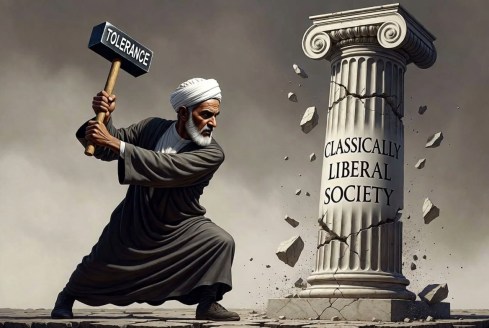
The paradox of tolerance is not a licence to suppress Muslims or peaceful belief. It is a warning that tolerance cannot survive if it grants coercive movements the freedom to destroy the conditions that make tolerance possible. Islamism grows from within Islam; it is neither the whole tree nor a foreign vine. Opposing it without collective guilt requires candour, equal enforcement and the confidence to defend our liberal inheritance.
There are few modern spectacles more interesting than Richard Dawkins speaking warmly about Christianity.
Not converting. Not recanting The God Delusion. Not wandering into Evensong with a softened heart and a sudden interest in incense. But speaking warmly, nevertheless.
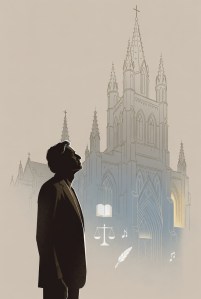 Dawkins has called himself a “cultural Christian.” He remains an atheist, which is what makes the admission interesting. He is not saying Christianity is true. He is noticing that Christianity helped form a civilization in which he could become Richard Dawkins: skeptical, eloquent, publicly irreverent, protected enough to criticize sacred things, and still culturally at home among the ruins and residues of the faith he rejects.
For a long time, many secular Westerners treated Christianity as something they had outgrown. It was old, morally complicated, often hypocritical, and associated with repression, scolding, and bad Sunday mornings. Keep the music, perhaps. Keep the architecture. Keep Christmas, provided no one gets doctrinal about it. The rest could be packed away.
There were reasons for that impatience. Churches persecuted, censored, lied, protected abusers, cozied up to power, and sometimes confused institutional self-interest with the will of God. No honest appreciation of Christian civilization can skip that part. But there is a difference between remembering the failures of an inheritance and forgetting that we inherited anything worth having.
The West was not built from one source. It is a quarrelsome inheritance: Greek reason, Roman law, Jewish moral seriousness, Christian theology, Germanic custom, common law, Reformation fracture, Enlightenment skepticism, scientific inquiry, and the long institutional habit of limiting power. Christianity did not invent every virtue from nothing, but it became one of the great furnaces in which those virtues were universalized, moralized, preached, contradicted, betrayed, and recovered.
Modern liberalism did not merely inherit Christian assumptions and put them in nicer clothes. It built institutions Christianity often resisted: robust free speech, religious disestablishment, broader suffrage, empirical science protected from clerical authority, and legal equality that went well beyond what most Christian societies were willing to grant. Some of the freedoms Dawkins enjoys were made possible by Christian moral inheritance. Others required sharp breaks from dominant Christian practice.
That tension is the point. The West is the product of argument, correction, rebellion, restraint, and institutional memory.
This is what modern secular people often miss. We imagine ourselves as freestanding moral adults. We believe in human dignity, equality before the law, freedom of conscience, care for the vulnerable, suspicion of tyranny, and the right to criticize authority. Fine. Keep all of that. But those commitments have a history. They were not produced by vibes, nor assembled last Tuesday by a committee with a land acknowledgement and a catering budget.
They came through centuries of conflict, doctrine, reform, law, blood, repentance, philosophy, institutional restraint, and exhaustion after too many people had killed each other over ultimate things.
To appreciate that inheritance is not to baptize every part of it. Christendom was not gentle. Christianity often had to be forced into better conduct by dissidents, reformers, scientists, heretics, abolitionists, and Christians reading their own scriptures more honestly than their institutions did. The West’s moral inheritance was not a clean gift. It was an argument, often conducted under pressure.
“The West is the product of argument, correction, rebellion, restraint, and institutional memory.”
But the argument happened inside a civilization shaped deeply by Christianity.
The freedom to doubt, mock religion, publish irreverent books, leave a faith, criticize clerics, and live without being ruled by priests was not inevitable. Nor was the expectation that women may walk unveiled, educated, employed, politically equal, and legally protected. These are achievements produced by particular histories, institutions, and moral restraints.
That is where Dawkins’ comparison with Islam enters the discussion, though it needs care.
The issue is not Muslim neighbours. Millions of Muslims live peacefully, work hard, raise families, keep faith privately, and want the ordinary goods everyone else wants: safety, dignity, friendship, decent schools, and a stable life. A serious argument begins by refusing collective suspicion.
The harder question is what happens when Islamic doctrine becomes politically confident and expects the wider society to accommodate its rules around blasphemy, apostasy, religious offence, sex roles, homosexuality, and public criticism. Outcomes differ by interpretation, education, migration patterns, and host-society confidence, but liberal societies still cannot survive by pretending every moral and legal order is equally compatible with liberal freedom.
Dawkins seems to understand that cultural Christianity has learned to live with disbelief in a way many religious systems have not. The Anglican church may annoy you. It may bore you. It may produce beige sermons, awkward committees, and hymns sung by twelve people spread across a nave built for three hundred. But it is unlikely to demand the state punish you for mocking it, which is not a small thing.
“But criticism without gratitude curdles into contempt, and contempt is a poor steward of anything worth preserving.”
The Sunday lesson, then, is not “become Christian or die,” nor “atheists secretly know God is real,” nor “all Muslims are enemies.” It is more modest and more useful: know where you are standing.
If you live in the West, you live inside an inheritance. You may criticize it. You should criticize it. The tradition itself contains the tools for doing so. But criticism without gratitude curdles into contempt, and contempt is a poor steward of anything worth preserving.
Secular liberalism has been living partly off inherited moral capital for a long time, even while adding real achievements of its own. Compassion, rights, conscience, equality, dissent, human dignity, forgiveness, reform, and care for the weak remained available, but the story of how they arrived became unfashionable.
A culture can run on inherited habits for a while. Maybe longer than its critics expect. But inheritance is not self-renewing, and gratitude alone is not repayment. If people are taught only to sneer at what formed them, they will not know what to keep, what to reform, what to defend, or what to pass on. If they merely admire the ruins, they become tourists in their own civilization.
Dawkins has not found God. He has noticed a debt.
The harder question is whether a civilization can repay that debt without pretending to believe what many of its citizens no longer believe.
There are places in the world where violence does not need religion.
And then there are places where religion makes it sharper.
Recent reports of attacks on Christian communities in parts of Africa—especially in Nigeria—have circulated widely. The language online is immediate and absolute: slaughter, persecution, genocide. Some of those claims oversimplify a complicated reality. The violence there is not one thing. It is insurgency, land conflict, criminality, and state weakness layered together in unstable ways.
But that is not the same as saying religion is irrelevant.
It is not.
In conflicts where identity is already strained, religion does something specific. It does not always cause the violence. It clarifies it. It names the sides. It tells participants who they are, who the enemy is, and—critically—why the conflict matters beyond survival or territory.
That shift matters.
A dispute over land can end in compromise. A struggle over resources can be negotiated, delayed, or abandoned. But when a conflict is framed in religious terms, it acquires a different gravity. The stakes move from material to moral. Victory is no longer just advantage. It becomes justification.
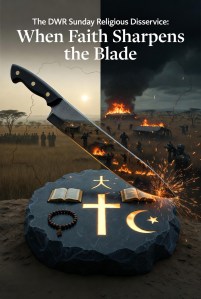
Religion does not create the blade. It tells you where to aim it.
This is why the same region can produce multiple kinds of violence at once. Armed groups with explicitly Islamist aims may target Christians as Christians. Local conflicts between herders and farmers may fall along religious lines and then harden under that framing. Criminal actors may adopt the language of faith because it organizes fear and loyalty more efficiently than profit alone.
The result is not a single, unified campaign. It is something less coherent and, in some ways, more dangerous: a landscape where violence can be justified in more than one register at once.
This is where outside observers often get it wrong.
To say “this is purely religious persecution” is to miss the structural drivers that sustain the conflict. To say “religion has nothing to do with it” is to ignore how meaning is assigned once violence begins. Both errors flatten the reality into something easier to argue about and harder to understand.
Religion, at its most potent, is a system for organizing meaning. In peaceful conditions, that can produce cohesion, charity, and restraint. In unstable conditions, it can do the opposite. It can elevate conflict, sanctify grievance, and make compromise feel like betrayal.
That is not unique to any one faith tradition. It is a property of belief when it becomes fused with identity under pressure.
The violence does not need religion to begin.
But once religion enters the frame, it changes what the violence is for.
And that is when it becomes harder to end.
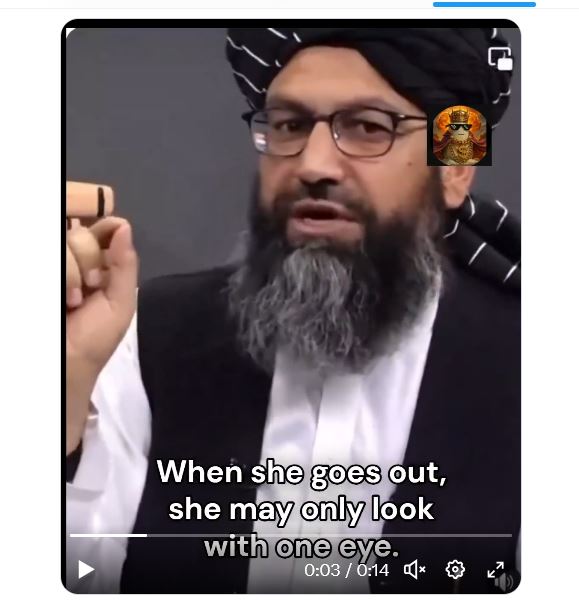
There are sermons that call men to humility, mercy, and repentance. Then there are sermons like this one: small, cruel, and drunk on power.In August 2025, a sermon by Taliban cleric Mahmood Zakeri circulated widely online. In it, he declared that a woman has no right to walk outside with both eyes open, and that if one eye remains uncovered it may be used only to watch the path, not to look around. He also reaffirmed the rule that women must leave home only with a male guardian.
That is not holiness. It is not modesty. It is the religious language of domination.
The point is not simply to cover women. It is to reduce them. A woman may see, but not look. She may move, but not appear. She may exist, but only under supervision. This is what tyranny looks like when it becomes intimate. It does not stop at law or force. It enters the body, the face, the eyes, and the terms of ordinary presence.
The Taliban’s rule over women has followed this logic from the start. Women and girls have been pushed out of school, work, and public life. They have been made dependent, restricted, and vulnerable by design. This sermon matters because it states the regime’s purpose with unusual bluntness. The goal is not public morality. The goal is female submission.
And this is where religion is being degraded along with women.
Islam is being used here not as a path to righteousness, but as a warrant for male control. Scripture and clerical authority are being conscripted to make domination sound sacred. That is one of the oldest abuses of religion: to take what should humble the strong and turn it into a weapon against the weak.
No serious moral society should accept that disguise. A woman is not a source of pollution to be hidden, escorted, monitored, and diminished. She is not male property. She is not a household object under external management. She is a human being. Any system that denies that is evil, whatever language it wraps around itself.
There is something especially repellent in the pettiness of it. Afghanistan has been battered by poverty, war, loss, and instability. Women there have already lost freedom, education, work, and legal protection. Faced with all that suffering, this cleric’s great moral concern is whether a woman may use both eyes.
That is not spiritual seriousness. It is sadism dressed as virtue.
When religion rots into ideology, this is what happens. The faith is no longer used to discipline pride or protect the vulnerable. It is used to flatter male authority and train women into fear. It becomes less a way to honor God than a system for breaking human beings into obedience.
A healthy religion reminds men that they are not God. The Taliban uses religion to tell them they may act like gods over women.











 bleatmop
 Mystro


 Dead Wild Roses
Your opinions…