
You are currently browsing the category archive for the ‘Media’ category.
Oh, for heaven’s sake.
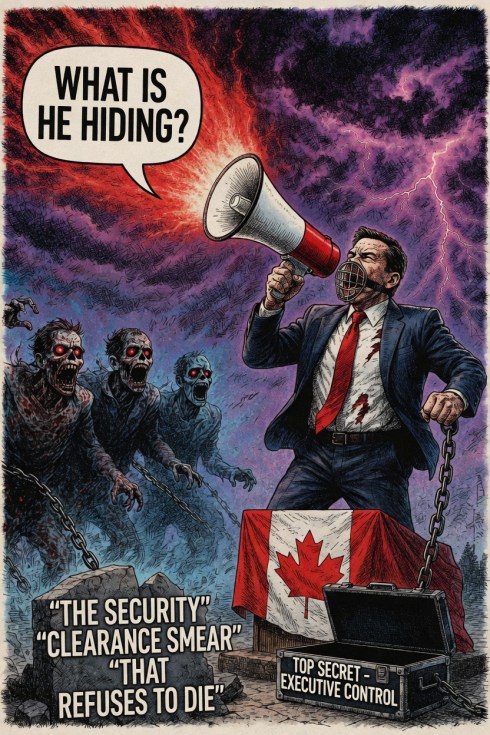
The Pierre Poilievre “security clearance” line has become one of those zombie claims in Canadian politics: killed repeatedly, buried repeatedly, and somehow still shambling around the media ecosystem looking for brains.
The lazy version goes like this: Poilievre does not have security clearance.
The line sounds grave because it is designed to sound grave. The average reader is supposed to hear it and supply the missing accusation: What is he hiding? Why can’t he pass the test? Is he compromised? The framing does not need to prove those suspicions. It only needs to keep them hovering.
But the real issue is not whether Poilievre is some random man off the street who cannot be trusted near a file folder. He served as a federal cabinet minister under Stephen Harper, including as minister of democratic reform and employment and social development. Cabinet ministers routinely handle sensitive government information. The current fight is over whether, as Leader of the Opposition, he should accept a particular classified briefing process under conditions that may limit what he can say afterward.
That is where the trick happens: critics collapse separate categories into one insinuating claim. Past cabinet access, present clearance status, and refusal of a specific classified-briefing regime are treated as though they are the same thing.
The accurate answer is not “his clearance never expires.” That claim is too broad and too easy to attack. Government of Canada security guidance says Secret clearance is valid for 10 years and Top Secret for 5 years. The stronger point is that the public is being offered a flattened version of a more complicated dispute.
The government, opposing parties, and many media voices say Poilievre “refuses to get security clearance.” Often, what they mean is that he has refused the additional clearance or classified briefing access needed to review certain foreign-interference material, including unredacted intelligence. Poilievre’s stated reason is that accepting those terms would restrict his ability to comment publicly.
You can view that choice as wise or reckless. But refusal under those terms is not the same as being unable to obtain clearance. It is not evidence that he failed a background check. It does not prove intelligence officials found him unfit. It means he has refused to enter a briefing regime with legal and political consequences.
Those consequences are not rhetorical decoration. The National Security and Intelligence Committee of Parliamentarians Act requires members to obtain and maintain the necessary Government of Canada security clearance, take an oath, and follow confidentiality rules. It also prohibits members and former members from knowingly disclosing protected information obtained through their work. The Supreme Court of Canada has upheld limits on parliamentary privilege in this context. In plain English: once you accept certain classified information under those rules, you may know more, but you may also be able to say less.
That architecture matters for an opposition leader. A government backbencher can absorb confidential information and stay quiet. A minister can be bound by cabinet confidence. But the Leader of the Opposition has a different role: to scrutinize the executive, press for disclosure, expose contradictions, and speak publicly when the government would rather manage the file behind closed doors.
There is still a serious criticism here. A potential prime minister should not be casually indifferent to classified intelligence. Foreign interference is not a branding exercise. It is real, ongoing, and aimed at Canadian institutions. Critics argue that Poilievre’s refusal leaves him unnecessarily blind on files he may one day have to manage from the Prime Minister’s Office.
That case should be made plainly: Poilievre should accept the clearance because national security requires informed leadership, even if that limits what he can say publicly afterward.
Fair enough. Argue that.
But do not imply he failed a clearance process. Do not suggest he is too compromised to receive sensitive information. Do not turn a strategic refusal into a character indictment.
Poilievre’s position may be risky. It may even be wrong in some circumstances. But the risk he identifies is also real. If the government possesses information embarrassing to itself, damaging to another party, or relevant to public accountability, a briefed opposition leader may become strategically constrained. In ordinary life, “knowing more” is usually an advantage. In opposition politics, knowing something you cannot use can become a leash.
This is why the “just get the clearance” demand is not neutral. It asks the Leader of the Opposition to step inside a confidentiality framework shaped by the executive he is supposed to scrutinize.
None of this automatically makes Poilievre right. There may be briefings he should accept. There may be moments when national security requires trust between government and opposition. But pretending the only possible explanation for refusal is guilt, cowardice, or hidden compromise is political theatre masquerading as procedural concern.
The machinery is more complicated than the slogan. Opposition leaders can receive classified briefings through different routes, with different levels of access and different obligations attached. Some briefings may require formal clearance. Some may involve confidentiality agreements. Some may leave a political leader better informed but publicly constrained.
So argue the real question.
Should the Leader of the Opposition accept classified briefings if doing so may limit his ability to criticize the government? Or should he remain outside that framework so he can keep pressing for public disclosure, especially when the issue is foreign interference in Canadian democracy?
Canadians can land on either side of that question. What they should not accept is the cheap version: Poilievre won’t get clearance — what is he hiding?
That is not analysis. It is insinuation with a lanyard.
The proper answer is to force precision.
Say what actually happened: Poilievre refused a particular classified briefing path because he believes it would constrain his ability to speak publicly and perform the adversarial role of opposition. His critics may call that irresponsible. His defenders may call it prudent. But anyone still selling the crude version is not informing the public.
They are laundering a smear through procedure, and Canadians should be tired of that trick by now.
References
- Government of Canada — Security clearance request process
Explains clearance levels and validity periods: Secret clearance is valid for 10 years; Top Secret clearance is valid for 5 years.
https://www.canada.ca/en/public-services-procurement/services/industrial-security/security-requirements-contracting/personnel-security-screening/processes/security-clearance-request.html - National Security and Intelligence Committee of Parliamentarians Act
Sets out clearance, oath, confidentiality, and disclosure obligations for NSICOP members.
https://laws-lois.justice.gc.ca/eng/acts/n-16.6/page-1.html - Supreme Court of Canada — Alford v. Canada (Attorney General), 2026 SCC 11
Confirms limits on parliamentary privilege for NSICOP-related secrecy obligations.
https://www.scc-csc.ca/judgments-jugements/cb/2026/41336/ - Reuters — Trudeau says some opposition MPs could be involved in foreign interference
Includes the context around Poilievre declining clearance to access intelligence from the foreign-interference probe.
https://www.reuters.com/world/americas/trudeau-says-some-opposition-canada-mps-could-be-involved-foreign-interference-2024-10-16/ - Foreign Interference Commission — PCO memo on classified briefings for opposition leaders
Discusses possible classified briefing routes for opposition leaders, including Secret-level briefings, Privy Councillor options, confidentiality agreements, and Top Secret requirements.
https://foreigninterferencecommission.ca/fileadmin/foreign_interference_commission/Documents/Exhibits_and_Presentations/Exhibits/CAN023012.pdf
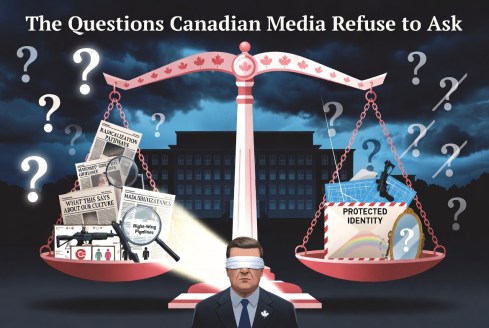
Canadian media know how to do pattern recognition when they want to.
Give them the right suspect, the right ideology, or the right grievance story, and they will produce instant analysis about pathways, warning signs, radicalization, social meaning, and what the event “says” about the culture. But let violence intersect with a politically protected identity category, and the appetite for explanation suddenly disappears.
That is the real story here.
A youth in Nova Scotia is accused in a foiled school attack plot involving online coordination, handwritten plans, imitation weapons, hate symbols, and threats. Weeks earlier, Canada saw the Tumbler Ridge massacre, one of the country’s rare school-linked mass shootings, carried out by a trans-identified male with prior mental-health-related police contacts. Two cases do not prove some grand law. They do, however, justify a question. When identity disturbance, grievance, alienation, and violence begin to cluster, are we allowed to notice, or does the conversation get shut down the moment the demographic becomes inconvenient?
That question is treated as indecent when it should be treated as basic public seriousness.
The point is not that trans identification causes violence. That would be a stupid claim, and an unserious one. The point is that severe identity instability, grievance, social isolation, and moral insulation from scrutiny can form a combustible mix, and our institutions become evasive when gender ideology is somewhere in the picture. They know how to be curious. They simply become selective about when curiosity is allowed.
That selectivity matters because schools are not seminar rooms. They are places where adults are supposed to notice risk before bodies hit the floor.
Instead, the public gets the usual flattening language. Troubled youth. Mental health struggle. Isolated incident. Complex circumstances. All of that may be true as far as it goes. What is missing is any willingness to ask whether a culture that treats identity claims as sacred, untouchable, and morally beyond scrutiny might also be making honest risk assessment harder than it should be. If a young person’s entire psychic life is being organized around grievance, estrangement, fantasy, and a demand that reality ratify the self at all costs, that is not automatically a violence pathway. But it is certainly not nothing.
And yet the moment this territory appears, Canadian media go soft in the head.
“When violence intersects with a protected identity category, Canadian media suddenly lose their appetite for explanation.”
They will interrogate masculinity, whiteness, right-wing pipelines, online extremism, misogyny, colonial resentment, and institutional failure when those frames are available. But when gender ideology may be part of the unstable mix, the analysis collapses into vagueness. Suddenly nobody wants to generalize. Nobody wants to connect dots. Nobody wants to risk saying the wrong thing. The protected category gets narrative shelter that other categories do not receive.
That is not neutrality. It is selective curiosity.
None of this means most gender-distressed youth are violent. Of course they are not. But public safety is not served by pretending that every cluster of instability must be discussed in the most generic terms possible just because one part of the profile has become politically delicate. Schools, parents, and the public deserve better than ritual euphemism after every near miss or body count.
The issue is not a proven demographic pattern. The issue is that when violence and identity pathology appear together inside a protected narrative, Canadian media suddenly lose their nerve. They stop asking explanatory questions not because the questions are irrational, but because the answers might offend the wrong people.
And that is how taboo makes serious societies stupider than they can afford to be.
One of the stupider habits in media criticism is the claim that one bubble tells the truth and the other tells fairy tales. In Canada, the usual version is that mainstream media give the public a softened, reassuring picture of Liberal rule, while X is where people go for the hard reality.
That flatters both sides.
The problem is not usually fabrication. It is calibration. Different media environments distort reality by different mechanisms. Mainstream outlets tend to smooth, normalize, and translate failure into managerial language. X tends to sharpen, inflame, and convert every pressure into proof of regime decay. One teaches underreaction. The other teaches overreaction.
The early Carney era makes the pattern easy to see. The Liberal rebound is real. 338Canada’s March 8 polling snapshot had the Liberals at 45%, with several late-February and early-March polls putting them in the mid-to-high 40s. Carney projects competence, institutional fluency, and stability at a moment when many voters are tired of noise. A media system does not need to invent momentum when momentum exists.
But that does not mean the picture is balanced. Institutional media often frame persistent problems in the language of management rather than consequence. Housing becomes a supply challenge. Immigration strain becomes recalibration. Cost-of-living pain becomes a headwind. Even when the facts are there, they are often cushioned by tone. A government cutting immigration targets after years of visible strain can be framed less as an admission of damage than as prudent adjustment. Ottawa’s own immigration levels plan uses the language of “restoring balance and control” while reducing temporary-resident arrivals and stabilizing permanent-resident admissions. A chronic failure described in the voice of process sounds less like failure.
“One side launders stress through institutional language. The other turns every strain into apocalypse.”
That is the mainstream distortion. It is not usually lie-by-falsehood. It is lie-by-emphasis. What is softened, what is normalized, what is treated as regrettable but basically under control.
X distorts in the opposite direction. It takes real pressures and narrates them at maximum intensity. Every shortage becomes collapse. Every compromise becomes betrayal. Every omission in legacy media becomes proof of protection or conspiracy. A grim housing forecast or weak affordability number can move through the platform in hours as evidence that Canada is finished. X sometimes performs a real service by surfacing data, reports, and institutional failures that legacy outlets underplay. Its weakness is not attention, but proportion.
That is why both bubbles feel persuasive from the inside. Each one is attached to something real. The mainstream press is right that public opinion can shift and governments can recover. X is right that the country’s underlying pressures did not disappear because the branding changed. Housing is still broken. CMHC’s latest supply-gap estimate says housing starts would need to rise to roughly 430,000 to 480,000 units a year through 2035 to restore affordability, far above the current pace. A better suit and calmer tone do not cancel that.
So the real divide is not truth versus lies. It is polished optimism versus permanent indictment. One side launders stress through institutional language. The other turns every strain into apocalypse. Neither gives citizens a good sense of scale.
That is the danger of media bubbles. They do not just tell people what to think. They teach people how hard to feel. Mainstream media often teach Canadians to underreact to chronic deterioration. X teaches them to experience every deterioration as final proof that the whole order is rotten.
Reality is uglier and less satisfying than either story. Canada is not collapsing. Canada is not well. Carney may have political momentum. The country may still be carrying pressures that no narrative reset can solve. Both things can be true at once.
The sane response is not to trust one bubble against the other. It is to distrust the emotional calibration of both. Read institutional media for reporting. Read adversarial media for pressure points. Believe neither atmosphere.
That is less exciting than choosing a tribe. It is also closer to reality.

Online discourse is exhausting for a simple reason: certain words are used not to describe reality, but to end the conversation. The label does the work. The argument never has to.
“Fascist” is one of those words.
In current usage, it often functions as a moral airhorn: you’re beyond the pale; you’re dangerous; you’re not worth debating. It gets tossed at people over ordinary ideological disputes about sex and gender, about speech norms, about state power, about immigration, about education. Sometimes it’s malice. Sometimes it’s a sincere attempt to name something authoritarian using the most nuclear term available. Either way, the practical effect is the same: “fascist” becomes a conversation-stopper rather than a description.
That’s why definitions matter. Not because language never evolves (it does), but because political language has consequences. When a term carries a freight of historical evil, using it casually is not “rhetorical adaptation.” It’s moral inflation. Moral inflation does not stay rhetorical for long.
Fascism isn’t just “authoritarian”
Start with what fascism is not.
Fascism is not merely “oppressive, dictatorial control.” That’s too broad. Plenty of regimes are oppressive. Plenty of dictators are brutal. If “fascist” just means “authoritarian,” it becomes a synonym for “bad,” and then it means nothing at all.
Fascism is a historically specific modern political project. A workable definition, tight enough to guide usage and broad enough to cover the main cases, looks like this:
Fascism is an authoritarian mass movement aimed at national rebirth, organized around the leader principle, hostile to liberal constraints (pluralism, due process, free speech), willing to use intimidation or violence against opponents, and committed to subordinating institutions to a single national story.
Notice the “mass movement” piece. Fascism is not only what the state does; it’s what a mobilized public is trained to do for the regime. It does not merely punish dissent. It cultivates a moral atmosphere in which dissent feels like treason, contamination, sabotage.
Economically, fascist systems often preserve nominal private ownership while subordinating markets, labour, and industry to regime goals through state direction and corporatist control. That’s not the essence, but it’s part of the recognizable package: the economy exists for the national project, not the other way around.
History: what it looked like when it was real
Words should cash out in the world.
Historically, fascism is anchored in early 20th-century Europe, most centrally Mussolini’s Italy and Hitler’s Germany. They differed in important ways, but the family resemblance is clear: politics becomes a spiritual drama of national humiliation and promised restoration; the leader becomes the embodiment of the nation; opposition becomes illegitimate by definition; and coercion becomes normalized as “necessary” for unity and renewal.
The methods are recognizably modern: propaganda, spectacle, the disciplining of media and education, the weaponization of law, the tolerated use of street-level intimidation, and the steady narrowing of permissible speech and association. It’s not merely “the government is strong.” It’s the fusion of power with myth, enforced socially and legally.
A practical threshold: not one trait, a cluster
If you want to use “fascist” responsibly, you need a threshold. Not a single feature, a cluster.
The label starts to become warranted only when several of these are present together:
- Leader principle: politics organized around a singular figure or party claiming a unique right to rule.
- Myth of national rebirth: humiliation plus promised restoration demanding unity and purification.
- Anti-pluralism: opponents treated as enemies, not fellow citizens.
- Suppression of dissent: legal, institutional, or social narrowing of speech and association.
- Propaganda and spectacle: mass emotional mobilization replacing open contest.
- Normalization of intimidation: harassment, threats, “consequences,” or violence used as political tools.
- Institutional capture: courts, schools, media, and professions bent into ideological instruments.
This is also how you keep your head when the internet offers you cheap clarity. If someone is merely wrong, stubborn, rude, or convinced, that is not fascism. If someone wants stronger regulation, that is not fascism. If someone defends free speech, or argues about sex and gender, that is certainly not fascism by definition. Those are disputes inside ordinary politics, however heated.
A concrete misuse: the pattern in miniature
Here’s the move you see constantly:
A person says, “I think compelled speech policies in workplaces and schools are a mistake.”
The reply is not, “I disagree, because…”
The reply is, “Fascist.”
What did the label accomplish? It converted a claim about policy into an accusation about moral essence. It implied the speaker is not merely mistaken but dangerous; not merely wrong but disqualifying. Once you have categorized someone as a “fascist,” the next steps feel justified: deplatforming, professional punishment, social exile, denial of hearing.
Maybe the labeler was “just venting.” Maybe it was “good-faith hyperbole.” But hyperbole has downstream effects. It trains the audience to treat coercion as civic hygiene.
Symmetry: this is not a left-only sin
And yes: the right does its own version. “Marxist” becomes a synonym for “liberal.” “Communist” becomes “anyone who wants a program.” “Groomer” becomes a sloppy club for any disagreement about education. “Traitor” becomes shorthand for “opponent who won.” Same mechanism, different tribe: labels as argument-substitutes and permission structures.
If we’re going to complain about language used as a weapon, we don’t get to only notice it when it hits our side.
Why this matters beyond the internet
The problem isn’t just vibes on social media. Label inflation spills into institutions.
When terms like “fascist” become casual descriptors, workplaces and professional bodies begin treating contested political disagreement as a safety issue. Media narratives start pre-sorting dissent as extremism. Politicians learn to substitute moral denunciation for persuasion. The public learns to fear argument and love punishment.
The final irony is that this habit corrodes the liberal norms that make pluralistic society possible: the expectation of disagreement, the discipline of evidence, and the moral restraint of not treating opponents as vermin.

A better standard
Here’s the rule I’m adopting: I’ll reserve “fascist” for cases where I can point to the cluster. Leader principle, anti-pluralism, suppression, intimidation, institutional capture, mythic rebirth. Not merely the heat of the dispute.
When I mean “authoritarian,” I’ll say authoritarian. When I mean “illiberal,” I’ll say illiberal. When I mean “coercive,” I’ll say coercive.
Definitions aren’t pedantry. They are the line between argument and excommunication, a public safety measure for language. “Fascist” should be a diagnosis you can defend, not a mood you can perform. If we flatten every disagreement into fascism, we train ourselves to crave punishment instead of persuasion, and we teach institutions to treat dissent as contamination. That habit does not protect democracy. It rots the muscles that make democracy possible, and it turns politics into a brawl we will eventually call governance.
Some children are genuinely vulnerable, atypical, or distressed, and they deserve careful support.
That should be easy to say. It should also be the beginning of the conversation, not the end of it.
The problem starts when a narrow duty of care is expanded into a broad teaching mandate. Support for a small number of children becomes a reason to saturate schools, children’s media, and online spaces with contested identity frameworks. What begins as accommodation becomes doctrine. What begins as care becomes a general lens for everyone.
That is the central move.
It is usually framed in soft language: inclusion, visibility, affirmation, making room. Sometimes that language is fair. But it can also hide a scope change. A real minority need is used to justify population-level exposure. The existence of some children who need unusual support does not, by itself, justify turning child-facing institutions into delivery systems for anti-normative identity scripts many children are not developmentally ready to evaluate.
Put simply: support is not the same thing as saturation.
A useful heuristic is the inoculation model. The implicit argument often sounds like this: expose everyone early and often to the framework so harm is prevented later. But that assumes the framework is age-appropriate, conceptually clear, and socially harmless when applied at scale. Those assumptions are usually asserted, not argued.
You can see the pattern in school frameworks like SOGI 123. SOGI 123 describes itself as an initiative to help educators make schools safer and more inclusive for students of all sexual orientations and gender identities, with tools spanning policy, school culture, and teaching resources. In British Columbia, SOGI 123 has been broadly integrated through educator networks and district participation structures. In Alberta, similar SOGI 123 resources and supports exist and are used, but public acceptance and implementation have been more contested and uneven. (Your local framing here is fine; if you want, we can add a specific Alberta anchor in the next pass.)
The point is not that every teacher using these materials has radical intentions. Most likely do not. The point is structural. A framework introduced in the name of protecting a minority of vulnerable students can become a general lens for shaping the environment of all students. That is exactly where support turns into saturation.
None of this requires pretending there are no benefits. Anti-bullying frameworks and school supports can reduce harassment and improve school climate for vulnerable students, and in some cases for other students as well. Recent SOGI 123 evaluation reporting in B.C. has explicitly claimed reductions in some forms of bullying and sexual-orientation discrimination, including effects observed for heterosexual students in studied schools. But that is a different question from whether a framework is well-bounded, developmentally fitted, and appropriate as a general lens for all children. A program can produce some good outcomes and still be overextended in scope.
This is also where ordinary parents often feel morally cornered. They are told the framework is simply about kindness and safety. Then they discover it also carries contested claims about identity, norms, and development. When they raise questions about age, fit, or timing, the objection is treated as hostility rather than prudence.
That rhetorical move matters. It is how debate gets shut down.
Some activist frameworks are not just asking for tolerance or non-harassment. They are more ambitious. They treat ordinary social norms as presumptively suspect—or as things to be actively challenged—rather than mostly inherited and refined. Adults can debate that in adult spaces. The problem is when those frameworks are translated into child guidance and presented as common sense before children are developmentally ready to sort through the concepts.
You do not need a graduate seminar to see the issue. Children imitate. Children seek belonging. Children absorb prestige cues. Children are shaped by what trusted adults celebrate. That is not bigotry. That is basic reality.
This is why developmental fit matters. Children do not process abstract identity questions the way adults do. Identity formation is gradual. Social context matters. Timing matters. Adult authority matters. Age appropriateness is not a slogan; it shifts across developmental stages, and what may be discussable at 16 is not automatically suitable at 6. When institutions present contested frameworks in a celebratory register first and a cautionary register later (or never), adults should worry.
The usual public binary is false. The choice is not between cruelty and total affirmation. It is not between neglect and ideological immersion. A sane society can do both things at once: provide targeted support for the children who truly need it, while refusing to reorganize the symbolic environment of all children around contested anti-normative frameworks.
That is not repression. It is proportion.
And proportion is exactly what gets lost when every concern is moralized and every request for limits is treated as harm.
We should be able to say, plainly, that some children need exceptional care without turning exceptional cases into the template for everyone else. We should be able to protect the vulnerable few without swamping the many. We should be able to teach kindness without requiring ideological inoculation.
If we cannot make those distinctions, then we are not practicing compassion. We are practicing scope creep with moral language.

Support for vulnerable students is necessary. But targeted care is not the same as saturating schools with contested identity frameworks for all children.
References
- SOGI 123 / SOGI Education. “SOGI 123 | Making Schools Safer and More Inclusive for All Students.”
https://www.sogieducation.org/ (SOGI 123) - SOGI Education. “What Is SOGI 123?”
https://www.sogieducation.org/question/what-is-sogi-123/
(official explainer page) - SOGI Education. “British Columbia.”
https://www.sogieducation.org/our-work/where-we-support/british-columbia/
(B.C. implementation / network context) - ARC Foundation. “UBC Evaluation of SOGI 123 (October 2024).”
https://www.arcfoundation.ca/ubc-evaluation-sogi-123-october-2024
(evaluation / outcomes framing from SOGI-supportive side) - Alberta Teachers’ Association. “What is SOGI 123?”
https://teachers.ab.ca/news/what-sogi-123 (teachers.ab.ca) - Keenan, H., and Lil Miss Hot Mess. “Drag Pedagogy: The Playful Practice of Queer Imagination in Early Childhood.” Curriculum Inquiry 51, no. 5 (2021): 578–594.
https://doi.org/10.1080/03626784.2020.1864621 - Gender Report (opinion/critical perspective). “We need to take ideological gender rhetoric out of education.” (Jan. 28, 2021).
https://genderreport.ca/sogi-gender-curriculum-queer-theory/ (CANADIAN GENDER REPORT) - Global News. “Duelling protests held in Edmonton over sexual orientation and gender identity policies in schools” (Sept. 20, 2024).
https://globalnews.ca/news/10766483/edmonton-gender-identity-sexual-orientation-alberta-schools/ (Global News)
Social media is not a neutral information pipeline. It is a distribution system for identity scripts, status incentives, and institutional messaging aimed at children and adolescents.
The internet matters, but the internet is not the first mover. The first mover is often the institution. Child-facing media packages contested identity-adjacent material in a glowing register—creativity, confidence, self-expression, empowerment—then platforms do what platforms do: amplify, repeat, and reward.
That sequence matters. Parents know the internet is porous and chaotic. Institutional children’s programming arrives pre-approved. It signals safety. It signals legitimacy. By the time a clip hits the feed, it is not just content. It is content stamped with adult authority.
Criticism of this pattern is routinely framed as hostility to “queer youth.” That framing is too convenient. The stronger criticism is about frameworks.
Some strands of queer activism are not simply asking for tolerance or protection from abuse. They are explicitly suspicious of norms as such, and in some cases treat norm disruption as a political good. Adults can debate that project in adult spaces. The problem begins when a norm-disruptive framework is repackaged as child guidance and presented as developmental common sense.
Developmental psychology matters here as a guardrail. Piaget’s core point still stands: children do not think like adults; reasoning develops in stages. Erikson likewise treats identity formation as developmental, social, and staged. Children and early adolescents are especially sensitive to imitation, belonging, prestige, and adult cues. That does not mean they lack an inner life. It means adults should not hand them high-status identity templates and call it pure self-discovery.
The question is not whether vulnerable youth exist. They do. The question is whether activist frameworks built to challenge adult social norms should be translated into child-facing institutional messaging as if they were straightforwardly age-appropriate. On that question, skepticism is not cruelty. It is adult judgment.
Public argument usually collapses here. One side calls it moral panic. The other calls it recruitment. Both are lazy.
Children are impressionable. Social learning is real. Status-seeking is real. Identity experimentation is real. None of that requires conspiracy thinking. It also does not justify a cartoon model of causation where one video produces one outcome. The serious concern is cumulative: repeated exposure, emotional framing, peer reinforcement, institutional endorsement, and algorithmic repetition shape what children perceive as admirable, normal, and socially rewarded.
That concern becomes more serious when the surrounding issue can become clinical. Once clinical pathways enter the picture, the adult burden of care rises. “Let kids explore” is not a sufficient standard when the surrounding culture is supplying scripts, rewards, and institutional validation at scale.
The evidence conversation has to stay honest. Research on social media and transgender or gender-diverse youth supports a mixed picture: online spaces can correlate with distress, discrimination, and problematic use, while also providing support, connection, and relief from offline isolation. Used carelessly, that literature gets abused in both directions—either as proof of “brainwashing” or as proof that social influence is irrelevant.
The more useful point is simpler: institutions increasingly present contested identity material to children in the language of celebration before they provide any framework for developmental caution. The sequencing is wrong. The tone is wrong. The confidence is often ahead of the evidence.
A sane standard is still available. Some online spaces help marginalized youth. Some online dynamics intensify confusion, distress, and imitation. Institutions should not present complex identity performance to children as if there are no downstream risks, tradeoffs, or developmental questions.
That is not cruelty. It is adult supervision.
The deeper problem is cultural, not merely digital. We outsource moral formation to feeds, then act surprised when children absorb what the feed rewards. Social media amplifies. Schools legitimize. Media narrates. Government ratifies. Then the shift is described as organic.
It is not fully organic. It is curated.
That does not mean every child in these spaces is inauthentic. It means authenticity itself is now being shaped inside an environment saturated with scripts, incentives, and prestige signals children are poorly equipped to evaluate critically.
If standards do not return, institutions will keep mistaking early exposure for compassion, and children will keep paying for adult vanity dressed up as progress.
References
-
Piaget, Jean, and Bärbel Inhelder. The Psychology of the Child.
-
Erikson, Erik H. Identity: Youth and Crisis.
-
Halperin, David M. Saint Foucault: Towards a Gay Hagiography. Oxford University Press, 1995.
-
Keenan, H., and Lil Miss Hot Mess. “Drag Pedagogy: The Playful Practice of Queer Imagination in Early Childhood.” Curriculum Inquiry (2021). DOI: 10.1080/03626784.2020.1864621.
-
CBC Kids News / Drag Kids segment (2017, resurfaced clip).
The first duty of public journalism after a massacre is simple: name the dead, establish the sequence, and tell the truth about what is known and what is not. That is media hygiene. That is how a public learns. That is how systems get fixed.
Instead, we got a firewall.
In the immediate wake of the Tumbler Ridge killings—home first, then school; five students dead, an education assistant dead; the perpetrator dead by suicide—the national conversation was quickly steered away from forensic clarity and toward reputational triage. In at least one major network segment, the frame was explicit: the story was “anti-trans disinformation” after the shooting. Not the chain of events. Not the failure points. Not the institutional blind spots. The message was prophylactic: watch what you say; the real danger is how people might talk about it.
This is not merely tone-deaf. It’s a form of complicity.
Not complicity in the act, obviously—complicity in what follows: the slow, predictable replacement of accountability with moral theatre. When a newsroom’s first instinct is to manage narrative risk, it begins to treat facts as flammable materials—things to handle with gloves, filter through approved experts, and keep away from ordinary citizens who might draw the “wrong” conclusions.
That is how gatekeepers lose legitimacy. And it is how tragedies become recurring.
The mechanism: switch the object of fear
Watch the pivot closely and it’s always the same move.
- A real event happens in the world—blood, bodies, families blown open.
- The newsroom identifies a second-order risk: public anger, political fallout, reputational damage to a protected consensus.
- The coverage shifts from “What happened?” to “What must we prevent?”
- Prevention is defined as protecting a narrative, not repairing a system.
The object of fear changes. Instead of fearing the next killing, the institutions fear the next argument.
So they tell you the problem is “misinformation.” They tell you the danger is “conflation.” They tell you this is a moment for “community support” and “protecting vulnerable people.” And those may all be decent impulses—in their proper place, at their proper time. But as a lead story? As the framing lens? As the moral of the segment?
That’s not reporting. That’s crisis communications.
“Don’t conflate” becomes a solvent
One line in particular functions like a solvent in the modern media ecosystem:
Don’t conflate an identity with violence.
Fine. True in the general case. But after a massacre, deployed as the first moral reflex, it does more than discourage scapegoating. It quietly discourages inquiry.
Because inquiry is not a vibe. Inquiry is a chain:
- What was the timeline?
- What were the warning signs?
- Who saw what?
- What interventions were tried?
- Where did they fail?
- What policies shaped those failures?
- What is going to change next week because children are dead?
A solvent doesn’t “refute” those questions. It dissolves the social permission to ask them. It turns scrutiny into contamination.
That is why it feels so out of touch to grieving parents: it is journalism behaving as if the central public hazard is discussion rather than risk.
Media complicity looks like this
Complicity, in this context, is not about malice. It’s about habit.
It’s the habitual choice to protect institutions from accountability by rerouting attention:
- From the scene to the discourse.
- From the victims to the community statement.
- From the timeline to the think-piece.
- From “what failed?” to “what mustn’t be said?”
A professional newsroom used to be allergic to this. The old standards—imperfect, often biased, frequently arrogant—still had a core ethic: facts first, advocacy last. If advocacy entered the frame, it was labeled as such. If uncertainty existed, it was named. If a claim couldn’t be verified, it didn’t get aired as settled truth.
Today, too often, we get advocacy laundering: press-release moralizing presented as news, with the added twist that dissent is treated as a moral defect rather than a factual dispute.
That is not neutrality. That is narrative commitment wearing a blazer.
What “media hygiene” used to mean (and must mean again)
A return to old standards isn’t nostalgia. It’s practical survival. Here’s what media hygiene looks like when it’s done properly—especially after mass violence:
1) Victims first.
Name the dead. Describe the community. Make the loss real before you make it useful.
2) Sequence before interpretation.
Timeline, confirmed facts, and clearly separated unknowns. No moral “lesson” until the basic chain is established.
3) Mechanisms over slogans.
If firearms were involved, the mechanism is access and storage—specific failures, not national clichés. If mental health is part of the background, the mechanism is escalation thresholds and follow-up—specific gaps, not hashtags.
4) No prophylactic framing.
Do not lead with “misinformation,” “backlash,” or “what this might fuel.” Those are downstream effects. They are not the event.
5) Don’t pre-label inquiry as bigotry.
Scapegoating is wrong. So is shutting down investigation by treating questions as dangerous.
6) Separation of church and newsroom.
Advocacy voices may be relevant. They must not become the controlling lens. Journalists should interrogate them the way they interrogate police, politicians, and corporations.
7) Corrections that cost you pride.
If you get something wrong, correct it prominently, not performatively. Trust is built when gatekeepers admit error without theatrics.
None of this requires “hating” anyone. It requires doing the job.

The consequence of failing the job
When media behaves like a narrative defense force, the public does not become more compassionate. It becomes more suspicious. It begins to assume that every tragedy will be translated into a pre-approved moral. It begins to look elsewhere for facts—often to sources far less responsible, far more conspiratorial, and far more cynical.
That is the boomerang effect of the firewall: the attempt to prevent “bad interpretations” produces a credibility vacuum, and the vacuum fills with poison.
If journalists want to stop that cycle, they can’t do it by lecturing the public into compliance. They can only do it by earning trust the old way: through sequence, clarity, restraint, and the disciplined refusal to turn atrocity into messaging.
Because if the first move after a massacre is to protect a narrative, the system will not learn.
And if the system does not learn, it will repeat. 🕯️











 bleatmop
 Mystro
 The Arbourist


 Dead Wild Roses
Your opinions…