
Too many land acknowledgements are not acknowledgements anymore. They are rituals of submission with nicer stationery.
Everyone knows the form. Before the meeting, concert, lecture, school assembly, or conference begins, someone reads a solemn paragraph about the land. The tone is reverent. The words are familiar. The effect is usually deadening. Nobody is supposed to argue with it. Nobody is supposed to ask what it means in practice. The ritual is complete once the room has been morally sorted.
That is the trick.
A land acknowledgement does not merely “acknowledge land.” It often imports a political frame. It suggests that some people belong here more deeply than others, that ordinary Canadians are guests in their own country, and that citizenship itself sits under a cloud of inherited guilt.
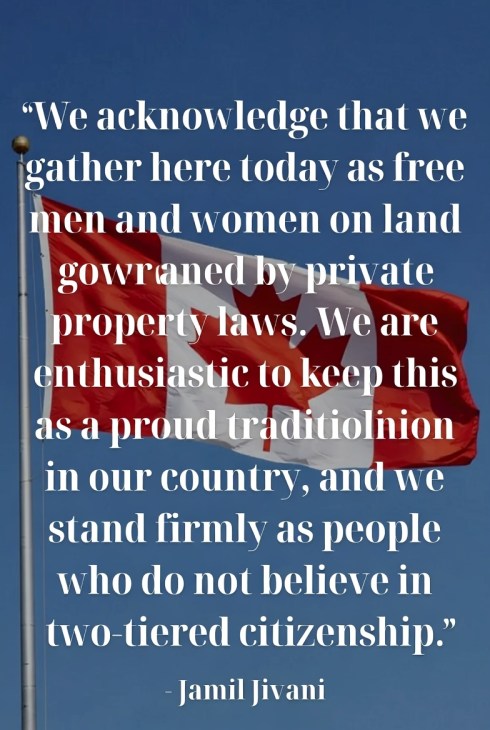
This is why Jamil Jivani’s version is useful:
“We acknowledge that we gather here today as free men and women on land governed by private property laws. We are enthusiastic to keep this as a proud tradition in our country, and we stand firmly as people who do not believe in two-tiered citizenship.”
That works because it does what the usual version refuses to do. It acknowledges the legal and political order under which people are actually gathered.
We are not meeting in a metaphysical guilt zone. We are meeting in Canada. That means Canadian law, constitutional government, treaty obligations, private property, Crown land, Aboriginal title, reserves, statutes, courts, and civic rights that apply to citizens as citizens.
The details matter. Canada’s land regime is not one simple thing, and anyone pretending otherwise is selling you a pamphlet, not an argument. But the public square still depends on a shared legal order. It cannot survive if every gathering begins by quietly ranking people according to ancestry.
That is why the phrase “land governed by private property laws” matters. It cuts through the incense.
Private property is not just about who owns a fence line or a parcel on a title map. It is one of the civilizational tools that lets strangers live beside each other without every dispute becoming a tribal contest. It turns land into a governed reality rather than a permanent symbolic battlefield. It lets people build homes, churches, schools, businesses, farms, and community halls without having to justify their existence every time someone invokes ancestry.
The usual acknowledgement often leaves people with a vague sense that Canada is illegitimate, but without saying clearly what should follow.
Are property titles invalid? Are municipal governments illegitimate? Are homeowners merely tenants of history? Are citizens equal, or are some citizens permanently morally prior because of bloodline?
These questions are usually dodged because answering them would reveal the radicalism hiding inside the ritual.
Jivani’s version answers plainly: no two-tiered citizenship.
That is the heart of it.
A serious country can honour Indigenous history. It can recognize treaties. It can correct specific injustices where evidence and law require correction. It can admit that governments have done cruel, stupid, and destructive things. None of that requires teaching Canadians that equal citizenship is somehow morally suspect.
But that is where many modern land acknowledgements drift. They sort the room into moral categories before the event even starts. Some people are original. Some are settlers. Some have ancestral legitimacy. Others inherit suspicion. The language remains soft, but the structure underneath it is hard.
That is not reconciliation. That is caste thinking with a grant application attached.
And no, refusing that frame does not mean pretending history began yesterday. This lazy accusation needs to be retired. Canadians can know the history without accepting a ritual designed to weaken their confidence in the country they inhabit. Memory does not require self-erasure. Justice does not require permanent civic grovelling. Respect does not require pretending that liberal citizenship is some colonial inconvenience we should all feel embarrassed about.
If people want reconciliation, then do the real work. Clarify treaty obligations. Improve reserve governance. Support economic development. Fix broken service delivery. Protect individual rights. Litigate actual claims. Negotiate actual settlements.
But stop pretending that reciting inherited guilt before a PowerPoint presentation is moral courage.
The better acknowledgement is provocative because it reverses the moral pressure. Instead of forcing citizens to rehearse guilt before they proceed, it affirms the conditions that let free people gather in the first place: law, property, citizenship, and equality before the state.
That is exactly why it will irritate the professional class that treats land acknowledgements as sacred theatre. It refuses the expected posture. It does not bow. It does not mumble through a half-confession. It says, openly, that Canada is a real country, that its legal order matters, and that citizenship must not be divided into ancestral ranks.
A land acknowledgement should acknowledge reality.
That is worth saying out loud.











 bleatmop
 Mystro


 Dead Wild Roses
1 comment
Comments feed for this article
May 13, 2026 at 6:56 am
tildeb
This should happen (as shown here) every time.
LikeLike