
You are currently browsing the daily archive for May 6, 2026.
In the last post, we left a question hanging:
When scientific claims change, are we getting closer to reality—or just watching consensus shift?
That question only holds together if we blur two different things into one.
The Quiet Category Error
When people say “science is a social construct,” they usually point to things that are obviously true.
Research is funded by institutions. Papers move through journals. Experts decide what gets published. Language shapes how ideas are framed.
All of that is real.
None of it defines the core activity.
The mistake is simple: treating the systems around science as if they determine what makes a scientific claim true.
What Actually Gets Tested
Strip everything else away and science becomes something much more basic.
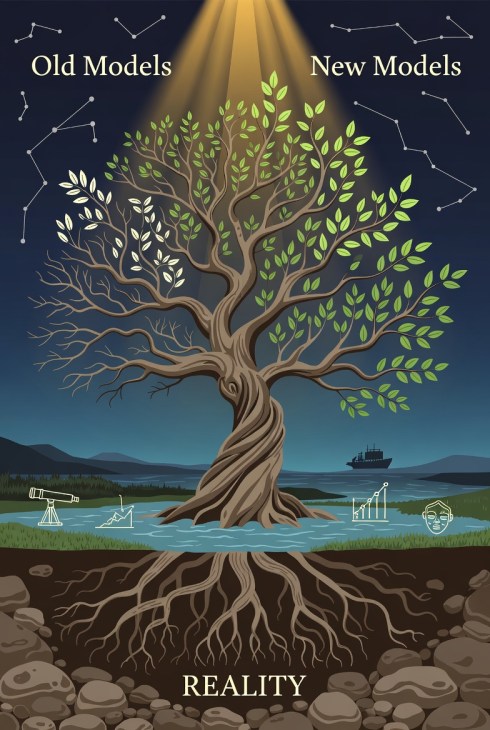
People build models of the world. Then they test them.
Not by agreement. Not by status.
By what happens when those models meet reality.
The ones that survive tend to do a few things well. They predict outcomes with some reliability. They explain more than their competitors. They hold together internally. And when new data arrives, they adjust without collapsing.
You don’t need to formalize those criteria to see them in action. You see them every time an idea quietly disappears because it stops working.
That disappearance isn’t negotiated.
It’s forced.
Influence Isn’t Determination
At this point the pushback comes quickly.
“Of course science is shaped by social forces.”
It is.
Those forces shape which questions get asked, which projects get funded, how results are presented, and how quickly findings spread. They can slow progress. They can distort it. Sometimes they can derail it for a while.
But they don’t determine whether a model tracks reality.
That’s the line.
You can delay discovery. You can confuse it. You can wrap it in bad language.
You can’t make a false model reliably predict outcomes just by agreeing that it does.
The Strong Claim—and the Weaker One
There’s a distinction that tends to get skipped.
A weaker claim says: science is socially embedded. That’s true and not especially controversial.
A stronger claim says: scientific truth itself is negotiated—shaped by power, language, and consensus.
That’s the one doing the real work.
And it doesn’t hold up under pressure.
If truth were negotiated, models wouldn’t behave the way they do across different contexts. They wouldn’t converge. They wouldn’t travel.
Pluto Didn’t Change
Take the familiar example of Pluto.
At one point, there were nine planets. Now there are eight.
On the surface, that looks like a shifting fact.
But nothing about Pluto changed. What changed was the classification system, refined in response to better observations and clearer criteria.
Run that process again—with the same data, in different countries, under different institutions—and you land in the same place.
That’s not consensus creating truth.
That’s constraint forcing alignment.
Authority Doesn’t Carry the Argument
Another social constructivist argument leans on expertise.
Science is what recognized experts agree on. Experts are socially validated. Therefore science is socially constructed.
Except that’s not how progress behaves.
Clyde Tombaugh discovered Pluto without formal credentials.
Michael Faraday made foundational contributions to electromagnetism with little formal training.
Their work wasn’t accepted because of status.
It was accepted because it held up.
Credentials can signal competence. They don’t determine whether a model survives contact with the world.
When Bias Enters, Science Starts to Fail
The strongest objection points to real failures.
“What about biased or harmful science?”
Those cases matter.
But look closely at what they show.
Take the Tuskegee syphilis study. It wasn’t just unethical. It was methodologically broken—biased sampling, invalid comparisons, contaminated conditions.
The result wasn’t just immoral.
It was useless as knowledge.
The same pattern appears elsewhere. Once ideology starts steering the model, predictive accuracy drops. Explanations weaken. The work stops holding together.
That isn’t science revealing its true nature.
That’s science breaking down.
A Brief Note on Paradigm Shifts
You’ll sometimes hear this framed in terms of paradigm shifts.
“If scientific frameworks change, doesn’t that mean knowledge is constructed?”
Frameworks do shape how data gets interpreted.
They don’t rescue models that fail.
When predictions stop landing and explanations start stretching, the model gives way.
Not because consensus changed.
Because it stopped working.
The Outer Layers Still Matter
None of this denies the obvious.
Funding is political. Publication standards are negotiated. Ethics are socially enforced.
These shape the environment science operates in. They can slow it down. They can distort it. They can even temporarily misdirect it.
But they don’t decide what’s true.
Because truth, in this context, isn’t assigned.
It’s encountered out there in the wild.
Back to the Tension
So when scientific claims change, what are we seeing?
Sometimes it’s better data refining a model. Sometimes it’s uncertainty narrowing over time.
Sometimes it’s institutional incentives shaping how results are framed.
The two get mixed together.
That’s why it feels unstable.
But only one of those layers determines whether the model actually works.
The Constraint That Holds
You can treat science as just another narrative shaped by power.
If you do, its authority collapses into politics.
Or you can recognize the constraint:
Reality pushes back.
It pushes back the same way regardless of who’s asking the question, what language they use, or which institution is involved.
That doesn’t make science perfect.
It makes it bounded.
And that boundary is the reason it works at all.
Where That Leaves Us
Science changes.
Scientists are biased.
Institutions are political.
None of that makes the core activity a social construct.
Because the core isn’t built out of agreement.
It’s built out of whether the model survives contact with the world and makes no distinction of who you are.
Glossary
Social Construct
An idea or category whose defining features depend on social agreement and can vary across cultures (e.g., money, legal systems).
Scientific Model
A structured representation used to explain and predict phenomena.
Empirical Constraint
The requirement that a model must align with observable reality.
Predictive Accuracy
How reliably a model forecasts outcomes.
Explanatory Power
How well a model accounts for observed phenomena relative to alternatives.
Coherence
Internal consistency within a model.
Model Robustness
The ability to adapt to new data without collapsing.
References
- The Structure of Scientific Revolutions
https://press.uchicago.edu/ucp/books/book/chicago/S/bo13179781.html - Theory and Reality
https://press.uchicago.edu/ucp/books/book/chicago/T/bo3773461.html - Fashionable Nonsense
https://www.penguinrandomhouse.com/books/117184/fashionable-nonsense-by-alan-sokal-and-jean-bricmont/ - Stanford Encyclopedia of Philosophy — Social Construction
https://plato.stanford.edu/entries/social-construction/ - National Archives — Tuskegee Study Overview
https://www.archives.gov/research/african-americans/individuals/tuskegee-study











 bleatmop
 Mystro
 The Arbourist


 Dead Wild Roses
Your opinions…