
You are currently browsing the tag archive for the ‘social construct’ tag.
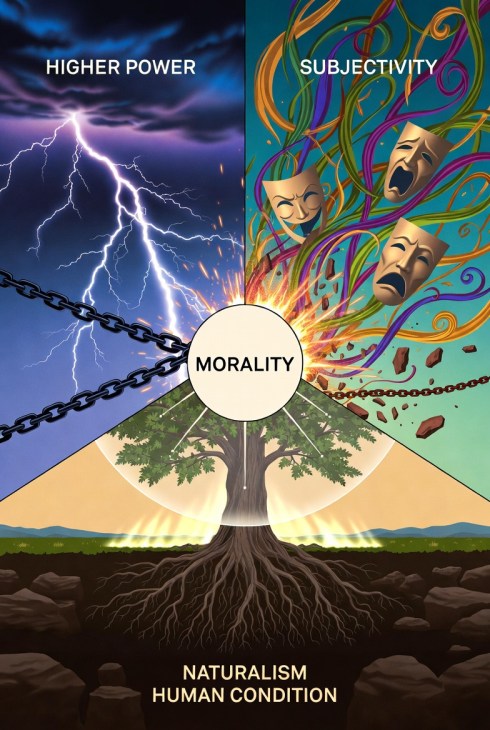
There is a moment in certain debates where everything speeds up. Morality is called subjective; subjectivity becomes preference; preference becomes power—and once power is named, the conversation is over. What began as a question about right and wrong turns into a contest of will. The move is effective because it presses on something real: if moral claims have no grounding beyond preference, it’s not obvious why anyone should follow them, especially when defection pays.
The pressure is genuine. The leap that follows is not.
The argument doesn’t stop at identifying the problem. It slides past it. The claim arrives fully formed: without objective grounding, morality collapses into power; if there is grounding, it must lie beyond human beings. From there, the appeal to a higher authority presents itself as the only way out. It’s clean, decisive—and too quick. It skips a possibility that does not depend on metaphysics at all.
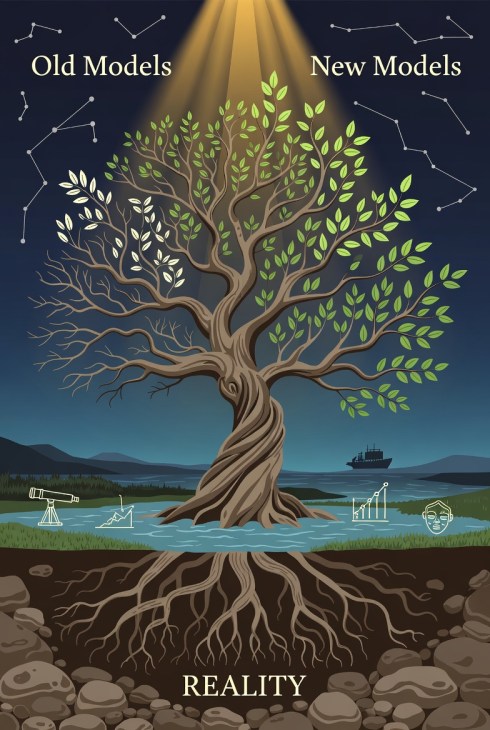
You don’t need a higher power to get constraint. You need a world that pushes back. That is already enough for science. The success of a model has little to do with who proposes it and everything to do with whether it survives contact with reality. When it fails, it fails for everyone. No appeal to authority rescues it. That is objectivity without metaphysical scaffolding.
Something similar appears in moral life, though in a different register. Human beings are not abstract choosers floating above circumstance. We are vulnerable, dependent, and locked into repeated interaction with others who are very much like us. That combination exerts pressure. Cooperation is not optional if anything stable is to be built; defection carries costs that accumulate; control over outcomes is partial at best; and roles do not remain fixed. Over time, those conditions shape what can persist.
Rules that cannot be justified beyond advantage tend to fracture. Norms that work only when you hold power lose their grip as soon as power shifts. Arrangements that fail under reversal—when you are no longer the beneficiary—erode the moment they are tested from the other side. You can see this in ordinary disputes: a speech rule that feels protective when applied to your side quickly feels suppressive when applied against it. None of this descends from above. It emerges from the conditions under which people have to live together.
“You don’t need a higher power to get constraint. You need a world that pushes back.”
This is why a simple question keeps resurfacing, even among people with no interest in philosophy: would this still make sense if I were on the receiving end? You don’t need theology to ask it. You don’t need a theory of value to feel when the answer is no. You need only to notice that positions change, that vulnerability is shared, and that rules have to survive that movement. That alone rules some things out. Not everything. But not nothing.
The familiar objection comes back quickly: if this is all human arrangement, isn’t it still just power? The answer is that power without constraint is unstable. Systems built on dominance invite resistance; rules applied asymmetrically invite defection; norms that cannot justify themselves beyond advantage lose legitimacy the moment advantage shifts. These are not floating intuitions. They are structural pressures. They can be ignored for a time. They do not disappear.
The point of the “nuke” is not to prove that morality is objective in the way gravity is objective, or that every moral question has a single correct answer waiting to be discovered. It does something narrower and more useful. It removes the claim that, absent a higher power, morality collapses into arbitrary preference backed by force. There is a third option: morality can be constructed and constrained at the same time—neither invented freely nor dictated from above, but shaped by the conditions under which human beings must deal with one another.
The attraction of higher grounding is easy to understand. It promises certainty, authority, final answers. Naturalism offers something thinner: no absolute guarantees, no universal enforcement, no resolution that settles every dispute. What it does offer is a way to sort between rules that hold up and those that don’t, to explain why some norms persist while others unravel, and to resist both relativism and coercion without appealing to anything outside the world.
Scientific objectivity does not require a perfect observer; it requires that models fail when they are wrong. Moral objectivity does not require a divine lawgiver; it requires that rules fail when they cannot withstand contact with the people they govern. That is a narrower claim than the one often made. It is also enough.
You can believe that morality ultimately rests beyond human beings. You can also see that, even without that belief, moral systems do not collapse into chaos. They bend, strain, and sometimes fail, then rebuild under pressure. They are not unconstrained—because we are not unconstrained.
And that pressure, more than any proclamation, is what gives morality its shape.
We’ve done the setup.
First, the feeling: something shifts, guidance changes, and people aren’t sure what they’re looking at. Then the distinction: science has social layers around it, but the core activity—testing models against reality—is constrained by something that isn’t.
Now we get to the part that matters:
What does it look like when that constraint holds—and when it doesn’t?
Because this isn’t theoretical.
It happens in the wild.
The Simple Test People Already Use
Most people don’t talk about models or epistemology.
They do something simpler.
They watch outcomes—whether predictions land, whether explanations hold up, whether the goalposts move after the fact.
When those answers line up, trust builds, even if the conclusion is inconvenient.
When they don’t, something else starts to creep in. Not always a conspiracy. Not always bad faith. But something other than clean model-testing.
What Healthy Science Looks Like
You don’t need a textbook definition. You can recognize it by behavior.
Healthy scientific practice tends to show a few patterns. Claims are tied to specific predictions. Uncertainty is stated, not buried. Errors get corrected without theatrical reversals. Competing models are allowed to fail on their own terms.
It can still be messy. It can still be wrong.
But the direction is clear: toward tighter alignment with reality.
When It Starts to Drift
When social pressures start bending the process, the signals change.
You begin to see claims framed as conclusions first, reasoning second. Heavy reliance on consensus language instead of model performance. Criticism treated as disloyalty rather than error-checking. Revisions framed as narrative continuity instead of correction.
None of these prove corruption on their own.
But together, they form a pattern—and people pick up on that pattern, even if they can’t articulate it.
The Substitution Problem
At the core, something gets swapped.
Instead of:
Does the model work?
You get:
Does the claim align with the current consensus?
That substitution is subtle. It doesn’t announce itself. It shows up in language, in incentives, in what gets amplified and what gets ignored.
And once it happens, the whole system starts to feel different.
Why It Feels Off
People aren’t just tracking claims. They’re tracking consistency—between what was said, what actually happened, and how the update was explained.
When those line up, even large changes feel legitimate.
When they don’t, even small adjustments feel like manipulation.
That’s the gap.
Where Constructivism Gets Its Grip
When people see that gap—shifting language, inconsistent framing, institutional defensiveness—they start looking for explanations.
One of those explanations is:
Maybe truth itself is being negotiated.
That’s where strong social constructivism starts to feel persuasive.
Not because it’s correct.
Because it seems to explain what people are seeing.
The Problem With That Conclusion
It overcorrects.
It takes real failures—communication breakdowns, incentive distortions, institutional bias—and treats them as proof that scientific truth itself is socially constructed.
But those same failures tend to degrade science’s ability to do the one thing that matters:
Track reality.
Bad models don’t suddenly start working because they’re socially supported.
They fail more obviously.
The Constraint Doesn’t Go Away
Even in distorted environments, the underlying constraint is still there.
Predictions still miss. Explanations still break. Reality still refuses to cooperate.
That’s why bad theories eventually collapse, better ones replace them, and the process—however uneven—keeps moving.
Not because institutions are perfect.
Because the world doesn’t bend.
What Actually Makes This Work
If you had to compress what keeps science from collapsing into pure consensus, it isn’t a slogan or an institution.
It’s a set of recurring demands placed on any model that wants to survive.
A model has to say what happens next—and then be judged against it. It has to explain more than its competitors without multiplying assumptions. It has to hold together internally when pushed, not unravel into contradiction. And when reality doesn’t cooperate, it has to adjust rather than dig in.
None of that depends on who proposes the model. None of it depends on which institution backs it.
Those pressures come from the outside.
And they’re what make it very difficult—though not impossible—for social forces to fully take over.
What This Means for the Rest of Us
You don’t need to become a scientist to navigate this.
But you do need a clearer lens.
When you’re looking at a scientific claim, the question isn’t:
Who agrees with this?
It’s:
What would count as this being wrong—and did that test happen?
That’s the difference between evaluating a model and deferring to a position.
The Line That Still Holds
Science is done by human beings. It sits inside institutions. It’s shaped by incentives.
None of that is in dispute.
But the reason it works—the reason it produces anything usable at all—is that it runs up against something that doesn’t care about any of that.
Reality pushes back.
It doesn’t negotiate. It doesn’t care about consensus. It doesn’t adjust to save face.
And that’s the only reason the entire enterprise holds together.
Final Position
Scientific objectivity doesn’t mean:
- scientists are unbiased
- institutions are clean
- conclusions never change
It means something narrower—and more important.
It means that, at its best, the process is constrained by whether its models survive contact with the world.
Everything else sits on top of that.
Sometimes cleanly.
Sometimes not.
But if you lose that constraint, you don’t just get flawed science.
You get something else entirely.
Further Reading
Core Philosophy of Science (Accessible but Serious)
- Theory and Reality
https://press.uchicago.edu/ucp/books/book/chicago/T/bo3773461.html
Best single overview of how science actually works—models, evidence, and realism vs anti-realism. - The Structure of Scientific Revolutions
https://press.uchicago.edu/ucp/books/book/chicago/S/bo13179781.html
Often cited by constructivists—worth reading directly to see what it does (and doesn’t) claim.
Critiques of Strong Social Constructivism
- Fashionable Nonsense
https://www.penguinrandomhouse.com/books/117184/fashionable-nonsense-by-alan-sokal-and-jean-bricmont/
A direct critique of postmodern misuse of scientific language and relativism. - Stanford Encyclopedia of Philosophy — Social Construction
https://plato.stanford.edu/entries/social-construction/
Clear, neutral breakdown of what “social construction” actually means across domains.
How Science Fails (and Self-Corrects)
- Tuskegee Syphilis Study — Overview
https://www.archives.gov/research/african-americans/individuals/tuskegee-study
A case of ethical and methodological failure—useful for understanding how bias corrupts both morality and knowledge. - The Demon-Haunted World
https://www.penguinrandomhouse.com/books/158581/the-demon-haunted-world-by-carl-sagan/
A practical defense of scientific thinking as a way of testing claims against reality.
Modern Trust & Institutional Context
- Why Trust Science?
https://press.princeton.edu/books/hardcover/9780691179001/why-trust-science
Argues for trust grounded in scientific processes and communities—useful as a counterpoint.
Something feels off.
You see it in how people talk now. Not just online—at work, in classrooms, in the small pause before someone says, “I don’t know what to believe anymore.”
It’s not ignorance. It’s not always partisan.
It’s closer to pattern recognition without a name.
Take a few examples most people have lived through.
During COVID-19, guidance shifted—sometimes quickly, sometimes awkwardly. Masks, transmission, vaccines, timelines. Some changes followed new data. Others reflected precaution, policy tradeoffs, or decisions made under uncertainty. On Climate Change, the core mechanism—greenhouse gases trapping heat—has been stable for decades, but the models refine over time: projections tighten, regional impacts shift, timelines adjust as more data comes in.
Go back further and you get something starker. For years, the health effects of Smoking were downplayed, muddied, or outright denied—sometimes with scientific backing that later collapsed under better evidence.
Individually, each case has its own explanation.
Put together, they produce a different reaction:
Why does this keep changing?
And underneath that:
Is this how knowledge works—or is something else going on?
The Fork Most People Feel But Don’t Name
There are two ways to read what’s happening.
First:
Science improves over time. Early models get revised as better evidence comes in. What looks like inconsistency is correction.
Second:
Scientific conclusions reflect the institutions and pressures around them. What looks like “updating the model” can also look like consensus shifting.
Most people don’t sit down and spell that out. They just feel the tension between the two.
Where the Signal Starts to Blur
Because here’s the problem:
Both interpretations contain some truth. Science does revise itself—that’s the mechanism doing its job—but institutions also decide what gets studied, reward certain kinds of results, and protect their credibility when they’re wrong, sometimes at the expense of how clearly the underlying models are tested, communicated, or corrected.
When those layers blur, the signal gets muddy.
What should look like correction starts to feel like reversal.
What should look like uncertainty narrowing starts to feel like narrative shift.
That’s where the “off” feeling comes from.
The Language Problem
Part of this is how science gets presented.
You’ll hear:
- “The science is settled”
- “Trust the experts”
- “Follow the consensus”
Those aren’t explanations. They’re conclusions.
And when the underlying details change later—as they often do—those statements don’t age well.
Not because science failed.
Because the way it was framed didn’t match how it actually works.
A Simpler Way to See It
Strip it down and the tension becomes clearer:
Does science discover things about the world that hold regardless of who studies them?
Or does it reflect the people, institutions, and pressures surrounding it?
Most people don’t need philosophy to feel the difference. They just need enough exposure to shifting guidance to start asking which one they’re looking at.
Why This Matters
In environments where trust is high, that distinction doesn’t get pushed very hard.
People assume:
- corrections are evidence-driven
- revisions are part of the process
- institutions are broadly acting in good faith
As trust becomes more conditional, the same behavior gets read differently. Updates start to look like spin. Uncertainty starts to look like cover. Expertise starts to look like authority protecting itself.
The Question That Actually Matters
So the real issue isn’t:
“Does science change?”
Of course it does.
The issue is:
What determines whether those changes move us closer to reality—or just reflect who has influence at the time?
That’s the line everything else hangs on.
Where This Goes Next
If science is mostly shaped by social forces, then its authority collapses into politics.
If it isn’t—if something else constrains it—then we need to be precise about what that is, and where the boundary lies.
That distinction matters more than most people realize.
Because it determines whether disagreement is something to be resolved…
or something to be won.
In the last post, we left a question hanging:
When scientific claims change, are we getting closer to reality—or just watching consensus shift?
That question only holds together if we blur two different things into one.
The Quiet Category Error
When people say “science is a social construct,” they usually point to things that are obviously true.
Research is funded by institutions. Papers move through journals. Experts decide what gets published. Language shapes how ideas are framed.
All of that is real.
None of it defines the core activity.
The mistake is simple: treating the systems around science as if they determine what makes a scientific claim true.
What Actually Gets Tested
Strip everything else away and science becomes something much more basic.
People build models of the world. Then they test them.
Not by agreement. Not by status.
By what happens when those models meet reality.
The ones that survive tend to do a few things well. They predict outcomes with some reliability. They explain more than their competitors. They hold together internally. And when new data arrives, they adjust without collapsing.
You don’t need to formalize those criteria to see them in action. You see them every time an idea quietly disappears because it stops working.
That disappearance isn’t negotiated.
It’s forced.
Influence Isn’t Determination
At this point the pushback comes quickly.
“Of course science is shaped by social forces.”
It is.
Those forces shape which questions get asked, which projects get funded, how results are presented, and how quickly findings spread. They can slow progress. They can distort it. Sometimes they can derail it for a while.
But they don’t determine whether a model tracks reality.
That’s the line.
You can delay discovery. You can confuse it. You can wrap it in bad language.
You can’t make a false model reliably predict outcomes just by agreeing that it does.
The Strong Claim—and the Weaker One
There’s a distinction that tends to get skipped.
A weaker claim says: science is socially embedded. That’s true and not especially controversial.
A stronger claim says: scientific truth itself is negotiated—shaped by power, language, and consensus.
That’s the one doing the real work.
And it doesn’t hold up under pressure.
If truth were negotiated, models wouldn’t behave the way they do across different contexts. They wouldn’t converge. They wouldn’t travel.
Pluto Didn’t Change
Take the familiar example of Pluto.
At one point, there were nine planets. Now there are eight.
On the surface, that looks like a shifting fact.
But nothing about Pluto changed. What changed was the classification system, refined in response to better observations and clearer criteria.
Run that process again—with the same data, in different countries, under different institutions—and you land in the same place.
That’s not consensus creating truth.
That’s constraint forcing alignment.
Authority Doesn’t Carry the Argument
Another social constructivist argument leans on expertise.
Science is what recognized experts agree on. Experts are socially validated. Therefore science is socially constructed.
Except that’s not how progress behaves.
Clyde Tombaugh discovered Pluto without formal credentials.
Michael Faraday made foundational contributions to electromagnetism with little formal training.
Their work wasn’t accepted because of status.
It was accepted because it held up.
Credentials can signal competence. They don’t determine whether a model survives contact with the world.
When Bias Enters, Science Starts to Fail
The strongest objection points to real failures.
“What about biased or harmful science?”
Those cases matter.
But look closely at what they show.
Take the Tuskegee syphilis study. It wasn’t just unethical. It was methodologically broken—biased sampling, invalid comparisons, contaminated conditions.
The result wasn’t just immoral.
It was useless as knowledge.
The same pattern appears elsewhere. Once ideology starts steering the model, predictive accuracy drops. Explanations weaken. The work stops holding together.
That isn’t science revealing its true nature.
That’s science breaking down.
A Brief Note on Paradigm Shifts
You’ll sometimes hear this framed in terms of paradigm shifts.
“If scientific frameworks change, doesn’t that mean knowledge is constructed?”
Frameworks do shape how data gets interpreted.
They don’t rescue models that fail.
When predictions stop landing and explanations start stretching, the model gives way.
Not because consensus changed.
Because it stopped working.
The Outer Layers Still Matter
None of this denies the obvious.
Funding is political. Publication standards are negotiated. Ethics are socially enforced.
These shape the environment science operates in. They can slow it down. They can distort it. They can even temporarily misdirect it.
But they don’t decide what’s true.
Because truth, in this context, isn’t assigned.
It’s encountered out there in the wild.
Back to the Tension
So when scientific claims change, what are we seeing?
Sometimes it’s better data refining a model. Sometimes it’s uncertainty narrowing over time.
Sometimes it’s institutional incentives shaping how results are framed.
The two get mixed together.
That’s why it feels unstable.
But only one of those layers determines whether the model actually works.
The Constraint That Holds
You can treat science as just another narrative shaped by power.
If you do, its authority collapses into politics.
Or you can recognize the constraint:
Reality pushes back.
It pushes back the same way regardless of who’s asking the question, what language they use, or which institution is involved.
That doesn’t make science perfect.
It makes it bounded.
And that boundary is the reason it works at all.
Where That Leaves Us
Science changes.
Scientists are biased.
Institutions are political.
None of that makes the core activity a social construct.
Because the core isn’t built out of agreement.
It’s built out of whether the model survives contact with the world and makes no distinction of who you are.
Glossary
Social Construct
An idea or category whose defining features depend on social agreement and can vary across cultures (e.g., money, legal systems).
Scientific Model
A structured representation used to explain and predict phenomena.
Empirical Constraint
The requirement that a model must align with observable reality.
Predictive Accuracy
How reliably a model forecasts outcomes.
Explanatory Power
How well a model accounts for observed phenomena relative to alternatives.
Coherence
Internal consistency within a model.
Model Robustness
The ability to adapt to new data without collapsing.
References
- The Structure of Scientific Revolutions
https://press.uchicago.edu/ucp/books/book/chicago/S/bo13179781.html - Theory and Reality
https://press.uchicago.edu/ucp/books/book/chicago/T/bo3773461.html - Fashionable Nonsense
https://www.penguinrandomhouse.com/books/117184/fashionable-nonsense-by-alan-sokal-and-jean-bricmont/ - Stanford Encyclopedia of Philosophy — Social Construction
https://plato.stanford.edu/entries/social-construction/ - National Archives — Tuskegee Study Overview
https://www.archives.gov/research/african-americans/individuals/tuskegee-study
Something feels off. You can hear it in the way certain arguments move too quickly, collapsing a complex moral landscape into a stark choice. On one side, morality is said to be subjective—nothing more than preference, culture, or perspective. On the other, we are told that without objective grounding, morality collapses into power. The argument is clean, decisive, and rhetorically effective. It is also incomplete.
The appeal of this framing lies in its speed. If morality is subjective, then moral claims reduce to preference. If they reduce to preference, there is no truth to adjudicate between them. And if there is no truth, disagreement can only be resolved through assertion and enforcement. The conclusion follows with a kind of mechanical certainty: without objective morality, ethics becomes power. It is a compelling chain, particularly in live discussion, where the pressure to respond quickly prevents careful unpacking. But the speed of the move is part of its strength—and its limitation. It skips over something most people already rely on in practice, even if they do not articulate it.
In everyday life, we do not treat all moral claims as interchangeable. Some feel as though they hold even in the face of disagreement; others do not. What distinguishes them is rarely stated explicitly, but it shows up in how people respond to rules and expectations. A simple test often operates in the background: does the rule apply both ways? Does it still make sense when the roles are reversed? Does it remain defensible when you are no longer the one benefiting from it?
You can see this play out in familiar disputes. A rule that restricts speech when it targets your side may feel justified; the same rule, applied in reverse, often feels like suppression. A policy that advantages your group can look like fairness in one direction and bias in the other. The reaction people have in those moments—that sense that something has shifted or isn’t being applied evenly—is not random. It’s the symmetry test quietly asserting itself.
“The question isn’t whether a rule benefits you—it’s whether it still makes sense if it doesn’t.”
When the answers line up, the rule tends to feel legitimate. When they don’t, something begins to grate. This is not a formal proof of moral truth. It is, however, a constraint on what people are willing to accept.
One way to bring that constraint into focus is through the thought experiment proposed by John Rawls. Imagine choosing the rules of a society without knowing who you will be within it—your position, your advantages, your vulnerabilities. From that standpoint, you cannot design the system to suit your own interests. You are forced to consider whether the rules would still be acceptable if you ended up on the losing side of them. Rawls does not claim to discover moral truth through this device. What he does is remove the most obvious avenue for bias and ask what remains once that advantage is gone.
What remains is not a set of metaphysical truths written into the structure of the universe. It is something more modest and, in practice, more useful: a constraint on justification. Some rules cannot be defended once you no longer know where you will stand. They rely too heavily on asymmetry, on the assumption that the person invoking them will not have to bear their cost. When that assumption is removed, the rule loses its force. This does not make morality objective in the way physical laws are objective, but it does show that not all moral systems are equally defensible.
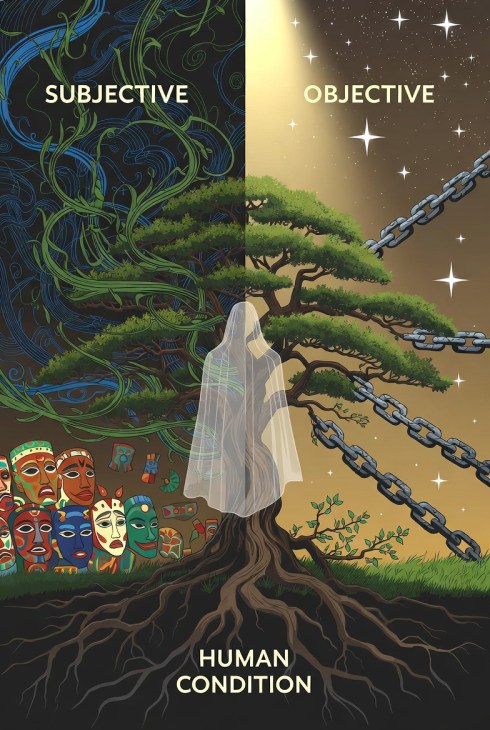
This is the space the binary argument overlooks. Morality does not have to be either fully objective in a metaphysical sense or entirely subjective and arbitrary. Most functioning moral systems occupy a middle ground. They are constructed and maintained through norms, institutions, and shared expectations, but they are also bounded by the conditions under which human beings live. We are vulnerable, dependent, and engaged in repeated interaction. Rules that exploit these conditions too aggressively tend to collapse under their own weight. Rules that can survive role reversal and long-term interaction tend to persist. They are not inevitable, but neither are they arbitrary.
The force of the “collapse into power” argument comes from its focus on weak forms of subjectivism. If morality is reduced to mere preference, then the conclusion follows quickly. But this is not how most moral reasoning operates in practice. Even absent a claim to objective truth, people appeal to considerations that go beyond preference: reciprocity, fairness, stability, and the costs of defection. These are not metaphysical foundations, but they are not empty either. They generate real limits on behavior and real expectations about what can be justified.
The question, then, is not simply whether morality is objective. That framing compresses too much into a single term. A more useful question is what constrains moral reasoning so that it does not collapse into preference or power. Rawls offers one answer in the form of symmetry under uncertainty. Ordinary social life offers another in the form of rules that must hold under repetition and reversal. Both point to the same underlying fact: moral systems are not free to take any shape whatsoever. They are limited by the requirements of justification and the conditions of human interaction.
This brings us back to the original feeling that something is off. That reaction often arises when a rule is applied inconsistently, when a principle shifts depending on who benefits, or when an argument demands compliance without offering a justification that would hold if positions were reversed. You do not need a fully developed moral philosophy to recognize that pattern. You only need to notice when the symmetry breaks.
Scientific objectivity does not require perfect scientists; it requires that their models survive contact with reality. Moral objectivity, if the term is to mean anything useful, does not require metaphysical certainty. It requires that the rules we live by survive contact with each other—across differences in position, power, and perspective. That is a narrower claim than the one often made in debate, but it is also a more defensible one.
Morality does not need to be written into the fabric of the universe to resist collapse. It needs something simpler: rules that can be justified without knowing who will bear their consequences, and that continue to function when they are applied to anyone over time. Once that is clear, the stark choice between objective truth and raw power begins to lose its grip. The problem is not that morality lacks a foundation, but that we often look for it in the wrong place.
Where This Goes Next
The question raised in the previous discussion—whether anything can meaningfully constrain our claims without collapsing into preference or power—does not end with morality.
It appears again, more sharply, in how we think about science itself.
If there is no constraint beyond social agreement, then scientific claims begin to look like moral ones at their weakest: negotiated, enforced, and revised under pressure. If there is a constraint, then we need to be precise about what it is and how it operates, because that distinction determines whether we are tracking reality or simply tracking consensus.
The essays that follow take up that question directly. They move from the same starting point—something feels off—to a clearer account of what, if anything, resists that collapse.











 bleatmop
 Mystro


 Dead Wild Roses
Your opinions…