
You are currently browsing the category archive for the ‘Culture’ category.
I have been a teacher for nearly twenty years, and one of the things we are purportedly supposed to teach is critical thinking. Yet I have rarely seen its meat and potatoes taught directly: how to examine a claim, distinguish evidence from inference, recognize our own incentives and ask what might prove us wrong. Epistemic hygiene seldom makes it to the table.
Knowing the difference between a transitive and intransitive verb is useful, but it does not teach someone how to interrogate their own cognition. Basic knowledge must come first because nobody can think critically about material they do not understand. After that, however, education often supplies more intricate content without spending much time on how beliefs are constructed, defended and corrected. Mastery means being able to teach the material reliably; thinking begins when you can examine its assumptions and identify what evidence would change your mind.
Genuine critical thinking—something different from applying the predetermined categories of critical theory—is harder still. On consequential subjects, truth must be extracted from incomplete evidence, interested testimony, competing interpretations and our capacity for self-deception. We are confirmation-seeking machines with an extraordinary ability to turn motivated reasoning into moral certainty.
My own intellectual progress—and I use the word progress lightly—began with enormous amounts of reading in my twenties and thirties: Noam Chomsky, Nick Turse, Chris Hedges, Naomi Klein, Arundhati Roy, Michael Moore and other writers overwhelmingly critical of the West, capitalism and American power.
Had I studied critical theory, dependency theory or post-colonialism, or grappled seriously with Derrida and Foucault? No. Nor had I read Milton Friedman or Friedrich Hayek; even now, I know much of their work through summaries rather than sustained engagement with the originals.
That was the trap. It was not that left-wing writers had gathered in a secret room and conspired to conceal their philosophical machinery. It was that the popular polemical writing I consumed rarely required me to inspect that machinery at all. Its conclusions arrived with their moral valence already installed. Capitalism was not merely an economic arrangement with strengths, failures and trade-offs; it was exploitation. Western power was not something to be judged according to particular actions and outcomes; it was presumptively imperial. Conservatives were not people advancing arguments I had considered and rejected. They were regressive people who wanted others to suffer.
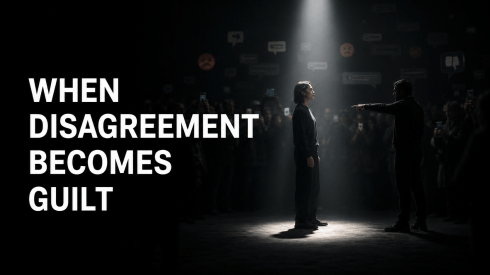
I had learned the conclusion—and the moral posture that protected it—before I understood the underlying dispute. Once that posture is established, disagreement no longer arrives as information. It arrives as evidence of guilt.
Consider a question that has become common in political conversation: “Surely you oppose the genocide Israel is committing in Gaza?”
It is grammatically a question but structurally a package of conclusions. Genocide is among the worst crimes human beings can commit; therefore, any decent person must oppose it. That part is easy. The difficulty is that the sentence quietly joins this uncontested moral premise to a disputed factual and legal conclusion: that Israel’s conduct in Gaza constitutes genocide.
To pause before accepting the second proposition is not to endorse dead civilians, starvation, collective punishment or war crimes. It is to ask whether the term has been established. Genocide requires specified acts accompanied by the intent to destroy, in whole or substantial part, a protected national, ethnic, racial or religious group. At the time of writing, the International Court of Justice has not issued a final judgment on South Africa’s case against Israel.
A responsible answer might begin: “I oppose genocide without qualification. I am not yet persuaded that genocide is the legally accurate description of Israel’s conduct in Gaza.”
Yet this distinction is often where the moral mechanism activates. Why are you reluctant to condemn genocide? How can you defend what Israel is doing? What kind of person needs more evidence while children are dying? The demand for factual discrimination is recoded as moral indifference, and uncertainty becomes complicity. If the exchange deteriorates far enough, racism, fascism and comparisons to Hitler soon follow.
Notice what has disappeared. We are no longer examining conduct, casualties, official statements or evidence of intent, nor distinguishing genocide from war crimes, crimes against humanity or the legally different consequences of urban warfare. The person who questioned the premise has been placed on trial instead.
Once you have been called a racist and had your ethical character placed under suspicion, what are you supposed to do? Real conversations occur within a social fabric of friendships, workplaces, institutions and reputations. People who know little about the original dispute still understand that proximity to an alleged racist can carry costs.
The rational response is often retreat: qualify what you said, apologize for how it was received or remain silent. None of this determines whether the original claim was true.
Being told to “do the work” can operate in much the same way. There are circumstances in which nobody is obligated to provide an introductory seminar to a belligerent stranger. But when someone advances a disputed public claim, the burden of supporting it does not transfer automatically to anyone who asks for evidence. “Educate yourself” is not an argument, and a reading list assembled entirely within one intellectual tradition is not a substitute for demonstrating the claim.
The accusation creates an enormous asymmetry. It takes seconds to call someone racist, transphobic, fascist or complicit in genocide. Answering may require reconstructing what was said, the evidence behind it and the distinctions being made. By then, the accusation has travelled farther than the rebuttal ever will. Whether intended or not, the effect disciplines everyone watching: this is what happens when the approved conclusion is questioned. What has been established is the price of examining it.
Social media does not create this mechanism, but it forms an unusually effective positive feedback loop around it. Ordinary conversation contains corrective signals: tone of voice, facial expression, hesitation, familiarity and the opportunity to clarify a sentence before it hardens into a verdict. Social media amputates those cues and places the exchange before an audience.
In its place, the platforms provide numbers. Likes, reposts, replies and impressions become crude heuristics for approval and importance, neither of which should be confused with truth. A careful argument that introduces uncertainty may appear weak beside a morally certain accusation that can be understood and shared in seconds. “That claim lacks evidence” requires examination. “You are a racist” requires only allegiance.
The economic structure reinforces the tendency. X allows eligible creators to earn money from content that generates impressions and interaction. Engagement measures activity, not truth value. A correction and a furious denunciation both count; the denunciation may travel farther because anger recruits participants more efficiently than qualification. Moral certainty produces engagement, engagement produces visibility, and visibility is mistaken for consensus.
None of this means moral judgment should be banished from argument. Some propositions are morally repugnant. An argument for racial supremacy, the deliberate murder of civilians or the legal subordination of women should be examined and condemned in moral terms. Refusing to make moral distinctions would not produce intellectual neutrality. It would produce moral cowardice.
The challenge is determining whether the judgment follows from honest examination or merely records our reaction to the person making it. The tribal animal in us is never far beneath the surface. When something important to our identity is questioned, we can experience disagreement as hostility, identify an enemy and begin assembling reasons why a bad person would say such a thing. Evidence is recruited for prosecution rather than examined for understanding.
This tendency is not confined to the activist left. Conservatives, religious communities, nationalists and every other group capable of forming a moral identity can protect their conclusions in the same way. The subject here is the moral vocabulary prevalent in contemporary progressive activism, not because progressives invented tribal cognition, but because terms such as racist, transphobic, fascist and complicit in genocide have become powerful instruments for enforcing its boundaries.
Some people earn those descriptions. The obligation is to demonstrate how. What exactly did the person claim? Was the disagreement factual, definitional or moral? What evidence supports the accusation? Are we applying the same standard to our allies? What would convince us that we had judged the person unfairly?
Charity does not mean weakening the conclusion until nobody can object to it, nor does it require endless patience with someone acting dishonestly. It means identifying the strongest fair version of an argument before criticizing it, locating the actual source of disagreement and leaving open the possibility that either participant may be wrong.
That final possibility is what the prefabricated moral accusation removes. Once disagreement proves guilt, the accuser no longer needs an error-correcting mechanism. The righteous cannot learn from the wicked; they can only expose, discipline or silence them.
The alternative is less emotionally satisfying and considerably more difficult. Return to the proposition. Separate the moral premise from the factual claim. Demand evidence without pretending that evidence eliminates moral responsibility. Judge conduct when the judgment has been earned, and remain willing to correct the judgment when it has not.
A society capable of disagreement must make room for people to be mistaken without making them monsters. Otherwise, moral language ceases to guide inquiry and becomes the means by which inquiry is brought to an end.
References
- International Court of Justice. “Application of the Convention on the Prevention and Punishment of the Crime of Genocide in the Gaza Strip (South Africa v. Israel).” https://www.icj-cij.org/case/192
- United Nations Office on Genocide Prevention and the Responsibility to Protect. “Definitions of Genocide and Related Crimes.” https://www.un.org/en/node/218413
- X Help Center. “Creator Revenue Sharing.” https://help.x.com/en/using-x/creator-revenue-sharing
Culture wars are easy to dismiss when your side is winning one.
The phrase suggests an artificial conflict manufactured by activists who cannot leave ordinary life alone. Yet every society teaches its members what is admirable, shameful, natural and just. The dispute begins when we ask who is doing the teaching—and what vision of society their institutions are working to produce.
Ideas hostile to the classical liberal principles upon which Western societies were founded have gained commanding influence across many of the institutions that produce and transmit culture. Schools, universities, publishers, arts organizations, media outlets and professional associations increasingly interpret society through categories of power, identity, oppression and liberation, while individual responsibility, equality before the law and freedom of conscience are treated with suspicion.
This did not happen because a secret committee issued instructions from a hidden room. Cultural change rarely works that neatly. People enter institutions carrying particular assumptions, hire and promote others who share them, reward work that conforms to the emerging consensus and gradually redefine what respectable people are permitted to believe. The framework also offers something many post-religious institutions lack: moral purpose, a vocabulary of sin and redemption, and a hierarchy of virtue in which conformity can be experienced as courage.
Over time, ideology becomes professional common sense.
To understand how this occurred, we need to return to a problem that confronted Marxists in the early twentieth century. Classical Marxism predicted that the working class in advanced capitalist societies would eventually rise against the bourgeois order. That revolution did not materialize in the industrial democracies of the West, where workers frequently remained attached to their countries, churches, families and inherited ways of life.
Antonio Gramsci, an Italian Marxist writing from a Fascist prison, attempted to explain why.
Gramsci argued that Western societies were not maintained by economic coercion or state violence alone. Their stability also depended upon what he called cultural hegemony: the network of institutions, customs and moral assumptions through which people came to regard the existing order as legitimate. Government possessed force, but civil society produced consent.
Churches, schools, universities, newspapers, unions, voluntary associations and intellectual institutions all helped form the common sense of the population. Together they created a protective structure around the political order, making a direct revolutionary assault far more difficult than Marxist theory had anticipated.
Gramsci did not leave behind a five-point infiltration manual. What he provided was more important: an explanation of why political revolution in the West required a prior struggle over culture. Before a movement could capture the state, it would have to establish intellectual and moral authority within civil society by cultivating its own educators, organizers, artists and “organic intellectuals.”
Gramsci called this prolonged cultural contest a “war of position.” Decades later, Rudi Dutschke gave a related strategy its memorable name: the “long march through the institutions.” The phrase was Dutschke’s, and direct intellectual transmission from Gramsci is disputed, but both recognized the same strategic reality: durable political transformation required sustained work within the institutions that formed public consciousness.
That contest has travelled a considerable distance. The economic categories of classical Marxism did not disappear, but they were joined by cultural categories drawn from race, sex, sexuality and identity. Society was increasingly interpreted as a struggle between oppressors and oppressed, while inherited norms and institutions were treated as mechanisms through which dominant groups preserved their power.
This is what I mean by cultural Marxism. Critics object that this is not orthodox Marxism, and they are correct in the narrow sense. It is Marxism adapted to a cultural register, retaining the moral architecture of oppressor and oppressed while changing the principal categories through which that conflict is understood.
This does not require an omnipotent conspiracy in which every progressive activist takes orders from a central authority. It describes the migration of Marxist habits of thought into the wider culture: the elevation of group identity over individual responsibility, the reduction of social relationships to power, the assumption that unequal outcomes demonstrate oppression and the belief that liberation requires the transformation of inherited institutions.
The institutional consequences are no longer theoretical. The Canada Council for the Arts explicitly applies equity principles across its funding programs and provides targeted support to designated priority groups. Its stated purpose is to correct persistent barriers, not to advance Marxism, but the policy illustrates how cultural resources are increasingly allocated through group-based concepts of equity rather than formally equal treatment. The Council describes that policy in its own terms.
Universities provide another measure of the emerging consensus. In a 2024 survey by the Foundation for Individual Rights and Expression, more than half of conservative faculty respondents reported at least occasionally concealing their political beliefs from colleagues to protect their careers. That does not prove that every campus has become ideologically uniform, but it does show that institutional culture can impose professional costs without requiring formal censorship. FIRE’s faculty report documents the wider pattern.
Politics lies downstream of this cultural formation. People arrive at elections with moral intuitions already shaped by the stories they have encountered, the history they have been taught and the institutions they have learned to trust. If children encounter Western civilization primarily through slavery, colonialism, racism and exclusion, they should not surprise us by concluding that their inheritance is uniquely shameful.
Those failures belong in the historical record and must not be concealed. Progressives can reasonably argue that many institutional changes corrected genuine exclusions, and they are right. Western societies did not always honour their own principles, while appeals to tradition sometimes protected injustice.
The dividing line is not whether institutions may change. It is whether reform extends liberal principles to people previously denied them or replaces those principles with group entitlement, inherited guilt and political tests. A civilization taught only through its crimes does not produce citizens equipped to improve it; it produces citizens emotionally prepared to repudiate it.
Classical liberals and conservatives have too often responded downstream. They pour money into elections, policy organizations, advertising and social media campaigns while giving comparatively little attention to the institutions that form political instincts before a campaign begins. They criticize ideological films without supporting better filmmakers, mock politicized novels without helping dissenting writers reach readers and complain about educational capture without cultivating teachers capable of presenting a richer account of Western history.
They are searching beneath the political streetlamp because that is where the light is better, even though the cultural keys were lost somewhere else.
Winning a culture war therefore requires more than defeating a candidate or exposing the latest ideological absurdity. Writers, filmmakers, musicians, teachers, publishers and artists who value freedom need patrons, professional networks, durable institutions and routes to an audience. Expecting every dissenting creator to finance, market and distribute his own work while established institutions subsidize the prevailing orthodoxy is not a serious cultural strategy.
This does not mean manufacturing classical liberal propaganda. Ideological art remains ideological art regardless of which side produces it, while characters who exist only to recite correct opinions are no more compelling when those opinions happen to be ours. The alternative culture must succeed as culture: truthful about human nature, alive to tragedy, unafraid of beauty and capable of showing why freedom is both valuable and demanding.
It must also teach Western history honestly enough to acknowledge cruelty and failure while explaining the development of individual rights, constitutional government, scientific inquiry, religious toleration and equality before the law. Positive cultural confidence does not require collective innocence, because a mature society can admit what its ancestors got wrong without pretending they built nothing worth inheriting.
Nor does national pride require hostility toward other peoples. It means recognizing that a country and civilization can possess a distinctive inheritance worthy of gratitude, stewardship and improvement. We can criticize our institutions while remaining committed to them, correct injustice without abandoning individual responsibility and reform society without teaching people to hate it.
The alternative offered by revolutionary politics is not merely reform at a faster pace. A movement that treats individual rights, procedural neutrality and freedom of conscience as instruments of oppression cannot be trusted to preserve those protections after acquiring power. Activists who regard institutions principally as weapons against their enemies may discover that revolutionary institutions have little tolerance for activists once the revolution is complete.

The proper response is not to imitate that illiberalism from the Right, but to contest the culture while remaining faithful to the classical liberal order we are trying to defend. That requires recovering the confidence to say that Western civilization, although imperfect, has produced achievements worth preserving; that freedom is more than camouflage for power; and that individuals cannot be reduced to racial, sexual or economic categories.
Politics still matters, but it cannot permanently defend principles that the culture has taught people to despise. If we want different political outcomes, we must begin further upstream, in the institutions and stories that teach each generation what is true, what is admirable and what kind of society deserves to survive.
Final installment of a fictional composite in three vignettes about a girl coming of age under Taliban rule.

III. The Room Where They Discussed Me
The men came after evening prayer, when the bread cloth had already been shaken clean and folded.
My mother knew before they knocked. I could tell by the way she moved through the room, touching things that did not need touching: the cups, the kettle, the edge of the mat near the wall. She wiped the same place on the tray twice, then held it toward the lamp as if dust might have hidden there deliberately.
“Put on the blue dress,” she said.
I was rinsing lentils, and the water ran brown over my fingers.
“The blue one?”
She did not look at me. “Yes.”
The blue dress was folded beneath my winter shawl. I had worn it for Eid two years ago, when it still hung loose and my aunt said I would grow into it. I had grown. Now the sleeves stopped too high and the seam pulled under one shoulder, as if the dress itself knew I was no longer the girl it had been made for.
I changed behind the hanging cloth near the sleeping mats. When I came out, I saw my school shoes behind the water jar and nearly moved them, not because they were in the way, but because they looked like they belonged to someone who had expected morning to keep its promises.
Then the knock came.
My father opened the gate himself.
There were three men: my uncle, a man with a square beard and soft hands, and an older man I had seen twice near the mosque gate. They entered with the careful heaviness of men who expect a room to make space for them before they sit.
My mother sent me for tea.
The cups rattled once on the tray. I stopped walking until they stilled, then carried them in with both hands.
My father sat nearest the lamp, my uncle beside him. The man with soft hands sat opposite them, his knees wide beneath his coat, while the older man leaned on a stick and watched everything without appearing to watch.
At first they did not say my name.
They spoke about families, wheat, work, reputation, a cousin in another district, a man who had gone to Pakistan and returned with money, the price of flour, the danger of waiting too long. My uncle laughed once and said girls were like fruit; a father should not leave them where the weather could reach them.
The men smiled at that. My mother kept her hands around the teapot.
I placed the tea in front of them, starting with the oldest man because my mother had taught me the order years before. My hand passed through the lamp light, and the blue sleeve pulled tight at my shoulder.
The man with soft hands looked at the cuff, then at my face; not long, but long enough for the room to notice.
“She is modest,” my uncle said.
My father nodded.
The man asked how old I was, and my father answered before I could breathe. The number sounded smaller in his mouth, flattened and carried away from me as if it belonged to a household account, not to a person.
The man stirred his tea though there was no sugar in it. “Young girls learn a house more easily.”
My uncle said something agreeable, and the older man with the stick tapped the floor once, not loudly, only enough to remind everyone that he remained part of the judgment.
I stood with the empty tray against my stomach until my father looked at me and said, “Go help your mother.”
In the kitchen, my mother had both hands flat on the table. The lentils sat in the bowl, half-rinsed, while water dripped from the edge one slow drop at a time. I put the tray down, and she reached for a cloth, missed it, then found it with her other hand.
“Am I to be married?” I asked.
She wrung the cloth once. Brown water ran into the bowl.
“Your father is speaking.”
That was not an answer, which was how I knew it was one.
I wanted her to turn around and say no, or not yet, or I will speak to him, or I will stand in the door and not move. I wanted her to become larger than the room, larger than the men, larger than whatever law had made her small before I was even born.
Instead she wiped the table.
“They say he has work,” she said.
“Who?”
She folded the cloth, unfolded it, then folded it again.
“The son.”
“How old?”
Her fingers stopped.
“Older.”
From the front room came laughter. My father’s laugh arrived last, careful and low.
“Does he know about me?” I asked.
My mother finally turned. For a moment anger crossed her face, but it did not know where to go and found no door.
“Do not speak foolishly.”
I lowered my eyes.
She reached for my wrist. Her fingers closed, then loosened. When I was small and feverish, she used to hold my wrist while counting my pulse; I remembered waking in the night with her beside me, lips moving in prayer, thumb soft against the inside of my arm. Now her hand rested in the same place as if she were checking whether I was still there.
The older man called for more tea.
My mother let go.
The second time I entered, the room had grown quieter.
A paper had appeared on the mat. Not an official paper, not yet, but folded and smoothed, with names spoken over it as if speaking could make them settle. My father had taken the good pen from the shelf, the one he used only for serious things: debts, letters, forms, names that needed to remain after the voice was gone.
My uncle was saying that a girl is safest under the authority of a husband. The man with soft hands said his son was firm but fair. The older man said a wife learns.
I set down the cups.
My father’s pen rolled toward the edge of the paper, and I caught it before it fell.
For one second I held it.
The pen was heavier than my pencil had been: black lacquer, silver clip, my father’s name scratched faintly near the cap. Every man in the room saw it in my hand, and the seeing itself became another instruction.
I placed it beside the paper. My father picked it up without touching my fingers.
“She reads well,” my uncle said, as if apologizing for me.
The man with soft hands gave a small smile. “Reading is useful for children. A wife needs other skills.”
The older man tapped his stick again, and my father did not look at me when he told me to go.
I went back to the kitchen and stood beside the wall where the plaster had cracked. My mother was pouring hot water into the teapot. Steam rose between us, softening her face and disappearing before it reached the ceiling.
“I do not want this,” I said.
The steam moved.
My mother closed the teapot lid.
“You do not know what this is.”
“I know enough.”
Her voice sharpened, then fell at once as she looked toward the front room. “You know books. You know school. You know words. That is not the same as knowing what happens when men decide you are disobedient.”
A sound came from the front room: paper lifted, folded, unfolded.
I thought of my notebook beneath the books in the chest, the broken pencil wrapped in cloth, the shoes behind the water jar. All my little hidden things, gathered like crumbs.
The older man called my father’s name.
My mother took my face in both hands, startling me because she had not done that in years. Her palms were warm from the teapot, thumbs resting just below my cheekbones as if she could hold my whole future there if she pressed carefully enough.
“Listen to me,” she whispered. “If they ask you anything, lower your eyes.”
“No.”
The word came out before I could catch it.
My mother’s fingers tightened against my face. Her eyes filled so quickly it frightened me.
“Do not make them hear you,” she said.
The front room went quiet.
We both heard it.
She let go and turned toward the stove. I picked up the tray because my hands needed to be doing something, and because if hands are busy, sometimes the mouth remains closed.
When I entered, the men were watching.
The older man gestured toward the space near the door. “Come here.”
I obeyed, not because I wanted to, but because my feet had learned obedience long before my mouth began objecting to it.
The man with soft hands looked at me with the mild patience people use for animals they expect to behave.
“Your father has spoken well of you,” he said.
I looked at the edge of the mat.
“You are obedient?”
My father answered.
“She is.”
The man waited. Perhaps he wanted to hear my voice; perhaps he wanted only to see whether I understood where to place it. Behind me, in the doorway, I could hear my mother breathing.
The room held still around my silence until the older man nodded.
“Good.”
Something moved from my father’s side of the mat to the other man’s: not money exactly, or not only money. A folded cloth. A small packet. Words about timing, honour, God, safety, duty. Words that passed above my head and landed on the paper.
The pen scratched. My father’s hand moved.
My name appeared where I had not written it.
Zahra.
Upside down, it looked like someone else’s name.
The men drank their tea. The man with soft hands asked if I could cook rice properly; my uncle said my mother had trained me well, and the older man said too much education made girls restless. Everyone agreed in different ways, some with words and some by letting the words stand.
I remained near the door until my mother touched my elbow.
In the kitchen she took the tray from me before I dropped it. Only then did I realize my hands were shaking.
“Sit,” she said.
I sat on the floor beside the lentils. The bowl was still there, the water settled now, with a few pale skins floating on the surface.
My mother crouched in front of me, her knees cracking softly.
“There may still be time,” she whispered.
She did not say for what.
Time to persuade him. Time to delay. Time to fold another dress. Time to teach me which silences keep bones unbroken.
From the front room came my father’s voice, lower now, serious in the way men sound when they believe they are protecting what they own.
The men stayed a long time.
When they finally left, my father walked them to the gate. I heard the scrape of sandals, the murmur of farewells, the older man’s stick striking the ground three times before the latch closed again.
My father returned with the good pen in his hand and placed it on the shelf.
No one spoke.
My brother had slept through most of it. He woke when the room quieted, rolled over, and asked if there was bread left. My mother gave him some. He ate with his eyes half closed, and a crumb fell onto his schoolbook, where it sat on the open page until the lamp smoked and the room darkened around it.
Later, after the lamp was lowered and my father lay down with his back to the room, my mother came to my mat. She knelt beside me and tucked the blanket near my shoulder, though I was too old for that and the night was not cold.
“I will speak to him tomorrow,” she whispered.
Her voice sounded as if it had travelled a long way to reach me.
I nodded.
She touched my hair once through the blanket, then went back to her place.
I waited until the house settled.
The chest opened with its small complaint. I paused, listening, then reached inside and found the notebook beneath the books. My broken pencil was still wrapped in the scarf. I had sharpened it badly with the kitchen knife two days before, and the wood was uneven under my fingers.
I sat by the wall while the room held the evening’s remains: lamp smoke, lentils, men’s tea, and the dust their shoes had brought in.
For a long time I did not write.
At last, I put the pencil to the page.
Today they discussed me.
The words looked too small for what had happened, so I tried again beneath them.
They asked whether I was obedient.
The pencil left a dark point on the page where my hand rested too long.
I wanted to write that I had said no, but I had not said it where it mattered. I had said it in the kitchen, into steam, into my mother’s hands, into the narrow space before fear entered the room.
I turned the page.
Outside, beyond the courtyard wall, something moved in the lane: a man’s voice, a cough, a door closing. Farther away, boys would be sleeping before school, their books thrown wherever their hands had dropped them.
I wrote one more line.
I was in the room.
Then, after a while, I added:
No one asked me to sign.
The pencil point held.
I closed the notebook and wrapped it in the scarf, but did not put it back at once. I held it against my chest until the hard edge of the cover pressed into my ribs.
Behind the water jar, my school shoes waited in the dark. I looked at them for a long time and understood, finally, that they were not waiting for morning anymore.
I placed the notebook beside the shoes.
Not hidden. Not exactly. Just with the other things that had belonged to the girl I was before men sat in a room and decided what to call my future.
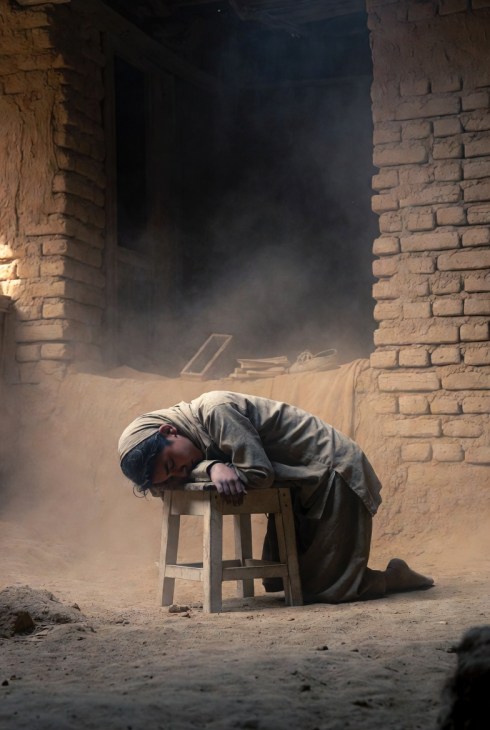
Zahra is fictional. But the wall is real.
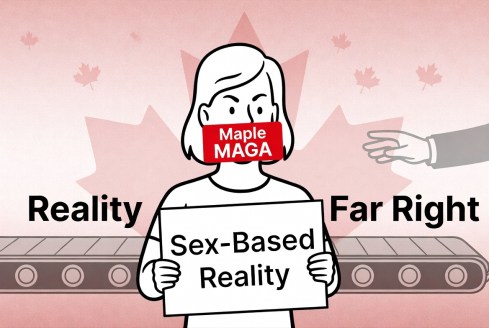
I have been called “Maple MAGA.”
It is a silly phrase, but not an innocent one. Imported American static with a Canadian toque pulled over it, the label works less as description than as sorting device: once attached, it tells the room what to do with the person before anyone has to answer what he said. That is its usefulness.
The charge, as far as I can tell, is not that I am secretly American, or that I want Donald Trump to annex the Prairies, or that I am pining for red hats on Parliament Hill. It is not that I support theocracy, oppose women’s education, or want priests running the courts.
The charge is simpler. I keep saying things that no longer sit comfortably inside the approved progressive frame.
 I defend freedom of expression, especially when the expression is rude, inconvenient, unfashionable, or badly timed. I think women and girls have sex-based rights that cannot be wished away by therapeutic language. I think female prisons should be for female prisoners. I think children should not be hurried into irreversible medical pathways to satisfy adult ideology. I think citizens should be free to read, think, doubt, argue, dissent, and change their minds without the state, the school board, the professional college, or the HR department treating their inner life as a compliance problem.
Apparently, this is enough now: not enough to make one wrong, which would require an argument; not enough to make one dangerous, which would require evidence; but enough to make one “far right,” “MAGA,” “reactionary,” “unsafe,” or whatever label is currently doing the work reasons used to do.
The insult is the visible part. Underneath it sits the relocation of the acceptable centre.
Cultures move. Language changes. Laws change. Public taste changes. Some changes are good and overdue; some are foolish; some begin as compassion and harden into coercion. There is nothing sacred about yesterday’s vocabulary merely because it is yesterday’s vocabulary, but cultural movement does not move reality.
That distinction is now being blurred. It is one thing for a society to change how it talks about sex, gender, identity, offence, harm, safety, and inclusion. It is another thing to pretend the underlying truths have changed because the approved language has changed.
A male body in a female prison does not become a female body because a policy manual has been updated. A teenage girl’s distress about her body does not become simple proof of a medical destiny because a professional association has learned a new script. A citizen’s refusal to repeat an ideological formula does not become hatred because an HR department calls the formula kindness.
The culture can change what is rewarded, what is punished, who gets invited to speak, who gets reported, who gets promoted, who gets quietly avoided, and who gets labelled a problem; it cannot change the truth.
Female prisons make the point concrete because, for most of living memory, saying that female prisons should be for female prisoners was not a right-wing position. It was barely a position at all. It sat in the background with other obvious assumptions: women’s shelters are for women, women’s sports are for women, and sex matters most in the places where privacy, vulnerability, male violence, and bodily difference are not abstractions.
“There is nothing sacred about yesterday’s vocabulary merely because it is yesterday’s vocabulary, but cultural movement does not move reality.”
Prisons are coercive institutions. Women inside them cannot simply leave, choose their neighbours, or opt out of policy experiments designed by people outside the walls. The state therefore has a heightened duty of care. Sex matters there; it matters when privacy is stripped away, when physical power is uneven, when trauma is common, and when the people affected have no meaningful escape route.
Yet once the vocabulary changes, the old safeguarding claim can be redescribed as extremism. Not because women became less vulnerable in prison, male-pattern violence disappeared, or sex stopped mattering in confined spaces; the argument is recoded because the permitted moral language changed around it.
This is the trick: move the official language, then treat unchanged reality as if it has been morally superseded.
The same pattern appears elsewhere. Free expression becomes “harm.” Privacy becomes “suspicion.” Doubt becomes “denial.” Genuine distress in young people is real, and compassion for it is necessary; but caution in youth medicine is not cruelty, and weak evidence does not become strong because the approved language insists it must. Refusing compelled belief becomes bigotry. The old liberal question — “Is this true, and may I say so?” — is replaced by a managerial one: “Does this comply with the approved moral vocabulary?”
There is a Gramscian flavour here. Gramsci understood something real about modern power: it does not operate only through police, courts, elections, and parliaments. It operates through culture; through schools, media, churches, universities, publishers, artists, professional bodies, and the people who teach society what respectable people are supposed to think.
Durable victory requires more than capturing the state; it requires shaping common sense. That is the part that feels familiar now: a workshop here, a policy update there, a glossary, a training module, a revised professional standard, a grant condition, a reputational warning. No jackboots required. Just enough pressure to teach ordinary people which sentences now come with consequences.
Most people understand the lesson. They have jobs, families, colleagues, reputations, mortgages, volunteer roles, and professional obligations. They do not want to be called hateful, unsafe, extremist, bigoted, MAGA, or far right; they do not want to become the example everyone else is warned about. So they move, or they fall silent.
Then comes the strange inversion. People who have not changed their minds are told they have moved to the far right. The old centre is renamed after the fact; positions that were once liberal, feminist, or civil-libertarian are reclassified as dangerous because the institutions around them have adopted a new script. The people did not move so much as find the centre moved around them.
That is why “Maple MAGA” is such a convenient little insult. It imports the emotional charge of American polarization and drops it onto Canadian disagreement. It lets the speaker skip the local argument: no need to examine the claim, no need to ask whether an older feminist concern might still be true, no need to wonder whether a civil-libertarian objection might have merit. The label supplies the answer before the question is allowed to form.
“Once that habit takes hold, precision disappears. These words become atmospheric; they create suspicion, not understanding, and suspicion is often all that is needed.”
This is especially poisonous in Canada, where we already borrow too many American reflexes. We take American slogans, American moral panics, American partisan categories, American racial scripts, American activist vocabulary, and American media obsessions, then pretend they map cleanly onto Canadian life. Usually they do not; but they are emotionally efficient, and that is often enough.
Once that habit takes hold, precision disappears. “MAGA” no longer means a specific American political movement. “Far right” no longer means a coherent political position. “Unsafe” no longer means a demonstrated danger. These words become atmospheric; they create suspicion, not understanding, and suspicion is often all that is needed.
A person does not have to be refuted if he has already been made socially radioactive. His argument does not have to be answered if the room has been taught to flinch before hearing it. That is the quiet power of these labels: they replace disagreement with contamination.
A free society cannot keep doing that and remain free in any serious sense. It cannot function if disagreement is treated as pollution, cannot remain liberal if every objection is recoded as harm, and cannot reason together if words are used to end thought rather than sharpen it.
Some people really are extremists. Some movements really are dangerous. Some ideas really do deserve fierce opposition; there is no virtue in pretending otherwise. But when the label comes before the argument, the argument never happens. Civic life begins to rot not when people disagree, but when they lose the habit of believing disagreement deserves an answer.
So no, I am not especially interested in proving that I am not “Maple MAGA.” The phrase is too silly to deserve that much respect. I am interested in why so many people now reach for labels instead of reasons: how free expression became suspect, how female rights became reactionary, how cognitive liberty became dangerous, and how ordinary citizens were told that standing still meant they had somehow moved to the far right.
The institutions moved the language, then pretended they had moved reality.
That is the lie at the centre of the whole exercise.
References / Further Reading
Correctional Service Canada — Commissioner’s Directive 100: Gender Diverse Offenders
Canada’s federal correctional policy on gender-diverse offenders, including placement according to gender identity or expression.
UK Ministry of Justice — New Transgender Prisoner Policy Comes Into Force
The 2023 England and Wales policy restricting placement of some transgender-identifying males in women’s prisons.
The Cass Review — Final Report
The 2024 independent review of gender identity services for children and young people in England, especially useful for the essay’s caution-in-youth-medicine point.
Ipsos Canada — Strong Majority of Canadians Continue to Support 2SLGBT+ Rights and Visibility
Useful public-opinion context showing broad support for LGBT rights alongside lower support for gender-identity-based rules in women’s sport.
Intersectionality was supposed to widen moral vision. It was supposed to help us notice people whom ordinary politics missed: the poor, the powerless, the socially disposable, the ones institutions found easy to ignore. In the UK grooming-gang scandals, fashionable activism too often managed the reverse. It did not merely fail to see vulnerable girls clearly. It helped teach institutions which facts were too dangerous to see.
“The answer is equality under reality. No exemptions. No euphemisms. No protected categories of fact.”
That failure has affected women and girls in the UK directly, and it still has to be discussed.
This is not a claim that every feminist organization said nothing. Some did necessary frontline work. Some supported survivors. Some backed reinvestigations, better data collection, and reforms to the criminal justice system. But institutional service provision is not the same thing as public moral leadership. When thousands of girls were exploited, trafficked, raped, dismissed, and disbelieved, the response from much of fashionable feminism was nowhere near equal to the horror. There was no great reckoning. No sustained mass campaign. No “believe these girls” moment of the kind the activist class knows perfectly well how to create when the story fits its preferred map.
And that is the point. The facts crossed the wrong political wires.
 Many of the victims were poor, working-class girls. Some were in care. Many had already been written off as difficult, damaged, promiscuous, unreliable, or not worth the trouble. They were exactly the kind of girls feminism should have defended without hesitation. But in several major local scandals, the perpetrators did not fit the easier script. Naming patterns around ethnicity, culture, community silence, misogyny, and institutional cowardice risked giving ammunition to the wrong people. So the moral machinery jammed.
The official record is blunt enough. In Rotherham, the Jay report estimated that around 1,400 children were sexually exploited between 1997 and 2013. It described girls raped by multiple perpetrators, trafficked between towns, threatened with guns, beaten, intimidated, and treated with contempt by police and other adults who should have protected them. The report also recorded institutional nervousness around naming perpetrators’ ethnic origins, including concern that doing so would be seen as racist or damage community cohesion.
A decade later, the Casey audit found that the problem had not been honestly mastered. Ethnicity was still not recorded for two-thirds of perpetrators in the national data. National evidence remained too poor to support simple claims, but local evidence from several force areas showed enough disproportionality involving Asian and Pakistani-heritage men to require further examination. Casey’s point was not racial blame. It was moral adulthood: refusing to examine these questions fails victims and leaves the field open to political extremists.
This is the coalition-protection filter in bureaucratic form. Under it, facts are no longer first tested by whether they are true. They are tested by whether they protect the approved political coalition. Will this strengthen the anti-racist narrative? Will it risk “Islamophobia”? Will the far right use it? Will it embarrass multicultural institutions? Will it complicate the story activists prefer to tell about power?
Those concerns are not invented from nothing. Bad actors do exploit real suffering for ugly ends. Racists have used these scandals to smear entire communities, and that should be rejected plainly. But the existence of bad actors cannot become a veto over truth. A fact does not stop being true because a deplorable notices it. A victim does not become less abused because her testimony is politically inconvenient. When that becomes difficult to say, fashionable intersectionality has moved from caution into moral irresponsibility.
At its best, intersectionality noticed that vulnerability is not always single-file. A poor girl in care is not simply “female.” She is female, poor, young, institutionally dependent, socially disposable, and already mistrusted by the adults around her. A serious intersectional feminism should have seen these girls with devastating clarity.
Too often, activist intersectionality became something else: an oppression-ranking system that sorted people into moral categories before listening to them. It encouraged activists to ask not “What happened?” but “Which group has more structural power?” Some vulnerabilities became politically legible; others became inconvenient noise. When the victim map and perpetrator map did not align cleanly, the abused girls were pushed behind the narrative.
That is an evasive machine, built to blur moral accountability and weaken allegiance to truth.
Oppression-based claims become dangerous distortions of reality when they stop being tested as claims and start being treated as moral credentials. They are not insight by default. They are not evidence by default. They are not compassion by default. A theory of power that cannot survive contact with awkward facts is not a serious moral framework. It is a shield.
In the grooming-gang scandals, the cost of that distortion was not academic. Girls paid when police treated them as troublemakers. They paid when social services minimized what was happening. They paid when officials avoided naming patterns for fear of racism accusations. They paid when public institutions became more anxious about community cohesion than child protection. And they continue to pay when debate is still diverted away from truth and toward reputation management.
The answer is not racial blame, collective guilt, or the lie that all abuse belongs to one community, one religion, or one ethnicity. That would be false and unjust.
The answer is equality under reality.
“Oppression-based claims become dangerous distortions of reality when they stop being tested as claims and start being treated as moral credentials.”
If white men offend, name it. If Pakistani-heritage men offend, name it. If institutions fail because of sexism, say so. If they fail because of class contempt, say so. If they fail because officials are frightened of being called racist, say so. If cultural attitudes toward women, outsiders, shame, honour, or sexual entitlement play a role in a specific pattern of offending, investigate it honestly. No exemptions. No euphemisms. No protected categories of fact.
Truth-based analysis is not cruelty. It is the minimum requirement for justice.
The girls failed by these scandals did not need a theory that arranged them neatly inside an activist diagram. They needed adults who could see them, believe them, protect them, and tell the truth about what had been done to them.
Intersectionality promised to see the overlooked.
These girls were overlooked anyway.
That should shame everyone who claims to care about women.
“The failed attempt to criminalize “denialism” should not end the argument. It should begin a more honest one.”
Canada has just been given a useful lesson in how not to defend historical truth.
A Senate committee recently amended Bill C-9, the federal government’s anti-hate bill, to include a new offence for “residential school denialism.” The amendment passed committee by a vote of 7–1, then failed in the full Senate by a vote of 41–32. The broader anti-hate bill continued, but this particular amendment was defeated.
That defeat matters, but not because the residential school system was harmless, invented, or benign. It was not. More than 150,000 First Nations, Inuit, and Métis children attended residential schools, often far from their families and communities. The National Centre for Truth and Reconciliation describes the system as explicitly designed to separate Indigenous children from their families and cultures.
The historical record is ugly: forced removal, family rupture, cultural suppression, underfunded institutions, abuse, neglect, disease, and deaths are not fringe claims. No serious account of Canadian history should pretend otherwise.
But seriousness cuts both ways. The record is not made more honest by flattening it into a morality play. Some former students did gain literacy, language skills, vocational training, religious formation, discipline, shelter, or relationships with individual staff who treated them decently. Some may have experienced school as an escape from poverty, instability, disease, or family circumstances that were already difficult. Those facts do not redeem the system. They do not cancel forced removal, cultural suppression, abuse, neglect, or death. But they do belong in the record, because truth does not improve when inconvenient evidence is treated as betrayal.
That is why criminalizing “denialism” is such a dangerous move.
What exactly would the law punish? Denying that residential schools existed? Denying that abuse occurred? Denying that children died? Questioning a specific claim about a specific site? Asking whether a radar anomaly is a confirmed grave? Objecting to the phrase “mass grave” where no excavation has confirmed one? Disputing the legal or moral use of the word genocide? Challenging a death count?
These are not all the same act, morally or historically. A liberal society should be extremely careful before treating them as if they belong in the same criminal category.
This is where the Streisand effect begins. Tell citizens that a subject is so sacred it may need criminal protection from questioning, and many will not become more trusting. They will become more curious. Worse, they will start to wonder what parts of the official story cannot survive scrutiny without a law standing guard.
Some of that suspicion will be crude, resentful, or motivated by bad faith. There are people who would like to minimize the residential school system because they do not want Canada, churches, or public institutions to bear moral responsibility for what happened.
But not all skepticism is denial. Some of it is ordinary democratic distrust, especially when public history becomes entangled with settlements, land claims, curriculum mandates, activist organizations, government funding, institutional prestige, and careers built around a particular moral narrative. Once those incentives exist, citizens are entitled to ask for precision.
Canada does not need denial. It also does not need another official morality play. It needs a deeper reckoning with the residential school period than our public institutions often seem willing to allow. That means holding several truths in view at once: the system involved coercion, assimilation, family rupture, abuse, neglect, disease, and deaths; some students also received education, training, religious formation, shelter, or stability they may not otherwise have had; some claims are well established, some are plausible but unverified, and some have been rhetorically inflated beyond the evidence.
A serious country should be able to say all of that without reaching for the Criminal Code.
The better answer is evidence: open archives, careful forensic verification, precise death counts, and honest distinctions between confirmed graves, suspected burials, cemetery sites, radar anomalies, neglect, abuse, disease, and deliberate killing. The documented record is already ugly enough. It does not need exaggeration, and it does not need state protection from hard questions.
If the story is true, it does not need blasphemy law. If parts of the story have been overstated, then criminalization only delays the reckoning Canada eventually has to have.
The state cannot protect historical truth by owning permissible memory. It can only make the eventual reckoning harder.
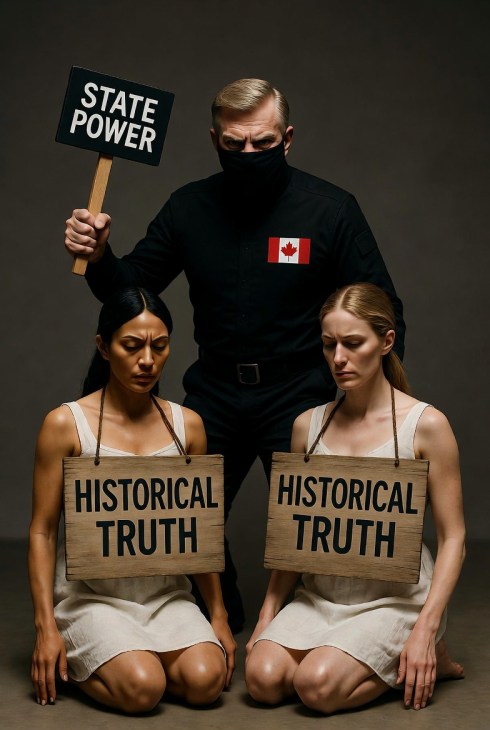
Historical truth does not become more trustworthy when the Criminal Code stands behind it.
“White people don’t get to decide what’s racist.”
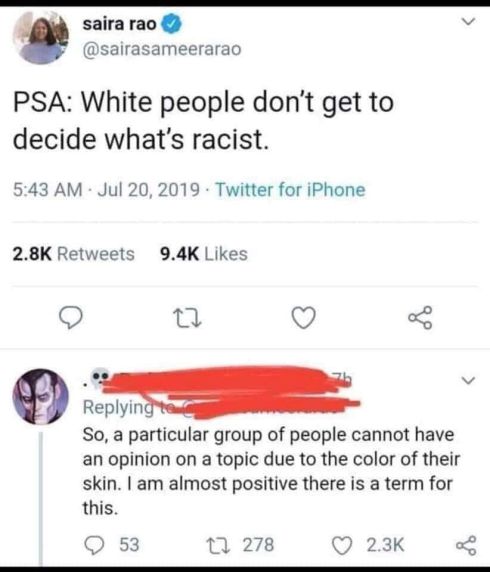
At first glance, this sounds like a demand for humility. And humility is not a bad thing. People can miss harms they do not personally experience. They can mistake comfort for neutrality. They can ignore patterns because those patterns do not touch them directly. Any honest account of racism has to leave room for that.
But the sentence does more than ask for humility. It draws a racial boundary around moral reasoning. It says that one group of people is not merely fallible, not merely prone to blind spots, but disqualified from judgment by birth.
That is where the sentence stops being a plea for listening and becomes something else. It becomes racial gatekeeping presented as moral expertise.
The screenshot is useful because it shows several aspects of critical theory coming into contact with the real world. Not in a seminar room. Not in a carefully footnoted academic paper. In the wild, where theory has been stripped of caveats, flattened into slogans, and handed to people who often have no idea where their fractured knowledge comes from or how badly it is being misused.
Most people who make these arguments are not theorists. They are downstream consumers of theory. They have inherited conclusions without the arguments, moral reflexes without the limits, and social weapons without the instruction manual. What reaches them is not a coherent philosophy but a cluster of habits: centre marginalized voices, listen and learn, impact matters more than intent, racism equals power plus prejudice, disagreement is fragility, demands for evidence are suspect, and dominant groups must defer.
Each of those claims contains a partial truth. That is why the machinery works.
People do have blind spots. Power does matter. Lived experience can reveal things outsiders miss. Social systems can produce unequal outcomes without anyone needing to wear a cartoon villain costume. A liberal society that cannot admit any of that becomes shallow and self-protective.
The problem begins when those partial truths become untouchable rules.
How the Move Works
The first assumption smuggled into the sentence is that racism is not primarily a judgment, action, belief, policy, habit, or pattern of unfair treatment. It is treated as an invisible mechanism operating beneath society. In this case, the mechanism is systemic racism: a hidden structure said to explain disparities, conflicts, speech, institutions, motives, and disagreement before any particular claim has been examined.
Again, systems are real. Institutions can produce patterns. History does not disappear because someone wants the conversation to be more comfortable. But in popular use, the mechanism often becomes unfalsifiable. If a disparity appears, the system explains it. If someone questions the explanation, the questioning becomes further evidence of the system. If a member of the alleged oppressor class objects, the objection is interpreted as fragility, denial, privilege, or complicity.
The claim no longer has to survive ordinary examination. The theory has already decided what resistance means.
“Unfalsifiable: a claim that cannot be proven wrong because every objection is reinterpreted as proof of the claim.”
The second assumption is that this mechanism can only work in one direction. This is where the “racism equals power plus prejudice” formula enters the bloodstream. In ordinary moral language, racism means judging, mistreating, excluding, or degrading people because of race. But under the power-plus-prejudice formula, racism is redefined so that only groups with systemic power can commit it. Members of designated oppressor classes can be mocked, stereotyped, excluded, insulted, or judged by race, but the framework classifies this as something other than racism because they occupy the wrong place in the hierarchy.
That is why “white people don’t get to decide what’s racist” can be treated as anti-racist rather than racial. The rule has already been made unequal.
The third assumption is epistemic. The oppressed are said to possess a kind of dual insight into how the system works. They understand their own experience from below, but they also understand the dominant group because they are forced to navigate its rules. The dominant group, by contrast, is presumed to be trapped inside its own power. It cannot see clearly because its comfort depends on not seeing.
There is a reasonable insight here. People lower in a hierarchy may notice pressures and hypocrisies that people higher up never have to think about. A worker may understand the boss’s rules better than the boss understands the worker’s life. A minority may notice social frictions the majority can glide past without naming.
But once that insight hardens into authority, the conversation changes. Standpoint stops being evidence offered into a common search for truth and becomes a credential. The person assigned to the oppressed position is treated as uniquely insightful. The person assigned to the oppressor position is treated as morally and intellectually compromised. At that point, argument no longer proceeds by shared standards. It proceeds by status.
You are no longer in a discussion. You are in a permission system.
“Permission system: a social rule where some people are allowed to define the issue, while others are expected only to listen, confess, or defer because of identity.”
This is the part ordinary people often sense but struggle to name. They think they are being invited into a moral conversation. In reality, every normal question has already been assigned a guilty interpretation.
They ask, “Isn’t it wrong to judge someone by skin colour?”
The answer comes back: “You do not get to decide that.”
They ask, “Shouldn’t the same rule apply to everyone?”
The answer comes back: “Equality language protects privilege.”
They ask, “Can we examine the evidence?”
The answer comes back: “Your demand for evidence is part of the problem.”
They ask, “How would this claim be proven wrong?”
The answer comes back: “That question itself shows your investment in domination.”
 Once this frame is accepted, the target cannot really answer. Refusal confirms guilt. Confession confirms guilt. Silence confirms guilt. Disagreement confirms guilt. The accusation is insulated from ordinary scrutiny because the mechanism is said to operate invisibly in the background, and only the approved interpreters are permitted to describe it.
That is why these encounters feel so maddening to normal people. They think they are dealing with a claim. Instead, they are dealing with a closed interpretive loop. Every exit has been marked as another entrance.
This is not an honest epistemology. It is a social technology for producing compliance.
The uglier part is that most people using it do not understand the machine they are operating. They have picked up fragments from universities, HR seminars, DEI training, social media, activist language, institutional statements, and moral peer pressure. They know the moves, not the machinery. They know which phrases confer status and which phrases mark someone as suspect. They may sincerely believe they are being compassionate, educated, and morally brave.
But sincerity does not rescue bad reasoning.
How to Recognize the Trap
A liberal society cannot function when moral claims are sorted by identity before they are examined. It depends on the possibility that anyone can ask whether a claim is true, fair, coherent, and consistently applied. It depends on open criticism, equal moral standing, and the right to question even claims made in the name of justice.
That does not mean every speaker is equally informed. It does not mean history is irrelevant. It does not mean racism only exists when someone says an obvious slur. It does not mean people with direct experience have nothing important to teach the rest of us.
It means no person’s race should grant immunity from scrutiny, and no person’s race should disqualify them from moral reasoning.
You do not need a PhD to notice when the rules have stopped applying equally. A few simple questions are often enough.
The first is the reciprocity test: would this rule be acceptable if the races were reversed? If the answer is no, then the rule is not a principle. It is a permission structure.
The second is the individual test: are we judging this person’s actual words and actions, or are we assigning moral status to an entire race? A society that cannot tell the difference between individual responsibility and racial status is not overcoming racism. It is reorganizing it.
The third is the evidence test: what would prove this claim wrong? Honest explanations can be examined. Bad explanations protect themselves by treating examination as aggression.
The fourth is the equal-rule test: does this standard apply to everyone, or only to approved groups? If one race may generalize, accuse, mock, or define the terms while another may only listen and confess, then we are not dealing with fairness.
The fifth is the liberal-society test: does this help people reason together, or does it sort them into racial teams? That question matters because liberal society depends on shared standards. Without them, public life becomes a contest over who gets to define reality and who is expected to submit.
These questions do not solve every hard case. They are not meant to. Racism can be subtle. Power can matter. History can shape the present in ways that are not obvious at first glance. But if a moral framework cannot survive these basic questions, the problem is not the questions.
The problem is the framework.
That is what makes a small sentence like “white people don’t get to decide what’s racist” worth examining. It is not merely rude. It is not merely hypocritical. It is a compressed example of a larger ideological move: convert a universal moral question into an identity-jurisdiction question.
Who may speak? Who must listen? Who is presumed insightful? Who is presumed guilty? Who gets to define the harm? Who is allowed to ask for evidence?
Once those roles are assigned by race, the conversation is no longer about racism in any honest moral sense. It is about power over the terms of reality.
A genuinely anti-racist society should reject that move.
Not because racism is unreal. Not because power is irrelevant. Not because lived experience does not matter. But because the cure for racial injustice cannot be a new racial priesthood deciding who is allowed to reason, who is allowed to question, and who must sit quietly while their moral standing is revoked.
Shared truth has to remain possible. So does shared criticism.
Otherwise, anti-racism becomes just another way to smuggle racial hierarchy back into public life, this time with better slogans and institutional approval.
—–
Glossary
Critical theory
A broad family of ideas that examines society through power, hierarchy, and oppression. It can reveal real blind spots, but in popular use it often turns into a habit of treating every disagreement as proof of hidden domination.
Systemic racism
The idea that racism can operate through institutions, patterns, incentives, and social habits, not only through individual prejudice. The problem comes when “systemic racism” is used as an all-purpose explanation that cannot be questioned or tested.
Power plus prejudice
A redefinition of racism that says racism is not simply racial prejudice or unfair treatment, but prejudice backed by social power. In practice, this often means racism is treated as something only dominant groups can commit.
Standpoint epistemology
The idea that people may notice different truths depending on their social position. Someone lower in a hierarchy may see pressures that someone higher up misses. The danger comes when perspective is treated as automatic authority.
Epistemology
A theory of knowledge: how we know what is true, what counts as evidence, and how claims should be tested.
Epistemic hygiene
The habits that keep our thinking clean: asking for evidence, checking assumptions, allowing disagreement, correcting errors, and refusing to protect favourite ideas from scrutiny.
Unfalsifiable
A claim that cannot be proven wrong because every objection is reinterpreted as proof of the claim. For example: “If you disagree, that only proves you are in denial.”
Lived experience
Knowledge gained from personal experience. It can be important evidence, but it should not become a veto over questions, criticism, or shared standards.
Identity-jurisdiction question
A shift from asking “Is this claim true?” to asking “Who is allowed to speak about this?” The issue becomes identity status rather than evidence or reasoning.
Permission system
A social rule where some people are allowed to define the issue, while others are expected only to listen, confess, or defer because of their identity.
Liberal society
A society built around equal moral standing, open debate, individual rights, shared standards, and the ability to criticize ideas without being treated as morally disqualified.
Racial gatekeeping
Using race to decide who is allowed to speak, judge, question, or define moral terms.
Closed interpretive loop
A pattern where every possible response confirms the accusation. Denial, silence, disagreement, or requests for evidence are all treated as further proof of guilt.
Moral reasoning
The process of deciding what is right or wrong using evidence, consistency, fairness, context, and principles that can be applied beyond one group.
Racial essentialism
Treating people as if their race determines their moral status, knowledge, guilt, innocence, or authority.











 bleatmop
 Mystro
 The Arbourist


 Dead Wild Roses
Your opinions…