
You are currently browsing the category archive for the ‘Culture’ category.
“White people don’t get to decide what’s racist.”
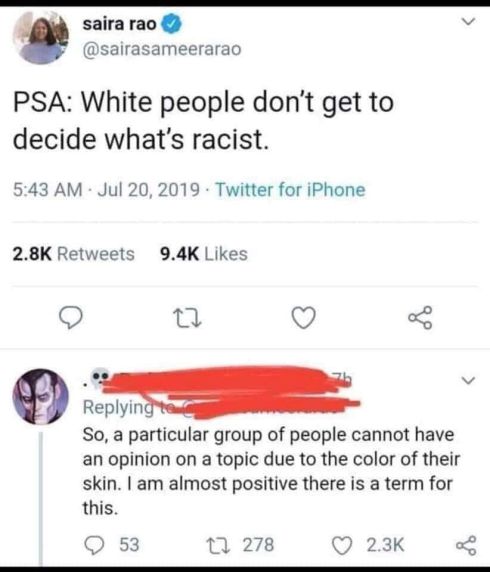
At first glance, this sounds like a demand for humility. And humility is not a bad thing. People can miss harms they do not personally experience. They can mistake comfort for neutrality. They can ignore patterns because those patterns do not touch them directly. Any honest account of racism has to leave room for that.
But the sentence does more than ask for humility. It draws a racial boundary around moral reasoning. It says that one group of people is not merely fallible, not merely prone to blind spots, but disqualified from judgment by birth.
That is where the sentence stops being a plea for listening and becomes something else. It becomes racial gatekeeping presented as moral expertise.
The screenshot is useful because it shows several aspects of critical theory coming into contact with the real world. Not in a seminar room. Not in a carefully footnoted academic paper. In the wild, where theory has been stripped of caveats, flattened into slogans, and handed to people who often have no idea where their fractured knowledge comes from or how badly it is being misused.
Most people who make these arguments are not theorists. They are downstream consumers of theory. They have inherited conclusions without the arguments, moral reflexes without the limits, and social weapons without the instruction manual. What reaches them is not a coherent philosophy but a cluster of habits: centre marginalized voices, listen and learn, impact matters more than intent, racism equals power plus prejudice, disagreement is fragility, demands for evidence are suspect, and dominant groups must defer.
Each of those claims contains a partial truth. That is why the machinery works.
People do have blind spots. Power does matter. Lived experience can reveal things outsiders miss. Social systems can produce unequal outcomes without anyone needing to wear a cartoon villain costume. A liberal society that cannot admit any of that becomes shallow and self-protective.
The problem begins when those partial truths become untouchable rules.
How the Move Works
The first assumption smuggled into the sentence is that racism is not primarily a judgment, action, belief, policy, habit, or pattern of unfair treatment. It is treated as an invisible mechanism operating beneath society. In this case, the mechanism is systemic racism: a hidden structure said to explain disparities, conflicts, speech, institutions, motives, and disagreement before any particular claim has been examined.
Again, systems are real. Institutions can produce patterns. History does not disappear because someone wants the conversation to be more comfortable. But in popular use, the mechanism often becomes unfalsifiable. If a disparity appears, the system explains it. If someone questions the explanation, the questioning becomes further evidence of the system. If a member of the alleged oppressor class objects, the objection is interpreted as fragility, denial, privilege, or complicity.
The claim no longer has to survive ordinary examination. The theory has already decided what resistance means.
“Unfalsifiable: a claim that cannot be proven wrong because every objection is reinterpreted as proof of the claim.”
The second assumption is that this mechanism can only work in one direction. This is where the “racism equals power plus prejudice” formula enters the bloodstream. In ordinary moral language, racism means judging, mistreating, excluding, or degrading people because of race. But under the power-plus-prejudice formula, racism is redefined so that only groups with systemic power can commit it. Members of designated oppressor classes can be mocked, stereotyped, excluded, insulted, or judged by race, but the framework classifies this as something other than racism because they occupy the wrong place in the hierarchy.
That is why “white people don’t get to decide what’s racist” can be treated as anti-racist rather than racial. The rule has already been made unequal.
The third assumption is epistemic. The oppressed are said to possess a kind of dual insight into how the system works. They understand their own experience from below, but they also understand the dominant group because they are forced to navigate its rules. The dominant group, by contrast, is presumed to be trapped inside its own power. It cannot see clearly because its comfort depends on not seeing.
There is a reasonable insight here. People lower in a hierarchy may notice pressures and hypocrisies that people higher up never have to think about. A worker may understand the boss’s rules better than the boss understands the worker’s life. A minority may notice social frictions the majority can glide past without naming.
But once that insight hardens into authority, the conversation changes. Standpoint stops being evidence offered into a common search for truth and becomes a credential. The person assigned to the oppressed position is treated as uniquely insightful. The person assigned to the oppressor position is treated as morally and intellectually compromised. At that point, argument no longer proceeds by shared standards. It proceeds by status.
You are no longer in a discussion. You are in a permission system.
“Permission system: a social rule where some people are allowed to define the issue, while others are expected only to listen, confess, or defer because of identity.”
This is the part ordinary people often sense but struggle to name. They think they are being invited into a moral conversation. In reality, every normal question has already been assigned a guilty interpretation.
They ask, “Isn’t it wrong to judge someone by skin colour?”
The answer comes back: “You do not get to decide that.”
They ask, “Shouldn’t the same rule apply to everyone?”
The answer comes back: “Equality language protects privilege.”
They ask, “Can we examine the evidence?”
The answer comes back: “Your demand for evidence is part of the problem.”
They ask, “How would this claim be proven wrong?”
The answer comes back: “That question itself shows your investment in domination.”
 Once this frame is accepted, the target cannot really answer. Refusal confirms guilt. Confession confirms guilt. Silence confirms guilt. Disagreement confirms guilt. The accusation is insulated from ordinary scrutiny because the mechanism is said to operate invisibly in the background, and only the approved interpreters are permitted to describe it.
That is why these encounters feel so maddening to normal people. They think they are dealing with a claim. Instead, they are dealing with a closed interpretive loop. Every exit has been marked as another entrance.
This is not an honest epistemology. It is a social technology for producing compliance.
The uglier part is that most people using it do not understand the machine they are operating. They have picked up fragments from universities, HR seminars, DEI training, social media, activist language, institutional statements, and moral peer pressure. They know the moves, not the machinery. They know which phrases confer status and which phrases mark someone as suspect. They may sincerely believe they are being compassionate, educated, and morally brave.
But sincerity does not rescue bad reasoning.
How to Recognize the Trap
A liberal society cannot function when moral claims are sorted by identity before they are examined. It depends on the possibility that anyone can ask whether a claim is true, fair, coherent, and consistently applied. It depends on open criticism, equal moral standing, and the right to question even claims made in the name of justice.
That does not mean every speaker is equally informed. It does not mean history is irrelevant. It does not mean racism only exists when someone says an obvious slur. It does not mean people with direct experience have nothing important to teach the rest of us.
It means no person’s race should grant immunity from scrutiny, and no person’s race should disqualify them from moral reasoning.
You do not need a PhD to notice when the rules have stopped applying equally. A few simple questions are often enough.
The first is the reciprocity test: would this rule be acceptable if the races were reversed? If the answer is no, then the rule is not a principle. It is a permission structure.
The second is the individual test: are we judging this person’s actual words and actions, or are we assigning moral status to an entire race? A society that cannot tell the difference between individual responsibility and racial status is not overcoming racism. It is reorganizing it.
The third is the evidence test: what would prove this claim wrong? Honest explanations can be examined. Bad explanations protect themselves by treating examination as aggression.
The fourth is the equal-rule test: does this standard apply to everyone, or only to approved groups? If one race may generalize, accuse, mock, or define the terms while another may only listen and confess, then we are not dealing with fairness.
The fifth is the liberal-society test: does this help people reason together, or does it sort them into racial teams? That question matters because liberal society depends on shared standards. Without them, public life becomes a contest over who gets to define reality and who is expected to submit.
These questions do not solve every hard case. They are not meant to. Racism can be subtle. Power can matter. History can shape the present in ways that are not obvious at first glance. But if a moral framework cannot survive these basic questions, the problem is not the questions.
The problem is the framework.
That is what makes a small sentence like “white people don’t get to decide what’s racist” worth examining. It is not merely rude. It is not merely hypocritical. It is a compressed example of a larger ideological move: convert a universal moral question into an identity-jurisdiction question.
Who may speak? Who must listen? Who is presumed insightful? Who is presumed guilty? Who gets to define the harm? Who is allowed to ask for evidence?
Once those roles are assigned by race, the conversation is no longer about racism in any honest moral sense. It is about power over the terms of reality.
A genuinely anti-racist society should reject that move.
Not because racism is unreal. Not because power is irrelevant. Not because lived experience does not matter. But because the cure for racial injustice cannot be a new racial priesthood deciding who is allowed to reason, who is allowed to question, and who must sit quietly while their moral standing is revoked.
Shared truth has to remain possible. So does shared criticism.
Otherwise, anti-racism becomes just another way to smuggle racial hierarchy back into public life, this time with better slogans and institutional approval.
—–
Glossary
Critical theory
A broad family of ideas that examines society through power, hierarchy, and oppression. It can reveal real blind spots, but in popular use it often turns into a habit of treating every disagreement as proof of hidden domination.
Systemic racism
The idea that racism can operate through institutions, patterns, incentives, and social habits, not only through individual prejudice. The problem comes when “systemic racism” is used as an all-purpose explanation that cannot be questioned or tested.
Power plus prejudice
A redefinition of racism that says racism is not simply racial prejudice or unfair treatment, but prejudice backed by social power. In practice, this often means racism is treated as something only dominant groups can commit.
Standpoint epistemology
The idea that people may notice different truths depending on their social position. Someone lower in a hierarchy may see pressures that someone higher up misses. The danger comes when perspective is treated as automatic authority.
Epistemology
A theory of knowledge: how we know what is true, what counts as evidence, and how claims should be tested.
Epistemic hygiene
The habits that keep our thinking clean: asking for evidence, checking assumptions, allowing disagreement, correcting errors, and refusing to protect favourite ideas from scrutiny.
Unfalsifiable
A claim that cannot be proven wrong because every objection is reinterpreted as proof of the claim. For example: “If you disagree, that only proves you are in denial.”
Lived experience
Knowledge gained from personal experience. It can be important evidence, but it should not become a veto over questions, criticism, or shared standards.
Identity-jurisdiction question
A shift from asking “Is this claim true?” to asking “Who is allowed to speak about this?” The issue becomes identity status rather than evidence or reasoning.
Permission system
A social rule where some people are allowed to define the issue, while others are expected only to listen, confess, or defer because of their identity.
Liberal society
A society built around equal moral standing, open debate, individual rights, shared standards, and the ability to criticize ideas without being treated as morally disqualified.
Racial gatekeeping
Using race to decide who is allowed to speak, judge, question, or define moral terms.
Closed interpretive loop
A pattern where every possible response confirms the accusation. Denial, silence, disagreement, or requests for evidence are all treated as further proof of guilt.
Moral reasoning
The process of deciding what is right or wrong using evidence, consistency, fairness, context, and principles that can be applied beyond one group.
Racial essentialism
Treating people as if their race determines their moral status, knowledge, guilt, innocence, or authority.
Most social lies do not begin as lies. They begin as little acts of politeness.
You laugh at a joke that was not funny. You say “no problem” when there was, in fact, a problem. You sit through a meeting where everyone knows the plan makes no sense, but nobody wants to be the person who slows the room down. Ordinary life requires tact. Not every uncomfortable truth needs to be hurled across the table the moment it appears.
But there is a difference between tact and required unreality.
Tact says we should not be needlessly cruel. Required unreality says we must say the false thing, affirm the false thing, organize institutions around the false thing, and treat anyone who refuses as morally suspect.
That difference matters because societies rarely drift away from truth in one dramatic leap. They drift through small accommodations. A phrase changes here. A courtesy becomes expected there. A workplace norm hardens into policy. A school form gets rewritten. A professional guideline quietly changes the question everyone is allowed to ask.
Then, one day, ordinary people look around and realize they are being asked to deny things they can see with their own eyes.
The debate over sex and gender is one of the clearest examples.
The first move was linguistic. “Sex observed at birth” became “sex assigned at birth.” Many people shrugged. It sounded harmless, maybe even compassionate. Why fight over wording? But the change was not neutral. “Observed” describes the recognition of a biological fact. “Assigned” suggests an administrative decision, something imposed, possibly mistaken, perhaps unjust.
No parent waits for a committee to assign sex. They see the baby. They know. The doctor observes. The parents understand. The paperwork follows reality; it does not create it.
But once “assigned” becomes normal, the ground has shifted. The old reality has not disappeared, but the language around it has been loosened. A fact starts to sound like an opinion. An observation starts to sound like an imposition. What was once obvious becomes something polite people are encouraged not to say too firmly.
Pronouns came next for many ordinary people. “What is the harm?” they were told. “It is just politeness.”
And in private life, adults can choose whatever courtesies they want. People use nicknames. People avoid sore spots. People soften language to keep peace with neighbours, coworkers, students, friends, and family. That is normal human life.
The difficulty begins when courtesy becomes compulsory and everyone is expected to speak as though sex has disappeared from the room.
A teacher pauses before saying “she.” A coworker catches himself mid-sentence. A parent sits through a school meeting and says nothing because every adult in the room knows what is being asked, and nobody wants to be first to break the spell. So people go along. They use words they do not quite believe. They tell themselves it is only a small thing.
“Those arguments matter. But before any of them can be had honestly, people must be allowed to say what they know is true.”
Small things train larger habits. Once people become accustomed to saying what they do not believe, the person who says, “wait, this is not accurate,” becomes the problem. Not the falsehood. Not the policy built on it. The person who interrupts the shared performance.
That is how a real slippery slope works. It is not that one concession magically causes the next. It is that each concession changes the moral conditions under which the next demand is judged.
If sex is “assigned,” and pronouns are only kindness, and refusing preferred language is cruelty, then female-only spaces start to look morally suspicious. The sign on the changing room may stay the same, but the rule underneath it changes. The word “women” remains on the door. What it means has been quietly edited.
That edit does not stay abstract. It reaches the sports team someone’s daughter trains with. It reaches shelters, prisons, changing rooms, rape-crisis services, and lesbian boundaries. All can be reframed as sites of exclusion. The question quietly changes from “Do women and girls have sex-based rights?” to “Why are you being unkind to this vulnerable person?”
None of this denies that some people experience genuine distress about their bodies. They do. The question is whether compassion requires everyone else to rewrite reality around that distress.
By then, the argument has already moved. Women are no longer asking to preserve boundaries rooted in sex. They are being asked to justify why those boundaries should exist at all.
That is not an abstract problem. It changes institutions. It changes policies. It changes what children are taught. It changes what professionals are allowed to say. It changes whether parents, teachers, doctors, athletes, and ordinary citizens are permitted to name reality without being accused of hatred.
The kind lie does not remain kind once people are punished for refusing it.
We can debate the details of medicine, sports, schools, safeguarding, and law. Those arguments matter. But before any of them can be had honestly, people must be allowed to say what they know is true.
Reality has a way of waiting. Bodies still exist. Sex still matters in medicine, sport, privacy, reproduction, vulnerability, and patterns of violence. Institutions can change their language, but language does not abolish the facts underneath it. Step away from truth for long enough and eventually reality supplies the correction.
Reality always bats last.
The point is not that every hard truth should be spoken harshly. Decency matters. So does compassion. But compassion detached from truth becomes something else. It becomes a demand that some people absorb real costs so everyone else can feel morally clean.
That is the part ordinary people need to notice. Every time they play along with a claim they know is not true, they are not merely being polite. They may be helping build the next rule, the next policy, the next institutional punishment for the person who finally says no.
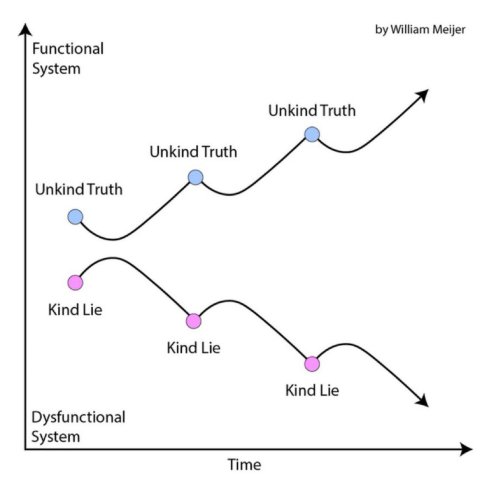
Truth is the lifeblood of any serious civilization. Not comfort, not ideological harmony, and not the temporary social peace that comes from teaching people to suppress what they can plainly see.
A society can survive mistakes. It can survive corruption. It can survive periods of confusion and even mass foolishness, provided enough people remain willing to describe reality honestly when the pressure arrives to do otherwise. What societies struggle to survive is organized dishonesty.
Reality is the brick wall waiting at the end of every false belief. You can postpone the collision for a while. You can build bureaucracies around the falsehood, invent softer language to cushion it, and punish people for pointing at the wall. The impact still comes.
That is why a recent quote from J. K. Rowling landed with such force:
“The West is currently divided between people who know he is a man and are prepared to say so and those who know this is a man but lie out of obedience to an ideology. There is no third option. Literally nobody on earth thinks ‘Roxanne Tickle’ is actually a woman.”
The quote unsettled people because it named something many Western institutions have spent years trying to blur: the widening gap between public language and private belief.
Large numbers of people now routinely say things in public that they would once have regarded as obviously false, not because the underlying biology changed, but because the social cost of dissent rose dramatically. That distinction matters, because this is not primarily a debate about kindness.
A decent society should discourage cruelty. It should not encourage humiliation, harassment, or needless malice toward people struggling with alienation, identity, or psychological distress. Most ordinary people understand this instinctively. But courtesy is not the same thing as compelled belief.
Calling someone by a preferred name is one thing. Demanding that citizens affirm propositions they do not believe to be true is something else entirely. The first is social grace. The second is ideological obedience.
 Nor is this an argument for replacing one rigid orthodoxy with another. Conservative traditions have their own temptations toward enforced piety, inherited blindness, and social punishment for inconvenient truths. Any worldview, religious or secular, progressive or reactionary, becomes dangerous when it starts protecting sacred assumptions from scrutiny. The standard cannot be nostalgia or novelty. The standard has to be reality itself: when a belief hits the brick wall, the belief must yield.
Modern Western institutions increasingly refuse to yield.
People learn quickly which observations are permitted and which ones carry risk. Teachers self-censor in classrooms. Employees rehearse approved language in HR seminars. Professionals choose silence over scrutiny. Friends whisper obvious opinions privately, then publicly perform uncertainty they do not actually feel. Entire bureaucracies now operate through euphemism, ritual language, and carefully managed ambiguity designed less to clarify reality than to avoid conflict with activist moral frameworks.
The social choreography becomes exhausting to watch because everyone notices the contradiction, while almost nobody wants to be the first person to say so aloud.
That atmosphere corrodes more than speech. It corrodes trust itself.
Once institutions begin demanding verbal loyalty to claims that large numbers of people privately reject, public language starts losing contact with reality. Words stop functioning primarily as descriptive tools and become signals of social compliance. The goal is no longer clarity. The goal is demonstrating moral alignment with the approved consensus.
History offers repeated warnings about where this habit leads. Not always to catastrophe on cinematic scales. Sometimes the damage is quieter and more banal than that. Institutions become incapable of self-correction because honest feedback becomes socially dangerous. Bad ideas survive longer than they should. Obvious failures remain unacknowledged. Citizens retreat into cynicism. Public trust declines because people can feel the gap between official language and observable reality widening in real time.
The lie does not even need to convince everyone to become destructive. It only needs to become socially mandatory.
That is the deeper danger here. A liberal society depends on the ability of ordinary people to speak plainly about reality without fear that disagreement itself will be treated as moral contamination. Once that principle collapses, coercion inevitably expands to fill the space left behind, not always through laws, but often through softer mechanisms: reputational pressure, professional risk, social isolation, algorithmic mobbing, institutional gatekeeping. The effect is similar either way. Silence becomes safer than honesty, and so more people stay silent.
The defenders of this system often insist they are merely asking for compassion. In many cases, I suspect some genuinely believe that. But compassion detached from truth eventually mutates into something harsher. If reality itself becomes negotiable, then social power determines what may be spoken. At that point the argument is no longer about tolerance. It becomes a struggle over who has authority to define reality for everyone else.
That is not progress. It is regression wrapped in therapeutic language.
None of this requires cruelty toward individuals or hatred. It requires only the willingness to say that observable reality still matters, even when saying so becomes socially uncomfortable. Reality does not disappear when institutions stop acknowledging it.
The brick wall remains where it always was, and civilizations that train themselves to look away rarely avoid the collision forever.
Women do not need permission to define themselves.
The word woman already has a meaning. It is not hateful to say so, and it is not extremist to defend female boundaries, female privacy, female sports, or female-only spaces. Women are adult human females. That definition is not a slur. It is the basis on which women’s rights were built.
The public silence around this issue is starting to crack because too many people can now see where the trajectory leads. A society that cannot define women cannot reliably protect them. Rights tied to sex become fragile once sex itself is treated as optional language.
Enough of the intimidation. Enough of the compelled speech. Enough of the social blackmail that brands ordinary women as bigots for wanting boundaries previous generations understood as normal, necessary, and humane.
The next step is not private agreement. It is public resistance, steady enough that institutions can no longer pretend the objection belongs only to cranks and extremists.
Write to elected officials and demand that sex-based protections be clarified in law as applying to biological sex. Support groups defending women’s sports, shelters, prisons, and female-only services. Push back in schools, workplaces, unions, professional associations, and public consultations when policies dissolve female boundaries into identity claims. Refuse the language games that make reality harder to discuss. Speak plainly, calmly, and repeatedly.
Support the journalists, writers, academics, whistleblowers, parents, athletes, and ordinary women who are absorbing the punishment for saying what millions still believe. Do not leave them standing alone while quietly agreeing with them afterward in private.
That private agreement is one of the main things keeping this machine alive. Institutions interpret silence as consent. Bureaucracies advance until they meet resistance, and too many citizens have been trained to mistake politeness for surrender.
This resistance does not require rage or cruelty. It requires steadiness, numbers, and the willingness to stop pretending obvious things are unsayable.
The backlash already underway across the Western world is not driven by hatred. It is driven by exhaustion with the claim that female boundaries are negotiable, that biology is taboo, and that dissent itself is immoral.
Women have the right to their own spaces, language, associations, and political interests. No court ruling or policy document can erase that reality.

One of the most effective moves in contemporary progressive argumentation, especially inside institutions that trade in moral prestige, is also one of the least truth-seeking: take an ordinary policy dispute, attach a moral charge to one side of it, and then treat resistance as evidence of personal defect.
The argument does not proceed by persuasion. It proceeds by contamination.
You are not merely skeptical of a DEI policy. You are hostile to inclusion. You are not asking whether a school lesson is age-appropriate. You are endangering vulnerable children. You are not questioning whether a land acknowledgement has become empty ritual. You are denying history. You are not concerned about due process, compelled speech, medical evidence, or institutional overreach. You are “unsafe.”
“The moral valence trap raises the social cost of dissent until silence looks like prudence.”
The mechanism is simple. First, the issue is moved from the realm of judgment into the realm of moral identity. Then the person asking questions is dragged with it. The disputed policy becomes kindness, justice, safety, inclusion, or harm reduction. Opposition becomes cruelty, hatred, danger, exclusion, or complicity. Once that happens, the argument is no longer about the thing itself. It is about whether you are the sort of person decent people should listen to.
This is dirty pool, but it works because most people do not want to be seen as cruel. They also do not want a meeting, classroom, workplace, choir rehearsal, staff room, or family dinner to become a tribunal. So they soften, retreat, or say nothing. The moral valence does its job. It raises the social cost of dissent until silence looks like prudence.
The tactic is not unique to progressives. Conservatives have used their own versions: dissent from a war becomes hatred of the troops; concern about state power becomes softness on crime; criticism of national myth becomes contempt for the country. The mechanism is the same. Policy disagreement is converted into a character flaw. The reason the progressive version deserves special attention now is not that it is uniquely wicked, but that it has become unusually powerful inside the institutions that shape respectable opinion: schools, universities, HR departments, media, charities, public agencies, and professional regulators.
The first defence is definitional clarity.
Do not accept suitcase words without unpacking them. Harm, safety, inclusion, dignity, equity, violence, erasure, and belonging are often used as if everyone already knows what they mean. Usually they do not. These words carry emotional force precisely because they remain blurry. A claim like “this policy protects safety” sounds serious, but it may mean physical safety, emotional comfort, reputational protection, ideological conformity, bureaucratic risk management, or the absence of disagreement.
Those are not the same thing.
The useful question is not “Do you care about safety?” That question has already been rigged. The useful question is: what kind of safety, for whom, from what, by what mechanism, and at what cost to others?
That last clause matters. Every moral claim has tradeoffs. A school policy that makes one child feel affirmed may require another child to lie. A workplace policy designed to create inclusion may create compelled speech. A public ritual meant to acknowledge one group may quietly pressure others into participation. A speech code meant to prevent harm may give administrators broad discretion to punish unpopular views.
Definitions bring the argument back to earth. They force slogans to become claims. Once a slogan becomes a claim, it can be examined.
The second defence is fairness in a liberal democratic society.
Progressive moral framing often assumes that once a group is described as vulnerable, its preferred policy should win by default. But liberal democracy cannot work that way. Vulnerability matters, but it does not abolish fairness. A decent society does not settle conflict by asking which side has the most emotionally powerful identity claim and then handing that side the institutional lever.
Fairness requires reciprocal rules. If one group may decline participation in a ritual that violates its conscience, others must be allowed the same freedom. If one group may describe its experience honestly, others must be allowed to describe theirs. If dignity matters for minorities, it also matters for dissenters. If safety matters for the anxious student, it also matters for the girl in the changing room, the employee pressured to say words he does not believe, the parent cut out of a consequential decision, or the teacher expected to enforce doctrine while pretending it is merely kindness.
The point is not that all claims are equal. Some are stronger than others. Some deserve accommodation. Some deserve rejection. But in a liberal society, moral concern cannot become a one-way ratchet where one side receives rights and the other receives obligations.
A fair question cuts through the fog: would this rule be acceptable if used by people you distrust?
If the answer is no, then the principle is not a principle. It is a weapon waiting for a friendly hand.

The third defence is free speech.
Not free speech as a bumper sticker. Not free speech as “I should be able to say anything without consequence.” Free speech as the basic operating condition of a truth-seeking society.
The moral valence trap depends on making certain questions unsayable. It does not always censor directly. Often it works through etiquette, professional risk, peer pressure, institutional language, and the quiet fear of being labelled. That is enough. You do not need formal censorship when people learn to pre-edit themselves before the room turns cold.
Free speech is not merely a personal liberty. It is a safeguard against institutional self-deception. Bad policies survive when people cannot question the assumptions underneath them. Medical scandals survive that way. Educational fads survive that way. Bureaucratic rituals survive that way. Ideologies survive that way. The organization tells itself that dissent is harm, then congratulates itself on the absence of dissent. An institution can call that consensus if it wants, but what it has really produced is managed silence.
This is also where the dissenter has to resist the forced confession. The moral valence trap often tries to make you prove your innocence before you are allowed to discuss the issue: “Do you support inclusion?” “Do you understand how harmful that is?” “Why are you uncomfortable with marginalized people being seen?” Sometimes these are sincere questions. Often they are attempts to move the conversation from the policy to your character. A useful response is calm redirection: I’m happy to discuss the rule. I’m not going to litigate my soul as a precondition for speaking.
The point is not to become rude or combative; it is to keep the discussion on the rule, the evidence, and the tradeoffs instead of letting it drift into a trial of your character.
Progressive argumentation wins when it turns politics into moral theatre. The trick is to refuse the theatre without refusing morality. There are real harms, real injustices, and real people who deserve protection, accommodation, and dignity. But moral language should clarify reality, not smother it. Once moral vocabulary becomes a substitute for evidence, mechanism, fairness, and speech, it stops being ethics and becomes discipline.
The answer is not counter-shaming, which only reproduces the same bad habit with different slogans, but steadiness: define the terms, ask who pays the cost, test the rule for reciprocity, and defend the right to question. A liberal society does not need citizens who agree about everything. It needs citizens who can disagree without turning every dispute into a loyalty test.
Too many land acknowledgements are not acknowledgements anymore. They are rituals of submission with nicer stationery.
Everyone knows the form. Before the meeting, concert, lecture, school assembly, or conference begins, someone reads a solemn paragraph about the land. The tone is reverent. The words are familiar. The effect is usually deadening. Nobody is supposed to argue with it. Nobody is supposed to ask what it means in practice. The ritual is complete once the room has been morally sorted.
That is the trick.
A land acknowledgement does not merely “acknowledge land.” It often imports a political frame. It suggests that some people belong here more deeply than others, that ordinary Canadians are guests in their own country, and that citizenship itself sits under a cloud of inherited guilt.
This is why Jamil Jivani’s version is useful:
“We acknowledge that we gather here today as free men and women on land governed by private property laws. We are enthusiastic to keep this as a proud tradition in our country, and we stand firmly as people who do not believe in two-tiered citizenship.”
That works because it does what the usual version refuses to do. It acknowledges the legal and political order under which people are actually gathered.
We are not meeting in a metaphysical guilt zone. We are meeting in Canada. That means Canadian law, constitutional government, treaty obligations, private property, Crown land, Aboriginal title, reserves, statutes, courts, and civic rights that apply to citizens as citizens.
The details matter. Canada’s land regime is not one simple thing, and anyone pretending otherwise is selling you a pamphlet, not an argument. But the public square still depends on a shared legal order. It cannot survive if every gathering begins by quietly ranking people according to ancestry.
That is why the phrase “land governed by private property laws” matters. It cuts through the incense.
Private property is not just about who owns a fence line or a parcel on a title map. It is one of the civilizational tools that lets strangers live beside each other without every dispute becoming a tribal contest. It turns land into a governed reality rather than a permanent symbolic battlefield. It lets people build homes, churches, schools, businesses, farms, and community halls without having to justify their existence every time someone invokes ancestry.
The usual acknowledgement often leaves people with a vague sense that Canada is illegitimate, but without saying clearly what should follow.
Are property titles invalid? Are municipal governments illegitimate? Are homeowners merely tenants of history? Are citizens equal, or are some citizens permanently morally prior because of bloodline?
These questions are usually dodged because answering them would reveal the radicalism hiding inside the ritual.
Jivani’s version answers plainly: no two-tiered citizenship.
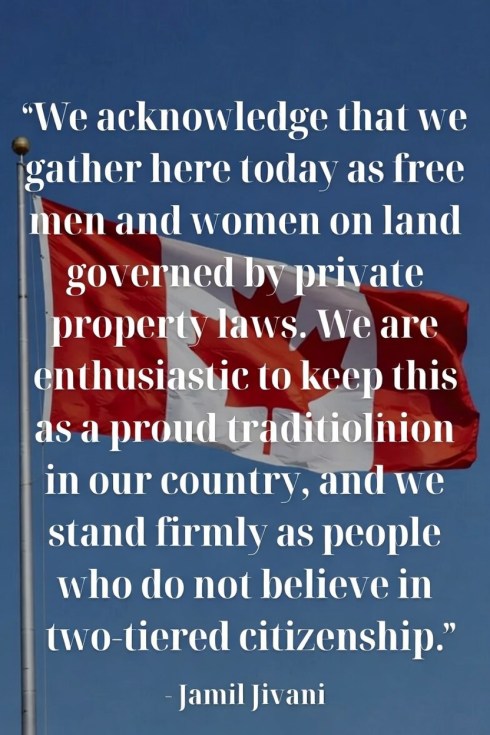
That is the heart of it.
A serious country can honour Indigenous history. It can recognize treaties. It can correct specific injustices where evidence and law require correction. It can admit that governments have done cruel, stupid, and destructive things. None of that requires teaching Canadians that equal citizenship is somehow morally suspect.
But that is where many modern land acknowledgements drift. They sort the room into moral categories before the event even starts. Some people are original. Some are settlers. Some have ancestral legitimacy. Others inherit suspicion. The language remains soft, but the structure underneath it is hard.
That is not reconciliation. That is caste thinking with a grant application attached.
And no, refusing that frame does not mean pretending history began yesterday. This lazy accusation needs to be retired. Canadians can know the history without accepting a ritual designed to weaken their confidence in the country they inhabit. Memory does not require self-erasure. Justice does not require permanent civic grovelling. Respect does not require pretending that liberal citizenship is some colonial inconvenience we should all feel embarrassed about.
If people want reconciliation, then do the real work. Clarify treaty obligations. Improve reserve governance. Support economic development. Fix broken service delivery. Protect individual rights. Litigate actual claims. Negotiate actual settlements.
But stop pretending that reciting inherited guilt before a PowerPoint presentation is moral courage.
The better acknowledgement is provocative because it reverses the moral pressure. Instead of forcing citizens to rehearse guilt before they proceed, it affirms the conditions that let free people gather in the first place: law, property, citizenship, and equality before the state.
That is exactly why it will irritate the professional class that treats land acknowledgements as sacred theatre. It refuses the expected posture. It does not bow. It does not mumble through a half-confession. It says, openly, that Canada is a real country, that its legal order matters, and that citizenship must not be divided into ancestral ranks.
A land acknowledgement should acknowledge reality.
That is worth saying out loud.
We’ve done the setup.
First, the feeling: something shifts, guidance changes, and people aren’t sure what they’re looking at. Then the distinction: science has social layers around it, but the core activity—testing models against reality—is constrained by something that isn’t.
Now we get to the part that matters:
What does it look like when that constraint holds—and when it doesn’t?
Because this isn’t theoretical.
It happens in the wild.
The Simple Test People Already Use
Most people don’t talk about models or epistemology.
They do something simpler.
They watch outcomes—whether predictions land, whether explanations hold up, whether the goalposts move after the fact.
When those answers line up, trust builds, even if the conclusion is inconvenient.
When they don’t, something else starts to creep in. Not always a conspiracy. Not always bad faith. But something other than clean model-testing.
What Healthy Science Looks Like
You don’t need a textbook definition. You can recognize it by behavior.
Healthy scientific practice tends to show a few patterns. Claims are tied to specific predictions. Uncertainty is stated, not buried. Errors get corrected without theatrical reversals. Competing models are allowed to fail on their own terms.
It can still be messy. It can still be wrong.
But the direction is clear: toward tighter alignment with reality.
When It Starts to Drift
When social pressures start bending the process, the signals change.
You begin to see claims framed as conclusions first, reasoning second. Heavy reliance on consensus language instead of model performance. Criticism treated as disloyalty rather than error-checking. Revisions framed as narrative continuity instead of correction.
None of these prove corruption on their own.
But together, they form a pattern—and people pick up on that pattern, even if they can’t articulate it.
The Substitution Problem
At the core, something gets swapped.
Instead of:
Does the model work?
You get:
Does the claim align with the current consensus?
That substitution is subtle. It doesn’t announce itself. It shows up in language, in incentives, in what gets amplified and what gets ignored.
And once it happens, the whole system starts to feel different.
Why It Feels Off
People aren’t just tracking claims. They’re tracking consistency—between what was said, what actually happened, and how the update was explained.
When those line up, even large changes feel legitimate.
When they don’t, even small adjustments feel like manipulation.
That’s the gap.
Where Constructivism Gets Its Grip
When people see that gap—shifting language, inconsistent framing, institutional defensiveness—they start looking for explanations.
One of those explanations is:
Maybe truth itself is being negotiated.
That’s where strong social constructivism starts to feel persuasive.
Not because it’s correct.
Because it seems to explain what people are seeing.
The Problem With That Conclusion
It overcorrects.
It takes real failures—communication breakdowns, incentive distortions, institutional bias—and treats them as proof that scientific truth itself is socially constructed.
But those same failures tend to degrade science’s ability to do the one thing that matters:
Track reality.
Bad models don’t suddenly start working because they’re socially supported.
They fail more obviously.
The Constraint Doesn’t Go Away
Even in distorted environments, the underlying constraint is still there.
Predictions still miss. Explanations still break. Reality still refuses to cooperate.
That’s why bad theories eventually collapse, better ones replace them, and the process—however uneven—keeps moving.
Not because institutions are perfect.
Because the world doesn’t bend.
What Actually Makes This Work
If you had to compress what keeps science from collapsing into pure consensus, it isn’t a slogan or an institution.
It’s a set of recurring demands placed on any model that wants to survive.
A model has to say what happens next—and then be judged against it. It has to explain more than its competitors without multiplying assumptions. It has to hold together internally when pushed, not unravel into contradiction. And when reality doesn’t cooperate, it has to adjust rather than dig in.
None of that depends on who proposes the model. None of it depends on which institution backs it.
Those pressures come from the outside.
And they’re what make it very difficult—though not impossible—for social forces to fully take over.
What This Means for the Rest of Us
You don’t need to become a scientist to navigate this.
But you do need a clearer lens.
When you’re looking at a scientific claim, the question isn’t:
Who agrees with this?
It’s:
What would count as this being wrong—and did that test happen?
That’s the difference between evaluating a model and deferring to a position.
The Line That Still Holds
Science is done by human beings. It sits inside institutions. It’s shaped by incentives.
None of that is in dispute.
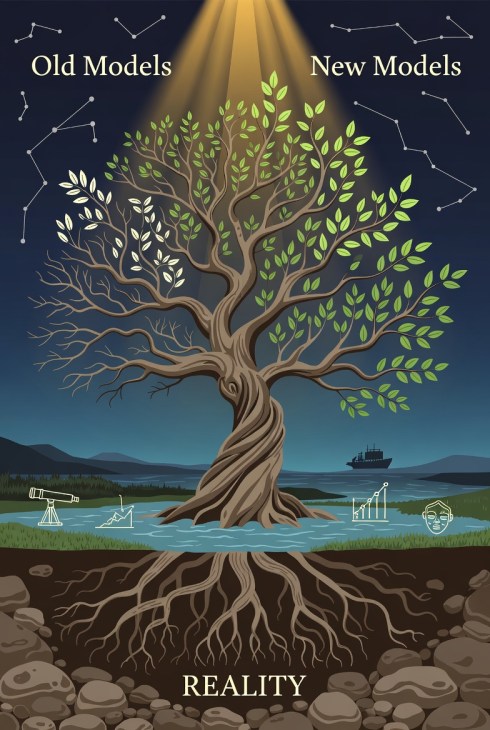
But the reason it works—the reason it produces anything usable at all—is that it runs up against something that doesn’t care about any of that.
Reality pushes back.
It doesn’t negotiate. It doesn’t care about consensus. It doesn’t adjust to save face.
And that’s the only reason the entire enterprise holds together.
Final Position
Scientific objectivity doesn’t mean:
- scientists are unbiased
- institutions are clean
- conclusions never change
It means something narrower—and more important.
It means that, at its best, the process is constrained by whether its models survive contact with the world.
Everything else sits on top of that.
Sometimes cleanly.
Sometimes not.
But if you lose that constraint, you don’t just get flawed science.
You get something else entirely.
Further Reading
Core Philosophy of Science (Accessible but Serious)
- Theory and Reality
https://press.uchicago.edu/ucp/books/book/chicago/T/bo3773461.html
Best single overview of how science actually works—models, evidence, and realism vs anti-realism. - The Structure of Scientific Revolutions
https://press.uchicago.edu/ucp/books/book/chicago/S/bo13179781.html
Often cited by constructivists—worth reading directly to see what it does (and doesn’t) claim.
Critiques of Strong Social Constructivism
- Fashionable Nonsense
https://www.penguinrandomhouse.com/books/117184/fashionable-nonsense-by-alan-sokal-and-jean-bricmont/
A direct critique of postmodern misuse of scientific language and relativism. - Stanford Encyclopedia of Philosophy — Social Construction
https://plato.stanford.edu/entries/social-construction/
Clear, neutral breakdown of what “social construction” actually means across domains.
How Science Fails (and Self-Corrects)
- Tuskegee Syphilis Study — Overview
https://www.archives.gov/research/african-americans/individuals/tuskegee-study
A case of ethical and methodological failure—useful for understanding how bias corrupts both morality and knowledge. - The Demon-Haunted World
https://www.penguinrandomhouse.com/books/158581/the-demon-haunted-world-by-carl-sagan/
A practical defense of scientific thinking as a way of testing claims against reality.
Modern Trust & Institutional Context
- Why Trust Science?
https://press.princeton.edu/books/hardcover/9780691179001/why-trust-science
Argues for trust grounded in scientific processes and communities—useful as a counterpoint.











 bleatmop
 Mystro
 The Arbourist


 Dead Wild Roses
Your opinions…