
You are currently browsing the tag archive for the ‘Anti-Racism’ tag.
The most revealing thing about modern slavery is not only that it exists. It is that so many people who invoke slavery as a moral category seem oddly uninterested in it when it is happening now.
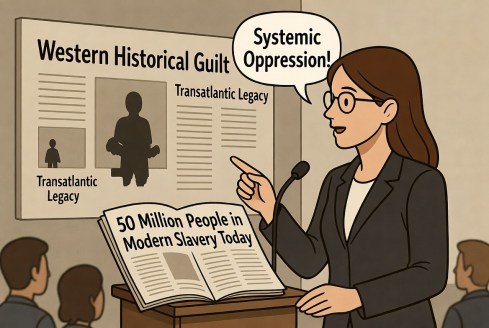
In contemporary activist politics, slavery is often treated as a permanent indictment of the West. It is invoked to explain present inequality, assign inherited guilt, rewrite institutional language, justify symbolic rituals, and discipline dissent. Some of that history matters. The transatlantic slave trade was real, brutal, and morally indefensible. A serious civilization should be able to tell the truth about its crimes.
But truth has a tense. If slavery matters morally, then slavery matters now.
According to the latest Global Estimates from the International Labour Organization, Walk Free, and the International Organization for Migration, roughly 50 million people were living in modern slavery on any given day in 2021: 27.6 million in forced labour and 22 million in forced marriage. Walk Free estimates that about 7 million people in Africa were living in modern slavery.
If slavery is invoked as a living moral category when it indicts the West, then slavery should also matter when people are being coerced, trafficked, forced into marriage, or trapped in labour today.
These are not metaphors. Modern slavery includes forced labour, forced marriage, trafficking, sexual exploitation, debt bondage, and other forms of coercion that people cannot freely refuse or leave.
Many human-rights groups do serious work on these abuses. That should be acknowledged. But the cultural volume is not the same. Western institutions pour energy into land acknowledgements, reparations debates, decolonization seminars, symbolic renamings, privilege workshops, and inherited-guilt rituals. Meanwhile, present-tense slavery struggles to command anything like the same moral attention.
Mauritania, for example, formally abolished slavery, yet descent-based slavery and slavery-like practices remain serious concerns. That should disturb anyone who claims to care about domination and human dignity. It should not be a niche humanitarian footnote.
The strongest activist reply is not ridiculous. Historical slavery did not vanish without consequence. The transatlantic slave trade, colonial rule, segregation, and legal exclusion shaped wealth, institutions, geography, and inherited disadvantage. A society does not become innocent simply because the worst laws are repealed.
That is a serious point. But it does not answer the problem of moral selectivity. If slavery is invoked as a living moral category when it indicts the West, then slavery should also matter when people are being coerced, trafficked, forced into marriage, or trapped in labour today.
This is where much contemporary anti-racism becomes revealing. In theory, it opposes domination and exploitation. In practice, it often functions as a selective solvent. It dissolves confidence in Western institutions, Western history, Western moral achievement, and Western civic inheritance, while offering little concrete help to people being dominated right now.
The predictable reply is that this is whataboutism. It is not. Whataboutism says, “Ignore this evil because that evil also exists.” The argument here is the opposite: if slavery is evil, then concern should become more urgent when slavery is happening now. Historical truth matters, but it cannot become a substitute for present-tense moral attention.
Nor is this answered by saying critics do not understand critical theory properly. If a theory constantly produces institutional rituals of guilt, suspicion, deconstruction, and accusation, ordinary citizens are allowed to judge it by its public effects. A politics that requires specialist initiation before anyone may notice its consequences has already left democratic argument behind.
The issue is not whether the West has sins in its history. It does. The issue is whether anti-racism is actually against domination, exploitation, and slavery as human evils, or whether those evils are useful mainly when they can be arranged into an indictment of Western society.
If slavery matters only when it can be used to shame the West, then slavery is not the real object of concern. The West is.
References
International Labour Organization, Walk Free, and International Organization for Migration. Global Estimates of Modern Slavery: Forced Labour and Forced Marriage.
https://www.ilo.org/publications/major-publications/global-estimates-modern-slavery-forced-labour-and-forced-marriage
Walk Free. Global Slavery Index 2023 — Global Findings.
https://www.walkfree.org/global-slavery-index/findings/global-findings/
Walk Free. Global Slavery Index 2023 — Modern Slavery in Africa.
https://www.walkfree.org/global-slavery-index/findings/regional-findings/africa/
Anti-Slavery International. What is Descent-Based Slavery?
https://www.antislavery.org/slavery-today/descent-based-slavery/
Anti-Slavery International. Mauritania: Descent-Based Slavery.
https://www.antislavery.org/what-we-do/mauritania/
Arab Reform Initiative. Racialized Hereditary Slavery in Mauritania: Interview with Activist Abidine Maettalla.
https://www.arab-reform.net/publication/racialized-hereditary-slavery-in-mauritania-interview-with-activist-abidine-maettalla/
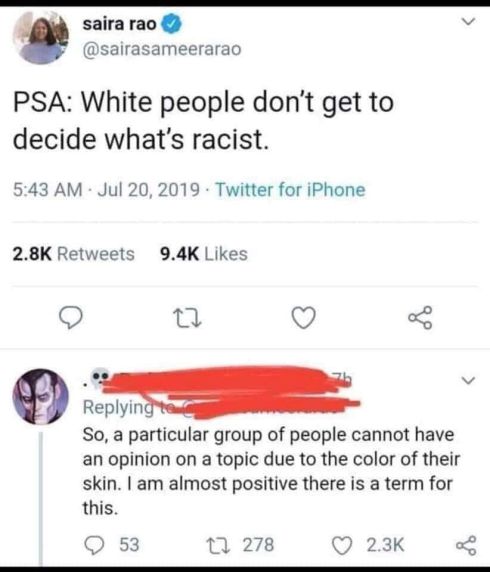
“White people don’t get to decide what’s racist.”
At first glance, this sounds like a demand for humility. And humility is not a bad thing. People can miss harms they do not personally experience. They can mistake comfort for neutrality. They can ignore patterns because those patterns do not touch them directly. Any honest account of racism has to leave room for that.
But the sentence does more than ask for humility. It draws a racial boundary around moral reasoning. It says that one group of people is not merely fallible, not merely prone to blind spots, but disqualified from judgment by birth.
That is where the sentence stops being a plea for listening and becomes something else. It becomes racial gatekeeping presented as moral expertise.
The screenshot is useful because it shows several aspects of critical theory coming into contact with the real world. Not in a seminar room. Not in a carefully footnoted academic paper. In the wild, where theory has been stripped of caveats, flattened into slogans, and handed to people who often have no idea where their fractured knowledge comes from or how badly it is being misused.
Most people who make these arguments are not theorists. They are downstream consumers of theory. They have inherited conclusions without the arguments, moral reflexes without the limits, and social weapons without the instruction manual. What reaches them is not a coherent philosophy but a cluster of habits: centre marginalized voices, listen and learn, impact matters more than intent, racism equals power plus prejudice, disagreement is fragility, demands for evidence are suspect, and dominant groups must defer.
Each of those claims contains a partial truth. That is why the machinery works.
People do have blind spots. Power does matter. Lived experience can reveal things outsiders miss. Social systems can produce unequal outcomes without anyone needing to wear a cartoon villain costume. A liberal society that cannot admit any of that becomes shallow and self-protective.
The problem begins when those partial truths become untouchable rules.
How the Move Works
The first assumption smuggled into the sentence is that racism is not primarily a judgment, action, belief, policy, habit, or pattern of unfair treatment. It is treated as an invisible mechanism operating beneath society. In this case, the mechanism is systemic racism: a hidden structure said to explain disparities, conflicts, speech, institutions, motives, and disagreement before any particular claim has been examined.
Again, systems are real. Institutions can produce patterns. History does not disappear because someone wants the conversation to be more comfortable. But in popular use, the mechanism often becomes unfalsifiable. If a disparity appears, the system explains it. If someone questions the explanation, the questioning becomes further evidence of the system. If a member of the alleged oppressor class objects, the objection is interpreted as fragility, denial, privilege, or complicity.
The claim no longer has to survive ordinary examination. The theory has already decided what resistance means.
“Unfalsifiable: a claim that cannot be proven wrong because every objection is reinterpreted as proof of the claim.”
The second assumption is that this mechanism can only work in one direction. This is where the “racism equals power plus prejudice” formula enters the bloodstream. In ordinary moral language, racism means judging, mistreating, excluding, or degrading people because of race. But under the power-plus-prejudice formula, racism is redefined so that only groups with systemic power can commit it. Members of designated oppressor classes can be mocked, stereotyped, excluded, insulted, or judged by race, but the framework classifies this as something other than racism because they occupy the wrong place in the hierarchy.
That is why “white people don’t get to decide what’s racist” can be treated as anti-racist rather than racial. The rule has already been made unequal.
The third assumption is epistemic. The oppressed are said to possess a kind of dual insight into how the system works. They understand their own experience from below, but they also understand the dominant group because they are forced to navigate its rules. The dominant group, by contrast, is presumed to be trapped inside its own power. It cannot see clearly because its comfort depends on not seeing.
There is a reasonable insight here. People lower in a hierarchy may notice pressures and hypocrisies that people higher up never have to think about. A worker may understand the boss’s rules better than the boss understands the worker’s life. A minority may notice social frictions the majority can glide past without naming.
But once that insight hardens into authority, the conversation changes. Standpoint stops being evidence offered into a common search for truth and becomes a credential. The person assigned to the oppressed position is treated as uniquely insightful. The person assigned to the oppressor position is treated as morally and intellectually compromised. At that point, argument no longer proceeds by shared standards. It proceeds by status.
You are no longer in a discussion. You are in a permission system.
“Permission system: a social rule where some people are allowed to define the issue, while others are expected only to listen, confess, or defer because of identity.”
This is the part ordinary people often sense but struggle to name. They think they are being invited into a moral conversation. In reality, every normal question has already been assigned a guilty interpretation.
They ask, “Isn’t it wrong to judge someone by skin colour?”
The answer comes back: “You do not get to decide that.”
They ask, “Shouldn’t the same rule apply to everyone?”
The answer comes back: “Equality language protects privilege.”
They ask, “Can we examine the evidence?”
The answer comes back: “Your demand for evidence is part of the problem.”
They ask, “How would this claim be proven wrong?”
The answer comes back: “That question itself shows your investment in domination.”
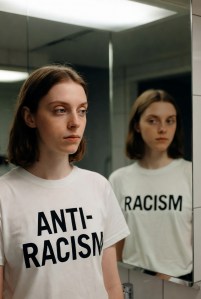 Once this frame is accepted, the target cannot really answer. Refusal confirms guilt. Confession confirms guilt. Silence confirms guilt. Disagreement confirms guilt. The accusation is insulated from ordinary scrutiny because the mechanism is said to operate invisibly in the background, and only the approved interpreters are permitted to describe it.
That is why these encounters feel so maddening to normal people. They think they are dealing with a claim. Instead, they are dealing with a closed interpretive loop. Every exit has been marked as another entrance.
This is not an honest epistemology. It is a social technology for producing compliance.
The uglier part is that most people using it do not understand the machine they are operating. They have picked up fragments from universities, HR seminars, DEI training, social media, activist language, institutional statements, and moral peer pressure. They know the moves, not the machinery. They know which phrases confer status and which phrases mark someone as suspect. They may sincerely believe they are being compassionate, educated, and morally brave.
But sincerity does not rescue bad reasoning.
How to Recognize the Trap
A liberal society cannot function when moral claims are sorted by identity before they are examined. It depends on the possibility that anyone can ask whether a claim is true, fair, coherent, and consistently applied. It depends on open criticism, equal moral standing, and the right to question even claims made in the name of justice.
That does not mean every speaker is equally informed. It does not mean history is irrelevant. It does not mean racism only exists when someone says an obvious slur. It does not mean people with direct experience have nothing important to teach the rest of us.
It means no person’s race should grant immunity from scrutiny, and no person’s race should disqualify them from moral reasoning.
You do not need a PhD to notice when the rules have stopped applying equally. A few simple questions are often enough.
The first is the reciprocity test: would this rule be acceptable if the races were reversed? If the answer is no, then the rule is not a principle. It is a permission structure.
The second is the individual test: are we judging this person’s actual words and actions, or are we assigning moral status to an entire race? A society that cannot tell the difference between individual responsibility and racial status is not overcoming racism. It is reorganizing it.
The third is the evidence test: what would prove this claim wrong? Honest explanations can be examined. Bad explanations protect themselves by treating examination as aggression.
The fourth is the equal-rule test: does this standard apply to everyone, or only to approved groups? If one race may generalize, accuse, mock, or define the terms while another may only listen and confess, then we are not dealing with fairness.
The fifth is the liberal-society test: does this help people reason together, or does it sort them into racial teams? That question matters because liberal society depends on shared standards. Without them, public life becomes a contest over who gets to define reality and who is expected to submit.
These questions do not solve every hard case. They are not meant to. Racism can be subtle. Power can matter. History can shape the present in ways that are not obvious at first glance. But if a moral framework cannot survive these basic questions, the problem is not the questions.
The problem is the framework.
That is what makes a small sentence like “white people don’t get to decide what’s racist” worth examining. It is not merely rude. It is not merely hypocritical. It is a compressed example of a larger ideological move: convert a universal moral question into an identity-jurisdiction question.
Who may speak? Who must listen? Who is presumed insightful? Who is presumed guilty? Who gets to define the harm? Who is allowed to ask for evidence?
Once those roles are assigned by race, the conversation is no longer about racism in any honest moral sense. It is about power over the terms of reality.
A genuinely anti-racist society should reject that move.
Not because racism is unreal. Not because power is irrelevant. Not because lived experience does not matter. But because the cure for racial injustice cannot be a new racial priesthood deciding who is allowed to reason, who is allowed to question, and who must sit quietly while their moral standing is revoked.
Shared truth has to remain possible. So does shared criticism.
Otherwise, anti-racism becomes just another way to smuggle racial hierarchy back into public life, this time with better slogans and institutional approval.
—–
Glossary
Critical theory
A broad family of ideas that examines society through power, hierarchy, and oppression. It can reveal real blind spots, but in popular use it often turns into a habit of treating every disagreement as proof of hidden domination.
Systemic racism
The idea that racism can operate through institutions, patterns, incentives, and social habits, not only through individual prejudice. The problem comes when “systemic racism” is used as an all-purpose explanation that cannot be questioned or tested.
Power plus prejudice
A redefinition of racism that says racism is not simply racial prejudice or unfair treatment, but prejudice backed by social power. In practice, this often means racism is treated as something only dominant groups can commit.
Standpoint epistemology
The idea that people may notice different truths depending on their social position. Someone lower in a hierarchy may see pressures that someone higher up misses. The danger comes when perspective is treated as automatic authority.
Epistemology
A theory of knowledge: how we know what is true, what counts as evidence, and how claims should be tested.
Epistemic hygiene
The habits that keep our thinking clean: asking for evidence, checking assumptions, allowing disagreement, correcting errors, and refusing to protect favourite ideas from scrutiny.
Unfalsifiable
A claim that cannot be proven wrong because every objection is reinterpreted as proof of the claim. For example: “If you disagree, that only proves you are in denial.”
Lived experience
Knowledge gained from personal experience. It can be important evidence, but it should not become a veto over questions, criticism, or shared standards.
Identity-jurisdiction question
A shift from asking “Is this claim true?” to asking “Who is allowed to speak about this?” The issue becomes identity status rather than evidence or reasoning.
Permission system
A social rule where some people are allowed to define the issue, while others are expected only to listen, confess, or defer because of their identity.
Liberal society
A society built around equal moral standing, open debate, individual rights, shared standards, and the ability to criticize ideas without being treated as morally disqualified.
Racial gatekeeping
Using race to decide who is allowed to speak, judge, question, or define moral terms.
Closed interpretive loop
A pattern where every possible response confirms the accusation. Denial, silence, disagreement, or requests for evidence are all treated as further proof of guilt.
Moral reasoning
The process of deciding what is right or wrong using evidence, consistency, fairness, context, and principles that can be applied beyond one group.
Racial essentialism
Treating people as if their race determines their moral status, knowledge, guilt, innocence, or authority.
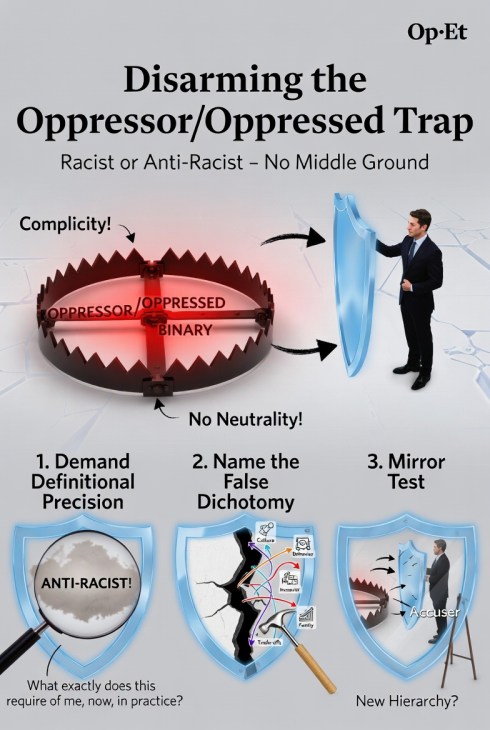
One of the most manipulative habits in contemporary politics is the oppressor/oppressed binary. It takes a complicated society, flattens it into a morality play, and assigns everyone a role before the argument even begins. You are not allowed to be a citizen, a skeptic, or simply a person trying to judge a claim on its merits. You must be either a resister of oppression or an accomplice to it. There is no middle ground. There is no neutrality. There is only confession or guilt.
This is the logic behind slogans like Ibram X. Kendi’s claim that the opposite of racist is not “not racist,” but “anti-racist.” It sounds brave and morally serious. In practice, it is a trap. It abolishes the possibility that a person can reject racism while also rejecting activist dogma, racial essentialism, or race-based policy. Once the slogan is accepted, disagreement itself becomes incriminating. Silence is violence. Skepticism is fragility. Restraint is complicity. The argument is rigged before it starts.
That is what makes the framework so effective. It does not persuade. It corners. It takes a difficult moral and empirical question and turns it into a loyalty test. Once that move is made, debate stops being a search for truth and becomes a public sorting ritual. On affirmative action, immigration, policing, school curricula, crime, history, or speech, the details matter less than whether you submit to the script. You are not judged by the quality of your reasoning. You are judged by whether you have signalled the right side.
The first way to break the trap is to demand definitional precision. Ask the simplest possible question: what, exactly, does “anti-racist” require of me here, now, in practice? What specific belief, action, or policy would prove that I am not complicit? Force the slogan to cash itself out. This matters because many activist terms draw their power from strategic vagueness. They sound morally elevated precisely because they are never pinned down. Once pinned down, they often expand into endless duties of confession, endorsement, and ideological retraining. When the standard can never be met, the point is no longer moral clarity. The point is obedience.
The second move is to name the false dichotomy. Calmly, but without apology. The binary assumes that every disparity is evidence of oppression and that every refusal to endorse the preferred remedy is therefore collaboration with injustice. But reality does not work that way. Human beings are not made of one motive. Institutions do not produce one kind of outcome. Policies have trade-offs. Causes are mixed. Incentives matter. Culture matters. History matters. Family structure matters. Behaviour matters. Human variation matters. A worldview that permits only one explanation is not morally deep. It is intellectually cheap.
“The point is no longer moral clarity. The point is obedience.”
Complexity starts to look like cowardice. Nuance starts to look like betrayal. Evidence that cuts against the preferred story is dismissed as harm. The framework protects itself the way bad frameworks always do: by treating every challenge as proof that the challenge was necessary.
The third move is the mirror test. If disagreement with your theory makes someone morally tainted, what exactly are you doing to dissenters? If refusal to use your language, endorse your policies, or accept your metaphysics makes a person an oppressor, then you have not abolished domination. You have redistributed it. You have built a new moral hierarchy with yourself at the top and everyone insufficiently converted beneath you. The names have changed. The structure has not.
This is why the binary feels so powerful. It flatters the speaker while shaming the listener. It offers moral clarity without the inconvenience of evidence. It turns political disagreement into a purity test and ordinary citizens into suspects. That is intoxicating, especially for people who enjoy the feeling of righteousness more than the discipline of thought.
Racism is real. Injustice is real. But so is the danger of any framework that treats disagreement as guilt and complexity as sin. Liberalism was built on the harder truth that citizens will differ, causes will be mixed, and power must be restrained even when exercised in the name of virtue. The oppressor/oppressed binary rejects that discipline. It wants a world of permanent accusation, permanent sorting, and permanent moral theatre.
Do not argue inside that trap. Do not accept the role of defendant in someone else’s catechism. Ask for definitions. Expose the binary. Turn the logic back on itself. The moment a moral framework abolishes the right to dissent, it has stopped being a tool of justice and become a costume for power.
To illustrate how deep the ‘social-justice’ mindset has permeated the cultures of the West, consider the following – Watch the video, and then try to imagine a white person saying the same thing. Would the reactions be different? Are your expectations different?
Coleman argues that we should do our best not to judge people on their immutable characteristics, but rather the content of their character.
Educators, parents- when you start getting the smell of “anti-racist” activism coming from your local school board be prepared to go on the offensive to keep this bullshit out of your school and away from your children. Just look at the mess this activist agenda has created in the Peel School Board.
“The “serious issues related to governance” identified by Rodrigues arose as a result of the disconnect between the conclusions and directives of the PDSB review and the real-world situation in the schools. The senior administrative team at the time knew that racism in the schools was, at most, one part of the reason for lower achievement and higher discipline rates among black students. They knew that to address these issues would require a broad, community-based set of actions many of which would not be supported by the woke activists who blamed all the problems black students were experiencing entirely on “systemic racism”. The reluctance on the part of senior administration to blame the entire problem on racism and embrace Kendi-style “antiracism” as the antidote meant that they had to go. They were cut loose (with a reported severance package of half a million each for Director Peter Joshua and his Associate Director Mark Harmon).
“As supervisor, I have worked with board staff, the Board of Trustees, community members, students, and parents over the past 2 and ½ years to rebuild relationships and trust that had been eroded over a significant period of time. When I accepted the appointment, I assumed control over a board that lacked capacity to effectively govern in the interests of all students of the board. Administrative leadership and elected leadership lacked the capacity and, in some cases, – as noted in the Investigator’s Report – the willingness to provide the leadership required to ensure that the diversity of students and families in the PDSB was well served.”
The community activists have been well served, but no one else has. The supervisor was disconnected from any actual educational reality on the ground; he did not work out of the board offices but rather at Queen’s Park. He was an unknown ghostly presence in the board and most staff never met him or received any correspondence from him. His role appeared to be to ensure that the local activists, who were demanding the application of Critical Theory (wokeism) to board polices and procedures, were consulted by senior administration at every turn. Under Rodriguez, a major purge took place in which the majority of the senior administration, lifelong educators with a wealth of experience, were shown the door. Since these were firings without cause, this exercise not only degraded the administration, replacing these knowledgeable veterans with inexperienced, ideologically-driven neophytes, it was also very expensive. Millions were spent on severance pay and early retirement packages, which essentially amounted to paying an administrator his or her full salary while they sat at home until they reached that date at which they could retire with an unreduced pension. Of course, receiving these handouts was predicated on keeping their mouths shut about what was really going on at the board. The point is that the effect of Rodrigues’ supervision was the replacement of highly experienced, traditional liberal, and relatively apolitical administrators with inexperienced, identity-obsessed followers of Kendi-style Critical Theory. As you might expect, the resulting impacts on student learning environments and teacher morale have been devastating.
“I have also invested significant time and resources to build the capacity of the Board of Trustees (Board) to position them to govern the PDSB in a manner that is accountable, transparent, respectful, and responsive to the issues and concerns of the communities it serves….”
The only people Rodrigues was accountable to were the race-essentialist activists. He has done absolutely nothing to model respect or responsiveness to community concerns about the hostile and divided climate he has created in the schools and offices of the board, in which all white people (especially heterosexual males) are characterized as oppressors while black people and other “marginalized groups” are cast as victims.
“While the newly elected board has begun its term of office in a productive and positive way, it is appropriate for regular updates to be sent to the minister to confirm that relationships are professional, respectful, and collaborative among the trustees and between the Board and the senior leadership team. The minister would be advised to similarly request confirmation and evidence that the Board is responding to community concerns in a respectful, timely and meaningful manner”.
It is clear from this statement, that while the board may have been handed back control of its operations, Big Brother will be watching. That means that Critical Theory will continue to govern PDSB policy as long as it remains the mainstream thinking in academia generally. And that could be a very long time.”
Divide and conquer is the preferred method on display here. The former board was isolated and those that did not buy into the program were purged in the name of ideological purity.











 bleatmop
 Mystro
 The Arbourist


 Dead Wild Roses
Your opinions…