
You are currently browsing the tag archive for the ‘Critical Theory’ tag.
One key idea behind activist-left identity politics is the ladder of oppression: the more marginalized identity categories a person can claim, the more moral and political weight their speech is assumed to carry.
 The theory has an old philosophical root. In the master/slave dialectic, the subordinate person is said to understand both worlds: his own condition and the world of the master who rules over him. The master, by contrast, often knows only his own comfort, his own assumptions, and the social order that flatters him. From this comes the later activist claim that oppressed people possess a clearer or “truer” insight into reality because they see power from below.
There is a partial truth here. People who live under a system often notice things the comfortable miss. A disabled person may see barriers others walk past. A woman may notice male behaviour men excuse or ignore. A racial minority may recognize social patterns the majority experiences only as normal background noise. Lived experience can expose blind spots.
The problem comes when this insight hardens into hierarchy.
Instead of treating experience as evidence to consider, activist politics often treats identity as authority. The more oppression factors a person can claim — race, sex, gender identity, sexuality, disability, poverty, colonial history — the higher they stand on the moral ladder. Their narrative is then “centred,” while those lower on the ladder are expected to listen, defer, apologize, or stay quiet.
At that point, argument has been replaced by ranking. A weak claim from the approved identity can be protected from criticism, while a strong claim from the wrong identity can be dismissed as privilege, fragility, or harm.
Lived experience matters, but it does not make someone automatically right. Suffering can reveal truths, but it can also narrow vision, sharpen resentment, or turn personal pain into bad policy.
A serious society listens to experience without making identity a substitute for reason. The question still has to be: is the claim true?
“White people don’t get to decide what’s racist.”
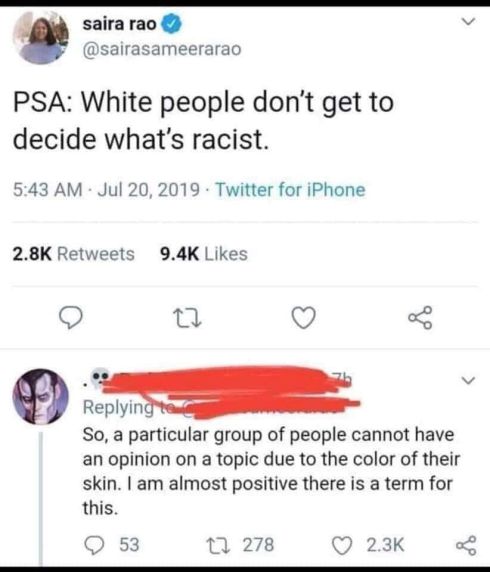
At first glance, this sounds like a demand for humility. And humility is not a bad thing. People can miss harms they do not personally experience. They can mistake comfort for neutrality. They can ignore patterns because those patterns do not touch them directly. Any honest account of racism has to leave room for that.
But the sentence does more than ask for humility. It draws a racial boundary around moral reasoning. It says that one group of people is not merely fallible, not merely prone to blind spots, but disqualified from judgment by birth.
That is where the sentence stops being a plea for listening and becomes something else. It becomes racial gatekeeping presented as moral expertise.
The screenshot is useful because it shows several aspects of critical theory coming into contact with the real world. Not in a seminar room. Not in a carefully footnoted academic paper. In the wild, where theory has been stripped of caveats, flattened into slogans, and handed to people who often have no idea where their fractured knowledge comes from or how badly it is being misused.
Most people who make these arguments are not theorists. They are downstream consumers of theory. They have inherited conclusions without the arguments, moral reflexes without the limits, and social weapons without the instruction manual. What reaches them is not a coherent philosophy but a cluster of habits: centre marginalized voices, listen and learn, impact matters more than intent, racism equals power plus prejudice, disagreement is fragility, demands for evidence are suspect, and dominant groups must defer.
Each of those claims contains a partial truth. That is why the machinery works.
People do have blind spots. Power does matter. Lived experience can reveal things outsiders miss. Social systems can produce unequal outcomes without anyone needing to wear a cartoon villain costume. A liberal society that cannot admit any of that becomes shallow and self-protective.
The problem begins when those partial truths become untouchable rules.
How the Move Works
The first assumption smuggled into the sentence is that racism is not primarily a judgment, action, belief, policy, habit, or pattern of unfair treatment. It is treated as an invisible mechanism operating beneath society. In this case, the mechanism is systemic racism: a hidden structure said to explain disparities, conflicts, speech, institutions, motives, and disagreement before any particular claim has been examined.
Again, systems are real. Institutions can produce patterns. History does not disappear because someone wants the conversation to be more comfortable. But in popular use, the mechanism often becomes unfalsifiable. If a disparity appears, the system explains it. If someone questions the explanation, the questioning becomes further evidence of the system. If a member of the alleged oppressor class objects, the objection is interpreted as fragility, denial, privilege, or complicity.
The claim no longer has to survive ordinary examination. The theory has already decided what resistance means.
“Unfalsifiable: a claim that cannot be proven wrong because every objection is reinterpreted as proof of the claim.”
The second assumption is that this mechanism can only work in one direction. This is where the “racism equals power plus prejudice” formula enters the bloodstream. In ordinary moral language, racism means judging, mistreating, excluding, or degrading people because of race. But under the power-plus-prejudice formula, racism is redefined so that only groups with systemic power can commit it. Members of designated oppressor classes can be mocked, stereotyped, excluded, insulted, or judged by race, but the framework classifies this as something other than racism because they occupy the wrong place in the hierarchy.
That is why “white people don’t get to decide what’s racist” can be treated as anti-racist rather than racial. The rule has already been made unequal.
The third assumption is epistemic. The oppressed are said to possess a kind of dual insight into how the system works. They understand their own experience from below, but they also understand the dominant group because they are forced to navigate its rules. The dominant group, by contrast, is presumed to be trapped inside its own power. It cannot see clearly because its comfort depends on not seeing.
There is a reasonable insight here. People lower in a hierarchy may notice pressures and hypocrisies that people higher up never have to think about. A worker may understand the boss’s rules better than the boss understands the worker’s life. A minority may notice social frictions the majority can glide past without naming.
But once that insight hardens into authority, the conversation changes. Standpoint stops being evidence offered into a common search for truth and becomes a credential. The person assigned to the oppressed position is treated as uniquely insightful. The person assigned to the oppressor position is treated as morally and intellectually compromised. At that point, argument no longer proceeds by shared standards. It proceeds by status.
You are no longer in a discussion. You are in a permission system.
“Permission system: a social rule where some people are allowed to define the issue, while others are expected only to listen, confess, or defer because of identity.”
This is the part ordinary people often sense but struggle to name. They think they are being invited into a moral conversation. In reality, every normal question has already been assigned a guilty interpretation.
They ask, “Isn’t it wrong to judge someone by skin colour?”
The answer comes back: “You do not get to decide that.”
They ask, “Shouldn’t the same rule apply to everyone?”
The answer comes back: “Equality language protects privilege.”
They ask, “Can we examine the evidence?”
The answer comes back: “Your demand for evidence is part of the problem.”
They ask, “How would this claim be proven wrong?”
The answer comes back: “That question itself shows your investment in domination.”
 Once this frame is accepted, the target cannot really answer. Refusal confirms guilt. Confession confirms guilt. Silence confirms guilt. Disagreement confirms guilt. The accusation is insulated from ordinary scrutiny because the mechanism is said to operate invisibly in the background, and only the approved interpreters are permitted to describe it.
That is why these encounters feel so maddening to normal people. They think they are dealing with a claim. Instead, they are dealing with a closed interpretive loop. Every exit has been marked as another entrance.
This is not an honest epistemology. It is a social technology for producing compliance.
The uglier part is that most people using it do not understand the machine they are operating. They have picked up fragments from universities, HR seminars, DEI training, social media, activist language, institutional statements, and moral peer pressure. They know the moves, not the machinery. They know which phrases confer status and which phrases mark someone as suspect. They may sincerely believe they are being compassionate, educated, and morally brave.
But sincerity does not rescue bad reasoning.
How to Recognize the Trap
A liberal society cannot function when moral claims are sorted by identity before they are examined. It depends on the possibility that anyone can ask whether a claim is true, fair, coherent, and consistently applied. It depends on open criticism, equal moral standing, and the right to question even claims made in the name of justice.
That does not mean every speaker is equally informed. It does not mean history is irrelevant. It does not mean racism only exists when someone says an obvious slur. It does not mean people with direct experience have nothing important to teach the rest of us.
It means no person’s race should grant immunity from scrutiny, and no person’s race should disqualify them from moral reasoning.
You do not need a PhD to notice when the rules have stopped applying equally. A few simple questions are often enough.
The first is the reciprocity test: would this rule be acceptable if the races were reversed? If the answer is no, then the rule is not a principle. It is a permission structure.
The second is the individual test: are we judging this person’s actual words and actions, or are we assigning moral status to an entire race? A society that cannot tell the difference between individual responsibility and racial status is not overcoming racism. It is reorganizing it.
The third is the evidence test: what would prove this claim wrong? Honest explanations can be examined. Bad explanations protect themselves by treating examination as aggression.
The fourth is the equal-rule test: does this standard apply to everyone, or only to approved groups? If one race may generalize, accuse, mock, or define the terms while another may only listen and confess, then we are not dealing with fairness.
The fifth is the liberal-society test: does this help people reason together, or does it sort them into racial teams? That question matters because liberal society depends on shared standards. Without them, public life becomes a contest over who gets to define reality and who is expected to submit.
These questions do not solve every hard case. They are not meant to. Racism can be subtle. Power can matter. History can shape the present in ways that are not obvious at first glance. But if a moral framework cannot survive these basic questions, the problem is not the questions.
The problem is the framework.
That is what makes a small sentence like “white people don’t get to decide what’s racist” worth examining. It is not merely rude. It is not merely hypocritical. It is a compressed example of a larger ideological move: convert a universal moral question into an identity-jurisdiction question.
Who may speak? Who must listen? Who is presumed insightful? Who is presumed guilty? Who gets to define the harm? Who is allowed to ask for evidence?
Once those roles are assigned by race, the conversation is no longer about racism in any honest moral sense. It is about power over the terms of reality.
A genuinely anti-racist society should reject that move.
Not because racism is unreal. Not because power is irrelevant. Not because lived experience does not matter. But because the cure for racial injustice cannot be a new racial priesthood deciding who is allowed to reason, who is allowed to question, and who must sit quietly while their moral standing is revoked.
Shared truth has to remain possible. So does shared criticism.
Otherwise, anti-racism becomes just another way to smuggle racial hierarchy back into public life, this time with better slogans and institutional approval.
—–
Glossary
Critical theory
A broad family of ideas that examines society through power, hierarchy, and oppression. It can reveal real blind spots, but in popular use it often turns into a habit of treating every disagreement as proof of hidden domination.
Systemic racism
The idea that racism can operate through institutions, patterns, incentives, and social habits, not only through individual prejudice. The problem comes when “systemic racism” is used as an all-purpose explanation that cannot be questioned or tested.
Power plus prejudice
A redefinition of racism that says racism is not simply racial prejudice or unfair treatment, but prejudice backed by social power. In practice, this often means racism is treated as something only dominant groups can commit.
Standpoint epistemology
The idea that people may notice different truths depending on their social position. Someone lower in a hierarchy may see pressures that someone higher up misses. The danger comes when perspective is treated as automatic authority.
Epistemology
A theory of knowledge: how we know what is true, what counts as evidence, and how claims should be tested.
Epistemic hygiene
The habits that keep our thinking clean: asking for evidence, checking assumptions, allowing disagreement, correcting errors, and refusing to protect favourite ideas from scrutiny.
Unfalsifiable
A claim that cannot be proven wrong because every objection is reinterpreted as proof of the claim. For example: “If you disagree, that only proves you are in denial.”
Lived experience
Knowledge gained from personal experience. It can be important evidence, but it should not become a veto over questions, criticism, or shared standards.
Identity-jurisdiction question
A shift from asking “Is this claim true?” to asking “Who is allowed to speak about this?” The issue becomes identity status rather than evidence or reasoning.
Permission system
A social rule where some people are allowed to define the issue, while others are expected only to listen, confess, or defer because of their identity.
Liberal society
A society built around equal moral standing, open debate, individual rights, shared standards, and the ability to criticize ideas without being treated as morally disqualified.
Racial gatekeeping
Using race to decide who is allowed to speak, judge, question, or define moral terms.
Closed interpretive loop
A pattern where every possible response confirms the accusation. Denial, silence, disagreement, or requests for evidence are all treated as further proof of guilt.
Moral reasoning
The process of deciding what is right or wrong using evidence, consistency, fairness, context, and principles that can be applied beyond one group.
Racial essentialism
Treating people as if their race determines their moral status, knowledge, guilt, innocence, or authority.
I’m not a religious individual. This series has made that clear enough over time, and I’m not about to reverse course now. But looking out at the current cultural moment, something else is becoming difficult to ignore: within many of our influential cultural and institutional spaces, people are not stepping away from religion into something stronger or more coherent; they are drifting into something thinner, more unstable, and ultimately more corrosive.
Call it cultural relativism, call it critical theory, call it the downstream effects of postmodern deconstruction—it doesn’t much matter which label you prefer. What matters is the shared move underneath it. The older structures that once oriented people toward truth, obligation, and restraint are no longer treated as imperfect guides to be improved upon; they are treated primarily as systems of power to be exposed, delegitimized, and, where possible, dismantled.
That shift does not leave a neutral vacuum.
A society cannot sustain itself on permanent critique, because critique alone does not tell you what to build in its place, nor does it supply the habits of restraint needed to keep that construction from collapsing.”
On a more personal level, it is increasingly common to encounter people who describe their lives almost entirely through the lens of structural disadvantage, even when their circumstances are relatively stable. The framework offers an explanation for frustration, but it also narrows the space for agency, because improvement begins to look less like progress and more like complicity in the very systems being critiqued.
People require some kind of orienting framework, not necessarily a perfect one, but one stable enough to tell them what is worth building, what must be limited, and what ought to endure beyond their immediate preferences. When every structure is interpreted first as an instrument of domination, that framework does not evolve into something better calibrated—it fragments. What follows is not so much liberation as drift, where moral language remains in use but loses its anchor, and where personal identity begins to carry more explanatory weight than shared standards ever could.
Some of this thinking has value in narrow contexts. As a tool for examining institutions, it can reveal blind spots, excesses, and genuine injustices that deserve correction. But once it escapes those boundaries and becomes a general worldview, it scales badly. A society cannot sustain itself on permanent critique, because critique alone does not tell you what to build in its place, nor does it supply the habits of restraint necessary to keep that construction from collapsing under pressure.
The psychological effects are not incidental here. If a person is taught, explicitly or implicitly, that every system they inhabit is stacked against them, and that their standing within that system is best understood through grievance rather than agency, the result is not empowerment in any meaningful sense. It is demoralization dressed up as insight. Over time, that posture makes collective life harder to maintain, not easier, because it erodes the basic trust required for cooperation.
This is where the comparison with religion, uncomfortable as it may be, begins to sharpen.
Religious frameworks, even when metaphysically suspect or internally inconsistent, tend to provide a coherent structure of meaning, obligation, and limitation. They impose costs. They constrain behaviour. They bind individuals into something that extends beyond the self, whether that is a community, a tradition, or a conception of the good that cannot be endlessly revised to suit immediate preference. Those features can be abused, and often have been, but they are not accidental—they are part of what makes such systems socially durable.
It is worth noting that some of the most stable and prosperous societies today are also among the least religious. That observation deserves to be taken seriously. But those societies are not culturally unmoored; they are, in many cases, the beneficiaries of long-standing moral traditions that continue to shape behaviour even as explicit belief declines. The question is not whether a society can function after religion recedes, but how long it can continue to draw on inherited norms once the structures that sustained them are no longer reinforced.
If the practical choice is between a society that retains some shared, if imperfect, moral architecture and one that dissolves that architecture in favour of perpetual deconstruction, I am no longer convinced that the latter is the safer or more enlightened path. That is not because religion is true in any ultimate sense, but because it appears to do something that our current alternatives struggle to replicate at scale. Secular frameworks capable of supplying meaning and restraint do exist. What remains unclear is whether they can achieve the same level of cultural penetration and durability without borrowing from the traditions they seek to replace.
This is not an argument for theocracy. A classically liberal state remains the best framework we have for preserving freedom, dissent, and pluralism across deep differences. But liberalism has never been self-sustaining in the way its defenders sometimes imagine. It has historically relied on inherited norms—habits of restraint, notions of duty, a willingness to subordinate impulse to something more enduring—that it did not generate on its own.
When those supporting structures are steadily stripped away, the system does not immediately collapse, but it does begin to thin out. The language of rights remains, but the culture that made those rights workable starts to erode. At that point, something else will fill the gap, and it is not guaranteed to be gentler, freer, or more rational than what came before.
None of this erases the historical abuses tied to religion. It simply raises the possibility that removing it creates vulnerabilities we have not yet learned to manage.
Religion, for all its flaws, once carried a significant portion of that load.
Remove it, or hollow it out beyond recognition, and the question is no longer whether people will believe in something. It is what they will reach for instead—and whether that replacement will prove more stable than the thing it displaced.

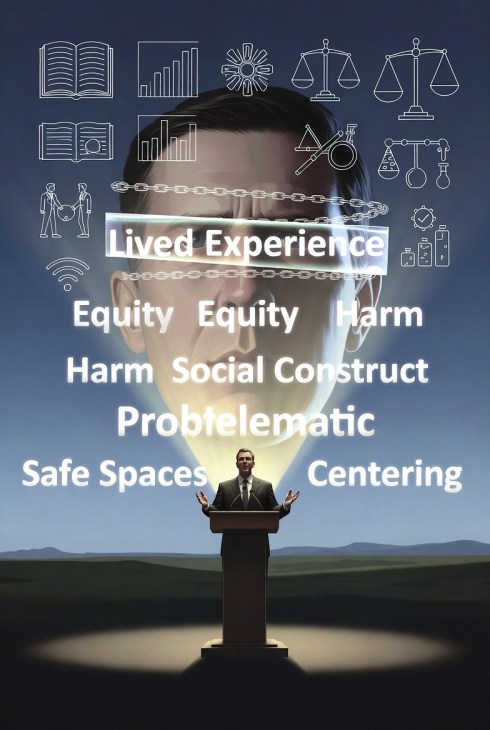
You can usually tell what kind of argument you’re about to hear before the argument is made.
It’s in the language.
Certain words don’t just describe reality—they quietly reframe it, often in ways that make disagreement harder before it even begins. They shift the ground you’re standing on, sometimes without you noticing.
Once you recognize them, the pattern becomes difficult to miss.
“By the time the argument begins, much of it has already been decided.”
Here are a few to listen for.
“Lived experience”
Often used to elevate subjective accounts above other forms of evidence.
Experience matters. But when it becomes the final authority, it can no longer be questioned or compared. At that point, it stops being evidence and becomes a conclusion.
“Social construct”
A useful concept in limited contexts. Overextended, it suggests that because something is shaped by society, it is therefore arbitrary or infinitely malleable.
The move is subtle: from influenced by culture to not anchored in reality at all.
“Harm”
A word that has expanded far beyond physical or material damage.
Disagreement, discomfort, or perceived invalidation can all be folded into it. Once that happens, ordinary debate starts to look like misconduct.
“Equity”
Not the same as equality.
It shifts the focus from equal rules to equal outcomes. That shift often justifies unequal treatment in the name of correcting disparities.
“Centering” / “Decentering”
Signals who is allowed to speak, and whose perspective is treated as primary.
Less about argument, more about managing whose voice carries authority.
“Problematic”
A soft accusation that avoids specificity.
It implies wrongdoing without clearly stating what the problem is, which makes it difficult to respond directly.
“Safe spaces”
Originally about protection from harassment. Now often used to limit exposure to challenging or opposing ideas.
The definition quietly expands from safety from harm to safety from disagreement.
None of these words are inherently illegitimate. The issue is how they are used. Individually, they can be useful. In combination, they tend to narrow the space for disagreement.
When they appear together, they often shift discussion away from evidence, elevate subjective claims beyond challenge, and quietly limit what can be said without consequence. By the time the argument begins, much of it has already been decided.
When you hear language like this, a simple question is usually enough: what claim is being made—and could I reasonably disagree with it? If the answer is no, you are no longer in a normal debate. You are being asked to accept a framework, not evaluate an argument.
This pattern isn’t unique to any one ideology. It appears wherever language is used to secure agreement before the argument begins. Language doesn’t just communicate ideas—it sets the terms under which those ideas can be questioned, and sometimes whether they can be questioned at all.
Would people hold the views they do if they understood the first principles those views rest on?
I suspect many would at least pause. Not necessarily abandon their position, but slow down long enough to ask what exactly they are affirming. This is not a universal pattern, but it shows up often enough in public discourse to be worth paying attention to.
What I am describing is a kind of reverse percolation. Ideas that begin in highly abstract settings move downward into activism and identity, where they are simplified, moralized, and widely adopted. Something is lost in that movement. The underlying logic—the structure that gave the idea its shape in the first place—does not always make the trip.
Take a common example.
One influential strand of queer theory makes a striking claim: that identity need not be grounded in any stable essence, but instead takes shape in relation to what is considered normal or legitimate. At the level of theory, this is an attempt to examine how norms are constructed and how they operate, often in ways that are invisible to those who benefit from them.
But when that framework moves out of the seminar room and into everyday political identity, it tends to arrive in a thinner form. The scaffolding is gone. What remains is the posture.
“Ideas move downward into mass use, losing fidelity as they go, and return upward not as refinement, but as reinforcement—positions hardening around ideas that have already shed much of what made them coherent.”
That shift creates a tension that is easy to miss. If an identity is defined in relation to norms, then friction with those norms is not an accidental byproduct; it is part of the structure. Yet many who adopt the language of queer politics encounter that friction as if it were imposed entirely from the outside, rather than something partly generated by the logic they have taken on.
This is where the gap begins to open—between first principles and lived adoption.
What makes the dynamic more interesting is that it does not run in a single direction.
A similar distortion can be seen in conservative responses, where disparate strands of progressive thought are often folded together under the single label of “liberalism.” In doing so, distinctions that matter are blurred or lost altogether. Classical liberalism, with its emphasis on individual rights, pluralism, and limits on power, is not interchangeable with theoretical frameworks that aim to critique or unsettle those foundations.
Once those categories collapse into each other, critique starts to rest on unstable ground.
The result is less a clash of well-formed positions than a kind of mirrored simplification. On one side, ideas are adopted without much reference to their internal logic. On the other, they are opposed without being clearly identified. Whether the greater loss happens in adoption or in response is difficult to say, and in a sense it does not matter; each process feeds the other.
This is where the reverse percolation effect completes its cycle.
Ideas move downward from abstraction into mass use, losing fidelity as they pass through each layer. They are then taken up again, interpreted, resisted, or amplified by others working from similarly partial models. What comes back is not refinement. It is reinforcement—positions hardening around ideas that have already shed much of what made them coherent.
At that point, disagreement becomes inevitable, because the participants are no longer operating within the same conceptual frame. Understanding does not so much fail as it is quietly set aside.

Glossary
Queer Theory
A body of academic thought that examines how categories like sex, gender, and sexuality are constructed, regulated, and experienced. It often challenges the idea that these categories are fixed or natural, instead emphasizing their fluidity and relationship to social norms. The field is not monolithic, and different strands place different weight on these elements.
Classical Liberalism
A political philosophy centred on individual rights, equality before the law, freedom of expression, and limits on state power. It forms the foundation of many modern democratic systems and emphasizes pluralism within a shared legal framework.
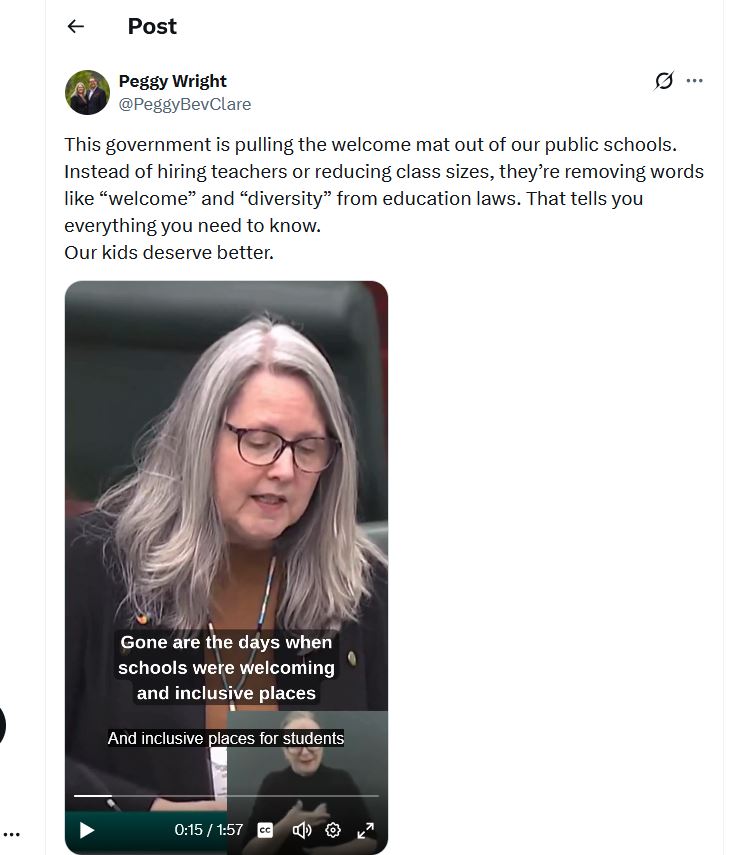
Posted by the NDP’s Peggy Wright on X.
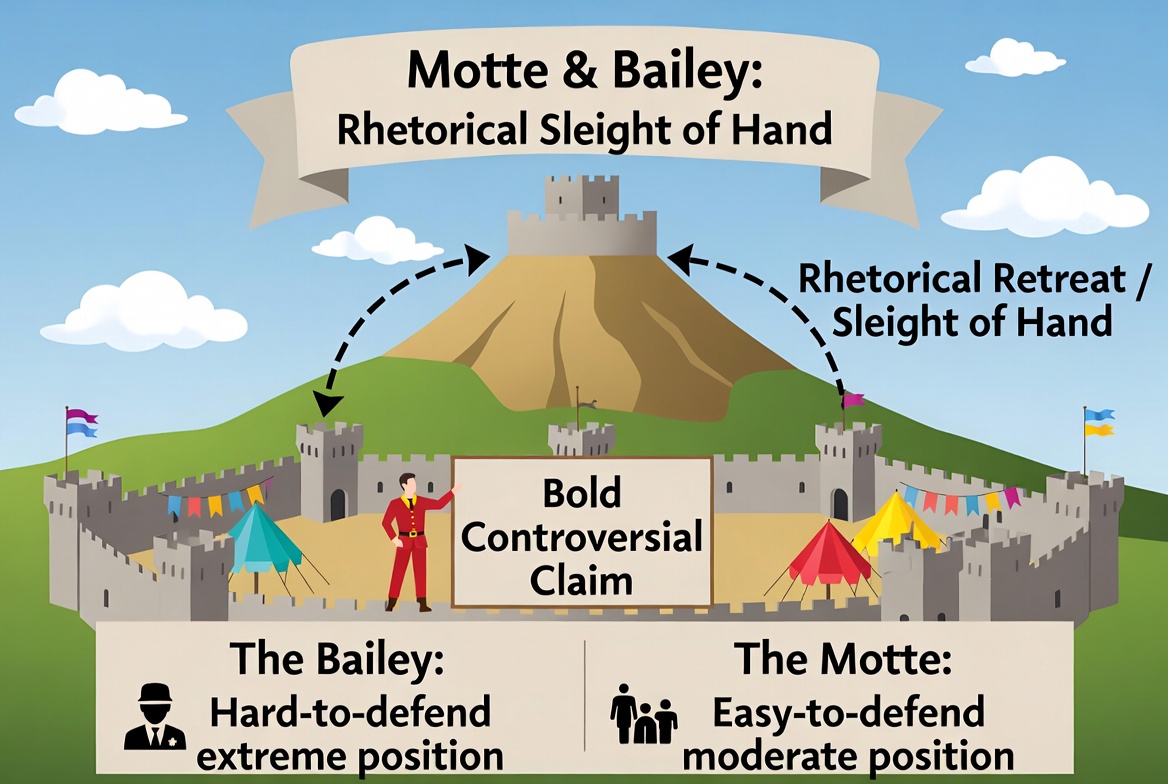
There is a recurring pattern in modern policy debates that most people sense but struggle to name. The argument presented to the public is not the policy that gets implemented. Instead, a broadly agreeable claim—something no reasonable person would oppose—is used to carry a far more specific and contested agenda into law. By the time the details become visible, the argument has already been won at the level that matters.
This is the structure known as the motte and bailey. The “motte” is the safe, defensible position: a statement so benign it feels almost churlish to resist. The “bailey” is the real position—the one with consequences, tradeoffs, and enforcement mechanisms. The move is simple. Sell the motte. Build the bailey. When challenged, retreat to the motte and accuse critics of attacking something obviously good.
You can see the pattern clearly in the recent dispute over education language. The public claim is that schools should be “welcoming,” “inclusive,” and respectful of “diversity.” No serious person objects to that in the abstract. But those terms are not operating as neutral descriptions. They have acquired specific policy meanings, often tied to particular ideological frameworks, institutional practices, and expectations placed on teachers and students. When legislation attempts to narrow or neutralize that language—shifting toward behavior-based standards like “safe and caring” environments grounded in responsibility and respect—the response is immediate: the government is “removing welcome,” attacking “diversity,” harming children. The motte is invoked as if it were the policy itself. The bailey disappears from view.
Watch the Move
In a recent legislative speech, MLA Peggy Wright provides a clean example of how this works in practice. She begins with a familiar image:
“Albertans put welcome mats in front of their doors. It means ‘come on in’ and we’re glad you are here.”
No disagreement is possible there. It is a moral and cultural baseline. But then the shift occurs. A change in statutory language becomes:
“the UCP is pulling up the welcome mat from all public schools.”
A metaphor replaces the policy. The audience is invited to react to exclusion rather than examine the legislation. The escalation continues:
“Gone are the days when schools were welcoming and inclusive places… celebrating diversity and uniqueness.”
At this point, the argument is no longer about wording. It is about intent, character, and harm. The key moment follows:
“the latest amendments… would strip words like ‘welcoming’ and ‘diversity’ from it.”
This is where the real question should be asked: does removing those words remove the underlying protections, or does it replace one framework of description with another? That question is never addressed. Instead, the speech returns immediately to moral framing:
“Diversity is a strength.”
In the abstract, yes. But the dispute is not over the abstract claim. It is over what “diversity” means in policy and practice. By collapsing the contested meaning into the harmless one, the argument avoids defending the actual implications. Criticism of the policy is recast as opposition to a universal good.
“The argument people agree to is not the policy that gets implemented.”
The most revealing line in the speech is this:
“Words are important… because they set the tone.”
That is true—and it explains the entire strategy.
This pattern isn’t random. It reflects a broader shift in how language is used in politics. Words like “diversity,” “inclusion,” and “safety” are no longer just descriptive. They function as instruments. If language helps shape how institutions operate and how people interpret reality, then controlling definitions becomes a form of power. Under that logic, you don’t need full public agreement on the details of a policy. You need agreement on the framing. Once that is secured, the content can expand behind it.
That helps explain why the motte and bailey is so effective. It allows advocates to operate on two levels at once. The public-facing level is morally attractive and broadly supported. The operational level is narrower, more contested, and often insulated from direct scrutiny. When the two are conflated, consent is manufactured. People believe they are endorsing a general principle when, in practice, they are enabling a specific program.
It works because most people are not trained to interrogate language this way. “Inclusion” sounds like inclusion. “Diversity” sounds like a mix of backgrounds and perspectives. “Safety” sounds like protection from harm. The terms carry moral weight before any definition is examined. By the time someone asks what they actually entail in practice, the rhetorical ground has already shifted. Opposition can be framed as hostility to the value itself rather than disagreement with its implementation.
The cost is not just confusion. It is the erosion of honest disagreement. If every critique of a policy can be recast as an attack on a universally accepted good, then meaningful debate becomes impossible. Language stops clarifying differences and starts concealing them. Institutions drift, not because the public has clearly chosen a direction, but because the terms of choice were never presented plainly.
This is why the technique matters. It is not just sharp rhetoric. It is a way of bypassing consent. If citizens cannot distinguish between the principle they are being asked to affirm and the policy that will follow from it, then they are no longer participating in a genuine democratic process. They are being managed through language.
If you think this reading is unfair, read the full remarks below and decide for yourself.
Appendix: Full Speech Transcript (April 2, 2026)
How to read this: Watch for the shift between general claims (“welcome,” “diversity”) and the specific policy being discussed. The argument depends on treating them as the same.
Full transcript of the video (Alberta Legislative Assembly session, ~1:57 long):
“Mr. Speaker, Albertans put welcome mats in front of their doors. It means ‘come on in’ and we’re glad you are here. And welcome to our house.But now the UCP is pulling up the welcome mat from all public schools.Gone are the days when schools were welcoming and inclusive places for students, celebrating diversity and uniqueness.That’s because the latest amendments to the Education Act would strip words like ‘welcoming’ and ‘diversity’ from it.This government combed through that bill and pulled the word ‘welcoming’ out eight times.Not satisfied with making our public schools less inviting — even as they function as important community hubs for many of our communities — then they went through and chopped the word ‘diversity’ out five times.Diversity is a strength.It used to say so in government policy, in legislation. But I guess not anymore.Words are important, Mr. Speaker, and that’s because they set the tone.When those in charge are threatened by words like diversity, welcome, and sense of belonging, there’s a problem. Because this is then about ideology and politics outside the classroom, not within.Instead of focusing on reducing class sizes, hiring teachers, and ensuring supports are there for all kids who need them, we get this distraction from a bill and government intent to narrow the frame so much that there is room for only one worldview: the UCP’s.And that’s the point.Straight out of the authoritarian playbook, Mr. Speaker.But, Mr. Speaker, our kids deserve that welcome mat back. I, for one, am extremely happy to let them know that they can expect it come next election, when it’s NDP in government and UCP — not our kids — who will find themselves unwelcome.”
Critical theory, as articulated by James Lindsay and rooted in the Frankfurt School’s intellectual project, forms the corrosive core of contemporary “woke” ideology. At its heart, it is not a constructive framework for social improvement but a methodological commitment to negation. Its aim is not to diagnose specific problems and propose reforms, but to discredit existing social arrangements by measuring them against an imagined standard of perfection that its own architects say cannot be positively described.
This orientation traces back to Max Horkheimer’s 1937 essay Traditional and Critical Theory. Traditional theory, he argued—drawing from the natural sciences and classical philosophies—engages with observable reality and grapples with the inevitable trade-offs embedded in human life. Critical theory rejects this approach. It evaluates the real world not against empirical evidence or feasible alternatives, but against a speculative ideal that can never be fully articulated, let alone realized. In 1969, Horkheimer reaffirmed this openly: because the ideal society cannot be conceptualized in existing terms, the only available activity is relentless critique of whatever exists. In effect, the real world is condemned for being real.
This negative idealism weaponizes the gap between the actual and the imaginary. Real societies, by necessity, require trade-offs: freedom of speech permits offensive speech; environmental protection imposes economic and temporal costs; social order requires rules, hierarchies of competence, and constraints on behavior. Critical theory interprets these trade-offs not as inherent features of human life but as intolerable flaws. It provides no functional replacement for what it seeks to dismantle. Instead, it declares that racism, class division, penal systems, borders, gender norms, or any designated “problematic” ought not to exist in the ideal world. Everything short of that unreachable ideal becomes proof of systemic oppression.
By measuring the real against an impossible standard, critical theory does not reform institutions—it erodes their legitimacy. It fosters perpetual grievance while strategically withholding any concrete alternative that could be scrutinized, tested, or judged by the same standards it applies to the world.
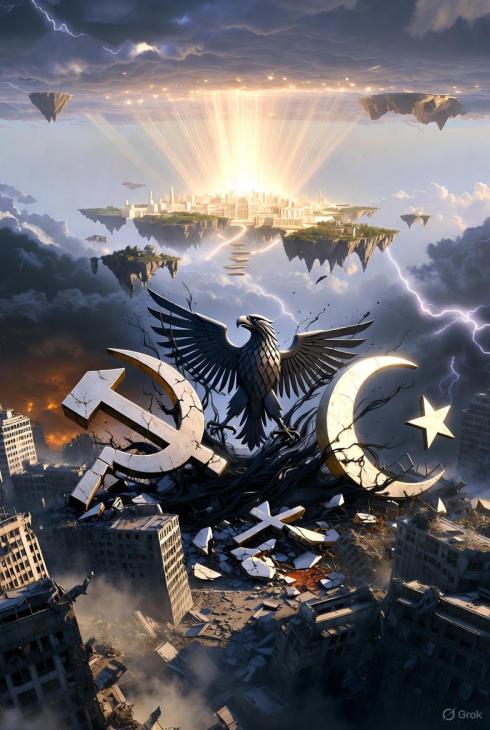
James Lindsay identifies three major historical ideologies that employ this same pattern of negative utopianism: communism, fascism, and political Islam. The claim is not that these movements are identical, but that they exhibit the same critical-theoretical structure:
- Communism imagines a stateless, classless society populated by “socialist man,” a type of human being who does not yet exist. Until such a person emerges, every tradition, institution, and authority is condemned as perpetuating exploitation.¹
- Fascism posits a perfectly ordered national or racial hierarchy unified around the mythic volk. Anything cosmopolitan, liberal, or “degenerate” is denounced as a betrayal of that utopian unity.²
- Political Islam (in its revolutionary form) imagines global submission to divine law. The present age is delegitimized as jahiliyyah—ignorance—and therefore unworthy of loyalty until the ideal community is imposed.³
In each case, the ideal is defined primarily by what it negates: capitalism, decadence, unbelief. And in each case, the historical results were catastrophic: gulags, war, genocide, theocratic oppression. The ideal was literally u-topian—“no place.”
Critical theory operates on precisely the same logic. Its power lies in inflaming resentment, undermining trust in existing institutions, and inducing a permanent revolutionary consciousness. It teaches adherents to view every tradition, norm, and hierarchy as illegitimate simply because it exists. It replaces trade-offs with absolutist moral demands, and flaws with indictments. It offers no blueprint for construction—only a sophisticated toolkit for deconstruction.
This is why contemporary “woke” politics behaves as it does. The endless denunciations of “systems,” “structures,” and “hegemonies”; the refusal to offer workable solutions; the moral absolutism; the perpetual expansion of grievance categories; the inability to articulate what a healthy society would look like—all reflect the same methodological negation that Horkheimer enshrined. It is criticism without end, and without responsibility.
Critical theory, in this sense, is not a path to reform but a program of societal disintegration. By demanding the impossible and attacking the real for failing to produce perfection, it generates only dissatisfaction, conflict, and institutional decay. The historical record is unambiguous: no system built on a negative utopia has ever produced anything but rubble.
To embrace critical theory is to wage war on reality under the banner of a perfection that cannot exist. That is why it must be understood clearly—and rejected root and branch.
Citations
Primary Critical Theory Sources
- Max Horkheimer, Traditional and Critical Theory (1937).
- Max Horkheimer, Critical Theory: Selected Essays (1969).
- Herbert Marcuse, One-Dimensional Man (1964).
- Jürgen Habermas, Knowledge and Human Interests (1968).
- Theodor W. Adorno, Negative Dialectics (1966).
Historical Ideology Sources
6. Karl Marx & Friedrich Engels, The German Ideology (1846); Critique of the Gotha Program (1875).
7. Benito Mussolini & Giovanni Gentile, The Doctrine of Fascism (1932).
8. Sayyid Qutb, Milestones (1964) — foundational for modern political Islam.
9. Ruhollah Khomeini, Islamic Government (1970).
Secondary Sources / Contemporary Analysis
10. James Lindsay, Cynical Theories (with Helen Pluckrose, 2020).
11. James Lindsay, The Marxification of Education (2023).
12. Roger Scruton, Fools, Frauds and Firebrands (2015).
13. Paul Gottfried, The Strange Death of Marxism (2005).
14. Mark Lilla, The Reckless Mind (2016).
15. John Gray, Black Mass: Apocalyptic Religion and the Death of Utopia (2007).
Glossary of Key Terms
Critical Theory – An ideological project originating with the Frankfurt School that critiques society against an impossible ideal rather than proposing practicable reforms.
Negative Idealism – Measuring reality against a utopia that cannot be articulated or realized.
Utopia – Literally “no place”; an imagined perfect society used as a moral weapon against the real world.
Hegemony – Antonio Gramsci’s concept of cultural dominance; used by CT to claim that norms and values are tools of oppression.
Structural Oppression – The assertion that unjust outcomes are produced by hidden systems rather than individual actions.
Standpoint Epistemology – The belief that knowledge is tied to identity; “lived experience” is epistemically privileged.
Praxis – Activism embedded into theory; in CT, the idea that theory must produce political action.
Reification – A Marxist term meaning the naturalization of social constructs; used to claim that institutions disguise power.
Signs You Are Encountering Critical Theory in Real Life
Here are the typical markers:
1. The language of systems and structures
Phrases like:
- “systemic oppression”
- “institutional racism”
- “hegemonic norms”
- “structures of privilege”
These shift blame from individuals to invisible systems.
2. Demands for perfect equity, not equality
If disparities alone are treated as dispositive evidence of injustice, CT is operating.
3. Appeals to lived experience as decisive evidence
Personal narrative is elevated above data or argument.
4. Moral asymmetry between groups
Some identities are framed as inherently oppressive; others as inherently oppressed.
5. Critique without end, without alternatives
If someone deconstructs everything but proposes nothing testable or concrete, it’s CT.
6. Rebranding ordinary conflict as oppression
If disagreement is treated as harm, and harm as violence, CT is at work.
7. The “if it exists, it’s oppressive” rule
Traditions, norms, meritocracy, law, biology—all treated as power structures.
How to Deal With Critical Theory in an Argument
Critical Theory arguments do not operate on normal rules of evidence or rational debate. Here’s how to engage effectively, calmly, and persuasively.
1. Reintroduce Trade-Offs
CT denies trade-offs. Bring them back.
“Every policy choice has costs—what trade-offs are you proposing in exchange for your solution?”
This forces concreteness.
2. Ask for Positive Alternatives
CT collapses when it must define what it wants.
“If the current system is oppressive, what specific system would you replace it with? How would it work in practice?”
Make them articulate the utopia in concrete terms. They rarely can.
3. Reject Claims Based Solely on Disparity
Demand causal reasoning.
“A disparity doesn’t automatically indicate discrimination. What evidence shows a causal link?”
This moves the debate from ideology to empiricism.
4. Expose Moral Asymmetry
Ask:
“Why are only some groups moralized? Do individuals still have agency?”
This undermines the oppressor/oppressed binary.
5. Clarify Definitions
CT thrives on shifting definitions.
Ask:
- “What do you mean by racism?”
- “How are you defining harm?”
- “What counts as violence?”
Pinning down definitions prevents concept-hopping.
6. Refuse Standpoint Epistemology
Challenge the epistemic claim:
“Lived experience matters, but it’s not a substitute for evidence. How can we verify your claim?”
This resets the terms of rational inquiry.
7. Separate Compassion From Ideology
Many people adopt CT-infused ideas because they want to be good.
Tell them:
“Your moral concern is admirable. CT is not the only—or even the best—way to address injustice.”
This opens space for alternatives and lowers defensiveness.











 bleatmop
 Mystro


 Dead Wild Roses
Your opinions…