
You are currently browsing the tag archive for the ‘Political Discourse’ tag.
One of the most effective moves in contemporary progressive argumentation, especially inside institutions that trade in moral prestige, is also one of the least truth-seeking: take an ordinary policy dispute, attach a moral charge to one side of it, and then treat resistance as evidence of personal defect.
The argument does not proceed by persuasion. It proceeds by contamination.
You are not merely skeptical of a DEI policy. You are hostile to inclusion. You are not asking whether a school lesson is age-appropriate. You are endangering vulnerable children. You are not questioning whether a land acknowledgement has become empty ritual. You are denying history. You are not concerned about due process, compelled speech, medical evidence, or institutional overreach. You are “unsafe.”
“The moral valence trap raises the social cost of dissent until silence looks like prudence.”
The mechanism is simple. First, the issue is moved from the realm of judgment into the realm of moral identity. Then the person asking questions is dragged with it. The disputed policy becomes kindness, justice, safety, inclusion, or harm reduction. Opposition becomes cruelty, hatred, danger, exclusion, or complicity. Once that happens, the argument is no longer about the thing itself. It is about whether you are the sort of person decent people should listen to.
This is dirty pool, but it works because most people do not want to be seen as cruel. They also do not want a meeting, classroom, workplace, choir rehearsal, staff room, or family dinner to become a tribunal. So they soften, retreat, or say nothing. The moral valence does its job. It raises the social cost of dissent until silence looks like prudence.
The tactic is not unique to progressives. Conservatives have used their own versions: dissent from a war becomes hatred of the troops; concern about state power becomes softness on crime; criticism of national myth becomes contempt for the country. The mechanism is the same. Policy disagreement is converted into a character flaw. The reason the progressive version deserves special attention now is not that it is uniquely wicked, but that it has become unusually powerful inside the institutions that shape respectable opinion: schools, universities, HR departments, media, charities, public agencies, and professional regulators.
The first defence is definitional clarity.
Do not accept suitcase words without unpacking them. Harm, safety, inclusion, dignity, equity, violence, erasure, and belonging are often used as if everyone already knows what they mean. Usually they do not. These words carry emotional force precisely because they remain blurry. A claim like “this policy protects safety” sounds serious, but it may mean physical safety, emotional comfort, reputational protection, ideological conformity, bureaucratic risk management, or the absence of disagreement.
Those are not the same thing.
The useful question is not “Do you care about safety?” That question has already been rigged. The useful question is: what kind of safety, for whom, from what, by what mechanism, and at what cost to others?
That last clause matters. Every moral claim has tradeoffs. A school policy that makes one child feel affirmed may require another child to lie. A workplace policy designed to create inclusion may create compelled speech. A public ritual meant to acknowledge one group may quietly pressure others into participation. A speech code meant to prevent harm may give administrators broad discretion to punish unpopular views.
Definitions bring the argument back to earth. They force slogans to become claims. Once a slogan becomes a claim, it can be examined.
The second defence is fairness in a liberal democratic society.
Progressive moral framing often assumes that once a group is described as vulnerable, its preferred policy should win by default. But liberal democracy cannot work that way. Vulnerability matters, but it does not abolish fairness. A decent society does not settle conflict by asking which side has the most emotionally powerful identity claim and then handing that side the institutional lever.
Fairness requires reciprocal rules. If one group may decline participation in a ritual that violates its conscience, others must be allowed the same freedom. If one group may describe its experience honestly, others must be allowed to describe theirs. If dignity matters for minorities, it also matters for dissenters. If safety matters for the anxious student, it also matters for the girl in the changing room, the employee pressured to say words he does not believe, the parent cut out of a consequential decision, or the teacher expected to enforce doctrine while pretending it is merely kindness.
The point is not that all claims are equal. Some are stronger than others. Some deserve accommodation. Some deserve rejection. But in a liberal society, moral concern cannot become a one-way ratchet where one side receives rights and the other receives obligations.
A fair question cuts through the fog: would this rule be acceptable if used by people you distrust?
If the answer is no, then the principle is not a principle. It is a weapon waiting for a friendly hand.

The third defence is free speech.
Not free speech as a bumper sticker. Not free speech as “I should be able to say anything without consequence.” Free speech as the basic operating condition of a truth-seeking society.
The moral valence trap depends on making certain questions unsayable. It does not always censor directly. Often it works through etiquette, professional risk, peer pressure, institutional language, and the quiet fear of being labelled. That is enough. You do not need formal censorship when people learn to pre-edit themselves before the room turns cold.
Free speech is not merely a personal liberty. It is a safeguard against institutional self-deception. Bad policies survive when people cannot question the assumptions underneath them. Medical scandals survive that way. Educational fads survive that way. Bureaucratic rituals survive that way. Ideologies survive that way. The organization tells itself that dissent is harm, then congratulates itself on the absence of dissent. An institution can call that consensus if it wants, but what it has really produced is managed silence.
This is also where the dissenter has to resist the forced confession. The moral valence trap often tries to make you prove your innocence before you are allowed to discuss the issue: “Do you support inclusion?” “Do you understand how harmful that is?” “Why are you uncomfortable with marginalized people being seen?” Sometimes these are sincere questions. Often they are attempts to move the conversation from the policy to your character. A useful response is calm redirection: I’m happy to discuss the rule. I’m not going to litigate my soul as a precondition for speaking.
The point is not to become rude or combative; it is to keep the discussion on the rule, the evidence, and the tradeoffs instead of letting it drift into a trial of your character.
Progressive argumentation wins when it turns politics into moral theatre. The trick is to refuse the theatre without refusing morality. There are real harms, real injustices, and real people who deserve protection, accommodation, and dignity. But moral language should clarify reality, not smother it. Once moral vocabulary becomes a substitute for evidence, mechanism, fairness, and speech, it stops being ethics and becomes discipline.
The answer is not counter-shaming, which only reproduces the same bad habit with different slogans, but steadiness: define the terms, ask who pays the cost, test the rule for reciprocity, and defend the right to question. A liberal society does not need citizens who agree about everything. It needs citizens who can disagree without turning every dispute into a loyalty test.
You can usually tell what kind of argument you’re about to hear before the argument is made.
It’s in the language.
Certain words don’t just describe reality—they quietly reframe it, often in ways that make disagreement harder before it even begins. They shift the ground you’re standing on, sometimes without you noticing.
Once you recognize them, the pattern becomes difficult to miss.
“By the time the argument begins, much of it has already been decided.”
Here are a few to listen for.
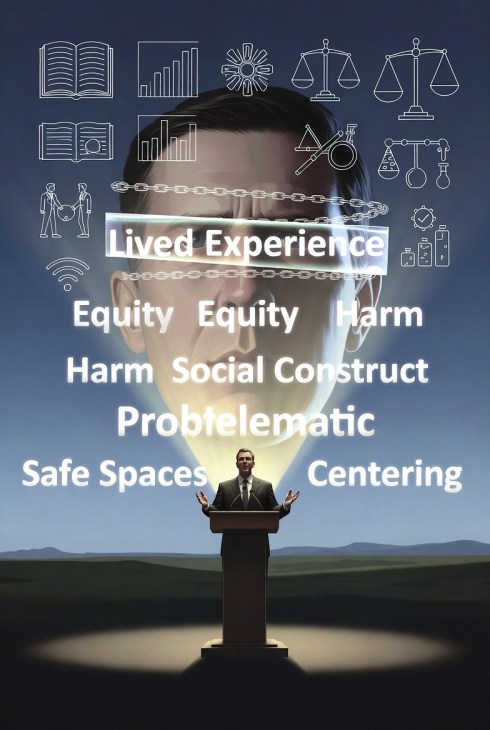
“Lived experience”
Often used to elevate subjective accounts above other forms of evidence.
Experience matters. But when it becomes the final authority, it can no longer be questioned or compared. At that point, it stops being evidence and becomes a conclusion.
“Social construct”
A useful concept in limited contexts. Overextended, it suggests that because something is shaped by society, it is therefore arbitrary or infinitely malleable.
The move is subtle: from influenced by culture to not anchored in reality at all.
“Harm”
A word that has expanded far beyond physical or material damage.
Disagreement, discomfort, or perceived invalidation can all be folded into it. Once that happens, ordinary debate starts to look like misconduct.
“Equity”
Not the same as equality.
It shifts the focus from equal rules to equal outcomes. That shift often justifies unequal treatment in the name of correcting disparities.
“Centering” / “Decentering”
Signals who is allowed to speak, and whose perspective is treated as primary.
Less about argument, more about managing whose voice carries authority.
“Problematic”
A soft accusation that avoids specificity.
It implies wrongdoing without clearly stating what the problem is, which makes it difficult to respond directly.
“Safe spaces”
Originally about protection from harassment. Now often used to limit exposure to challenging or opposing ideas.
The definition quietly expands from safety from harm to safety from disagreement.
None of these words are inherently illegitimate. The issue is how they are used. Individually, they can be useful. In combination, they tend to narrow the space for disagreement.
When they appear together, they often shift discussion away from evidence, elevate subjective claims beyond challenge, and quietly limit what can be said without consequence. By the time the argument begins, much of it has already been decided.
When you hear language like this, a simple question is usually enough: what claim is being made—and could I reasonably disagree with it? If the answer is no, you are no longer in a normal debate. You are being asked to accept a framework, not evaluate an argument.
This pattern isn’t unique to any one ideology. It appears wherever language is used to secure agreement before the argument begins. Language doesn’t just communicate ideas—it sets the terms under which those ideas can be questioned, and sometimes whether they can be questioned at all.
Much of the current conflict around gender identity is framed as a debate about compassion, recognition, and inclusion. At a more basic level, it is also a conflict about language—specifically, whether individuals can be expected to adopt terms that do not align with their understanding of reality.
Pronouns seem like a small thing. In practice, they are not.
They are not simply polite conventions. They function as statements about a person. To use a pronoun is to make a claim, and when that claim is contested, the disagreement is not about tone but about what is being asserted.
For a time, the direction of that disagreement appeared settled. In many settings, declining to use requested pronouns was treated not as a difference of view, but as a form of harm. Social and professional consequences followed—sometimes quickly, sometimes quietly, but with enough consistency to shape behaviour.
That shift matters because it changes the role language plays. It moves from something negotiated between individuals to something that, in certain contexts, is expected and enforced.
There is a difference between courtesy and agreement.
Courtesy is voluntary. It allows for discretion, context, and mutual recognition. Agreement operates differently. It narrows the range of acceptable responses and attaches consequences to deviation. The two can overlap, but they are not the same thing, and treating them as interchangeable obscures the boundary where disagreement becomes difficult to express.
The argument for using preferred pronouns is often framed as a matter of basic dignity—a small concession that reduces friction in everyday life. At that level, it has real force. Most people are willing to extend minor courtesies to make social interactions smoother, especially when the cost appears low.
The difficulty is that this framing does not remain stable.
“Once language is tied to required affirmation, refusal is no longer treated as disagreement, but as harm.”
What begins as a request for courtesy has, in many contexts, become an expectation of agreement. The distinction matters. Courtesy allows for discretion; agreement does not. Once language is tied to a required affirmation, refusal is no longer interpreted as indifference or disagreement, but as harm.
That shift changes the nature of the interaction. It moves from a voluntary accommodation between individuals to a norm that carries social or professional consequences. At that point, the question is no longer whether one is willing to be polite. It is whether one can be required to make a claim one does not believe to be true.
This is why pronouns became a point of pressure.
They are easy to enforce, highly visible, and symbolically loaded. Agreeing to their use is often treated as a minimal concession. Refusing them is treated as a line crossed. That asymmetry is not accidental. It makes pronouns an effective entry point for broader expectations about how language should function.
There is also a boundary question that is harder to avoid than it first appears.
Individuals are free to describe themselves as they choose. That freedom, however, does not automatically extend to requiring others to adopt the same description. At some point, a shared language is still needed, and that language cannot function if its basic terms are entirely detached from common reference points.
For many people, this is where the conflict becomes unavoidable.
Refusing to adopt certain pronouns is not always an act of hostility. In some cases, it is an attempt to preserve a distinction between what one believes to be true and what one is being asked to say. Whether that distinction is respected or overridden has implications that extend beyond the immediate interaction.
Once language becomes a site of compelled agreement, the scope of that agreement rarely remains fixed.
That is why this feels, to some, like an early point of decision. Not because the issue is small, but because it establishes what can be asked—and what must be said.

Would people hold the views they do if they understood the first principles those views rest on?
I suspect many would at least pause. Not necessarily abandon their position, but slow down long enough to ask what exactly they are affirming. This is not a universal pattern, but it shows up often enough in public discourse to be worth paying attention to.
What I am describing is a kind of reverse percolation. Ideas that begin in highly abstract settings move downward into activism and identity, where they are simplified, moralized, and widely adopted. Something is lost in that movement. The underlying logic—the structure that gave the idea its shape in the first place—does not always make the trip.
Take a common example.
One influential strand of queer theory makes a striking claim: that identity need not be grounded in any stable essence, but instead takes shape in relation to what is considered normal or legitimate. At the level of theory, this is an attempt to examine how norms are constructed and how they operate, often in ways that are invisible to those who benefit from them.
But when that framework moves out of the seminar room and into everyday political identity, it tends to arrive in a thinner form. The scaffolding is gone. What remains is the posture.
“Ideas move downward into mass use, losing fidelity as they go, and return upward not as refinement, but as reinforcement—positions hardening around ideas that have already shed much of what made them coherent.”
That shift creates a tension that is easy to miss. If an identity is defined in relation to norms, then friction with those norms is not an accidental byproduct; it is part of the structure. Yet many who adopt the language of queer politics encounter that friction as if it were imposed entirely from the outside, rather than something partly generated by the logic they have taken on.
This is where the gap begins to open—between first principles and lived adoption.
What makes the dynamic more interesting is that it does not run in a single direction.
A similar distortion can be seen in conservative responses, where disparate strands of progressive thought are often folded together under the single label of “liberalism.” In doing so, distinctions that matter are blurred or lost altogether. Classical liberalism, with its emphasis on individual rights, pluralism, and limits on power, is not interchangeable with theoretical frameworks that aim to critique or unsettle those foundations.
Once those categories collapse into each other, critique starts to rest on unstable ground.
The result is less a clash of well-formed positions than a kind of mirrored simplification. On one side, ideas are adopted without much reference to their internal logic. On the other, they are opposed without being clearly identified. Whether the greater loss happens in adoption or in response is difficult to say, and in a sense it does not matter; each process feeds the other.
This is where the reverse percolation effect completes its cycle.
Ideas move downward from abstraction into mass use, losing fidelity as they pass through each layer. They are then taken up again, interpreted, resisted, or amplified by others working from similarly partial models. What comes back is not refinement. It is reinforcement—positions hardening around ideas that have already shed much of what made them coherent.
At that point, disagreement becomes inevitable, because the participants are no longer operating within the same conceptual frame. Understanding does not so much fail as it is quietly set aside.

Glossary
Queer Theory
A body of academic thought that examines how categories like sex, gender, and sexuality are constructed, regulated, and experienced. It often challenges the idea that these categories are fixed or natural, instead emphasizing their fluidity and relationship to social norms. The field is not monolithic, and different strands place different weight on these elements.
Classical Liberalism
A political philosophy centred on individual rights, equality before the law, freedom of expression, and limits on state power. It forms the foundation of many modern democratic systems and emphasizes pluralism within a shared legal framework.
American foreign policy seems to be carefully insulated from the majority of the American population. I’m thinking that, outside the respective frenzied political bases, the general populace has little or no taste for international misadventures and the inevitable blowback that accompanies imperial meddling in the affairs of other states. Yet here we be, because the venerated elite have decided that Venezuela’s impertinence (questioning and moving against the US sphere of influence in Central/South America) is distinctly unpalatable and, indeed, *something* must be done.
The kowtowing to this interventionialist narrative crosses party lines and speaks to the amount of power wielded by the power brokers that set the tone for US political discussion. David Rosen writes:
“While the Republicans led the fictitious chant for a “hard coup,” the Democrats were divided, split over a “hard” vs a “soft” coup and – for a growing number — a “no” coup. Will Trump’s ham-fisted effort to topple Maduro split the Democratic Party?
***
South Florida’s three Democratic Congresswomen — Donna Shalala, Debbie Wasserman Schultz and Debbie Mucarsel-Powell – are among the strongest supporters of the administration’s campaign to overthrow the Maduro government.
Donna Shalala – a classic liberal, Pres. Bill Clinton’s formerSecretary of Health and Human Services and leading Hillary-for-president supporter – has taken an unequivocal stand: “And all of us are waiting to see what the military will do and to make sure that we send very clear messages of our support for the people of Venezuela, for the acting president as well as for military leaders that are prepared to step up and bring down the Maduro government.”
This no-nonsense interventionist position is shared by other Democrats, most notably the (undeclared) presidential candidate, Joe Biden, who said: “The international community must support Juan Guaidó and the National Assembly. It is time for Maduro to step aside and allow a democratic transition.” The declared candidate Sen. Cory Booker (D-NJ) shouted, “Maduro has to go.”
Senate Minority Whip Dick Durbin (D-IL) has taken up Trump’s call to oust Maduro:
He [Guaidó] knows how much the Venezuelan people have suffered, how the Maduro regime bankrupted the nation and destroyed its democracy and its economy, and how desperate the people of his country are to rejoin the community of democracies. I told him we in the United States stand ready to help, and the Venezuelan people need our help to rebuild their country’s democracy and economy and to help the millions of Venezuelan refugees safely return home.
Some Democratic presidential candidates seek cover in the “soft” coup approach. A spokesperson forSen. Kirsten Gillibrand (D-NY) said she “supports working with our allies to recognize Juan Guaidó – who was legitimately elected – as the interim president under the Constitution until Venezuela can hold new elections.” And Sen. Amy Klobuchar whimpered, “I support the people of Venezuela standing up against Maduro, installing a new leader, and restoring democracy in Venezuela.”
But those who appear to oppose a “hard” coup, including U.S. military intervention, don’t want to come out and say it explicitly. Sen. Sherrod Brown (D-OH), another undeclared presidential candidate, lambasted the Trump administration’s “loose talk of possible military intervention” as “reckless and irresponsible.” But then fell back on the “free and fair elections” – or soft coup – stand. “We should work with our allies and use economic, political and diplomatic leverage to help bring about free and fair elections, limit escalating tension, and ensure the safety of Americans on the ground,” he said.
Sen. Elizabeth Warren (D-MA), a declared presidential candidate, shares Brown’s half-hearted stand. She has strongly opposed the use of sanctions and then intones: “The Venezuelan people deserve free and fair elections, an economy that works, and the ability to live without fear of violence from their own government.” Dah?
Unremarkably, the Democrats who take either a hard or soft position regarding a coup in Venezuela present themselves as “progressives.” In the good-old-days of American politics, say 2010, Democrats were “liberals,” “moderates” and – with rare exception – “radicals” (i.e., secret socialists, even Marxists). Unfortunately, today every Democrat claims to be a “progressive.”
A handful of Democrats have come out against U.S. intervention, no matter whether hard or soft. Rep. Tulsi Gabbard (D-HI), another declared president candidate, has taken the strongest, most unequivocal stand opposed to intervention. She said, put simple: “The United States needs to stay out of Venezuela.” She tweeted, rejecting Trump’s recognition of Guaidó as president: “Let the Venezuelan people determine their future. We don’t want other countries to choose our leaders — so we have to stop trying to choose theirs.” Like no other politician, she went to heart of the issue, tweeting:“It’s about the oil … again,”
Sen. Bernie Sanders (I-VT), a declared presidential candidate and self-declared democratic socialist, has been criticized for his rather wimpy stand on Venezuela. However, he’s reframed Gabbard’s statement about the role of oil, recognizing the core driving force of U.S. imperialism. “However, we must learn the lessons of the past and not be in the business of regime change or supporting coups – as we have in Chile, Guatemala, Brazil, and the Dominican Republic.” Driving the point home, he insisted: “The United States has a long history of inappropriately intervening in Latin American countries; we must not go down that road again.”
Some critical voices are out there, but sadly, not enough to derail the interventionalist narrative that is dominating the discourse.











 bleatmop
 Mystro


 Dead Wild Roses
Your opinions…