
You are currently browsing the tag archive for the ‘Canadian Politics’ tag.

In a major step toward operational readiness, officials have confirmed that a garbage can has now been installed at the Great Canadian Space Launch Pad.
The addition follows months of consultation, stakeholder engagement, environmental review, accessibility assessment and interdepartmental coordination.
No rockets have launched.
However, the facility is now better equipped to receive granola-bar wrappers, discarded briefing notes and the occasional five-year strategic plan.
Government officials described the garbage can as “a visible commitment to sustainable aerospace infrastructure.”
A ribbon-cutting ceremony is expected shortly.
 If you supported Mark Carney because you believed Canada needed steady economic leadership, that was not an irrational choice.
He entered office during a serious trade conflict with the United States. Tariffs, threats and uncertainty weakened exports, discouraged investment and made long-term planning more difficult. Canada’s economic problems were not created by one prime minister, and they cannot be solved by one speech or budget.
Carney therefore deserves to be judged fairly.
But fairly does not mean uncritically.
A recent Nanos poll found that 60 per cent of Canadians believe Carney has done a good or very good job handling the economy, while only 24 per cent rate his performance as poor or very poor. That confidence exists despite real GDP shrinking by approximately 0.05 per cent during his first year—the weakest first-year result for a Canadian prime minister since comparable records began in 1963.
That historical comparison is striking, but it should not be treated as a final verdict.
Aggregate GDP has also been restrained by slower population growth. In the first quarter of 2026, total real GDP was unchanged, but real GDP per person rose by 0.2 per cent because Canada’s population declined. Comparing prime ministers who governed during very different rates of population growth is therefore not entirely apples to apples.
Nor does the poll necessarily prove that Liberal voters have been dazzled by Carney’s résumé.
Many may be judging him against the circumstances he inherited. They may believe he is managing a bad hand competently, even though the economy remains weak. That is a defensible position.
But the benefit of the doubt is not the same as a demonstrated economic record.
The record is mixed
Canada is not clearly in recession. The Bank of Canada has said so directly. More than half of industries were still growing, and recent data suggested that economic growth was beginning to resume. Consumer spending remained resilient, while some business surveys showed improving investment and hiring intentions.
Those facts matter. An honest assessment should include them.
But the broader picture remains weak. Real GDP was unchanged in the first quarter after declining 0.2 per cent in the final quarter of 2025. Final domestic demand edged down 0.1 per cent. Business capital investment fell another 0.7 per cent—its fifth consecutive quarterly decline—and residential investment fell by 2 per cent.
There were promising details beneath those numbers. Investment increased in machinery and equipment, software, mineral exploration and non-residential buildings. Those may be early signs of the more productive economy Carney says he wants to build.
But they are not yet evidence that the transformation has occurred.
The Bank of Canada’s own assessment is appropriately restrained: the economy remains weak, is operating below its potential and contains significant labour-market slack, even as some indicators begin to improve.
That is not an economic catastrophe.
It is also not an economic triumph.
Carney asked to be judged on delivery
Carney has presented his government as one that will attract investment, build major projects, diversify Canadian trade and make the country more economically independent.
Those goals are sensible. They may also take years to achieve.
But that makes it especially important to distinguish between a policy announcement and an economic result.
A project announced is not necessarily a project financed. A project approved is not necessarily a project built. Public spending is not automatically productive investment. A government can describe itself as ambitious without having changed the underlying economy.
Carney’s supporters should therefore ask clear questions.
Is total private investment rising over several quarters? Are major projects moving from consultation and approval into construction? Is productivity improving? Is real GDP per person recovering consistently rather than for a single quarter? Are Canadian businesses finding substantial new markets outside the United States? Are wages and disposable incomes rising after inflation?
Those are not Conservative questions.
They are the questions any economically serious government should be required to answer.
Support should remain conditional
Liberal voters do not need to abandon Carney simply because his first-year growth record is poor. They do not need to pretend that Donald Trump’s trade policies are irrelevant, or blame Ottawa for every economic difficulty.
Carney may be managing an extremely difficult situation competently. He may be laying foundations whose value will become visible only later.
But “may” is doing important work in those sentences.
A plausible strategy is not a completed achievement. A sophisticated explanation is not economic growth. Credentials can justify giving a leader responsibility; they cannot prove that he has used it successfully.
Carney has earned time to demonstrate that his plans can raise investment, productivity and Canadian living standards.
He has not yet earned a declaration of economic success.
Supporting a government should not mean protecting it from measurement. Serious support should be conditional: tied to clear standards, observable outcomes and a willingness to acknowledge when promises have not become reality.
Mark Carney may deserve the benefit of the doubt.
He does not deserve exemption from the burden of proof.
Most of us were never really taught how political debate is supposed to work. We absorbed it from bad examples.
 Say the words “political debate” and many people picture television panels where two partisan performers interrupt each other until a producer cuts to commercial, or the online version: a thread full of dunks, slogans, insults, and people congratulating themselves for having exposed the other side as stupid, corrupt, dangerous, or insane. That may be what political debate often looks like now, but it is not what political conversation in a liberal democracy is for.
I am not interested in rules-lawyering everyone’s tone. People are free to be blunt, angry, sarcastic, partisan, impatient, and rude. Politics is not a finishing school, and some public arguments deserve a sharp answer. The problem is not that Canadians are sometimes impolite with one another. The deeper problem is that a more corrosive habit has been creeping into our political life: we have started evaluating the speaker before we evaluate the argument.
A claim appears, and before anyone asks whether it is true, reasonable, exaggerated, foolish, or worth answering, the person making it is sorted. Loyal or suspect. One of us or one of them. Serious citizen or coded enemy. Once that sorting happens, the argument itself begins to vanish from view, because the real work has already been done by the classification.
That is the temptation captured by the friend/enemy distinction, a phrase most famously associated with Carl Schmitt, the early twentieth-century German political theorist whose wider politics should not be sanitized or treated as a model. I am not invoking Schmitt as a guide. I am using the distinction as a warning label, because it names something liberal societies need to recognize early: the moment politics stops being a contest of judgment and becomes a test of allegiance.
In ordinary life, we all distinguish between allies, opponents, rivals, strangers, and genuine threats. Prudence is not the problem. A country should know when it is being pressured. Citizens should be able to recognize bad faith, fanaticism, corruption, and hostile interests. Liberal democracy does not require political innocence; it requires enough discipline to keep prudence from hardening into total suspicion.
The danger comes when disagreement no longer remains disagreement but becomes evidence of allegiance. The question shifts from “Is this true?” or “What evidence supports it?” to “Whose side are you on?” The person matters more than the claim, the label matters more than the reasoning, and the side-taking becomes the argument. When politics moves there, liberal democracy begins to lose the oxygen it needs to survive.
A free society depends on the possibility that fellow citizens can disagree sharply without becoming enemies of the country. It asks us to answer arguments rather than merely classify the people making them. It leaves room for someone to be wrong, irritating, partisan, badly informed, or even deeply mistaken without being treated as a contaminant in the public square.
I saw this play out recently in a small online exchange around the phrase “Maple MAGA.” There is a real criticism buried in that label. Some Canadians have been far too indulgent toward Donald Trump’s rhetoric about this country, and some have seemed more animated by American partisan identity than by Canadian sovereignty. When a Canadian cheers pressure from Washington against Canada, or treats our independence as a bargaining chip in someone else’s political theatre, that deserves a firm answer because Canada is not an accessory to American politics, not a province-in-waiting, and not for sale.
 But “Maple MAGA” often does more work than that. Instead of describing a specific position, it expands into a moral category. It gathers people in. It becomes a way of marking domestic opponents as suspect before their arguments are considered. The issue is no longer what a person actually argued about Canadian policy, economic weakness, sovereignty, or Ottawa’s failures. The issue becomes whether he has denounced the correct villain, in the correct language, with the correct visible enthusiasm.
That is where debate begins turning into a loyalty test, because there is a real difference between saying Trump’s rhetoric toward Canada was hostile and saying Canadian citizens must use a demanded label before their arguments can be taken seriously. The first is a judgment about foreign conduct. The second smuggles a test of domestic belonging into political conversation.
Once that happens, the original issue starts to disappear. Was Canada’s economic weakness caused mainly by domestic policy, American pressure, or some combination of both? Is “Maple MAGA” an accurate description of a real political tendency, or a lazy smear used to dismiss people who dislike Ottawa’s direction? Is the argument being made true, false, half-true, exaggerated, or badly framed? Those questions take patience, which is exactly why the loyalty test is so tempting.
The loyalty test asks for something much simpler. Are you one of us, or one of them? Have you said the required phrase? Have you distanced yourself enough? Have you performed the right moral posture before being allowed into the conversation? At that point, politics has slipped away from argument and into status testing.
This is not unique to one party, one movement, or one ideological tribe. Conservatives have their own shortcuts: “woke,” “globalist,” “Laurentian elite,” “anti-Canadian,” and plenty of other labels used when answering a person would take more work than sorting him. Progressives have their versions. Populists have theirs. Centrists have theirs too, though they often dress the habit up as responsible seriousness. Every faction has a vocabulary for making opponents morally inadmissible before the argument begins.
The “Maple MAGA” example is useful because it is current, Canadian, and revealing. It shows how quickly a legitimate concern can become a domestic sorting tool. Trump’s obnoxious rhetoric about Canada, along with threats of economic pressure, gave Canadians good reason to be alert. A patriotic response was necessary, because no serious country should shrug when a powerful neighbour treats its sovereignty casually. But a necessary patriotic response can still curdle into something unhealthy when an external threat becomes a way of disciplining internal dissent.
Criticism of Ottawa, Liberal policy, or the direction of the country can be made to look foreign-aligned, morally suspect, or insufficiently Canadian. A foreign politician becomes the shadow cast over every local disagreement. The moment someone criticizes domestic policy, the insinuation arrives: whose side are you really on? That is a dangerous move even when it begins from a real grievance.
A foreign leader can behave badly. A neighbouring country can apply pressure. A government can be right to resist that pressure. None of this means Canadian citizens lose the right to criticize their own government without first proving that they belong to the acceptable moral category.
Canada is not the United States, and our political culture is not yet as intensely polarized. We should be careful not to exaggerate the crisis, but that is exactly why the habit matters now. Civic decay is easier to resist while it is still forming; once it hardens into the ordinary way politics is done, people stop noticing the damage.
Liberal democracy does not require us to pretend every argument is good. Some arguments are foolish, dishonest, thin, or soaked in partisan fog. Some are recycled grievance dressed up as principle. Some deserve a brief answer and a quick dismissal. But even then, the way to answer a bad argument is to answer it: expose the error, challenge the premise, show the missing evidence, point out the contradiction, or say plainly that the argument fails.
What should not become our first move is declaring the person contaminated and treating that as a substitute for thought. Social media makes the shortcut feel righteous because contempt performs well. Sneering is easy to understand. Labels travel faster than arguments. A caricature can be shared in seconds, while a fair summary takes effort and usually wins less applause.
Anyone can dunk, sneer, caricature, and perform disgust for an approving crowd. The harder civic discipline is being able to state an opponent’s position in terms he would recognize, not because every view deserves endless patience, not because politics should become a parlour game for people with too much time and too few convictions, and not because all sides are equally right, honest, or harmless. The point is simpler than that: you cannot seriously defeat an argument you have not first understood.
If you can only answer the worst caricature of your opponent, you are not debating so much as shadowboxing. You may win applause from people who already agree with you, but you have not clarified the issue, persuaded the undecided, or improved the public conversation by one inch.
 That is one of the civic habits we are losing. We are becoming quick at identifying villains and slow at understanding claims. We know how to attach labels, detect contamination, and turn disagreement into a question of moral hygiene, while forgetting how to stay with an argument long enough to know what it actually says.
A liberal democratic citizen should be able to say: I think you are wrong, and I will answer you. I think your politics are mistaken, but I will not treat you as an enemy of the country. I think your judgment is poor, but I will not demand a ritual of denunciation before you are allowed to speak. That is not softness, weakness, or both-sides evasion; it is democratic discipline.
When Canadian debate becomes a loyalty test, we do not become more patriotic. We become easier to manipulate. Once every issue is reduced to friend or enemy, loyal or traitor, acceptable or suspect, we stop asking whether arguments are true and start asking whether people belong.
That is not how a free country reasons with itself, and a country that can no longer reason with itself will eventually be governed by fear, resentment, and whoever is most skilled at naming enemies.
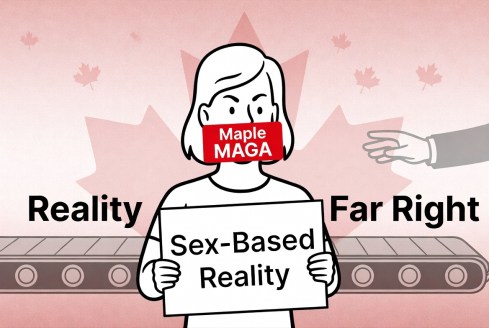
I have been called “Maple MAGA.”
It is a silly phrase, but not an innocent one. Imported American static with a Canadian toque pulled over it, the label works less as description than as sorting device: once attached, it tells the room what to do with the person before anyone has to answer what he said. That is its usefulness.
The charge, as far as I can tell, is not that I am secretly American, or that I want Donald Trump to annex the Prairies, or that I am pining for red hats on Parliament Hill. It is not that I support theocracy, oppose women’s education, or want priests running the courts.
The charge is simpler. I keep saying things that no longer sit comfortably inside the approved progressive frame.
I defend freedom of expression, especially when the expression is rude, inconvenient, unfashionable, or badly timed. I think women and girls have sex-based rights that cannot be wished away by therapeutic language. I think female prisons should be for female prisoners. I think children should not be hurried into irreversible medical pathways to satisfy adult ideology. I think citizens should be free to read, think, doubt, argue, dissent, and change their minds without the state, the school board, the professional college, or the HR department treating their inner life as a compliance problem.
Apparently, this is enough now: not enough to make one wrong, which would require an argument; not enough to make one dangerous, which would require evidence; but enough to make one “far right,” “MAGA,” “reactionary,” “unsafe,” or whatever label is currently doing the work reasons used to do.
The insult is the visible part. Underneath it sits the relocation of the acceptable centre.
Cultures move. Language changes. Laws change. Public taste changes. Some changes are good and overdue; some are foolish; some begin as compassion and harden into coercion. There is nothing sacred about yesterday’s vocabulary merely because it is yesterday’s vocabulary, but cultural movement does not move reality.
That distinction is now being blurred. It is one thing for a society to change how it talks about sex, gender, identity, offence, harm, safety, and inclusion. It is another thing to pretend the underlying truths have changed because the approved language has changed.
A male body in a female prison does not become a female body because a policy manual has been updated. A teenage girl’s distress about her body does not become simple proof of a medical destiny because a professional association has learned a new script. A citizen’s refusal to repeat an ideological formula does not become hatred because an HR department calls the formula kindness.
The culture can change what is rewarded, what is punished, who gets invited to speak, who gets reported, who gets promoted, who gets quietly avoided, and who gets labelled a problem; it cannot change the truth.
Female prisons make the point concrete because, for most of living memory, saying that female prisons should be for female prisoners was not a right-wing position. It was barely a position at all. It sat in the background with other obvious assumptions: women’s shelters are for women, women’s sports are for women, and sex matters most in the places where privacy, vulnerability, male violence, and bodily difference are not abstractions.
“There is nothing sacred about yesterday’s vocabulary merely because it is yesterday’s vocabulary, but cultural movement does not move reality.”
Prisons are coercive institutions. Women inside them cannot simply leave, choose their neighbours, or opt out of policy experiments designed by people outside the walls. The state therefore has a heightened duty of care. Sex matters there; it matters when privacy is stripped away, when physical power is uneven, when trauma is common, and when the people affected have no meaningful escape route.
Yet once the vocabulary changes, the old safeguarding claim can be redescribed as extremism. Not because women became less vulnerable in prison, male-pattern violence disappeared, or sex stopped mattering in confined spaces; the argument is recoded because the permitted moral language changed around it.
This is the trick: move the official language, then treat unchanged reality as if it has been morally superseded.
The same pattern appears elsewhere. Free expression becomes “harm.” Privacy becomes “suspicion.” Doubt becomes “denial.” Genuine distress in young people is real, and compassion for it is necessary; but caution in youth medicine is not cruelty, and weak evidence does not become strong because the approved language insists it must. Refusing compelled belief becomes bigotry. The old liberal question — “Is this true, and may I say so?” — is replaced by a managerial one: “Does this comply with the approved moral vocabulary?”
There is a Gramscian flavour here. Gramsci understood something real about modern power: it does not operate only through police, courts, elections, and parliaments. It operates through culture; through schools, media, churches, universities, publishers, artists, professional bodies, and the people who teach society what respectable people are supposed to think.
Durable victory requires more than capturing the state; it requires shaping common sense. That is the part that feels familiar now: a workshop here, a policy update there, a glossary, a training module, a revised professional standard, a grant condition, a reputational warning. No jackboots required. Just enough pressure to teach ordinary people which sentences now come with consequences.
Most people understand the lesson. They have jobs, families, colleagues, reputations, mortgages, volunteer roles, and professional obligations. They do not want to be called hateful, unsafe, extremist, bigoted, MAGA, or far right; they do not want to become the example everyone else is warned about. So they move, or they fall silent.
Then comes the strange inversion. People who have not changed their minds are told they have moved to the far right. The old centre is renamed after the fact; positions that were once liberal, feminist, or civil-libertarian are reclassified as dangerous because the institutions around them have adopted a new script. The people did not move so much as find the centre moved around them.
That is why “Maple MAGA” is such a convenient little insult. It imports the emotional charge of American polarization and drops it onto Canadian disagreement. It lets the speaker skip the local argument: no need to examine the claim, no need to ask whether an older feminist concern might still be true, no need to wonder whether a civil-libertarian objection might have merit. The label supplies the answer before the question is allowed to form.
“Once that habit takes hold, precision disappears. These words become atmospheric; they create suspicion, not understanding, and suspicion is often all that is needed.”
This is especially poisonous in Canada, where we already borrow too many American reflexes. We take American slogans, American moral panics, American partisan categories, American racial scripts, American activist vocabulary, and American media obsessions, then pretend they map cleanly onto Canadian life. Usually they do not; but they are emotionally efficient, and that is often enough.
Once that habit takes hold, precision disappears. “MAGA” no longer means a specific American political movement. “Far right” no longer means a coherent political position. “Unsafe” no longer means a demonstrated danger. These words become atmospheric; they create suspicion, not understanding, and suspicion is often all that is needed.
A person does not have to be refuted if he has already been made socially radioactive. His argument does not have to be answered if the room has been taught to flinch before hearing it. That is the quiet power of these labels: they replace disagreement with contamination.
A free society cannot keep doing that and remain free in any serious sense. It cannot function if disagreement is treated as pollution, cannot remain liberal if every objection is recoded as harm, and cannot reason together if words are used to end thought rather than sharpen it.
Some people really are extremists. Some movements really are dangerous. Some ideas really do deserve fierce opposition; there is no virtue in pretending otherwise. But when the label comes before the argument, the argument never happens. Civic life begins to rot not when people disagree, but when they lose the habit of believing disagreement deserves an answer.
So no, I am not especially interested in proving that I am not “Maple MAGA.” The phrase is too silly to deserve that much respect. I am interested in why so many people now reach for labels instead of reasons: how free expression became suspect, how female rights became reactionary, how cognitive liberty became dangerous, and how ordinary citizens were told that standing still meant they had somehow moved to the far right.
The institutions moved the language, then pretended they had moved reality.
That is the lie at the centre of the whole exercise.
References / Further Reading
Correctional Service Canada — Commissioner’s Directive 100: Gender Diverse Offenders
Canada’s federal correctional policy on gender-diverse offenders, including placement according to gender identity or expression.
UK Ministry of Justice — New Transgender Prisoner Policy Comes Into Force
The 2023 England and Wales policy restricting placement of some transgender-identifying males in women’s prisons.
The Cass Review — Final Report
The 2024 independent review of gender identity services for children and young people in England, especially useful for the essay’s caution-in-youth-medicine point.
Ipsos Canada — Strong Majority of Canadians Continue to Support 2SLGBT+ Rights and Visibility
Useful public-opinion context showing broad support for LGBT rights alongside lower support for gender-identity-based rules in women’s sport.
Public institutions should be careful with the symbols they elevate.
A government building, school, courthouse, legislature, or public office does not belong to one faction of the public. It belongs to the whole public. That is why its official symbols should remain broad, civic, and restrained. In Canada, that means the Canadian flag and the official provincial or territorial flag.
Those flags are imperfect because the country is imperfect. No national symbol can carry every wound, achievement, grievance, regional difference, or private identity without strain. But an official flag is not supposed to say everything. It marks the common civic space where citizens disagree, argue, vote, work, worship, protest, and live together.
Supporters of additional flags often argue that these displays are not partisan. A Pride flag, for example, may be understood as a message of welcome rather than a political demand. That argument should not be mocked. Many people look to public institutions for reassurance that they belong.
But belonging cannot depend on seeing one’s preferred symbol raised by the state.
Once public institutions begin flying non-official flags, even for sympathetic reasons, they move away from neutrality. The question is no longer whether a particular cause is worthy. Many causes are worthy. The question is whether public authority should place its symbolic weight behind some identities, causes, or movements while declining others.
That creates a problem no institution can manage fairly for long. A flag raised for one group becomes a precedent. A refusal becomes a statement. A commemoration becomes an expectation. The flagpole slowly turns from a civic symbol into a contested notice board.
Canada does not need public institutions sorting citizens by official recognition. It needs shared civic ground.
This does not prevent citizens or private organizations from displaying the symbols that matter to them. A free society should leave people room to speak, assemble, advocate, celebrate, mourn, and disagree. Civil society can be expressive because it is plural. Public institutions should be restrained because they serve everyone.
Institutional neutrality is not indifference. It is a way of keeping public authority from being captured by the pressures of the moment. It tells citizens they do not need to belong to the favoured cause of the day in order to belong in the country.
The Canadian flag and official provincial flags are broad enough for that purpose. They do not erase difference, but they refuse to make difference the first fact of public life.
Let citizens bring their arguments. Let institutions hold the common ground.
Canada has entered the space race, and by “entered” I mean we appear to have placed a rectangle of concrete in the woods and surrounded it with gravel.

Canada’s space race appears to be stuck in Phase One: gravel.
This is not nothing. In government terms, it may already count as Phase One.
Somewhere, no doubt, there is a strategic framework, a ministerial announcement, a regional development grant, a climate lens, an Indigenous consultation pathway, a diversity procurement plan, and a glossy PDF featuring a child looking up at the stars. Canada loves a working group. It is how we convert urgency into chairs.
Meanwhile, private industry keeps doing the irritating thing it sometimes does: building things. Not perfectly, not gently, not without waste, ego, or spectacle. But the rockets exist. The launches happen. The failures produce data. The next version gets built. The machine moves.
Government moves too, but differently. It studies, regulates, announces, pauses, re-announces, commissions, rebrands, and eventually unveils a pad of poured concrete as evidence that the future has been properly consulted into existence.
This is the broader Canadian problem. We have become excellent at the language of ambition and strangely bad at the discipline of execution. We can describe innovation. We can fund innovation. We can convene panels on innovation. We can produce national strategies about innovation. But at some point, a serious country has to build the thing.
The comparison is unfair, of course. SpaceX is a private company with immense capital, a high tolerance for risk, and a founder constitutionally incapable of leaving well enough alone. Government has different responsibilities: accountability to citizens, laws, budgets, safety rules, and public interest.
Fair enough.
But accountability cannot become an alibi for paralysis. Regulation cannot become a substitute for competence. Process cannot become the product.
A country that wants a space industry needs more than a space-shaped clearing in the gravel. It needs permission to fail, speed to iterate, and institutions that understand the difference between managing decline and building capacity.
Canada does not lack talent, land, brains, or engineering ability. What it lacks is a governing culture that can still turn intention into machinery.
Until that changes, our space program may remain perfectly Canadian: safe, inclusive, fully consulted, and still waiting for liftoff.
The government is right about one thing: children are not safe in much of online life. But that does not make every child-safety law wise, limited, or safe for a free society.
Parents have a real responsibility to monitor their children’s welfare, and that includes internet activity. Freedom does not mean abandoning children to whatever social media companies, algorithms, predators, influencers, or peer-status machines decide to push at them next. A free society still expects adults to act like adults.
But parental responsibility is not the same thing as state permissioning. Bill C-34, the federal government’s Safe Social Media Act, should be read with that distinction in mind. The issue is not whether children should be protected from online harm. They should. The issue is whether protecting them requires building the habits, infrastructure, and bureaucracy of identity-gated internet access.
That danger is sharpened by how much the bill leaves to regulation. Many of the most important questions — which services are covered, how age will be verified, what exemptions will exist, and how the new regulator will enforce compliance — are not settled in the public-facing moral language of child safety. They are pushed into future administrative machinery.
That matters. A social media ban for users under sixteen cannot enforce itself. Platforms must know who is under sixteen. To know that, they must verify age. And once age verification becomes normal, adults are pulled into the same machinery because they must prove they are not children.

Child safety should not require Canadians to trade the open internet for a permission slip.
This is where the civil-liberties danger begins. The stated aim is child safety. The operating mechanism is identity checking. Once identity checking becomes a normal condition of access, it will not stay politely confined to one narrow category of service forever.
The strongest argument for the bill is not frivolous. Social media companies have profited from addictive design, algorithmic pressure, sexualized content, bullying, and misery dressed up as engagement. Parents are right to be angry. Governments are right to ask whether platforms have been allowed to externalize too much harm onto children and families.
But good intentions do not make a bad tool harmless.
Online anonymity is not just a convenience for trolls. It matters for political dissent, unpopular opinions, whistleblowing, vulnerable people, religious minorities, abuse victims, workers criticizing employers, and ordinary citizens who do not want every thought, search, argument, or association tied back to their legal identity.
For some Canadians, anonymity is not a luxury. It is part of how they remain able to think and speak honestly. Teachers, nurses, public servants, professionals, small-business owners, and employees in ideologically narrow workplaces all understand the problem. A person can hold lawful, serious, defensible opinions and still know that one bad-faith complaint, one screenshot, or one HR process can turn ordinary dissent into a professional liability.
Canadians should not reject child protection simply because the state has chosen a bad tool. If there are unobtrusive ways to reduce children’s exposure to exploitation, addiction loops, algorithmic pressure, and adult content without creating surveillance architecture, we should pursue them. Better parental tools, device-level controls, digital literacy, stronger enforcement against predators, and less addictive platform design are all fair subjects for debate.
“Child safety is real. Identity-gated access is still a dangerous cure.”
But a checkpoint internet is not a small price to pay. It changes the relationship between citizen and screen, reader and state, speaker and regulator. Once access depends on verification, the open internet begins to look less like a public square and more like a permissioned space.
That is too much power to normalize under the language of safety.
Our rights in Canada are unlikely to be taken away all at once. They erode gradually: one safety measure, one administrative convenience, one temporary verification requirement at a time, until the extraordinary becomes ordinary and the ordinary becomes mandatory.
Then, one day, pedestrianly, Canadians may discover that freedoms they thought were secure have become permissions they must ask for.











 bleatmop
 Mystro
 The Arbourist


 Dead Wild Roses
Your opinions…