
You are currently browsing the category archive for the ‘Education’ category.
Would people hold the views they do if they understood the first principles those views rest on?
I suspect many would at least pause. Not necessarily abandon their position, but slow down long enough to ask what exactly they are affirming. This is not a universal pattern, but it shows up often enough in public discourse to be worth paying attention to.
What I am describing is a kind of reverse percolation. Ideas that begin in highly abstract settings move downward into activism and identity, where they are simplified, moralized, and widely adopted. Something is lost in that movement. The underlying logic—the structure that gave the idea its shape in the first place—does not always make the trip.
Take a common example.
One influential strand of queer theory makes a striking claim: that identity need not be grounded in any stable essence, but instead takes shape in relation to what is considered normal or legitimate. At the level of theory, this is an attempt to examine how norms are constructed and how they operate, often in ways that are invisible to those who benefit from them.
But when that framework moves out of the seminar room and into everyday political identity, it tends to arrive in a thinner form. The scaffolding is gone. What remains is the posture.
“Ideas move downward into mass use, losing fidelity as they go, and return upward not as refinement, but as reinforcement—positions hardening around ideas that have already shed much of what made them coherent.”
That shift creates a tension that is easy to miss. If an identity is defined in relation to norms, then friction with those norms is not an accidental byproduct; it is part of the structure. Yet many who adopt the language of queer politics encounter that friction as if it were imposed entirely from the outside, rather than something partly generated by the logic they have taken on.
This is where the gap begins to open—between first principles and lived adoption.
What makes the dynamic more interesting is that it does not run in a single direction.
A similar distortion can be seen in conservative responses, where disparate strands of progressive thought are often folded together under the single label of “liberalism.” In doing so, distinctions that matter are blurred or lost altogether. Classical liberalism, with its emphasis on individual rights, pluralism, and limits on power, is not interchangeable with theoretical frameworks that aim to critique or unsettle those foundations.
Once those categories collapse into each other, critique starts to rest on unstable ground.
The result is less a clash of well-formed positions than a kind of mirrored simplification. On one side, ideas are adopted without much reference to their internal logic. On the other, they are opposed without being clearly identified. Whether the greater loss happens in adoption or in response is difficult to say, and in a sense it does not matter; each process feeds the other.
This is where the reverse percolation effect completes its cycle.
Ideas move downward from abstraction into mass use, losing fidelity as they pass through each layer. They are then taken up again, interpreted, resisted, or amplified by others working from similarly partial models. What comes back is not refinement. It is reinforcement—positions hardening around ideas that have already shed much of what made them coherent.
At that point, disagreement becomes inevitable, because the participants are no longer operating within the same conceptual frame. Understanding does not so much fail as it is quietly set aside.

Glossary
Queer Theory
A body of academic thought that examines how categories like sex, gender, and sexuality are constructed, regulated, and experienced. It often challenges the idea that these categories are fixed or natural, instead emphasizing their fluidity and relationship to social norms. The field is not monolithic, and different strands place different weight on these elements.
Classical Liberalism
A political philosophy centred on individual rights, equality before the law, freedom of expression, and limits on state power. It forms the foundation of many modern democratic systems and emphasizes pluralism within a shared legal framework.
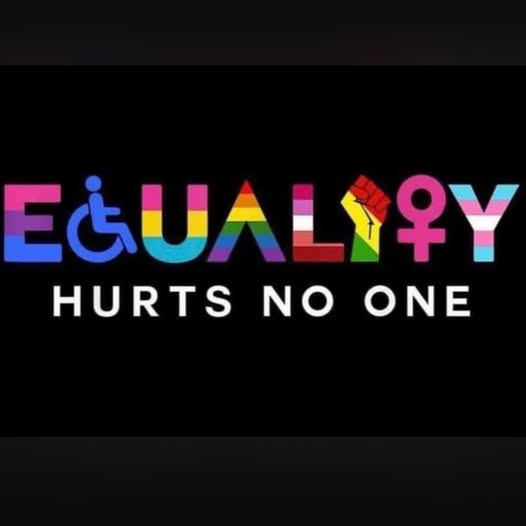
There’s a reason this image works. It uses a word almost everyone agrees with—equality—and then quietly fills that word with something else. The result is not an argument. It’s a substitution.
Look at it closely. The word “EQUALITY” is rendered in bright, appealing colors, layered with symbols of recognizable identity categories: disability, sexuality, gender, race, activism. Beneath it, the slogan: “hurts no one.” At the level of feeling, this is uncontroversial. Of course equality hurts no one. That’s the point of the concept. Equal treatment under the same rules is the baseline promise of any liberal order. But that is not what the image is actually depicting. The text says equality. The visual payload says something else entirely.
Equality, properly understood, is individual and procedural. It asks a simple question: are the same rules being applied to each person, regardless of who they are? It does not guarantee equal outcomes. It does not engineer results. It does not sort people into categories and adjust treatment accordingly. It holds the line at equal standing before the law and equal access to opportunity. That is why it is durable. It does not require constant intervention or measurement. It does not need to know who you are in order to decide how you should be treated.
The imagery in this poster points in a different direction. It is not concerned with individuals. It is concerned with groups. Each symbol represents a category that, within contemporary political frameworks, is treated as requiring not just equal treatment, but differential treatment in order to achieve parity of outcomes. That is the logic behind quotas, preferences, representational mandates, and a wide range of institutional policies now grouped under the umbrella of equity. That distinction matters. Because once you move from equal treatment to managed outcomes, you have to start making choices about who gets what, and why.
This is where the slogan “hurts no one” stops doing honest work. Equality, in the classical sense, really does not hurt anyone. It simply refuses to privilege or penalize based on identity. Equity, by contrast, is not costless. It reallocates opportunities. It lowers or shifts standards in some contexts. It elevates some groups explicitly. That may be justified in specific cases, but it is not neutral, and it is not universally painless. Someone is always paying the adjustment.
The poster resolves this tension through a familiar rhetorical move. It collapses the distinction. By wrapping equity-coded symbols inside the word equality, it invites the viewer to endorse a more controversial framework under the banner of a universally accepted one. The move is subtle enough that many people will not notice it, but strong enough that disagreement can be framed as opposition to “equality” itself. That is not clarification. It is camouflage.
The poster says equality. It is not. And pretending otherwise is not harmless, no matter how bright the colors or how reassuring the slogan.
You can see the tell in the composition. If the message were truly about equality in the classical sense, the image would not need to foreground identity categories at all. It would not need symbols. It would not need color-coding. The entire point of equality is that the categories do not matter when rules are applied. Here, the categories are the point. They are not incidental. They are doing the conceptual work.
None of this means the concerns associated with those categories are trivial or illegitimate. Some are serious. Some are contested. Some are overextended. All of them deserve to be argued on their own terms. But that argument has to be made honestly. It cannot be smuggled in under a word that already carries broad moral agreement.
This is the broader pattern. Take a term with a stable, widely accepted meaning. Expand or alter the underlying concept. Keep the original word. Let the new meaning ride on the old legitimacy. If challenged, collapse the distinction and accuse critics of opposing the original value. It is effective. It is also corrosive.
Words are not decoration. They are load-bearing. If we stop distinguishing between equality and equity, we lose the ability to argue about either of them clearly. And when that happens, policy follows confusion. Decisions get made without admitting what is being traded off, or who is being prioritized. That is not a small failure. It is how serious disagreements get papered over until they break.
The attack on Bill 25 has settled into a familiar script. Critics say it will make schools less welcoming, by which they mean that restricting ideological flag displays, limiting board activism, and requiring neutrality in certain forms of programming will make some students feel unseen or unwanted. It is an effective line because it hides a political claim inside the language of care. Nobody wants an unwelcoming school. The trick is that welcoming is being made to mean more than safety, decency, and respect.
A school should be safe, orderly, and humane. It should protect students from bullying, enforce standards of conduct, and make it possible for children to learn without fear or humiliation. What does not follow is the larger claim now being pushed by Bill 25’s opponents: that a public school must also visibly signal allegiance to a particular moral framework, and that if it stops doing so it has somehow become hostile.
“Protection is not the same as endorsement.”
That is the switch.
On the actual text, Bill 25 does not erase students, ban disagreement, or outlaw difficult topics. What it does is narrower, and more defensible, than its critics pretend. It pushes Alberta’s education law back toward institutional restraint. The bill revises parts of the Education Act’s language around school climate, requires courses and instructional materials to encourage a wide range of perspectives and foster critical thinking, says boards must refrain from taking political, social, or ideological positions unrelated to their duties, and requires certain non-approved programming to be impartial, fair, neutral, and free of personal bias. It also restricts school flags by default to the Canadian and Alberta flags, subject to later regulatory exceptions.
That is not a purge. It is a correction.
Now, the strongest version of the other side’s case is not hard to state. Some vulnerable students really do experience explicit symbols of affirmation as reassuring. Some will feel more at ease in an environment where support is made visible rather than merely promised in policy language. And because Bill 25 uses broad terms like “political, social or ideological” and refers to “common values and beliefs of Albertans,” it is fair to ask how those phrases will be applied in practice. A sloppy implementation could create confusion where schools need clarity.
Those are real concerns. They still do not settle the argument.
A public institution cannot make emotional reassurance the test for what it is allowed to endorse. The fact that some students feel comforted by visible institutional alignment does not mean the institution should align itself with a contested worldview. In a pluralistic public school, there will always be students who feel affirmed by one framework and alienated by another. The institution cannot solve that problem by choosing a side and calling the choice kindness. Its job is to protect students, maintain order, teach well, and show restraint in the use of its authority.
A public school is not a campaign office, a therapeutic identity space, or an activist workshop with a literacy block attached. It is a public institution. It belongs to families who do not agree with one another about politics, morality, religion, sex, identity, or the kind of society they want their children to inherit. Such an institution cannot remain trustworthy for long if it begins signaling that one contested framework has acquired official moral status.
This is why so much of the criticism of Bill 25 feels dishonest. It starts from a true premise and then quietly expands it. Some students are vulnerable. Fine. They deserve protection, dignity, and ordinary decency. But from that narrow duty of care, critics jump to a much broader demand: that the institution must visibly ratify a particular set of assumptions and display them as part of the school’s moral atmosphere. Protection becomes affirmation, affirmation becomes endorsement, and endorsement begins to drift into instruction.
“A school can protect a student without acting as a billboard for a worldview.”
That is the real dispute.
A teacher can treat every child with dignity without using classroom authority to suggest that contested beliefs about sex, identity, and society have already been settled beyond argument. A board can meet its legal obligations without issuing statements on every political controversy fashionable adults feel obliged to perform opinions about. Bill 25 does not solve all of this, but it does attempt to restore some institutional discipline where that discipline had plainly weakened.
As a teacher, that part is hard to ignore. I am not in the classroom to advertise my politics, recruit students into a moral sensibility, or drape school authority over my own preferred social vision and call the result compassion. I am there to teach. That means helping students read carefully, write clearly, listen seriously, and argue without slogans doing all the work for them. It also means knowing where my job ends.
That professional boundary now seems strangely difficult for some people to defend. They talk as though asking an institution to remain neutral is the same thing as demanding that individual students disappear. It is not. Bill 25 does not say students cannot exist as they are, think as they do, or discuss difficult questions. What it says, in substance, is that the institution itself should exercise more restraint in the positions it takes, the programming it allows outside the approved curriculum, and the symbolic alignment it displays as a public body.
That is a long way from the apocalyptic language being used against it.
None of this means the bill is perfect. It is not. The practical details will matter, and future regulations will matter even more. But arguing over those details is not the same as falsifying the centre.
And the centre is simple. A public school should not behave like an ideological camp that happens to issue report cards. It should teach students from many backgrounds under rules that are serious, fair, and publicly defensible. It should protect the vulnerable without demanding institutional allegiance to one faction’s beliefs. It should cultivate thought rather than posture, and trust rather than theatre.
The most dishonest move Bill 25’s opponents have made is to present neutrality as though it were hostility. That only works if one has already confused institutional discipline with emotional abandonment. Once every limit on symbolic activism is recast as an attack on children, no boundary remains. The institution becomes available for endless moral capture by whichever faction is best at translating its politics into therapeutic language.
That is not a school anyone should trust.
Bill 25 does not solve every problem in education. What it does do is move, however imperfectly, in the right direction. It treats the school as a public institution rather than a stage for institutional self-display. It reminds boards and educators that restraint is part of professionalism. It suggests, at long last, that children can be protected without making ideology the atmosphere everyone is expected to breathe.
That is not cruelty. It is maturity.

References
Bill 25 (official PDF):
Click to access 20251023_bill-025.pdf
Government of Alberta overview:
https://www.alberta.ca/removing-politics-and-ideology-from-alberta-classrooms
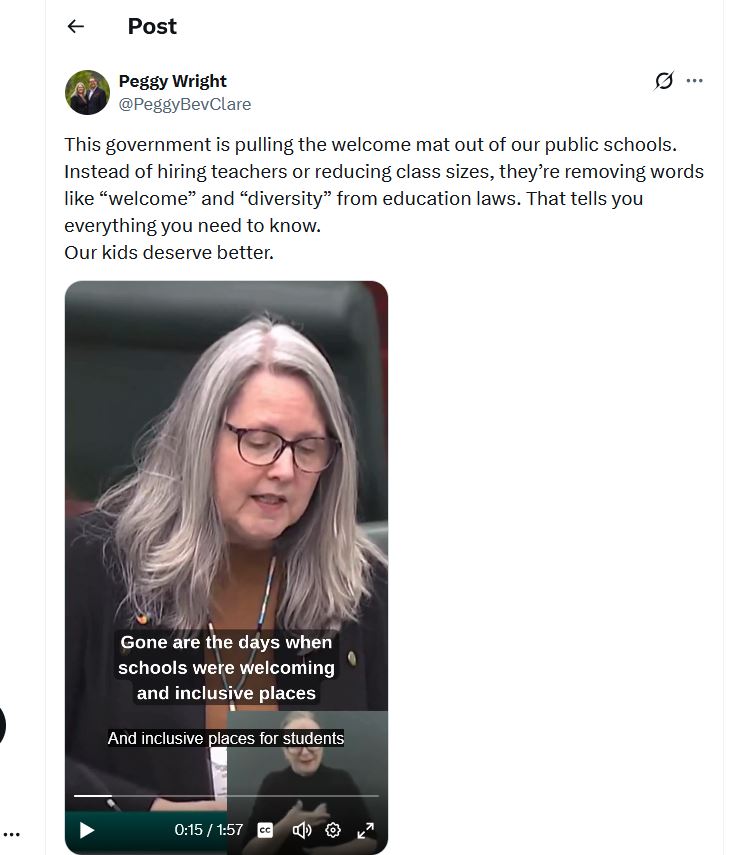
Posted by the NDP’s Peggy Wright on X.
There is a recurring pattern in modern policy debates that most people sense but struggle to name. The argument presented to the public is not the policy that gets implemented. Instead, a broadly agreeable claim—something no reasonable person would oppose—is used to carry a far more specific and contested agenda into law. By the time the details become visible, the argument has already been won at the level that matters.
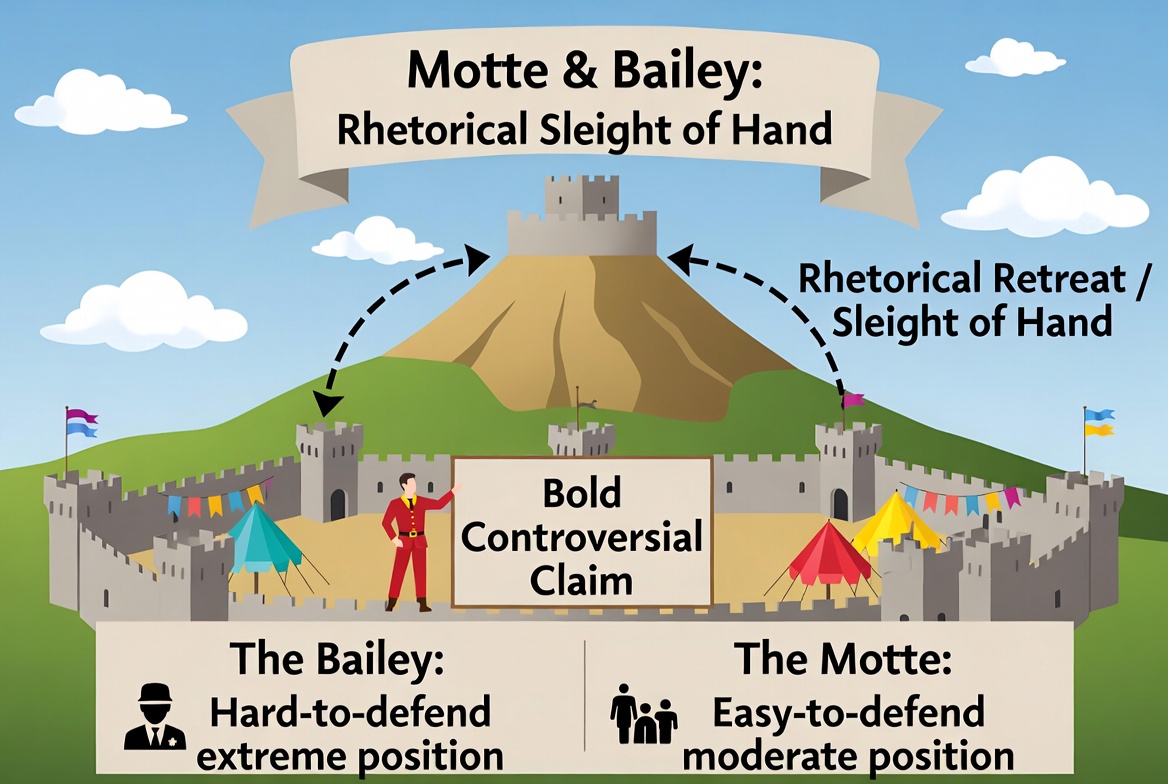
This is the structure known as the motte and bailey. The “motte” is the safe, defensible position: a statement so benign it feels almost churlish to resist. The “bailey” is the real position—the one with consequences, tradeoffs, and enforcement mechanisms. The move is simple. Sell the motte. Build the bailey. When challenged, retreat to the motte and accuse critics of attacking something obviously good.
You can see the pattern clearly in the recent dispute over education language. The public claim is that schools should be “welcoming,” “inclusive,” and respectful of “diversity.” No serious person objects to that in the abstract. But those terms are not operating as neutral descriptions. They have acquired specific policy meanings, often tied to particular ideological frameworks, institutional practices, and expectations placed on teachers and students. When legislation attempts to narrow or neutralize that language—shifting toward behavior-based standards like “safe and caring” environments grounded in responsibility and respect—the response is immediate: the government is “removing welcome,” attacking “diversity,” harming children. The motte is invoked as if it were the policy itself. The bailey disappears from view.
Watch the Move
In a recent legislative speech, MLA Peggy Wright provides a clean example of how this works in practice. She begins with a familiar image:
“Albertans put welcome mats in front of their doors. It means ‘come on in’ and we’re glad you are here.”
No disagreement is possible there. It is a moral and cultural baseline. But then the shift occurs. A change in statutory language becomes:
“the UCP is pulling up the welcome mat from all public schools.”
A metaphor replaces the policy. The audience is invited to react to exclusion rather than examine the legislation. The escalation continues:
“Gone are the days when schools were welcoming and inclusive places… celebrating diversity and uniqueness.”
At this point, the argument is no longer about wording. It is about intent, character, and harm. The key moment follows:
“the latest amendments… would strip words like ‘welcoming’ and ‘diversity’ from it.”
This is where the real question should be asked: does removing those words remove the underlying protections, or does it replace one framework of description with another? That question is never addressed. Instead, the speech returns immediately to moral framing:
“Diversity is a strength.”
In the abstract, yes. But the dispute is not over the abstract claim. It is over what “diversity” means in policy and practice. By collapsing the contested meaning into the harmless one, the argument avoids defending the actual implications. Criticism of the policy is recast as opposition to a universal good.
“The argument people agree to is not the policy that gets implemented.”
The most revealing line in the speech is this:
“Words are important… because they set the tone.”
That is true—and it explains the entire strategy.
This pattern isn’t random. It reflects a broader shift in how language is used in politics. Words like “diversity,” “inclusion,” and “safety” are no longer just descriptive. They function as instruments. If language helps shape how institutions operate and how people interpret reality, then controlling definitions becomes a form of power. Under that logic, you don’t need full public agreement on the details of a policy. You need agreement on the framing. Once that is secured, the content can expand behind it.
That helps explain why the motte and bailey is so effective. It allows advocates to operate on two levels at once. The public-facing level is morally attractive and broadly supported. The operational level is narrower, more contested, and often insulated from direct scrutiny. When the two are conflated, consent is manufactured. People believe they are endorsing a general principle when, in practice, they are enabling a specific program.
It works because most people are not trained to interrogate language this way. “Inclusion” sounds like inclusion. “Diversity” sounds like a mix of backgrounds and perspectives. “Safety” sounds like protection from harm. The terms carry moral weight before any definition is examined. By the time someone asks what they actually entail in practice, the rhetorical ground has already shifted. Opposition can be framed as hostility to the value itself rather than disagreement with its implementation.
The cost is not just confusion. It is the erosion of honest disagreement. If every critique of a policy can be recast as an attack on a universally accepted good, then meaningful debate becomes impossible. Language stops clarifying differences and starts concealing them. Institutions drift, not because the public has clearly chosen a direction, but because the terms of choice were never presented plainly.
This is why the technique matters. It is not just sharp rhetoric. It is a way of bypassing consent. If citizens cannot distinguish between the principle they are being asked to affirm and the policy that will follow from it, then they are no longer participating in a genuine democratic process. They are being managed through language.
If you think this reading is unfair, read the full remarks below and decide for yourself.
Appendix: Full Speech Transcript (April 2, 2026)
How to read this: Watch for the shift between general claims (“welcome,” “diversity”) and the specific policy being discussed. The argument depends on treating them as the same.
Full transcript of the video (Alberta Legislative Assembly session, ~1:57 long):
“Mr. Speaker, Albertans put welcome mats in front of their doors. It means ‘come on in’ and we’re glad you are here. And welcome to our house.But now the UCP is pulling up the welcome mat from all public schools.Gone are the days when schools were welcoming and inclusive places for students, celebrating diversity and uniqueness.That’s because the latest amendments to the Education Act would strip words like ‘welcoming’ and ‘diversity’ from it.This government combed through that bill and pulled the word ‘welcoming’ out eight times.Not satisfied with making our public schools less inviting — even as they function as important community hubs for many of our communities — then they went through and chopped the word ‘diversity’ out five times.Diversity is a strength.It used to say so in government policy, in legislation. But I guess not anymore.Words are important, Mr. Speaker, and that’s because they set the tone.When those in charge are threatened by words like diversity, welcome, and sense of belonging, there’s a problem. Because this is then about ideology and politics outside the classroom, not within.Instead of focusing on reducing class sizes, hiring teachers, and ensuring supports are there for all kids who need them, we get this distraction from a bill and government intent to narrow the frame so much that there is room for only one worldview: the UCP’s.And that’s the point.Straight out of the authoritarian playbook, Mr. Speaker.But, Mr. Speaker, our kids deserve that welcome mat back. I, for one, am extremely happy to let them know that they can expect it come next election, when it’s NDP in government and UCP — not our kids — who will find themselves unwelcome.”
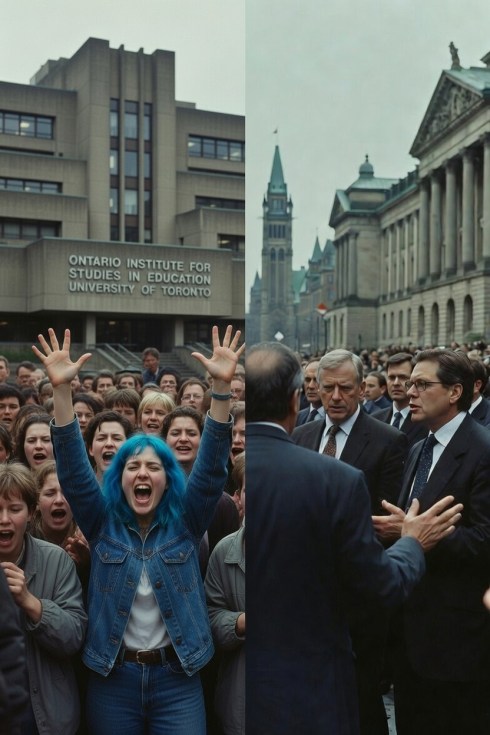
The Ontario Institute for Studies in Education at the University of Toronto is hosting its 13th annual decolonizing conference from March 12 to 14, 2026. The title tells you plenty: Colonial Ruptures: Unmasking Ongoing Coloniality and Fostering Counter Insurgency, Resistance and Liberatory Possibilities. The event materials describe a gathering of scholars, activists, educators, artists, Elders, and community leaders committed to critical reflection, collective action, and “decolonial futures.” They speak of resisting “global capital extractivism and supremacist thinking,” rejecting “colonial binaries,” and advancing liberatory possibilities. This is not an outside caricature. It is the institution describing itself.
That matters because OISE is not a fringe collective borrowing university space for a weekend. It is one of the country’s most influential faculties of education, and CIARS is one of its public-facing centres. A conference like this does not define every part of OISE, but it does reveal a real moral and intellectual current inside one of Canada’s most important teacher-forming institutions. When an institution like that adopts the language of rupture, insurgency, resistance, and decolonial struggle, critics are entitled to ask a basic question: is this education in the ordinary civic sense, or ideological formation dressed in educational language?
To be fair, proponents would say the purpose is not social fragmentation but repair. They would say decolonizing education means confronting historical blind spots, taking Indigenous and anti-racist perspectives seriously, and widening the moral vocabulary of the classroom. Fine. That case should be acknowledged. But public language still matters. When a flagship faculty of education foregrounds coloniality, rupture, counter-insurgency, and resistance, it signals something more than curricular broadening. It signals an adversarial posture, even when softened by the language of care, solidarity, and reimagined futures.
That is the real concern. The problem is not that Canada’s injustices are being taught. A serious country should teach its history honestly. The problem is that teacher formation may be drifting toward a framework in which critique stops being a tool of civic improvement and becomes the default grammar through which the society itself is read. In theory, decolonial approaches and core educational goals can coexist. In practice, the public-facing language here suggests a hierarchy of concerns in which ideological critique increasingly outranks institutional competence, shared citizenship, and academic pluralism.
“What the public sees is not repair but drift: a professional class fluent in rupture and resistance while the country struggles to do ordinary things well.”
People notice that shift because they are already living inside a country under strain. Canada has struggled with weak productivity for years. The OECD’s 2025 survey says the outlook was worsened by trade uncertainty and tariffs, projects a decline in GDP from the second quarter of 2025 because of falling exports to the United States, and devotes sustained attention to the problem of raising business-sector productivity. Housing is worse. CMHC said in 2025 that restoring affordability to 2019 levels would require roughly 430,000 to 480,000 new housing units per year until 2035, about double the recent pace. That is not ideological spin. It is the national housing agency saying the country is not building nearly enough homes.
So people look around and see weak productivity, punishing housing costs, trade pressure, strained public capacity, and thinning civic confidence. Then they watch elite educational institutions pour moral energy into conferences on colonial rupture and liberatory counter-insurgency. The disconnect is hard to miss. Citizens who want functional schools, affordable homes, competent government, and some residue of common national identity are told, again and again, that the deeper task is deconstruction. Not reform. Not competence. Deconstruction.
That is one reason disillusionment has grown. The problem is not honest history. It is not the inclusion of neglected perspectives. The problem is that “decolonizing” has become, in practice, a legitimating language for ideological sorting. It shifts attention away from what institutions are for and toward the moral drama of permanent critique. In education, that is a serious danger. A teacher should be equipped to help students read, write, reason, deliberate, and live with others in a shared society. If the training environment increasingly teaches that the shared society itself is morally suspect at the root, the civic consequences are unlikely to be good.
Canada does not need amnesia. It does not need self-flattery either. But it also does not need a professional class trained to interpret the country chiefly through the grammar of oppression, rupture, and resistance. A society held together by trust, inheritance, and common rules cannot sustain indefinite elite suspicion toward its own foundations. If public institutions want to recover legitimacy, they will have to rediscover a language of citizenship, competence, pluralism, and shared belonging. Until then, more Canadians will keep feeling that the country they were told to love is being taught to despise itself.
References
OISE / CIARS conference page
https://www.oise.utoronto.ca/ciars/ciars-2026-xiii-decolonizing-conference-1
OISE / SJE newsletter page on the conference
https://www.oise.utoronto.ca/sje/newsletter/march-2026/CIARS-newsletter-conference
OISE February 2026 conference notice
https://www.oise.utoronto.ca/home/sje/newsletter/february-2026/CIARS-conference
CIARS centre page
https://www.oise.utoronto.ca/ciars
CMHC housing supply report page
https://www.cmhc-schl.gc.ca/professionals/housing-markets-data-and-research/housing-research/research-reports/accelerate-supply/canadas-housing-supply-shortages-a-new-framework
CMHC housing supply gap explainer
https://www.cmhc-schl.gc.ca/observer/2025/updating-canada-housing-supply-shortages-new-housing-supply-gap-estimates
CMHC news release on housing supply gaps
https://www.cmhc-schl.gc.ca/media-newsroom/news-releases/2025/cmhc-releases-latest-housing-supply-gaps-report
OECD Economic Survey of Canada 2025
https://www.oecd.org/en/publications/2025/05/oecd-economic-surveys-canada-2025_ee18a269.html
OECD full report
https://www.oecd.org/en/publications/2025/05/oecd-economic-surveys-canada-2025_ee18a269/full-report.html
OECD chapter on raising business-sector productivity
https://www.oecd.org/en/publications/2025/05/oecd-economic-surveys-canada-2025_ee18a269/full-report/raising-business-sector-productivity_443bcd88.html
Glossary
Decolonizing
A broad academic and political term for efforts to challenge ideas, institutions, and practices seen as shaped by colonial power.
Coloniality
The claim that power structures formed under colonial rule can persist long after formal colonial administration ends.
Counter-insurgency
Traditionally, efforts to resist or suppress insurgent movements. In academic settings it is often used metaphorically, which is part of why it sounds so militant.
Colonial binaries
Simple oppositions said to come out of colonial thinking, such as colonizer/colonized or civilized/uncivilized.
Liberatory
A term used to describe ideas or practices aimed at freeing people from oppression or domination.
Extractivism
An economic model focused on intensive resource extraction, usually criticized for environmental damage or unequal power.
Academic pluralism
The principle that higher education should make room for genuine intellectual diversity rather than one dominant ideological framework.
Civic order
The shared rules, institutions, and habits that allow people with real differences to live together in one political community.
Paul Brandt is not a fringe troll with a microphone. He’s a mainstream Canadian artist with a public record of philanthropy, and he’s closely associated with “Not In My City,” a project focused on combating sexual exploitation and trafficking. So when he was slated to appear as a keynote speaker at Alberta’s North Central Teachers’ Convention and then disappeared from the final program, the obvious question is not “what did he tweet?” It’s simpler:
Who made that decision, and why won’t they say so plainly?
The reporting to date suggests Brandt was initially scheduled, then “not included in the final schedule,” with no substantive explanation offered beyond that. That’s not a scheduling explanation. That’s a refusal to explain.
And refusals matter, because when institutions won’t tell the truth in normal language, people assume the worst—and sometimes they’re right.
The Mechanism: Institutional Silence Creates Political Meaning
If you remove a speaker at the last minute and provide no reason, you create a vacuum. That vacuum fills with the most plausible theory available.
In this case, the most widely circulated theory is that Brandt’s public comments touching Alberta independence politics annoyed someone. Is that proven? No. It remains inference. But it is an inference made easier by the ATA ecosystem’s habits: highly political instincts, high message discipline, low transparency.
If the truth is mundane—contract issue, travel issue, logistical conflict—then say it. If the truth is “we didn’t want this topic,” then say that, too. Adults can handle disagreements. What they can’t handle is managerial fog deployed as reputational control.
Precision: Who Is “The ATA” Here?
One important correction: teachers’ conventions are not simply “the ATA” as a monolith. Convention programming is organized by convention associations and boards; the ATA is part of the structure, but local governance and planning matter.
That distinction doesn’t let anyone off the hook. It just tells us where accountability should point: the convention organizers and the ATA officials involved need to identify the decision-maker.
Not “we didn’t include him.”
Not “the schedule changed.”
Not “it was complicated.”
Name the person or committee. Publish the rationale. Own it.
The Drag Bingo Contrast (What We Can Prove, and What We Can’t)
Let’s also clean up another point, because credibility matters more than vibes.
There is evidence that at least one ATA local (Calgary Public Teachers, ATA Local 38) has promoted drag bingo events for teachers—adult social programming and fundraising, including a “Drag Bingo 2.0” event advertised for February 28, 2026 at Hudsons Canada’s Pub. Other posts and recaps indicate this has been a recurring event.
What that does not prove is “drag queen programming for children in classrooms.” If you want to make that claim, you need separate documentation. This piece doesn’t need it.
The point is narrower and stronger:
ATA-affiliated organizations are willing to put their name to drag entertainment for adults, as part of educator culture—and yet they won’t clearly explain why a speaker connected to anti-exploitation advocacy was removed from a major professional gathering.
That mismatch doesn’t prove bad intent. It proves something else: selective transparency. When the programming is ideologically safe, the institution is loud. When the programming might trigger internal conflict, the institution becomes a ghost.
The Real Issue Isn’t Paul Brandt. It’s Institutional Governance.
If you are a teacher paying dues, you should be furious—not necessarily because Brandt is the perfect keynote, but because your professional association is behaving like a risk-management shop instead of a member-serving institution.
Here are the questions that require answers:
- Who made the call to remove him from the program?
- What criterion was used—professional relevance, conduct, political sensitivity, “safety,” reputation risk?
- When was the decision made?
- Was Brandt given a reason, and is that reason publishable?
- Will the organizers commit to a transparency standard going forward?
If those questions can’t be answered, the institution has a bigger problem than one cancelled keynote. It has a legitimacy problem.
Because once you normalize silent removals, you don’t just manage controversy. You teach your own members that power flows upward, speech gets filtered, and you’re expected to smile.
Verdict
You can disagree about Alberta independence. You can dislike country music. You can even decide a trafficking-focused keynote doesn’t fit your convention theme. Fine. That’s politics.
But if you can’t say it openly—if your default mode is bland non-answers and managerial evasion—then you’re not leading educators. You’re managing a brand.
And Alberta parents are right to notice. When the people tasked with protecting children won’t speak plainly about their own choices, they don’t look principled. They look captured.
Albertans deserve better than that. And teachers do too.

Some children are genuinely vulnerable, atypical, or distressed, and they deserve careful support.
That should be easy to say. It should also be the beginning of the conversation, not the end of it.
The problem starts when a narrow duty of care is expanded into a broad teaching mandate. Support for a small number of children becomes a reason to saturate schools, children’s media, and online spaces with contested identity frameworks. What begins as accommodation becomes doctrine. What begins as care becomes a general lens for everyone.
That is the central move.
It is usually framed in soft language: inclusion, visibility, affirmation, making room. Sometimes that language is fair. But it can also hide a scope change. A real minority need is used to justify population-level exposure. The existence of some children who need unusual support does not, by itself, justify turning child-facing institutions into delivery systems for anti-normative identity scripts many children are not developmentally ready to evaluate.
Put simply: support is not the same thing as saturation.
A useful heuristic is the inoculation model. The implicit argument often sounds like this: expose everyone early and often to the framework so harm is prevented later. But that assumes the framework is age-appropriate, conceptually clear, and socially harmless when applied at scale. Those assumptions are usually asserted, not argued.
You can see the pattern in school frameworks like SOGI 123. SOGI 123 describes itself as an initiative to help educators make schools safer and more inclusive for students of all sexual orientations and gender identities, with tools spanning policy, school culture, and teaching resources. In British Columbia, SOGI 123 has been broadly integrated through educator networks and district participation structures. In Alberta, similar SOGI 123 resources and supports exist and are used, but public acceptance and implementation have been more contested and uneven. (Your local framing here is fine; if you want, we can add a specific Alberta anchor in the next pass.)
The point is not that every teacher using these materials has radical intentions. Most likely do not. The point is structural. A framework introduced in the name of protecting a minority of vulnerable students can become a general lens for shaping the environment of all students. That is exactly where support turns into saturation.
None of this requires pretending there are no benefits. Anti-bullying frameworks and school supports can reduce harassment and improve school climate for vulnerable students, and in some cases for other students as well. Recent SOGI 123 evaluation reporting in B.C. has explicitly claimed reductions in some forms of bullying and sexual-orientation discrimination, including effects observed for heterosexual students in studied schools. But that is a different question from whether a framework is well-bounded, developmentally fitted, and appropriate as a general lens for all children. A program can produce some good outcomes and still be overextended in scope.
This is also where ordinary parents often feel morally cornered. They are told the framework is simply about kindness and safety. Then they discover it also carries contested claims about identity, norms, and development. When they raise questions about age, fit, or timing, the objection is treated as hostility rather than prudence.
That rhetorical move matters. It is how debate gets shut down.
Some activist frameworks are not just asking for tolerance or non-harassment. They are more ambitious. They treat ordinary social norms as presumptively suspect—or as things to be actively challenged—rather than mostly inherited and refined. Adults can debate that in adult spaces. The problem is when those frameworks are translated into child guidance and presented as common sense before children are developmentally ready to sort through the concepts.
You do not need a graduate seminar to see the issue. Children imitate. Children seek belonging. Children absorb prestige cues. Children are shaped by what trusted adults celebrate. That is not bigotry. That is basic reality.
This is why developmental fit matters. Children do not process abstract identity questions the way adults do. Identity formation is gradual. Social context matters. Timing matters. Adult authority matters. Age appropriateness is not a slogan; it shifts across developmental stages, and what may be discussable at 16 is not automatically suitable at 6. When institutions present contested frameworks in a celebratory register first and a cautionary register later (or never), adults should worry.
The usual public binary is false. The choice is not between cruelty and total affirmation. It is not between neglect and ideological immersion. A sane society can do both things at once: provide targeted support for the children who truly need it, while refusing to reorganize the symbolic environment of all children around contested anti-normative frameworks.
That is not repression. It is proportion.
And proportion is exactly what gets lost when every concern is moralized and every request for limits is treated as harm.
We should be able to say, plainly, that some children need exceptional care without turning exceptional cases into the template for everyone else. We should be able to protect the vulnerable few without swamping the many. We should be able to teach kindness without requiring ideological inoculation.
If we cannot make those distinctions, then we are not practicing compassion. We are practicing scope creep with moral language.

Support for vulnerable students is necessary. But targeted care is not the same as saturating schools with contested identity frameworks for all children.
References
- SOGI 123 / SOGI Education. “SOGI 123 | Making Schools Safer and More Inclusive for All Students.”
https://www.sogieducation.org/ (SOGI 123) - SOGI Education. “What Is SOGI 123?”
https://www.sogieducation.org/question/what-is-sogi-123/
(official explainer page) - SOGI Education. “British Columbia.”
https://www.sogieducation.org/our-work/where-we-support/british-columbia/
(B.C. implementation / network context) - ARC Foundation. “UBC Evaluation of SOGI 123 (October 2024).”
https://www.arcfoundation.ca/ubc-evaluation-sogi-123-october-2024
(evaluation / outcomes framing from SOGI-supportive side) - Alberta Teachers’ Association. “What is SOGI 123?”
https://teachers.ab.ca/news/what-sogi-123 (teachers.ab.ca) - Keenan, H., and Lil Miss Hot Mess. “Drag Pedagogy: The Playful Practice of Queer Imagination in Early Childhood.” Curriculum Inquiry 51, no. 5 (2021): 578–594.
https://doi.org/10.1080/03626784.2020.1864621 - Gender Report (opinion/critical perspective). “We need to take ideological gender rhetoric out of education.” (Jan. 28, 2021).
https://genderreport.ca/sogi-gender-curriculum-queer-theory/ (CANADIAN GENDER REPORT) - Global News. “Duelling protests held in Edmonton over sexual orientation and gender identity policies in schools” (Sept. 20, 2024).
https://globalnews.ca/news/10766483/edmonton-gender-identity-sexual-orientation-alberta-schools/ (Global News)











 bleatmop
 Mystro
 The Arbourist


 Dead Wild Roses
Your opinions…