
You are currently browsing the tag archive for the ‘Social Policy’ tag.
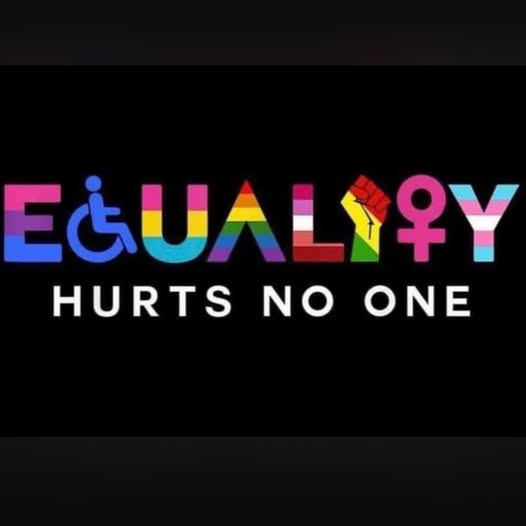
There’s a reason this image works. It uses a word almost everyone agrees with—equality—and then quietly fills that word with something else. The result is not an argument. It’s a substitution.
Look at it closely. The word “EQUALITY” is rendered in bright, appealing colors, layered with symbols of recognizable identity categories: disability, sexuality, gender, race, activism. Beneath it, the slogan: “hurts no one.” At the level of feeling, this is uncontroversial. Of course equality hurts no one. That’s the point of the concept. Equal treatment under the same rules is the baseline promise of any liberal order. But that is not what the image is actually depicting. The text says equality. The visual payload says something else entirely.
Equality, properly understood, is individual and procedural. It asks a simple question: are the same rules being applied to each person, regardless of who they are? It does not guarantee equal outcomes. It does not engineer results. It does not sort people into categories and adjust treatment accordingly. It holds the line at equal standing before the law and equal access to opportunity. That is why it is durable. It does not require constant intervention or measurement. It does not need to know who you are in order to decide how you should be treated.
The imagery in this poster points in a different direction. It is not concerned with individuals. It is concerned with groups. Each symbol represents a category that, within contemporary political frameworks, is treated as requiring not just equal treatment, but differential treatment in order to achieve parity of outcomes. That is the logic behind quotas, preferences, representational mandates, and a wide range of institutional policies now grouped under the umbrella of equity. That distinction matters. Because once you move from equal treatment to managed outcomes, you have to start making choices about who gets what, and why.
This is where the slogan “hurts no one” stops doing honest work. Equality, in the classical sense, really does not hurt anyone. It simply refuses to privilege or penalize based on identity. Equity, by contrast, is not costless. It reallocates opportunities. It lowers or shifts standards in some contexts. It elevates some groups explicitly. That may be justified in specific cases, but it is not neutral, and it is not universally painless. Someone is always paying the adjustment.
The poster resolves this tension through a familiar rhetorical move. It collapses the distinction. By wrapping equity-coded symbols inside the word equality, it invites the viewer to endorse a more controversial framework under the banner of a universally accepted one. The move is subtle enough that many people will not notice it, but strong enough that disagreement can be framed as opposition to “equality” itself. That is not clarification. It is camouflage.
The poster says equality. It is not. And pretending otherwise is not harmless, no matter how bright the colors or how reassuring the slogan.
You can see the tell in the composition. If the message were truly about equality in the classical sense, the image would not need to foreground identity categories at all. It would not need symbols. It would not need color-coding. The entire point of equality is that the categories do not matter when rules are applied. Here, the categories are the point. They are not incidental. They are doing the conceptual work.
None of this means the concerns associated with those categories are trivial or illegitimate. Some are serious. Some are contested. Some are overextended. All of them deserve to be argued on their own terms. But that argument has to be made honestly. It cannot be smuggled in under a word that already carries broad moral agreement.
This is the broader pattern. Take a term with a stable, widely accepted meaning. Expand or alter the underlying concept. Keep the original word. Let the new meaning ride on the old legitimacy. If challenged, collapse the distinction and accuse critics of opposing the original value. It is effective. It is also corrosive.
Words are not decoration. They are load-bearing. If we stop distinguishing between equality and equity, we lose the ability to argue about either of them clearly. And when that happens, policy follows confusion. Decisions get made without admitting what is being traded off, or who is being prioritized. That is not a small failure. It is how serious disagreements get papered over until they break.
Some children are genuinely vulnerable, atypical, or distressed, and they deserve careful support.
That should be easy to say. It should also be the beginning of the conversation, not the end of it.
The problem starts when a narrow duty of care is expanded into a broad teaching mandate. Support for a small number of children becomes a reason to saturate schools, children’s media, and online spaces with contested identity frameworks. What begins as accommodation becomes doctrine. What begins as care becomes a general lens for everyone.
That is the central move.
It is usually framed in soft language: inclusion, visibility, affirmation, making room. Sometimes that language is fair. But it can also hide a scope change. A real minority need is used to justify population-level exposure. The existence of some children who need unusual support does not, by itself, justify turning child-facing institutions into delivery systems for anti-normative identity scripts many children are not developmentally ready to evaluate.
Put simply: support is not the same thing as saturation.
A useful heuristic is the inoculation model. The implicit argument often sounds like this: expose everyone early and often to the framework so harm is prevented later. But that assumes the framework is age-appropriate, conceptually clear, and socially harmless when applied at scale. Those assumptions are usually asserted, not argued.
You can see the pattern in school frameworks like SOGI 123. SOGI 123 describes itself as an initiative to help educators make schools safer and more inclusive for students of all sexual orientations and gender identities, with tools spanning policy, school culture, and teaching resources. In British Columbia, SOGI 123 has been broadly integrated through educator networks and district participation structures. In Alberta, similar SOGI 123 resources and supports exist and are used, but public acceptance and implementation have been more contested and uneven. (Your local framing here is fine; if you want, we can add a specific Alberta anchor in the next pass.)
The point is not that every teacher using these materials has radical intentions. Most likely do not. The point is structural. A framework introduced in the name of protecting a minority of vulnerable students can become a general lens for shaping the environment of all students. That is exactly where support turns into saturation.
None of this requires pretending there are no benefits. Anti-bullying frameworks and school supports can reduce harassment and improve school climate for vulnerable students, and in some cases for other students as well. Recent SOGI 123 evaluation reporting in B.C. has explicitly claimed reductions in some forms of bullying and sexual-orientation discrimination, including effects observed for heterosexual students in studied schools. But that is a different question from whether a framework is well-bounded, developmentally fitted, and appropriate as a general lens for all children. A program can produce some good outcomes and still be overextended in scope.
This is also where ordinary parents often feel morally cornered. They are told the framework is simply about kindness and safety. Then they discover it also carries contested claims about identity, norms, and development. When they raise questions about age, fit, or timing, the objection is treated as hostility rather than prudence.
That rhetorical move matters. It is how debate gets shut down.
Some activist frameworks are not just asking for tolerance or non-harassment. They are more ambitious. They treat ordinary social norms as presumptively suspect—or as things to be actively challenged—rather than mostly inherited and refined. Adults can debate that in adult spaces. The problem is when those frameworks are translated into child guidance and presented as common sense before children are developmentally ready to sort through the concepts.
You do not need a graduate seminar to see the issue. Children imitate. Children seek belonging. Children absorb prestige cues. Children are shaped by what trusted adults celebrate. That is not bigotry. That is basic reality.
This is why developmental fit matters. Children do not process abstract identity questions the way adults do. Identity formation is gradual. Social context matters. Timing matters. Adult authority matters. Age appropriateness is not a slogan; it shifts across developmental stages, and what may be discussable at 16 is not automatically suitable at 6. When institutions present contested frameworks in a celebratory register first and a cautionary register later (or never), adults should worry.
The usual public binary is false. The choice is not between cruelty and total affirmation. It is not between neglect and ideological immersion. A sane society can do both things at once: provide targeted support for the children who truly need it, while refusing to reorganize the symbolic environment of all children around contested anti-normative frameworks.
That is not repression. It is proportion.
And proportion is exactly what gets lost when every concern is moralized and every request for limits is treated as harm.
We should be able to say, plainly, that some children need exceptional care without turning exceptional cases into the template for everyone else. We should be able to protect the vulnerable few without swamping the many. We should be able to teach kindness without requiring ideological inoculation.
If we cannot make those distinctions, then we are not practicing compassion. We are practicing scope creep with moral language.

Support for vulnerable students is necessary. But targeted care is not the same as saturating schools with contested identity frameworks for all children.
References
- SOGI 123 / SOGI Education. “SOGI 123 | Making Schools Safer and More Inclusive for All Students.”
https://www.sogieducation.org/ (SOGI 123) - SOGI Education. “What Is SOGI 123?”
https://www.sogieducation.org/question/what-is-sogi-123/
(official explainer page) - SOGI Education. “British Columbia.”
https://www.sogieducation.org/our-work/where-we-support/british-columbia/
(B.C. implementation / network context) - ARC Foundation. “UBC Evaluation of SOGI 123 (October 2024).”
https://www.arcfoundation.ca/ubc-evaluation-sogi-123-october-2024
(evaluation / outcomes framing from SOGI-supportive side) - Alberta Teachers’ Association. “What is SOGI 123?”
https://teachers.ab.ca/news/what-sogi-123 (teachers.ab.ca) - Keenan, H., and Lil Miss Hot Mess. “Drag Pedagogy: The Playful Practice of Queer Imagination in Early Childhood.” Curriculum Inquiry 51, no. 5 (2021): 578–594.
https://doi.org/10.1080/03626784.2020.1864621 - Gender Report (opinion/critical perspective). “We need to take ideological gender rhetoric out of education.” (Jan. 28, 2021).
https://genderreport.ca/sogi-gender-curriculum-queer-theory/ (CANADIAN GENDER REPORT) - Global News. “Duelling protests held in Edmonton over sexual orientation and gender identity policies in schools” (Sept. 20, 2024).
https://globalnews.ca/news/10766483/edmonton-gender-identity-sexual-orientation-alberta-schools/ (Global News)
This post is dedicated to debunking the whole “harsh punishment on criminals is good” mentality. This post will have nothing to do about ‘prisoner rights’ or ‘criminal coddling’, but rather it will look at the efficacy of ‘harsh punishment’ on crime in general and how efficient longer jail sentences would be. Does it actually work? To what degree? Is that degree of success worth what it costs to citizens? Lets take a look.
 For as long as there have been communities, murderers and thieves have been seen as criminals. Indeed, non-human primates share this with us as they will also punish, banish or kill deviants of this kind. And since the birth of the community, punishment for these crimes has been vast, varied, ingenuitive, brutally painful, and many have been fatal. So what we have is a near perfect case study. Thousands of years worth of experiments where two specific crimes have met with the pinnacle exemplars of the object of our study, harsh punishment. If harsh punishment really had any effect whatsoever on deterring or reducing crime, after those many thousands of years of diligent application we should find that the social problems of murder and theft are all but solved, strange memories of an era long past away. As we don’t seem to be any closer to a crime free utopia than early communities (indeed, most would argue we are further away) the only conclusion is that harsh punishment is contending for the rank of ‘most ineffective idea ever actualized by any government’, which is a highly competitive race. But for those that find this thought experiment a bit too neat, lets break it down a bit and look at our system of imprisonment.











 bleatmop
 Mystro
 The Arbourist


 Dead Wild Roses
Your opinions…