
You are currently browsing the tag archive for the ‘DEI’ tag.


In 2020, the Smithsonian’s National Museum of African American History and Culture published the two graphics above as part of its “Talking About Race” portal.
A necessary disclaimer: the museum removed the chart after criticism and acknowledged, “We erred in including it.” It is not current Smithsonian policy. That correction deserves recognition.
The point of revisiting it is not to pretend otherwise, but to examine the ideas circulating within an institution when someone created this material, others approved it, and the museum decided it was fit for public education.
Look at what the chart assigns to “whiteness”: objective and rational thinking, the scientific method, cause-and-effect reasoning, hard work, delayed gratification, planning for the future, self-reliance, decision-making, written communication, politeness and the protection of property.
If a white supremacist had claimed these were distinctively white characteristics, everyone would recognize the racism immediately. Placed inside an anti-racist framework, however, the same racial essentialism was briefly presented as enlightenment.
What does the chart imply about people who are not white? That rationality, foresight, scientific thinking and self-discipline are foreign norms imposed upon them? The creators may not have intended that conclusion, but they constructed the racial division that produces it.
There are a few legitimate observations buried inside the mess. American holidays have been shaped by Christianity, its legal system descends substantially from English common law, and its history was often taught through European settlement and male political leaders. “Win at all costs,” female subordination and treating wealth as personal worth are also reasonable targets for criticism.
The chart destroys those distinctions by dumping historical inheritance, social conventions, genuine vices and universal human capacities into one container marked whiteness. English common law, Barbie, scientific reasoning, bland food and delayed gratification are all made expressions of the same racialized system.
Objectivity is not white. It is a method for correcting the biases found in every human population. Written traditions developed across civilizations. Parents of every race sacrifice for their children, workers labour toward future goals, and societies everywhere use observation and causal reasoning to survive.
To produce something this ridiculous requires more than an editorial mistake. It requires an institutional culture that has spent so long treating Western inheritance as presumptively oppressive that civilizational self-criticism has curdled into self-repudiation. Once “whiteness” became the organizing category, apparently nobody stopped to ask what assigning rationality and hard work to white people implied about everyone else.
The museum eventually did stop, listen and withdraw the chart. Good.
But the artifact remains instructive. When anti-racism teaches that reason, discipline and foresight are white characteristics, it has not defeated racism. It has reproduced racism, reversed the approved moral direction and called the result education.
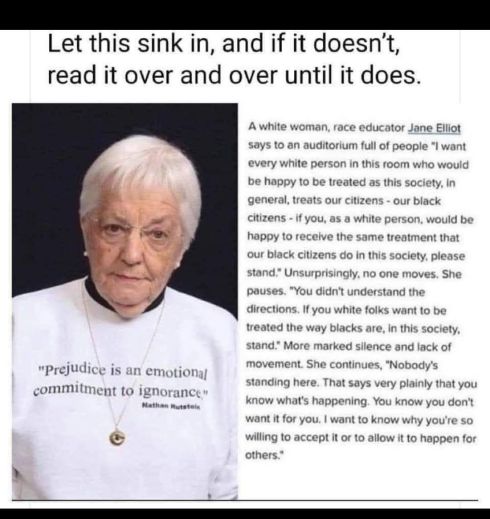
Jane Elliott’s famous classroom exercise functions less like an argument and more like a secular parable.
The audience is presented with a moral test. Nobody stands. The silence becomes confession. The lesson is declared revealed.
But notice what is happening structurally.
The participants are not asked to examine evidence, define terms, compare variables, or challenge premises. They are placed inside a ritualized moral frame where refusing the conclusion becomes socially dangerous. The emotional pressure is the mechanism. The audience is guided toward public affirmation through implied guilt.
That is why these exercises often feel spiritually familiar.
Traditional religion used testimony, confession, symbolic reenactment, and moral witness to move people toward conviction. Modern ideological movements often use remarkably similar tools while insisting they are merely “educating.”
The problem is not asking people to care about injustice. Serious injustice exists. The problem begins when emotional coercion replaces open inquiry.
What precisely does “treated the way black citizens are treated” mean?
Compared to whom?
Measured how?
Across what institutions?
At what time scale?
What evidence complicates the claim?
What tradeoffs emerge from proposed solutions?
Those questions are absent because the exercise is not designed to survive interrogation. It is designed to produce moral alignment.
That distinction matters.
Once disagreement becomes evidence of moral failure, accountability starts collapsing. The audience is no longer participating in an argument. They are participating in a liturgy.
And liturgies tend to react poorly when someone interrupts the ritual to ask whether the sermon is true.
One of the stranger features of modern public life is watching people who can spot religious dogma at fifty paces lose the gift the moment the dogma arrives in institutional clothing.
Put the claim in a pulpit and they reach for their Voltaire.
Put it in a workshop binder with equity on the cover and suddenly everyone is very concerned about tone.
That is not an argument against every claim made under DEI. Some discrimination is real. Some institutions have treated people badly while congratulating themselves for being fair. There is nothing strange about wanting hiring, schooling, policing, or public services to be less arbitrary and less cruel. A serious society should be able to hear those claims without flinching.
But hearing is not kneeling.
There is a difference between ordinary anti-discrimination work and the more ambitious creed that often travels under the same acronym. Widening a hiring pool is not the same thing as treating every statistical gap as proof of moral corruption. Removing needless barriers is not the same thing as teaching employees to confess inherited guilt in approved vocabulary. One belongs to public argument. The other starts looking for candles.
Religion, at least, usually admits when it is dealing with sacred things. It has altars, prayers, prohibitions, confessions, authorized interpreters, and a long memory for people who ask the wrong questions. The newer version arrives with less incense and more paperwork: forms, trainings, hiring rubrics, grant language, land acknowledgements, and small ceremonial statements read into microphones before everyone gets on with the actual event.
The room knows what is happening.
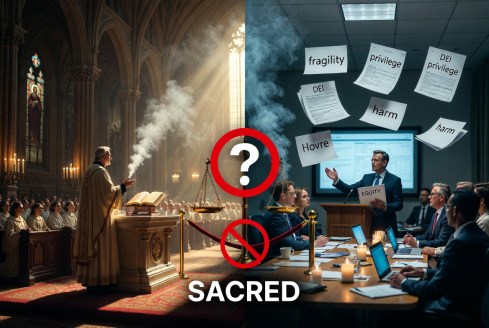
You may ask questions, technically. You may even be praised for your “curiosity,” provided your curiosity walks on a leash. Ask what equity means in practice. Ask who measures it. Ask what evidence would count against the program. Ask whether disagreement is permitted or merely pathologized. The temperature changes. Chairs shift. Someone smiles too carefully.
The comparison here is not that DEI managers are burning heretics in the town square. Scale matters. A missed promotion, HR complaint, grant denial, public scolding, or quiet reputational warning is not the Spanish Inquisition, and pretending otherwise only makes the critic sound unserious.
But mechanisms matter too. Church authorities once treated doubt as spiritual failure. Modern DEI culture often treats dissent as fragility, privilege, bigotry, or harm. The accusation has moved from the soul to the psychology, but the social lesson is familiar enough: you are not merely wrong; your question has exposed something unclean in you.
People notice. They adjust their faces. They save the real conversation for the parking lot.
That is how sacred subjects survive in public institutions. Not because everyone believes. Not even because the doctrine is especially persuasive. They survive because enough people learn the price of candour. A teacher nods through the training module. A board member lets the phrase pass. A musician reads the little ritual line because this is supposed to be a concert, not a committee war. An employee keeps the objection in his throat because rent is due and reputational damage compounds quickly.
And if DEI wants to remain in the world of policy rather than piety, it has to answer ordinary policy questions. Does the training work? Compared with what? At what cost? Does it reduce discrimination, or merely produce better-trained public language? Does it improve decisions, or teach people to repeat approved formulas while moving their actual thoughts elsewhere? Mandatory unconscious-bias training, in particular, has hardly earned the right to be treated as revealed truth. Some interventions may help in some contexts. Fine. Then test them, measure them, revise them, and stop treating skepticism as contamination.
Power has always enjoyed borrowing moral language. Traditional religion needed scrutiny for that reason. So does DEI. So does nationalism. So does environmentalism. So does any movement that claims authority over public life while placing its own premises behind velvet rope.
The question is not whether a belief is religious or secular. The question is whether it can be challenged without punishment.
What do you mean?
How do you know?
Who benefits?
Who pays?
What happens to the person who says no?
Those are not hostile questions. They are the minimum price of entering public argument. A doctrine that cannot tolerate them is not being protected from cruelty. It is being protected from accountability.
The old religions taught us what happens when moral certainty gets institutional shelter. The new secular religions are generous enough to provide a refresher course, complete with handouts, acronyms, and a sign-in sheet.
No belief gets immunity because it flatters itself as compassion.
And when ordinary people start moving their honest conversations out of the room, the institution has already chosen the sermon over the argument.
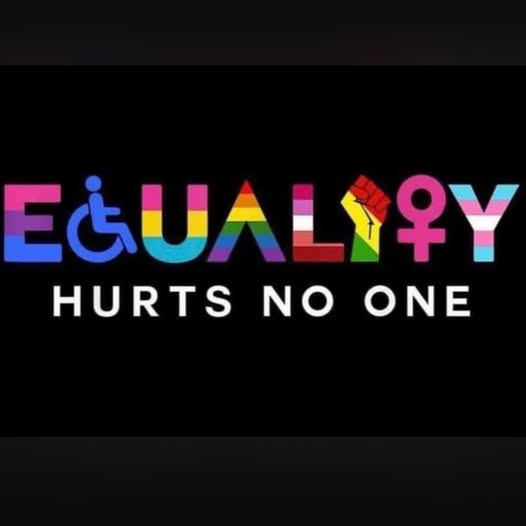
There’s a reason this image works. It uses a word almost everyone agrees with—equality—and then quietly fills that word with something else. The result is not an argument. It’s a substitution.
Look at it closely. The word “EQUALITY” is rendered in bright, appealing colors, layered with symbols of recognizable identity categories: disability, sexuality, gender, race, activism. Beneath it, the slogan: “hurts no one.” At the level of feeling, this is uncontroversial. Of course equality hurts no one. That’s the point of the concept. Equal treatment under the same rules is the baseline promise of any liberal order. But that is not what the image is actually depicting. The text says equality. The visual payload says something else entirely.
Equality, properly understood, is individual and procedural. It asks a simple question: are the same rules being applied to each person, regardless of who they are? It does not guarantee equal outcomes. It does not engineer results. It does not sort people into categories and adjust treatment accordingly. It holds the line at equal standing before the law and equal access to opportunity. That is why it is durable. It does not require constant intervention or measurement. It does not need to know who you are in order to decide how you should be treated.
The imagery in this poster points in a different direction. It is not concerned with individuals. It is concerned with groups. Each symbol represents a category that, within contemporary political frameworks, is treated as requiring not just equal treatment, but differential treatment in order to achieve parity of outcomes. That is the logic behind quotas, preferences, representational mandates, and a wide range of institutional policies now grouped under the umbrella of equity. That distinction matters. Because once you move from equal treatment to managed outcomes, you have to start making choices about who gets what, and why.
This is where the slogan “hurts no one” stops doing honest work. Equality, in the classical sense, really does not hurt anyone. It simply refuses to privilege or penalize based on identity. Equity, by contrast, is not costless. It reallocates opportunities. It lowers or shifts standards in some contexts. It elevates some groups explicitly. That may be justified in specific cases, but it is not neutral, and it is not universally painless. Someone is always paying the adjustment.
The poster resolves this tension through a familiar rhetorical move. It collapses the distinction. By wrapping equity-coded symbols inside the word equality, it invites the viewer to endorse a more controversial framework under the banner of a universally accepted one. The move is subtle enough that many people will not notice it, but strong enough that disagreement can be framed as opposition to “equality” itself. That is not clarification. It is camouflage.
The poster says equality. It is not. And pretending otherwise is not harmless, no matter how bright the colors or how reassuring the slogan.
You can see the tell in the composition. If the message were truly about equality in the classical sense, the image would not need to foreground identity categories at all. It would not need symbols. It would not need color-coding. The entire point of equality is that the categories do not matter when rules are applied. Here, the categories are the point. They are not incidental. They are doing the conceptual work.
None of this means the concerns associated with those categories are trivial or illegitimate. Some are serious. Some are contested. Some are overextended. All of them deserve to be argued on their own terms. But that argument has to be made honestly. It cannot be smuggled in under a word that already carries broad moral agreement.
This is the broader pattern. Take a term with a stable, widely accepted meaning. Expand or alter the underlying concept. Keep the original word. Let the new meaning ride on the old legitimacy. If challenged, collapse the distinction and accuse critics of opposing the original value. It is effective. It is also corrosive.
Words are not decoration. They are load-bearing. If we stop distinguishing between equality and equity, we lose the ability to argue about either of them clearly. And when that happens, policy follows confusion. Decisions get made without admitting what is being traded off, or who is being prioritized. That is not a small failure. It is how serious disagreements get papered over until they break.
I woke this morning to the sort of silence one usually associates with miracles or the CBC losing funding. It was not the usual Canadian silence of people muttering “well, that’s concerning” while being mugged by ideology in a Lululemon hoodie. No. It was the silence that comes after a fever breaks.
By breakfast, the first signs were impossible to miss. Gender ideology had finally been moved to its proper shelf: comparative religion. It now sat comfortably beside crystal healing, Gnostic sects, and the more enthusiastic forms of astrology. Canadians, with characteristic politeness, agreed that adults were free to believe in innate gender spirits if they wished. They were simply no longer allowed to drag those beliefs into schools, prisons, women’s shelters, human rights tribunals, or sports governing bodies and demand that everybody else call it science.
Female spaces reverted, almost overnight, to the radical old principle that women are female. Women’s prisons once again housed women. Women’s shelters once again served women. Women’s hospital wards, changing rooms, crisis centres, rape relief services, and athletic categories all quietly recovered their original function. The country did not collapse. No one burst into flames. The sun rose, the buses ran late, and Canadian women experienced the deeply unfamiliar sensation of not having to explain why privacy, fairness, and physical safety were not hate crimes.
“They were replaced by the revolutionary practice of getting on with things.”
Even the sports pages improved. Men were removed from women’s competitions with so little fuss one wondered why the insanity had been allowed to continue so long. Records began to mean something again. Girls stopped being told that getting flattened by male bodies was a teachable moment in inclusion.
Meanwhile, Canada seemed to have recovered from a long and embarrassing binge. DEI offices vanished like travelling carnivals after a municipal scandal. Land acknowledgements were quietly retired from every meeting and kindergarten graduation after the public noticed they had not, in fact, altered land title or improved anyone’s life. They were replaced by the revolutionary practice of getting on with things.
Freedom of speech also made an unexpected return. Not the decorative kind. The real kind. The kind where one could say true or unpopular things without being marched through a moral struggle session by people whose entire personality is a lanyard.
For several glorious hours, the country seemed almost curable.
Then I remembered the date.

Happy April Fool’s Day.
Travis Dhanraj’s July 7, 2025 resignation from CBC News exposes a deepening crisis at Canada’s public broadcaster: a culture of ideological conformity that punishes dissent and undermines its public mandate. In a scathing resignation letter, Dhanraj claims he was “forced to resign” due to a “workplace culture defined by retaliation, exclusion, and psychological harm,” where questioning “tokenism masquerading as diversity, problematic political coverage protocols, and the erosion of editorial independence” became a “career-ending move.” His allegations paint a damning picture of an institution that prioritizes a monolithic worldview over journalistic integrity. A 20-year veteran and former host of Canada Tonight, Dhanraj says he was “systematically sidelined” and “denied the editorial access and institutional support necessary to fulfill my public service role” after advocating for more balanced coverage. These claims raise urgent questions about CBC’s commitment to serving all Canadians.
According to Dhanraj and his legal counsel, CBC’s approach to diversity, equity, and inclusion (DEI) functions as a veneer for performative tokenism rather than genuine pluralism. His resignation letter denounces what he calls “a system designed to elevate certain voices and diminish others,” alleging that his efforts to confront this imbalance were met with retaliation. His lawyer, Kathryn Marshall, contends that CBC leadership assumed Dhanraj would adopt a “liberal worldview” based on his Indo-Caribbean background—an expectation that turned into marginalization when he platformed politically diverse voices, including Conservatives.
When he sought to broaden the range of political perspectives on air, Dhanraj claims that “internal booking and editorial protocols were weaponized to create structural barriers for some while empowering others, particularly a small circle of senior Ottawa-based journalists.” These allegations suggest that the CBC’s DEI policies prioritize surface-level representation while enforcing ideological uniformity. Such practices risk alienating Canadians who value intellectual diversity and erode the CBC’s credibility as a publicly funded institution tasked with reflecting the full spectrum of public opinion.
Dhanraj’s experience further illustrates the erosion of editorial independence and objectivity within CBC News. “I was told I would be ‘a bold voice in journalism.’ I took that role seriously,” he writes. “But what happens behind the scenes at CBC too often contradicts what’s shown to the public.” His push to “expand political balance” reportedly led to accusations that he was on a “crusade,” and he was “repeatedly denied access to key newsmakers.” The February 2025 cancellation of Canada Tonight—replaced by Hanomansing Tonight—and CBC’s internal investigation into an April 2024 post on X, in which Dhanraj noted then-president Catherine Tait’s refusal to be interviewed, indicate an institutional climate that discourages independent inquiry and punishes dissent.
CBC’s public response has done little to allay these concerns. In a statement, spokesperson Kerry Kelly said the broadcaster “categorically rejects” Dhanraj’s allegations but cited “privacy and confidentiality considerations,” offering no substantive rebuttal. This evasive posture reinforces perceptions of an organization more interested in protecting its image than addressing internal dysfunction. Meanwhile, CBC head of public affairs Chuck Thompson insisted that Dhanraj remains “on leave”—despite his public resignation—raising questions about transparency. Adding to the controversy, CBC allegedly demanded that Dhanraj sign a non-disclosure agreement (NDA), which he refused. Marshall described the NDA as “Stalinist,” claiming it was designed not to protect privacy but to “sign away [Dhanraj’s] voice.” If accurate, this suggests an institution seeking to suppress criticism rather than confront it.
The CBC’s apparent descent into ideological conformity demands more than cosmetic reform. Dhanraj’s resignation is a clarion call: “CBC doesn’t need more workshops. It needs accountability. It needs reform. It needs courage.” If left unaddressed, the broadcaster risks permanent reputational damage and growing public disengagement.
Reform must begin at the top—replacing leadership that enforces orthodoxy, revisiting DEI frameworks that suppress intellectual pluralism, and reestablishing editorial protocols that prioritize accuracy, fairness, and independence. Journalists must be empowered to ask hard questions without fear of reprisal. Only through such transformation can the CBC rebuild trust and fulfill its mandate to serve all Canadians, not just those who share a prevailing ideological stance.
The nation is watching. Silence is no longer an option.

Sources Cited
-
Dhanraj, Travis. “Email to all‑staff at CBC News,” July 7, 2025. Published excerpts via St. Albert Gazette (Canadian Press):
Nicole Thompson, St. Albert Gazette, “CBC News anchor Travis Dhanraj says he was ‘forced’ to resign…” July 7, 2025.
URL: https://www.stalbertgazette.com/lifestyle-news/cbc-news-anchor-travis-dhanraj-says-he-was-forced-to-resign-from-broadcaster-10912196 Reddit+7St. Albert Gazette+7Yahoo News UK+7 -
Lawyer Kathryn Marshall (statement):
As quoted in St. Albert Gazette:CBC assumed Dhanraj would hold a certain “liberal world view” based on “the colour of his skin.” MediaPolicy.ca+4St. Albert Gazette+4The Hub+4
-
Quote from resignation letter (“tokenism masquerading as diversity…”):
Reported in St. Albert Gazette and Yahoo News UK:
Yahoo News UK, “CBC host Travis Dhanraj says he was ‘silenced’ and ‘forced to resign’…” MediaPolicy.ca+3The Hub+3The Times of India+3St. Albert Gazette+2Yahoo News UK+2Reddit+2 -
CBC response (“categorically rejects the accusations…” / privacy concerns):
St. Albert Gazette via CP confirms CBC’s statement quoting Kerry Kelly Yahoo News UK+6St. Albert Gazette+6Reddit+6 -
Replacement of Canada Tonight with Hanomansing Tonight (Feb 2025):
Wikipedia, Ian Hanomansing page:…CBC announced that Hanomansing will become host of a new nightly news program, Hanomansing Tonight, on CBC News Network beginning February 18, 2025. Instagram+3Wikipedia+3Reddit+3
-
Lawyer describing NDA as “Stalinist” and the broader legal push (including planned human rights complaint):
Referenced in r/canadian thread summarizing quotes from Dhanraj and Marshall: MediaPolicy.caYouTube+7Reddit+7The Hub+7 -
Coverage and push for accountability (“Conservatives want hearings…”):
MediaPolicy.ca, “Conservatives want hearings on Travis Dhanraj quitting the CBC,” July 12, 2025. YouTube+9MediaPolicy.ca+9MediaPolicy.ca+9 -
Further legal details and broader staff culture claims:
MediaPolicy.ca, July 17, 2025, describes Marshall’s invitation to whistleblowers and her “Stalinist” remark. MediaPolicy.ca -
General reporting on toxic workplace culture and DEI criticism:
Times of India, “CBC news anchor Travis Dhanraj resigns, citing ‘toxic and bullying’ workplace culture,” July 8, 2025. The Times of India
Freedom of speech is a cornerstone of Canadian democracy, enshrined in Section 2(b) of the Canadian Charter of Rights and Freedoms, which protects the right to express one’s opinions and beliefs without fear of censorship or reprisal. This fundamental right fosters open dialogue, encourages diverse perspectives, and underpins a free and democratic society. However, in recent years, the rise of Diversity, Equity, and Inclusion (DEI) initiatives, often rooted in ideological frameworks that prioritize certain narratives over others, has posed challenges to free expression. The case of Margaret Munn, a teacher candidate at the University of Western Ontario (UWO), exemplifies how such initiatives can suppress dissenting voices. Munn faced significant repercussions for expressing views critical of DEI and decolonization policies during her teacher training, highlighting a troubling trend where ideological conformity overshadows open discourse (FSU Canada, 2024).
Margaret Munn’s experience at UWO illustrates the chilling effect of DEI initiatives on academic freedom and free speech. As a mature student in the Bachelor of Education program, Munn was required to demonstrate “professionalism” by aligning with DEI and decolonization principles, which she found overly prescriptive. When she expressed concerns about these frameworks and their impact on educational practices, she faced accusations of unprofessionalism and was ultimately expelled from her practicum placement. This led to her inability to complete her degree, effectively derailing her career aspirations (FSU Canada, 2024). The Faculty of Education’s response, as detailed in court documents, emphasized adherence to institutional values over open debate, suggesting that questioning DEI principles was incompatible with professional standards (Court File No. CV-24-00002418-0000, 2024). This case underscores how DEI initiatives, when rigidly enforced, can create an environment where only approved viewpoints are tolerated, stifling the very diversity of thought they claim to promote.
The broader implications of Munn’s case reflect a growing tension between free speech and ideological mandates in Canadian institutions. DEI frameworks often emphasize collective equity over individual rights, which can lead to policies that prioritize certain groups’ sensitivities over open dialogue. At UWO, Munn was penalized not for harmful actions but for her intellectual dissent, which was deemed a violation of the faculty’s commitment to inclusivity (Quillette, 2024). This approach mirrors a wider trend where “woke” ideologies—encompassing DEI, decolonization, and related social justice frameworks—impose speech codes that limit what can be said or questioned. Such restrictions risk creating echo chambers, where only ideologically aligned perspectives are permitted, undermining the principles of academic inquiry and free expression that universities are meant to uphold. The suppression of Munn’s voice demonstrates how these initiatives can weaponize concepts like professionalism to silence dissent, eroding the pluralistic foundation of Canadian society.
Defending freedom of speech requires acknowledging that true diversity includes diversity of thought, even when those thoughts challenge prevailing ideologies. The Munn case highlights the need for institutions to prioritize open debate over ideological conformity. Universities, as bastions of intellectual freedom, should foster environments where students and faculty can question policies like DEI without fear of retribution. The Faculty Solidarity Unit (FSU) argues that Munn’s expulsion reflects a systemic issue where academic institutions prioritize ideological goals over Charter-protected rights (FSU Canada, 2024). Protecting free speech does not mean endorsing every viewpoint but ensuring that all perspectives can be expressed and debated without penalty. By contrast, the rigid application of DEI frameworks, as seen at UWO, risks creating a hierarchy of acceptable speech, where only certain ideas are deemed safe or professional, undermining the democratic principles that allow Canada to thrive.
In conclusion, the case of Margaret Munn vs. University of Western Ontario serves as a cautionary tale about the erosion of freedom of speech in Canada under the guise of DEI and related ideological initiatives. While these frameworks aim to promote inclusivity, their implementation can suppress dissenting voices, as seen in Munn’s expulsion for questioning institutional policies. Freedom of speech is not just a legal right but a cultural necessity that enables robust debate and the pursuit of truth. To safeguard this right, Canadian institutions must resist the temptation to enforce ideological conformity and instead embrace open dialogue, even when it challenges prevailing norms. By doing so, they can uphold the values of a free and democratic society where all voices, including those like Munn’s, are heard and respected (Quillette, 2024).
References
- FSU Canada. (2024). Margaret Munn v. University of Western Ontario. Retrieved from https://fsucanada.ca/margaret-munn-v-university-of-western-ontario/
- Court File No. CV-24-00002418-0000. (2024). Munn v. University of Western Ontario. Retrieved from https://acrobat.adobe.com/id/urn:aaid:sc:US:325ae543-0142-4ab4-9bb6-c79bae4e4571?viewer%21megaVerb=group-discover
- Quillette. (2024). Lessons from a Teachers’ College Battle over Free Speech and Decolonization. Retrieved from https://quillette.com/2024/11/29/lessons-from-a-teachers-college-battle-over-free-speech-and-decolonization/












 bleatmop
 Mystro


 Dead Wild Roses
Your opinions…