
You are currently browsing the tag archive for the ‘DEI’ tag.
The DEI (Diversity, Equity, and Inclusion) requirements for the Library Technician position at BC Cancer in Vancouver appear to be more of a political purity test than a set of skills directly relevant to the job. The qualifications demand a deep understanding of systemic racism, Indigenous Peoples’ health contexts, and familiarity with specific legislative documents like the Truth & Reconciliation Commission’s Calls to Action and the Declaration on the Rights of Indigenous Peoples Act. While these are important societal issues, they are not inherently tied to the core duties of a library technician, such as organizing materials, assisting patrons, or managing databases. This focus on ideological alignment risks prioritizing political correctness over practical expertise, potentially alienating candidates who excel in the technical and operational aspects of the role but may not meet these specific ideological benchmarks.
Moreover, these requirements could deter highly qualified candidates who lack the specified DEI knowledge but possess exceptional skills in library management, customer service, or technical proficiency. For instance, a candidate with years of experience in library systems, a knack for efficient cataloging, and strong interpersonal skills might be overlooked if they haven’t engaged deeply with Indigenous-specific anti-racism education or settler-colonial history. By emphasizing these DEI criteria, the hiring process may inadvertently filter out individuals who could otherwise excel in the role, replacing merit-based selection with a test of ideological conformity. This approach undermines the goal of hiring the best candidate for the job, as it prioritizes social justice credentials over the practical abilities needed to perform the role effectively.
Ultimately, while fostering diversity and inclusion is a noble goal, the DEI requirements for this position create an unnecessary barrier to entry that may compromise the quality of the hire. The library technician role demands skills like alphanumeric filing, communication, and equipment operation, as outlined in the job description, yet the DEI expectations overshadow these core competencies. By focusing on political and cultural knowledge that is tangential to the job’s day-to-day responsibilities, BC Cancer risks missing out on candidates who could bring efficiency, innovation, and excellence to the role, thus hindering the organization’s ability to serve its patrons effectively.

https://jobs.phsa.ca/job/vancouver/library-technician-bc-cancer-vancouver/909/79784591232
So much of the discussion around DEI is people arguing about two or more very different ideas of what DEI is. Let’s investigate that problem – like many of the situations we face as a society today much of the furor is being caused by have multiple definitions of the same idea.
Polysemy—the fact that words or concepts like DEI (Diversity, Equity, and Inclusion) can have multiple meanings—does indeed complicate discussions about it. Supporters might define DEI as a noble effort to ensure fairness and opportunity for all, as seen in your earlier examples (e.g., accommodations for disabled neighbors or pregnant friends). Critics, however, might interpret it differently, focusing on its implementation or unintended consequences. Below is a 5-point breakdown of why DEI, as commonly applied, might not be a good thing for society, while acknowledging this definitional divide and approaching the critique thoughtfully.
1. It Can Prioritize Group Identity Over Individual Merit
-
Critics’ View: DEI often emphasizes categories like race, gender, or disability status, which can shift focus away from a person’s skills or qualifications. For example, hiring quotas (real or perceived) might lead to someone being chosen to “check a box” rather than based on their ability.
-
Supporters’ Definition Clash: Supporters might say DEI is about removing barriers, not enforcing quotas—like ensuring the autistic barista gets a fair shot. But when DEI translates into policies that seem to favor group outcomes over individual effort, it risks alienating those who value meritocracy, creating resentment instead of unity.
2. It May Undermine Equal Treatment Under the Guise of Equity
-
Critics’ View: Equity, a core DEI pillar, seeks equal outcomes rather than equal opportunities. This can lead to unequal treatment—e.g., giving extra resources to one group while others receive less, even if their circumstances differ due to personal choices or chance. Critics argue this contradicts the principle of fairness it claims to uphold.
-
Supporters’ Definition Clash: Supporters might frame equity as leveling the playing field (e.g., accommodations for a pregnant friend via FMLA). Yet when DEI pushes beyond legal protections into preferential policies, it can feel like reverse discrimination to those outside the targeted groups, fueling social division.
3. It Risks Oversimplifying Complex Social Issues
-
Critics’ View: DEI often reduces multifaceted problems—like poverty, education gaps, or workplace struggles—to identity-based solutions. For instance, a veteran’s employment challenges might stem from PTSD or lack of training, not just their veteran status. DEI’s broad brush can miss these nuances, offering symbolic fixes rather than addressing root causes.
-
Supporters’ Definition Clash: Supporters might argue DEI raises awareness of systemic barriers (e.g., for the Down syndrome bagger). But critics contend that awareness alone, without tailored solutions, can become performative, leaving deeper issues unresolved while claiming progress.
4. It Can Foster Resentment and Polarization
-
Critics’ View: When DEI initiatives spotlight certain groups for special attention, others may feel excluded or unfairly judged. For example, a non-disabled worker might resent extra accommodations for a colleague who works fewer hours, even if those accommodations are fair. This breeds a “zero-sum” mindset where one group’s gain feels like another’s loss.
-
Supporters’ Definition Clash: Supporters might see DEI as uplifting everyone (e.g., ensuring the disabled neighbor thrives). Yet if the messaging or execution seems to pit groups against each other, it can erode trust and cohesion—counter to the inclusive society supporters envision.
5. It May Encourage Dependency on Institutional Fixes Over Personal Agency
-
Critics’ View: By framing systemic change as the solution, DEI can unintentionally discourage individual initiative. If people expect workplaces to adapt to every need (beyond reasonable accommodations), it might weaken resilience or accountability—like assuming a job should mold to you rather than you rising to meet its demands.
-
Supporters’ Definition Clash: Supporters might say DEI empowers people (e.g., giving the autistic barista tools to succeed). Critics, though, worry that over-reliance on DEI frameworks could shift responsibility from individuals to institutions, reducing self-reliance and long-term societal strength.
Closing Thought:
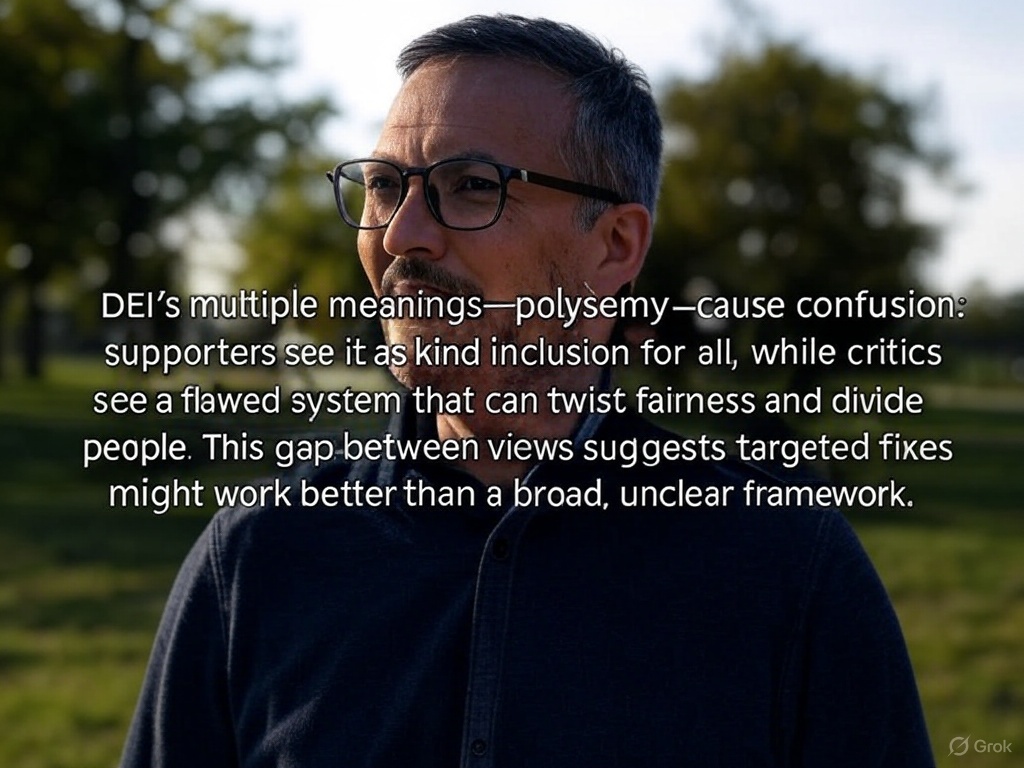
The polysemy of DEI is key here. Supporters often define it as a compassionate, inclusive ideal—helping the marginalized shine, as in your examples. Critics, however, see it as a bureaucratic or ideological tool that, in practice, can distort fairness, divide people, and oversimplify reality. The tension lies in how it’s applied: a supporter’s vision of DEI as “opportunity for all” might not match the critic’s experience of it as “preference for some.” This gap suggests society might benefit more from targeted, practical solutions (like existing laws or community efforts) than a catch-all framework that means different things to different people.
Well, here we have 3 movie posters as they were displayed in mainland China. What do you see missing?
Are the anti-racism activists losing their minds about this? Can the vaunted arbiters of social justice be bothered with actual racism?
Naaaah. The REAL work is to keep looking for the systemically racism Unicorn that permeates EVERY facet of western society and must be rooted out – but only the experts can see it and you’ll have to hire them to get these dire systemic Unicorns out of your organization…
Should we actively oppose racism and racists sentiments, absolutely. Do we need a class of self appointed experts to root out the systemic racism that only they have the insight to see and root out? – Probably not.



In reference to an interesting coincidence, that through civil rights activism and a incremental changes to our society overt and institutionalized racism is largely over. But with most of racism in society gone, what then (thanks grok) – When cults face falsification of their beliefs, they often employ several strategies to retreat from reality:
Denial and Reinterpretation:
Denial: Cults might outright deny any evidence that contradicts their beliefs, claiming it to be false, misleading, or part of a conspiracy against them.
Reinterpretation: They might reinterpret the evidence in a way that fits their narrative. For example, if a prophecy doesn’t come true, they might claim it was a “spiritual” fulfillment or that the prophecy was misinterpreted by outsiders.
Isolation: Cults often increase their isolation from the outside world. This can involve moving to remote locations, restricting access to external information (like news or internet), or discouraging interactions with non-members. Isolation helps prevent members from being exposed to contradicting information or viewpoints
.
Shifting Blame or Goalposts:
Shifting Blame: If something goes wrong, rather than questioning the belief system, the leadership might blame members for not being faithful enough or external forces for interference.
Moving the Goalposts: They might change their doctrines or predictions subtly or significantly to account for the falsification without admitting error. This can mean setting new dates for prophecies or redefining what the prophecy meant.
Cognitive Dissonance Management:
When faced with evidence against their beliefs, members might experience cognitive dissonance. Cult leaders often provide explanations or new interpretations to reduce this discomfort, reinforcing loyalty and belief.
Increased Control and Manipulation:
There might be an increase in psychological manipulation techniques, like love bombing, where members are showered with affection to quell doubts, or fear tactics where leaving the group is associated with dire consequences.
Creation of Parallel Realities:
Cults might develop their own news sources, vocabulary, or interpretations of events to create a reality that aligns with their beliefs. This parallel reality can make external critique seem irrelevant or part of an antagonistic narrative.
Rituals and Practices:
Increasing the frequency or intensity of rituals can reinforce group identity and belief. These practices can act as a distraction from reality or as a mechanism to reaffirm faith in the face of contradictory evidence.
Charismatic Leadership:
The leader might become more central, perhaps through claiming new revelations or visions that explain away the falsification. This can also involve the leader becoming more authoritarian, ensuring that followers remain under tight control.
By using these methods, cults not only protect their belief systems from external critique but also maintain internal cohesion and loyalty among members, even when faced with undeniable evidence against their doctrines.
Let’s take a look at the three arguments and counter-arguments commonly used to when discussing Diversity policies within the framework of Diversity, Equity, and Inclusion (DEI):
Undermining Merit-Based Systems:
Explanation: Critics argue that diversity policies can lead to a focus on demographic representation over merit, potentially resulting in less qualified individuals being selected for positions. This perspective suggests that prioritizing diversity might mean overlooking the most competent candidates, thereby undermining the meritocratic principles that are supposed to drive organizational success and fairness.
Counterpoint: Proponents of DEI might argue that what’s often labeled as “merit” can be influenced by biases, where traditional metrics of merit do not account for systemic disadvantages some groups face. They propose that diversity initiatives aim to expand the pool of candidates, ensuring that merit is assessed within a broader, more equitable context.
Promoting Division and Resentment:
Explanation: There’s an argument that DEI policies can foster division by emphasizing differences rather than commonalities, leading to resentment among those who feel they are discriminated against or unfairly overlooked due to their demographic characteristics. This can create an “us vs. them” mentality, potentially fracturing team cohesion and morale.
Counterpoint: Supporters might counter that acknowledging and addressing differences is essential for true inclusion, promoting understanding rather than division. They argue that well-implemented DEI strategies educate, unite, and enrich workplace culture by celebrating diversity as a strength rather than a source of division.
Inefficiency and Reduced Performance:
Explanation: Some critics claim that diversity for its own sake can introduce inefficiencies. They suggest that integrating diverse perspectives might initially slow down decision-making processes due to the need for more discussion to reconcile differing viewpoints or cultural misunderstandings. This could be seen as a hindrance in fast-paced environments where quick, decisive action is valued.
Counterpoint: Advocates for diversity would argue that while there might be an initial adjustment period, the long-term benefits include more innovative solutions, better problem-solving, and resilience against groupthink. They cite studies showing that diverse teams can outperform homogeneous ones over time by leveraging a wider range of experiences and ideas.
These arguments are part of a broader, ongoing debate about the implementation and impact of DEI policies. Each point of view has its merits and criticisms, and the effectiveness of diversity policies can depend significantly on how they are executed within specific organizational contexts. The goal should be to critically assess both the challenges and benefits in pursuit of a balanced approach that truly enhances equity and inclusion.
Colin Wright goes over the study in that demonstrates that DEI training actually increases divisiveness and strife.
“The NCRI study investigated the psychological effects of DEI pedagogy, specifically training programs that draw heavily from texts like Ibram X. Kendi’s How to Be an Antiracist and Robin DiAngelo’s White Fragility. The findings were unsettling, though perhaps not surprising to longstanding opponents of such programs. Through carefully controlled experiments, the researchers demonstrated that exposure to anti-oppressive (i.e., anti-racist) rhetoric—common in many DEI initiatives—consistently amplified perceptions of bias where none existed. Participants were more likely to see prejudice in neutral scenarios and to support punitive actions against imagined offenders. These effects were not marginal; hostility and punitive tendencies increased by double-digit percentages across multiple measures. Perhaps most troubling, the study revealed a chilling convergence with authoritarian attitudes, suggesting that such training is fostering not empathy, but coercion and control.
The implications of these findings cannot be downplayed. DEI programs have become a fixture in workplaces, schools, and universities across the United States, with a 2023 Pew Research Center report indicating that more than half of U.S. workers have attended some form of DEI training. Institutions collectively spend approximately $8 billion annually on these initiatives, yet the NCRI study underscores how little scrutiny they receive. While proponents of DEI argue that these programs are essential to achieving equity and dismantling systemic oppression, the NCRI’s data suggests that such efforts may actually be deepening divisions and cultivating hostility.”
Who would have thought that focusing on differences and promoting guilt would lead to negative outcomes…?
Tweet #1 – NDP in full righteous name calling fury.
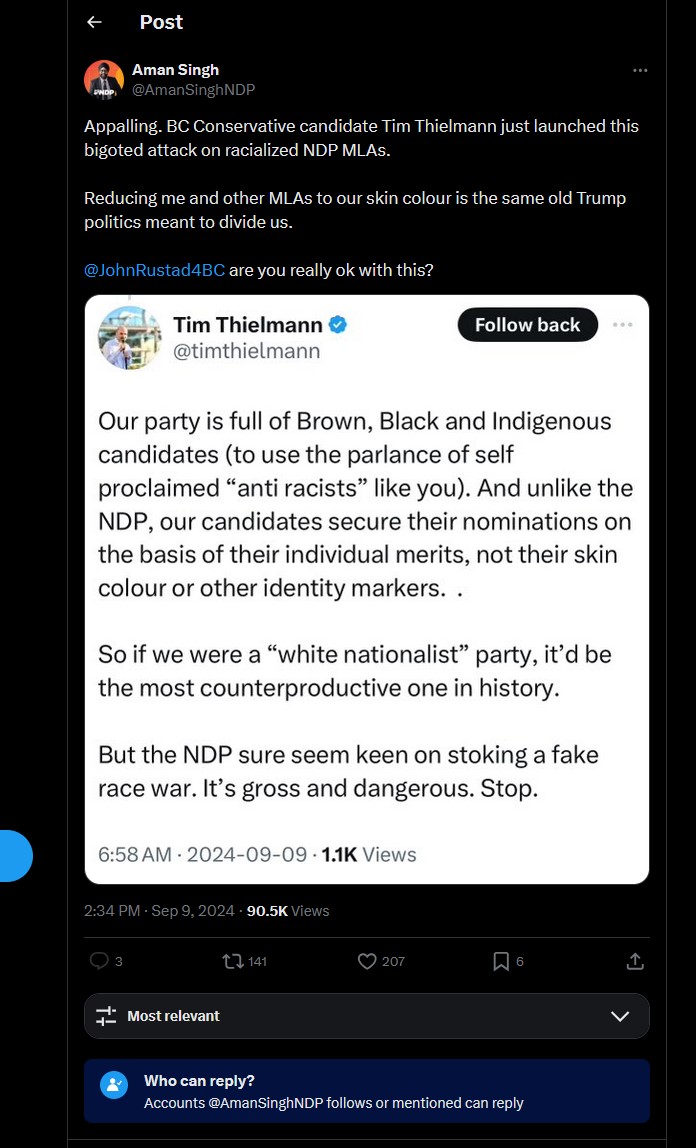
Tweet #2 – The pigeons coming home to roost.

This is your brain on “anti-racism” and “DEI”.
Just say no.
We end up hurting the most vulnerable people in society when we turn away from empirical evidence and the real world. Listen and enumerate the damage being done to children in the name of ‘combating systemic racism’.











 bleatmop
 Mystro
 The Arbourist


 Dead Wild Roses
Your opinions…