
You are currently browsing the category archive for the ‘Politics’ category.
Have you ever held your tongue during an otherwise friendly conversation because you could see exactly what would happen if you spoke your mind? Not because you lacked an answer, but because answering would transform the conversation into a trial of your character.
Scope note: Critical Theory is a diverse and disputed intellectual tradition. This essay offers a broad introduction to a recurring mechanism in contemporary woke politics; it does not claim that every critical theorist thinks alike or that every systemic criticism is false.
Why can saying that sex is a biological reality make you a transphobe? How can defending merit-based standards make you a racist? Why can asking that factual claims be judged by shared evidence turn you into a Western imperialist? Why can asking how 215 radar anomalies came to be reported as the remains of 215 children make you a colonialist or denialist? How can requesting concrete examples of systemic racism become proof that you are too privileged—or possess too much “false consciousness”—to recognize it?
Any of those questions may be reasonable, mistaken, or badly phrased. The tell is not whether the questioner is right. It is whether the question gets answered—or the questioner gets morally diagnosed.
“The argument ends before it begins. Instead of the claim being examined, you are.”

The argument ends before it begins. Instead of the claim being examined, you are.
You walk away wondering whether you really are the latest variety of “-phobe,” “-ist,” or some other socially shameful thing. Perhaps you were insensitive. Perhaps you missed something. Or perhaps you encountered a system of thought in which disagreement is not processed as information but reclassified as further evidence of your moral or ideological conditioning.
Well, dear reader, you have probably met Critical Theory without being formally introduced.
The Theory Beneath the Argument
Critical Theory emerged from the Western Marxist tradition associated with the Frankfurt School. Its foundational statement is usually traced to Max Horkheimer’s 1937 essay, Traditional and Critical Theory. We do not need the complete family tree here. The important distinction is between a theory that tries to describe and explain society and one that also intends to transform it.
The contemporary pattern did not travel unchanged from Horkheimer. It combined with later theories of power, identity, standpoint, and language before being simplified into activist practice. We are tracing that recurring logic, not claiming that every modern slogan came directly from Frankfurt in 1937.
Nor is self-sealing reasoning exclusive to the woke Left. Religious, nationalist, conspiratorial, and right-wing movements can do it as well. This essay examines the contemporary critical form because that is the form at issue here.
Critical Theory begins with a reasonable observation: societies do more than make laws. Families, schools, religions, media, professional bodies, and governments also transmit the values and categories through which people understand the world. The stronger claim is that these institutions reproduce existing power. What society calls normal, objective, reasonable, or meritorious may be the ruling order explaining itself in flattering language.
This is hegemony in plain English: power becomes secure when its assumptions feel like common sense. Social construction describes how language, customs, and institutions shape social categories. Critical consciousness is the claimed ability to recognize the power beneath those apparently natural arrangements.
These ideas are not useless. Institutions can possess blind spots. Rules written without discriminatory intent can produce unfair effects. Testimony from outsiders can expose facts that insiders overlook. A society genuinely interested in justice must be able to examine patterns extending beyond one malicious person or one explicit rule.
The trouble begins when power becomes the master explanation, and when the framework stops asking whether a particular institution is unjust and begins presuming that its apparent neutrality is how the injustice hides.
The Critical Theory Two-Step (Actually, Three Steps)
Imagine that an employer uses an examination to select applicants, and one demographic group passes at a lower rate. A serious inquiry asks whether the examination measures skills required for the job, whether applicants had equal preparation, whether discrimination affected the process, or whether another explanation better fits the evidence. The examination might be sound, biased, partly useful, or indefensible. We investigate because we do not yet know.
A critical analysis asks another legitimate question: who defined merit, and might the examination reward the experiences and expectations of the dominant group? That question can reveal something important. It becomes ideological when its answer is assumed in advance and protected from ordinary correction.
This is where the Critical Theory Two-Step begins.
Step one: disqualify the referee.
The standards normally used to settle the disagreement—objectivity, evidence, neutrality, consistent definitions, individual responsibility, and equal treatment—are redescribed as products of the dominant system. They cannot be trusted to judge that system because they help reproduce it.
Step two: put the questioner on trial.
Once common standards have been disqualified, attention shifts from the claim to the person questioning it. Why are you demanding evidence? Whose interests does your objection serve? What privilege shapes your perspective? What fragility, unconscious bias, or false consciousness prevents you from recognizing the deeper truth?
You cannot appeal to neutral standards because those standards are said to be compromised. You cannot challenge that conclusion because your challenge demonstrates how thoroughly the system has compromised you.
This is not merely an internet caricature. In a 2017 paper on feminist and critical-race philosophy classes, Alison Bailey cautions that resistance can be difficult to interpret, but calls one category “privilege-preserving epistemic pushback.” She describes it as “willful ignorance,” rather than scepticism or critical thinking, and recommends treating it as a “shadow text” alongside the assigned reading. The problem remains: the instructor using the framework decides which objection is genuine and which merely exposes the student’s privilege. Step two carries us directly into step three.
That is the deer-in-the-headlights moment. You entered expecting a discussion about whether something was true and discovered that the real proceeding concerned whether you were morally qualified to ask.
This pattern explains why neutrality becomes complicity, silence becomes violence, disagreement becomes harm, and equal treatment becomes a means of preserving inequality. These are not random contradictions. Once the system is presumed guilty, refusing the critical interpretation helps the guilty system continue.
Who Gets the Whistle?
Disqualifying neutral standards does not eliminate authority. It relocates authority.
The person with critical consciousness claims to see what ordinary consciousness cannot. Lived experience may supply the evidence, while academics and activists supply the framework explaining what that experience means. When members of the same group disagree, the dissenter can be diagnosed as having internalized the dominant ideology. The new hierarchy favours the critically conscious expert over the compromised expert, and approved lived experience over dissident lived experience.
Liberal inquiry accepts that the referee may be biased and allows everyone to challenge the calls. Ideological Critical Theory declares the rules corrupt, dismisses the referee, and then quietly hands the whistle to those who possess the correct consciousness.
The pattern now has three steps: disqualify the supposedly neutral standards, scrutinize the person who appeals to them, and transfer authority to those with critical consciousness. The referee has not disappeared. A new one has taken the whistle—and its calls are no longer open to challenge on equal terms.
The Negative Utopia
Where is this process supposed to lead?
Critical Theory can name its shiny future in moral terms: liberation, justice, equality, and freedom from domination. It is much less clear about the institutions that will produce those things. Horkheimer stated the difficulty himself. Its basic commitment was the “abolition of social injustice,” but he acknowledged that the transformed society could not be concretely known until it existed. If the concepts of the present society are part of the problem, they cannot be trusted to describe the solution.
The result is a future described by subtraction: what we have now, only without racism, sexism, hierarchy, exclusion, exploitation, oppressive norms, and unequal outcomes. Ask who will exercise authority, how competing rights will be reconciled, or what limits will bind the new institutions, and the answer often restates the wish: power will be shared, institutions equitable, and outcomes just.
This is the negative utopia. The criticism can be ruthless while the construction remains hazy. If the existing order reproduces domination, tearing it down can count as progress even when the replacement remains a hope that something better will emerge.
If reformers can name the replacement institutions, admit their trade-offs, limit their authority, and explain how their failures will be corrected, then they have answered this criticism. Their proposal must then be judged on its merits.
The existing liberal society is then compared not with another functioning society but with an imagined condition free of its imperfections. Every distance between liberal principles and liberal practice becomes another crack in the structure. Critical Theory pours itself into those cracks and freezes there, widening genuine failures into evidence that the whole arrangement is illegitimate. The new damage exposes further cracks, which invite another application of the theory.
Imagining a better society is not the problem. Liberal reform requires moral imagination. The danger begins when the imagined society is judged entirely by its intentions while the existing society is judged by every one of its failures.
This places the self-correcting mechanism in the wrong location. When the theory collides with reality, its premises rarely enter the dock. Failure is attributed to entrenched power, social conditioning, backlash, co-option, insufficient commitment, or incomplete transformation. Harmful reforms show that reform did not go far enough, resistance demonstrates false consciousness, and contrary evidence reveals who controls what counts as evidence.
The theory does not lose. Society merely proves how much more theory it requires.
That helps explain why dismantling an institution can count as progress without a workable replacement. If stability means stabilized injustice, disruption acquires moral value of its own. Revolution becomes a permanent process of identifying, delegitimizing, and breaking whatever reproduces the old society.
The Liberal Answer
Classical liberalism does not pretend that knowledge falls from the heavens untouched by human interests. Knowledge is produced by limited people inside fallible institutions. Power can distort research, experts can protect one another, and a comfortable consensus can be wrong.
The liberal answer is not an impossible view from nowhere. It is a society in which views from everywhere may collide.

Liberal inquiry does not abolish authority; it makes authority contestable.
Jonathan Rauch condenses this system of “liberal science” into two rules: no one gets the final say, and no one has personal authority.
No one gets the final say because every public claim remains open to criticism and correction. Society needs provisional conclusions, but longevity, popularity, credentials, and institutional endorsement do not make them permanently incontestable.
No one has personal authority because identity, experience, and social position cannot settle a public claim. Experience may provide evidence others lack, and demonstrated expertise deserves serious weight. Neither lived experience nor professional status grants immunity from examination.
Free speech is therefore more than permission to say unpleasant things. It is part of liberal democracy’s error-correcting machinery. John Stuart Mill understood that a suppressed opinion might be true, partly true, or usefully wrong. Even a correct belief becomes little more than inherited prejudice when nobody is permitted to test it.
The liberal system does not guarantee that truth will win every argument. It prevents any faction from acquiring permanent authority to decide which arguments may occur.
This is the answer to the claim that knowledge is socially constructed and hegemonically reproduced. Yes, knowledge is socially produced. That does not mean it is socially determined. Reality constrains what can survive honest investigation, while open disagreement allows people with different interests and blind spots to expose one another’s errors.
We can socially decide that a red light means stop. We cannot socially decide that an unsafe bridge will remain standing. Culture creates some meanings; it does not create every fact those meanings describe.
Liberal institutions can certainly betray these principles. Universities can punish dissent, governments can conceal information, journalists can become conformist, and professional organizations can convert consensus into dogma. When that happens, the critical diagnosis earns some of its force.
The liberal remedy is more contestability: open the records, protect the dissenter, disclose the conflict, replicate the finding, permit the rival explanation, and let the argument continue. Liberal democracy can repair its cracks without declaring the entire structure fraudulent.
What to Notice Next Time
The next time a disputed claim turns into an examination of your moral character, watch for the two-step. Were the shared standards of evidence first declared compromised? Did scrutiny then move from the assertion to the identity, motives, or consciousness of the person asking about it? Who acquired the authority to interpret the dispute after the ordinary referee was dismissed?
Then ask the questions that every theory and every proposed remedy should have to survive. What evidence would prove the claim wrong? What competing explanation has been considered? What will replace the institution being dismantled? Who will exercise power afterward? How will that power be challenged and removed?
Critical Theory can identify real cracks in a liberal society. Its ideological power begins when those cracks can confirm the theory while almost nothing can disprove it.
Not every appeal to power, identity, or systemic effects completes this pattern. If an argument supplies evidence, answers objections without diagnosing the objector, specifies its remedy, and identifies what would count against it, then it remains contestable. It may be right or wrong, but it is not the closed system described here.
You are not obligated to accept that arrangement. The question itself is not evidence of guilt.

Liberal inquiry promises no final destination—only an open road on which every claim may be questioned.
Would You Like to Know More?
- The Woke Machine
How grievance becomes identity, identity becomes a special authority to know, and disagreement becomes further evidence of guilt. - The Woke Machine in the Wild
What happens when the machine escapes the seminar room: friend–enemy sorting, exception ethics, institutional conflict, and versions of the pattern on both Left and Right. - Woke for the Rest of Us
A pocket field guide for recognizing the script in real time, complete with diagnostic tests and conversational escape hatches. - When Disagreement Becomes Guilt
How a theory stops processing objections as information and begins treating them as evidence of the dissenter’s moral corruption. - The DSA’s Utopia Begins by Breaking the Society We Have
Why a movement without a credible institutional destination can still possess a revolutionary direction: dismantle the existing order first and discover what follows later. - “Hate” as a Governance Tool
How moral language can perform administrative work by reclassifying disputed arguments as harms that institutions may suppress rather than answer. - Beyond the Oppressor/Oppressed Lens
A deeper examination of the binary framework that sorts people by group power and struggles to accommodate agency, context, mixed motives, or individual responsibility. - Reading: Cynical Theories
An introduction to the postmodern knowledge principle: how suspicion of objectivity, language, and universal categories merged with an analysis centred upon power.
References
- Horkheimer, Max. Traditional and Critical Theory (1937), in Critical Theory: Selected Essays. Columbia Law School-hosted PDF: https://blogs.law.columbia.edu/critique1313/files/2019/09/Horkheimer-Traditional-and-Critical-Theory-2.pdf
- Institut für Sozialforschung. “The History of the IfS.” https://www.ifs.uni-frankfurt.de/history.html
- Stanford Encyclopedia of Philosophy. “Critical Theory (Frankfurt School).” https://plato.stanford.edu/entries/critical-theory/
- Mill, John Stuart. On Liberty (1859). https://eet.pixel-online.org/files/etranslation/original/Mill%2C%20On%20Liberty.pdf
- Rauch, Jonathan. Kindly Inquisitors: The New Attacks on Free Thought. University of Chicago Press, expanded edition, 2013.
- Rauch, Jonathan. “The Constitution of Knowledge.” National Affairs, 2021. https://nationalaffairs.com/publications/detail/the-constitution-of-knowledge
- Bailey, Alison. “Tracking Privilege-Preserving Epistemic Pushback in Feminist and Critical Race Philosophy Classes.” Hypatia 32, no. 4 (2017): 876–892. https://ir.library.illinoisstate.edu/fpphil/4/
- Crown-Indigenous Relations and Northern Affairs Canada. “Unmarked Burial Sites / Residential Schools Missing Children Community Support Fund,” June 5, 2026. https://www.rcaanc-cirnac.gc.ca/eng/1772556985244/1772557018851
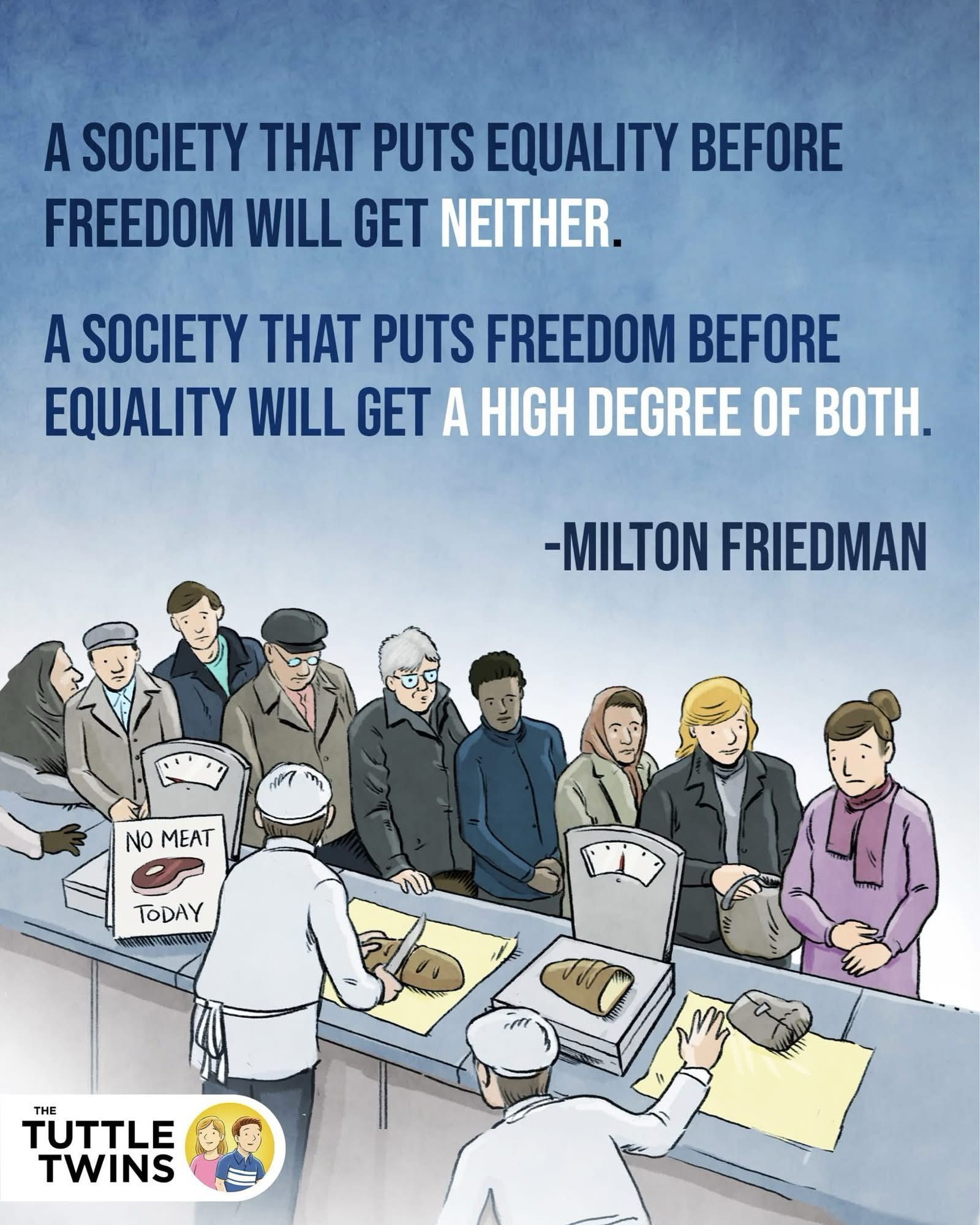
The Democratic Socialists of America have published a new program called Workers Deserve More. Its opening vision is deliberately inviting: imagine a day without capitalism in which you enjoy your work, control your own labour and work only as much as you are able and society needs. There is no debt, no mortgage, no landlord and very little reason to worry about money. Food, education, energy, medicine and transportation have become common goods rather than businesses.
It is easy to understand the appeal. Housing is increasingly unaffordable, medical costs can ruin American families, corporate power has become entangled with government, and too many people work long hours without achieving much security. Socialists do not invent these grievances. They gain followers by recognizing real failures and then presenting themselves as the only people willing to fix them.
The trouble begins when the DSA program moves from describing its destination to explaining how it intends to get there. Its goal is not a regulated market economy with universal healthcare and stronger social programs. The DSA wants to end capitalism, establish a classless society, draft a new constitution and create what it calls a “democratic socialist republic.” It concedes that some demands may be won through the existing system, but says complete victory requires “building a new society from the ground up.”
The DSA presents those immediate demands as transitional. That does not moderate the destination; it makes reform within the existing system an instrument for eventually replacing it. This is the revolutionary premise beneath the pleasant illustrations. Private ownership, profit, corporations, the presidency, the Supreme Court, the Senate, police, prisons and border enforcement are not treated as institutions that may require reform, but as obstacles standing between the working class and liberation.
The economic promises depend upon the same evasive logic. Declaring housing, food, electricity and medicine to be human rights does not produce houses, grow food, generate electricity or train doctors. All remain scarce goods requiring labour, investment, expertise and choices about competing uses. Prices do more than collect payment: they transmit dispersed information about supply, demand and trade-offs that no planning committee possesses in one place. If prices and private ownership no longer perform that coordinating work, political authorities must decide what will be produced, how much will be available and who receives it.
The DSA calls that authority democratic, as though the adjective settles the matter. Its program would place the largest corporations and essential industries under public ownership while making the executive and judiciary chosen by and subordinate to Congress. It would also abolish the Senate and Electoral College. Whatever one thinks of those individual institutions, their combined replacement would concentrate enormous political and economic power while weakening the independent bodies capable of restraining it.
That combination is more dangerous than any single spending proposal. A government that finances housing, controls major industries, directs energy and transportation, and oversees much of employment possesses forms of leverage that no private corporation can match. If the same political movement controls the legislature and the institutions intended to review its decisions, dissent may remain legal on paper while becoming increasingly expensive in practice.
This is where democratic socialism parts company with ordinary social democracy. Liberal societies can provide public healthcare, social insurance, labour protections and assistance to the poor while retaining markets, private property, constitutional restraints and competing centres of power. Those compromises can be debated and adjusted. The DSA rejects that settlement because it regards capitalism and the present constitutional order themselves as the problem.
The DSA is a big-tent organization, and not every member or endorsed candidate will be equally committed to every clause. But this is its national program, not a fringe caucus tract; DSA says candidates seeking national endorsement will be expected to accept and promote it. Its official ambitions are radical enough without James Lindsay’s more heated comparisons with Lenin and Mao.
The DSA promises a society in which ordinary people finally control their lives. Its path there, however, requires dismantling the economic and constitutional pluralism that prevents any one faction from controlling everyone else. The utopia appears gentle because the program dwells on the day after the revolution. We should pay considerably more attention to what must be broken on the way there.

References
- Democratic Socialists of America. “Workers Deserve More.” Official DSA program, 2026.
- Kaiser, Adam. “DSA Launches New Program.” Democratic Left, July 17, 2026.
- Hayek, F. A. “The Use of Knowledge in Society.” The American Economic Review, Vol. 35, No. 4, September 1945, pp. 519–530.
- Lindsay, James. “What Is the DSA Platform?.” The New Discourses Podcast, Episode 214, July 22, 2026.
The argument over whether the Nazis were socialists usually collapses into a contest between two slogans. One side points to the party’s name and declares the case closed. The other notes that Hitler hated Marxism, preserved private firms and murdered communists, and declares the word meaningless.
Neither account is adequate. National Socialism was not Marxism, and Nazi Germany did not reproduce the Soviet system of state ownership. But “socialist” was not merely a decorative word pasted onto an otherwise conventional market economy. Hitler repeatedly described his movement as socialist, defined what he meant by the term, and built an economy in which private ownership was increasingly subordinated to the purposes of the state.
The institutional comparison here is chiefly with Bolshevik and Soviet state socialism, the model examined by Mises and Temin, rather than with every democratic, market or libertarian socialist tradition. The evidence can establish what Hitler meant and how the Nazi economy operated. Whether that places National Socialism within the larger socialist family depends partly upon which feature is treated as decisive: social ownership and the abolition of private capital, or the routine coercive direction of production, investment, labour and prices as an organizing principle rather than a temporary emergency measure. Economic controls alone do not settle the classification, but neither can formal ownership settle it by itself.
The cleanest evidence comes from Hitler himself. In his unpublished 1928 Second Book, he joined the two parts of his creed: “I am a German nationalist … I am a socialist. I see no class and no social estate before me.” He then defined the relevant community as a people joined by blood, language and a common fate.
That sentence does not describe Marxist socialism. The collective is not the international working class but the racial nation—the Volk. Hitler’s intended community would supposedly transcend class while excluding those who did not belong by ancestry. His conception was racial where Marxism was class-based, national where Marxism was international, and hierarchical where Marxism promised eventual classlessness.
Whatever label one ultimately applies, the conception was explicitly collectivist. The individual did not stand prior to the community, and neither worker nor owner possessed rights that could be asserted against its political mission.
Hitler made the distinction even more plainly in an interview first published in 1923 and republished in edited form by Liberty magazine in 1932. In that later version, he insisted that “our socialism is national,” said that it “does not repudiate private property,” and concluded that “state and race are one.” Its mediated publication history gives this passage less weight than Hitler’s manuscript, but the definition is consistent with the one he recorded in 1928: property could remain, provided it served the racial state.
The party programme points in the same direction. The NSDAP’s 1920 platform demanded the “nationalization of all trusts,” “profit-sharing in large industries,” generous old-age pensions, land expropriation for public purposes and the communalization of large department stores. Its governing principle was stated without ambiguity: “COMMON GOOD BEFORE INDIVIDUAL GOOD.”
The programme also demanded racial citizenship, territorial expansion, censorship and a powerful central authority. Its economic and racial provisions were not separate projects. They belonged to a single conception of national community in which the state would decide who belonged, what the common good required and which private interests could be permitted to survive.
This document should not be treated as a precise blueprint for everything Hitler later did. The United States Holocaust Memorial Museum notes that the party remained officially committed to the programme but did not pursue all 25 points equally. The Nazis also privatized some enterprises that had fallen into state hands during the Depression, protected compliant industrialists and allowed private profits. These are genuine differences from Bolshevik socialism, not details to be waved away.
Yet privatization did not mean liberalization. As economist Germà Bel has documented, the sale of state holdings occurred alongside expanding regulation and political control. The title could be private even as the uses of the property were made answerable to the regime.
The treatment of labour also cuts against any simple identification with worker-centred socialism. In 1933 the Nazis destroyed the independent trade unions, confiscated their assets and replaced them with the German Labour Front, which joined employers and employees under party supervision. Collective bargaining disappeared, strikes were prohibited and state-appointed trustees helped determine wages and working conditions. Large firms continued to seek profits, while the regime acquired authority to compel firms into cartels and favoured businesses useful to rearmament. Class conflict was not resolved in favour of labour; it was suppressed in favour of the racial-national project.
This is the distinction Ludwig von Mises drew in Human Action. The Russian path formally nationalized farms, shops and factories. The German path preserved the appearance of owners, managers, wages and prices while transferring decisive authority over production to the state. In Mises’s deliberately severe formulation, “market exchange is merely a sham.”
Mises overstated the totality of that control. Economic historians Christoph Buchheim and Jonas Scherner have shown that private firms retained meaningful room to choose investments, negotiate contracts and sometimes decline government projects. His description fits the regime’s trajectory better than it describes every firm throughout the entire period.
The degree of command was not constant. State direction expanded between 1933 and 1936, intensified under the Four-Year Plan and became still more coercive during the war. Hitler’s confidential memorandum calling for the plan supplied its priority: “The German economy must be ready for war within four years.” Imports, raw materials, prices, wages, labour and investment were increasingly directed toward autarky and rearmament, leaving consumer preference subordinate to the political project.
Economic historian Peter Temin represents the more expansive interpretation of these similarities. After comparing fixed prices, coercive allocation, bureaucratic direction and the sacrifice of consumption to heavy industry and military preparation, he concluded that the National Socialists were “socialist in practice as well as in name.”
Other economic historians resist that classification because private ownership, profit and contractual discretion remained structurally important. On this reading, Nazi Germany is better described as authoritarian corporatism, a command economy under private ownership or a politically directed capitalist economy. The broader functional definitions used, in different ways, by Mises and Temin emphasize the state’s direction of production; their critics emphasize who owned firms, received profits and retained room to make economic decisions. The disagreement is not simply over the evidence, but over which evidence should control the classification.
The Soviet state generally owned the means of production; Nazi Germany normally commanded an economy whose firms remained privately owned and profit-seeking. Bolshevik socialism legitimized itself through class revolution. National Socialism mobilized society through race, nation and conquest. Their victims, internal structures and promised destinations were different.
Their common rejection was liberalism: the idea that individuals possess rights prior to the collective, that property places some decisions beyond routine political command, and that economic activity may pursue purposes not assigned by the state. Both systems subordinated those principles to an overriding communal project, although they defined the community differently and took different institutional paths toward controlling it. This commonality does not by itself make National Socialism socialist, but it explains why the comparison is more than wordplay.
Calling Nazism Marxist is historically illiterate. Pretending its use of socialism was nothing but a marketing trick is not much better. National Socialism was a racial-national collectivism that deliberately called itself socialist and subordinated private property to political purposes without entirely abolishing either private profit or entrepreneurial discretion. Under a definition centred on social ownership and the abolition of private capital, it does not qualify as socialism. Under the broader functional approach used by Mises and Temin, its coercive direction of economic life gives it significant socialist characteristics.
The label therefore remains contestable. Hitler nevertheless told us what his conception of socialism meant: not common ownership by the proletariat, but the subordination of class, property and individual interest to the racial nation. The shared danger identified here is totalitarian rather than the essence of every socialist tradition: once the state claims unlimited authority to define the collective good, formal ownership survives only for as long as obedience does.

Sources
- Adolf Hitler, Hitler’s Second Book: The Unpublished Sequel to Mein Kampf, chapter V.
- George Sylvester Viereck, 1923 interview with Adolf Hitler, republished in edited form by Liberty in 1932.
- Programme of the National Socialist German Workers’ Party, Avalon Project, Yale Law School.
- United States Holocaust Memorial Museum, “Nazi Party Platform”.
- German History in Documents and Images, “Appeal of the German Labor Front after the Dissolution of the Free Trade Unions”.
- Adolf Hitler, Confidential Memorandum on Autarky, August 1936.
- Ludwig von Mises, Human Action, “The Intervention”.
- Peter Temin, “Soviet and Nazi Economic Planning in the 1930s”, Economic History Review 44, no. 4 (1991).
- Christoph Buchheim and Jonas Scherner, “The Role of Private Property in the Nazi Economy: The Case of Industry”, Journal of Economic History 66, no. 2 (2006).
- Germà Bel, “Against the Mainstream: Nazi Privatization in 1930s Germany”, Economic History Review 63, no. 1 (2010).
- Philip C. Newman, “Key German Cartels under the Nazi Regime”, Quarterly Journal of Economics 62, no. 4 (1948).
“You typed it. Someone lived it.”
That is the ominous opening of an Edmonton Police Service campaign encouraging residents to report “online hate.” Perhaps this means threats, criminal harassment, incitement to violence or the wilful promotion of hatred—all matters in which the police may have a legitimate role.

Follow the link, however, and the mandate becomes considerably broader.
EPS defines a “hate-motivated incident” as a non-criminal action motivated by bias, prejudice or hate. Its examples include insults, offensive jokes, slurs and racial comments. Reports receive a police file number, are reviewed by Hate Crime investigators and may result in contact from an investigator.
In other words, Edmonton police are inviting citizens to report one another for speech that the police themselves acknowledge may be entirely lawful.
There is a reasonable argument for recording certain non-criminal incidents. A slur painted on someone’s fence may precede vandalism or violence. A pattern of escalating behaviour may help police assess a later threat. Victims may also need information about services even when no charge is possible.
But those limited purposes do not justify a public campaign that deliberately blurs the boundary between crime and offence.
Canadian law sets a demanding threshold for criminal hate speech. Public incitement must be likely to cause a breach of the peace, while wilful promotion requires more than an ugly opinion or an offensive joke. The Supreme Court has described the legal definition of hatred as an “onerous and objective standard.” That high threshold exists because freedom of expression means very little if it protects only speech that authorities consider kind, constructive or socially beneficial.
“Hate has no home here” may be a civic aspiration, but it is not a legal standard. Hurt is real, yet hurt alone does not confer police jurisdiction.
When police encourage reports of lawful expression, they place the weight of the state behind ordinary social and political disputes. The resulting file may never produce a charge, but the knowledge that a joke, argument or unpopular opinion can reach a Hate Crime investigator is itself capable of chilling speech.
EPS should vigorously investigate threats, harassment, vandalism and criminal hate propaganda. It should also tell citizens clearly when reported conduct is not a police matter.
A free society must leave room for speech that is stupid, cruel and offensive. Such speech can be answered, condemned or ignored. It should not automatically become an entry in a police database.
The police exist to enforce the law—not to supervise Edmonton’s emotional climate.
References
- Edmonton Police Service, “Report a Hate Motivated Incident Online”:
https://www.edmontonpolice.ca/ContactEPS/ReportAHateMotivatedIncidentOnline - Edmonton Police Service, “Hate and Bias Crime”:
https://www.edmontonpolice.ca/CommunityPolicing/OrganizedCrime/HateBiasCrime - Criminal Code, section 319:
https://laws-lois.justice.gc.ca/eng/acts/c-46/section-319.html - Supreme Court of Canada, Hansman v. Neufeld, 2023 SCC 14:
https://decisions.scc-csc.ca/scc-csc/scc-csc/en/item/19911/index.do
About 50,000 people crossed illegally from Morocco into the Spanish territory of Ceuta within two days. Most were young Moroccan men, although women, children and other nationalities were also present. At least 67 people died, while more than 48,000 returned after discovering that Ceuta did not provide an open route into mainland Europe.[1]
Whether one calls this an invasion, a migration crisis or a mass border breach, the underlying principle should not be controversial: a sovereign country must be able to decide who enters, in what numbers and under what conditions.
Immigration can be enormously beneficial. Canada’s traditional system was built around that recognition. It was not perfect, nor was every immigrant selected solely for economic potential, but it generally combined skilled immigration, family reunification and humanitarian obligations within controlled annual limits. Canada admitted approximately 260,000 permanent immigrants in 2014.[2]
By 2024, permanent admissions had risen to nearly 484,000. More consequentially, temporary residents had grown from 3.3 per cent of Canada’s population in 2018 to 7.5 per cent in 2024. Even the federal government eventually acknowledged that this unprecedented increase was placing pressure on housing, health care and schools.[3]
Most of these newcomers did not enter Canada illegally. That distinction matters. Canada’s failure was largely self-inflicted: governments expanded legal and temporary pathways without ensuring that housing, infrastructure and public services could absorb the resulting population growth. The Bank of Canada observed that vacancy rates began falling shortly after immigration increased in 2015 because housing construction failed to keep pace.[4]
That is not the fault of immigrants who accepted Canada’s invitation. It is the fault of governments that treated intake targets as statements of virtue rather than practical commitments requiring homes, doctors, classrooms and public consent.
A just immigration system must account for three parties: those hoping to immigrate, those who followed the rules and were admitted, and the citizens whose country is receiving them. Uncontrolled illegal entry cheats lawful applicants. Excessive legal intake strains communities and leaves newcomers competing for scarce housing and services. Refusing to discuss either problem eventually destroys public confidence in immigration itself.
Strong borders are therefore not contrary to compassion. Clear rules, enforceable limits and admissions kept within a country’s plausible capacity are what allow immigration to remain fair, beneficial and politically sustainable. Capacity can never be calculated perfectly, but uncertainty is not an excuse to ignore obvious strain.
A country that cannot—or will not—decide who may enter is not practising generosity. It is surrendering the conditions that make generosity possible.

References
- Reuters, “Spain installs floating barrier in Ceuta after calm night following border rush,” August 1, 2026.
https://www.reuters.com/world/europe/spain-installs-floating-barrier-ceuta-after-calm-night-following-border-rush-2026-08-01/ - Statistics Canada, “Permanent and temporary immigration to Canada from 2012 to 2014.”
https://www150.statcan.gc.ca/n1/pub/91-209-x/2016001/article/14615-eng.htm - Immigration, Refugees and Citizenship Canada, “2025 Annual Report to Parliament on Immigration.”
https://www.canada.ca/en/immigration-refugees-citizenship/corporate/publications-manuals/annual-report-parliament-immigration-2025.html - Bank of Canada, “Immigration, housing and the outlook for inflation,” December 7, 2023.
https://www.bankofcanada.ca/2023/12/economic-progress-report-immigration-housing-outlook-inflation/
One of the stranger features of the debate over gender identity is that women are still expected to apologize for noticing when policies affect them.
When male bodies enter female prisons, shelters, changing rooms or athletic categories, sex matters. When children are placed on a medical pathway with lifelong consequences, sex matters. When crime statistics, scholarships or political representation are organized by sex, definitions matter. Refusing to pretend otherwise is not hatred; it is the beginning of an honest discussion.
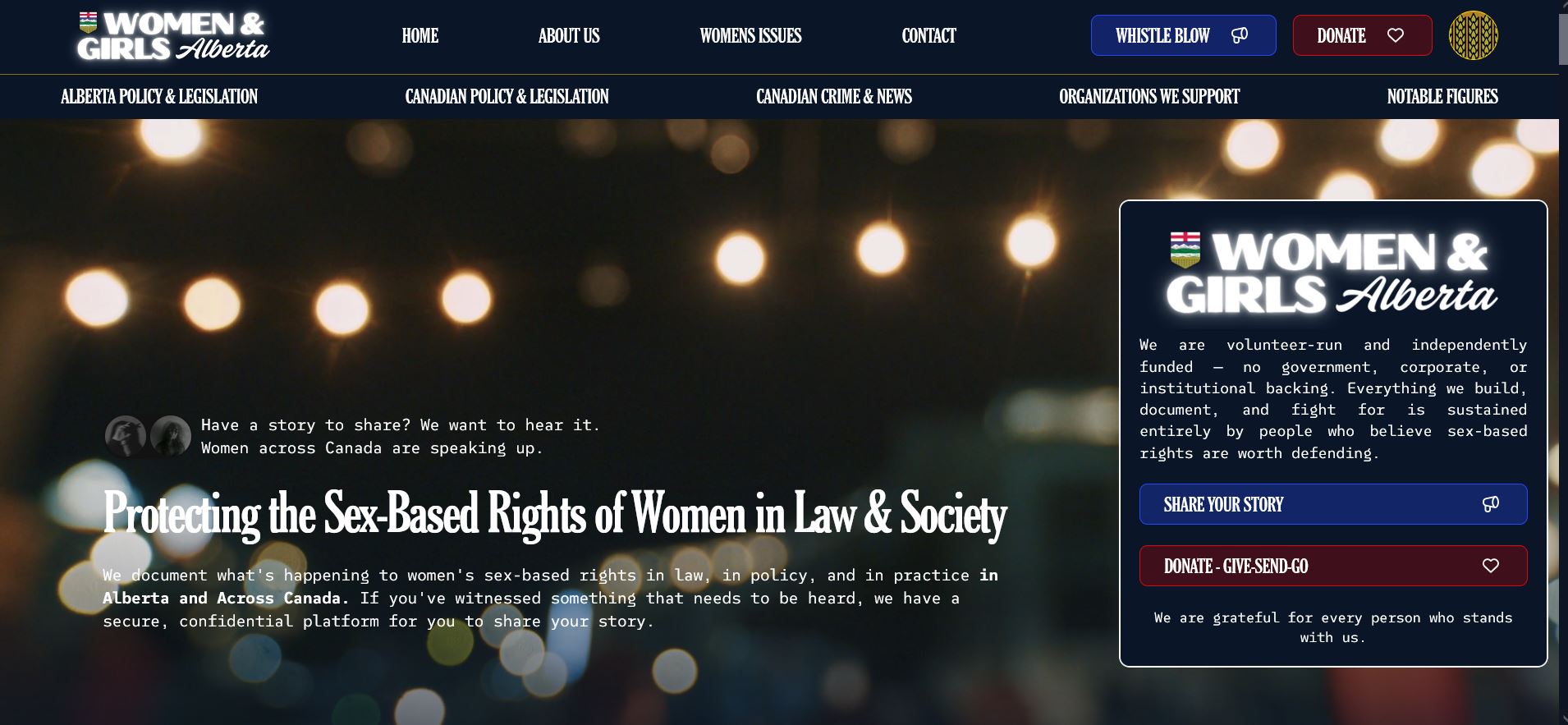
Women & Girls Alberta is an Alberta-based, women-led organization working to restore sex-based rights and protections in law, public policy and everyday life. Its platform reflects something I have argued repeatedly on this site: individual dignity does not require society to abandon material reality.
The organization focuses on the practical conflicts created when self-declared gender identity is allowed to override sex. These include women’s sports, prison safety, rape-crisis services, bodily privacy, lesbian boundaries, women’s scholarships, accurate crime statistics and single-sex spaces. Its issues section brings these concerns together rather than treating each controversy as an isolated incident.
 That matters because institutional change often occurs quietly. A definition changes inside a policy manual. A reporting category becomes unreliable. A woman raises a privacy or safeguarding concern and discovers that the institution has already decided which questions may be asked. By the time the public notices, the new rule is presented as settled practice rather than a political choice that should have been debated.
Women & Girls Alberta is doing more than issuing statements. The organization collects legislation, policy developments, documented cases and Canadian news concerning the erosion of sex-based protections. Its stated mandate includes providing sex-based policy analysis, supporting legislative clarity and creating opportunities for public discussion. Readers can examine its sources and arguments for themselves rather than being asked to accept a slogan.
Especially valuable is its confidential reporting platform, through which women can document experiences involving prisons, hospitals, shelters, schools, workplaces, sports and government programs. The organization says submissions can be made without an account or a name through a system built on the open-source GlobaLeaks platform, and it provides additional precautions for people concerned about professional retaliation or identification.
The point is not to declare every allegation true merely because it has been submitted. The point is to gather accounts, documents and recurring patterns that institutions may otherwise ignore. Evidence cannot be examined until people are permitted to report it.
The strongest argument from the other side should be acknowledged: transgender people are entitled to safety, civil treatment and protection from genuine discrimination. Nothing about defending women’s sex-based rights requires cruelty toward anyone. But compassion cannot mean that every competing interest disappears. Nor can one group’s desire for recognition automatically override another group’s privacy, safety, freedom of association or right to fair competition.
A pluralistic society must be capable of protecting individuals without demanding that women surrender the language needed to describe their bodies, their boundaries and their rights.
That is why I support the work of Women & Girls Alberta. It is giving women a place to speak, documenting policies that deserve public scrutiny and insisting that biological sex remains a legitimate and sometimes indispensable legal category.
Visit the Women & Girls Alberta website, read its platform, examine the evidence and share its work. Those who agree with its mission can also subscribe, contribute or help ensure that women who have something important to report know where they can be heard.
Women should not need permission to defend rights that exist because they are women.











 bleatmop
 Mystro


 Dead Wild Roses
Your opinions…