
You are currently browsing the tag archive for the ‘Moral Philosophy’ tag.
The phrase “Judeo-Christian values” is often used loosely, so it is worth defining what it means in its strongest form.
Judaism and Christianity are not identical. They differ profoundly on theology, covenant, salvation, scripture, and the person of Jesus. The term “Judeo-Christian” can also flatten real historical tensions, including centuries of Christian anti-Judaism.
Nor did the West emerge from religion alone. Western civilization is a synthesis: Hebrew religion, Christian theology, Greek philosophy, Roman law, English common law, Germanic custom, Enlightenment liberalism, and centuries of political struggle all helped shape it.
Still, the Judeo-Christian inheritance gave the West several core moral claims that remain foundational. They are not the whole story, but they are a decisive part of the story.
1. Human beings possess inherent dignity
Human worth is not granted by the state, the tribe, the ruler, the market, the collective, or the majority.
In the biblical tradition, man is made in the image of God. That idea helped ground the belief that each person has moral worth beyond usefulness, status, race, sex, class, strength, or productivity.
This does not mean the West always honoured that claim. It often failed it catastrophically. But the claim itself became one of the standards by which those failures could be judged.
2. Moral law stands above human law
Kings, courts, governments, and majorities are not the highest moral authority.
A law can be legal and still be wicked. A ruler can hold power and still be morally wrong. The prophets rebuked kings. Christian natural law later joined biblical morality to Greek and Roman philosophy. Out of that synthesis came a powerful Western intuition: political power is answerable to a higher standard of justice.
This is one root of the rule of law, constitutional government, and the right to resist tyranny.
3. Each person is morally responsible
Human beings are not merely products of tribe, class, history, oppression, biology, or circumstance.
People can choose. People can do right or wrong. Guilt and innocence matter. Conscience matters. Repentance, judgment, forgiveness, and accountability all depend on the belief that human beings are moral agents.
Greek philosophy also emphasized moral formation and self-examination, but the Judeo-Christian tradition gave personal responsibility a particularly intense moral and spiritual weight.
4. Justice must be joined to mercy
Wrongdoing matters. Evil should not be excused, ignored, or sentimentalized.
But justice must not become mere vengeance. The Judeo-Christian tradition also emphasizes mercy, repentance, forgiveness, charity, care for the poor, protection of the vulnerable, and restraint against cruelty.
This helped form some of the West’s most important charitable and reforming institutions: hospitals, schools, poor relief, abolitionist movements, prison reform, and the idea that the weak are not disposable.
5. Power must be morally limited
Human beings are fallen, proud, corruptible, and tempted by domination.
Therefore rulers are not gods. The state is not sacred. The majority is not automatically righteous. Authority must be restrained by law, conscience, duty, and moral limits.
This idea did not come from religion alone. Greek political thought, Roman republicanism, common law, and Enlightenment constitutionalism all mattered. But the Judeo-Christian suspicion of human pride and idolatrous power gave the West a deep moral reason to distrust unchecked authority.
The short version
So when people speak seriously about Judeo-Christian values, the strongest list is this:
- Human dignity
- Moral law above human law
- Personal moral responsibility
- Justice tempered by mercy
- Power limited by law and conscience
These values are not uniquely owned by Judaism or Christianity. They have parallels elsewhere, and they can be defended in secular language.
But in the West, they were deeply shaped, transmitted, institutionalized, and morally charged by the Judeo-Christian inheritance.
That is the strongest version of the claim. Not that the West was purely Judeo-Christian. Not that every Western failure can be excused by appealing to religion. Not that secular reason contributed nothing.
The better claim is this: the West became what it became through a moral synthesis, and the Judeo-Christian tradition supplied several of its most important claims about dignity, conscience, justice, mercy, and the limits of power.

Something feels off. You can hear it in the way certain arguments move too quickly, collapsing a complex moral landscape into a stark choice. On one side, morality is said to be subjective—nothing more than preference, culture, or perspective. On the other, we are told that without objective grounding, morality collapses into power. The argument is clean, decisive, and rhetorically effective. It is also incomplete.
The appeal of this framing lies in its speed. If morality is subjective, then moral claims reduce to preference. If they reduce to preference, there is no truth to adjudicate between them. And if there is no truth, disagreement can only be resolved through assertion and enforcement. The conclusion follows with a kind of mechanical certainty: without objective morality, ethics becomes power. It is a compelling chain, particularly in live discussion, where the pressure to respond quickly prevents careful unpacking. But the speed of the move is part of its strength—and its limitation. It skips over something most people already rely on in practice, even if they do not articulate it.
In everyday life, we do not treat all moral claims as interchangeable. Some feel as though they hold even in the face of disagreement; others do not. What distinguishes them is rarely stated explicitly, but it shows up in how people respond to rules and expectations. A simple test often operates in the background: does the rule apply both ways? Does it still make sense when the roles are reversed? Does it remain defensible when you are no longer the one benefiting from it?
You can see this play out in familiar disputes. A rule that restricts speech when it targets your side may feel justified; the same rule, applied in reverse, often feels like suppression. A policy that advantages your group can look like fairness in one direction and bias in the other. The reaction people have in those moments—that sense that something has shifted or isn’t being applied evenly—is not random. It’s the symmetry test quietly asserting itself.
“The question isn’t whether a rule benefits you—it’s whether it still makes sense if it doesn’t.”
When the answers line up, the rule tends to feel legitimate. When they don’t, something begins to grate. This is not a formal proof of moral truth. It is, however, a constraint on what people are willing to accept.
One way to bring that constraint into focus is through the thought experiment proposed by John Rawls. Imagine choosing the rules of a society without knowing who you will be within it—your position, your advantages, your vulnerabilities. From that standpoint, you cannot design the system to suit your own interests. You are forced to consider whether the rules would still be acceptable if you ended up on the losing side of them. Rawls does not claim to discover moral truth through this device. What he does is remove the most obvious avenue for bias and ask what remains once that advantage is gone.
What remains is not a set of metaphysical truths written into the structure of the universe. It is something more modest and, in practice, more useful: a constraint on justification. Some rules cannot be defended once you no longer know where you will stand. They rely too heavily on asymmetry, on the assumption that the person invoking them will not have to bear their cost. When that assumption is removed, the rule loses its force. This does not make morality objective in the way physical laws are objective, but it does show that not all moral systems are equally defensible.
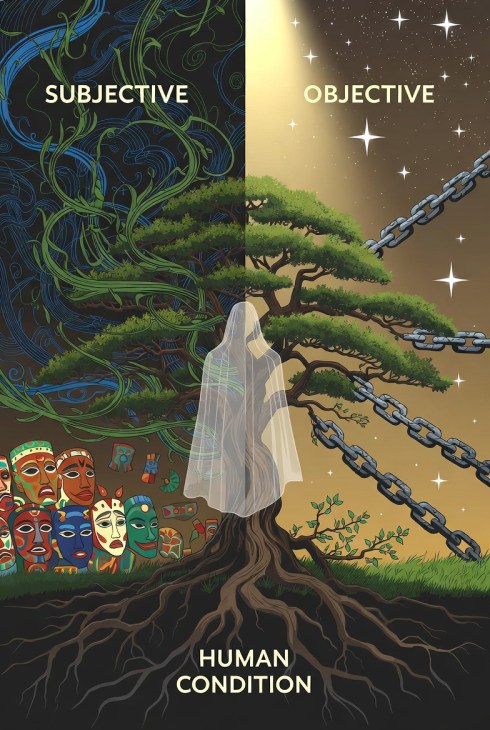
This is the space the binary argument overlooks. Morality does not have to be either fully objective in a metaphysical sense or entirely subjective and arbitrary. Most functioning moral systems occupy a middle ground. They are constructed and maintained through norms, institutions, and shared expectations, but they are also bounded by the conditions under which human beings live. We are vulnerable, dependent, and engaged in repeated interaction. Rules that exploit these conditions too aggressively tend to collapse under their own weight. Rules that can survive role reversal and long-term interaction tend to persist. They are not inevitable, but neither are they arbitrary.
The force of the “collapse into power” argument comes from its focus on weak forms of subjectivism. If morality is reduced to mere preference, then the conclusion follows quickly. But this is not how most moral reasoning operates in practice. Even absent a claim to objective truth, people appeal to considerations that go beyond preference: reciprocity, fairness, stability, and the costs of defection. These are not metaphysical foundations, but they are not empty either. They generate real limits on behavior and real expectations about what can be justified.
The question, then, is not simply whether morality is objective. That framing compresses too much into a single term. A more useful question is what constrains moral reasoning so that it does not collapse into preference or power. Rawls offers one answer in the form of symmetry under uncertainty. Ordinary social life offers another in the form of rules that must hold under repetition and reversal. Both point to the same underlying fact: moral systems are not free to take any shape whatsoever. They are limited by the requirements of justification and the conditions of human interaction.
This brings us back to the original feeling that something is off. That reaction often arises when a rule is applied inconsistently, when a principle shifts depending on who benefits, or when an argument demands compliance without offering a justification that would hold if positions were reversed. You do not need a fully developed moral philosophy to recognize that pattern. You only need to notice when the symmetry breaks.
Scientific objectivity does not require perfect scientists; it requires that their models survive contact with reality. Moral objectivity, if the term is to mean anything useful, does not require metaphysical certainty. It requires that the rules we live by survive contact with each other—across differences in position, power, and perspective. That is a narrower claim than the one often made in debate, but it is also a more defensible one.
Morality does not need to be written into the fabric of the universe to resist collapse. It needs something simpler: rules that can be justified without knowing who will bear their consequences, and that continue to function when they are applied to anyone over time. Once that is clear, the stark choice between objective truth and raw power begins to lose its grip. The problem is not that morality lacks a foundation, but that we often look for it in the wrong place.
Where This Goes Next
The question raised in the previous discussion—whether anything can meaningfully constrain our claims without collapsing into preference or power—does not end with morality.
It appears again, more sharply, in how we think about science itself.
If there is no constraint beyond social agreement, then scientific claims begin to look like moral ones at their weakest: negotiated, enforced, and revised under pressure. If there is a constraint, then we need to be precise about what it is and how it operates, because that distinction determines whether we are tracking reality or simply tracking consensus.
The essays that follow take up that question directly. They move from the same starting point—something feels off—to a clearer account of what, if anything, resists that collapse.
There is a reason the recent interview on TRIGGERnometry featuring Andrew Wilson has drawn attention. Wilson does not simply argue positions; he shifts the ground beneath them. In a discussion about subjective morality and objective truth, that ability is decisive. Much of his effectiveness comes not from the novelty of his claims, but from the speed and clarity with which he forces his interlocutors to confront the implications of their own assumptions.
At the center of his argument is a compressed but powerful move. If morality is subjective, then moral claims reduce to preference. If they reduce to preference, then disagreement cannot be resolved through appeal to truth, but only through assertion and enforcement. From there, the conclusion follows: without objective morality, ethics collapses into power. It is a clean chain of reasoning, rhetorically efficient and difficult to interrupt in real time, especially when opponents have not fully examined the foundations of their own views.
Part of what makes this approach so effective is that it presses on a genuine weakness in much contemporary moral discourse. Secular arguments about morality often appeal to harm, fairness, or consensus. These are intuitively compelling and widely shared, but they are not self-grounding in a strict sense. They rely on assumptions that are rarely defended at a deeper level. When Wilson asks why these principles should bind anyone who does not already accept them, the hesitation that follows is real. Moral language tends to present itself as if it refers to something objective, even when speakers explicitly deny that such objectivity exists. That tension creates an opening, and Wilson exploits it with precision.
There is, in other words, a strong version of his argument. If moral claims are entirely subjective, then their authority becomes difficult to justify beyond the boundaries of a given framework. The question “why should anyone outside your system care?” is not rhetorical; it is a genuine challenge. It exposes the gap between the way people speak about morality and the way they often ground it, if they ground it at all. On this point, Wilson is not merely performing. He is identifying a real philosophical pressure.
The difficulty lies in what follows. Wilson moves from the observation that subjective morality has grounding problems to the conclusion that it therefore collapses into power. That step is doing more work than it appears. It bypasses a large middle space in which most moral systems actually operate. Societies do not typically function by reducing all moral claims to arbitrary preference, nor do they rely on universally agreed metaphysical truths. They operate through a combination of norms, institutions, reciprocal expectations, and forms of reasoning that are neither purely objective nor wholly arbitrary. These structures impose real constraints on behavior. They shape incentives, establish boundaries, and generate predictability over time.
A simple example makes the point. Most people keep small promises—returning a borrowed item, showing up when they say they will—not because of objective moral truth, but because repeated interaction makes reliability valuable and defection costly. Over time, those expectations harden into norms that feel binding, even if their origin is entirely practical.
Underlying Wilson’s move is an assumption that if a claim is not objectively grounded, it has no binding force. That assumption is not obviously correct. Much of what governs human behavior lacks objective grounding in a strict philosophical sense. Laws, contracts, and social norms are not objective truths in the way physical laws are, yet they bind behavior effectively. Their force arises from shared expectations, enforcement mechanisms, and the long-term costs of violation. The relevant question, then, is not simply whether morality is objective, but what kinds of systems are capable of generating stable and predictable constraints on human conduct.
“Wilson doesn’t defeat morality without objectivity—he defeats weaker versions of it faster than they can defend themselves.”
Wilson’s own solution—grounding morality in God—does attempt to solve this problem by anchoring obligation outside human preference. Whether that succeeds is a separate question. It secures authority for those who accept it, but does not obviously resolve disagreement among those who do not.
This is where the conversation in the interview begins to fragment. Wilson is arguing at the level of justification: what ultimately grounds moral claims and gives them authority. The hosts, by contrast, are operating at the level of function: how moral systems work in practice and how societies maintain order and cooperation. These are related but distinct questions. One concerns philosophical legitimacy; the other concerns social viability. When they are treated as interchangeable, the discussion collapses into confusion. Wilson’s advantage is that he keeps the focus tightly on justification, where his binary framing is strongest. The hosts attempt to shift toward function, but without fully articulating how functional systems can resist the collapse he describes, their responses remain incomplete.
A more effective reply would have acknowledged the grounding problem while resisting the forced conclusion. Even if morality is not objectively grounded, it does not follow that it is arbitrary or that it reduces to raw power. Systems of cooperation and constraint can emerge from the conditions of human life itself: shared vulnerability, repeated interaction, and the high cost of disorder. These factors generate incentives for stable norms and predictable behavior. They do not eliminate conflict or disagreement, but they provide a framework within which those disagreements can be managed without constant recourse to coercion.
This does not eliminate the binding problem entirely. Functional systems explain why cooperation emerges and persists, but they do not fully answer why an individual should comply when defection is advantageous and enforcement is weak. That tension remains, even in the most stable societies.
Wilson’s rhetorical strength lies in the fact that he does not need to defeat this more complex position. He only needs to expose the instability of a weaker one. Once his opponents concede that morality is subjective without offering a robust account of how subjective systems generate binding norms, he can recast their position as preference backed by social pressure and, ultimately, by force. That recasting is not entirely wrong, but it is incomplete. It compresses a complicated reality into a stark alternative, and in doing so it gains persuasive force at the cost of nuance.
The result is an argument that is both powerful and limited. It succeeds as a critique of poorly grounded moral subjectivism, but it overreaches when it claims that subjectivity necessarily entails collapse into power. In practice, moral systems occupy a space between objective truth and arbitrary preference. They are constructed, negotiated, and enforced, but they are also constrained by human conditions that make certain arrangements more stable than others.
Wilson is, in this sense, asking a legitimate question. The problem is that he answers it too quickly. By collapsing the range of possible moral systems into a binary, he forces clarity but sacrifices accuracy. That trade-off is what makes him such an effective debater. It is also what limits the depth of the conclusions he draws.
I’m not a religious individual. This series has made that clear enough over time, and I’m not about to reverse course now. But looking out at the current cultural moment, something else is becoming difficult to ignore: within many of our influential cultural and institutional spaces, people are not stepping away from religion into something stronger or more coherent; they are drifting into something thinner, more unstable, and ultimately more corrosive.
Call it cultural relativism, call it critical theory, call it the downstream effects of postmodern deconstruction—it doesn’t much matter which label you prefer. What matters is the shared move underneath it. The older structures that once oriented people toward truth, obligation, and restraint are no longer treated as imperfect guides to be improved upon; they are treated primarily as systems of power to be exposed, delegitimized, and, where possible, dismantled.
That shift does not leave a neutral vacuum.
A society cannot sustain itself on permanent critique, because critique alone does not tell you what to build in its place, nor does it supply the habits of restraint needed to keep that construction from collapsing.”
On a more personal level, it is increasingly common to encounter people who describe their lives almost entirely through the lens of structural disadvantage, even when their circumstances are relatively stable. The framework offers an explanation for frustration, but it also narrows the space for agency, because improvement begins to look less like progress and more like complicity in the very systems being critiqued.
People require some kind of orienting framework, not necessarily a perfect one, but one stable enough to tell them what is worth building, what must be limited, and what ought to endure beyond their immediate preferences. When every structure is interpreted first as an instrument of domination, that framework does not evolve into something better calibrated—it fragments. What follows is not so much liberation as drift, where moral language remains in use but loses its anchor, and where personal identity begins to carry more explanatory weight than shared standards ever could.
Some of this thinking has value in narrow contexts. As a tool for examining institutions, it can reveal blind spots, excesses, and genuine injustices that deserve correction. But once it escapes those boundaries and becomes a general worldview, it scales badly. A society cannot sustain itself on permanent critique, because critique alone does not tell you what to build in its place, nor does it supply the habits of restraint necessary to keep that construction from collapsing under pressure.
The psychological effects are not incidental here. If a person is taught, explicitly or implicitly, that every system they inhabit is stacked against them, and that their standing within that system is best understood through grievance rather than agency, the result is not empowerment in any meaningful sense. It is demoralization dressed up as insight. Over time, that posture makes collective life harder to maintain, not easier, because it erodes the basic trust required for cooperation.
This is where the comparison with religion, uncomfortable as it may be, begins to sharpen.
Religious frameworks, even when metaphysically suspect or internally inconsistent, tend to provide a coherent structure of meaning, obligation, and limitation. They impose costs. They constrain behaviour. They bind individuals into something that extends beyond the self, whether that is a community, a tradition, or a conception of the good that cannot be endlessly revised to suit immediate preference. Those features can be abused, and often have been, but they are not accidental—they are part of what makes such systems socially durable.
It is worth noting that some of the most stable and prosperous societies today are also among the least religious. That observation deserves to be taken seriously. But those societies are not culturally unmoored; they are, in many cases, the beneficiaries of long-standing moral traditions that continue to shape behaviour even as explicit belief declines. The question is not whether a society can function after religion recedes, but how long it can continue to draw on inherited norms once the structures that sustained them are no longer reinforced.
If the practical choice is between a society that retains some shared, if imperfect, moral architecture and one that dissolves that architecture in favour of perpetual deconstruction, I am no longer convinced that the latter is the safer or more enlightened path. That is not because religion is true in any ultimate sense, but because it appears to do something that our current alternatives struggle to replicate at scale. Secular frameworks capable of supplying meaning and restraint do exist. What remains unclear is whether they can achieve the same level of cultural penetration and durability without borrowing from the traditions they seek to replace.
This is not an argument for theocracy. A classically liberal state remains the best framework we have for preserving freedom, dissent, and pluralism across deep differences. But liberalism has never been self-sustaining in the way its defenders sometimes imagine. It has historically relied on inherited norms—habits of restraint, notions of duty, a willingness to subordinate impulse to something more enduring—that it did not generate on its own.
When those supporting structures are steadily stripped away, the system does not immediately collapse, but it does begin to thin out. The language of rights remains, but the culture that made those rights workable starts to erode. At that point, something else will fill the gap, and it is not guaranteed to be gentler, freer, or more rational than what came before.
None of this erases the historical abuses tied to religion. It simply raises the possibility that removing it creates vulnerabilities we have not yet learned to manage.
Religion, for all its flaws, once carried a significant portion of that load.
Remove it, or hollow it out beyond recognition, and the question is no longer whether people will believe in something. It is what they will reach for instead—and whether that replacement will prove more stable than the thing it displaced.












 bleatmop
 Mystro


 Dead Wild Roses
Your opinions…