
You are currently browsing the tag archive for the ‘Cultural Critique’ tag.
I’m not a religious individual. This series has made that clear enough over time, and I’m not about to reverse course now. But looking out at the current cultural moment, something else is becoming difficult to ignore: within many of our influential cultural and institutional spaces, people are not stepping away from religion into something stronger or more coherent; they are drifting into something thinner, more unstable, and ultimately more corrosive.
Call it cultural relativism, call it critical theory, call it the downstream effects of postmodern deconstruction—it doesn’t much matter which label you prefer. What matters is the shared move underneath it. The older structures that once oriented people toward truth, obligation, and restraint are no longer treated as imperfect guides to be improved upon; they are treated primarily as systems of power to be exposed, delegitimized, and, where possible, dismantled.
That shift does not leave a neutral vacuum.
A society cannot sustain itself on permanent critique, because critique alone does not tell you what to build in its place, nor does it supply the habits of restraint needed to keep that construction from collapsing.”
On a more personal level, it is increasingly common to encounter people who describe their lives almost entirely through the lens of structural disadvantage, even when their circumstances are relatively stable. The framework offers an explanation for frustration, but it also narrows the space for agency, because improvement begins to look less like progress and more like complicity in the very systems being critiqued.
People require some kind of orienting framework, not necessarily a perfect one, but one stable enough to tell them what is worth building, what must be limited, and what ought to endure beyond their immediate preferences. When every structure is interpreted first as an instrument of domination, that framework does not evolve into something better calibrated—it fragments. What follows is not so much liberation as drift, where moral language remains in use but loses its anchor, and where personal identity begins to carry more explanatory weight than shared standards ever could.
Some of this thinking has value in narrow contexts. As a tool for examining institutions, it can reveal blind spots, excesses, and genuine injustices that deserve correction. But once it escapes those boundaries and becomes a general worldview, it scales badly. A society cannot sustain itself on permanent critique, because critique alone does not tell you what to build in its place, nor does it supply the habits of restraint necessary to keep that construction from collapsing under pressure.
The psychological effects are not incidental here. If a person is taught, explicitly or implicitly, that every system they inhabit is stacked against them, and that their standing within that system is best understood through grievance rather than agency, the result is not empowerment in any meaningful sense. It is demoralization dressed up as insight. Over time, that posture makes collective life harder to maintain, not easier, because it erodes the basic trust required for cooperation.
This is where the comparison with religion, uncomfortable as it may be, begins to sharpen.
Religious frameworks, even when metaphysically suspect or internally inconsistent, tend to provide a coherent structure of meaning, obligation, and limitation. They impose costs. They constrain behaviour. They bind individuals into something that extends beyond the self, whether that is a community, a tradition, or a conception of the good that cannot be endlessly revised to suit immediate preference. Those features can be abused, and often have been, but they are not accidental—they are part of what makes such systems socially durable.
It is worth noting that some of the most stable and prosperous societies today are also among the least religious. That observation deserves to be taken seriously. But those societies are not culturally unmoored; they are, in many cases, the beneficiaries of long-standing moral traditions that continue to shape behaviour even as explicit belief declines. The question is not whether a society can function after religion recedes, but how long it can continue to draw on inherited norms once the structures that sustained them are no longer reinforced.
If the practical choice is between a society that retains some shared, if imperfect, moral architecture and one that dissolves that architecture in favour of perpetual deconstruction, I am no longer convinced that the latter is the safer or more enlightened path. That is not because religion is true in any ultimate sense, but because it appears to do something that our current alternatives struggle to replicate at scale. Secular frameworks capable of supplying meaning and restraint do exist. What remains unclear is whether they can achieve the same level of cultural penetration and durability without borrowing from the traditions they seek to replace.
This is not an argument for theocracy. A classically liberal state remains the best framework we have for preserving freedom, dissent, and pluralism across deep differences. But liberalism has never been self-sustaining in the way its defenders sometimes imagine. It has historically relied on inherited norms—habits of restraint, notions of duty, a willingness to subordinate impulse to something more enduring—that it did not generate on its own.
When those supporting structures are steadily stripped away, the system does not immediately collapse, but it does begin to thin out. The language of rights remains, but the culture that made those rights workable starts to erode. At that point, something else will fill the gap, and it is not guaranteed to be gentler, freer, or more rational than what came before.
None of this erases the historical abuses tied to religion. It simply raises the possibility that removing it creates vulnerabilities we have not yet learned to manage.
Religion, for all its flaws, once carried a significant portion of that load.
Remove it, or hollow it out beyond recognition, and the question is no longer whether people will believe in something. It is what they will reach for instead—and whether that replacement will prove more stable than the thing it displaced.

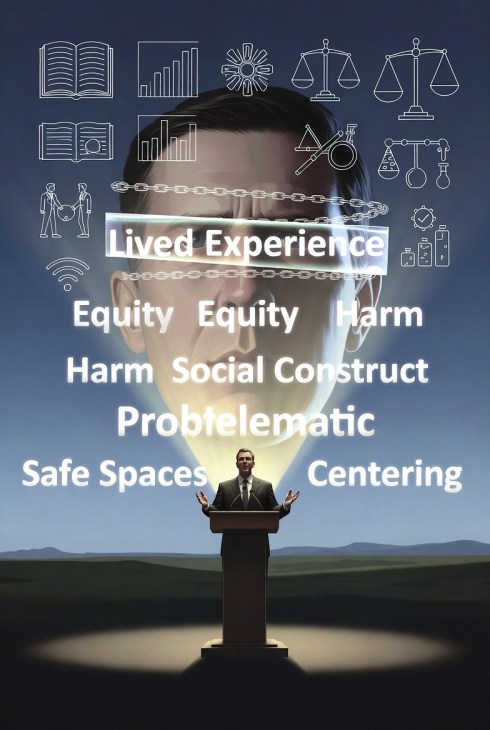
You can usually tell what kind of argument you’re about to hear before the argument is made.
It’s in the language.
Certain words don’t just describe reality—they quietly reframe it, often in ways that make disagreement harder before it even begins. They shift the ground you’re standing on, sometimes without you noticing.
Once you recognize them, the pattern becomes difficult to miss.
“By the time the argument begins, much of it has already been decided.”
Here are a few to listen for.
“Lived experience”
Often used to elevate subjective accounts above other forms of evidence.
Experience matters. But when it becomes the final authority, it can no longer be questioned or compared. At that point, it stops being evidence and becomes a conclusion.
“Social construct”
A useful concept in limited contexts. Overextended, it suggests that because something is shaped by society, it is therefore arbitrary or infinitely malleable.
The move is subtle: from influenced by culture to not anchored in reality at all.
“Harm”
A word that has expanded far beyond physical or material damage.
Disagreement, discomfort, or perceived invalidation can all be folded into it. Once that happens, ordinary debate starts to look like misconduct.
“Equity”
Not the same as equality.
It shifts the focus from equal rules to equal outcomes. That shift often justifies unequal treatment in the name of correcting disparities.
“Centering” / “Decentering”
Signals who is allowed to speak, and whose perspective is treated as primary.
Less about argument, more about managing whose voice carries authority.
“Problematic”
A soft accusation that avoids specificity.
It implies wrongdoing without clearly stating what the problem is, which makes it difficult to respond directly.
“Safe spaces”
Originally about protection from harassment. Now often used to limit exposure to challenging or opposing ideas.
The definition quietly expands from safety from harm to safety from disagreement.
None of these words are inherently illegitimate. The issue is how they are used. Individually, they can be useful. In combination, they tend to narrow the space for disagreement.
When they appear together, they often shift discussion away from evidence, elevate subjective claims beyond challenge, and quietly limit what can be said without consequence. By the time the argument begins, much of it has already been decided.
When you hear language like this, a simple question is usually enough: what claim is being made—and could I reasonably disagree with it? If the answer is no, you are no longer in a normal debate. You are being asked to accept a framework, not evaluate an argument.
This pattern isn’t unique to any one ideology. It appears wherever language is used to secure agreement before the argument begins. Language doesn’t just communicate ideas—it sets the terms under which those ideas can be questioned, and sometimes whether they can be questioned at all.
Much of the current conflict around gender identity is framed as a debate about compassion, recognition, and inclusion. At a more basic level, it is also a conflict about language—specifically, whether individuals can be expected to adopt terms that do not align with their understanding of reality.
Pronouns seem like a small thing. In practice, they are not.
They are not simply polite conventions. They function as statements about a person. To use a pronoun is to make a claim, and when that claim is contested, the disagreement is not about tone but about what is being asserted.
For a time, the direction of that disagreement appeared settled. In many settings, declining to use requested pronouns was treated not as a difference of view, but as a form of harm. Social and professional consequences followed—sometimes quickly, sometimes quietly, but with enough consistency to shape behaviour.
That shift matters because it changes the role language plays. It moves from something negotiated between individuals to something that, in certain contexts, is expected and enforced.
There is a difference between courtesy and agreement.
Courtesy is voluntary. It allows for discretion, context, and mutual recognition. Agreement operates differently. It narrows the range of acceptable responses and attaches consequences to deviation. The two can overlap, but they are not the same thing, and treating them as interchangeable obscures the boundary where disagreement becomes difficult to express.
The argument for using preferred pronouns is often framed as a matter of basic dignity—a small concession that reduces friction in everyday life. At that level, it has real force. Most people are willing to extend minor courtesies to make social interactions smoother, especially when the cost appears low.
The difficulty is that this framing does not remain stable.
“Once language is tied to required affirmation, refusal is no longer treated as disagreement, but as harm.”
What begins as a request for courtesy has, in many contexts, become an expectation of agreement. The distinction matters. Courtesy allows for discretion; agreement does not. Once language is tied to a required affirmation, refusal is no longer interpreted as indifference or disagreement, but as harm.
That shift changes the nature of the interaction. It moves from a voluntary accommodation between individuals to a norm that carries social or professional consequences. At that point, the question is no longer whether one is willing to be polite. It is whether one can be required to make a claim one does not believe to be true.
This is why pronouns became a point of pressure.
They are easy to enforce, highly visible, and symbolically loaded. Agreeing to their use is often treated as a minimal concession. Refusing them is treated as a line crossed. That asymmetry is not accidental. It makes pronouns an effective entry point for broader expectations about how language should function.
There is also a boundary question that is harder to avoid than it first appears.
Individuals are free to describe themselves as they choose. That freedom, however, does not automatically extend to requiring others to adopt the same description. At some point, a shared language is still needed, and that language cannot function if its basic terms are entirely detached from common reference points.
For many people, this is where the conflict becomes unavoidable.
Refusing to adopt certain pronouns is not always an act of hostility. In some cases, it is an attempt to preserve a distinction between what one believes to be true and what one is being asked to say. Whether that distinction is respected or overridden has implications that extend beyond the immediate interaction.
Once language becomes a site of compelled agreement, the scope of that agreement rarely remains fixed.
That is why this feels, to some, like an early point of decision. Not because the issue is small, but because it establishes what can be asked—and what must be said.

In a previous piece, I described what happens when ideas move from abstraction into mass use. They tend to lose fidelity along the way. What begins as theory arrives as posture, and what returns is often a reinforced version of something only partially understood.
That process raises a second question.
What kinds of systems can survive that kind of pressure?
Whether we are talking about an ideology, a scientific framework, or a political structure, the answer is less mysterious than it first appears. The systems that endure—and, more importantly, the ones that improve over time—share a common feature: they contain some built-in way of correcting their own errors.
At some point in their operation, they turn inward. They compare outcomes to expectations, theory to reality, and allow that comparison to have consequences. When the mismatch becomes difficult to ignore, something gives. Assumptions are revised, methods adjusted, conclusions reconsidered. Not always quickly, and rarely cleanly, but the process exists.
Without that phase, a system can still function for a time. It can even appear successful. But it has no reliable way to distinguish between being right and merely being unchallenged.
This is where the divergence begins.
Some systems treat failure as information. Others treat it as an external intrusion. In the first case, error becomes a resource—something to be examined, incorporated, and learned from. In the second, it becomes something to be explained away, often by shifting attention outward.
The pattern is familiar. When predictions fail, the explanation drifts toward circumstances, interference, or incomplete implementation, rather than toward the model itself.
That difference is not cosmetic. It determines whether a system gradually converges toward reality or begins to drift away from it.
Certain ideological systems illustrate the problem. When outcomes fail to match predictions, the failure is often attributed not to the theory itself, but to contamination from external forces—imperfect implementation, hostile environments, insufficient commitment. The theory remains intact; the world is judged to have fallen short.
“If no possible outcome can count as disconfirming evidence, a system doesn’t just resist error—it begins to accumulate it.”
That move preserves internal coherence, at least on the surface, but it comes at a cost. If no possible outcome can count as disconfirming evidence, then the system has insulated itself from correction. It can adapt in form—changing language, adjusting strategy—while leaving its core assumptions largely untouched.
In practice, this kind of insulation does not operate in a vacuum. Correction, when it happens, is often forced from the outside—through competition, failure, or pressure from systems that are less tolerant of error. The process is uneven, sometimes delayed, and not always recognized for what it is.
Still, the underlying constraint remains.
No system is exempt from it. Any framework that cannot absorb disconfirming evidence will eventually begin to separate from the reality it claims to describe, regardless of how compelling its starting assumptions may have been.
Where error cannot be internalized, it does not disappear. It accumulates.
And once that accumulation becomes visible, trust begins to erode—not necessarily because people have worked through the theory in detail, but because the outputs no longer align with what they can see for themselves.
This is where the two dynamics meet.
Ideas that lose fidelity as they spread place additional strain on the systems that carry them. If those systems can absorb and correct for that loss, they tend to stabilize. If they cannot, the distortion compounds.
The difference is not a matter of intent or intelligence. It is structural.
A system that cannot, or will not, update itself in response to reality does not simply make mistakes it will simply accumulate them.

Would people hold the views they do if they understood the first principles those views rest on?
I suspect many would at least pause. Not necessarily abandon their position, but slow down long enough to ask what exactly they are affirming. This is not a universal pattern, but it shows up often enough in public discourse to be worth paying attention to.
What I am describing is a kind of reverse percolation. Ideas that begin in highly abstract settings move downward into activism and identity, where they are simplified, moralized, and widely adopted. Something is lost in that movement. The underlying logic—the structure that gave the idea its shape in the first place—does not always make the trip.
Take a common example.
One influential strand of queer theory makes a striking claim: that identity need not be grounded in any stable essence, but instead takes shape in relation to what is considered normal or legitimate. At the level of theory, this is an attempt to examine how norms are constructed and how they operate, often in ways that are invisible to those who benefit from them.
But when that framework moves out of the seminar room and into everyday political identity, it tends to arrive in a thinner form. The scaffolding is gone. What remains is the posture.
“Ideas move downward into mass use, losing fidelity as they go, and return upward not as refinement, but as reinforcement—positions hardening around ideas that have already shed much of what made them coherent.”
That shift creates a tension that is easy to miss. If an identity is defined in relation to norms, then friction with those norms is not an accidental byproduct; it is part of the structure. Yet many who adopt the language of queer politics encounter that friction as if it were imposed entirely from the outside, rather than something partly generated by the logic they have taken on.
This is where the gap begins to open—between first principles and lived adoption.
What makes the dynamic more interesting is that it does not run in a single direction.
A similar distortion can be seen in conservative responses, where disparate strands of progressive thought are often folded together under the single label of “liberalism.” In doing so, distinctions that matter are blurred or lost altogether. Classical liberalism, with its emphasis on individual rights, pluralism, and limits on power, is not interchangeable with theoretical frameworks that aim to critique or unsettle those foundations.
Once those categories collapse into each other, critique starts to rest on unstable ground.
The result is less a clash of well-formed positions than a kind of mirrored simplification. On one side, ideas are adopted without much reference to their internal logic. On the other, they are opposed without being clearly identified. Whether the greater loss happens in adoption or in response is difficult to say, and in a sense it does not matter; each process feeds the other.
This is where the reverse percolation effect completes its cycle.
Ideas move downward from abstraction into mass use, losing fidelity as they pass through each layer. They are then taken up again, interpreted, resisted, or amplified by others working from similarly partial models. What comes back is not refinement. It is reinforcement—positions hardening around ideas that have already shed much of what made them coherent.
At that point, disagreement becomes inevitable, because the participants are no longer operating within the same conceptual frame. Understanding does not so much fail as it is quietly set aside.

Glossary
Queer Theory
A body of academic thought that examines how categories like sex, gender, and sexuality are constructed, regulated, and experienced. It often challenges the idea that these categories are fixed or natural, instead emphasizing their fluidity and relationship to social norms. The field is not monolithic, and different strands place different weight on these elements.
Classical Liberalism
A political philosophy centred on individual rights, equality before the law, freedom of expression, and limits on state power. It forms the foundation of many modern democratic systems and emphasizes pluralism within a shared legal framework.











 bleatmop
 Mystro
 The Arbourist


 Dead Wild Roses
Your opinions…