
You are currently browsing the tag archive for the ‘political theory’ tag.
In a previous piece, I described what happens when ideas move from abstraction into mass use. They tend to lose fidelity along the way. What begins as theory arrives as posture, and what returns is often a reinforced version of something only partially understood.
That process raises a second question.
What kinds of systems can survive that kind of pressure?
Whether we are talking about an ideology, a scientific framework, or a political structure, the answer is less mysterious than it first appears. The systems that endure—and, more importantly, the ones that improve over time—share a common feature: they contain some built-in way of correcting their own errors.
At some point in their operation, they turn inward. They compare outcomes to expectations, theory to reality, and allow that comparison to have consequences. When the mismatch becomes difficult to ignore, something gives. Assumptions are revised, methods adjusted, conclusions reconsidered. Not always quickly, and rarely cleanly, but the process exists.
Without that phase, a system can still function for a time. It can even appear successful. But it has no reliable way to distinguish between being right and merely being unchallenged.
This is where the divergence begins.
Some systems treat failure as information. Others treat it as an external intrusion. In the first case, error becomes a resource—something to be examined, incorporated, and learned from. In the second, it becomes something to be explained away, often by shifting attention outward.
The pattern is familiar. When predictions fail, the explanation drifts toward circumstances, interference, or incomplete implementation, rather than toward the model itself.
That difference is not cosmetic. It determines whether a system gradually converges toward reality or begins to drift away from it.
Certain ideological systems illustrate the problem. When outcomes fail to match predictions, the failure is often attributed not to the theory itself, but to contamination from external forces—imperfect implementation, hostile environments, insufficient commitment. The theory remains intact; the world is judged to have fallen short.
“If no possible outcome can count as disconfirming evidence, a system doesn’t just resist error—it begins to accumulate it.”
That move preserves internal coherence, at least on the surface, but it comes at a cost. If no possible outcome can count as disconfirming evidence, then the system has insulated itself from correction. It can adapt in form—changing language, adjusting strategy—while leaving its core assumptions largely untouched.
In practice, this kind of insulation does not operate in a vacuum. Correction, when it happens, is often forced from the outside—through competition, failure, or pressure from systems that are less tolerant of error. The process is uneven, sometimes delayed, and not always recognized for what it is.
Still, the underlying constraint remains.
No system is exempt from it. Any framework that cannot absorb disconfirming evidence will eventually begin to separate from the reality it claims to describe, regardless of how compelling its starting assumptions may have been.
Where error cannot be internalized, it does not disappear. It accumulates.
And once that accumulation becomes visible, trust begins to erode—not necessarily because people have worked through the theory in detail, but because the outputs no longer align with what they can see for themselves.
This is where the two dynamics meet.
Ideas that lose fidelity as they spread place additional strain on the systems that carry them. If those systems can absorb and correct for that loss, they tend to stabilize. If they cannot, the distortion compounds.
The difference is not a matter of intent or intelligence. It is structural.
A system that cannot, or will not, update itself in response to reality does not simply make mistakes it will simply accumulate them.

There’s a popular line making the rounds:
“I’m communist with my family, socialist with my friends, liberal with my country, and capitalist with the rest of the world.”
It’s clever. It’s also half right—and half sloppy.
The part worth keeping is simple enough: scale changes the rules.
What works for five people does not scale to fifty million. Not because people become worse, but because the system itself becomes something different. A family, a circle of friends, a town, a nation—these are not just larger and smaller versions of the same thing. They are different kinds of coordination problems.
Start with the family. From a distance, it can look vaguely “communist”: shared resources, little formal accounting, distribution by need rather than contract. But that description confuses appearances for mechanism. Families do not work because they have stumbled onto a workable version of communism. They work because they are held together by thick trust, intimate knowledge, moral obligation, and affection. You know who is trying, who is struggling, who is coasting, and who is carrying more than their share. Love and duty do much of the coordinating work that, elsewhere, would have to be done by prices, rules, or enforcement.
That is not an economic system. It is a moral one.
Expand outward to friendship networks and you get something looser but still recognizably personal. Friends split restaurant bills unevenly, help each other move, pick up tabs, lend money, and trade favors without keeping a precise ledger. Reciprocity exists, but it remains informal because reputation still does the work. The group is small enough that selfishness has social consequences, and generosity has memory.
Still not socialism. Still a trust network.
Scale it again, though, and the whole structure changes. Once you move from dozens of known people to millions of strangers, the conditions that made those smaller systems work begin to disappear. You no longer know the participants. You cannot directly observe effort. Reputation becomes local rather than systemic. Free riding becomes harder to detect and easier to excuse. The moral visibility that kept the small group coherent starts to fade.
And that is before you even reach the information problem.
Mises and Hayek saw this clearly. In a large society, the knowledge needed to coordinate production, consumption, scarcity, and changing local conditions is radically dispersed. No planner can gather it all in a usable form, still less process it in real time. Prices do something extraordinary here: they compress enormous amounts of scattered information into signals people can actually act on. They tell producers where demand is rising, tell consumers where scarcity is biting, and help strangers coordinate without ever needing to know one another.
But information is only half the story. The other half is incentives, and this is where many soft-focus arguments about solidarity fall apart.
In a family, the bond is part of the reward. Parents sacrifice for children because they love them. Children often learn obligation because they are formed inside a web of expectation and attachment. Friends help each other because affection, shame, pride, and mutual memory all shape conduct. In a large anonymous system, those bonds weaken. Once effort and reward drift too far apart, behavior changes. People conserve effort, game criteria, hide costs, seek advantages, and respond to whatever incentives the system actually creates rather than to the moral language used to defend it.
That is why bloated systems so often fill up with evasion, rent-seeking, bureaucratic padding, and endless struggles over who pays, who receives, and who gets to define fairness. This is not mainly because people are unusually wicked. It is because incentives shape conduct more reliably than rhetoric does.
The problem is not that people become monsters at scale. The problem is that systems stop being personal.
At small scale, coordination is moral and relational. At large scale, it must become impersonal and systemic.
That is where markets enter—not as a sacred ideology, but as a coordination mechanism built for strangers. Prices transmit information. Profit and loss impose discipline. Competition corrects error. Contracts reduce uncertainty. None of this requires perfect virtue. That is precisely the point. Markets work not because people are angels, but because the system does not depend on them being angels.
That is why they scale.
Now, a fair steelman is necessary here, because the redistributive instinct is not born from pure foolishness. Advocates of more social-democratic or socialist arrangements are often responding to something real. Human beings are not just market actors. They are children, parents, dependents, pensioners, caregivers, and sometimes casualties of bad luck they did not choose. A society that treats every need as a private burden and every vulnerability as a market outcome to be endured will become efficient in a narrow sense, but also harsh, brittle, and politically unstable. The desire to soften outcomes, provide public goods, and preserve a baseline of dignity is not irrational. It is, in many cases, a morally serious response to genuine dependency.
That much should be conceded.
What should not be conceded is the next leap: the claim that because markets need moral and political correction, they can therefore be replaced as the primary mechanism of large-scale coordination. They cannot. A decent society may use the state to cushion, insure, stabilize, and set guardrails. But the moment it starts treating political instruction as a substitute for price signals, or good intentions as a substitute for incentive alignment, it begins to lose the information and discipline that complex systems require.
As systems scale, coordination must shift from relationships to mechanisms, and from assumed goodwill to aligned incentives.
This is also why the original slogan overshoots. Markets are not the only thing that scales. States scale too, in limited and specific ways. Law, infrastructure, policing, and certain public goods are not produced by market exchange alone. And between the family and the nation lies an entire middle world of institutions—firms, charities, churches, schools, municipalities, associations—that mix trust, hierarchy, rules, custom, and incentives in different proportions.
The real lesson, then, is not “capitalism good, everything else bad.” That is too crude to be useful.
The real lesson is that systems must be judged by the kind of coordination problem they are trying to solve. Small groups can run on trust because trust is visible and enforceable. Large societies cannot. They need mechanisms that work under conditions of anonymity, partial knowledge, conflicting interests, and imperfect virtue. Any model that ignores those conditions will eventually break, no matter how beautiful its moral language sounds at dinner.
That is the recurring mistake. People take the emotional clarity of small-group life—sharing, sacrifice, mutual care—and try to project it onto systems too large for those tools to govern. When the result disappoints, they blame greed, selfishness, or insufficient solidarity. They almost never blame the mismatch between the model and the scale.
They should.
Because the deepest constraint here is not moral. It is structural.
You can run a family on trust. You can run a country on rules. But if those rules ignore incentives, trust will not save you.

References for Curious Readers
F. A. Hayek, “The Use of Knowledge in Society” (1945).
The classic statement of the knowledge problem: why the information needed to coordinate an economy is dispersed among millions of people and cannot be fully centralized. Published in The American Economic Review.
Ludwig von Mises, “Economic Calculation in the Socialist Commonwealth” (1920).
The foundational statement of the economic calculation problem: without market prices for capital goods, rational large-scale allocation becomes impossible.
Elinor Ostrom, Nobel Prize Lecture, “Beyond Markets and States” (2009).
Useful as a corrective to simplistic binaries. Ostrom’s work shows that some common resources can be governed successfully through rules, enforcement, and local institutions rather than either pure markets or total central control.
Nobel Prize in Economic Sciences 2009 – Popular Information / Summary.
A concise overview of why Ostrom and Oliver Williamson mattered: economic life is governed not only by markets and states, but also by firms, associations, and other institutions. This supports the essay’s “missing middle layer” point.
Political movements rarely collapse under the weight of disappointment alone. More often they reinterpret it. The promised future fails to arrive and the social stain lingers. The purified horizon recedes. Yet instead of asking whether the ideal was underdescribed, whether tradeoffs were real, or whether some tensions are permanent, the movement reaches for a simpler, more morally useful answer. Someone must be responsible. Someone must be standing in the way.
That move is not incidental. It is one of the recurring temptations built into negative idealism. A politics that defines the good chiefly as the removal of stain will struggle to explain why the stain persists. It can admit limits, revise its assumptions, and accept that some conflicts are permanent. Or it can personalize failure. It can insist that justice was within reach and that redemption was delayed only because obstructing people refused to yield. The first response chastens politics. The second radicalizes it.
Scapegoats appear when disappointment is moralized and limits are no longer acceptable. That is the core mechanism. An ideal remains unrealized. Frustration mounts. The possibility of tragedy, tradeoff, or flawed assumptions is set aside. Failure is pinned on agents. ‘Obstructors’ are named. Politics begins to shift from persuasion toward purification. The opponent is no longer merely someone who disagrees. The opponent now explains why the world has not yet been redeemed.
The pattern recurs for powerful reasons. To admit permanent tensions is to surrender the fantasy of total resolution. To admit real tradeoffs is to abandon moral simplicity. To admit that one’s own vision may be incomplete is harder still, because movements do not merely carry ideals. They build identities around them. Limits humble. Enemies vindicate. Blame preserves innocence. The fault lies not in the ambition itself, but in the people who would not let justice arrive.
Scapegoats are politically useful because they do more than absorb frustration. They organize power. They compress complexity into a story with clear villains and motives. They unify believers by giving them a common target. Diffuse resistance hardens into visible obstruction. Disagreement ceases to look like ordinary pluralism. It begins to look like sabotage. Critics are not merely wrong. They are carrying forward the very stain the movement exists to erase.
This logic also carries a psychological advantage. Human beings prefer agency to accident, sabotage to friction, guilt to limitation. A stubborn social problem becomes easier to bear when it can be attached to a face, a faction, or a contaminating group. Moral frustration seeks an author. The scapegoat supplies one. Enemy-making is therefore not only political. It is cognitively comforting.
“Scapegoats appear when disappointment is moralized and limits are no longer acceptable.”
The pattern has surfaced across very different traditions. Revolutionary movements have blamed classes, wreckers, or traitors. Racial utopias have pointed to impurity and contamination. Religious purges have singled out heretics and corrupters. Newer forms of moralized identity politics often begin with abstract systems, then gradually attach those systems to suspect categories of persons whose resistance, speech, habits, or mere presence becomes evidence that the harm endures. The doctrines change. The designated enemies change. The underlying move remains the same: disappointment is personalized so the ideal can remain morally intact.
Once that move is made, the atmosphere shifts. Persuasion gives way to exposure, isolation, discipline, and, if necessary, removal of those said to make redemption impossible. The language of diagnosis becomes the language of contamination. The social problem is no longer located chiefly in institutions or arrangements. It is carried by enemies. Disagreement itself now appears as complicity.
In ordinary politics, argument tests judgments under conditions of pluralism. In a politics of purification, argument becomes secondary. The real task is sorting: who is aligned with the redeemed future, and who is not? Who is mistaken, and who is stained? Who can be re-educated, and who must be excluded? Pluralism starts to look like weakness. Procedural restraint starts to look like moral cowardice.
“The enemy, then, does not merely explain failure. The enemy gives the movement its mission.”
The enemy, then, does not merely explain failure. The enemy gives the movement its mission. It supplies urgency, focus, solidarity, and justification for harder measures. Disappointment is redirected into action. Instead of questioning whether the ideal itself was flawed or impossible to complete, the movement can declare that justice remains delayed because the guilty remain active. The search for a better order becomes inseparable from the search for those who prevent it.
Scapegoating is therefore not a side effect of negative idealism. It is one of its built-in temptations. A movement that cannot define completion, accept limits, or survive disappointment without moral injury will search for a human cause for what reality refuses to yield. Before force comes justification. Before punishment comes moral sorting. The search for the guilty is how purification prepares itself for power.
This is where the next danger begins.
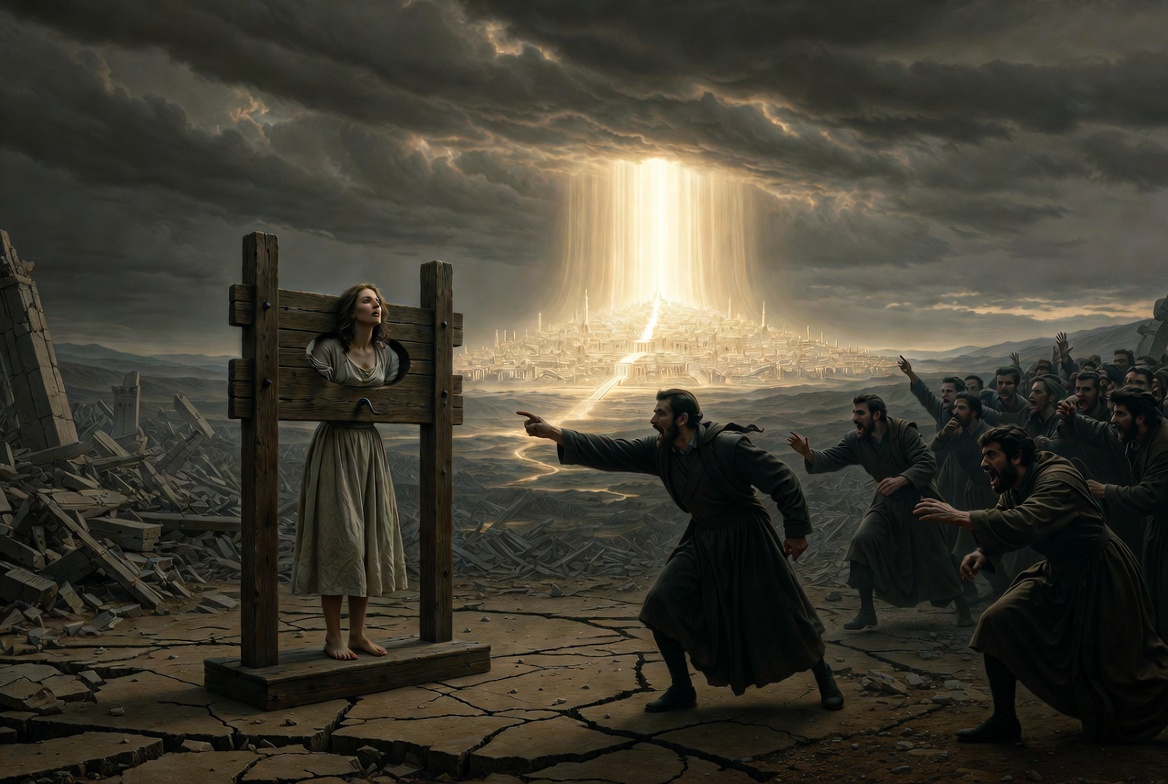
When limits cannot be named, someone must be blamed.
Most political reform begins from a defect that can be named and a remedy that can be argued over. A law is unjust. A policy fails. An institution overreaches. The aim is improvement, not redemption. The point is to correct a problem within the permanent constraints of social life.
A different kind of politics begins elsewhere. It is driven less by a concrete vision of what a good society can actually sustain than by an intense certainty about what must be abolished: domination, exclusion, stigma, hierarchy, impurity. The ideal appears first not as a positive order with defined institutions, costs, limits, and tradeoffs, but as a purified horizon from which every visible moral stain has been removed.
That structure matters. A politics organized around what must disappear often possesses enormous critical energy but weak constructive discipline. It can identify contamination faster than it can describe settlement. It can mobilize outrage faster than it can specify completion. Because its standard is defined chiefly by negation, it struggles to say when the work is done. The result is a politics of permanent dissatisfaction: a style of moral and political life in which every remaining imperfection is read not as evidence of human limits, conflicting goods, or institutional friction, but as proof that the world is still guilty.
I will call this negative idealism. By that I mean a way of thinking in which the desired social order is known mainly by its absences rather than by its positive form. No oppression. No exclusion. No domination. No harm. No taint. Those aspirations can contain real moral insight. But as political endpoints they are unstable unless they are joined to harder questions. What institutions will carry this vision? What tradeoffs does it permit? What tensions are permanent? What counts as enough? When those questions go unanswered, negation begins to do more than criticize the present. It becomes a self-renewing engine of dissatisfaction.
The attraction is not mysterious. Negation is easier than construction. It is emotionally cleaner to denounce a stain than to design a settlement. Critique flatters the conscience. Construction burdens it. One allows people to inhabit moral clarity. The other forces them to reckon with scarcity, conflict, enforcement, and cost. It is easier to unite people around what they reject than around the terms on which they are prepared to live together.
“The structure is often recognizable: a purified horizon is announced, reality fails to comply, the gap is moralized, and the search for the guilty begins.”
That asymmetry gives this style of politics much of its force. It does not need to answer many hard questions in order to condemn domination, exclusion, or stigma. It can gather energy long before it can govern. It can speak in the language of moral emergency without yet saying what institutions would embody its ideal, what competing goods would have to be balanced, or what losses would remain even after reform. In that sense, it is potent precisely because it defers the moment when aspiration must submit to architecture.
Politics becomes serious at exactly that moment. It becomes serious when a moral vision is forced to move from diagnosis to design. What laws would reflect its principles? What institutional powers would be needed to enforce them? What rights would be protected when goods conflict? What exclusions would still remain, and on what grounds? What counts as enough? These are not secondary questions. They are the point at which aspiration is tested by the world it proposes to inhabit.
Here the negatively defined ideal often begins to wobble. The problem is not that it identifies nothing real. Many such projects do identify real injustices, real cruelties, and real failures of social order. The problem is that the ideal itself remains underdescribed. A society can reduce particular evils. It can mitigate harms. It can discipline abuses. But it cannot become a place with no stigma, no hierarchy, no domination, no friction, no exclusion, and no conflict unless words have ceased to mean what they usually mean. Human beings are finite. Goods compete. Institutions are blunt. Boundaries protect some things by restricting others. Social life is not clean.
Once that reality is faced, the burden of politics changes. The question is no longer how to abolish every trace of moral injury, but how to order a society under conditions where some tensions are permanent and some tradeoffs are unavoidable. That is the work negative idealism resists. It prefers purification to settlement. It treats compromise as contamination. It treats incompleteness not as a condition of human life, but as evidence that the moral task has been betrayed.
That is why dissatisfaction becomes self-renewing. An ideal that cannot be positively specified also cannot be clearly achieved. There is always another residue to expose, another hidden structure to name, another dissenter to classify as complicit, another demand that must now be treated as morally urgent because prior concessions have already established the principle. Partial victories do not calm the impulse. They often intensify it. Each gain becomes evidence that the horizon can be pressed farther still, and each remaining imperfection becomes proof that justice has been delayed by someone’s refusal, cowardice, or bad faith.
What this pattern often lacks is a serious category of tragedy. Not every persistent social imperfection survives because wicked people protect it. Some survive because resources are finite, institutions are crude, and goods that matter can come into conflict without any clean resolution. Freedom and equality can pull against each other. Inclusion and standards can pull against each other. Compassion and truth can pull against each other. Order has costs, but disorder has costs too. A politics that cannot admit such tensions will misread the world it is trying to govern.
The refusal to acknowledge limits distorts judgment. What should have been recognized as friction, tradeoff, or permanence is recoded as obstruction. What should have been understood as an unintended cost is treated as evidence of hidden malice. What should have been accepted as the unfinished character of social life is interpreted instead as proof that the work has been sabotaged. A movement that cannot say, “this good is real, but incomplete,” will be tempted to say, “this good has been denied because guilty people still stand in the way.”
This does not belong to one ideology alone. Variations of the pattern have appeared in revolutionary class politics, racial purification movements, and newer forms of moralized identity activism. The content differs. The vocabulary differs. The designated enemies differ. But the structure is often recognizable: a purified horizon is announced, reality fails to comply, the gap is moralized, and the search for the guilty begins.
That is the deeper political danger in negative idealism. It does not merely produce endless critique. It creates pressure to personalize failure. If the ideal is pure, and the ideal remains unrealized, then the fault must lie not in the ambition itself, nor in the constraints of reality, but in the people said to be resisting redemption. At that point dissatisfaction ceases to be diagnostic and becomes accusatory. The inability to perfect the world is no longer treated as a human condition. It is treated as evidence that enemies remain.
“A politics that knows the good chiefly as the removal of taint will have difficulty describing completion, accepting limits, or recognizing partial success.”
Ordinary politics depends on a harder and more chastened wisdom. It depends on the recognition that some injustices can be reduced without being abolished, that some conflicts must be managed rather than solved, and that settlement is often the proper goal where purification is impossible. A society that loses that wisdom becomes vulnerable to movements that know how to denounce every stain but do not know how to live with human limits. Such movements can speak with immense conviction. What they struggle to do is stop.
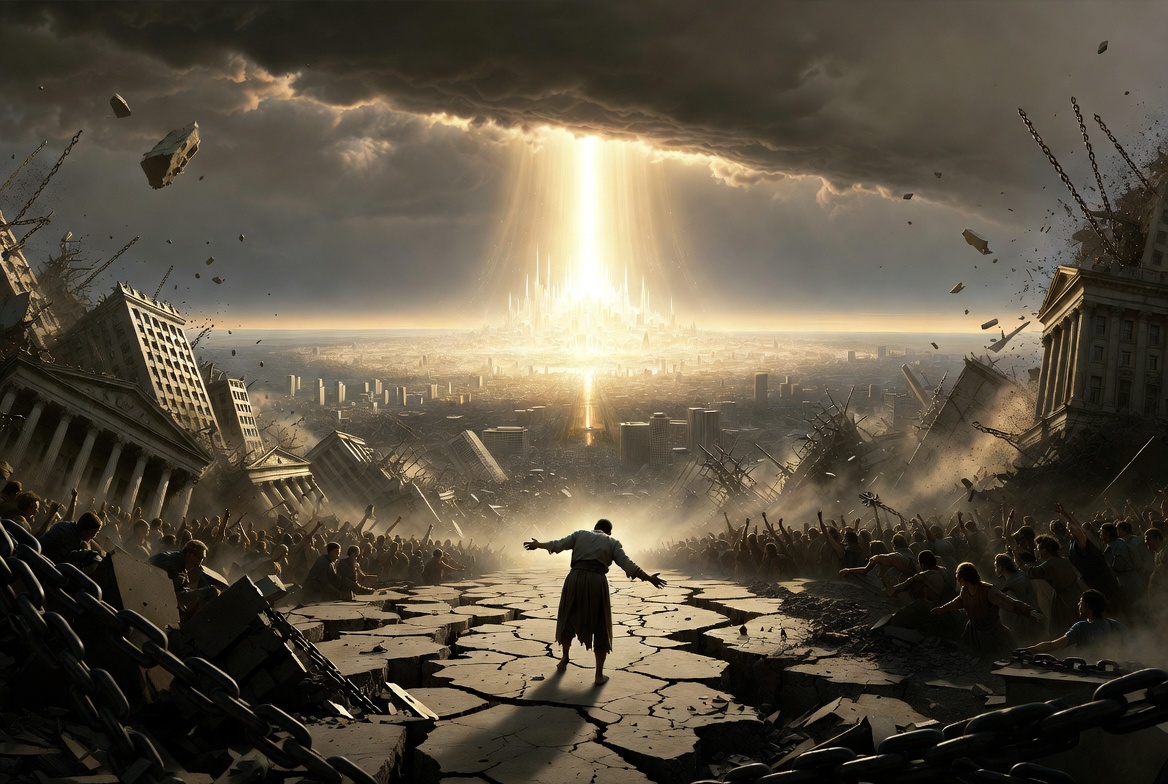
None of this means moral criticism is misplaced, or that reform should be timid, or that injustice is merely the name we give to unavoidable discomfort. It means something narrower and harder. A politics that knows the good chiefly as the removal of taint will have difficulty describing completion, accepting limits, or recognizing partial success. It will remain permanently dissatisfied because the horizon it serves is permanently receding. And once that condition sets in, the search for a better order can all too easily become a search for the guilty.
This is where the next question begins. If a movement cannot explain the gap between its ideal and reality through limits, tradeoffs, or tragedy, how will it explain that gap instead? Usually by finding someone to blame.
Glossary
Negative idealism: A way of thinking in which the desired social order is known mainly by what it seeks to abolish rather than by a clear positive account of what it can sustain.
Purified horizon: An imagined social condition from which moral stain has been removed, even though its institutions, limits, and tradeoffs remain vague.
Permanent dissatisfaction: The condition that arises when a movement cannot clearly define completion and so treats every remaining imperfection as proof that the work is unfinished.
Tragedy: The fact that some social tensions persist not because of sabotage or malice, but because goods conflict, resources are finite, and human beings are limited.
Settlement: A workable political order that manages conflict and tradeoffs without pretending to abolish them entirely.
One of the most destructive temptations in politics is the urge to turn disagreement into moralized tribal war. Not argument. Not persuasion. Not the hard, frustrating work of governing a society full of competing interests and imperfect people. War. Friends and enemies. Allies and traitors. The pure and the contaminated. Once that frame takes hold, politics stops being about order, restraint, and judgment. It becomes a loyalty machine. Carl Schmitt gave this instinct its most famous formulation in The Concept of the Political, where he argued that the essence of politics lies in the distinction between public friend and public enemy. He was right to see that real political life can descend to existential conflict. He was wrong to treat that descent as the essence of politics rather than one of the permanent dangers civilized politics is supposed to contain. The friend-enemy distinction is not the foundation of healthy politics. It is the logic of political decay.
The danger is not only that the framework is harsh. Politics can be harsh. The danger is that it installs enmity at the center of public life and pushes everything else to the margins. Institutions, laws, debate, compromise, constitutional limits, due process, even ordinary factual disagreement all become secondary. What matters is identifying the enemy, consolidating the team, and punishing hesitation. That is why this logic travels so easily across ideologies. It can appear in revolutionary Marxism, in Maoist “enemies of the people,” in Islamist loyalty-and-disavowal frameworks, in activist binaries like ally versus bigot or oppressor versus oppressed, and in right-wing scripts about traitors, regime collaborators, and weak conservatives who supposedly enable the left. The vocabulary changes. The mechanism does not. A public enemy is named, and then a moral test is imposed: how fully will you align against him?
“The ratchet always turns one way: toward greater fanaticism, greater purification, greater moral ugliness. Truth is subordinated to solidarity. Principle is subordinated to faction.”
What makes this logic totalitarian is that it abolishes the space for dissent. Once the enemy has been declared, neutrality is no longer allowed. You either join the mobilization or you are suspected of serving the enemy’s cause. Hesitation becomes complicity. Refusal becomes betrayal. Moderation becomes guilt. That is how political movements become purge machines. You can either be anti-racist or you are helping racism. You can either be a trans ally or you are enabling bigotry. You can either fight the deep state, resist the regime, and oppose the left without reservation, or you are a RINO, a coward, a collaborator. This is the structure that matters. Not the tribe wearing it. Once politics is moralized into friend and enemy, the pressure falls hardest not only on official opponents, but on the insufficiently zealous within one’s own camp.
That is why factions organized around “no enemies to the left” or “no enemies to the right” almost always radicalize inward. The outer edge of the movement becomes untouchable because criticizing it risks helping the enemy. So the only safe targets are moderates, doubters, and fellow travelers who fail the loyalty test. The left protects its most extreme activists and attacks liberals who cannot keep up. The right protects its own hardliners and attacks conservatives who still think prudence, constitutional restraint, or factual discipline matter. In both cases, the center is hollowed out first. The ratchet always turns one way: toward greater fanaticism, greater purification, greater moral ugliness. Truth is subordinated to solidarity. Principle is subordinated to faction. Politics ceases to be the art of living together under conditions of disagreement and becomes a permanent sorting mechanism for friends, enemies, and suspects.
A civilized society cannot survive on those terms. That does not mean pretending enemies never exist. They do. Free societies are not obliged to indulge movements openly hostile to liberty, law, and peaceful coexistence. But the achievement of constitutional civilization is precisely that it refuses to make enmity the organizing principle of normal public life. It channels conflict through law, opposition, procedure, restraint, and rights. It leaves room for disagreement without turning every disagreement into proof of treason. That is the line Schmitt blurred and totalitarian movements erase completely. The mistake is not in noticing that politics can become existential. The mistake is in treating that possibility as the deepest truth of politics and then building public life around it. Once you do that, purges are no longer an accident. They are the destination. Friend-enemy politics is not realism. It is the operating system of political decay.

One of the more unsettling ideas in political history is that civilization may depend not only on teaching people virtue, but on steadily removing the people least capable of civilized life.
That is the thesis Peter Frost and Henry Harpending explore in Western Europe, State Formation, and Genetic Pacification. It cuts against the modern habit of explaining violent disorder almost entirely through environment, incentives, poverty, trauma, and weak institutions. Those things matter. But Frost and Harpending press a harder possibility: what if the long pacification of Western Europe was driven not only by stronger states and changing norms, but also by selection against the men most prone to chronic violence? (PubMed)
The historical pattern they point to is clear. In medieval Europe, homicide rates were vastly higher than in the modern West. Over time, as states consolidated their monopoly on violence and private vengeance receded, courts imposed the death penalty more systematically. Frost and Harpending argue that by the late Middle Ages, courts were condemning between 0.5 and 1.0 percent of all men of each generation to death, with perhaps as many more violent offenders dying at the scene of crimes or in prison while awaiting trial. Meanwhile, long-run homicide rates in Western Europe fell dramatically across the centuries. That broader decline is visible not only in their paper but in later summaries built from Manuel Eisner’s historical homicide datasets. (PubMed; Our World in Data)
That much already matters. Peace is not the natural resting state of a society. It is achieved. It is enforced. It is built through institutions capable of suppressing predation. The state does not merely administer order after the fact. It creates the conditions under which ordinary trust can exist. Without that floor, commerce, family stability, education, beauty, and freedom remain fragile.
But Frost and Harpending are interested in more than deterrence. Their stronger claim is that repeated removal of violent men from the breeding population may have altered the population itself over many generations. In plain language: if men most disposed to impulsive violence, predation, and chronic criminality are disproportionately executed, killed while offending, or otherwise prevented from reproducing, then over centuries one should expect some reduction in the prevalence of those tendencies. The state, in that account, does not just restrain violence from the outside. It may slowly reshape the human material with which the society reproduces itself. (PubMed)
That is the interesting part of the thesis, and the part that needs the cleanest handling. Frost and Harpending present it not as a settled master key to European history, but as a plausible co-factor alongside state formation, punishment, and cultural conditioning. Direct genomic confirmation remains absent. Other explanations place more weight on the state’s monopoly on violence, changing norms of self-control, declining honor culture, economic development, and improved policing. So the strongest honest claim is not that the paper has solved the history of European pacification. It is that it raises a serious possibility modern readers are strongly conditioned not to consider. (PubMed)
“Civilization is not sustained by kindness alone. It rests on a prior achievement: order strong enough to protect the peaceable from the predatory.”
Even with that caution in place, the paper still does useful work. It moves the discussion beyond the sterile split between “bad systems” and “bad individuals.” It suggests a layered civilizing process: institutions suppress violent conduct, norms change under the shelter of that order, and then, possibly, population traits shift over time as the most antisocial men are less likely to survive and reproduce. Culture and coercion do not sit in separate boxes here. They interact.
You do not have to buy every part of that model to see why it has force. A society does not begin from zero every generation. It inherits habits, expectations, institutions, and distributions of temperament formed over long stretches of time. If Western Europe became unusually low in interpersonal violence by world-historical standards, that happened through a civilizing process measured in centuries, not slogans. It was produced by a long narrowing of the space in which violent men could operate, flourish, and reproduce themselves socially.
That last phrase matters because reproduction here is not only biological. Violent men reproduce disorder culturally as well. They shape neighborhoods, train younger males, normalize intimidation, degrade family life, and turn predation into a viable strategy. Once that ecology is established, disorder becomes self-reinforcing. The reverse is also true. When a state reliably incapacitates the worst predators, peace can become self-reinforcing too.
That is part of why modern examples like El Salvador draw so much attention. The cases are not equivalent, and they do not prove Frost and Harpending’s genetic hypothesis. What they do show is older and simpler: when a state decisively removes a violent criminal stratum from daily circulation, social peace can return with surprising speed. The IMF reported in 2025 that El Salvador’s homicide rate fell from 54 per 100,000 in 2018 to 1.8 in 2024, and tied the improvement in security to stronger growth, tourism, remittances, and investor confidence. Human Rights Watch, from the opposite moral angle, also reports a significant decline in gang violence while warning that restricted data access and changes in homicide counting complicate full independent verification. (IMF; HRW; AP)
That is where a serious reader has to keep both truths in view at once. El Salvador does not demonstrate multi-generational selection. It demonstrates the older principle that predators must be removed from circulation if ordinary life is to recover. At the same time, Human Rights Watch documents arbitrary detention, torture, ill-treatment, and deaths in custody under the state of exception. The rights costs are real. The case does not prove that every harsh regime is wise. It proves that liberal societies often flatter themselves about how peace is maintained. (HRW)
This is not an argument for population engineering or collective guilt. It is an argument for recognizing that a small fraction of high-rate violent offenders can do outsized damage, and that civilization depends on their incapacitation. Modern liberal societies are comfortable discussing prevention, rehabilitation, and root causes. They are much less comfortable discussing the incorrigible. But any serious civilization needs a theory of that minority and the will to act on it long enough for the peaceable majority to live normally.
That, in the end, is the value of Frost and Harpending’s paper. Not that it offers a final key to history. Not that every part of its model has been settled beyond dispute. It matters because it reopens a forbidden question: how much of social peace depends not merely on teaching better values, but on the long-term suppression of the people least fit for peaceful life? Even readers who reject the paper’s stronger selection claim should still feel the pressure of that deeper point. Order is not self-generating. It has to be maintained against people who would dissolve it if allowed.
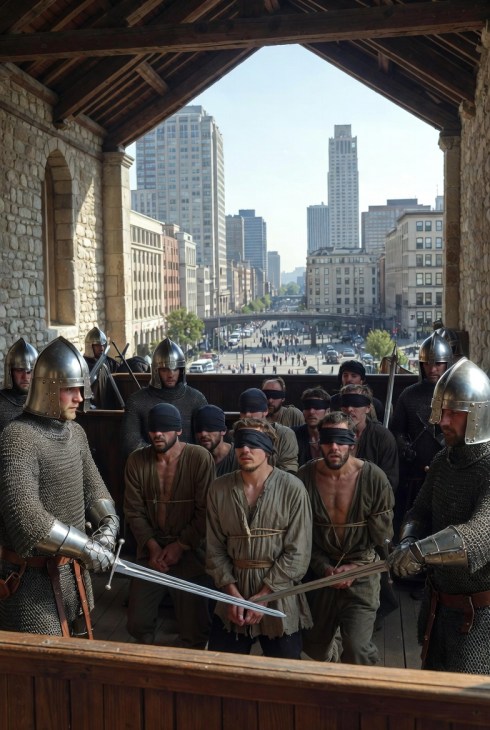
Modern states, at their best, answer that problem more humanely than medieval ones did. They use prisons rather than gallows. They rely on due process rather than spectacle. Good. They should. But the softer method does not abolish the harder principle. Social peace depends on removing certain people from the field, sometimes for a very long time.
That is the truth buried beneath the discomfort here. Civilization is not sustained by kindness alone. It rests on a prior achievement: order strong enough to protect the peaceable from the predatory. Everything higher comes after that.
References
Peter Frost and Henry C. Harpending, “Western Europe, State Formation, and Genetic Pacification,” Evolutionary Psychology 13, no. 1 (2015). PubMed: https://pubmed.ncbi.nlm.nih.gov/25748943/ ; journal page: https://journals.sagepub.com/doi/10.1177/147470491501300114
International Monetary Fund, El Salvador: Request for Extended Arrangement Under the Extended Fund Facility (2025). IMF page: https://www.elibrary.imf.org/view/journals/002/2025/058/article-A001-en.xml ; PDF: https://www.imf.org/-/media/files/publications/cr/2025/english/1slvea2025001-print-pdf.pdf
Human Rights Watch, “World Report 2026: El Salvador.” https://www.hrw.org/world-report/2026/country-chapters/el-salvador
Our World in Data, historical homicide materials drawing on Manuel Eisner’s data: https://ourworldindata.org/data-insights/homicide-rates-have-declined-dramatically-over-the-centuries and https://ourworldindata.org/grapher/homicide-rates-across-western-europe
Associated Press, “El Salvador closes 2024 with a record low number of homicides.” https://apnews.com/article/69384a8705267eaddd18dcd28a53465b











 bleatmop
 Mystro


 Dead Wild Roses
Your opinions…