
You are currently browsing the category archive for the ‘Economy’ category.
Imagine a society where death is no longer a hard stop.
Consciousness can be stored, transferred, and reinserted into a new body. The body becomes a vessel. Identity persists. Time, for those who can afford it, stretches indefinitely.
You do not need to know the details of Altered Carbon to see the structure of the problem. Remove biological limits, and you remove one of the most reliable forms of turnover any society has ever had.
What follows is not dramatic at first. It is cumulative.
In the world we recognize, power circulates in part because people leave it. Careers end. Wealth fragments. Networks decay. Even without formal limits, time imposes a boundary. That boundary forces renewal, not because the system is designed perfectly, but because it cannot avoid it.
If consciousness can persist indefinitely, that boundary weakens.
The same individuals remain in place. They retain capital, relationships, and institutional knowledge. They continue to make decisions, influence outcomes, and shape the system around them. Over time, the difference between participating in the system and becoming part of its permanent structure begins to blur.
This is not a question of morality in the first instance. It is a question of accumulation.
Wealth compounds across lifetimes. Influence compounds with familiarity. Access compounds through repeated interaction. The longer these elements remain uninterrupted, the harder it becomes for new entrants to meaningfully compete. Opportunity does not disappear, but it narrows.
That outcome is not guaranteed. Wider access, voluntary exit, or new institutional limits could disrupt it. But absent those constraints, the direction is difficult to avoid.
In such a system, inequality is no longer measured in degrees. It becomes structural.
“Without effective limits on power, continuity does not distribute advantage. It locks it in place.”
The usual guardrails weaken. In our current world, corruption has a kind of half-life. People age out. Scandals catch up. Networks dissolve under pressure or time. None of these mechanisms are perfect, but together they create friction. That friction limits how long any one configuration of power can persist.
Remove the time constraint, and that friction thins.
Relationships that would have faded can now endure. Favors accumulate across decades that turn into centuries. Institutional memory becomes personal memory. The system no longer resets itself. It settles.
It is possible that new forms of turnover would emerge to replace biological limits. Mandatory retirement, cultural norms of succession, or institutional resets could reintroduce friction. The question is whether such mechanisms would be strong enough to counteract uninterrupted accumulation.
There are arguments in favor of such continuity. Long-lived individuals might think in longer horizons. Experience might deepen judgment. Stability could replace volatility. These are not trivial advantages.
But they depend on something stronger than continuity itself. They depend on constraint.
Without effective limits on power, continuity amplifies existing advantages. It does not distribute them. It locks them in place.
This is where the connection to high-trust systems becomes clear.
Trust depends on more than fairness in the abstract. It depends on the visible circulation of power. People need to believe that positions are contingent, that access is not permanent, and that outcomes are not pre-set by those who have already secured their place.
If the same individuals can remain indefinitely, that belief becomes harder to sustain. The system may still function. It may even function efficiently. But it begins to feel less like a field of participation and more like a structure that has already been decided.
You do not need overt abuse of power for this shift to occur. You only need continuity without interruption.
Any system built on indefinite continuity would therefore depend on constraints that are more deliberate and more robust than those we rely on today.
A society organized this way would not necessarily collapse. It could be orderly, productive, and even stable.
But without mechanisms to force rotation, it would carry a persistent risk.
Power would not simply be held.
It would be kept.

Power no longer circulates; it settles. The immortal remains enthroned while new generations are blocked, and the clock of turnover lies shattered and chained forever.
Most Canadians could not point to the Strait of Hormuz on a map.
They are about to feel it anyway.
Roughly a fifth of the world’s oil passes through that narrow stretch of water. When it is stable, nobody notices. When it is threatened, everything downstream begins to move—prices, shipping costs, political calculations. Geography, in this sense, is not abstract. It is mechanical.
The current tension in the region has put that mechanism back into play.
It does not require a full disruption to matter. Risk alone is enough. Insurance premiums rise. Tanker routes adjust. Traders price in uncertainty. Oil climbs before a single barrel is lost. And because energy sits underneath everything—transport, production, food—the effects do not stay contained.
“When energy moves, everything else follows.”
This is where the distance between foreign policy and daily life collapses.
Higher fuel costs bleed into groceries. Shipping delays ripple into availability. Central banks, already cautious, hesitate further. Governments face pressure to respond to a problem they do not control. The system tightens, not through a single shock, but through accumulated friction.
None of this depends on whether people are paying attention.
The map exists either way.

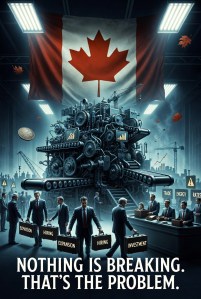
Nothing is breaking. That’s the problem.
Canada’s economy is not in crisis. There is no crash, no panic, no headline moment that forces a response. Instead, there is something quieter and more dangerous: hesitation.
Businesses are waiting. Hiring continues, but cautiously. Investment is delayed, not cancelled. Consumers are still spending, but with an edge of restraint. The numbers, taken individually, do not alarm. Together, they describe an economy that has lost its forward motion.
This is what a waiting economy looks like.
The mechanism is simple. When uncertainty rises—over trade, over energy, over rates—decision-making slows. Firms defer expansion. Employers hold off on adding staff. Households pause larger commitments. Each decision is rational in isolation. In aggregate, they compound into stagnation.
“When everyone waits, the slowdown compounds.”
The difficulty is that this kind of slowdown rarely triggers a clean policy response. Central banks do not cut aggressively because inflation risks remain. Governments hesitate to stimulate because nothing appears broken. The system drifts, and the cost accumulates in the background—missed growth, weaker productivity, fewer opportunities quietly foregone.
A crisis forces action the hesitation invites drift.
And drift, left long enough, becomes its own kind of shock.
There’s a popular line making the rounds:
“I’m communist with my family, socialist with my friends, liberal with my country, and capitalist with the rest of the world.”
It’s clever. It’s also half right—and half sloppy.
The part worth keeping is simple enough: scale changes the rules.
What works for five people does not scale to fifty million. Not because people become worse, but because the system itself becomes something different. A family, a circle of friends, a town, a nation—these are not just larger and smaller versions of the same thing. They are different kinds of coordination problems.
Start with the family. From a distance, it can look vaguely “communist”: shared resources, little formal accounting, distribution by need rather than contract. But that description confuses appearances for mechanism. Families do not work because they have stumbled onto a workable version of communism. They work because they are held together by thick trust, intimate knowledge, moral obligation, and affection. You know who is trying, who is struggling, who is coasting, and who is carrying more than their share. Love and duty do much of the coordinating work that, elsewhere, would have to be done by prices, rules, or enforcement.
That is not an economic system. It is a moral one.
Expand outward to friendship networks and you get something looser but still recognizably personal. Friends split restaurant bills unevenly, help each other move, pick up tabs, lend money, and trade favors without keeping a precise ledger. Reciprocity exists, but it remains informal because reputation still does the work. The group is small enough that selfishness has social consequences, and generosity has memory.
Still not socialism. Still a trust network.
Scale it again, though, and the whole structure changes. Once you move from dozens of known people to millions of strangers, the conditions that made those smaller systems work begin to disappear. You no longer know the participants. You cannot directly observe effort. Reputation becomes local rather than systemic. Free riding becomes harder to detect and easier to excuse. The moral visibility that kept the small group coherent starts to fade.
And that is before you even reach the information problem.
Mises and Hayek saw this clearly. In a large society, the knowledge needed to coordinate production, consumption, scarcity, and changing local conditions is radically dispersed. No planner can gather it all in a usable form, still less process it in real time. Prices do something extraordinary here: they compress enormous amounts of scattered information into signals people can actually act on. They tell producers where demand is rising, tell consumers where scarcity is biting, and help strangers coordinate without ever needing to know one another.
But information is only half the story. The other half is incentives, and this is where many soft-focus arguments about solidarity fall apart.
In a family, the bond is part of the reward. Parents sacrifice for children because they love them. Children often learn obligation because they are formed inside a web of expectation and attachment. Friends help each other because affection, shame, pride, and mutual memory all shape conduct. In a large anonymous system, those bonds weaken. Once effort and reward drift too far apart, behavior changes. People conserve effort, game criteria, hide costs, seek advantages, and respond to whatever incentives the system actually creates rather than to the moral language used to defend it.
That is why bloated systems so often fill up with evasion, rent-seeking, bureaucratic padding, and endless struggles over who pays, who receives, and who gets to define fairness. This is not mainly because people are unusually wicked. It is because incentives shape conduct more reliably than rhetoric does.
The problem is not that people become monsters at scale. The problem is that systems stop being personal.
At small scale, coordination is moral and relational. At large scale, it must become impersonal and systemic.
That is where markets enter—not as a sacred ideology, but as a coordination mechanism built for strangers. Prices transmit information. Profit and loss impose discipline. Competition corrects error. Contracts reduce uncertainty. None of this requires perfect virtue. That is precisely the point. Markets work not because people are angels, but because the system does not depend on them being angels.
That is why they scale.
Now, a fair steelman is necessary here, because the redistributive instinct is not born from pure foolishness. Advocates of more social-democratic or socialist arrangements are often responding to something real. Human beings are not just market actors. They are children, parents, dependents, pensioners, caregivers, and sometimes casualties of bad luck they did not choose. A society that treats every need as a private burden and every vulnerability as a market outcome to be endured will become efficient in a narrow sense, but also harsh, brittle, and politically unstable. The desire to soften outcomes, provide public goods, and preserve a baseline of dignity is not irrational. It is, in many cases, a morally serious response to genuine dependency.
That much should be conceded.
What should not be conceded is the next leap: the claim that because markets need moral and political correction, they can therefore be replaced as the primary mechanism of large-scale coordination. They cannot. A decent society may use the state to cushion, insure, stabilize, and set guardrails. But the moment it starts treating political instruction as a substitute for price signals, or good intentions as a substitute for incentive alignment, it begins to lose the information and discipline that complex systems require.
As systems scale, coordination must shift from relationships to mechanisms, and from assumed goodwill to aligned incentives.
This is also why the original slogan overshoots. Markets are not the only thing that scales. States scale too, in limited and specific ways. Law, infrastructure, policing, and certain public goods are not produced by market exchange alone. And between the family and the nation lies an entire middle world of institutions—firms, charities, churches, schools, municipalities, associations—that mix trust, hierarchy, rules, custom, and incentives in different proportions.
The real lesson, then, is not “capitalism good, everything else bad.” That is too crude to be useful.
The real lesson is that systems must be judged by the kind of coordination problem they are trying to solve. Small groups can run on trust because trust is visible and enforceable. Large societies cannot. They need mechanisms that work under conditions of anonymity, partial knowledge, conflicting interests, and imperfect virtue. Any model that ignores those conditions will eventually break, no matter how beautiful its moral language sounds at dinner.
That is the recurring mistake. People take the emotional clarity of small-group life—sharing, sacrifice, mutual care—and try to project it onto systems too large for those tools to govern. When the result disappoints, they blame greed, selfishness, or insufficient solidarity. They almost never blame the mismatch between the model and the scale.
They should.
Because the deepest constraint here is not moral. It is structural.
You can run a family on trust. You can run a country on rules. But if those rules ignore incentives, trust will not save you.

References for Curious Readers
F. A. Hayek, “The Use of Knowledge in Society” (1945).
The classic statement of the knowledge problem: why the information needed to coordinate an economy is dispersed among millions of people and cannot be fully centralized. Published in The American Economic Review.
Ludwig von Mises, “Economic Calculation in the Socialist Commonwealth” (1920).
The foundational statement of the economic calculation problem: without market prices for capital goods, rational large-scale allocation becomes impossible.
Elinor Ostrom, Nobel Prize Lecture, “Beyond Markets and States” (2009).
Useful as a corrective to simplistic binaries. Ostrom’s work shows that some common resources can be governed successfully through rules, enforcement, and local institutions rather than either pure markets or total central control.
Nobel Prize in Economic Sciences 2009 – Popular Information / Summary.
A concise overview of why Ostrom and Oliver Williamson mattered: economic life is governed not only by markets and states, but also by firms, associations, and other institutions. This supports the essay’s “missing middle layer” point.
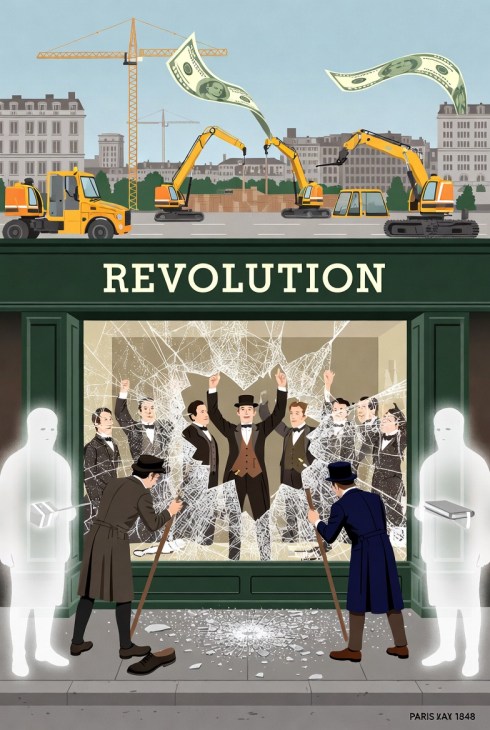
The ‘Broken Window’ parable has lasted because the mistake it identifies is permanent. People keep confusing motion with wealth.
A shop window gets smashed. The glazier benefits. He is paid to replace it. Money changes hands. Work is created. Onlookers reassure themselves that the damage at least “helped somebody.” Bastiat’s point is that this is where bad economic reasoning begins. The shopkeeper must now spend money restoring what he already had instead of buying something new, improving his business, saving, or investing. The glazier gains work. The shopkeeper loses options. Society ends up with a replaced window instead of a replaced window plus whatever else might have been created. That is not growth. It is recovery from loss.
In That Which Is Seen, and That Which Is Not Seen, published in 1850, Bastiat gave this simple error its enduring form. The visible effect is easy to grasp: the glazier gets income, then spends it elsewhere, and activity ripples outward. But the visible beneficiary is only half the story. What disappears from view are the unrealized alternatives: the suit never bought, the tool never purchased, the apprentice never hired, the expansion never attempted. The fallacy survives because the gain is concrete and public while the loss is dispersed and hypothetical. One can be pointed to. The other must be reasoned out.
“People keep confusing motion with wealth. Visible activity is easy to celebrate. The wealth that never came into being is harder to see, and easier to ignore.”
That is why the broken window is not really about vandalism. It is about how easily public argument stops at the first visible effect and calls the matter settled. Once you see that, a great deal of modern economic rhetoric starts to look less like analysis than stagecraft.
The pattern is familiar in debates over stimulus spending. Governments announce major spending packages. The public is shown crews on worksites, contracts being signed, jobs being counted, funds “flowing into the economy.” The imagery is always immediate and flattering. Something is happening. Therefore something good must be happening.
But visible activity is not the same thing as net wealth creation. Government does not create resources from nothing. It taxes them away, borrows them away, or inflates them away. In each case, resources are redirected from other possible uses. The serious question is not whether public spending produces measurable effects. Of course it does. The serious question is whether those resources would have created more value had they remained in private hands, guided by price signals, local knowledge, and voluntary choice rather than political allocation.
That is where the unseen side of the ledger matters. We see the bridge. We do not see the private investment that never happened because capital was drawn elsewhere. We see the subsidized payroll. We do not see the household purchasing power weakened by inflation. We see the grant recipient. We do not see the startup that never secured financing, or the consumer demand that was blunted by higher taxes or debt service. Public spending can make its beneficiaries highly visible while leaving its displaced alternatives diffuse and mostly invisible. That is politically useful, but analytically weak.
The usual reply is that recessions change the equation. When labour is idle, capital is underused, and private demand collapses, government spending may mobilize resources that would otherwise sit dormant. That is the strongest counterargument, and it should be taken seriously. A deep recession is not the same as a fully employed economy. Slack matters. Timing matters. Liquidity panics matter. A blanket denial of all countercyclical policy is cruder than Bastiat’s actual insight deserves.
But this does not rescue the broken window logic from criticism because it does not actually answer it. Even in a downturn, the central question remains comparative: compared to what? If the claim is that temporary public spending can stabilize demand under exceptional conditions, that is at least a serious argument. But it is not the same argument as saying that destruction creates prosperity, or that politically directed spending is wealth in itself. It still matters what is being funded, how efficiently it is administered, what incentives it creates, and whether the spending is genuinely using idle resources or merely displacing better uses that are harder to measure in real time.
“Replacement is not creation. Redirection is not prosperity. A society does not become richer by repairing destruction and calling the bustle growth.”
That distinction matters because bad arguments often smuggle themselves in under good intentions. A narrow case for emergency stabilization can turn into a permanent political habit of treating state spending as inherently productive. Once that shift happens, Bastiat’s warning reasserts itself in full. Replacement is still not creation. Redirection is still not spontaneous enrichment. Measured output can rise while underlying wealth formation weakens.
The same mistake appears after natural disasters and during wartime booms. After a hurricane, people say rebuilding will “boost the economy.” During war, people point to full factories and rising production figures. But rebuilding what was destroyed is not the same as becoming richer. Producing goods for destruction is not the same as expanding civilian prosperity. These events may generate employment, contracts, and output. They do not erase the prior loss. The relevant comparison is not between disaster and inactivity. It is between the world after destruction and the world in which the destruction never occurred.
That is what makes Bastiat’s lesson both obvious and routinely ignored. Visible motion is emotionally persuasive. A ribbon-cutting is easier to celebrate than an opportunity cost. A government announcement is easier to narrate than a private investment that never happened. Political systems are structurally biased toward what can be displayed, counted, branded, and claimed. The unseen has no ceremony attached to it. It leaves no plaque.
So the broken window fallacy endures not because the logic is hard, but because the discipline is hard. It requires people to keep asking the next question after the applause line. Jobs doing what? Spending on what? At whose expense? Relative to which forgone alternative? In a free economy, resources are scarce and choices are real. To pretend otherwise because spending is visible is to confuse accounting entries with prosperity.
Bastiat’s point remains devastating because it cuts through so much noise. Destruction does not enrich. Replacement does not add net wealth. Spending is not identical with prosperity. A society becomes richer when it creates new value, lowers costs, improves production, expands choice, and allows people to direct resources toward ends they actually value. It becomes poorer when it burns wealth, redirects capital by force, and congratulates itself for the bustle that follows.
That was true in Bastiat’s time. It is true now. The forms get larger, the numbers get bigger, and the rhetoric gets smoother, but the underlying mistake does not change. The glazier is still real. So is the window. So is everything we never got because we mistook repair, diversion, and visible activity for growth.
References
Bastiat, Frédéric. “What Is Seen and What Is Not Seen.” Online Library of Liberty.
https://oll.libertyfund.org/pages/wswns
Bastiat, Frédéric. “That Which Is Seen, and That Which Is Not Seen.”
https://bastiat.org/en/twisatwins.html
Bastiat, Frédéric. “Chapter 1: What Is Seen and What Is Not Seen.” Econlib.
Encyclopaedia Britannica. “Frédéric Bastiat.”
https://www.britannica.com/money/Frederic-Bastiat
Cullen, Joseph A., and Roger H. Gordon. “Taxes and Wartime Mobilization in the U.S. Economy: World War II as a Natural Experiment.” NBER Working Paper 12801.
Garin, Andy. “The Wartime Origins of Industry Location and Economic Mobility in the United States.” NBER Working Paper 33418.
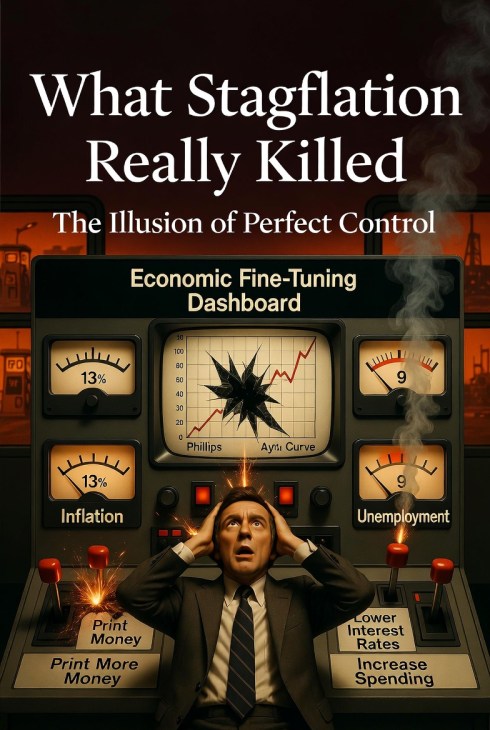
The lesson of 1970s stagflation was not that governments can do nothing. It was that the people running policy understood less than they claimed, and that the tools they trusted were much cruder than advertised. The “Great Inflation” from roughly 1965 to 1982 forced economists and central banks to rethink how inflation, unemployment, and monetary policy actually interact. (Federal Reserve History)
For a time, the postwar consensus rested on a flattering idea. Inflation and unemployment were treated as a manageable trade-off. The Phillips Curve was not just read as a pattern in the data. In practice, it became a governing intuition: if unemployment rose, policymakers could push demand higher and accept somewhat more inflation as the cost. That was the real temptation. A relationship observed under one set of conditions was quietly promoted into an instrument of control. The curve stopped being a caution and became a dashboard. That is where the error entered. As later critiques made clear, any apparent trade-off could break down once expectations adjusted. (Federal Reserve History)
Then the 1970s arrived and the trade-off stopped behaving.
Inflation rose sharply while unemployment also remained painfully high. BLS historical CPI data show annual U.S. inflation at 11.0 percent in 1974, 11.3 percent in 1979, and 13.5 percent in 1980. Federal Reserve History identifies this whole era as the defining macroeconomic crisis of the late twentieth century precisely because it combined persistent inflation with serious economic weakness and forced a rethink of earlier policy assumptions. The old promise had implied that these pressures could be balanced against each other. Instead they arrived together. (Bureau of Labor Statistics)
It is tempting to tell that story too neatly. Some people reduce stagflation to one cause, usually Nixon’s August 1971 suspension of dollar convertibility into gold. That was a major monetary break, and it helped bring the Bretton Woods system to an end. But it was not the whole story. Nixon’s package also included wage and price controls, and the wider period was shaped by multiple interacting forces, including oil shocks and broader inflation dynamics. The point of that complexity is not to rescue the old confidence. It is to bury it. An economy shaped by that many moving parts was never going to be managed with the precision implied by mid-century technocratic rhetoric. (Federal Reserve History)
This is where some critics of monetary manipulation look stronger in retrospect than they did at the time. Austrian economists such as Mises and Hayek had long warned that money and credit are not harmless policy tools. Cheap credit can distort investment. Monetary expansion can scramble price signals. Artificial booms can end in painful correction. There is no need to pretend they possessed a complete script for every feature of 1970s macroeconomics. They did not. But they were directionally right about something central: when policymakers treat money as an instrument of short-run management rather than a framework for stable coordination, they increase the odds of disorder. That warning aged better than the promise of fine-tuning. This is an interpretive judgment, but it is supported by how badly the simpler policy reading of the Phillips Curve fared during the Great Inflation. (Federal Reserve History)
Paul Volcker’s anti-inflation campaign in the early 1980s drove the point home in brutal form. The Federal Reserve’s October 1979 shift to tighter anti-inflation policy helped bring inflation down, but the price of restoring credibility was severe. Federal Reserve History notes that inflation fell sharply after its 1980 peak, while unemployment reached 10.8 percent in late 1982 during the deep 1981–82 recession. That was not the triumph of elegant expert control. It was the bill arriving. Once inflationary disorder hardens, the correction is rarely gentle. (Federal Reserve History)
So what did stagflation actually kill?
Not economics. Not all state action. Not even every Keynesian insight. What it killed was a style of elite confidence. It killed the belief that national economies can be fine-tuned with enough intelligence, enough models, and enough institutional nerve. It killed the conceit that the dashboard is the machine. The language has changed since then. The models are more sophisticated. The temptation is still with us. Every generation of managers wants to believe that this time the controls are better and the uncertainties smaller. The 1970s remain useful because they remind us that policy operates under limits, trade-offs turn ugly, and reality does not care how elegant the model looked on paper. (Federal Reserve History)
Glossary
Phillips Curve
A model associated with a short-run relationship between inflation and unemployment. In practice, many policymakers treated it as if lower unemployment could be purchased with somewhat higher inflation. The 1970s badly damaged confidence in that simple reading. (Federal Reserve History)
Stagflation
A period of high inflation combined with weak growth and high unemployment. The 1970s made the term famous because that combination was supposed to be difficult to sustain under older policy assumptions. (Federal Reserve History)
Fiat money
Money that is not redeemable for a commodity such as gold and instead depends on legal and institutional backing. Nixon’s 1971 decision ended dollar convertibility into gold for foreign governments and central banks. (Federal Reserve History)
Bretton Woods system
The postwar international monetary order in which other currencies were pegged to the U.S. dollar, and the dollar was convertible into gold under the system’s rules. It unraveled in the early 1970s. (Federal Reserve History)
Disinflation
A slowing in the rate of inflation. Prices may still be rising, but less quickly than before. Volcker’s early-1980s policy is a classic U.S. example. (Federal Reserve History)
References / URLs
Federal Reserve History, “The Great Inflation”
https://www.federalreservehistory.org/essays/great-inflation
Federal Reserve History, “Nixon Ends Convertibility of U.S. Dollars to Gold and Announces Wage/Price Controls”
https://www.federalreservehistory.org/essays/gold-convertibility-ends
Federal Reserve History, “Volcker’s Announcement of Anti-Inflation Measures”
https://www.federalreservehistory.org/essays/anti-inflation-measures
Federal Reserve History, “Recession of 1981–82”
https://www.federalreservehistory.org/essays/recession-of-1981-82
Federal Reserve History, “Creation of the Bretton Woods System”
https://www.federalreservehistory.org/essays/bretton-woods-created
U.S. Bureau of Labor Statistics, Historical CPI-U, 1913–2023
https://www.bls.gov/cpi/tables/supplemental-files/historical-cpi-u-202312.pdf
Canada is in the middle of a familiar temptation: the Americans are difficult, therefore the Chinese offer must be sane.
The immediate backdrop is concrete. On January 16, 2026, Canada announced a reset in economic ties with China that includes lowering barriers for a set number of Chinese EVs, while China reduces tariffs on key Canadian exports like canola. (Reuters) Washington responded with open irritation, warning Canada it may regret the move and stressing Chinese EVs will face U.S. barriers. (Reuters)
If you want a simple, pasteable bromide for people losing their minds online, it’s this: the U.S. and China both do bad things, but they do bad things in different ways, at different scales, with different “escape hatches.” One is a democracy with adversarial institutions that sometimes work. The other is a one-party state that treats accountability as a threat.
To make that visible, here are five egregious “hits” from each—then the contrast that actually matters.
Five things the United States does that Canadians have reason to resent
1) Protectionist trade punishment against allies
Steel/aluminum tariffs and recurring lumber duties are the classic pattern: national-interest rhetoric, domestic political payoff, allied collateral damage. Canada has repeatedly challenged U.S. measures on steel/aluminum and softwood lumber. (Global Affairs Canada)
Takeaway: the U.S. will squeeze Canada when it’s convenient—sometimes loudly, sometimes as a bureaucratic grind.
2) Energy and infrastructure whiplash
Keystone XL is the poster child of U.S. policy reversals that impose real costs north of the border and then move on. The project’s termination is documented by the company and Canadian/Alberta sources. (TC Energy)
Takeaway: the U.S. can treat Canadian capital as disposable when U.S. domestic politics flips.
3) Extraterritorial reach into Canadians’ private financial lives
FATCA and related information-sharing arrangements are widely experienced as a sovereignty irritant (and have been litigated in Canada). The Supreme Court of Canada ultimately declined to hear a constitutional challenge in 2023. (STEP)
Takeaway: the U.S. often assumes its laws get to follow people across borders.
4) A surveillance state that had to be restrained after the fact
Bulk telephone metadata collection under Patriot Act authorities became politically toxic and was later reformed/ended under the USA Freedom Act’s structure. (Default)
Takeaway: democracies can drift into overreach; the difference is that overreach can become a scandal, a law change, and a court fight.
5) The post-9/11 stain: indefinite detention and coercive interrogation
Guantánamo’s long-running controversy and the Senate Intelligence Committee’s reporting on the CIA program remain enduring examples of U.S. moral failure. (Senate Select Committee on Intelligence)
Takeaway: the U.S. is capable of serious rights abuses—then also capable of documenting them publicly, litigating them, and partially reversing course.
Five things the People’s Republic of China does that are categorically different
1) Mass rights violations against Uyghurs and other Muslim minorities in Xinjiang
The UN human rights office assessed serious human rights concerns in Xinjiang and noted that the scale of certain detention practices may constitute international crimes, including crimes against humanity. Canada has publicly echoed those concerns in multilateral statements. (OHCHR)
Takeaway: this is not “policy disagreement.” It’s a regime-scale human rights problem.
2) Hong Kong: the model of “one country, one party”
The ongoing use of the national security framework to prosecute prominent pro-democracy figures is a live, observable indicator of how Beijing treats dissent when it has full jurisdiction. (Reuters)
Takeaway: when Beijing says “stability,” it means obedience.
3) Foreign interference and transnational pressure tactics
Canadian public safety materials and parliamentary reporting describe investigations into transnational repression activity and concerns around “overseas police stations” and foreign influence. (Public Safety Canada)
Takeaway: the Chinese state’s threat model can extend into diaspora communities abroad.
4) Systematic acquisition—licit and illicit—of sensitive technology and IP
The U.S. intelligence community’s public threat assessment explicitly describes China’s efforts to accelerate S&T progress through licit and illicit means, including IP acquisition/theft and cyber operations. (Director of National Intelligence)
Takeaway: your “market partner” may also be running an extraction strategy against your innovation base.
5) Environmental and maritime predation at scale
China remains a dominant player in coal buildout even while expanding renewables, a dual-track strategy with global climate implications. (Financial Times)
On the oceans, multiple research and advocacy reports emphasize the size and global footprint of China’s distant-water fishing and associated IUU concerns. (Brookings)
Takeaway: when the state backs extraction, the externalities get exported.
Compare and contrast: the difference is accountability
If you read those lists and conclude “both sides are bad,” you’ve missed the key variable.
The U.S. does bad things in a system with adversarial leak paths:
investigative journalism, courts, opposition parties, congressional reports, and leadership turnover. That doesn’t prevent abuses. It does make abuses contestable—and sometimes reversible. (Senate Select Committee on Intelligence)
China does bad things in a system designed to prevent contestation:
one-party rule, censorship, legal instruments aimed at “subversion,” and a governance style that treats independent scrutiny as hostile action. The problem isn’t “China is foreign.” The problem is that the regime’s incentives run against transparency by design. (Reuters)
So when someone says, “Maybe we should pivot away from the Americans,” the adult response is:
- Yes, diversify.
- No, don’t pretend dependency on an authoritarian state is merely a swap of suppliers.
A quick media-literacy rule for your feed
If a post uses a checklist like “America did X, therefore China is fine,” it’s usually laundering a conclusion.
A better frame is risk profile:
- In a democracy, policy risk is high but visible—and the country can change its mind in public.
- In a one-party state, policy risk is lower until it isn’t—and then you discover the rules were never meant to protect you.
Canada can do business with anyone. But it should not confuse trade with trust, or frustration with Washington with safety in Beijing.
If Canada wants autonomy, the answer isn’t romanticizing China. It’s building a broader portfolio across countries where the rule of law is not a slogan in a press release.

References
- Canada–China trade reset (EV tariffs/canola): Reuters; Guardian. (Reuters)
- U.S. criticism of Canada opening to Chinese EVs: Reuters. (Reuters)
- U.S. tariffs/lumber disputes: Global Affairs Canada; Reuters. (Global Affairs Canada)
- Keystone XL termination: TC Energy; Government of Alberta. (TC Energy)
- FATCA Canadian challenge result: STEP (re Supreme Court dismissal). (STEP)
- USA Freedom Act / end of bulk metadata: Lawfare; Just Security. (Default)
- CIA detention/interrogation report: U.S. Senate Intelligence Committee report PDF. (Senate Select Committee on Intelligence)
- Guantánamo context: Reuters; Amnesty. (Reuters)
- Xinjiang assessment: OHCHR report + Canada multilateral statement. (OHCHR)
- Hong Kong NSL crackdown example: Reuters (Jimmy Lai). (Reuters)
- Transnational repression / overseas police station concerns: Public Safety Canada; House of Commons report PDF. (Public Safety Canada)
- China tech acquisition / IP theft framing: ODNI Annual Threat Assessment PDF. (Director of National Intelligence)
- Coal buildout: Financial Times; Reuters analysis. (Financial Times)
- Distant-water fishing footprint / IUU concerns: Brookings; EJF; Oceana. (Brookings)











 bleatmop
 Mystro
 The Arbourist


 Dead Wild Roses
Your opinions…