
Imagine a society where death is no longer a hard stop.
Consciousness can be stored, transferred, and reinserted into a new body. The body becomes a vessel. Identity persists. Time, for those who can afford it, stretches indefinitely.
You do not need to know the details of Altered Carbon to see the structure of the problem. Remove biological limits, and you remove one of the most reliable forms of turnover any society has ever had.
What follows is not dramatic at first. It is cumulative.
In the world we recognize, power circulates in part because people leave it. Careers end. Wealth fragments. Networks decay. Even without formal limits, time imposes a boundary. That boundary forces renewal, not because the system is designed perfectly, but because it cannot avoid it.
If consciousness can persist indefinitely, that boundary weakens.
The same individuals remain in place. They retain capital, relationships, and institutional knowledge. They continue to make decisions, influence outcomes, and shape the system around them. Over time, the difference between participating in the system and becoming part of its permanent structure begins to blur.
This is not a question of morality in the first instance. It is a question of accumulation.
Wealth compounds across lifetimes. Influence compounds with familiarity. Access compounds through repeated interaction. The longer these elements remain uninterrupted, the harder it becomes for new entrants to meaningfully compete. Opportunity does not disappear, but it narrows.
That outcome is not guaranteed. Wider access, voluntary exit, or new institutional limits could disrupt it. But absent those constraints, the direction is difficult to avoid.
In such a system, inequality is no longer measured in degrees. It becomes structural.
“Without effective limits on power, continuity does not distribute advantage. It locks it in place.”
The usual guardrails weaken. In our current world, corruption has a kind of half-life. People age out. Scandals catch up. Networks dissolve under pressure or time. None of these mechanisms are perfect, but together they create friction. That friction limits how long any one configuration of power can persist.
Remove the time constraint, and that friction thins.
Relationships that would have faded can now endure. Favors accumulate across decades that turn into centuries. Institutional memory becomes personal memory. The system no longer resets itself. It settles.
It is possible that new forms of turnover would emerge to replace biological limits. Mandatory retirement, cultural norms of succession, or institutional resets could reintroduce friction. The question is whether such mechanisms would be strong enough to counteract uninterrupted accumulation.
There are arguments in favor of such continuity. Long-lived individuals might think in longer horizons. Experience might deepen judgment. Stability could replace volatility. These are not trivial advantages.
But they depend on something stronger than continuity itself. They depend on constraint.
Without effective limits on power, continuity amplifies existing advantages. It does not distribute them. It locks them in place.
This is where the connection to high-trust systems becomes clear.
Trust depends on more than fairness in the abstract. It depends on the visible circulation of power. People need to believe that positions are contingent, that access is not permanent, and that outcomes are not pre-set by those who have already secured their place.
If the same individuals can remain indefinitely, that belief becomes harder to sustain. The system may still function. It may even function efficiently. But it begins to feel less like a field of participation and more like a structure that has already been decided.
You do not need overt abuse of power for this shift to occur. You only need continuity without interruption.
Any system built on indefinite continuity would therefore depend on constraints that are more deliberate and more robust than those we rely on today.
A society organized this way would not necessarily collapse. It could be orderly, productive, and even stable.
But without mechanisms to force rotation, it would carry a persistent risk.
Power would not simply be held.
It would be kept.
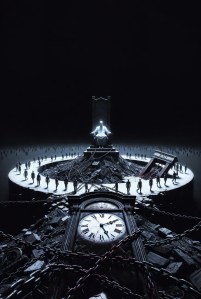
Power no longer circulates; it settles. The immortal remains enthroned while new generations are blocked, and the clock of turnover lies shattered and chained forever.











 bleatmop
 Mystro
 The Arbourist


 Dead Wild Roses
3 comments
Comments feed for this article
May 2, 2026 at 11:22 am
mcmiller36
I think about this topic often but could never articulate my thoughts even half as well. Great post!
LikeLike
May 2, 2026 at 2:36 pm
The Arbourist
I think I’ve read and watched too much science/speculative fiction :) Thanks for the compliment.
What are your thoughts on the possible artificial or machine induced immortality? Good? Bad? Yes?
LikeLike
May 2, 2026 at 3:54 pm
mcmiller36
Tried to reply the usual way but wordpress being weird. I find it extremely disturbing. We’re not meant to continue eternally
LikeLike