
You are currently browsing the daily archive for April 22, 2026.
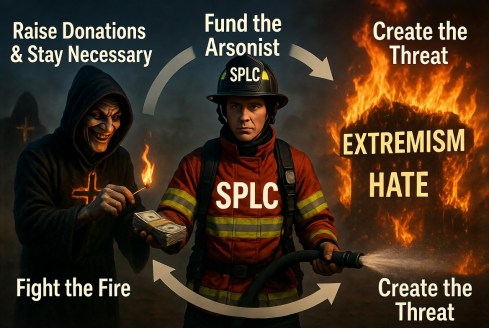
The scandal around the Southern Poverty Law Center matters for one reason above all: it exposes a mechanism.
If the allegations now before a U.S. court are borne out, the charge is stark: an organization built to fight extremism may have been financially entangled with the very actors it claims to oppose. The SPLC says this was an informant program. The Department of Justice says it was something else.
That distinction matters legally. But analytically, the incentive structure is already visible.
Create the threat. Amplify the threat. Position yourself as the authority on the threat. Then monetize the response.
That loop is the story.
And once you see it, you can’t unsee it.
Because the real danger isn’t confined to one American organization. It’s the export model.
“When institutions depend on a problem for their legitimacy, they do not simply respond to it.
They begin—slowly, rationally—to ensure it never goes away.”
In Canada, the same structural incentives are in play. Groups like the Canadian Anti-Hate Network operate within a system where funding, relevance, and authority are tied to the persistence of “hate” as a visible social problem. They do not need to fund extremists to reproduce the same dynamic. They only need to expand the boundary of what counts as extremism.
That is the quieter version of the same loop.
If your mandate depends on the persistence of a threat, then ambiguity becomes an asset. Lines blur. Categories stretch. Dissent edges toward designation. Over time, the distance between “wrong” and “dangerous” collapses.
You don’t need burning crosses if you can redefine disagreement as harm.
This is where the SPLC story stops being scandal and starts becoming signal.
Because the underlying logic is identical:
- The problem must persist
- The threat must remain legible
- The institution must remain necessary
And if reality doesn’t supply enough fuel, the system has incentives to… supplement.
That doesn’t always mean fabrication. More often, it means selection, amplification, and framing. The worst examples are elevated. Edge cases become representative. Boundaries widen quietly.
Until the label “hate” no longer describes a phenomenon—it polices a conversation.
That’s the iceberg.
The visible scandal is shocking because it’s crude. Funding extremists while fundraising against extremism is a contradiction people can grasp immediately. But the more sophisticated version—the one that operates through classification, narrative control, and institutional trust—is harder to detect and far more durable.
And once embedded, it reshapes discourse itself.
People self-censor and institutions defer. Then the obsequious journalists haphazardly cite.
With no regard for truth the designation becomes the argument.
At that point, the system no longer needs to prove anything. It only needs to point.
The SPLC case, if proven, is the blunt instrument version of the problem. The more durable form operates without headlines, through incentives that reward threat maintenance over problem resolution.
That is the real risk.
Because when institutions depend on a problem for their legitimacy, they do not simply respond to it.
They begin, slowly and rationally, to ensure it never goes away.
Sources for readers
- US Department of Justice: https://www.justice.gov/opa/pr/federal-grand-jury-charges-southern-poverty-law-center-wire-fraud-false-statements-and
- CNBC report on the federal indictment of the SPLC:
https://www.cnbc.com/2026/04/21/splc-indicted-doj-extremism-funding.html - The Guardian coverage including SPLC’s response and defense:
https://www.theguardian.com/us-news/2026/apr/21/splc-indictment-doj-response - Juno News reporting on Canadian Anti-Hate Network funding and criticism: https://junonews.com/2025/03/15/canadian-anti-hate-network-government-funding-controversy/
Much of the current conflict around gender identity is framed as a debate about compassion, recognition, and inclusion. At a more basic level, it is also a conflict about language—specifically, whether individuals can be expected to adopt terms that do not align with their understanding of reality.
Pronouns seem like a small thing. In practice, they are not.
They are not simply polite conventions. They function as statements about a person. To use a pronoun is to make a claim, and when that claim is contested, the disagreement is not about tone but about what is being asserted.
For a time, the direction of that disagreement appeared settled. In many settings, declining to use requested pronouns was treated not as a difference of view, but as a form of harm. Social and professional consequences followed—sometimes quickly, sometimes quietly, but with enough consistency to shape behaviour.
That shift matters because it changes the role language plays. It moves from something negotiated between individuals to something that, in certain contexts, is expected and enforced.
There is a difference between courtesy and agreement.
Courtesy is voluntary. It allows for discretion, context, and mutual recognition. Agreement operates differently. It narrows the range of acceptable responses and attaches consequences to deviation. The two can overlap, but they are not the same thing, and treating them as interchangeable obscures the boundary where disagreement becomes difficult to express.
The argument for using preferred pronouns is often framed as a matter of basic dignity—a small concession that reduces friction in everyday life. At that level, it has real force. Most people are willing to extend minor courtesies to make social interactions smoother, especially when the cost appears low.
The difficulty is that this framing does not remain stable.
“Once language is tied to required affirmation, refusal is no longer treated as disagreement, but as harm.”
What begins as a request for courtesy has, in many contexts, become an expectation of agreement. The distinction matters. Courtesy allows for discretion; agreement does not. Once language is tied to a required affirmation, refusal is no longer interpreted as indifference or disagreement, but as harm.
That shift changes the nature of the interaction. It moves from a voluntary accommodation between individuals to a norm that carries social or professional consequences. At that point, the question is no longer whether one is willing to be polite. It is whether one can be required to make a claim one does not believe to be true.
This is why pronouns became a point of pressure.
They are easy to enforce, highly visible, and symbolically loaded. Agreeing to their use is often treated as a minimal concession. Refusing them is treated as a line crossed. That asymmetry is not accidental. It makes pronouns an effective entry point for broader expectations about how language should function.
There is also a boundary question that is harder to avoid than it first appears.
Individuals are free to describe themselves as they choose. That freedom, however, does not automatically extend to requiring others to adopt the same description. At some point, a shared language is still needed, and that language cannot function if its basic terms are entirely detached from common reference points.
For many people, this is where the conflict becomes unavoidable.
Refusing to adopt certain pronouns is not always an act of hostility. In some cases, it is an attempt to preserve a distinction between what one believes to be true and what one is being asked to say. Whether that distinction is respected or overridden has implications that extend beyond the immediate interaction.
Once language becomes a site of compelled agreement, the scope of that agreement rarely remains fixed.
That is why this feels, to some, like an early point of decision. Not because the issue is small, but because it establishes what can be asked—and what must be said.












 bleatmop
 Mystro
 The Arbourist


 Dead Wild Roses
Your opinions…