
You are currently browsing the tag archive for the ‘Language’ tag.
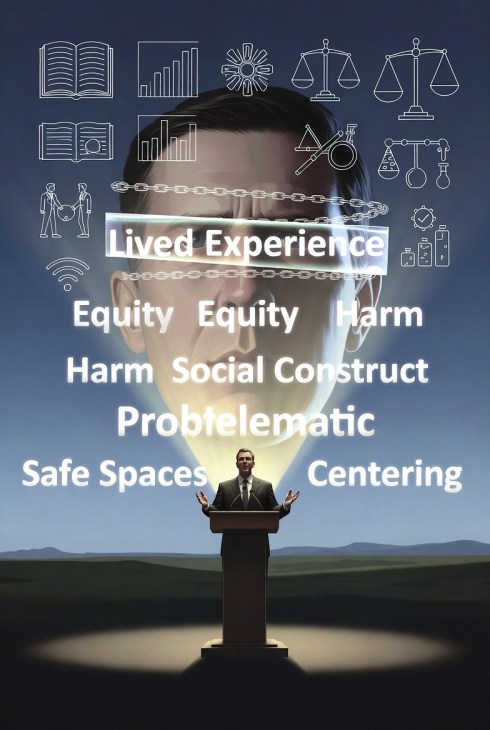
You can usually tell what kind of argument you’re about to hear before the argument is made.
It’s in the language.
Certain words don’t just describe reality—they quietly reframe it, often in ways that make disagreement harder before it even begins. They shift the ground you’re standing on, sometimes without you noticing.
Once you recognize them, the pattern becomes difficult to miss.
“By the time the argument begins, much of it has already been decided.”
Here are a few to listen for.
“Lived experience”
Often used to elevate subjective accounts above other forms of evidence.
Experience matters. But when it becomes the final authority, it can no longer be questioned or compared. At that point, it stops being evidence and becomes a conclusion.
“Social construct”
A useful concept in limited contexts. Overextended, it suggests that because something is shaped by society, it is therefore arbitrary or infinitely malleable.
The move is subtle: from influenced by culture to not anchored in reality at all.
“Harm”
A word that has expanded far beyond physical or material damage.
Disagreement, discomfort, or perceived invalidation can all be folded into it. Once that happens, ordinary debate starts to look like misconduct.
“Equity”
Not the same as equality.
It shifts the focus from equal rules to equal outcomes. That shift often justifies unequal treatment in the name of correcting disparities.
“Centering” / “Decentering”
Signals who is allowed to speak, and whose perspective is treated as primary.
Less about argument, more about managing whose voice carries authority.
“Problematic”
A soft accusation that avoids specificity.
It implies wrongdoing without clearly stating what the problem is, which makes it difficult to respond directly.
“Safe spaces”
Originally about protection from harassment. Now often used to limit exposure to challenging or opposing ideas.
The definition quietly expands from safety from harm to safety from disagreement.
None of these words are inherently illegitimate. The issue is how they are used. Individually, they can be useful. In combination, they tend to narrow the space for disagreement.
When they appear together, they often shift discussion away from evidence, elevate subjective claims beyond challenge, and quietly limit what can be said without consequence. By the time the argument begins, much of it has already been decided.
When you hear language like this, a simple question is usually enough: what claim is being made—and could I reasonably disagree with it? If the answer is no, you are no longer in a normal debate. You are being asked to accept a framework, not evaluate an argument.
This pattern isn’t unique to any one ideology. It appears wherever language is used to secure agreement before the argument begins. Language doesn’t just communicate ideas—it sets the terms under which those ideas can be questioned, and sometimes whether they can be questioned at all.
Much of the current conflict around gender identity is framed as a debate about compassion, recognition, and inclusion. At a more basic level, it is also a conflict about language—specifically, whether individuals can be expected to adopt terms that do not align with their understanding of reality.
Pronouns seem like a small thing. In practice, they are not.
They are not simply polite conventions. They function as statements about a person. To use a pronoun is to make a claim, and when that claim is contested, the disagreement is not about tone but about what is being asserted.
For a time, the direction of that disagreement appeared settled. In many settings, declining to use requested pronouns was treated not as a difference of view, but as a form of harm. Social and professional consequences followed—sometimes quickly, sometimes quietly, but with enough consistency to shape behaviour.
That shift matters because it changes the role language plays. It moves from something negotiated between individuals to something that, in certain contexts, is expected and enforced.
There is a difference between courtesy and agreement.
Courtesy is voluntary. It allows for discretion, context, and mutual recognition. Agreement operates differently. It narrows the range of acceptable responses and attaches consequences to deviation. The two can overlap, but they are not the same thing, and treating them as interchangeable obscures the boundary where disagreement becomes difficult to express.
The argument for using preferred pronouns is often framed as a matter of basic dignity—a small concession that reduces friction in everyday life. At that level, it has real force. Most people are willing to extend minor courtesies to make social interactions smoother, especially when the cost appears low.
The difficulty is that this framing does not remain stable.
“Once language is tied to required affirmation, refusal is no longer treated as disagreement, but as harm.”
What begins as a request for courtesy has, in many contexts, become an expectation of agreement. The distinction matters. Courtesy allows for discretion; agreement does not. Once language is tied to a required affirmation, refusal is no longer interpreted as indifference or disagreement, but as harm.
That shift changes the nature of the interaction. It moves from a voluntary accommodation between individuals to a norm that carries social or professional consequences. At that point, the question is no longer whether one is willing to be polite. It is whether one can be required to make a claim one does not believe to be true.
This is why pronouns became a point of pressure.
They are easy to enforce, highly visible, and symbolically loaded. Agreeing to their use is often treated as a minimal concession. Refusing them is treated as a line crossed. That asymmetry is not accidental. It makes pronouns an effective entry point for broader expectations about how language should function.
There is also a boundary question that is harder to avoid than it first appears.
Individuals are free to describe themselves as they choose. That freedom, however, does not automatically extend to requiring others to adopt the same description. At some point, a shared language is still needed, and that language cannot function if its basic terms are entirely detached from common reference points.
For many people, this is where the conflict becomes unavoidable.
Refusing to adopt certain pronouns is not always an act of hostility. In some cases, it is an attempt to preserve a distinction between what one believes to be true and what one is being asked to say. Whether that distinction is respected or overridden has implications that extend beyond the immediate interaction.
Once language becomes a site of compelled agreement, the scope of that agreement rarely remains fixed.
That is why this feels, to some, like an early point of decision. Not because the issue is small, but because it establishes what can be asked—and what must be said.

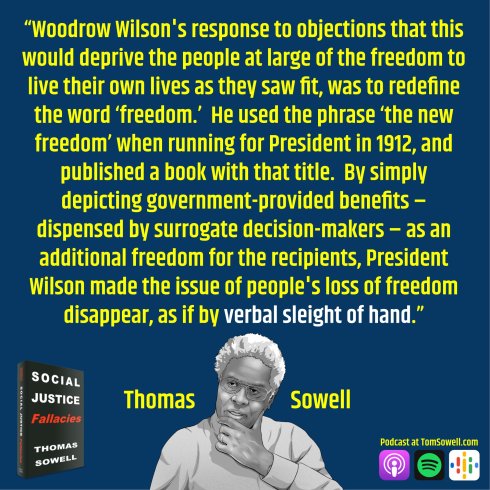
This is why we need to be so careful with our language and people who want to deform it for their own political ends. The activist Left uses the same vernacular as most ordinary people do, but also have a second meaning which also use that reflect their true intentions. In an argument, they flip between what is commonly understood and their special meaning of the word. Until you stake out exactly what they mean, and get them to define their terms they will run you around the mulberry bush bouncing between the different definitions of the same word.
Need an example – Take the word “inclusion”. See what you think it means, then find out what how the activist Left uses the term.
Learning about how language changes overtime is fascinating. An excerpt from Lane Greene essay over at Aeon.
“There is something odd about the vowels of English. Have you ever noticed that every language in Europe seems to use the letter A the same way? From latte to lager to tapas, Italian, German and Spanish all seem to use it for the ah sound. And at some level, this seems natural; if you learn frango is ‘chicken’ in Portuguese, you will probably know to pronounce it with an ah, not an ay. How, then, did English get A to sound like it does in plate, name, face and so on?
Look around the other ‘long’ vowels in English, and they seem out of whack in similar ways. The letter I has an ee sound from Nice to Nizhni Novgorod; why does it have the sound it does in English write and ride? And why do two Os yield the sound they do in boot and food?
The answer is the Great Vowel Shift. From the middle English period and continuing into the early modern era, the entire set of English long vowels underwent a radical disruption. Meet used to be pronounced a bit like modern mate. Boot used to sound like boat. (But both vowels were monophthongs, not diphthongs; the modern long A is really pronounced like ay-ee said quickly, but the vowel in medieval meet was a pure single vowel.)
During the Great Vowel Shift, ee and oo started to move towards the sounds they have today. Nobody knows why. It’s likely that some people noticed at the time and groused about it. In any case, there was really a problem: now ee was too close to the vowel in time, which in that era was pronounced tee-muh. And oo was too close to the vowel in house, which was then pronounced hoose.
Speakers didn’t passively accept the confusion. What happened next shows the genius of what economists call spontaneous order. In response to their new pushy neighbours in the vowel space, the vowels in time and house started to change, too, becoming something like tuh-eem and huh-oos. Other changes prompted yet more changes, too: the vowel in mate – then pronounced mah-tuh – moved towards the sound of the modern vowel in cat. That made it a little too close to meat, which was pronounced like a drawn-out version of the modern met. So the vowel in meat changed too.
Throughout the system, vowels were on the move. Nobody in a 15th-century tavern (men carried knives back then) wants to confuse meet, meat and mate. So they responded to a potentially damaging change by changing something else. A few vowels ended up merging. So meet and meat became homophones. But mostly the system just settled down with each vowel in a new place. It was the Great Vowel Shift, not the Great Vowel Pile-Up.
Such shifts are common enough that they have earned a name: ‘chain shifts’. These are what happens when one change prompts another, which in turn prompts yet another, and so on, until the language arrives at a new equilibrium.”
“Clear language – lucid, rational language – to a man at war with both truth and reason, is an existential threat. Clear language to such a man is a direct assault on his obfuscations, contradictions and lies. To him, it is the voice of the enemy. To him, it is fake news. Because he knows, if only intuitively, what we know to our cost: that without clear language, there is no standard of truth.”
-John Le Carré
I do like the Germans and their language specific words, here is a list of some of them. :)
Engelsgeduld: (lit.: angel’s patience) great amount of patience
Feierabend: (lit.: party-evening) the rest of the day that remains after work
Fernweh: the desire/longing to travel to faraway places/ foreign countries
Fingerspitzengefühl: (lit.: fingertips-feeling) good skill in handling things/ sensitivity and empathy
Fremdschämen: (lit.: foreign shame) shame that arises from the compassion with someone who made a fool of himself
Geborgenheit: more than safety, protection and invulnerability, it symbolises peace, warmth and calm you feel especially when you’re with the people you’re close to (e.g. family, friends)
Gemütlichkeit: feeling of comfort
Habseligkeiten: valuable and personally important possessions
Innerer Schweinehund: (lit.: inner pig-dog = weaker self) the part of a person that they have to overcome to be productive
Kitsch: objects with superficial beauty that are actually useless but are appreciated nonetheless
Konfliktfähigkeit: (lit.: conflict ability/skill) ability to deal with conflict / ability to constructively solve interpersonal conflicts
Kummerspeck: (lit.: grief/sorrow bacon (fat)) gained weight from emotional overeating (especially after a breakup)
Lebenslüge: (lit.: life’s lie) a lie that you tell yourself to make life more bearable
Mitdenken: (lit.: with-thinking) ability to think for yourself and do more than what you were demanded to do / trying to find a conceptional solution to a problem together with other people
Sehnsucht: intense inner longing for somebody, something or a place
Schnapsidee: (lit.: schnapps idea) a ridiculous and crazy plan/idea you have while you are drunk
Sprachgefühl: (lit.: language feeling) feeling/sense of language, instinctive feel for a certain language / intuitive feeling of what is linguistically appropriate
Stehaufmännchen: (lit.: little stand up man) someone who doesn’t give up and begins anew
Torschlusspanik: (lit.: gate-closing-panic) the fear of missing something important / not being able to do some things (because you’re too old)
Verschlimmbessern: (lit.: verschlimmern=exasperate, verbessern=improve) improve something for the worse / make something worse but with having had the intention of improving it
Vorführeffekt: (lit.: demo effect) the effect that something you’re actually able to do doesn’t work when you want to demonstrate it to other people
Waldeinsamkeit: (lit.: forest loneliness/solitude) the seclusion/solitude of the forest
Warmduscher: (lit.: warm showerer/ somebody who showers with warm water) a wimp / a person that doesn’t like to leave their comfort zone
Weltschmerz: (lit.: world pain (world weariness)) gratuitous melancholia / kind of feeling experienced by someone who believes that physical reality can never satisfy the demands of the mind / the feeling of anxiety caused by the ills of the world
Zeitgeist: (lit.: time-spirit, spirit of the time ) the dominant set of ideals and beliefs that motivate the actions of the members of a society in a particular period in time
Auntie Wanda on the Pronoun Game.
“Pronouns refer to visible sex and a man is referred to as a “he.” Not everyone has to play your word games.”
“Pronouns aren’t malicious, they’re neutral words that refer to female people and male people respectively. The knowledge that our species has two sexes isn’t malicious either.
I’ve never once had a gender identity proponent clearly articulate what they even think the words “woman” and “man” mean beyond being common words for people with specific sex-differentiated biology. As far as I’m concerned it’s a bunch of people adhering to and perpetuating sexist ideas that being a woman or man is something beyond biology, some inherent personality or behavior. And that’s malicious. “











 bleatmop
 Mystro


 Dead Wild Roses
Your opinions…