
You are currently browsing the category archive for the ‘Queer Bullshit’ category.
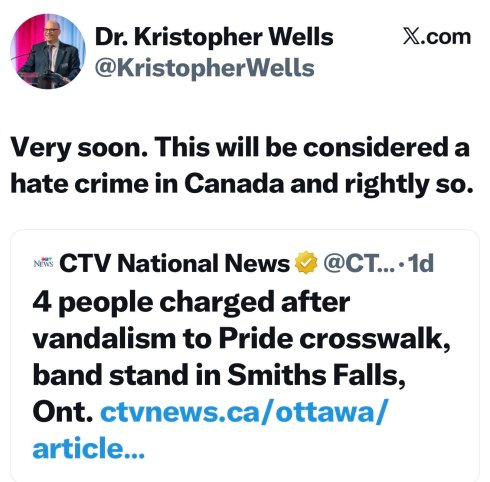
The Smiths Falls rainbow crosswalk incident is useful because it is small enough to see the pattern clearly.
Someone vandalized a municipal rainbow crosswalk. That is wrong. Public property was damaged, and ordinary criminal law already covers it: mischief, property damage, fines, restitution, cleanup. Use those tools.
The escalation is the problem. Kristopher Wells suggested this kind of vandalism should soon be treated as a hate crime, and “rightly so.” That turns damaged paint on a road into something much larger: an attack on an entire community, a public safety event, and a test of whether the state will treat disrespect toward a progressive symbol as criminal hatred.
Hate motivation can matter. A swastika on a synagogue, threats painted on a family’s home, or targeted destruction meant to intimidate a minority community is not just graffiti. The act carries a message. The law can recognize that.
But evidence has to do the work. Not activist framing, media amplification, institutional pressure, or the assumption that because a symbol represents a protected group, contempt for the symbol must be treated as hatred toward the group.
A rainbow crosswalk is not private expression. It is a public installation, approved by a municipality, painted on shared civic property, and usually funded through public money. Citizens are allowed to support it. They are also allowed to dislike it, object to it, mock it, or argue that local governments should not turn infrastructure into moral messaging.
None of that excuses vandalism. The vandal still damaged property. Charge the conduct.
The problem is what happens after the spray paint dries. Activists demand the heaviest moral and legal frame available. Police and prosecutors are pressured to read ideological meaning into the act. Media coverage turns a local property offence into a symbolic attack on “the community.” The damaged object becomes less important than the ritual around it.
That is the weaponization problem. Progressive causes increasingly try to convert contested public symbols into protected civic relics. Once that happens, the state is no longer being asked only to punish damage. It is being asked to police the meaning of disrespect.
The older liberal case for gay rights had force because it demanded equal treatment under the law: no jailing, no firing, no harassment, no denial of ordinary civic dignity. That case asked the state to stop treating gay people as legal outsiders.
This newer pattern asks the state to do something different. It asks the state to affirm symbols, language, and institutional rituals, then treat resistance as suspect. The public notices the difference, even when it lacks the vocabulary for it.
Smiths Falls should handle this as vandalism unless clear evidence of targeted intimidation, threats, organized harassment, or explicit hatred toward identifiable people emerges. If that evidence exists, bring it forward. If it does not, damaged municipal paint should not be inflated into a hate-crime drama.
A society can punish vandalism without sacralizing public symbols. It can protect actual people without letting activists turn insult, contempt, or disrespect into presumptive criminal hatred.
That distinction is not a technicality. It is one of the ways a free society keeps criminal law from becoming a tool of ideological management.
The recent Tickle v Giggle ruling exposes a widening gap between legal language and ordinary reality.
The court held that a female-only app unlawfully discriminated against a ‘transgender woman’ by excluding him from the platform. The legal mechanism matters: this was framed through gender-identity discrimination protections. But the practical result is hard to miss. A space created for women was told it could not draw its boundary around being female.
That has consequences beyond one app.
Women’s sex-based protections exist because sex is real. Pregnancy is real. Male-pattern violence is real. Privacy concerns in shelters, prisons, changing rooms, sports, and intimate female spaces are not imaginary. They are not bigotry dressed up as discomfort. They arise from material differences that law once had enough common sense to recognize.
A humane society can treat transgender people with dignity and still preserve female-only spaces. Those two duties are not enemies unless ideology makes them so.
The problem with this ruling is that it pushes women into the old subordinate role again: accommodate first, object later, and expect punishment if the objection sounds too firm. Female boundaries become negotiable. Female discomfort becomes suspect. Meanwhile, identity claims are treated as moral imperatives that everyone else must organize around.
That is not equality. It is a new hierarchy with better manners.
Ordinary people notice the coercion. They notice the pressure to say things publicly that they do not believe privately. They notice that everyone still understands what sex is when the issue is medical care, crime statistics, pregnancy, or athletics, but suddenly becomes confused when women try to maintain a boundary.
This is why the issue refuses to disappear. Reality keeps returning through the side door.
The law should protect every citizen from harassment and mistreatment. But it should not compel society to pretend that sex is meaningless. If women cannot define female-only spaces around biological sex, then “woman” has lost the legal coherence that made women’s rights possible in the first place.
This decision should be overturned, and the law should be clarified: sex means biological sex where single-sex spaces, services, sports, and protections are concerned.
Without that correction, women are being told to move aside in the name of inclusion.
They have heard that instruction before.

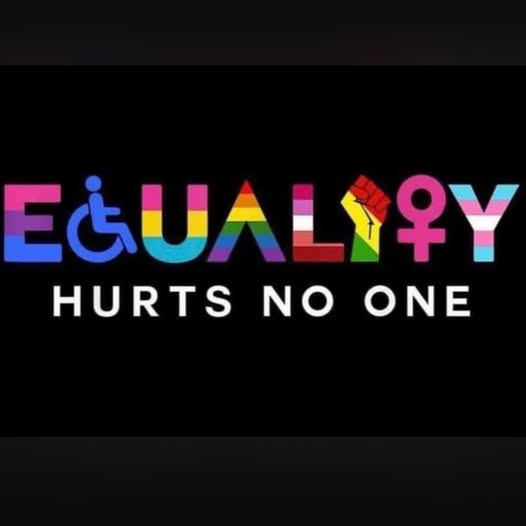
There’s a reason this image works. It uses a word almost everyone agrees with—equality—and then quietly fills that word with something else. The result is not an argument. It’s a substitution.
Look at it closely. The word “EQUALITY” is rendered in bright, appealing colors, layered with symbols of recognizable identity categories: disability, sexuality, gender, race, activism. Beneath it, the slogan: “hurts no one.” At the level of feeling, this is uncontroversial. Of course equality hurts no one. That’s the point of the concept. Equal treatment under the same rules is the baseline promise of any liberal order. But that is not what the image is actually depicting. The text says equality. The visual payload says something else entirely.
Equality, properly understood, is individual and procedural. It asks a simple question: are the same rules being applied to each person, regardless of who they are? It does not guarantee equal outcomes. It does not engineer results. It does not sort people into categories and adjust treatment accordingly. It holds the line at equal standing before the law and equal access to opportunity. That is why it is durable. It does not require constant intervention or measurement. It does not need to know who you are in order to decide how you should be treated.
The imagery in this poster points in a different direction. It is not concerned with individuals. It is concerned with groups. Each symbol represents a category that, within contemporary political frameworks, is treated as requiring not just equal treatment, but differential treatment in order to achieve parity of outcomes. That is the logic behind quotas, preferences, representational mandates, and a wide range of institutional policies now grouped under the umbrella of equity. That distinction matters. Because once you move from equal treatment to managed outcomes, you have to start making choices about who gets what, and why.
This is where the slogan “hurts no one” stops doing honest work. Equality, in the classical sense, really does not hurt anyone. It simply refuses to privilege or penalize based on identity. Equity, by contrast, is not costless. It reallocates opportunities. It lowers or shifts standards in some contexts. It elevates some groups explicitly. That may be justified in specific cases, but it is not neutral, and it is not universally painless. Someone is always paying the adjustment.
The poster resolves this tension through a familiar rhetorical move. It collapses the distinction. By wrapping equity-coded symbols inside the word equality, it invites the viewer to endorse a more controversial framework under the banner of a universally accepted one. The move is subtle enough that many people will not notice it, but strong enough that disagreement can be framed as opposition to “equality” itself. That is not clarification. It is camouflage.
The poster says equality. It is not. And pretending otherwise is not harmless, no matter how bright the colors or how reassuring the slogan.
You can see the tell in the composition. If the message were truly about equality in the classical sense, the image would not need to foreground identity categories at all. It would not need symbols. It would not need color-coding. The entire point of equality is that the categories do not matter when rules are applied. Here, the categories are the point. They are not incidental. They are doing the conceptual work.
None of this means the concerns associated with those categories are trivial or illegitimate. Some are serious. Some are contested. Some are overextended. All of them deserve to be argued on their own terms. But that argument has to be made honestly. It cannot be smuggled in under a word that already carries broad moral agreement.
This is the broader pattern. Take a term with a stable, widely accepted meaning. Expand or alter the underlying concept. Keep the original word. Let the new meaning ride on the old legitimacy. If challenged, collapse the distinction and accuse critics of opposing the original value. It is effective. It is also corrosive.
Words are not decoration. They are load-bearing. If we stop distinguishing between equality and equity, we lose the ability to argue about either of them clearly. And when that happens, policy follows confusion. Decisions get made without admitting what is being traded off, or who is being prioritized. That is not a small failure. It is how serious disagreements get papered over until they break.
The woke left speaks endlessly about colonization, erasure, and the violence of imposing alien categories onto other peoples. Then, on gender, it does exactly that. “Two-spirit” is not a generic synonym for nonbinary or trans. It was coined in a specific Indigenous context, for Indigenous people, to describe realities bound up with particular nations, ceremonial roles, and community obligations. The same is true of hijra, fa’afafine, bissu, and similar roles elsewhere. These are not free-floating proof texts for Western activists. They are culturally embedded forms of life. To strip them out of their own cosmologies and social structures, then redeploy them as evidence for a universal modern gender framework, is not solidarity. It is appropriation with moral vanity attached.
“The people most fluent in the language of decolonization cannot stop subordinating Indigenous meaning to Western identity fashion.”
The same pattern appears in history. Joan of Arc, Chevalier d’Eon, Herculine Barbin, and other ambiguous or unusual figures are routinely conscripted into a modern trans genealogy, as if the past existed chiefly to validate present slogans. But this is not historical recovery. It is retrospective annexation. These people lived inside worlds structured by religion, law, custom, sex, status, and necessity in ways that do not map cleanly onto 21st-century identity language. To force modern labels onto them is not to “see” them at last. It is to erase the terms on which they actually understood themselves. The activist flatters himself that he is rescuing the past from ignorance. In reality he is recolonizing it.
That is the real irony. The people most eager to denounce Western universalism cannot stop universalizing their own categories. The people most fluent in the language of decolonization cannot stop subordinating Indigenous meaning to Western identity fashion. The people most obsessed with “listening to lived experience” routinely ignore living communities when those communities resist being folded into the approved script. This is not liberation. It is a familiar imperial habit in progressive costume: take what is particular, local, sacred, and historically bounded, flatten it into an abstract category, and then call the theft inclusion.
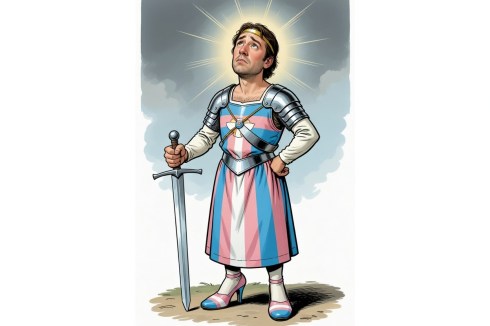
John of Arc
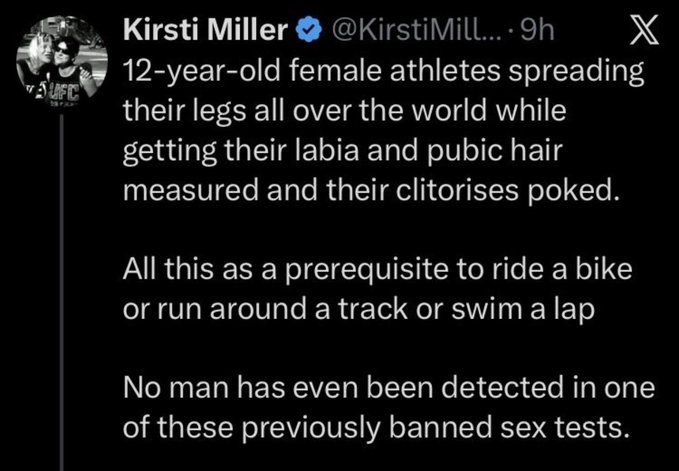
This is not argument. It is selective framing used to shut the argument down before it begins.
Yes, sport once used degrading sex tests. The old “nude parade” era was real. Women were subjected to visual and even anatomical examination in the 1960s, and those practices deserved to die. But that is not the current rule. The current activist trick is to drag the ugliest abuses of the past into the frame, staple them to a modern eligibility rule, and hope the reader is too disgusted to notice the switch.
The IOC’s new Olympic rule is not genital inspection of random girls. Reuters reports it is a one-time SRY-gene screen for elite female-category eligibility, using saliva, a cheek swab, or blood, and that it applies from LA 2028 onward to the Olympic pathway, not to amateur sport. Athletes who test positive can still compete in male, mixed, or open categories. That is not barbarism. It is category enforcement.
World Boxing is also not what the tweet implies. Its published policy applies to athletes over 18 in World Boxing-owned or sanctioned events, using a once-in-a-lifetime PCR or equivalent genetic test. Again, this is not “little girls can’t ride a bike without a genital exam.” It is a rule for elite competition in a combat sport where fairness and safety are not decorative concerns.
That is why this rhetoric is dishonest. It does not answer the real question, because the real question is hard: if female sport is a protected sex category, how is that category enforced when eligibility is disputed? Instead of answering that, activists change the subject. They substitute panic imagery, selective history, and moral blackmail. They want “naked parade” and “cheek swab” to feel like the same thing. They are not the same thing.
“A category that cannot be enforced is not protected. It is ornamental.”
The old methods were degrading and scientifically crude. Fine. Then make the process narrower, cleaner, and more private. But do not pretend that the female category can exist on the condition that no one is ever allowed to verify it. A category that cannot be enforced is not protected. It is ornamental. And that is the actual goal of this rhetoric: not to protect women from cruelty, but to make fairness, boundaries, and safety in female sport impossible to defend without first apologizing for something nobody is proposing.
“Trans kids didn’t exist until we created them” is blunt phrasing, but the mechanism underneath it is real: kids don’t merely reveal identities; they adopt the identity-models a culture supplies and rewards. Adolescence is a meaning-factory. Pain looks for an explanation. Alienation looks for a tribe. If adults and institutions elevate one interpretive story for distress and then attach moral prestige, protection-from-questioning, and instant community to that story we should expect more kids to step into it. Not because every child is “lying,” but because this is how social scripts spread: they simplify suffering, convert it into status, and offer belonging on demand.
Proponents will tell a cleaner story. They claim “trans kids have always existed” and we’re simply seeing higher visibility in a less stigmatizing age. They claim affirmation is harm reduction. They claim the clinical pathway is cautious, selective, and evidence-informed. And they claim the “social contagion” frame is just a pretext to dismiss real dysphoria. That’s the best version of their public narrative: visibility + safety + compassion + careful medicine. The problem is that this narrative asks society to treat disputed assumptions as settled truth and then to treat moral confidence as a substitute for evidence – precisely in the domain where evidence must be strongest: irreversible interventions for minors.
That’s where the ideology runs aground. The evidence base for pediatric medical transition—especially puberty suppression—has repeatedly been assessed as weak and low-certainty. The York-led systematic review published in Archives of Disease in Childhood concluded there is a lack of high-quality research on puberty suppression in adolescents with gender dysphoria/incongruence, and that no firm conclusions can be drawn about impacts on dysphoria or mental/psychosocial outcomes. A 2025 systematic review in the same journal similarly characterized the best available evidence on puberty blockers’ effects as mostly very low certainty. This isn’t a minor academic quibble. It’s the difference between “we have strong reasons to believe this helps, on balance” and “we cannot be confident what this does to developing bodies and minds.” When the confidence level is that low, the ethical default is not acceleration; it’s restraint.
And restraint is exactly what some public health systems have moved toward—because the claims didn’t cash out in robust evidence. In the UK, the NHS stopped routine prescribing of puberty blockers for under-18s and restricted them to research context, and the government moved to make restrictions indefinite after expert advice citing insufficient evidence of safety. NHS England’s Cass implementation materials also frame puberty blockers as part of a research program with long-term follow-up, alongside evaluation of psychosocial interventions. That is not what “settled science” looks like. That is what a field looks like when it is finally admitting—late—that it has been making high-stakes moves on thin ice.
Now zoom out from the clinic to the culture, because this is the part people keep refusing to say out loud: the social environment is not neutral. Once schools, media, and professional bodies moralize one framework (“affirmation is care”) and stigmatize alternatives (“questioning is harm”), you get a one-way ratchet. A child declares an identity; the adults are trained that the declaration must be treated as authoritative; “exploration” becomes suspect if it doesn’t begin with affirmation; and any friction is rebranded as abuse. That moral framing isn’t compassion—it’s epistemic closure. And epistemic closure is exactly how you end up routing heterogeneous adolescent distress into a single explanatory funnel.
Because the presenting population isn’t one thing. It’s a mix: anxiety, depression, trauma, obsessive traits, social contagion dynamics, autism-spectrum features, sexual discomfort, body dysmorphia, internalized homophobia, loneliness, and the general misery of puberty in a screen-soaked status economy. Give that mix one glamorous story with institutional backing, and you will pull more children into it. You will also make it harder for them to exit, because the identity becomes socially defended and medically reinforced. Once irreversible steps begin, doubt becomes expensive. Regret becomes unspeakable. The “care model” becomes self-protecting: the deeper you go, the harder it is to admit the initial certainty was misplaced.
This is why I don’t treat “gender-affirming care” as a neutral phrase. It’s marketing language for a clinical posture that—too often—front-loads conclusion and back-loads caution. Real care for minors under uncertainty looks boring: slow assessment, serious differential diagnosis, treatment of comorbidities, family stability, and time. Real care doesn’t require anyone to be cruel. It requires adults to resist the temptation to turn a child’s distress into an adult moral performance. It requires institutions to stop rewarding certainty and punishing skepticism. It requires the basic humility to say: “We might not know what’s going on yet, and that means we don’t get to make irreversible bets with children.”
If we don’t change course, the end state is predictable. More kids will be swept into an identity pipeline that confers instant meaning but demands escalating commitment. More parents will be coerced by policy and stigma rather than persuaded by evidence. More clinicians will practice defensively in a moralized climate. And the backlash won’t stay polite or surgical; it will arrive as a blunt instrument, because careful critics were dismissed as hateful for too long. That’s the social damage: not merely the trend itself, but the institutional refusal to admit uncertainty until the human costs become impossible to ignore.

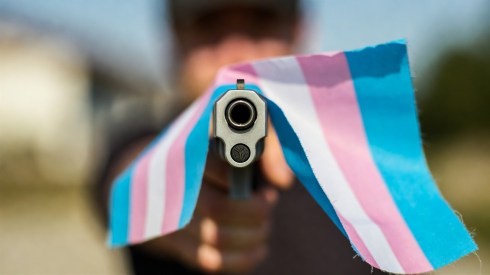
In the remote British Columbia town of Tumbler Ridge, a horrific school shooting unfolded on February 10, 2026, claiming eight lives, including five children aged 12 to 13 and a female educator, while injuring more than two dozen others. One 12-year-old girl remains in critical condition with severe brain trauma from a gunshot wound to the head. The perpetrator, 18-year-old Jesse Van Rootselaar, a biological male who had been transitioning and identifying as female since approximately age 12, first killed their 39-year-old mother and 11-year-old stepbrother at home before opening fire at Tumbler Ridge Secondary School. Van Rootselaar then died by suicide. Authorities noted a history of mental health crises, multiple police interventions at the family home, school dropout several years prior, and access to household firearms despite an expired license.
Canadian legacy media outlets, including CTV, quickly pivoted to familiar territory: gun control. Coverage highlighted past mass shootings as drivers for stricter firearm laws, the suspect’s lapsed license, and questions about why previously seized household weapons were returned. This framing reduced the tragedy to a debate over firearms access rather than examining the full context of the shooter’s background and actions. By prioritizing this narrative, major outlets failed to provide the public with a complete picture, focusing on policy talking points instead of the human and societal elements at play.
The cultural and personal factors warrant far greater scrutiny. Van Rootselaar’s transition began in early adolescence, a developmental stage coinciding with documented mental health challenges and police contacts. Broader societal patterns include rising youth mental health crises potentially linked to identity-based ideologies, social influences on gender dysphoria, family disruptions, and widespread use of psychiatric medications. When media outlets gloss over or sideline these dimensions in favor of gun-centric stories, they shield uncomfortable truths about how modern cultural pressures such as rapid affirmation of gender confusion in minors may contribute to instability in vulnerable young people.
This selective reporting directly endangers the public. By obsessing over gun restrictions while minimizing mental health epidemics, the effects of early gender transitions amid distress, and the role of identity politics, media and policymakers divert attention from actionable prevention. Communities, families, and educators lack candid discussion of warning signs or reforms needed to address root causes. The outcome is repeated tragedies, as resources target symptoms among law-abiding citizens rather than the underlying cultural and psychological drivers producing alienated or radicalized youth.It is time to demand truthful journalism that confronts reality head-on. The Tumbler Ridge victims deserve more than politicized narratives that dishonor their memory by avoiding difficult conversations about mental illness, unchecked gender ideology, and societal conditions fostering despair. Facing these issues honestly through better mental health support, cautious approaches to youth transitions, and cultural course correction offers the best hope of preventing future horrors.
Legacy media’s reluctance to engage fully undermines public safety and erodes trust when clarity is most needed.
References
- CNN: Canada mass shooting at a school and home (February 11-12, 2026) – https://www.cnn.com/world/live-news/tumbler-ridge-canada-shooting-02-11-26
- USA Today: Who is Jesse Van Rootselaar, teen who killed 8 in Canada – https://www.usatoday.com/story/news/nation/2026/02/11/jesse-van-rootselaar-tumbler-ridge-canada-shooter/88631889007/
- CTV News: Mass shootings in Canada have helped prompt changes to firearm laws – https://www.ctvnews.ca/politics/article/mass-shootings-in-canada-have-helped-prompt-changes-to-firearm-laws-over-the-decades/
- BBC News: Police name suspect in Canada school shooting as 18-year-old Jesse Van Rootselaar – https://www.bbc.com/news/live/cr5lnzqdr5pt
- Al Jazeera: Canada police identify shooting suspect as 18-year-old Jesse Van Rootselaar – https://www.aljazeera.com/news/2026/2/12/canada-police-identify-shooting-suspect-as-18-year-old-jesse-van-rootselaar
- Additional reporting from The New York Times, CBC News, and official RCMP statements via multiple outlets.











 bleatmop
 Mystro
 The Arbourist


 Dead Wild Roses
Your opinions…