
You are currently browsing the tag archive for the ‘Liberalism’ tag.
There are few modern spectacles more interesting than Richard Dawkins speaking warmly about Christianity.
Not converting. Not recanting The God Delusion. Not wandering into Evensong with a softened heart and a sudden interest in incense. But speaking warmly, nevertheless.
 Dawkins has called himself a “cultural Christian.” He remains an atheist, which is what makes the admission interesting. He is not saying Christianity is true. He is noticing that Christianity helped form a civilization in which he could become Richard Dawkins: skeptical, eloquent, publicly irreverent, protected enough to criticize sacred things, and still culturally at home among the ruins and residues of the faith he rejects.
For a long time, many secular Westerners treated Christianity as something they had outgrown. It was old, morally complicated, often hypocritical, and associated with repression, scolding, and bad Sunday mornings. Keep the music, perhaps. Keep the architecture. Keep Christmas, provided no one gets doctrinal about it. The rest could be packed away.
There were reasons for that impatience. Churches persecuted, censored, lied, protected abusers, cozied up to power, and sometimes confused institutional self-interest with the will of God. No honest appreciation of Christian civilization can skip that part. But there is a difference between remembering the failures of an inheritance and forgetting that we inherited anything worth having.
The West was not built from one source. It is a quarrelsome inheritance: Greek reason, Roman law, Jewish moral seriousness, Christian theology, Germanic custom, common law, Reformation fracture, Enlightenment skepticism, scientific inquiry, and the long institutional habit of limiting power. Christianity did not invent every virtue from nothing, but it became one of the great furnaces in which those virtues were universalized, moralized, preached, contradicted, betrayed, and recovered.
Modern liberalism did not merely inherit Christian assumptions and put them in nicer clothes. It built institutions Christianity often resisted: robust free speech, religious disestablishment, broader suffrage, empirical science protected from clerical authority, and legal equality that went well beyond what most Christian societies were willing to grant. Some of the freedoms Dawkins enjoys were made possible by Christian moral inheritance. Others required sharp breaks from dominant Christian practice.
That tension is the point. The West is the product of argument, correction, rebellion, restraint, and institutional memory.
This is what modern secular people often miss. We imagine ourselves as freestanding moral adults. We believe in human dignity, equality before the law, freedom of conscience, care for the vulnerable, suspicion of tyranny, and the right to criticize authority. Fine. Keep all of that. But those commitments have a history. They were not produced by vibes, nor assembled last Tuesday by a committee with a land acknowledgement and a catering budget.
They came through centuries of conflict, doctrine, reform, law, blood, repentance, philosophy, institutional restraint, and exhaustion after too many people had killed each other over ultimate things.
To appreciate that inheritance is not to baptize every part of it. Christendom was not gentle. Christianity often had to be forced into better conduct by dissidents, reformers, scientists, heretics, abolitionists, and Christians reading their own scriptures more honestly than their institutions did. The West’s moral inheritance was not a clean gift. It was an argument, often conducted under pressure.
“The West is the product of argument, correction, rebellion, restraint, and institutional memory.”
But the argument happened inside a civilization shaped deeply by Christianity.
The freedom to doubt, mock religion, publish irreverent books, leave a faith, criticize clerics, and live without being ruled by priests was not inevitable. Nor was the expectation that women may walk unveiled, educated, employed, politically equal, and legally protected. These are achievements produced by particular histories, institutions, and moral restraints.
That is where Dawkins’ comparison with Islam enters the discussion, though it needs care.
The issue is not Muslim neighbours. Millions of Muslims live peacefully, work hard, raise families, keep faith privately, and want the ordinary goods everyone else wants: safety, dignity, friendship, decent schools, and a stable life. A serious argument begins by refusing collective suspicion.
The harder question is what happens when Islamic doctrine becomes politically confident and expects the wider society to accommodate its rules around blasphemy, apostasy, religious offence, sex roles, homosexuality, and public criticism. Outcomes differ by interpretation, education, migration patterns, and host-society confidence, but liberal societies still cannot survive by pretending every moral and legal order is equally compatible with liberal freedom.
Dawkins seems to understand that cultural Christianity has learned to live with disbelief in a way many religious systems have not. The Anglican church may annoy you. It may bore you. It may produce beige sermons, awkward committees, and hymns sung by twelve people spread across a nave built for three hundred. But it is unlikely to demand the state punish you for mocking it, which is not a small thing.
“But criticism without gratitude curdles into contempt, and contempt is a poor steward of anything worth preserving.”
The Sunday lesson, then, is not “become Christian or die,” nor “atheists secretly know God is real,” nor “all Muslims are enemies.” It is more modest and more useful: know where you are standing.
If you live in the West, you live inside an inheritance. You may criticize it. You should criticize it. The tradition itself contains the tools for doing so. But criticism without gratitude curdles into contempt, and contempt is a poor steward of anything worth preserving.
Secular liberalism has been living partly off inherited moral capital for a long time, even while adding real achievements of its own. Compassion, rights, conscience, equality, dissent, human dignity, forgiveness, reform, and care for the weak remained available, but the story of how they arrived became unfashionable.
A culture can run on inherited habits for a while. Maybe longer than its critics expect. But inheritance is not self-renewing, and gratitude alone is not repayment. If people are taught only to sneer at what formed them, they will not know what to keep, what to reform, what to defend, or what to pass on. If they merely admire the ruins, they become tourists in their own civilization.
Dawkins has not found God. He has noticed a debt.
The harder question is whether a civilization can repay that debt without pretending to believe what many of its citizens no longer believe.
One of the stranger features of modern public life is watching people who can spot religious dogma at fifty paces lose the gift the moment the dogma arrives in institutional clothing.
Put the claim in a pulpit and they reach for their Voltaire.
Put it in a workshop binder with equity on the cover and suddenly everyone is very concerned about tone.
That is not an argument against every claim made under DEI. Some discrimination is real. Some institutions have treated people badly while congratulating themselves for being fair. There is nothing strange about wanting hiring, schooling, policing, or public services to be less arbitrary and less cruel. A serious society should be able to hear those claims without flinching.
But hearing is not kneeling.
There is a difference between ordinary anti-discrimination work and the more ambitious creed that often travels under the same acronym. Widening a hiring pool is not the same thing as treating every statistical gap as proof of moral corruption. Removing needless barriers is not the same thing as teaching employees to confess inherited guilt in approved vocabulary. One belongs to public argument. The other starts looking for candles.
Religion, at least, usually admits when it is dealing with sacred things. It has altars, prayers, prohibitions, confessions, authorized interpreters, and a long memory for people who ask the wrong questions. The newer version arrives with less incense and more paperwork: forms, trainings, hiring rubrics, grant language, land acknowledgements, and small ceremonial statements read into microphones before everyone gets on with the actual event.
The room knows what is happening.
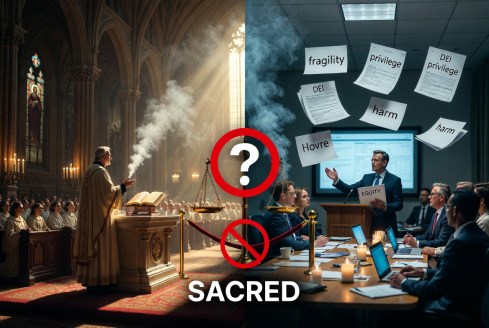
You may ask questions, technically. You may even be praised for your “curiosity,” provided your curiosity walks on a leash. Ask what equity means in practice. Ask who measures it. Ask what evidence would count against the program. Ask whether disagreement is permitted or merely pathologized. The temperature changes. Chairs shift. Someone smiles too carefully.
The comparison here is not that DEI managers are burning heretics in the town square. Scale matters. A missed promotion, HR complaint, grant denial, public scolding, or quiet reputational warning is not the Spanish Inquisition, and pretending otherwise only makes the critic sound unserious.
But mechanisms matter too. Church authorities once treated doubt as spiritual failure. Modern DEI culture often treats dissent as fragility, privilege, bigotry, or harm. The accusation has moved from the soul to the psychology, but the social lesson is familiar enough: you are not merely wrong; your question has exposed something unclean in you.
People notice. They adjust their faces. They save the real conversation for the parking lot.
That is how sacred subjects survive in public institutions. Not because everyone believes. Not even because the doctrine is especially persuasive. They survive because enough people learn the price of candour. A teacher nods through the training module. A board member lets the phrase pass. A musician reads the little ritual line because this is supposed to be a concert, not a committee war. An employee keeps the objection in his throat because rent is due and reputational damage compounds quickly.
And if DEI wants to remain in the world of policy rather than piety, it has to answer ordinary policy questions. Does the training work? Compared with what? At what cost? Does it reduce discrimination, or merely produce better-trained public language? Does it improve decisions, or teach people to repeat approved formulas while moving their actual thoughts elsewhere? Mandatory unconscious-bias training, in particular, has hardly earned the right to be treated as revealed truth. Some interventions may help in some contexts. Fine. Then test them, measure them, revise them, and stop treating skepticism as contamination.
Power has always enjoyed borrowing moral language. Traditional religion needed scrutiny for that reason. So does DEI. So does nationalism. So does environmentalism. So does any movement that claims authority over public life while placing its own premises behind velvet rope.
The question is not whether a belief is religious or secular. The question is whether it can be challenged without punishment.
What do you mean?
How do you know?
Who benefits?
Who pays?
What happens to the person who says no?
Those are not hostile questions. They are the minimum price of entering public argument. A doctrine that cannot tolerate them is not being protected from cruelty. It is being protected from accountability.
The old religions taught us what happens when moral certainty gets institutional shelter. The new secular religions are generous enough to provide a refresher course, complete with handouts, acronyms, and a sign-in sheet.
No belief gets immunity because it flatters itself as compassion.
And when ordinary people start moving their honest conversations out of the room, the institution has already chosen the sermon over the argument.
I’m not a religious individual. This series has made that clear enough over time, and I’m not about to reverse course now. But looking out at the current cultural moment, something else is becoming difficult to ignore: within many of our influential cultural and institutional spaces, people are not stepping away from religion into something stronger or more coherent; they are drifting into something thinner, more unstable, and ultimately more corrosive.
Call it cultural relativism, call it critical theory, call it the downstream effects of postmodern deconstruction—it doesn’t much matter which label you prefer. What matters is the shared move underneath it. The older structures that once oriented people toward truth, obligation, and restraint are no longer treated as imperfect guides to be improved upon; they are treated primarily as systems of power to be exposed, delegitimized, and, where possible, dismantled.
That shift does not leave a neutral vacuum.
A society cannot sustain itself on permanent critique, because critique alone does not tell you what to build in its place, nor does it supply the habits of restraint needed to keep that construction from collapsing.”
On a more personal level, it is increasingly common to encounter people who describe their lives almost entirely through the lens of structural disadvantage, even when their circumstances are relatively stable. The framework offers an explanation for frustration, but it also narrows the space for agency, because improvement begins to look less like progress and more like complicity in the very systems being critiqued.
People require some kind of orienting framework, not necessarily a perfect one, but one stable enough to tell them what is worth building, what must be limited, and what ought to endure beyond their immediate preferences. When every structure is interpreted first as an instrument of domination, that framework does not evolve into something better calibrated—it fragments. What follows is not so much liberation as drift, where moral language remains in use but loses its anchor, and where personal identity begins to carry more explanatory weight than shared standards ever could.
Some of this thinking has value in narrow contexts. As a tool for examining institutions, it can reveal blind spots, excesses, and genuine injustices that deserve correction. But once it escapes those boundaries and becomes a general worldview, it scales badly. A society cannot sustain itself on permanent critique, because critique alone does not tell you what to build in its place, nor does it supply the habits of restraint necessary to keep that construction from collapsing under pressure.
The psychological effects are not incidental here. If a person is taught, explicitly or implicitly, that every system they inhabit is stacked against them, and that their standing within that system is best understood through grievance rather than agency, the result is not empowerment in any meaningful sense. It is demoralization dressed up as insight. Over time, that posture makes collective life harder to maintain, not easier, because it erodes the basic trust required for cooperation.
This is where the comparison with religion, uncomfortable as it may be, begins to sharpen.
Religious frameworks, even when metaphysically suspect or internally inconsistent, tend to provide a coherent structure of meaning, obligation, and limitation. They impose costs. They constrain behaviour. They bind individuals into something that extends beyond the self, whether that is a community, a tradition, or a conception of the good that cannot be endlessly revised to suit immediate preference. Those features can be abused, and often have been, but they are not accidental—they are part of what makes such systems socially durable.
It is worth noting that some of the most stable and prosperous societies today are also among the least religious. That observation deserves to be taken seriously. But those societies are not culturally unmoored; they are, in many cases, the beneficiaries of long-standing moral traditions that continue to shape behaviour even as explicit belief declines. The question is not whether a society can function after religion recedes, but how long it can continue to draw on inherited norms once the structures that sustained them are no longer reinforced.
If the practical choice is between a society that retains some shared, if imperfect, moral architecture and one that dissolves that architecture in favour of perpetual deconstruction, I am no longer convinced that the latter is the safer or more enlightened path. That is not because religion is true in any ultimate sense, but because it appears to do something that our current alternatives struggle to replicate at scale. Secular frameworks capable of supplying meaning and restraint do exist. What remains unclear is whether they can achieve the same level of cultural penetration and durability without borrowing from the traditions they seek to replace.
This is not an argument for theocracy. A classically liberal state remains the best framework we have for preserving freedom, dissent, and pluralism across deep differences. But liberalism has never been self-sustaining in the way its defenders sometimes imagine. It has historically relied on inherited norms—habits of restraint, notions of duty, a willingness to subordinate impulse to something more enduring—that it did not generate on its own.
When those supporting structures are steadily stripped away, the system does not immediately collapse, but it does begin to thin out. The language of rights remains, but the culture that made those rights workable starts to erode. At that point, something else will fill the gap, and it is not guaranteed to be gentler, freer, or more rational than what came before.
None of this erases the historical abuses tied to religion. It simply raises the possibility that removing it creates vulnerabilities we have not yet learned to manage.
Religion, for all its flaws, once carried a significant portion of that load.
Remove it, or hollow it out beyond recognition, and the question is no longer whether people will believe in something. It is what they will reach for instead—and whether that replacement will prove more stable than the thing it displaced.

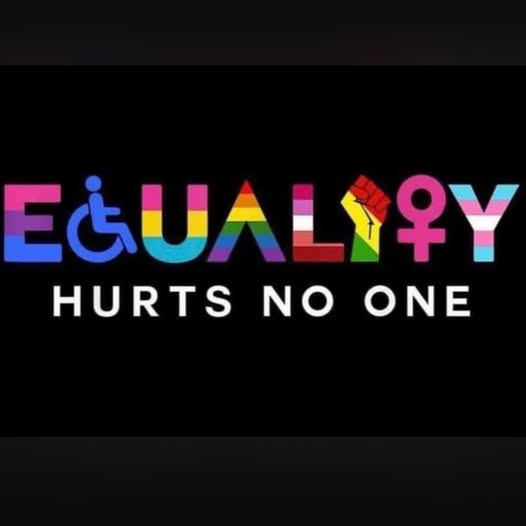
There’s a reason this image works. It uses a word almost everyone agrees with—equality—and then quietly fills that word with something else. The result is not an argument. It’s a substitution.
Look at it closely. The word “EQUALITY” is rendered in bright, appealing colors, layered with symbols of recognizable identity categories: disability, sexuality, gender, race, activism. Beneath it, the slogan: “hurts no one.” At the level of feeling, this is uncontroversial. Of course equality hurts no one. That’s the point of the concept. Equal treatment under the same rules is the baseline promise of any liberal order. But that is not what the image is actually depicting. The text says equality. The visual payload says something else entirely.
Equality, properly understood, is individual and procedural. It asks a simple question: are the same rules being applied to each person, regardless of who they are? It does not guarantee equal outcomes. It does not engineer results. It does not sort people into categories and adjust treatment accordingly. It holds the line at equal standing before the law and equal access to opportunity. That is why it is durable. It does not require constant intervention or measurement. It does not need to know who you are in order to decide how you should be treated.
The imagery in this poster points in a different direction. It is not concerned with individuals. It is concerned with groups. Each symbol represents a category that, within contemporary political frameworks, is treated as requiring not just equal treatment, but differential treatment in order to achieve parity of outcomes. That is the logic behind quotas, preferences, representational mandates, and a wide range of institutional policies now grouped under the umbrella of equity. That distinction matters. Because once you move from equal treatment to managed outcomes, you have to start making choices about who gets what, and why.
This is where the slogan “hurts no one” stops doing honest work. Equality, in the classical sense, really does not hurt anyone. It simply refuses to privilege or penalize based on identity. Equity, by contrast, is not costless. It reallocates opportunities. It lowers or shifts standards in some contexts. It elevates some groups explicitly. That may be justified in specific cases, but it is not neutral, and it is not universally painless. Someone is always paying the adjustment.
The poster resolves this tension through a familiar rhetorical move. It collapses the distinction. By wrapping equity-coded symbols inside the word equality, it invites the viewer to endorse a more controversial framework under the banner of a universally accepted one. The move is subtle enough that many people will not notice it, but strong enough that disagreement can be framed as opposition to “equality” itself. That is not clarification. It is camouflage.
The poster says equality. It is not. And pretending otherwise is not harmless, no matter how bright the colors or how reassuring the slogan.
You can see the tell in the composition. If the message were truly about equality in the classical sense, the image would not need to foreground identity categories at all. It would not need symbols. It would not need color-coding. The entire point of equality is that the categories do not matter when rules are applied. Here, the categories are the point. They are not incidental. They are doing the conceptual work.
None of this means the concerns associated with those categories are trivial or illegitimate. Some are serious. Some are contested. Some are overextended. All of them deserve to be argued on their own terms. But that argument has to be made honestly. It cannot be smuggled in under a word that already carries broad moral agreement.
This is the broader pattern. Take a term with a stable, widely accepted meaning. Expand or alter the underlying concept. Keep the original word. Let the new meaning ride on the old legitimacy. If challenged, collapse the distinction and accuse critics of opposing the original value. It is effective. It is also corrosive.
Words are not decoration. They are load-bearing. If we stop distinguishing between equality and equity, we lose the ability to argue about either of them clearly. And when that happens, policy follows confusion. Decisions get made without admitting what is being traded off, or who is being prioritized. That is not a small failure. It is how serious disagreements get papered over until they break.
One of the most destructive temptations in politics is the urge to turn disagreement into moralized tribal war. Not argument. Not persuasion. Not the hard, frustrating work of governing a society full of competing interests and imperfect people. War. Friends and enemies. Allies and traitors. The pure and the contaminated. Once that frame takes hold, politics stops being about order, restraint, and judgment. It becomes a loyalty machine. Carl Schmitt gave this instinct its most famous formulation in The Concept of the Political, where he argued that the essence of politics lies in the distinction between public friend and public enemy. He was right to see that real political life can descend to existential conflict. He was wrong to treat that descent as the essence of politics rather than one of the permanent dangers civilized politics is supposed to contain. The friend-enemy distinction is not the foundation of healthy politics. It is the logic of political decay.
The danger is not only that the framework is harsh. Politics can be harsh. The danger is that it installs enmity at the center of public life and pushes everything else to the margins. Institutions, laws, debate, compromise, constitutional limits, due process, even ordinary factual disagreement all become secondary. What matters is identifying the enemy, consolidating the team, and punishing hesitation. That is why this logic travels so easily across ideologies. It can appear in revolutionary Marxism, in Maoist “enemies of the people,” in Islamist loyalty-and-disavowal frameworks, in activist binaries like ally versus bigot or oppressor versus oppressed, and in right-wing scripts about traitors, regime collaborators, and weak conservatives who supposedly enable the left. The vocabulary changes. The mechanism does not. A public enemy is named, and then a moral test is imposed: how fully will you align against him?
“The ratchet always turns one way: toward greater fanaticism, greater purification, greater moral ugliness. Truth is subordinated to solidarity. Principle is subordinated to faction.”
What makes this logic totalitarian is that it abolishes the space for dissent. Once the enemy has been declared, neutrality is no longer allowed. You either join the mobilization or you are suspected of serving the enemy’s cause. Hesitation becomes complicity. Refusal becomes betrayal. Moderation becomes guilt. That is how political movements become purge machines. You can either be anti-racist or you are helping racism. You can either be a trans ally or you are enabling bigotry. You can either fight the deep state, resist the regime, and oppose the left without reservation, or you are a RINO, a coward, a collaborator. This is the structure that matters. Not the tribe wearing it. Once politics is moralized into friend and enemy, the pressure falls hardest not only on official opponents, but on the insufficiently zealous within one’s own camp.
That is why factions organized around “no enemies to the left” or “no enemies to the right” almost always radicalize inward. The outer edge of the movement becomes untouchable because criticizing it risks helping the enemy. So the only safe targets are moderates, doubters, and fellow travelers who fail the loyalty test. The left protects its most extreme activists and attacks liberals who cannot keep up. The right protects its own hardliners and attacks conservatives who still think prudence, constitutional restraint, or factual discipline matter. In both cases, the center is hollowed out first. The ratchet always turns one way: toward greater fanaticism, greater purification, greater moral ugliness. Truth is subordinated to solidarity. Principle is subordinated to faction. Politics ceases to be the art of living together under conditions of disagreement and becomes a permanent sorting mechanism for friends, enemies, and suspects.
A civilized society cannot survive on those terms. That does not mean pretending enemies never exist. They do. Free societies are not obliged to indulge movements openly hostile to liberty, law, and peaceful coexistence. But the achievement of constitutional civilization is precisely that it refuses to make enmity the organizing principle of normal public life. It channels conflict through law, opposition, procedure, restraint, and rights. It leaves room for disagreement without turning every disagreement into proof of treason. That is the line Schmitt blurred and totalitarian movements erase completely. The mistake is not in noticing that politics can become existential. The mistake is in treating that possibility as the deepest truth of politics and then building public life around it. Once you do that, purges are no longer an accident. They are the destination. Friend-enemy politics is not realism. It is the operating system of political decay.

Trans rights activists have argued that trans people have a right to be recognised as their preferred gender in both the private and public spheres and that the law should protect this right.
Gender critical groups, however, claim that efforts to undermine single sex spaces put women’s safety at risk while attempts to police language on this issue constitute a threat freedom of speech.
This panel event disentangled this debate by giving speakers from both sides the opportunity to present their case for whether transgender ideology is necessary outgrowth of liberal values, or a threat to them.
On the Panel:
Peter Tatchell – Human rights campaigner and activist.
Freda Wallace – Political commentator, freelance writer and host of the Gender Nebulous podcast.
Helen Joyce – Former finance editor at the Economist, author of Trans: When Ideology Meets Reality and director of advocacy at Sex Matters.
Marc Glendening – Head of Cultural affairs at the IEA and author of the Transgender Ideology report published by the IEA in August.
One of the curses that progressives that have gone awry (the woke) bring to the table is often the disregard of objective fact. For the faux-progressive sets, the more oppressive factors that you happen to bring to the situation makes your insights somehow more relevant and more important (‘truthier’) than someone who has experienced less oppression. So much of faux-progressive time is spent comparing, ordering, and reordering postures and arguments in accordance with perceived levels of oppression that the actual truth of the matter becomes lost in the internecine conflict that inevitably occurs.
We as a society need to decide that objective truth matters and strive to base our decisions on the version of events/details that most closely coincides with the material reality we all share. In short we need to return to and reaffirm the ideas of the Enlightenment and of the Classical Liberalism that followed.











 bleatmop
 Mystro
 The Arbourist


 Dead Wild Roses
Your opinions…