There’s a reason this image works. It uses a word almost everyone agrees with—equality—and then quietly fills that word with something else. The result is not an argument. It’s a substitution.
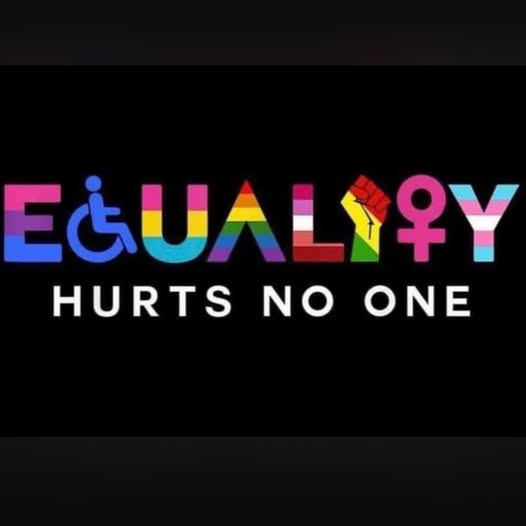
Look at it closely. The word “EQUALITY” is rendered in bright, appealing colors, layered with symbols of recognizable identity categories: disability, sexuality, gender, race, activism. Beneath it, the slogan: “hurts no one.” At the level of feeling, this is uncontroversial. Of course equality hurts no one. That’s the point of the concept. Equal treatment under the same rules is the baseline promise of any liberal order. But that is not what the image is actually depicting. The text says equality. The visual payload says something else entirely.
Equality, properly understood, is individual and procedural. It asks a simple question: are the same rules being applied to each person, regardless of who they are? It does not guarantee equal outcomes. It does not engineer results. It does not sort people into categories and adjust treatment accordingly. It holds the line at equal standing before the law and equal access to opportunity. That is why it is durable. It does not require constant intervention or measurement. It does not need to know who you are in order to decide how you should be treated.
The imagery in this poster points in a different direction. It is not concerned with individuals. It is concerned with groups. Each symbol represents a category that, within contemporary political frameworks, is treated as requiring not just equal treatment, but differential treatment in order to achieve parity of outcomes. That is the logic behind quotas, preferences, representational mandates, and a wide range of institutional policies now grouped under the umbrella of equity. That distinction matters. Because once you move from equal treatment to managed outcomes, you have to start making choices about who gets what, and why.
This is where the slogan “hurts no one” stops doing honest work. Equality, in the classical sense, really does not hurt anyone. It simply refuses to privilege or penalize based on identity. Equity, by contrast, is not costless. It reallocates opportunities. It lowers or shifts standards in some contexts. It elevates some groups explicitly. That may be justified in specific cases, but it is not neutral, and it is not universally painless. Someone is always paying the adjustment.
The poster resolves this tension through a familiar rhetorical move. It collapses the distinction. By wrapping equity-coded symbols inside the word equality, it invites the viewer to endorse a more controversial framework under the banner of a universally accepted one. The move is subtle enough that many people will not notice it, but strong enough that disagreement can be framed as opposition to “equality” itself. That is not clarification. It is camouflage.
The poster says equality. It is not. And pretending otherwise is not harmless, no matter how bright the colors or how reassuring the slogan.
You can see the tell in the composition. If the message were truly about equality in the classical sense, the image would not need to foreground identity categories at all. It would not need symbols. It would not need color-coding. The entire point of equality is that the categories do not matter when rules are applied. Here, the categories are the point. They are not incidental. They are doing the conceptual work.
None of this means the concerns associated with those categories are trivial or illegitimate. Some are serious. Some are contested. Some are overextended. All of them deserve to be argued on their own terms. But that argument has to be made honestly. It cannot be smuggled in under a word that already carries broad moral agreement.
This is the broader pattern. Take a term with a stable, widely accepted meaning. Expand or alter the underlying concept. Keep the original word. Let the new meaning ride on the old legitimacy. If challenged, collapse the distinction and accuse critics of opposing the original value. It is effective. It is also corrosive.
Words are not decoration. They are load-bearing. If we stop distinguishing between equality and equity, we lose the ability to argue about either of them clearly. And when that happens, policy follows confusion. Decisions get made without admitting what is being traded off, or who is being prioritized. That is not a small failure. It is how serious disagreements get papered over until they break.
I kind of need to know now, what the fuck is going on in Ontario with their interpretation of Human Rights and Discrimination. What I do know is that we do not solve present day discrimination by race, by MORE discrimination by race. This bizarre Kafkaesque excerpt from the C2C website.
On November 10, 2022 – lightning fast by HRTO standards – I heard from the Tribunal again. It was a brief but formal Decision that reasserted the SummerUp program’s legality and ended with an Order declaring, “The Application is dismissed.” In her decision, adjudicator Eva Nichols took issue, again, with the idea that I had a right to bring forward such a case when I had not “faced any form of discrimination on a protected ground” and because I had confirmed I was not bringing the application forward on behalf of another person, namely my son.
But it was the Decision’s Kafkaesque mental process that stood out. Nichols pointed out that “colour and race are among the protected grounds” under which discrimination is prohibited. But, she wrote, “They are not terms that are defined in the Code.”
“No fixed definition”: The HRTO now holds that race is a “social construct” that can be based on mutable characteristics from beliefs and manner of speech to clothing, diet and leisure preferences – things long considered stereotypes.
Instead, the OHRC “offers the following definitions in its Policy and guidelines on racism and racial discrimination…The Commission has explained ‘race’ as socially constructed differences among people based on characteristics such as accent or manner of speech, name, clothing, diet, beliefs and practices, leisure preferences, places of origin and so forth…Recognizing that race is a social construct, the Commission describes people as ‘racialized person’ or ‘racialized group’ instead of the more outdated and inaccurate terms ‘racial minority,’ ‘visible minority,’ ‘person of colour’ or ‘non-White.’ There is no fixed definition of racial discrimination… [emphasis added].”
So race is a legal grounds on which discrimination is prohibited. But it has no definition – and in fact can be based on things like what we eat or what we do for fun. In other words, on racial stereotypes the use of which, in the not so distant past, would themselves have been considered outrageously racist. Nor is there a definition of racial discrimination per se. The Tribunal’s decision did, however, specify one thing racial discrimination can’t be: “[19] It is important to note in the Tribunal’s jurisprudence that an allegation of racial discrimination or discrimination on the grounds of colour is not one that can be or has been successfully claimed by persons who are white and non-racialized [emphasis added].”
In other words, according to the Tribunal, white people cannot be discriminated against on the basis of their whiteness. (It’s not true, however, that such a claim has never succeeded. A group of white employees in B.C. not only won their case against that province’s Human Rights Tribunal but also successfully defended their claim in court that they were unjustly fired due to their “wrong” race.)
The belief that white people cannot suffer discrimination because they are white is not only held by the HRTO, but is often expressed in the media and by activists. (Source of right photo: alecperkins, licensed under CC BY 2.0)
It’s difficult to grasp which of the two major elements of the HRTO’s decision is more troubling: that blatant acts of discrimination are excused, and in fact are not even considered worthy of consideration if the person discriminated against is white, or that the OHRC is redefining race and racism as based on “social constructs” – habits and practices, like clothing and leisure preferences, that long were considered stereotypes.
What is ad block? It is an application that, at your discretion blocks out advertising so you can browse the internet for content as opposed to ads. If you do not have it, get it here so you can enjoy my blog without the insidious advertising.












 bleatmop
 Mystro
 The Arbourist


 Dead Wild Roses
Your opinions…