
You are currently browsing the category archive for the ‘Racism’ category.


In 2020, the Smithsonian’s National Museum of African American History and Culture published the two graphics above as part of its “Talking About Race” portal.
A necessary disclaimer: the museum removed the chart after criticism and acknowledged, “We erred in including it.” It is not current Smithsonian policy. That correction deserves recognition.
The point of revisiting it is not to pretend otherwise, but to examine the ideas circulating within an institution when someone created this material, others approved it, and the museum decided it was fit for public education.
Look at what the chart assigns to “whiteness”: objective and rational thinking, the scientific method, cause-and-effect reasoning, hard work, delayed gratification, planning for the future, self-reliance, decision-making, written communication, politeness and the protection of property.
If a white supremacist had claimed these were distinctively white characteristics, everyone would recognize the racism immediately. Placed inside an anti-racist framework, however, the same racial essentialism was briefly presented as enlightenment.
What does the chart imply about people who are not white? That rationality, foresight, scientific thinking and self-discipline are foreign norms imposed upon them? The creators may not have intended that conclusion, but they constructed the racial division that produces it.
There are a few legitimate observations buried inside the mess. American holidays have been shaped by Christianity, its legal system descends substantially from English common law, and its history was often taught through European settlement and male political leaders. “Win at all costs,” female subordination and treating wealth as personal worth are also reasonable targets for criticism.
The chart destroys those distinctions by dumping historical inheritance, social conventions, genuine vices and universal human capacities into one container marked whiteness. English common law, Barbie, scientific reasoning, bland food and delayed gratification are all made expressions of the same racialized system.
Objectivity is not white. It is a method for correcting the biases found in every human population. Written traditions developed across civilizations. Parents of every race sacrifice for their children, workers labour toward future goals, and societies everywhere use observation and causal reasoning to survive.
To produce something this ridiculous requires more than an editorial mistake. It requires an institutional culture that has spent so long treating Western inheritance as presumptively oppressive that civilizational self-criticism has curdled into self-repudiation. Once “whiteness” became the organizing category, apparently nobody stopped to ask what assigning rationality and hard work to white people implied about everyone else.
The museum eventually did stop, listen and withdraw the chart. Good.
But the artifact remains instructive. When anti-racism teaches that reason, discipline and foresight are white characteristics, it has not defeated racism. It has reproduced racism, reversed the approved moral direction and called the result education.
The most revealing thing about modern slavery is not only that it exists. It is that so many people who invoke slavery as a moral category seem oddly uninterested in it when it is happening now.
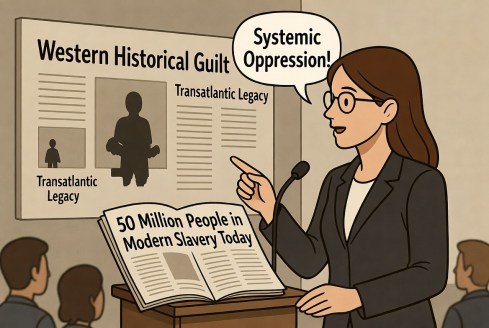
In contemporary activist politics, slavery is often treated as a permanent indictment of the West. It is invoked to explain present inequality, assign inherited guilt, rewrite institutional language, justify symbolic rituals, and discipline dissent. Some of that history matters. The transatlantic slave trade was real, brutal, and morally indefensible. A serious civilization should be able to tell the truth about its crimes.
But truth has a tense. If slavery matters morally, then slavery matters now.
According to the latest Global Estimates from the International Labour Organization, Walk Free, and the International Organization for Migration, roughly 50 million people were living in modern slavery on any given day in 2021: 27.6 million in forced labour and 22 million in forced marriage. Walk Free estimates that about 7 million people in Africa were living in modern slavery.
If slavery is invoked as a living moral category when it indicts the West, then slavery should also matter when people are being coerced, trafficked, forced into marriage, or trapped in labour today.
These are not metaphors. Modern slavery includes forced labour, forced marriage, trafficking, sexual exploitation, debt bondage, and other forms of coercion that people cannot freely refuse or leave.
Many human-rights groups do serious work on these abuses. That should be acknowledged. But the cultural volume is not the same. Western institutions pour energy into land acknowledgements, reparations debates, decolonization seminars, symbolic renamings, privilege workshops, and inherited-guilt rituals. Meanwhile, present-tense slavery struggles to command anything like the same moral attention.
Mauritania, for example, formally abolished slavery, yet descent-based slavery and slavery-like practices remain serious concerns. That should disturb anyone who claims to care about domination and human dignity. It should not be a niche humanitarian footnote.
The strongest activist reply is not ridiculous. Historical slavery did not vanish without consequence. The transatlantic slave trade, colonial rule, segregation, and legal exclusion shaped wealth, institutions, geography, and inherited disadvantage. A society does not become innocent simply because the worst laws are repealed.
That is a serious point. But it does not answer the problem of moral selectivity. If slavery is invoked as a living moral category when it indicts the West, then slavery should also matter when people are being coerced, trafficked, forced into marriage, or trapped in labour today.
This is where much contemporary anti-racism becomes revealing. In theory, it opposes domination and exploitation. In practice, it often functions as a selective solvent. It dissolves confidence in Western institutions, Western history, Western moral achievement, and Western civic inheritance, while offering little concrete help to people being dominated right now.
The predictable reply is that this is whataboutism. It is not. Whataboutism says, “Ignore this evil because that evil also exists.” The argument here is the opposite: if slavery is evil, then concern should become more urgent when slavery is happening now. Historical truth matters, but it cannot become a substitute for present-tense moral attention.
Nor is this answered by saying critics do not understand critical theory properly. If a theory constantly produces institutional rituals of guilt, suspicion, deconstruction, and accusation, ordinary citizens are allowed to judge it by its public effects. A politics that requires specialist initiation before anyone may notice its consequences has already left democratic argument behind.
The issue is not whether the West has sins in its history. It does. The issue is whether anti-racism is actually against domination, exploitation, and slavery as human evils, or whether those evils are useful mainly when they can be arranged into an indictment of Western society.
If slavery matters only when it can be used to shame the West, then slavery is not the real object of concern. The West is.
References
International Labour Organization, Walk Free, and International Organization for Migration. Global Estimates of Modern Slavery: Forced Labour and Forced Marriage.
https://www.ilo.org/publications/major-publications/global-estimates-modern-slavery-forced-labour-and-forced-marriage
Walk Free. Global Slavery Index 2023 — Global Findings.
https://www.walkfree.org/global-slavery-index/findings/global-findings/
Walk Free. Global Slavery Index 2023 — Modern Slavery in Africa.
https://www.walkfree.org/global-slavery-index/findings/regional-findings/africa/
Anti-Slavery International. What is Descent-Based Slavery?
https://www.antislavery.org/slavery-today/descent-based-slavery/
Anti-Slavery International. Mauritania: Descent-Based Slavery.
https://www.antislavery.org/what-we-do/mauritania/
Arab Reform Initiative. Racialized Hereditary Slavery in Mauritania: Interview with Activist Abidine Maettalla.
https://www.arab-reform.net/publication/racialized-hereditary-slavery-in-mauritania-interview-with-activist-abidine-maettalla/
“White people don’t get to decide what’s racist.”
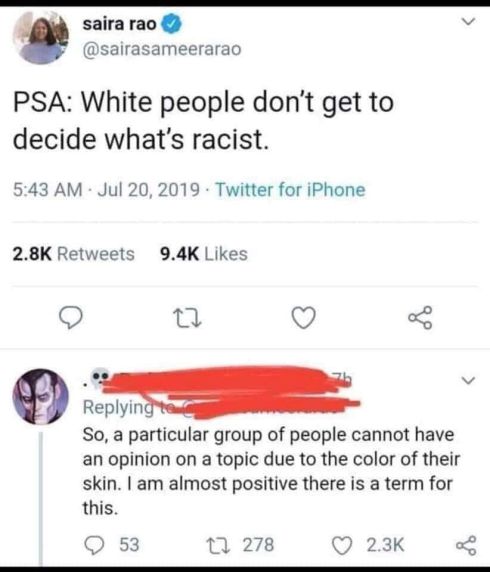
At first glance, this sounds like a demand for humility. And humility is not a bad thing. People can miss harms they do not personally experience. They can mistake comfort for neutrality. They can ignore patterns because those patterns do not touch them directly. Any honest account of racism has to leave room for that.
But the sentence does more than ask for humility. It draws a racial boundary around moral reasoning. It says that one group of people is not merely fallible, not merely prone to blind spots, but disqualified from judgment by birth.
That is where the sentence stops being a plea for listening and becomes something else. It becomes racial gatekeeping presented as moral expertise.
The screenshot is useful because it shows several aspects of critical theory coming into contact with the real world. Not in a seminar room. Not in a carefully footnoted academic paper. In the wild, where theory has been stripped of caveats, flattened into slogans, and handed to people who often have no idea where their fractured knowledge comes from or how badly it is being misused.
Most people who make these arguments are not theorists. They are downstream consumers of theory. They have inherited conclusions without the arguments, moral reflexes without the limits, and social weapons without the instruction manual. What reaches them is not a coherent philosophy but a cluster of habits: centre marginalized voices, listen and learn, impact matters more than intent, racism equals power plus prejudice, disagreement is fragility, demands for evidence are suspect, and dominant groups must defer.
Each of those claims contains a partial truth. That is why the machinery works.
People do have blind spots. Power does matter. Lived experience can reveal things outsiders miss. Social systems can produce unequal outcomes without anyone needing to wear a cartoon villain costume. A liberal society that cannot admit any of that becomes shallow and self-protective.
The problem begins when those partial truths become untouchable rules.
How the Move Works
The first assumption smuggled into the sentence is that racism is not primarily a judgment, action, belief, policy, habit, or pattern of unfair treatment. It is treated as an invisible mechanism operating beneath society. In this case, the mechanism is systemic racism: a hidden structure said to explain disparities, conflicts, speech, institutions, motives, and disagreement before any particular claim has been examined.
Again, systems are real. Institutions can produce patterns. History does not disappear because someone wants the conversation to be more comfortable. But in popular use, the mechanism often becomes unfalsifiable. If a disparity appears, the system explains it. If someone questions the explanation, the questioning becomes further evidence of the system. If a member of the alleged oppressor class objects, the objection is interpreted as fragility, denial, privilege, or complicity.
The claim no longer has to survive ordinary examination. The theory has already decided what resistance means.
“Unfalsifiable: a claim that cannot be proven wrong because every objection is reinterpreted as proof of the claim.”
The second assumption is that this mechanism can only work in one direction. This is where the “racism equals power plus prejudice” formula enters the bloodstream. In ordinary moral language, racism means judging, mistreating, excluding, or degrading people because of race. But under the power-plus-prejudice formula, racism is redefined so that only groups with systemic power can commit it. Members of designated oppressor classes can be mocked, stereotyped, excluded, insulted, or judged by race, but the framework classifies this as something other than racism because they occupy the wrong place in the hierarchy.
That is why “white people don’t get to decide what’s racist” can be treated as anti-racist rather than racial. The rule has already been made unequal.
The third assumption is epistemic. The oppressed are said to possess a kind of dual insight into how the system works. They understand their own experience from below, but they also understand the dominant group because they are forced to navigate its rules. The dominant group, by contrast, is presumed to be trapped inside its own power. It cannot see clearly because its comfort depends on not seeing.
There is a reasonable insight here. People lower in a hierarchy may notice pressures and hypocrisies that people higher up never have to think about. A worker may understand the boss’s rules better than the boss understands the worker’s life. A minority may notice social frictions the majority can glide past without naming.
But once that insight hardens into authority, the conversation changes. Standpoint stops being evidence offered into a common search for truth and becomes a credential. The person assigned to the oppressed position is treated as uniquely insightful. The person assigned to the oppressor position is treated as morally and intellectually compromised. At that point, argument no longer proceeds by shared standards. It proceeds by status.
You are no longer in a discussion. You are in a permission system.
“Permission system: a social rule where some people are allowed to define the issue, while others are expected only to listen, confess, or defer because of identity.”
This is the part ordinary people often sense but struggle to name. They think they are being invited into a moral conversation. In reality, every normal question has already been assigned a guilty interpretation.
They ask, “Isn’t it wrong to judge someone by skin colour?”
The answer comes back: “You do not get to decide that.”
They ask, “Shouldn’t the same rule apply to everyone?”
The answer comes back: “Equality language protects privilege.”
They ask, “Can we examine the evidence?”
The answer comes back: “Your demand for evidence is part of the problem.”
They ask, “How would this claim be proven wrong?”
The answer comes back: “That question itself shows your investment in domination.”
 Once this frame is accepted, the target cannot really answer. Refusal confirms guilt. Confession confirms guilt. Silence confirms guilt. Disagreement confirms guilt. The accusation is insulated from ordinary scrutiny because the mechanism is said to operate invisibly in the background, and only the approved interpreters are permitted to describe it.
That is why these encounters feel so maddening to normal people. They think they are dealing with a claim. Instead, they are dealing with a closed interpretive loop. Every exit has been marked as another entrance.
This is not an honest epistemology. It is a social technology for producing compliance.
The uglier part is that most people using it do not understand the machine they are operating. They have picked up fragments from universities, HR seminars, DEI training, social media, activist language, institutional statements, and moral peer pressure. They know the moves, not the machinery. They know which phrases confer status and which phrases mark someone as suspect. They may sincerely believe they are being compassionate, educated, and morally brave.
But sincerity does not rescue bad reasoning.
How to Recognize the Trap
A liberal society cannot function when moral claims are sorted by identity before they are examined. It depends on the possibility that anyone can ask whether a claim is true, fair, coherent, and consistently applied. It depends on open criticism, equal moral standing, and the right to question even claims made in the name of justice.
That does not mean every speaker is equally informed. It does not mean history is irrelevant. It does not mean racism only exists when someone says an obvious slur. It does not mean people with direct experience have nothing important to teach the rest of us.
It means no person’s race should grant immunity from scrutiny, and no person’s race should disqualify them from moral reasoning.
You do not need a PhD to notice when the rules have stopped applying equally. A few simple questions are often enough.
The first is the reciprocity test: would this rule be acceptable if the races were reversed? If the answer is no, then the rule is not a principle. It is a permission structure.
The second is the individual test: are we judging this person’s actual words and actions, or are we assigning moral status to an entire race? A society that cannot tell the difference between individual responsibility and racial status is not overcoming racism. It is reorganizing it.
The third is the evidence test: what would prove this claim wrong? Honest explanations can be examined. Bad explanations protect themselves by treating examination as aggression.
The fourth is the equal-rule test: does this standard apply to everyone, or only to approved groups? If one race may generalize, accuse, mock, or define the terms while another may only listen and confess, then we are not dealing with fairness.
The fifth is the liberal-society test: does this help people reason together, or does it sort them into racial teams? That question matters because liberal society depends on shared standards. Without them, public life becomes a contest over who gets to define reality and who is expected to submit.
These questions do not solve every hard case. They are not meant to. Racism can be subtle. Power can matter. History can shape the present in ways that are not obvious at first glance. But if a moral framework cannot survive these basic questions, the problem is not the questions.
The problem is the framework.
That is what makes a small sentence like “white people don’t get to decide what’s racist” worth examining. It is not merely rude. It is not merely hypocritical. It is a compressed example of a larger ideological move: convert a universal moral question into an identity-jurisdiction question.
Who may speak? Who must listen? Who is presumed insightful? Who is presumed guilty? Who gets to define the harm? Who is allowed to ask for evidence?
Once those roles are assigned by race, the conversation is no longer about racism in any honest moral sense. It is about power over the terms of reality.
A genuinely anti-racist society should reject that move.
Not because racism is unreal. Not because power is irrelevant. Not because lived experience does not matter. But because the cure for racial injustice cannot be a new racial priesthood deciding who is allowed to reason, who is allowed to question, and who must sit quietly while their moral standing is revoked.
Shared truth has to remain possible. So does shared criticism.
Otherwise, anti-racism becomes just another way to smuggle racial hierarchy back into public life, this time with better slogans and institutional approval.
—–
Glossary
Critical theory
A broad family of ideas that examines society through power, hierarchy, and oppression. It can reveal real blind spots, but in popular use it often turns into a habit of treating every disagreement as proof of hidden domination.
Systemic racism
The idea that racism can operate through institutions, patterns, incentives, and social habits, not only through individual prejudice. The problem comes when “systemic racism” is used as an all-purpose explanation that cannot be questioned or tested.
Power plus prejudice
A redefinition of racism that says racism is not simply racial prejudice or unfair treatment, but prejudice backed by social power. In practice, this often means racism is treated as something only dominant groups can commit.
Standpoint epistemology
The idea that people may notice different truths depending on their social position. Someone lower in a hierarchy may see pressures that someone higher up misses. The danger comes when perspective is treated as automatic authority.
Epistemology
A theory of knowledge: how we know what is true, what counts as evidence, and how claims should be tested.
Epistemic hygiene
The habits that keep our thinking clean: asking for evidence, checking assumptions, allowing disagreement, correcting errors, and refusing to protect favourite ideas from scrutiny.
Unfalsifiable
A claim that cannot be proven wrong because every objection is reinterpreted as proof of the claim. For example: “If you disagree, that only proves you are in denial.”
Lived experience
Knowledge gained from personal experience. It can be important evidence, but it should not become a veto over questions, criticism, or shared standards.
Identity-jurisdiction question
A shift from asking “Is this claim true?” to asking “Who is allowed to speak about this?” The issue becomes identity status rather than evidence or reasoning.
Permission system
A social rule where some people are allowed to define the issue, while others are expected only to listen, confess, or defer because of their identity.
Liberal society
A society built around equal moral standing, open debate, individual rights, shared standards, and the ability to criticize ideas without being treated as morally disqualified.
Racial gatekeeping
Using race to decide who is allowed to speak, judge, question, or define moral terms.
Closed interpretive loop
A pattern where every possible response confirms the accusation. Denial, silence, disagreement, or requests for evidence are all treated as further proof of guilt.
Moral reasoning
The process of deciding what is right or wrong using evidence, consistency, fairness, context, and principles that can be applied beyond one group.
Racial essentialism
Treating people as if their race determines their moral status, knowledge, guilt, innocence, or authority.
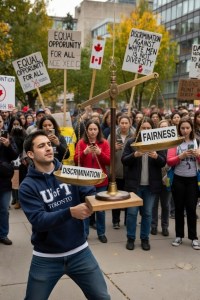
A University of Toronto Scarborough posting for an Assistant Professor in Computational Biology and Data Science looks like a standard academic hire. It isn’t. It is a restricted competition tied to a Canada Research Chair (CRC) nomination.
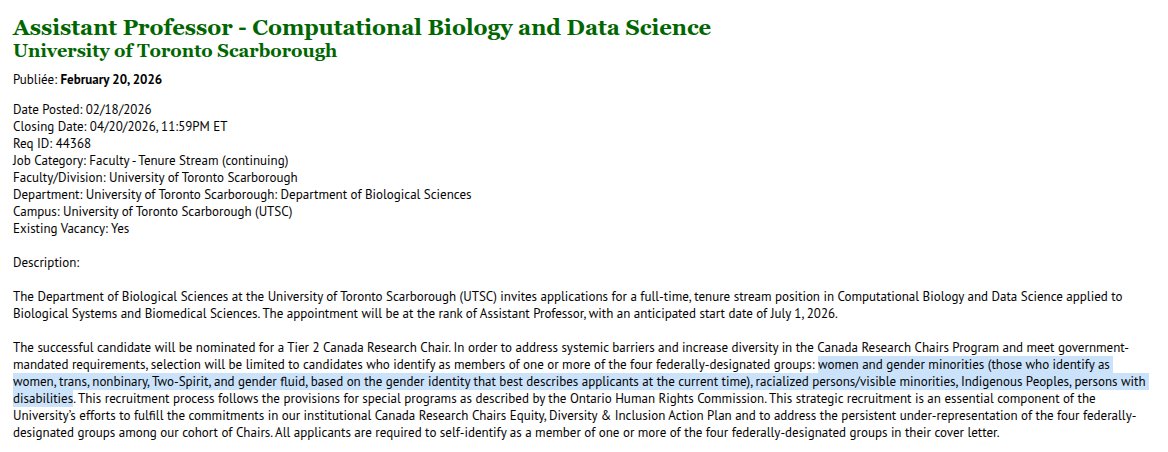 The posting requires applicants to self-identify as a member of one or more “designated groups” in their cover letter, namely women or gender minorities, racialized persons, Indigenous Peoples, or persons with disabilities. If you do not fit one of those categories, you are not eligible to apply. That is not an inference. It is in the posting.
That one detail captures the reality of modern equity administration in Canadian universities: what is framed as “removing barriers” often functions, in practice, as category-based exclusion.
This is not a rogue department. It is a federal program mechanism.
The university did not invent this framework on its own. The hiring restriction is attached to the Canada Research Chairs program, a federal initiative that allocates prestige and funding to institutions under defined rules. One major rule-set is the CRC equity framework, which includes population-based targets for the four designated groups. The program’s stated targets to be reached by the end of 2029 are: 50.9% women and gender equity-seeking groups, 22% racialized persons, 4.9% Indigenous Peoples, and 7.5% persons with disabilities.
Again, these are not vibes. They are published benchmarks tied to institutional plans and program governance.
The key point is the enforcement logic. Under the CRC’s settlement and enforcement framework, institutions that miss interim targets can face consequences that shape nominations and recruitment practices. In plain terms: the program can push institutions toward restricted competitions where eligibility is limited to designated groups.
So when you see a posting that excludes broad classes of Canadians from applying, it is not a one-off. It is a downstream product of rules that tie federal research prestige to demographic targets.
The problem is the normalization of identity gates
Defenders will say this is equity. They will argue that special measures are justified to counter historical bias and structural disadvantage. That is the argument, and it deserves to be stated fairly.
But there is a moral and civic cost to the method. When eligibility is restricted by identity categories, the institution is no longer selecting among all qualified candidates. It is selecting among those who clear an identity threshold first. That is not “equal opportunity.” It is a gate that sorts people before their work is even evaluated.
If you want a simple test for whether this is principled, reverse the identity labels. A posting that said “whites only” or “men only” would be condemned instantly, for good reason. You do not escape discrimination by flipping who benefits. You normalize discrimination by making it administratively routine.
A better standard
If Canada wants fairness in academic hiring, the standard should be straightforward: open eligibility, transparent criteria, and selection based on demonstrated excellence. If there are pipeline problems, fix the pipeline. Broaden recruitment, strengthen mentorship, reduce opaque networking advantages, and enforce accountable evaluation.
Do not solve bias by writing exclusions into job postings, then congratulating yourself for it. That approach trains young researchers to see institutions as political allocation machines rather than merit-seeking communities. And once that belief sets in, you do not get trust back easily.
References
1) U of T Scarborough job posting (Assistant Professor – Computational Biology and Data Science)
https://jobs.utoronto.ca/job/Scarborough-Assistant-Professor-Computational-Biology-and-Data-Science-ON/599939517/
2) Canada Research Chairs: “Establishing equity targets for 2021 to 2029”
https://www.chairs-chaires.gc.ca/program-programme/equity-equite/targets-cibles-eng.aspx
3) CRC Program representation statistics (lists the population-based targets and deadline)
https://www.chairs-chaires.gc.ca/about_us-a_notre_sujet/statistics-statistiques-eng.aspx
4) CRC: Equity, Diversity and Inclusion requirements and practices (overview, settlement context)
https://www.chairs-chaires.gc.ca/program-programme/equity-equite/index-eng.aspx
5) CRC: 2021 Canadian Human Rights Settlement Agreement page (program framing and enforcement context)
https://www.chairs-chaires.gc.ca/program-programme/equity-equite/2021_settlement-reglement-eng.aspx
6) House of Commons Standing Committee on Science and Research, Meeting No. 2 (witness panel includes Steven Pinker and Azim Shariff)
https://www.ourcommons.ca/documentviewer/en/45-1/SRSR/meeting-2/evidence

Well, here we have 3 movie posters as they were displayed in mainland China. What do you see missing?
Are the anti-racism activists losing their minds about this? Can the vaunted arbiters of social justice be bothered with actual racism?
Naaaah. The REAL work is to keep looking for the systemically racism Unicorn that permeates EVERY facet of western society and must be rooted out – but only the experts can see it and you’ll have to hire them to get these dire systemic Unicorns out of your organization…
Should we actively oppose racism and racists sentiments, absolutely. Do we need a class of self appointed experts to root out the systemic racism that only they have the insight to see and root out? – Probably not.



In reference to an interesting coincidence, that through civil rights activism and a incremental changes to our society overt and institutionalized racism is largely over. But with most of racism in society gone, what then (thanks grok) – When cults face falsification of their beliefs, they often employ several strategies to retreat from reality:
Denial and Reinterpretation:
Denial: Cults might outright deny any evidence that contradicts their beliefs, claiming it to be false, misleading, or part of a conspiracy against them.
Reinterpretation: They might reinterpret the evidence in a way that fits their narrative. For example, if a prophecy doesn’t come true, they might claim it was a “spiritual” fulfillment or that the prophecy was misinterpreted by outsiders.
Isolation: Cults often increase their isolation from the outside world. This can involve moving to remote locations, restricting access to external information (like news or internet), or discouraging interactions with non-members. Isolation helps prevent members from being exposed to contradicting information or viewpoints
.
Shifting Blame or Goalposts:
Shifting Blame: If something goes wrong, rather than questioning the belief system, the leadership might blame members for not being faithful enough or external forces for interference.
Moving the Goalposts: They might change their doctrines or predictions subtly or significantly to account for the falsification without admitting error. This can mean setting new dates for prophecies or redefining what the prophecy meant.
Cognitive Dissonance Management:
When faced with evidence against their beliefs, members might experience cognitive dissonance. Cult leaders often provide explanations or new interpretations to reduce this discomfort, reinforcing loyalty and belief.
Increased Control and Manipulation:
There might be an increase in psychological manipulation techniques, like love bombing, where members are showered with affection to quell doubts, or fear tactics where leaving the group is associated with dire consequences.
Creation of Parallel Realities:
Cults might develop their own news sources, vocabulary, or interpretations of events to create a reality that aligns with their beliefs. This parallel reality can make external critique seem irrelevant or part of an antagonistic narrative.
Rituals and Practices:
Increasing the frequency or intensity of rituals can reinforce group identity and belief. These practices can act as a distraction from reality or as a mechanism to reaffirm faith in the face of contradictory evidence.
Charismatic Leadership:
The leader might become more central, perhaps through claiming new revelations or visions that explain away the falsification. This can also involve the leader becoming more authoritarian, ensuring that followers remain under tight control.
By using these methods, cults not only protect their belief systems from external critique but also maintain internal cohesion and loyalty among members, even when faced with undeniable evidence against their doctrines.
Arguing with the activists is often tedious and tendentious, why? Because they tend to define their pet concepts in such ways are purposefully inscrutable and hard to respond honestly to. James Lindsay unpacks the activist view of Racism and how to navigate the through their obfuscatory conceptions of it.
“You might find some success with the approaches you’re thinking of, depending on whose ears they land upon, but I don’t think you’ll win much ground with them. They certainly won’t convince anyone well-steeped in the Woke ideology. That’s now how these people think about the issue, and they’ll just point to your arguments as another example of you not really understanding how racism works. You’ll be hoisted by your own petard. The only way for you to get around this is to demonstrate that you do know how racism works, on their terms, and that you reject it for good reasons, which is almost impossible when you’re going up against a large group of people who think the opposite way.
Still, you have to understand “racism” like they do to try to do anything. The Woke use a very particular, very narrow definition of “racism” that has a very expansive application because it is believed to be “systemic” and thus applicable to and a part of everything. This extremely broad and expansive application of the term “racism” belies just how peculiar and restrictive the actual definition is.
The way they see “racism” is that it was something that was invented by early (pre)-scientific discussions of race and (genetic) heritability in the European context in the 15th–17th centuries, which were then amplified in the 18th and 19th centuries to justify the enslavement of black Africans and colonial conquests that Europeans were doing all over the world at the time. They believe, not wholly wrongly, that white Europeans invented the modern idea of “race” as an inheritable status and tied it to social standing so they could use it to conquer and enslave while providing themselves with access to society that they intentionally excluded all others from having. The trouble is, historically, this is mostly true. Some of the details are a bit messed up, like believing that “science” in the 16th century is roughly the same thing as science now and that most people think of race the same way in terms of the social-standing arguments as they did centuries ago, but the origin story they give is largely correct if you neglect the relevance of the evolution of human thought over the last several hundred years. They believe this system to be utterly pervasive throughout every possible aspect of every contemporary society that has been in any way influenced by any Western thought, and this is a huge problem (called “white supremacy” or “colonialism,” depending on the activist making a ruckus about it).
This brings us to a first important point. Because they only think in terms of this particular way of thinking about race, what happened in other contexts in the past, like the Muslim enslavement of the Slavs, or what happens outside of the West, as in India, cannot be understood as “racism” (or even racially-motivated behavior). This is because “race” and “racism” specifically refer to a system of domination tied to white people granting themselves superiority and all others having inferiority as described above. It doesn’t mean anything else, and that’s the heart of “prejudice plus power” definition they make so much noise about. The “power” part is the power white people gave themselves a few centuries ago and, in many—but not all—cases, fought tooth and nail to maintain until relatively recently in our history. Thus, Indians can be prejudiced toward each other and might even have their own systems of power, but they fall outside of the system of power in which “racism” is defined. Same goes for the Muslims enslaving the Slavs. The system of power isn’t the white, Western one and thus is inscrutable from their perspective. (It would be a culturally chauvinistic act to try to analyze other cultures because of the cultural relativism at the heart of the Woke worldview.) It could be theorized somehow, one must suppose, but not as “racism,” which was a white, Western invention (in their eyes). (This seems like a weird semantic game because it is one.)
Now we can make a little headway toward charting a useful reply, though. The confusion itself tells us something: that we don’t think about racism this way anymore. It took centuries of work in liberalism—seeing universal humanity, treating people as individuals, gathering better information through science and ethics, and persuading people to understand these improvements on their own terms through education and public appeal—to break that meaning down and replace it with the one we’re more familiar with today: holding some races up as superior or others down as inferior, or taking intentional actions that are in accordance with such beliefs. The “prejudice + power” reformulation by the Woke is an attempt to try to resurrect the old view, probably because things in society got too equal to continue using the more sensible liberal view and keep making radical gains.
But let’s back up and let something sink in. Their definition of “racism” is only that which white people set up in the 15th century going forward to justify slavery and colonialism by defining a white race that got the privileges of society and all the other races as inferior. That, and its legacy that remains today. Anything else, in the Woke worldview, is not “racism.” It might be bad; it might be prejudice; it might be discrimination; but it’s not “racism.” Yet again, in the Woke way of thinking, then, it’s considered a form of (white, Western) cultural chauvinism to call the racism that Indian people believe and do to each other by the term “racism,” or to believe that “racism” can be reversed and put back against white people, either by other racial groups gaining the effective power or by taking white people out of the white-majority or Western context and rendering them the minority.
So black people in a particular context—like a group of them kidnapping a lone white person—might be using race as a reason to act badly against a white person but, because that one relevant “system of power” is not in play, it wouldn’t be viewed by the Woke as “racism.” It just doesn’t meet their very peculiar and narrow definition of “racism” because that’s not the relevant “power” in the “system of power” that they demand be in operation. (This is the kind of argument that can only be maintained in the deepest confusion or by lying outright, by the way.) Even in India, the relevant power dynamic is held to be the one that white Europeans set up for themselves in the 15th century and since, and its influences by colonialism, and the way it applies to the Indian region now. No other power is the relevant system of power under consideration. (If you notice this is a form of white, Western chauvinism, that’s because it is one.)
Practically speaking, that means anything you do to try to argue against the Woke understanding of “racism” in terms that normal people today actually understand to characterize racism falls into their trap. They’ve set you up to be able to say you don’t understand racism—and then insinuate or state that it’s because you’re white. This last extra accusation follows, for them, because part of the definition of that system of racism is the internalization by white people that white dominance is normal and natural, and thus white people are unable to understand that “the system” even exists at all. More than that, they “don’t know and don’t want to know.” Again, this was probably (mostly) true 100 years ago, but it hasn’t been legally true in at least 50 years and hasn’t had almost any cultural influence in at least 30 years.
This is also why the Woke would tell you that you thinking “it’s racist to say white people can’t understand racism” shows that you don’t understand “racism,” as they mean it. In the Woke worldview, it’s the default state of affairs that white people can’t understand “racism” and that white people are in a dominant social position they created for themselves with regard to race. That means that, for them, thinking there can be “racism” against white people proves you don’t understand “racism” (probably because you’re white). The only understanding they can comprehend is that “racism” is a social and political fiction created by white people specifically for oppressing other races.
The Woke definition of “white” explicitly says this: “white,” in the Woke definition, is a racial category created by Europeans with white skin specifically to grant themselves social privilege and a position of social dominance over people with other skin tones. They named as a privilege of “whiteness” the ability to decide who is and who is not “white,” and thus who is and is not invited to share in the privileges of full membership in society. Then they naturalized this for themselves through many arguments appealing to early and incorrect “scientific” explanations that are now seen as pseudoscience and ethical arguments that have been rejected as unethical for decades, or in some cases, over a century. This, though, is also why they say that “whiteness” intrinsically contains “anti-blackness,” because whereas lighter “brown” skin-tones could be included as “white” (as with Italians and other Mediterraneans), black, by definition, can’t be made “white.” This is a duplicitous way for them to think about the issue because they also say that “whiteness” most relevantly not a feature of one’s birth but a kind of social property that could, in effect, be extended to anyone regardless of their race—and they know they’re playing both sides of the ball on this one.
To wrap up, any strategy you might take up for combating these ideas has to come from a position that shows you understand that “racism,” as they define it, is, and only is, a political creation by white people to advance their own interests and oppress other races in the advancement of their own interests. That’s what they mean by “racism,” and that’s what they believe white people can’t understand.
(You’ll notice I’ve proved them wrong in this right here and now, so the counterargument would be that it’s only truly comprehensible by lived experience—what racism is like to live with—which is, as you indicated, something white people often do experience in discrimination and prejudice, not least now under Woke terms, but also especially when leaving majority-white contexts, just like everyone else would in parallel situations. This then forces them to say that’s not “racism” being experienced, because they mean “racism” on their own definition, which white people can’t experience by their definition. This stance is what it seems as well, a demand that we all just have to take their word for it, which we all recognize as a terrible basis for making any kind of real-world decision with consequences that other people have to live with. And that’s the thing: people can believe whatever they want about racism, but if we’re going to set policy by it that effects everyone, we all have to understand the terms and have access to the basis for understanding them so that we can agree to them. Anything else is a form of gnostic totalitarianism.)
The way you challenge that, once you show you’ve understood it, is to point out that all of the meaningful progress on fighting racism has rejected, not embraced, this antiquated view and moved racism away from being considered a systemic property and toward being a matter of individual conscience, belief, and action. That is, racism was moved away from something that is (as a system) or that people are (as people) to something that people believe or do (and thus could reject or refrain from doing), and this specific change in understanding the concept is what allowed us to reduce its influence and what can allow us to minimize it going further, if not eradicate it entirely. Thus, you can demonstrate you understand and reject their understanding of racism and assert your own because it has more reason and better ethics behind it. You won’t convince the fully Woke, who will just retreat into their own appeals to “lived experience,” but pretty much everyone else will be impressed and see that it’s not you who doesn’t understand what’s going on.”
TL;DR:
The passage discusses the Woke ideology‘s specific definition of “racism,” which is rooted in historical European notions of race to justify colonialism and slavery, emphasizing systemic power dynamics where only white people can be racist due to historical privilege. This definition dismisses racism in non-Western contexts or against white people as not “true racism.” The author argues that to counter this perspective, one must first understand and then challenge this narrow definition by showing that modern anti-racism progress has redefined racism as an individual belief or action, not just a systemic issue, thereby offering a more inclusive and ethical view that could be more effective in reducing racism. However, fully Woke individuals might not be convinced by this argument, sticking to their lived experience narrative.











 bleatmop
 Mystro
 The Arbourist


 Dead Wild Roses
Your opinions…