
You are currently browsing the tag archive for the ‘Canada’ tag.
Canada’s ruling class has become very good at sounding compassionate while making the country less livable.
That is not the same as saying compassion is the problem. It is not. A decent country should care about fairness, dignity, historical wrongs, clean air, decent schools, housing, wages, and whether ordinary people can build a stable life. The problem begins when the language of care becomes a substitute for competence.
The road does not get built, the house does not get approved and mysteriously the paycheque does not stretch.
But the statement was inclusive, the framework was equitable, and the branding was excellent.
This is the Canadian disease in its current form. We have become fluent in the language of public virtue while becoming strangely incompetent at the material tasks that make public virtue affordable. Productivity is weak. Housing is absurdly expensive. Infrastructure is strained. Governments borrow more to deliver less. Businesses hesitate to invest. Young people look at the cost of living and quietly revise their expectations downward.
None of this is caused by slogans alone. Canada’s problems are real and structural: regulatory drag, housing bottlenecks, capital trapped in real estate, public-sector risk aversion, interprovincial barriers, immigration levels that outran housing and infrastructure capacity, and a political class allergic to trade-offs. A land acknowledgement did not create all that. A diversity statement did not single-handedly break productivity.
But symbolic politics gave our institutions a prettier way to avoid the problem.
 Once a government, university, corporation, or bureaucracy learns to measure moral posture more eagerly than delivery, failure becomes easier to disguise. The meeting had the right language. The report had the right vocabulary. The procurement process had the right values. The strategy document had the right tone. Meanwhile, the project slipped, the costs climbed, the housing never arrived, and the public was asked to admire the intentions.
Serious societies argue about trade-offs. They ask what a policy costs, who pays, what it produces, and whether the promised benefits are worth the burden. Unserious societies turn every hard question into a morality play. If you ask whether immigration levels are matched to housing, schools, health care, and infrastructure, you are accused of cruelty. If you ask whether a project approval process has become impossible to navigate, you are accused of hating the environment. If you ask whether equity metrics are displacing competence, you are told the question itself is suspicious.
That trick works for a while. It flatters the people using it. It turns arithmetic into moral failure and makes practical objections look ugly. But reality is not impressed by compassionate branding.
A country cannot announce its way out of weak productivity. It cannot consult its way into affordable housing. It cannot regulate its way into abundance while making useful work slow, expensive, and politically hazardous. It cannot keep treating prosperity as an inheritance while sneering at the habits that created it.
Canada does not need to abandon moral language. It needs to demote moral theatre. Justice matters, but so does delivery. Compassion matters, but so does arithmetic. Environmental stewardship matters, but so does affordable energy. Inclusion matters, but so does the basic ability to build homes, roads, businesses, and lives.
The country does not need another sermon about who we are, but rather Canadians need evidence that we can still do useful things.
Prosperity is built, measured, maintained, and defended. A country that forgets this can still sound compassionate while becoming poorer, slower, more indebted, and harder to live in.
Too many land acknowledgements are not acknowledgements anymore. They are rituals of submission with nicer stationery.
Everyone knows the form. Before the meeting, concert, lecture, school assembly, or conference begins, someone reads a solemn paragraph about the land. The tone is reverent. The words are familiar. The effect is usually deadening. Nobody is supposed to argue with it. Nobody is supposed to ask what it means in practice. The ritual is complete once the room has been morally sorted.
That is the trick.
A land acknowledgement does not merely “acknowledge land.” It often imports a political frame. It suggests that some people belong here more deeply than others, that ordinary Canadians are guests in their own country, and that citizenship itself sits under a cloud of inherited guilt.
This is why Jamil Jivani’s version is useful:
“We acknowledge that we gather here today as free men and women on land governed by private property laws. We are enthusiastic to keep this as a proud tradition in our country, and we stand firmly as people who do not believe in two-tiered citizenship.”
That works because it does what the usual version refuses to do. It acknowledges the legal and political order under which people are actually gathered.
We are not meeting in a metaphysical guilt zone. We are meeting in Canada. That means Canadian law, constitutional government, treaty obligations, private property, Crown land, Aboriginal title, reserves, statutes, courts, and civic rights that apply to citizens as citizens.
The details matter. Canada’s land regime is not one simple thing, and anyone pretending otherwise is selling you a pamphlet, not an argument. But the public square still depends on a shared legal order. It cannot survive if every gathering begins by quietly ranking people according to ancestry.
That is why the phrase “land governed by private property laws” matters. It cuts through the incense.
Private property is not just about who owns a fence line or a parcel on a title map. It is one of the civilizational tools that lets strangers live beside each other without every dispute becoming a tribal contest. It turns land into a governed reality rather than a permanent symbolic battlefield. It lets people build homes, churches, schools, businesses, farms, and community halls without having to justify their existence every time someone invokes ancestry.
The usual acknowledgement often leaves people with a vague sense that Canada is illegitimate, but without saying clearly what should follow.
Are property titles invalid? Are municipal governments illegitimate? Are homeowners merely tenants of history? Are citizens equal, or are some citizens permanently morally prior because of bloodline?
These questions are usually dodged because answering them would reveal the radicalism hiding inside the ritual.
Jivani’s version answers plainly: no two-tiered citizenship.

That is the heart of it.
A serious country can honour Indigenous history. It can recognize treaties. It can correct specific injustices where evidence and law require correction. It can admit that governments have done cruel, stupid, and destructive things. None of that requires teaching Canadians that equal citizenship is somehow morally suspect.
But that is where many modern land acknowledgements drift. They sort the room into moral categories before the event even starts. Some people are original. Some are settlers. Some have ancestral legitimacy. Others inherit suspicion. The language remains soft, but the structure underneath it is hard.
That is not reconciliation. That is caste thinking with a grant application attached.
And no, refusing that frame does not mean pretending history began yesterday. This lazy accusation needs to be retired. Canadians can know the history without accepting a ritual designed to weaken their confidence in the country they inhabit. Memory does not require self-erasure. Justice does not require permanent civic grovelling. Respect does not require pretending that liberal citizenship is some colonial inconvenience we should all feel embarrassed about.
If people want reconciliation, then do the real work. Clarify treaty obligations. Improve reserve governance. Support economic development. Fix broken service delivery. Protect individual rights. Litigate actual claims. Negotiate actual settlements.
But stop pretending that reciting inherited guilt before a PowerPoint presentation is moral courage.
The better acknowledgement is provocative because it reverses the moral pressure. Instead of forcing citizens to rehearse guilt before they proceed, it affirms the conditions that let free people gather in the first place: law, property, citizenship, and equality before the state.
That is exactly why it will irritate the professional class that treats land acknowledgements as sacred theatre. It refuses the expected posture. It does not bow. It does not mumble through a half-confession. It says, openly, that Canada is a real country, that its legal order matters, and that citizenship must not be divided into ancestral ranks.
A land acknowledgement should acknowledge reality.
That is worth saying out loud.
One of the quiet functions of a healthy political system is rotation.
Not because one party is virtuous and the other corrupt, but because time in power changes incentives in ways that are predictable, even if they are not always obvious in the moment. Networks deepen, relationships harden, and what begins as governance slowly shifts toward maintenance—of position, of access, of advantage.
Canada does not impose formal term limits on governments, but it has long relied on something that functions similarly in practice. Parties rise, govern for a period, accumulate political and institutional cost, and are eventually replaced. The pattern is not mechanical, and it is not guaranteed, but it has been consistent enough to act as a kind of informal corrective.
That corrective matters because it interrupts accumulation.
Given enough time, any governing party begins to operate within a system that is increasingly shaped by its own presence. Decision-making becomes more insulated. Access becomes more selective. The line between public purpose and political survival, while never erased, becomes easier to move in small ways that rarely register as decisive in isolation.
Recent Canadian politics illustrates the point without needing to overstate it. Controversies such as the ArriveCAN app controversy and the SNC-Lavalin affair do not require an assumption of uniquely bad actors to be understood. They are better read as symptoms of what tends to happen when a government remains at the centre of power long enough for incentives to drift and institutional friction to thin.
This is not a claim about one party. Given enough time, any governing party will face the same structural pressures. The names change. The pattern does not.
This is not, in the first instance, a question of intent. It is a question of structure. The longer a party governs, the more the system begins to orient toward its continuation. That orientation does not appear all at once. It develops through small accommodations, repeated often enough that they begin to feel normal.
“Given enough time, any governing party begins to operate within a system that is increasingly shaped by its own presence.”
Historically, Canadian politics has corrected for this through turnover. Governments change, and with that change comes a reintroduction of uncertainty. New actors enter. Old networks loosen. Decisions that once passed quietly are re-examined under a different set of incentives. The system does not become pure, but it becomes less settled.
That correction is not without cost. Rotation introduces instability, resets institutional memory, and can produce policy whiplash as new governments relearn old lessons. These are not trivial drawbacks. The question is whether the discipline imposed by credible exit outweighs the friction introduced by change.
That distinction matters.
When the expectation of rotation weakens, the effect is not immediate collapse. What changes first is the texture of the system. Power becomes less contingent, less exposed to disruption, and therefore less disciplined by the possibility of loss. The longer that condition persists, the more governance begins to resemble continuity rather than contest.
A system does not need dramatic failure to drift in this direction. It only needs the mechanisms that interrupt accumulation to operate less reliably than before.
If that is true, then the health of the system depends less on who governs than on whether the expectation of replacement remains credible.
High-trust societies depend, in part, on the belief that power circulates and that no position is permanently secured. That belief does not rest on rhetoric. It rests on repeated demonstration.
When that demonstration becomes less frequent, trust does not vanish overnight. It thins, gradually, as the gap between expectation and experience widens.
And once that gap becomes large enough, the system is no longer experienced as dynamic.
It is experienced as fixed.

We feel safe in places like Alberta for a simple reason. Not because the system is especially gentle, and not because people are unusually kind, but because we believe the rules will be enforced, reliably and without fear or favour.
That belief does most of the work. It sits quietly in the background of daily life, doing its job precisely because it rarely has to announce itself. You don’t need to know the Criminal Code in detail. You only need to trust that when someone breaks it in a serious way, the response will reduce the chance of it happening again.
When that belief weakens, the shift is subtle at first. It doesn’t arrive as a declaration. It shows up in patterns. Arrest, release, reoffend, repeat. People notice, not as legal experts, but as observers of outcomes. The conclusion they draw is not complicated: the system is no longer reliably containing those who break its rules.
That is where trust begins to erode.
In Canada, this question intersects with a specific and sensitive legal reality. Sentencing is not strictly uniform. Courts are required to consider the unique systemic and historical circumstances of Indigenous offenders through what are commonly called Gladue factors, originating in R v Gladue and reaffirmed in R v Ipeelee. These rulings direct judges to account for the effects of residential schools, displacement, and intergenerational trauma when determining an appropriate sentence.
The intent here is not trivial. Indigenous Canadians make up roughly 4 to 5 percent of the population, yet account for over 30 percent of those in custody, with incarceration rates approaching ten times that of non-Indigenous Canadians. A justice system that ignored that disparity entirely would risk perpetuating injustice under the banner of neutrality.
That is the strongest case for Gladue principles, and it deserves to be taken seriously.
“A system that adjusts sentencing to account for historical injustice may be justified in principle. But if those adjustments affect how long repeat offenders are incapacitated, the question is not ideological. It is practical: does the system reduce harm?”
But a justice system is not judged by intent alone. It is judged by outcomes, particularly where public safety is concerned. And those outcomes sit alongside another set of facts that are harder to keep in view.
Indigenous women experience violent victimization at more than double the national rate. They are killed at rates several times higher than non-Indigenous women. Much of this violence occurs within known social networks rather than as random acts, which places the question of repeat offending and system response directly at the centre of the issue.
At the same time, recidivism is not a marginal phenomenon. Data from Correctional Service Canada shows that a significant proportion of offenders reoffend after release, with rates notably higher among Indigenous offenders. That does not make reoffending inevitable. It does establish that risk is real, and that it clusters.
Placed together, these realities create a tension that cannot be resolved by appeal to intent alone. A system that adjusts sentencing to account for historical injustice may be justified in principle. But that same system operates in a world where victimization is not evenly distributed, and where recidivism is not negligible. If those adjustments meaningfully affect how long repeat offenders are incapacitated, then the question is not ideological. It is practical: does the system, in aggregate, reduce harm?
To ask that question is not to deny the moral foundation of the policy. It is to take it seriously enough to test it against reality.
This is where the conversation often breaks down. Raising the issue is treated as a signal of bias rather than a request for evaluation. But a high-trust society cannot function on selective clarity. It has to be able to hold two things in view at once: that historical injustice matters, and that the primary function of a justice system is to protect the public from repeat harm. These aims are not mutually exclusive. But neither are they automatically aligned.
If they come into tension, and in some cases they do, the answer cannot be to ignore the friction because it is uncomfortable. Nor can it be to retreat into abstract claims about equality that bypass real differences in circumstance. The harder task is to examine whether the current balance is working as intended.
None of this implies that Gladue principles should be abandoned, nor that historical context should be ignored. It implies something narrower, and more demanding. Any system that modifies sentencing must also ensure that high-risk, repeat offenders, regardless of background, are reliably identified and contained. If those goals cannot be reconciled in practice, then the framework requires adjustment, not rhetorical defense.
Because the cost of getting this wrong is not abstract. It is paid in the quiet erosion of trust, and in the lived reality of those most exposed to harm.
High-trust societies are not sustained by kindness alone. They are sustained by the belief that rules are enforced, that serious harm is contained, and that the system works in the direction of protection. When that belief weakens through patterns rather than proclamations, trust does not collapse all at once.
It erodes.
And once it erodes far enough, it does not matter how compassionate the system intended to be.
It will no longer be believed.

Glossary
Gladue Factors
Legal considerations requiring Canadian judges to account for the unique systemic and historical circumstances affecting Indigenous offenders when determining a sentence. These can include the legacy of residential schools, intergenerational trauma, and community conditions.
R v Gladue
A Supreme Court of Canada decision establishing that courts must consider the background and systemic factors affecting Indigenous offenders under section 718.2(e) of the Criminal Code.
R v Ipeelee
A follow-up Supreme Court decision reinforcing that Gladue principles must be applied in all cases involving Indigenous offenders and clarifying their importance in sentencing.
Recidivism
The tendency of a convicted individual to reoffend after being released from custody or completing a sentence.
High-Trust Society
A society in which individuals broadly believe that institutions, laws, and fellow citizens operate predictably and fairly, reducing the need for constant vigilance or defensive behavior.
References
Statistics Canada – Indigenous victimization and incarceration data
https://www150.statcan.gc.ca/n1/pub/85-002-x/2023001/article/00006-eng.htm
https://www150.statcan.gc.ca/n1/pub/85-002-x/2023001/article/00004-eng.htm
Correctional Service Canada – Recidivism data
https://www.canada.ca/en/correctional-service/corporate/library/research/emerging-results/19-02.html
Department of Justice Canada – Gladue background and application
https://www.justice.gc.ca/eng/rp-pr/jr/gladue/p2.html
National Inquiry into Missing and Murdered Indigenous Women and Girls – Final report and findings
https://www.mmiwg-ffada.ca/final-report/
R v Gladue – Full decision (CanLII)
https://www.canlii.org/en/ca/scc/doc/1999/1999canlii679/1999canlii679.html
R v Ipeelee – Full decision (CanLII)
https://www.canlii.org/en/ca/scc/doc/2012/2012scc13/2012scc13.html
Nothing is breaking. That’s the problem.
Canada’s economy is not in crisis. There is no crash, no panic, no headline moment that forces a response. Instead, there is something quieter and more dangerous: hesitation.
Businesses are waiting. Hiring continues, but cautiously. Investment is delayed, not cancelled. Consumers are still spending, but with an edge of restraint. The numbers, taken individually, do not alarm. Together, they describe an economy that has lost its forward motion.
This is what a waiting economy looks like.
The mechanism is simple. When uncertainty rises—over trade, over energy, over rates—decision-making slows. Firms defer expansion. Employers hold off on adding staff. Households pause larger commitments. Each decision is rational in isolation. In aggregate, they compound into stagnation.
“When everyone waits, the slowdown compounds.”
The difficulty is that this kind of slowdown rarely triggers a clean policy response. Central banks do not cut aggressively because inflation risks remain. Governments hesitate to stimulate because nothing appears broken. The system drifts, and the cost accumulates in the background—missed growth, weaker productivity, fewer opportunities quietly foregone.
A crisis forces action the hesitation invites drift.
And drift, left long enough, becomes its own kind of shock.

Mark Carney is on the verge of a majority government. Not through an election, but through parliamentary drift—floor crossings, seat math, timing.
There is nothing illegitimate about this. Canada’s system allows it. MPs are not bound to their parties, and governments rise or fall on confidence, not sentiment. This is how the machine is designed to work.
But design is not the same as meaning.
A majority government is not just a number. It is a signal—of public consent, of direction, of political momentum. When that signal comes from an election, it carries weight. When it emerges mid-cycle, assembled rather than won, it carries ambiguity. The risk is not how the majority is formed. The risk is how it is interpreted.
This is where mandate inflation creeps in.
A government that reaches majority status without facing voters may begin to act as though it has received a fresh endorsement. It hasn’t. It has acquired power within the rules, but without a reset of public consent. That distinction matters, especially when decisions carry long time horizons or high political cost.
None of this requires outrage. It requires discipline. A government in this position should govern with an awareness of how it arrived where it is—carefully, incrementally, and with an eye toward legitimacy, not just legality.
Because the test is not whether the system allows it.
The test is whether the public continues to accept what follows.

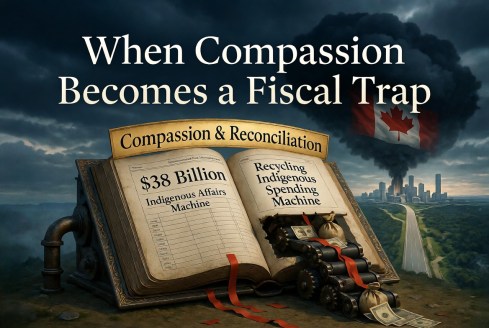
Canada’s Indigenous spending model has a problem it can no longer hide behind good intentions.
We are spending roughly $38 billion a year through core departments alone, after a decade of rapid expansion. The question is not whether that money is justified in principle. The question is whether it works.
On the outcomes that matter most—housing, child welfare, clean water reliability, and long-term economic independence—the answer is uneven at best and stagnant at worst. Progress exists. It is real. But it is not proportional to the scale of the spending. That gap between money spent and results achieved is the whole argument.
A system that cannot convert large, sustained spending into durable independence is not compassionate. It is failing.
The current model does not primarily produce independence. It manages dependency.
Spending has risen sharply, yet the Auditor General still found unsatisfactory progress on 53% of prior recommendations across core areas such as water, health access, emergency management, and socio-economic gaps. That is the mechanism in plain terms: more money flows, the system expands, compliance and administration thicken, and outcomes move slowly.
This is not just a funding shortage. It is a delivery failure.
And a delivery system that cannot convert major, repeated spending increases into reliable improvement is not neutral. It is misallocating resources at scale.
Canada is not bankrupt. But it is not insulated from fiscal reality either.
Federal spending is approaching half a trillion dollars. Debt-service costs are rising. Demographics are tightening the margin for error. You do not need a full sovereign-debt crisis for political choices to narrow. You just need pressure. A serious downturn, rising interest costs, or prolonged fiscal strain can force governments into reprioritization very quickly.
And when that happens, governments do not trim politely. They cut where they can.
That is where the current model becomes morally and fiscally dangerous at the same time. A system built on permanent federal transfers is stable only while those transfers keep flowing at politically tolerable levels. The moment that assumption weakens, those most dependent on the state become the most exposed to its limits.
That is the point too many sentimental arguments glide past. Dependency is not merely expensive. It is fragile.
A support model that only works while fiscal capacity keeps expanding is not a support model. It is a fair-weather dependency machine.
The present structure also rewards the wrong things. It rewards program expansion over completion, compliance over outcomes, announcements over maintenance, and federal management over local accountability. Money moves. Reports get written. Conditions improve, if they improve, far too slowly.
Look at drinking water. Ottawa rightly points to advisories lifted over the past decade. That progress matters. But Ottawa’s own figures also show that long-term advisories remain, and that many systems still require operational improvements before advisories can be lifted. That is not mainly a ribbon-cutting problem. It is a maintenance and systems problem. Building is politically photogenic. Sustaining is harder. The current model has often been better at funding capital headlines than at securing competent long-run operation.
The same broader pattern appears elsewhere. Indigenous children remain dramatically overrepresented in foster care. In 2021, Indigenous children made up 7.7% of children under 15, but 53.8% of children in foster care. A system that absorbs this much money and still leaves such ratios in place does not get to call itself successful because it can point to process, intent, or moral vocabulary.
If a model is expensive, underperforming, and fragile, it does not get preserved untouched. It gets triaged.
That means being willing to contemplate deep reductions—on the order of half to two-thirds over time—not as punishment, but as forced prioritization. The case is not for abandoning Indigenous communities. The case is for abandoning the fantasy that every current layer of spending is equally necessary, equally effective, or equally defensible.
Not everything should survive.
What should be protected is what is plainly essential: clean water systems with funded long-term maintenance, core health and emergency services, schooling, literacy, child protection, housing tied to credible upkeep plans, and communities that demonstrate effective local governance capacity.
What should be cut, compressed, or eliminated is the non-essential layer that accumulates in every morally protected spending regime: duplicative federal administration, consultant-driven program layers, pilot projects that never scale, compliance regimes that consume resources without clearly improving lives, and symbolic reconciliation spending detached from measurable outcomes.
If a program cannot show serious, durable improvement, it does not get to exist because it sounds compassionate in a press release.
This is where critics will predictably panic and moralize. They will say that Indigenous communities cost more to support because of historical injustice, geographic isolation, damaged infrastructure baselines, and the enduring effects of state misconduct. That is the strongest version of the opposing case, and parts of it are obviously true.
Historical injustice matters. Geographic isolation matters. Remote delivery costs are real. Weak starting conditions are real.
But that argument does not rescue the current model.
Historical injustice explains the starting line. It does not excuse a decade of rapidly expanding budgets with only partial and uneven progress. A moral claim to support is not the same thing as a proof that the delivery structure works. And after this much spending, defenders of the status quo still cannot point to outcome improvement proportionate to the scale of expenditure.
That matters because dependency wrapped in the language of reconciliation is still dependency. A model that leaves communities structurally tied to Ottawa’s fiscal condition is not empowering them. It is exposing them.
The answer, then, is not cuts for their own sake. It is reallocation.
Savings from the non-essential layer should be redirected in two directions. First, toward fiscal stabilization, because a state that loses control of its finances loses control of its choices. Second, toward connective infrastructure: roads, bridges, utilities, and other corridors that physically integrate isolated communities into provincial economies and reduce the permanent cost of remoteness.
Isolation is not an identity. It is, in significant part, an engineering and governance problem.
If you do not solve that problem, you will subsidize its consequences forever.
Historical injustice explains the starting line. It does not excuse ten years of bigger budgets with only marginal gap closure.
This is the part polite politics hates to say aloud. A country that refuses to discipline failing systems during periods of relative control increases the odds that future discipline will arrive under pressure instead. Markets impose limits. Debt-service costs impose limits. Fiscal stress imposes limits. In more extreme scenarios, countries lose the luxury of setting their own reform timetable and their own reform terms.
Better a hard reallocation now than a panicked contraction later.
Better to choose triage than to have it chosen for you.
The question is not whether Canada should support Indigenous communities. It should.
The question is whether Canada is willing to admit that the current model is not delivering enough, not fast enough, and not durably enough to justify its scale. Because the worst outcome is not reform. The worst outcome is drift: a system that consumes, reassures, and congratulates itself right up until the moment it cannot continue.
And then fails all at once.
References
- Indigenous Services Canada and Crown-Indigenous Relations and Northern Affairs Canada planned spending totals for 2025–26, approximately $38 billion combined.
- Office of the Auditor General of Canada follow-up finding that 53% of prior recommendations showed unsatisfactory progress.
- Indigenous Services Canada figures on long-term drinking water advisories, including advisories lifted and those still active.
- Statistics Canada figures showing Indigenous children as 7.7% of children under 15 but 53.8% of children in foster care in 2021.
- Federal spending and debt-pressure context from the budget and main estimates material summarized in the source text.











 bleatmop
 Mystro


 Dead Wild Roses
Your opinions…