
You are currently browsing the tag archive for the ‘public trust’ tag.
The Globe and Mail did not merely publish a bad headline. It published a small moral confession.

“SpaceX IPO makes Elon Musk the first trillionaire. Here’s how to properly hate him” was not serious analysis. It was an invitation to contempt. The newspaper later admitted the headline failed its editorial standards and replaced it. That was the right decision, but also the minimum.
The article itself may have been more nuanced than the headline. That distinction matters. But headlines are not decorative. They are the public face of an argument, the thing most readers see first, and often the only part that travels across social media. When a major Canadian newspaper packages an opinion piece as a lesson in how to “properly hate” someone, it tells us something about the institution’s instincts.
Billionaires, especially those wielding enormous cultural, economic, and political influence, deserve scrutiny. Questions about wealth concentration, government contracts, labour practices, market power, and political access are legitimate. Elon Musk is not above criticism.
But hatred is not scrutiny.
This episode reveals something important about the Overton window in Canadian legacy media. A headline encouraging readers to hate a prominent figure would normally be condemned as toxic polarization if it came from random voices online. When it appears under a respected masthead and targets the approved villain of the moment, it becomes clever commentary, at least until the backlash forces a correction.
Some will say the headline was ironic, exaggerated, or merely provocative. Fine. But institutions do not get to spend years warning the public about extremism, misinformation, online toxicity, and the collapse of civil discourse, then shrug when their own opinion pages dress contempt up as wit. Irony does not launder hatred into analysis.
Canadian media frequently complain about declining trust. This is one reason trust declines. Ordinary readers can see the double standard. They are told to be civil, careful, and responsible, while prestige outlets permit themselves moral indulgences they would condemn in others.
This is not about shielding Musk from criticism. It is about defending the line between rigorous critique and sanctioned contempt. A serious newspaper should sharpen readers’ thinking. It should not tutor them in how to hate more elegantly.
The Globe’s correction is welcome. But Canadians are entitled to ask what editorial culture allowed such a headline to go live in the first place.
If hatred is corrosive when it bubbles up from the public, it does not improve when it flows down from the opinion pages.
Something feels off.
You see it in how people talk now. Not just online—at work, in classrooms, in the small pause before someone says, “I don’t know what to believe anymore.”
It’s not ignorance. It’s not always partisan.
It’s closer to pattern recognition without a name.
Take a few examples most people have lived through.
During COVID-19, guidance shifted—sometimes quickly, sometimes awkwardly. Masks, transmission, vaccines, timelines. Some changes followed new data. Others reflected precaution, policy tradeoffs, or decisions made under uncertainty. On Climate Change, the core mechanism—greenhouse gases trapping heat—has been stable for decades, but the models refine over time: projections tighten, regional impacts shift, timelines adjust as more data comes in.
Go back further and you get something starker. For years, the health effects of Smoking were downplayed, muddied, or outright denied—sometimes with scientific backing that later collapsed under better evidence.
Individually, each case has its own explanation.
Put together, they produce a different reaction:
Why does this keep changing?
And underneath that:
Is this how knowledge works—or is something else going on?
The Fork Most People Feel But Don’t Name
There are two ways to read what’s happening.
First:
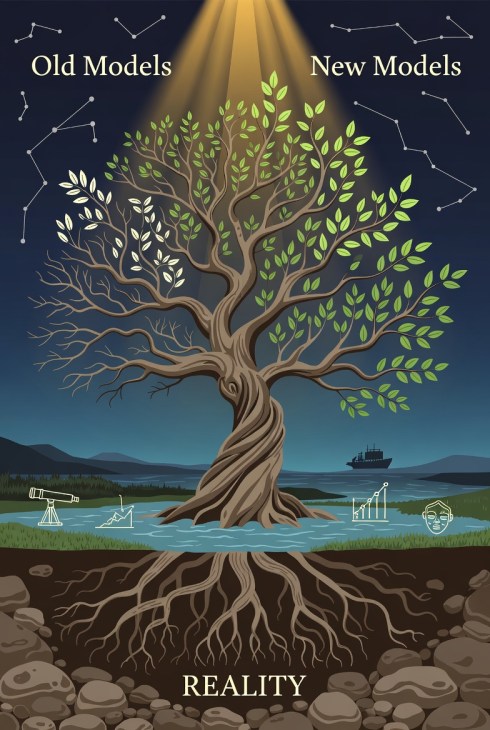
Science improves over time. Early models get revised as better evidence comes in. What looks like inconsistency is correction.
Second:
Scientific conclusions reflect the institutions and pressures around them. What looks like “updating the model” can also look like consensus shifting.
Most people don’t sit down and spell that out. They just feel the tension between the two.
Where the Signal Starts to Blur
Because here’s the problem:
Both interpretations contain some truth. Science does revise itself—that’s the mechanism doing its job—but institutions also decide what gets studied, reward certain kinds of results, and protect their credibility when they’re wrong, sometimes at the expense of how clearly the underlying models are tested, communicated, or corrected.
When those layers blur, the signal gets muddy.
What should look like correction starts to feel like reversal.
What should look like uncertainty narrowing starts to feel like narrative shift.
That’s where the “off” feeling comes from.
The Language Problem
Part of this is how science gets presented.
You’ll hear:
- “The science is settled”
- “Trust the experts”
- “Follow the consensus”
Those aren’t explanations. They’re conclusions.
And when the underlying details change later—as they often do—those statements don’t age well.
Not because science failed.
Because the way it was framed didn’t match how it actually works.
A Simpler Way to See It
Strip it down and the tension becomes clearer:
Does science discover things about the world that hold regardless of who studies them?
Or does it reflect the people, institutions, and pressures surrounding it?
Most people don’t need philosophy to feel the difference. They just need enough exposure to shifting guidance to start asking which one they’re looking at.
Why This Matters
In environments where trust is high, that distinction doesn’t get pushed very hard.
People assume:
- corrections are evidence-driven
- revisions are part of the process
- institutions are broadly acting in good faith
As trust becomes more conditional, the same behavior gets read differently. Updates start to look like spin. Uncertainty starts to look like cover. Expertise starts to look like authority protecting itself.
The Question That Actually Matters
So the real issue isn’t:
“Does science change?”
Of course it does.
The issue is:
What determines whether those changes move us closer to reality—or just reflect who has influence at the time?
That’s the line everything else hangs on.
Where This Goes Next
If science is mostly shaped by social forces, then its authority collapses into politics.
If it isn’t—if something else constrains it—then we need to be precise about what that is, and where the boundary lies.
That distinction matters more than most people realize.
Because it determines whether disagreement is something to be resolved…
or something to be won.
One of the quiet functions of a healthy political system is rotation.
Not because one party is virtuous and the other corrupt, but because time in power changes incentives in ways that are predictable, even if they are not always obvious in the moment. Networks deepen, relationships harden, and what begins as governance slowly shifts toward maintenance—of position, of access, of advantage.
Canada does not impose formal term limits on governments, but it has long relied on something that functions similarly in practice. Parties rise, govern for a period, accumulate political and institutional cost, and are eventually replaced. The pattern is not mechanical, and it is not guaranteed, but it has been consistent enough to act as a kind of informal corrective.
That corrective matters because it interrupts accumulation.
Given enough time, any governing party begins to operate within a system that is increasingly shaped by its own presence. Decision-making becomes more insulated. Access becomes more selective. The line between public purpose and political survival, while never erased, becomes easier to move in small ways that rarely register as decisive in isolation.
Recent Canadian politics illustrates the point without needing to overstate it. Controversies such as the ArriveCAN app controversy and the SNC-Lavalin affair do not require an assumption of uniquely bad actors to be understood. They are better read as symptoms of what tends to happen when a government remains at the centre of power long enough for incentives to drift and institutional friction to thin.
This is not a claim about one party. Given enough time, any governing party will face the same structural pressures. The names change. The pattern does not.
This is not, in the first instance, a question of intent. It is a question of structure. The longer a party governs, the more the system begins to orient toward its continuation. That orientation does not appear all at once. It develops through small accommodations, repeated often enough that they begin to feel normal.
“Given enough time, any governing party begins to operate within a system that is increasingly shaped by its own presence.”
Historically, Canadian politics has corrected for this through turnover. Governments change, and with that change comes a reintroduction of uncertainty. New actors enter. Old networks loosen. Decisions that once passed quietly are re-examined under a different set of incentives. The system does not become pure, but it becomes less settled.
That correction is not without cost. Rotation introduces instability, resets institutional memory, and can produce policy whiplash as new governments relearn old lessons. These are not trivial drawbacks. The question is whether the discipline imposed by credible exit outweighs the friction introduced by change.
That distinction matters.
When the expectation of rotation weakens, the effect is not immediate collapse. What changes first is the texture of the system. Power becomes less contingent, less exposed to disruption, and therefore less disciplined by the possibility of loss. The longer that condition persists, the more governance begins to resemble continuity rather than contest.
A system does not need dramatic failure to drift in this direction. It only needs the mechanisms that interrupt accumulation to operate less reliably than before.
If that is true, then the health of the system depends less on who governs than on whether the expectation of replacement remains credible.
High-trust societies depend, in part, on the belief that power circulates and that no position is permanently secured. That belief does not rest on rhetoric. It rests on repeated demonstration.
When that demonstration becomes less frequent, trust does not vanish overnight. It thins, gradually, as the gap between expectation and experience widens.
And once that gap becomes large enough, the system is no longer experienced as dynamic.
It is experienced as fixed.












 bleatmop
 Mystro


 Dead Wild Roses
Your opinions…