
You are currently browsing the tag archive for the ‘governance’ tag.
There’s a low-grade feeling in the background of a lot of conversations right now that something isn’t quite working the way it used to.
Not broken. Not collapsing. Just… off.
The rules still exist. The institutions still function. On paper, everything is in place. But the sense that things are moving in the direction they claim to be moving has started to thin, and people tend to notice that long before they can explain it.
It’s difficult to point to a single cause. That’s part of why the feeling lingers. When something breaks, you can name it. When something drifts, you feel it first and only understand it later.
That unease tends to show up when the quiet constraints that keep systems stable begin to weaken.
In law, it looks like uneven enforcement. In politics, it shows up when power stops feeling like something that will eventually change hands. More generally, it appears whenever positions begin to feel fixed rather than contingent.
Most of the time, these constraints operate in the background. They don’t need to be defended constantly because they are demonstrated often enough that people take them for granted. You see rules applied. You see consequences land. You see people leave positions they once held.
That’s usually enough.
When those patterns become less consistent, the system doesn’t collapse. It adjusts. Power becomes a little less exposed, a little more predictable, but not in a reassuring way. Access narrows, not through explicit barriers, but through familiarity and repetition.
You start to see the same outcomes, or at least the same kinds of outcomes, and they become easier to anticipate.
At first, most people adapt without thinking much about it. Systems can absorb a surprising amount of this kind of drift. But the adjustment isn’t free. It changes how people relate to the system itself.
They rely on it less. They work around it more. And eventually, they stop assuming that the rules being stated are the rules that actually matter.
That shift is quiet, but it matters.
This is not an argument that the past was fair, pure, or evenly experienced. Many people never experienced the old constraints as neutral. The point is narrower. When the public no longer believes the operative rules match the stated rules, trust begins to thin.
Analysts of collapse tend to focus on endpoints. Resource exhaustion. Rising complexity. External shock. Those accounts are valuable, and they explain why systems eventually fail.
What they describe less clearly is the phase that comes before that.
The point where the system still functions, but no longer feels like it is working as intended.
That phase is where most people live, and it is where most systems are decided.
Because once a system reaches the point where it requires constant effort to maintain the appearance of fairness, the cost of sustaining it begins to rise. Not just in money, but in attention, coordination, and trust.
More oversight gets added. More process. More intervention. Each change is meant to correct a small imbalance. Taken together, they make the system heavier and harder to move.
At some point, the question shifts. It’s no longer just whether the system is fair or efficient. It becomes whether it is worth maintaining in its current form.
That’s where drift turns into something else.
Not collapse in the dramatic sense, but simplification. People disengage. Participation drops. Compliance becomes selective. The system doesn’t explode. It contracts.
If that is the direction of travel, then the question is not how to prevent collapse entirely. No system avoids change indefinitely.
The question is how to restore the constraints that keep drift from becoming the default condition.
The answer is less dramatic than most people expect.
It doesn’t require perfect leaders, sweeping reform, or a complete redesign of institutions. It requires something more basic, and more difficult to sustain.
The system has to demonstrate, consistently and visibly, that its constraints still hold.
That demonstration has to be more than messaging.
It has to take the form of consequences that land where they should, including on allies, insiders, and institutions themselves. It means oversight with teeth, rules applied even when politically inconvenient, and positions that remain genuinely vulnerable to replacement rather than quietly secured over time.
These are not abstract principles. They are operational ones.
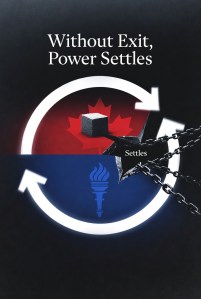
A system that enforces its rules selectively teaches people to look for exceptions. A system that allows power to settle teaches people that outcomes are predetermined. A system that avoids disruption teaches people that disruption is no longer possible.
Reversing that drift doesn’t happen through messaging. It happens through action, repeated often enough that people begin to believe what they are seeing again.
Trust is not restored by argument. It is restored by demonstration.
And that demonstration has to be visible enough that people can recognize it without being told what it means.
That is the path forward.
Not a guarantee of stability. Not a return to some idealized past. But a re-establishment of the conditions under which systems remain both legible and worth participating in.
Because the alternative is not immediate collapse, it is something a little more quieter and under the radar.
A system that continues to function, but no longer convinces.

Suggested Further Reading
If this line of thinking resonates, these works explore different parts of the same problem from complementary angles:
- The Collapse of Complex Societies — Joseph Tainter
A clear account of how increasing complexity yields diminishing returns, and why systems often simplify rather than fail dramatically. - Collapse — Jared Diamond
Examines how societies respond—successfully or not—to environmental, political, and economic pressures over time. - Guns, Germs, and Steel — Jared Diamond
A broader look at how geography and structural conditions shape long-term societal development and stability. - Rivers of Gold, Rivers of Blood — Anthony Quinn
Explores how wealth, empire, and resource flows influence power, expansion, and institutional behavior. - Altered Carbon — created by Laeta Kalogridis (based on the novel by Richard K. Morgan)
A speculative take on what happens when one of society’s most fundamental constraints—biological exit—is removed entirely.
One of the quiet functions of a healthy political system is rotation.
Not because one party is virtuous and the other corrupt, but because time in power changes incentives in ways that are predictable, even if they are not always obvious in the moment. Networks deepen, relationships harden, and what begins as governance slowly shifts toward maintenance—of position, of access, of advantage.
Canada does not impose formal term limits on governments, but it has long relied on something that functions similarly in practice. Parties rise, govern for a period, accumulate political and institutional cost, and are eventually replaced. The pattern is not mechanical, and it is not guaranteed, but it has been consistent enough to act as a kind of informal corrective.
That corrective matters because it interrupts accumulation.
Given enough time, any governing party begins to operate within a system that is increasingly shaped by its own presence. Decision-making becomes more insulated. Access becomes more selective. The line between public purpose and political survival, while never erased, becomes easier to move in small ways that rarely register as decisive in isolation.
Recent Canadian politics illustrates the point without needing to overstate it. Controversies such as the ArriveCAN app controversy and the SNC-Lavalin affair do not require an assumption of uniquely bad actors to be understood. They are better read as symptoms of what tends to happen when a government remains at the centre of power long enough for incentives to drift and institutional friction to thin.
This is not a claim about one party. Given enough time, any governing party will face the same structural pressures. The names change. The pattern does not.
This is not, in the first instance, a question of intent. It is a question of structure. The longer a party governs, the more the system begins to orient toward its continuation. That orientation does not appear all at once. It develops through small accommodations, repeated often enough that they begin to feel normal.
“Given enough time, any governing party begins to operate within a system that is increasingly shaped by its own presence.”
Historically, Canadian politics has corrected for this through turnover. Governments change, and with that change comes a reintroduction of uncertainty. New actors enter. Old networks loosen. Decisions that once passed quietly are re-examined under a different set of incentives. The system does not become pure, but it becomes less settled.
That correction is not without cost. Rotation introduces instability, resets institutional memory, and can produce policy whiplash as new governments relearn old lessons. These are not trivial drawbacks. The question is whether the discipline imposed by credible exit outweighs the friction introduced by change.
That distinction matters.
When the expectation of rotation weakens, the effect is not immediate collapse. What changes first is the texture of the system. Power becomes less contingent, less exposed to disruption, and therefore less disciplined by the possibility of loss. The longer that condition persists, the more governance begins to resemble continuity rather than contest.
A system does not need dramatic failure to drift in this direction. It only needs the mechanisms that interrupt accumulation to operate less reliably than before.
If that is true, then the health of the system depends less on who governs than on whether the expectation of replacement remains credible.
High-trust societies depend, in part, on the belief that power circulates and that no position is permanently secured. That belief does not rest on rhetoric. It rests on repeated demonstration.
When that demonstration becomes less frequent, trust does not vanish overnight. It thins, gradually, as the gap between expectation and experience widens.
And once that gap becomes large enough, the system is no longer experienced as dynamic.
It is experienced as fixed.











 bleatmop
 Mystro


 Dead Wild Roses
Your opinions…