
You are currently browsing the tag archive for the ‘democratic systems’ tag.
One of the quiet functions of a healthy political system is rotation.
Not because one party is virtuous and the other corrupt, but because time in power changes incentives in ways that are predictable, even if they are not always obvious in the moment. Networks deepen, relationships harden, and what begins as governance slowly shifts toward maintenance—of position, of access, of advantage.
Canada does not impose formal term limits on governments, but it has long relied on something that functions similarly in practice. Parties rise, govern for a period, accumulate political and institutional cost, and are eventually replaced. The pattern is not mechanical, and it is not guaranteed, but it has been consistent enough to act as a kind of informal corrective.
That corrective matters because it interrupts accumulation.
Given enough time, any governing party begins to operate within a system that is increasingly shaped by its own presence. Decision-making becomes more insulated. Access becomes more selective. The line between public purpose and political survival, while never erased, becomes easier to move in small ways that rarely register as decisive in isolation.
Recent Canadian politics illustrates the point without needing to overstate it. Controversies such as the ArriveCAN app controversy and the SNC-Lavalin affair do not require an assumption of uniquely bad actors to be understood. They are better read as symptoms of what tends to happen when a government remains at the centre of power long enough for incentives to drift and institutional friction to thin.
This is not a claim about one party. Given enough time, any governing party will face the same structural pressures. The names change. The pattern does not.
This is not, in the first instance, a question of intent. It is a question of structure. The longer a party governs, the more the system begins to orient toward its continuation. That orientation does not appear all at once. It develops through small accommodations, repeated often enough that they begin to feel normal.
“Given enough time, any governing party begins to operate within a system that is increasingly shaped by its own presence.”
Historically, Canadian politics has corrected for this through turnover. Governments change, and with that change comes a reintroduction of uncertainty. New actors enter. Old networks loosen. Decisions that once passed quietly are re-examined under a different set of incentives. The system does not become pure, but it becomes less settled.
That correction is not without cost. Rotation introduces instability, resets institutional memory, and can produce policy whiplash as new governments relearn old lessons. These are not trivial drawbacks. The question is whether the discipline imposed by credible exit outweighs the friction introduced by change.
That distinction matters.
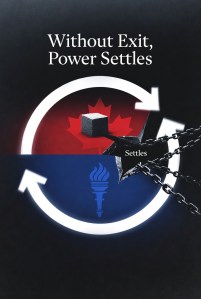
When the expectation of rotation weakens, the effect is not immediate collapse. What changes first is the texture of the system. Power becomes less contingent, less exposed to disruption, and therefore less disciplined by the possibility of loss. The longer that condition persists, the more governance begins to resemble continuity rather than contest.
A system does not need dramatic failure to drift in this direction. It only needs the mechanisms that interrupt accumulation to operate less reliably than before.
If that is true, then the health of the system depends less on who governs than on whether the expectation of replacement remains credible.
High-trust societies depend, in part, on the belief that power circulates and that no position is permanently secured. That belief does not rest on rhetoric. It rests on repeated demonstration.
When that demonstration becomes less frequent, trust does not vanish overnight. It thins, gradually, as the gap between expectation and experience widens.
And once that gap becomes large enough, the system is no longer experienced as dynamic.
It is experienced as fixed.
We have a long way to go to fix the democratic systems in the US and Canada. Paul Street, writing for Counterpunch gives a little insight into the ‘electoral process’.
“Yes, we get to vote. Super. Big deal. Mammon reigns nonetheless in the United States, where, as the leading liberal political scientists Benjamin Page and Martin Gilens find, “government policy…reflects the wishes of those with money, not the wishes of the millions of ordinary citizens who turn out every two years to choose among the preapproved, money-vetted candidates for federal office.” Trump is a bit of an anomaly – a sign of an elections and party system in crisis and an empire in decline. He wasn’t pre-approved or vetted by the usual U.S. “deep state” corporate, financial, and imperial gatekeepers. The ruling-class had been trying to figure out what the Hell to do with him ever since he shocked even himself (though not Steve Bannon) by pre-empting the coronation of the “Queen of Chaos.” He is a homegrown capitalist oligarch nonetheless, a real estate mogul of vast and parasitic wealth who is no more likely to fulfill his populist-sounding campaign pledges than any previous POTUS of the neoliberal era. His lethally racist, sexist, nativist, nuclear-weapons-brandishing, and (last but not at all least) eco-cidal rise to the nominal CEO position atop the U.S.-imperial oligarchy is no less a reflection of the dominant role of big U.S. capitalist money and homegrown plutocracy in U.S. politics than a more classically establishment Hillary ascendancy would have been. It’s got little to do with Russia, Russia, Russia – the great diversion that fills U.S. political airwaves and newsprint as the world careens ever closer to oligarchy-imposed geocide and to a thermonuclear conflagration that the RussiaGate gambit is recklessly encouraging.”
Not the most rosy picture being painted. Reforming our democratic systems to actually reflect the views of the electorate has to be made a priority. The gilded age we exist in now is just a small taste of what is to come.











 bleatmop
 Mystro


 Dead Wild Roses
Your opinions…