
Something feels off.
You see it in how people talk now. Not just online—at work, in classrooms, in the small pause before someone says, “I don’t know what to believe anymore.”
It’s not ignorance. It’s not always partisan.
It’s closer to pattern recognition without a name.
Take a few examples most people have lived through.
During COVID-19, guidance shifted—sometimes quickly, sometimes awkwardly. Masks, transmission, vaccines, timelines. Some changes followed new data. Others reflected precaution, policy tradeoffs, or decisions made under uncertainty. On Climate Change, the core mechanism—greenhouse gases trapping heat—has been stable for decades, but the models refine over time: projections tighten, regional impacts shift, timelines adjust as more data comes in.
Go back further and you get something starker. For years, the health effects of Smoking were downplayed, muddied, or outright denied—sometimes with scientific backing that later collapsed under better evidence.
Individually, each case has its own explanation.
Put together, they produce a different reaction:
Why does this keep changing?
And underneath that:
Is this how knowledge works—or is something else going on?
The Fork Most People Feel But Don’t Name
There are two ways to read what’s happening.
First:
Science improves over time. Early models get revised as better evidence comes in. What looks like inconsistency is correction.
Second:
Scientific conclusions reflect the institutions and pressures around them. What looks like “updating the model” can also look like consensus shifting.
Most people don’t sit down and spell that out. They just feel the tension between the two.
Where the Signal Starts to Blur
Because here’s the problem:
Both interpretations contain some truth. Science does revise itself—that’s the mechanism doing its job—but institutions also decide what gets studied, reward certain kinds of results, and protect their credibility when they’re wrong, sometimes at the expense of how clearly the underlying models are tested, communicated, or corrected.
When those layers blur, the signal gets muddy.
What should look like correction starts to feel like reversal.
What should look like uncertainty narrowing starts to feel like narrative shift.
That’s where the “off” feeling comes from.
The Language Problem
Part of this is how science gets presented.
You’ll hear:
- “The science is settled”
- “Trust the experts”
- “Follow the consensus”
Those aren’t explanations. They’re conclusions.
And when the underlying details change later—as they often do—those statements don’t age well.
Not because science failed.
Because the way it was framed didn’t match how it actually works.
A Simpler Way to See It
Strip it down and the tension becomes clearer:
Does science discover things about the world that hold regardless of who studies them?
Or does it reflect the people, institutions, and pressures surrounding it?
Most people don’t need philosophy to feel the difference. They just need enough exposure to shifting guidance to start asking which one they’re looking at.
Why This Matters
In environments where trust is high, that distinction doesn’t get pushed very hard.
People assume:
- corrections are evidence-driven
- revisions are part of the process
- institutions are broadly acting in good faith
As trust becomes more conditional, the same behavior gets read differently. Updates start to look like spin. Uncertainty starts to look like cover. Expertise starts to look like authority protecting itself.
The Question That Actually Matters
So the real issue isn’t:
“Does science change?”
Of course it does.
The issue is:
What determines whether those changes move us closer to reality—or just reflect who has influence at the time?
That’s the line everything else hangs on.
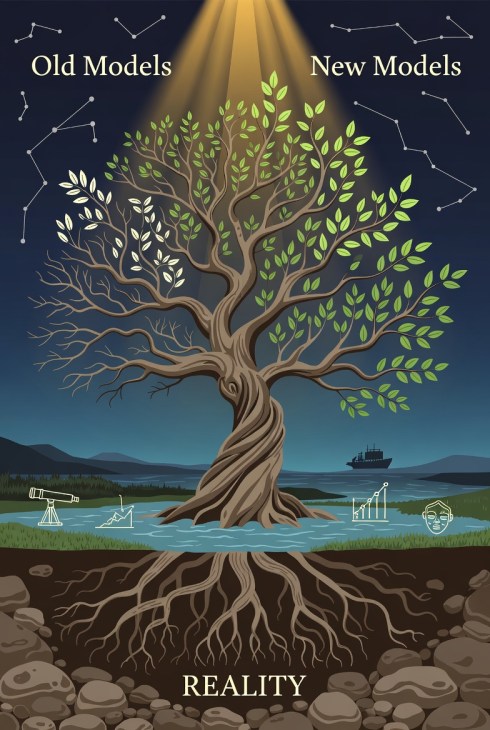
Where This Goes Next
If science is mostly shaped by social forces, then its authority collapses into politics.
If it isn’t—if something else constrains it—then we need to be precise about what that is, and where the boundary lies.
That distinction matters more than most people realize.
Because it determines whether disagreement is something to be resolved…
or something to be won.











 bleatmop
 Mystro


 Dead Wild Roses
1 comment
Comments feed for this article
May 7, 2026 at 7:16 am
Steve Ruis
Kudos on this! Re “I don’t know what to believe anymore.” The problem with this statement is the word “believe.” All scientific findings are conditional, by design. They are not set in stone. For example, Einstein established the supremacy of the speed of light, that nothing could move faster. Yet for the next 100 years people have been looking at things to support the claim that that is not really the case. This is how things go.
As a scientist, I have felt disappointment when some aspect of theory I favor has fallen out of favor, but that is not a problem with the science, but a problem with me.
LikeLiked by 1 person