
You are currently browsing the tag archive for the ‘Christianity’ tag.
There are few modern spectacles more interesting than Richard Dawkins speaking warmly about Christianity.
Not converting. Not recanting The God Delusion. Not wandering into Evensong with a softened heart and a sudden interest in incense. But speaking warmly, nevertheless.
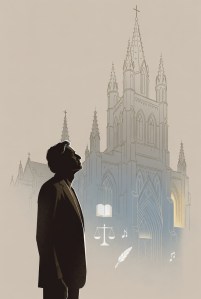 Dawkins has called himself a “cultural Christian.” He remains an atheist, which is what makes the admission interesting. He is not saying Christianity is true. He is noticing that Christianity helped form a civilization in which he could become Richard Dawkins: skeptical, eloquent, publicly irreverent, protected enough to criticize sacred things, and still culturally at home among the ruins and residues of the faith he rejects.
For a long time, many secular Westerners treated Christianity as something they had outgrown. It was old, morally complicated, often hypocritical, and associated with repression, scolding, and bad Sunday mornings. Keep the music, perhaps. Keep the architecture. Keep Christmas, provided no one gets doctrinal about it. The rest could be packed away.
There were reasons for that impatience. Churches persecuted, censored, lied, protected abusers, cozied up to power, and sometimes confused institutional self-interest with the will of God. No honest appreciation of Christian civilization can skip that part. But there is a difference between remembering the failures of an inheritance and forgetting that we inherited anything worth having.
The West was not built from one source. It is a quarrelsome inheritance: Greek reason, Roman law, Jewish moral seriousness, Christian theology, Germanic custom, common law, Reformation fracture, Enlightenment skepticism, scientific inquiry, and the long institutional habit of limiting power. Christianity did not invent every virtue from nothing, but it became one of the great furnaces in which those virtues were universalized, moralized, preached, contradicted, betrayed, and recovered.
Modern liberalism did not merely inherit Christian assumptions and put them in nicer clothes. It built institutions Christianity often resisted: robust free speech, religious disestablishment, broader suffrage, empirical science protected from clerical authority, and legal equality that went well beyond what most Christian societies were willing to grant. Some of the freedoms Dawkins enjoys were made possible by Christian moral inheritance. Others required sharp breaks from dominant Christian practice.
That tension is the point. The West is the product of argument, correction, rebellion, restraint, and institutional memory.
This is what modern secular people often miss. We imagine ourselves as freestanding moral adults. We believe in human dignity, equality before the law, freedom of conscience, care for the vulnerable, suspicion of tyranny, and the right to criticize authority. Fine. Keep all of that. But those commitments have a history. They were not produced by vibes, nor assembled last Tuesday by a committee with a land acknowledgement and a catering budget.
They came through centuries of conflict, doctrine, reform, law, blood, repentance, philosophy, institutional restraint, and exhaustion after too many people had killed each other over ultimate things.
To appreciate that inheritance is not to baptize every part of it. Christendom was not gentle. Christianity often had to be forced into better conduct by dissidents, reformers, scientists, heretics, abolitionists, and Christians reading their own scriptures more honestly than their institutions did. The West’s moral inheritance was not a clean gift. It was an argument, often conducted under pressure.
“The West is the product of argument, correction, rebellion, restraint, and institutional memory.”
But the argument happened inside a civilization shaped deeply by Christianity.
The freedom to doubt, mock religion, publish irreverent books, leave a faith, criticize clerics, and live without being ruled by priests was not inevitable. Nor was the expectation that women may walk unveiled, educated, employed, politically equal, and legally protected. These are achievements produced by particular histories, institutions, and moral restraints.
That is where Dawkins’ comparison with Islam enters the discussion, though it needs care.
The issue is not Muslim neighbours. Millions of Muslims live peacefully, work hard, raise families, keep faith privately, and want the ordinary goods everyone else wants: safety, dignity, friendship, decent schools, and a stable life. A serious argument begins by refusing collective suspicion.
The harder question is what happens when Islamic doctrine becomes politically confident and expects the wider society to accommodate its rules around blasphemy, apostasy, religious offence, sex roles, homosexuality, and public criticism. Outcomes differ by interpretation, education, migration patterns, and host-society confidence, but liberal societies still cannot survive by pretending every moral and legal order is equally compatible with liberal freedom.
Dawkins seems to understand that cultural Christianity has learned to live with disbelief in a way many religious systems have not. The Anglican church may annoy you. It may bore you. It may produce beige sermons, awkward committees, and hymns sung by twelve people spread across a nave built for three hundred. But it is unlikely to demand the state punish you for mocking it, which is not a small thing.
“But criticism without gratitude curdles into contempt, and contempt is a poor steward of anything worth preserving.”
The Sunday lesson, then, is not “become Christian or die,” nor “atheists secretly know God is real,” nor “all Muslims are enemies.” It is more modest and more useful: know where you are standing.
If you live in the West, you live inside an inheritance. You may criticize it. You should criticize it. The tradition itself contains the tools for doing so. But criticism without gratitude curdles into contempt, and contempt is a poor steward of anything worth preserving.
Secular liberalism has been living partly off inherited moral capital for a long time, even while adding real achievements of its own. Compassion, rights, conscience, equality, dissent, human dignity, forgiveness, reform, and care for the weak remained available, but the story of how they arrived became unfashionable.
A culture can run on inherited habits for a while. Maybe longer than its critics expect. But inheritance is not self-renewing, and gratitude alone is not repayment. If people are taught only to sneer at what formed them, they will not know what to keep, what to reform, what to defend, or what to pass on. If they merely admire the ruins, they become tourists in their own civilization.
Dawkins has not found God. He has noticed a debt.
The harder question is whether a civilization can repay that debt without pretending to believe what many of its citizens no longer believe.
There are places in the world where violence does not need religion.
And then there are places where religion makes it sharper.
Recent reports of attacks on Christian communities in parts of Africa—especially in Nigeria—have circulated widely. The language online is immediate and absolute: slaughter, persecution, genocide. Some of those claims oversimplify a complicated reality. The violence there is not one thing. It is insurgency, land conflict, criminality, and state weakness layered together in unstable ways.
But that is not the same as saying religion is irrelevant.
It is not.
In conflicts where identity is already strained, religion does something specific. It does not always cause the violence. It clarifies it. It names the sides. It tells participants who they are, who the enemy is, and—critically—why the conflict matters beyond survival or territory.
That shift matters.
A dispute over land can end in compromise. A struggle over resources can be negotiated, delayed, or abandoned. But when a conflict is framed in religious terms, it acquires a different gravity. The stakes move from material to moral. Victory is no longer just advantage. It becomes justification.
Religion does not create the blade. It tells you where to aim it.
This is why the same region can produce multiple kinds of violence at once. Armed groups with explicitly Islamist aims may target Christians as Christians. Local conflicts between herders and farmers may fall along religious lines and then harden under that framing. Criminal actors may adopt the language of faith because it organizes fear and loyalty more efficiently than profit alone.
The result is not a single, unified campaign. It is something less coherent and, in some ways, more dangerous: a landscape where violence can be justified in more than one register at once.
This is where outside observers often get it wrong.
To say “this is purely religious persecution” is to miss the structural drivers that sustain the conflict. To say “religion has nothing to do with it” is to ignore how meaning is assigned once violence begins. Both errors flatten the reality into something easier to argue about and harder to understand.
Religion, at its most potent, is a system for organizing meaning. In peaceful conditions, that can produce cohesion, charity, and restraint. In unstable conditions, it can do the opposite. It can elevate conflict, sanctify grievance, and make compromise feel like betrayal.
That is not unique to any one faith tradition. It is a property of belief when it becomes fused with identity under pressure.
The violence does not need religion to begin.
But once religion enters the frame, it changes what the violence is for.
And that is when it becomes harder to end.

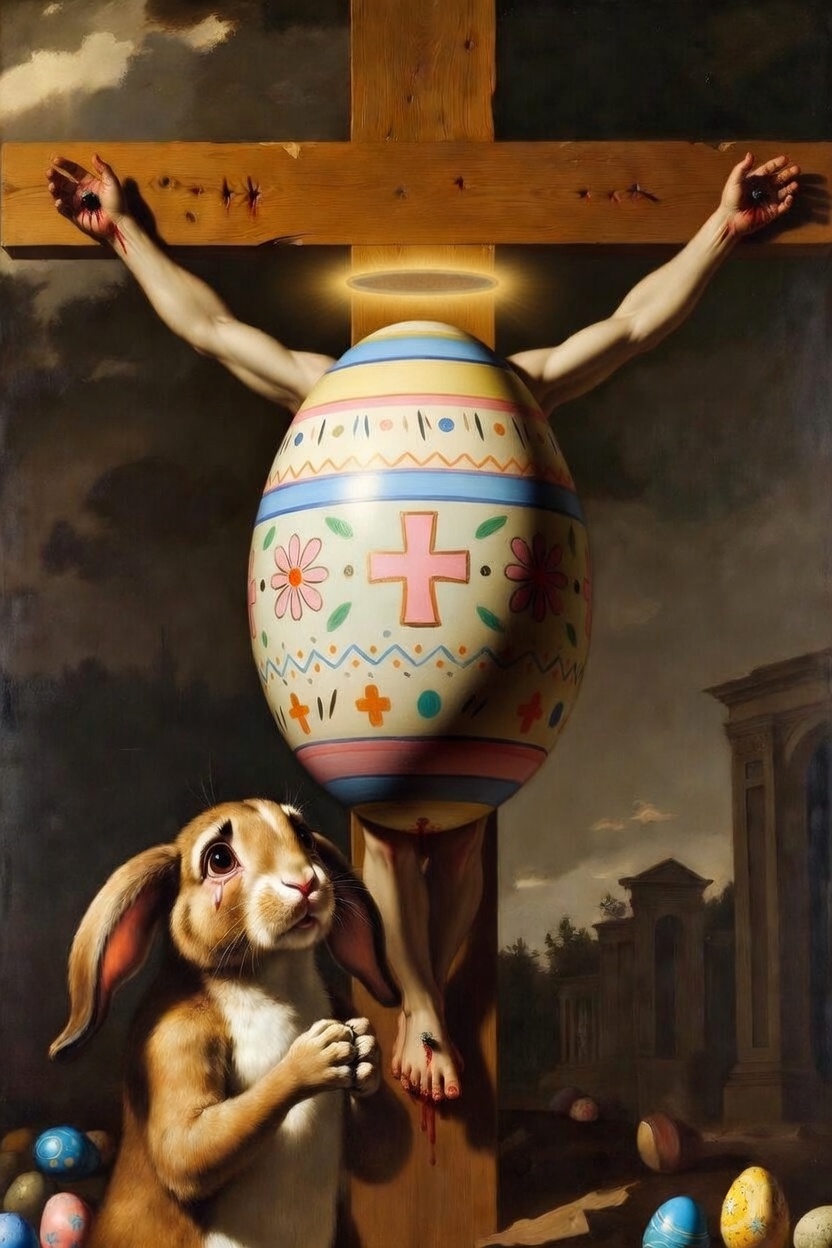
And in those days the people took the Egg and lifted it up.
For they had inherited a story too severe for annual use. It spoke of sin, sacrifice, judgment, and the defeat of death. This was felt to be excessive. So the people, being practical, placed an Egg at the centre instead.
And the Egg was found to be most serviceable. It made no demands. It required no repentance. It offered renewal without cost, festivity without doctrine, and transcendence in colours suitable for children.
So the teachers taught the people, saying: “Behold, life emerges from the shell.”
And the merchants said: “Behold also the premium edition.”
And the people were pleased, for the new symbols were soft, and the old ones had been sharp.
Now there remained, in the background, certain older shapes: a cross, some blood, the memory of an execution, and the rumour that something more serious had once been meant here. But these were judged unhelpful to the season and were retained chiefly as atmosphere.
Thus the Bunny was appointed witness, being harmless and incapable of theology.
And every year thereafter the people gathered in bright garments and proclaimed the feast of renewal. They spoke warmly of spring, family, and hope. They hid eggs for the children. They exchanged sweets. And they congratulated themselves on having preserved the holiday while removing from it all that might interrupt digestion.
So the form remained, and the meaning was transferred.
And this was counted wisdom.
Yet some, looking upon the Egg lifted where once another figure had stood, felt a faint unease, as of men who have kept the ceremony and misplaced the object.
But the people called this nostalgia, and continued the celebration.
I am an atheist. I do not believe in God, miracles, or an afterlife. Yet I am convinced that without Christianity, the West as we know it would be in deep trouble. This is not a plea for conversion; it is a historical and institutional argument about causation, moral capital, and societal resilience. Christianity supplied the ethical vocabulary, the metaphysical glue, and the organizational scaffolding that transformed a patchwork of tribes into a civilization capable of self-correction and sustained progress. Remove it, and the structure does not stand neutral—it tends toward fragmentation and moral erosion.
Conceding the Objections
The historical record contains horrors: the Inquisition, the Crusades, witch-burnings, and biblical endorsements of slavery and stoning. The Spanish Inquisition executed 3,000–5,000 people over three and a half centuries (Henry Kamen, The Spanish Inquisition, 1997). The Crusades may have claimed 1–3 million lives across two centuries (Thomas Madden, The New Concise History of the Crusades, 2005). Leviticus prescribes death for adultery and homosexuality. These human costs cannot be denied.
Yet scale and context matter. The secular French Reign of Terror executed over 16,000 in a single year (1793–94). Twentieth-century atheist regimes accounted for roughly 100 million deaths in six decades (The Black Book of Communism, 1997). The same biblical canon that justified cruelty also contained the seeds of reform. Jesus’ “let him without sin cast the first stone” (John 8:7) and Paul’s “the letter kills, but the spirit gives life” (2 Corinthians 3:6) inspired Christian abolitionists to resist literalist cruelty. Christianity, unlike pagan or purely rational codes, possesses an internal dialectic capable of moral self-correction.
The Pre-Christian Baseline
The world Christianity inherited was ethically limited. Rome was an administrative marvel but morally parochial: one in four newborns was exposed on hillsides (W. V. Harris, 1982), gladiatorial combat entertained hundreds of thousands, and slavery was normalized by Aristotle and unchallenged by Cicero. Pagan philanthropy existed—evergetism—but it was episodic, tied to civic prestige, not universal duty.
Christianity introduced a transformative idea: every human being, slave or emperor, bore the image of God (imago Dei). Gregory of Nyssa condemned slavery as theft from the Creator in 379 CE. Constantine’s successors banned infanticide by 361 CE (Codex Theodosianus 3.3.1). These were not Enlightenment innovations; they were theological imperatives that eventually rewrote law and custom.
Institutions That Outlived Their Creed
The West’s institutional DNA is stamped with Christian influence:
- Literacy and knowledge: Monastic scriptoria preserved Virgil alongside the Vulgate. Cathedral schools evolved into Bologna (1088) and Paris (1150)—the first universities, chartered to pursue truth as a reflection of divine order.
- Care systems: Basil of Caesarea built the basilias in the fourth century, a network of hospitals, orphanages, and poor relief. No pre-Christian society systematized charity on this scale.
- Rule of law: The Decalogue’s absolute prohibitions and the Sermon on the Mount’s inward ethic created trust horizons essential for complex societies. English common law, the Magna Carta (1215), and the U.S. Declaration’s “endowed by their Creator” trace their lineage to Christian natural-law theory.
Secular analogues arrived centuries later and proved fragile without transcendent accountability. The Soviet Union inherited Orthodox hospitals but could not sustain them after purging “idealism.”
The Borrowing Fallacy
Many modern atheists condemn Leviticus yet insist on universal dignity. That norm is not self-evident; it is a Christian export. Nietzsche saw this clearly: the “death of God” would undo slave morality and return society to master morality (Genealogy of Morals, 1887). When we demand compassion from power, we are smuggling Christian principles into a secular argument. Strip away the premise, and human relations default to “the strong do what they can and the weak suffer what they must” (Thucydides).
Contemporary Evidence
Secularization correlates with institutional and social atrophy. Europe’s fertility rate hovers at 1.5, and marriage and volunteerism track church attendance downward. The World Values Survey shows that religious societies retain higher interpersonal trust. The West exports human rights grounded in Christian-derived universality; competitors offer efficiency without reciprocity.
Some argue secular humanism could replace Christianity. Yet historical experience shows moral innovation without transcendent accountability is fragile: Enlightenment ethics, while intellectually powerful, required centuries of reinforcement from religiously-informed social norms to take root widely.
A Charitable Conclusion
Christians must acknowledge their tradition’s abuses alongside its capacity for self-correction. Atheists should recognize that our moral vocabulary—equality, compassion, rights—was not discovered by reason alone but forged in a crucible we no longer actively tend. The West lives off borrowed moral capital. When the account empties, we will not revert to a benign pagan golden age; we will confront efficient barbarism dressed in bureaucratic language.
Christianity is not true, in my view. But it was necessary. And it may still be.

References
- Harris, W. V. (1982). Ancient Literacy. Harvard University Press.
- Kamen, Henry. (1997). The Spanish Inquisition: A Historical Revision. Yale University Press.
- Madden, Thomas F. (2005). The New Concise History of the Crusades. Rowman & Littlefield.
- Popper, Karl. (1972). The Open Society and Its Enemies. Princeton University Press.
- The Black Book of Communism: Crimes, Terror, Repression (1997). Stéphane Courtois et al. Harvard University Press.
- Nietzsche, Friedrich. (1887). On the Genealogy of Morals.
- Thucydides. History of the Peloponnesian War. Trans. Rex Warner. Penguin Classics, 1972.
- Codex Theodosianus. (438 CE). Codex of the Theodosian Code, Book 3, Title 3, Law 1.
- World Values Survey. (2017). “Wave 7 (2017–2020) Survey Data.” Retrieved from https://www.worldvaluessurvey.org.
Competing for the religion of ‘peace’ I see…

Confused? So is the rest of the rational world. :)











 bleatmop
 Mystro
 The Arbourist


 Dead Wild Roses
Your opinions…