
You are currently browsing the tag archive for the ‘Conflict Analysis’ tag.
There are places in the world where violence does not need religion.
And then there are places where religion makes it sharper.
Recent reports of attacks on Christian communities in parts of Africa—especially in Nigeria—have circulated widely. The language online is immediate and absolute: slaughter, persecution, genocide. Some of those claims oversimplify a complicated reality. The violence there is not one thing. It is insurgency, land conflict, criminality, and state weakness layered together in unstable ways.
But that is not the same as saying religion is irrelevant.
It is not.
In conflicts where identity is already strained, religion does something specific. It does not always cause the violence. It clarifies it. It names the sides. It tells participants who they are, who the enemy is, and—critically—why the conflict matters beyond survival or territory.
That shift matters.
A dispute over land can end in compromise. A struggle over resources can be negotiated, delayed, or abandoned. But when a conflict is framed in religious terms, it acquires a different gravity. The stakes move from material to moral. Victory is no longer just advantage. It becomes justification.
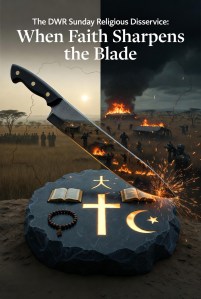
Religion does not create the blade. It tells you where to aim it.
This is why the same region can produce multiple kinds of violence at once. Armed groups with explicitly Islamist aims may target Christians as Christians. Local conflicts between herders and farmers may fall along religious lines and then harden under that framing. Criminal actors may adopt the language of faith because it organizes fear and loyalty more efficiently than profit alone.
The result is not a single, unified campaign. It is something less coherent and, in some ways, more dangerous: a landscape where violence can be justified in more than one register at once.
This is where outside observers often get it wrong.
To say “this is purely religious persecution” is to miss the structural drivers that sustain the conflict. To say “religion has nothing to do with it” is to ignore how meaning is assigned once violence begins. Both errors flatten the reality into something easier to argue about and harder to understand.
Religion, at its most potent, is a system for organizing meaning. In peaceful conditions, that can produce cohesion, charity, and restraint. In unstable conditions, it can do the opposite. It can elevate conflict, sanctify grievance, and make compromise feel like betrayal.
That is not unique to any one faith tradition. It is a property of belief when it becomes fused with identity under pressure.
The violence does not need religion to begin.
But once religion enters the frame, it changes what the violence is for.
And that is when it becomes harder to end.











 bleatmop
 Mystro
 The Arbourist


 Dead Wild Roses
Your opinions…