
You are currently browsing the daily archive for May 12, 2026.
Oh, for heaven’s sake.
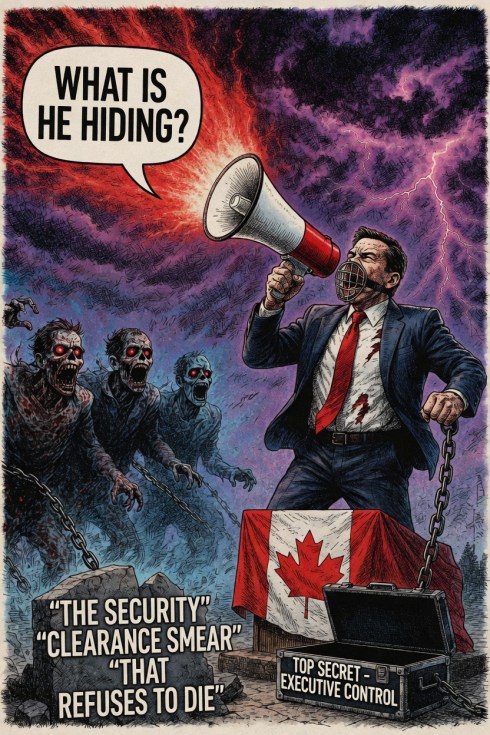
The Pierre Poilievre “security clearance” line has become one of those zombie claims in Canadian politics: killed repeatedly, buried repeatedly, and somehow still shambling around the media ecosystem looking for brains.
The lazy version goes like this: Poilievre does not have security clearance.
The line sounds grave because it is designed to sound grave. The average reader is supposed to hear it and supply the missing accusation: What is he hiding? Why can’t he pass the test? Is he compromised? The framing does not need to prove those suspicions. It only needs to keep them hovering.
But the real issue is not whether Poilievre is some random man off the street who cannot be trusted near a file folder. He served as a federal cabinet minister under Stephen Harper, including as minister of democratic reform and employment and social development. Cabinet ministers routinely handle sensitive government information. The current fight is over whether, as Leader of the Opposition, he should accept a particular classified briefing process under conditions that may limit what he can say afterward.
That is where the trick happens: critics collapse separate categories into one insinuating claim. Past cabinet access, present clearance status, and refusal of a specific classified-briefing regime are treated as though they are the same thing.
The accurate answer is not “his clearance never expires.” That claim is too broad and too easy to attack. Government of Canada security guidance says Secret clearance is valid for 10 years and Top Secret for 5 years. The stronger point is that the public is being offered a flattened version of a more complicated dispute.
The government, opposing parties, and many media voices say Poilievre “refuses to get security clearance.” Often, what they mean is that he has refused the additional clearance or classified briefing access needed to review certain foreign-interference material, including unredacted intelligence. Poilievre’s stated reason is that accepting those terms would restrict his ability to comment publicly.
You can view that choice as wise or reckless. But refusal under those terms is not the same as being unable to obtain clearance. It is not evidence that he failed a background check. It does not prove intelligence officials found him unfit. It means he has refused to enter a briefing regime with legal and political consequences.
Those consequences are not rhetorical decoration. The National Security and Intelligence Committee of Parliamentarians Act requires members to obtain and maintain the necessary Government of Canada security clearance, take an oath, and follow confidentiality rules. It also prohibits members and former members from knowingly disclosing protected information obtained through their work. The Supreme Court of Canada has upheld limits on parliamentary privilege in this context. In plain English: once you accept certain classified information under those rules, you may know more, but you may also be able to say less.
That architecture matters for an opposition leader. A government backbencher can absorb confidential information and stay quiet. A minister can be bound by cabinet confidence. But the Leader of the Opposition has a different role: to scrutinize the executive, press for disclosure, expose contradictions, and speak publicly when the government would rather manage the file behind closed doors.
There is still a serious criticism here. A potential prime minister should not be casually indifferent to classified intelligence. Foreign interference is not a branding exercise. It is real, ongoing, and aimed at Canadian institutions. Critics argue that Poilievre’s refusal leaves him unnecessarily blind on files he may one day have to manage from the Prime Minister’s Office.
That case should be made plainly: Poilievre should accept the clearance because national security requires informed leadership, even if that limits what he can say publicly afterward.
Fair enough. Argue that.
But do not imply he failed a clearance process. Do not suggest he is too compromised to receive sensitive information. Do not turn a strategic refusal into a character indictment.
Poilievre’s position may be risky. It may even be wrong in some circumstances. But the risk he identifies is also real. If the government possesses information embarrassing to itself, damaging to another party, or relevant to public accountability, a briefed opposition leader may become strategically constrained. In ordinary life, “knowing more” is usually an advantage. In opposition politics, knowing something you cannot use can become a leash.
This is why the “just get the clearance” demand is not neutral. It asks the Leader of the Opposition to step inside a confidentiality framework shaped by the executive he is supposed to scrutinize.
None of this automatically makes Poilievre right. There may be briefings he should accept. There may be moments when national security requires trust between government and opposition. But pretending the only possible explanation for refusal is guilt, cowardice, or hidden compromise is political theatre masquerading as procedural concern.
The machinery is more complicated than the slogan. Opposition leaders can receive classified briefings through different routes, with different levels of access and different obligations attached. Some briefings may require formal clearance. Some may involve confidentiality agreements. Some may leave a political leader better informed but publicly constrained.
So argue the real question.
Should the Leader of the Opposition accept classified briefings if doing so may limit his ability to criticize the government? Or should he remain outside that framework so he can keep pressing for public disclosure, especially when the issue is foreign interference in Canadian democracy?
Canadians can land on either side of that question. What they should not accept is the cheap version: Poilievre won’t get clearance — what is he hiding?
That is not analysis. It is insinuation with a lanyard.
The proper answer is to force precision.
Say what actually happened: Poilievre refused a particular classified briefing path because he believes it would constrain his ability to speak publicly and perform the adversarial role of opposition. His critics may call that irresponsible. His defenders may call it prudent. But anyone still selling the crude version is not informing the public.
They are laundering a smear through procedure, and Canadians should be tired of that trick by now.
References
- Government of Canada — Security clearance request process
Explains clearance levels and validity periods: Secret clearance is valid for 10 years; Top Secret clearance is valid for 5 years.
https://www.canada.ca/en/public-services-procurement/services/industrial-security/security-requirements-contracting/personnel-security-screening/processes/security-clearance-request.html - National Security and Intelligence Committee of Parliamentarians Act
Sets out clearance, oath, confidentiality, and disclosure obligations for NSICOP members.
https://laws-lois.justice.gc.ca/eng/acts/n-16.6/page-1.html - Supreme Court of Canada — Alford v. Canada (Attorney General), 2026 SCC 11
Confirms limits on parliamentary privilege for NSICOP-related secrecy obligations.
https://www.scc-csc.ca/judgments-jugements/cb/2026/41336/ - Reuters — Trudeau says some opposition MPs could be involved in foreign interference
Includes the context around Poilievre declining clearance to access intelligence from the foreign-interference probe.
https://www.reuters.com/world/americas/trudeau-says-some-opposition-canada-mps-could-be-involved-foreign-interference-2024-10-16/ - Foreign Interference Commission — PCO memo on classified briefings for opposition leaders
Discusses possible classified briefing routes for opposition leaders, including Secret-level briefings, Privy Councillor options, confidentiality agreements, and Top Secret requirements.
https://foreigninterferencecommission.ca/fileadmin/foreign_interference_commission/Documents/Exhibits_and_Presentations/Exhibits/CAN023012.pdf











 bleatmop
 Mystro
 The Arbourist


 Dead Wild Roses
Your opinions…