
You are currently browsing the tag archive for the ‘Media Framing’ tag.
Oh, for heaven’s sake.
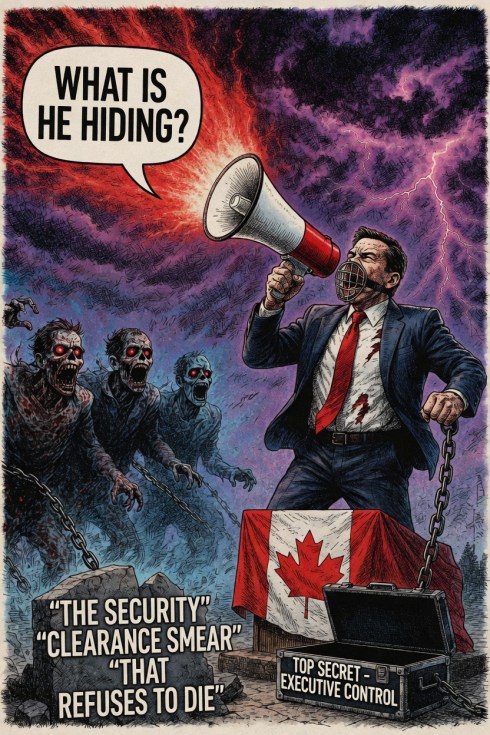
The Pierre Poilievre “security clearance” line has become one of those zombie claims in Canadian politics: killed repeatedly, buried repeatedly, and somehow still shambling around the media ecosystem looking for brains.
The lazy version goes like this: Poilievre does not have security clearance.
The line sounds grave because it is designed to sound grave. The average reader is supposed to hear it and supply the missing accusation: What is he hiding? Why can’t he pass the test? Is he compromised? The framing does not need to prove those suspicions. It only needs to keep them hovering.
But the real issue is not whether Poilievre is some random man off the street who cannot be trusted near a file folder. He served as a federal cabinet minister under Stephen Harper, including as minister of democratic reform and employment and social development. Cabinet ministers routinely handle sensitive government information. The current fight is over whether, as Leader of the Opposition, he should accept a particular classified briefing process under conditions that may limit what he can say afterward.
That is where the trick happens: critics collapse separate categories into one insinuating claim. Past cabinet access, present clearance status, and refusal of a specific classified-briefing regime are treated as though they are the same thing.
The accurate answer is not “his clearance never expires.” That claim is too broad and too easy to attack. Government of Canada security guidance says Secret clearance is valid for 10 years and Top Secret for 5 years. The stronger point is that the public is being offered a flattened version of a more complicated dispute.
The government, opposing parties, and many media voices say Poilievre “refuses to get security clearance.” Often, what they mean is that he has refused the additional clearance or classified briefing access needed to review certain foreign-interference material, including unredacted intelligence. Poilievre’s stated reason is that accepting those terms would restrict his ability to comment publicly.
You can view that choice as wise or reckless. But refusal under those terms is not the same as being unable to obtain clearance. It is not evidence that he failed a background check. It does not prove intelligence officials found him unfit. It means he has refused to enter a briefing regime with legal and political consequences.
Those consequences are not rhetorical decoration. The National Security and Intelligence Committee of Parliamentarians Act requires members to obtain and maintain the necessary Government of Canada security clearance, take an oath, and follow confidentiality rules. It also prohibits members and former members from knowingly disclosing protected information obtained through their work. The Supreme Court of Canada has upheld limits on parliamentary privilege in this context. In plain English: once you accept certain classified information under those rules, you may know more, but you may also be able to say less.
That architecture matters for an opposition leader. A government backbencher can absorb confidential information and stay quiet. A minister can be bound by cabinet confidence. But the Leader of the Opposition has a different role: to scrutinize the executive, press for disclosure, expose contradictions, and speak publicly when the government would rather manage the file behind closed doors.
There is still a serious criticism here. A potential prime minister should not be casually indifferent to classified intelligence. Foreign interference is not a branding exercise. It is real, ongoing, and aimed at Canadian institutions. Critics argue that Poilievre’s refusal leaves him unnecessarily blind on files he may one day have to manage from the Prime Minister’s Office.
That case should be made plainly: Poilievre should accept the clearance because national security requires informed leadership, even if that limits what he can say publicly afterward.
Fair enough. Argue that.
But do not imply he failed a clearance process. Do not suggest he is too compromised to receive sensitive information. Do not turn a strategic refusal into a character indictment.
Poilievre’s position may be risky. It may even be wrong in some circumstances. But the risk he identifies is also real. If the government possesses information embarrassing to itself, damaging to another party, or relevant to public accountability, a briefed opposition leader may become strategically constrained. In ordinary life, “knowing more” is usually an advantage. In opposition politics, knowing something you cannot use can become a leash.
This is why the “just get the clearance” demand is not neutral. It asks the Leader of the Opposition to step inside a confidentiality framework shaped by the executive he is supposed to scrutinize.
None of this automatically makes Poilievre right. There may be briefings he should accept. There may be moments when national security requires trust between government and opposition. But pretending the only possible explanation for refusal is guilt, cowardice, or hidden compromise is political theatre masquerading as procedural concern.
The machinery is more complicated than the slogan. Opposition leaders can receive classified briefings through different routes, with different levels of access and different obligations attached. Some briefings may require formal clearance. Some may involve confidentiality agreements. Some may leave a political leader better informed but publicly constrained.
So argue the real question.
Should the Leader of the Opposition accept classified briefings if doing so may limit his ability to criticize the government? Or should he remain outside that framework so he can keep pressing for public disclosure, especially when the issue is foreign interference in Canadian democracy?
Canadians can land on either side of that question. What they should not accept is the cheap version: Poilievre won’t get clearance — what is he hiding?
That is not analysis. It is insinuation with a lanyard.
The proper answer is to force precision.
Say what actually happened: Poilievre refused a particular classified briefing path because he believes it would constrain his ability to speak publicly and perform the adversarial role of opposition. His critics may call that irresponsible. His defenders may call it prudent. But anyone still selling the crude version is not informing the public.
They are laundering a smear through procedure, and Canadians should be tired of that trick by now.
References
- Government of Canada — Security clearance request process
Explains clearance levels and validity periods: Secret clearance is valid for 10 years; Top Secret clearance is valid for 5 years.
https://www.canada.ca/en/public-services-procurement/services/industrial-security/security-requirements-contracting/personnel-security-screening/processes/security-clearance-request.html - National Security and Intelligence Committee of Parliamentarians Act
Sets out clearance, oath, confidentiality, and disclosure obligations for NSICOP members.
https://laws-lois.justice.gc.ca/eng/acts/n-16.6/page-1.html - Supreme Court of Canada — Alford v. Canada (Attorney General), 2026 SCC 11
Confirms limits on parliamentary privilege for NSICOP-related secrecy obligations.
https://www.scc-csc.ca/judgments-jugements/cb/2026/41336/ - Reuters — Trudeau says some opposition MPs could be involved in foreign interference
Includes the context around Poilievre declining clearance to access intelligence from the foreign-interference probe.
https://www.reuters.com/world/americas/trudeau-says-some-opposition-canada-mps-could-be-involved-foreign-interference-2024-10-16/ - Foreign Interference Commission — PCO memo on classified briefings for opposition leaders
Discusses possible classified briefing routes for opposition leaders, including Secret-level briefings, Privy Councillor options, confidentiality agreements, and Top Secret requirements.
https://foreigninterferencecommission.ca/fileadmin/foreign_interference_commission/Documents/Exhibits_and_Presentations/Exhibits/CAN023012.pdf
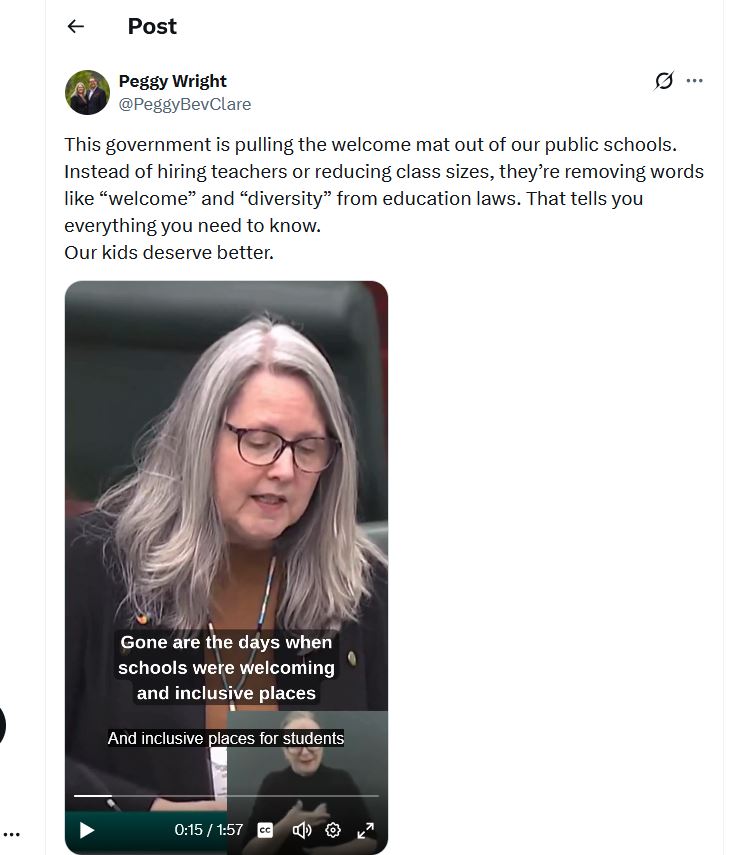
Posted by the NDP’s Peggy Wright on X.
There is a recurring pattern in modern policy debates that most people sense but struggle to name. The argument presented to the public is not the policy that gets implemented. Instead, a broadly agreeable claim—something no reasonable person would oppose—is used to carry a far more specific and contested agenda into law. By the time the details become visible, the argument has already been won at the level that matters.
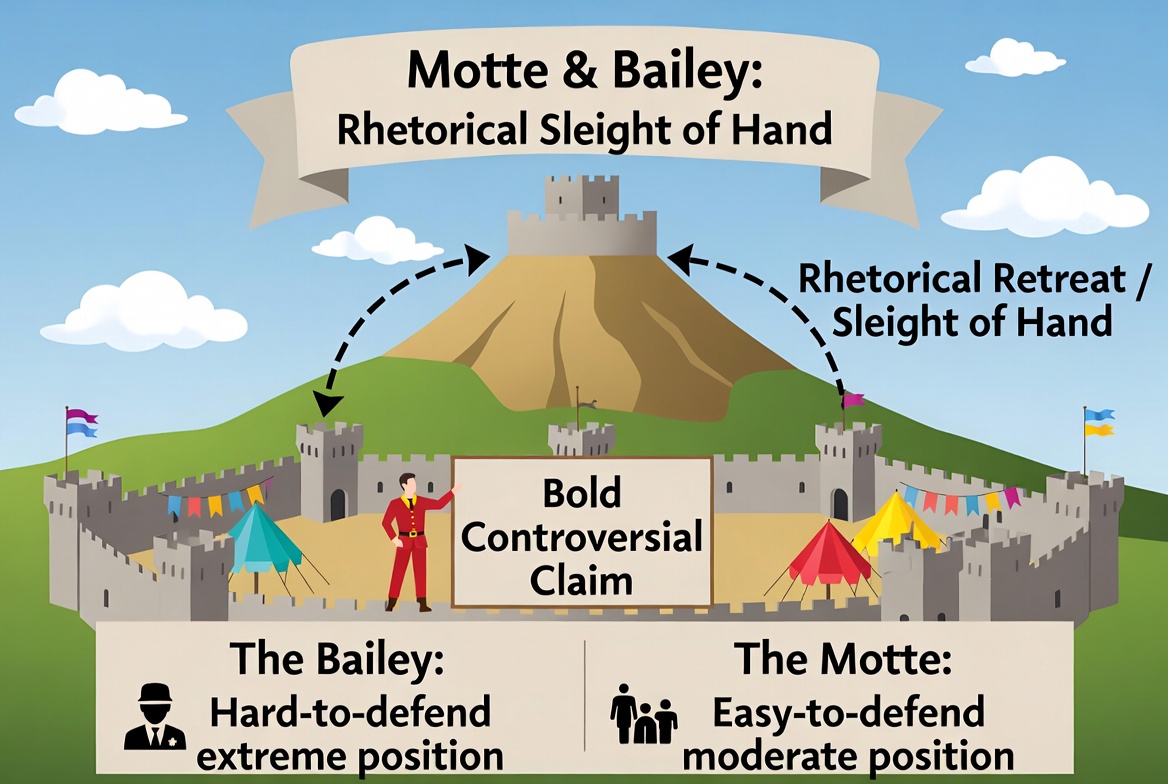
This is the structure known as the motte and bailey. The “motte” is the safe, defensible position: a statement so benign it feels almost churlish to resist. The “bailey” is the real position—the one with consequences, tradeoffs, and enforcement mechanisms. The move is simple. Sell the motte. Build the bailey. When challenged, retreat to the motte and accuse critics of attacking something obviously good.
You can see the pattern clearly in the recent dispute over education language. The public claim is that schools should be “welcoming,” “inclusive,” and respectful of “diversity.” No serious person objects to that in the abstract. But those terms are not operating as neutral descriptions. They have acquired specific policy meanings, often tied to particular ideological frameworks, institutional practices, and expectations placed on teachers and students. When legislation attempts to narrow or neutralize that language—shifting toward behavior-based standards like “safe and caring” environments grounded in responsibility and respect—the response is immediate: the government is “removing welcome,” attacking “diversity,” harming children. The motte is invoked as if it were the policy itself. The bailey disappears from view.
Watch the Move
In a recent legislative speech, MLA Peggy Wright provides a clean example of how this works in practice. She begins with a familiar image:
“Albertans put welcome mats in front of their doors. It means ‘come on in’ and we’re glad you are here.”
No disagreement is possible there. It is a moral and cultural baseline. But then the shift occurs. A change in statutory language becomes:
“the UCP is pulling up the welcome mat from all public schools.”
A metaphor replaces the policy. The audience is invited to react to exclusion rather than examine the legislation. The escalation continues:
“Gone are the days when schools were welcoming and inclusive places… celebrating diversity and uniqueness.”
At this point, the argument is no longer about wording. It is about intent, character, and harm. The key moment follows:
“the latest amendments… would strip words like ‘welcoming’ and ‘diversity’ from it.”
This is where the real question should be asked: does removing those words remove the underlying protections, or does it replace one framework of description with another? That question is never addressed. Instead, the speech returns immediately to moral framing:
“Diversity is a strength.”
In the abstract, yes. But the dispute is not over the abstract claim. It is over what “diversity” means in policy and practice. By collapsing the contested meaning into the harmless one, the argument avoids defending the actual implications. Criticism of the policy is recast as opposition to a universal good.
“The argument people agree to is not the policy that gets implemented.”
The most revealing line in the speech is this:
“Words are important… because they set the tone.”
That is true—and it explains the entire strategy.
This pattern isn’t random. It reflects a broader shift in how language is used in politics. Words like “diversity,” “inclusion,” and “safety” are no longer just descriptive. They function as instruments. If language helps shape how institutions operate and how people interpret reality, then controlling definitions becomes a form of power. Under that logic, you don’t need full public agreement on the details of a policy. You need agreement on the framing. Once that is secured, the content can expand behind it.
That helps explain why the motte and bailey is so effective. It allows advocates to operate on two levels at once. The public-facing level is morally attractive and broadly supported. The operational level is narrower, more contested, and often insulated from direct scrutiny. When the two are conflated, consent is manufactured. People believe they are endorsing a general principle when, in practice, they are enabling a specific program.
It works because most people are not trained to interrogate language this way. “Inclusion” sounds like inclusion. “Diversity” sounds like a mix of backgrounds and perspectives. “Safety” sounds like protection from harm. The terms carry moral weight before any definition is examined. By the time someone asks what they actually entail in practice, the rhetorical ground has already shifted. Opposition can be framed as hostility to the value itself rather than disagreement with its implementation.
The cost is not just confusion. It is the erosion of honest disagreement. If every critique of a policy can be recast as an attack on a universally accepted good, then meaningful debate becomes impossible. Language stops clarifying differences and starts concealing them. Institutions drift, not because the public has clearly chosen a direction, but because the terms of choice were never presented plainly.
This is why the technique matters. It is not just sharp rhetoric. It is a way of bypassing consent. If citizens cannot distinguish between the principle they are being asked to affirm and the policy that will follow from it, then they are no longer participating in a genuine democratic process. They are being managed through language.
If you think this reading is unfair, read the full remarks below and decide for yourself.
Appendix: Full Speech Transcript (April 2, 2026)
How to read this: Watch for the shift between general claims (“welcome,” “diversity”) and the specific policy being discussed. The argument depends on treating them as the same.
Full transcript of the video (Alberta Legislative Assembly session, ~1:57 long):
“Mr. Speaker, Albertans put welcome mats in front of their doors. It means ‘come on in’ and we’re glad you are here. And welcome to our house.But now the UCP is pulling up the welcome mat from all public schools.Gone are the days when schools were welcoming and inclusive places for students, celebrating diversity and uniqueness.That’s because the latest amendments to the Education Act would strip words like ‘welcoming’ and ‘diversity’ from it.This government combed through that bill and pulled the word ‘welcoming’ out eight times.Not satisfied with making our public schools less inviting — even as they function as important community hubs for many of our communities — then they went through and chopped the word ‘diversity’ out five times.Diversity is a strength.It used to say so in government policy, in legislation. But I guess not anymore.Words are important, Mr. Speaker, and that’s because they set the tone.When those in charge are threatened by words like diversity, welcome, and sense of belonging, there’s a problem. Because this is then about ideology and politics outside the classroom, not within.Instead of focusing on reducing class sizes, hiring teachers, and ensuring supports are there for all kids who need them, we get this distraction from a bill and government intent to narrow the frame so much that there is room for only one worldview: the UCP’s.And that’s the point.Straight out of the authoritarian playbook, Mr. Speaker.But, Mr. Speaker, our kids deserve that welcome mat back. I, for one, am extremely happy to let them know that they can expect it come next election, when it’s NDP in government and UCP — not our kids — who will find themselves unwelcome.”
Canadian media know how to do pattern recognition when they want to.
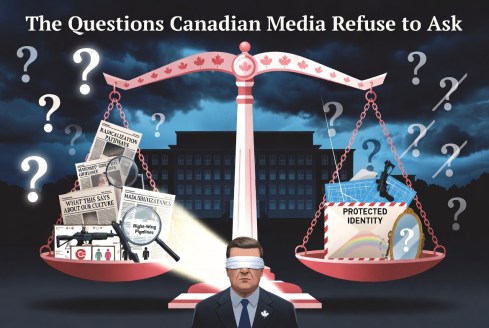
Give them the right suspect, the right ideology, or the right grievance story, and they will produce instant analysis about pathways, warning signs, radicalization, social meaning, and what the event “says” about the culture. But let violence intersect with a politically protected identity category, and the appetite for explanation suddenly disappears.
That is the real story here.
A youth in Nova Scotia is accused in a foiled school attack plot involving online coordination, handwritten plans, imitation weapons, hate symbols, and threats. Weeks earlier, Canada saw the Tumbler Ridge massacre, one of the country’s rare school-linked mass shootings, carried out by a trans-identified male with prior mental-health-related police contacts. Two cases do not prove some grand law. They do, however, justify a question. When identity disturbance, grievance, alienation, and violence begin to cluster, are we allowed to notice, or does the conversation get shut down the moment the demographic becomes inconvenient?
That question is treated as indecent when it should be treated as basic public seriousness.
The point is not that trans identification causes violence. That would be a stupid claim, and an unserious one. The point is that severe identity instability, grievance, social isolation, and moral insulation from scrutiny can form a combustible mix, and our institutions become evasive when gender ideology is somewhere in the picture. They know how to be curious. They simply become selective about when curiosity is allowed.
That selectivity matters because schools are not seminar rooms. They are places where adults are supposed to notice risk before bodies hit the floor.
Instead, the public gets the usual flattening language. Troubled youth. Mental health struggle. Isolated incident. Complex circumstances. All of that may be true as far as it goes. What is missing is any willingness to ask whether a culture that treats identity claims as sacred, untouchable, and morally beyond scrutiny might also be making honest risk assessment harder than it should be. If a young person’s entire psychic life is being organized around grievance, estrangement, fantasy, and a demand that reality ratify the self at all costs, that is not automatically a violence pathway. But it is certainly not nothing.
And yet the moment this territory appears, Canadian media go soft in the head.
“When violence intersects with a protected identity category, Canadian media suddenly lose their appetite for explanation.”
They will interrogate masculinity, whiteness, right-wing pipelines, online extremism, misogyny, colonial resentment, and institutional failure when those frames are available. But when gender ideology may be part of the unstable mix, the analysis collapses into vagueness. Suddenly nobody wants to generalize. Nobody wants to connect dots. Nobody wants to risk saying the wrong thing. The protected category gets narrative shelter that other categories do not receive.
That is not neutrality. It is selective curiosity.
None of this means most gender-distressed youth are violent. Of course they are not. But public safety is not served by pretending that every cluster of instability must be discussed in the most generic terms possible just because one part of the profile has become politically delicate. Schools, parents, and the public deserve better than ritual euphemism after every near miss or body count.
The issue is not a proven demographic pattern. The issue is that when violence and identity pathology appear together inside a protected narrative, Canadian media suddenly lose their nerve. They stop asking explanatory questions not because the questions are irrational, but because the answers might offend the wrong people.
And that is how taboo makes serious societies stupider than they can afford to be.











 bleatmop
 Mystro
 The Arbourist


 Dead Wild Roses
Your opinions…