
You are currently browsing the tag archive for the ‘Public Policy’ tag.
A recent post from a Women’s Liberation Front activist should be read less as a complaint than as a warning about how institutions train dissenters to accept contempt as normal.
She describes years of opposing gender-identity legislation in California: travelling to Sacramento, meeting legislative offices, testifying at hearings, and trying to explain to ordinary people what the policies actually mean. Female locker rooms become mixed-sex spaces by administrative decree. Girls’ sports and girls’ boundaries become conditional. Distressed young women are placed on medical pathways that can permanently alter healthy bodies.
The remarkable part is not merely that lawmakers disagree with her. Disagreement is expected in politics. What stands out is the air of pre-judgment around the process. She writes that legislators’ offices treat these women with “barely contained disdain.” Public hearings fill with activists who regard any defence of female boundaries as proof of bigotry. The women objecting are not received as citizens raising serious concerns about privacy, safeguarding, fairness, or medical ethics. They are treated as a nuisance class: managed, endured, and socially disqualified before the argument begins.
A functioning democracy does not require lawmakers to agree with every citizen. It does require them to hear citizens as citizens. When women raise concerns about intimate spaces, parental knowledge, fair competition, or irreversible interventions on minors, the answer cannot simply be a sneer and a label. “Bigot” is not an argument. “Hate” is not a policy analysis. “Inclusion” does not magically settle every conflict between competing rights.
Institutional capture often works this way. It does not begin by winning every argument in public. It begins by deciding which arguments are permitted to count. After that, the ordinary political process becomes strangely theatrical. Hearings still happen. Citizens still line up to speak. Legislators still nod along with the solemn expressions of people performing democratic patience. But the conclusion has already been filed away. These women are not constituents with claims on representation. They are obstacles to be routed around.
“A functioning democracy does not require lawmakers to agree with every citizen. It does require them to hear citizens as citizens.”
California is an especially sharp example because its political culture is so one-sided on this issue. The institutions are not neutral referees; they have chosen a side, and women who object are expected to absorb that fact politely. Over time, this wears people down. The WoLF activist’s most revealing line is not the one about crazy legislation. It is the moment of recognition: going to Washington, D.C. reminded her how badly she had become accustomed to being treated in California.
That is what contempt does over time. It lowers your expectations. It trains you to think basic respect is a luxury. It teaches you that being ignored is normal, that being caricatured is normal, that being called hateful for stating sex-based concerns is the price of admission.
This is especially perverse when the dissenters are women defending women’s boundaries. Feminism once insisted that female privacy, bodily integrity, and protection from male entitlement mattered. Now women who make those arguments are often treated as embarrassing relics, reactionaries, or moral contaminants. The old feminist vocabulary survives, but the sex class it was built to defend has been quietly replaced by a more fashionable abstraction.
The inversion should be obvious by now. Women are told they must be compassionate while their own concerns are dismissed. Girls are told inclusion matters while fairness and privacy are negotiated away on their behalf. Parents are told to trust institutions that increasingly treat hesitation as a threat. Citizens are told democracy is sacred while lawmakers learn to ignore the public on issues where the public is far less progressive than the activist class.
“The hearings still happen. Citizens still line up to speak. But the conclusion has already been filed away.”
This is why the fight matters even when a particular bill is lost. Public opposition creates a record. It denies consensus. It tells other women they are not alone. It forces legislators to own what they are doing rather than hiding behind bureaucratic language and moral fog.
Eventually, legislators need to pay a political price for treating women this way. Not because disagreement is forbidden. Not because every feminist objection should automatically prevail. But because a political class that can dismiss women’s sex-based concerns with contempt has learned something dangerous about power: the right moral vocabulary can make ordinary citizens disappear.
Women cannot win a fight they are shamed out of entering. They cannot defend boundaries they are not allowed to name. They cannot rely on institutions that have already decided their objections are evidence of guilt.
The point is not that every battle will be won in Sacramento. Some will be lost. Maybe many. But silence is how capture becomes permanent. Visibility is how it starts to crack.

Institutional capture rarely arrives breathing fire. More often, it brings a binder, a microphone, and a schedule.
There’s a popular line making the rounds:
“I’m communist with my family, socialist with my friends, liberal with my country, and capitalist with the rest of the world.”
It’s clever. It’s also half right—and half sloppy.
The part worth keeping is simple enough: scale changes the rules.
What works for five people does not scale to fifty million. Not because people become worse, but because the system itself becomes something different. A family, a circle of friends, a town, a nation—these are not just larger and smaller versions of the same thing. They are different kinds of coordination problems.
Start with the family. From a distance, it can look vaguely “communist”: shared resources, little formal accounting, distribution by need rather than contract. But that description confuses appearances for mechanism. Families do not work because they have stumbled onto a workable version of communism. They work because they are held together by thick trust, intimate knowledge, moral obligation, and affection. You know who is trying, who is struggling, who is coasting, and who is carrying more than their share. Love and duty do much of the coordinating work that, elsewhere, would have to be done by prices, rules, or enforcement.
That is not an economic system. It is a moral one.
Expand outward to friendship networks and you get something looser but still recognizably personal. Friends split restaurant bills unevenly, help each other move, pick up tabs, lend money, and trade favors without keeping a precise ledger. Reciprocity exists, but it remains informal because reputation still does the work. The group is small enough that selfishness has social consequences, and generosity has memory.
Still not socialism. Still a trust network.
Scale it again, though, and the whole structure changes. Once you move from dozens of known people to millions of strangers, the conditions that made those smaller systems work begin to disappear. You no longer know the participants. You cannot directly observe effort. Reputation becomes local rather than systemic. Free riding becomes harder to detect and easier to excuse. The moral visibility that kept the small group coherent starts to fade.
And that is before you even reach the information problem.
Mises and Hayek saw this clearly. In a large society, the knowledge needed to coordinate production, consumption, scarcity, and changing local conditions is radically dispersed. No planner can gather it all in a usable form, still less process it in real time. Prices do something extraordinary here: they compress enormous amounts of scattered information into signals people can actually act on. They tell producers where demand is rising, tell consumers where scarcity is biting, and help strangers coordinate without ever needing to know one another.
But information is only half the story. The other half is incentives, and this is where many soft-focus arguments about solidarity fall apart.
In a family, the bond is part of the reward. Parents sacrifice for children because they love them. Children often learn obligation because they are formed inside a web of expectation and attachment. Friends help each other because affection, shame, pride, and mutual memory all shape conduct. In a large anonymous system, those bonds weaken. Once effort and reward drift too far apart, behavior changes. People conserve effort, game criteria, hide costs, seek advantages, and respond to whatever incentives the system actually creates rather than to the moral language used to defend it.
That is why bloated systems so often fill up with evasion, rent-seeking, bureaucratic padding, and endless struggles over who pays, who receives, and who gets to define fairness. This is not mainly because people are unusually wicked. It is because incentives shape conduct more reliably than rhetoric does.
The problem is not that people become monsters at scale. The problem is that systems stop being personal.
At small scale, coordination is moral and relational. At large scale, it must become impersonal and systemic.
That is where markets enter—not as a sacred ideology, but as a coordination mechanism built for strangers. Prices transmit information. Profit and loss impose discipline. Competition corrects error. Contracts reduce uncertainty. None of this requires perfect virtue. That is precisely the point. Markets work not because people are angels, but because the system does not depend on them being angels.
That is why they scale.
Now, a fair steelman is necessary here, because the redistributive instinct is not born from pure foolishness. Advocates of more social-democratic or socialist arrangements are often responding to something real. Human beings are not just market actors. They are children, parents, dependents, pensioners, caregivers, and sometimes casualties of bad luck they did not choose. A society that treats every need as a private burden and every vulnerability as a market outcome to be endured will become efficient in a narrow sense, but also harsh, brittle, and politically unstable. The desire to soften outcomes, provide public goods, and preserve a baseline of dignity is not irrational. It is, in many cases, a morally serious response to genuine dependency.
That much should be conceded.
What should not be conceded is the next leap: the claim that because markets need moral and political correction, they can therefore be replaced as the primary mechanism of large-scale coordination. They cannot. A decent society may use the state to cushion, insure, stabilize, and set guardrails. But the moment it starts treating political instruction as a substitute for price signals, or good intentions as a substitute for incentive alignment, it begins to lose the information and discipline that complex systems require.
As systems scale, coordination must shift from relationships to mechanisms, and from assumed goodwill to aligned incentives.
This is also why the original slogan overshoots. Markets are not the only thing that scales. States scale too, in limited and specific ways. Law, infrastructure, policing, and certain public goods are not produced by market exchange alone. And between the family and the nation lies an entire middle world of institutions—firms, charities, churches, schools, municipalities, associations—that mix trust, hierarchy, rules, custom, and incentives in different proportions.
The real lesson, then, is not “capitalism good, everything else bad.” That is too crude to be useful.
The real lesson is that systems must be judged by the kind of coordination problem they are trying to solve. Small groups can run on trust because trust is visible and enforceable. Large societies cannot. They need mechanisms that work under conditions of anonymity, partial knowledge, conflicting interests, and imperfect virtue. Any model that ignores those conditions will eventually break, no matter how beautiful its moral language sounds at dinner.
That is the recurring mistake. People take the emotional clarity of small-group life—sharing, sacrifice, mutual care—and try to project it onto systems too large for those tools to govern. When the result disappoints, they blame greed, selfishness, or insufficient solidarity. They almost never blame the mismatch between the model and the scale.
They should.
Because the deepest constraint here is not moral. It is structural.
You can run a family on trust. You can run a country on rules. But if those rules ignore incentives, trust will not save you.

References for Curious Readers
F. A. Hayek, “The Use of Knowledge in Society” (1945).
The classic statement of the knowledge problem: why the information needed to coordinate an economy is dispersed among millions of people and cannot be fully centralized. Published in The American Economic Review.
Ludwig von Mises, “Economic Calculation in the Socialist Commonwealth” (1920).
The foundational statement of the economic calculation problem: without market prices for capital goods, rational large-scale allocation becomes impossible.
Elinor Ostrom, Nobel Prize Lecture, “Beyond Markets and States” (2009).
Useful as a corrective to simplistic binaries. Ostrom’s work shows that some common resources can be governed successfully through rules, enforcement, and local institutions rather than either pure markets or total central control.
Nobel Prize in Economic Sciences 2009 – Popular Information / Summary.
A concise overview of why Ostrom and Oliver Williamson mattered: economic life is governed not only by markets and states, but also by firms, associations, and other institutions. This supports the essay’s “missing middle layer” point.
Posted by the NDP’s Peggy Wright on X.

There is a recurring pattern in modern policy debates that most people sense but struggle to name. The argument presented to the public is not the policy that gets implemented. Instead, a broadly agreeable claim—something no reasonable person would oppose—is used to carry a far more specific and contested agenda into law. By the time the details become visible, the argument has already been won at the level that matters.
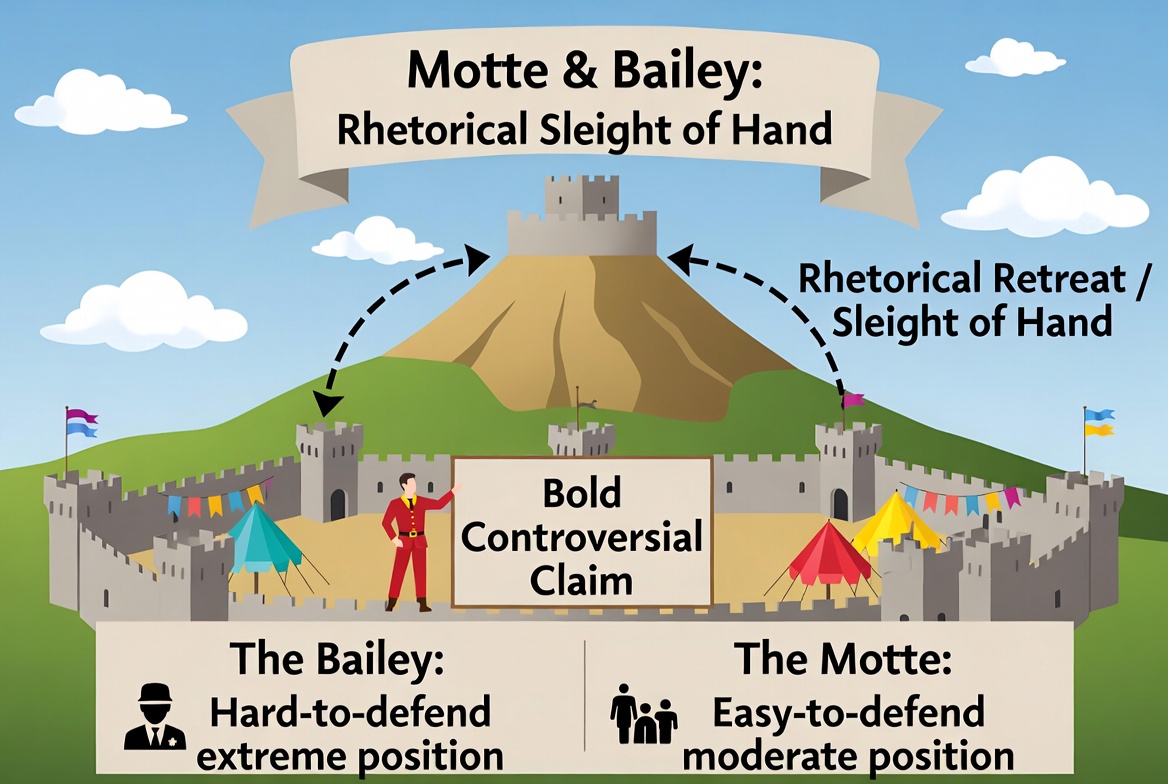
This is the structure known as the motte and bailey. The “motte” is the safe, defensible position: a statement so benign it feels almost churlish to resist. The “bailey” is the real position—the one with consequences, tradeoffs, and enforcement mechanisms. The move is simple. Sell the motte. Build the bailey. When challenged, retreat to the motte and accuse critics of attacking something obviously good.
You can see the pattern clearly in the recent dispute over education language. The public claim is that schools should be “welcoming,” “inclusive,” and respectful of “diversity.” No serious person objects to that in the abstract. But those terms are not operating as neutral descriptions. They have acquired specific policy meanings, often tied to particular ideological frameworks, institutional practices, and expectations placed on teachers and students. When legislation attempts to narrow or neutralize that language—shifting toward behavior-based standards like “safe and caring” environments grounded in responsibility and respect—the response is immediate: the government is “removing welcome,” attacking “diversity,” harming children. The motte is invoked as if it were the policy itself. The bailey disappears from view.
Watch the Move
In a recent legislative speech, MLA Peggy Wright provides a clean example of how this works in practice. She begins with a familiar image:
“Albertans put welcome mats in front of their doors. It means ‘come on in’ and we’re glad you are here.”
No disagreement is possible there. It is a moral and cultural baseline. But then the shift occurs. A change in statutory language becomes:
“the UCP is pulling up the welcome mat from all public schools.”
A metaphor replaces the policy. The audience is invited to react to exclusion rather than examine the legislation. The escalation continues:
“Gone are the days when schools were welcoming and inclusive places… celebrating diversity and uniqueness.”
At this point, the argument is no longer about wording. It is about intent, character, and harm. The key moment follows:
“the latest amendments… would strip words like ‘welcoming’ and ‘diversity’ from it.”
This is where the real question should be asked: does removing those words remove the underlying protections, or does it replace one framework of description with another? That question is never addressed. Instead, the speech returns immediately to moral framing:
“Diversity is a strength.”
In the abstract, yes. But the dispute is not over the abstract claim. It is over what “diversity” means in policy and practice. By collapsing the contested meaning into the harmless one, the argument avoids defending the actual implications. Criticism of the policy is recast as opposition to a universal good.
“The argument people agree to is not the policy that gets implemented.”
The most revealing line in the speech is this:
“Words are important… because they set the tone.”
That is true—and it explains the entire strategy.
This pattern isn’t random. It reflects a broader shift in how language is used in politics. Words like “diversity,” “inclusion,” and “safety” are no longer just descriptive. They function as instruments. If language helps shape how institutions operate and how people interpret reality, then controlling definitions becomes a form of power. Under that logic, you don’t need full public agreement on the details of a policy. You need agreement on the framing. Once that is secured, the content can expand behind it.
That helps explain why the motte and bailey is so effective. It allows advocates to operate on two levels at once. The public-facing level is morally attractive and broadly supported. The operational level is narrower, more contested, and often insulated from direct scrutiny. When the two are conflated, consent is manufactured. People believe they are endorsing a general principle when, in practice, they are enabling a specific program.
It works because most people are not trained to interrogate language this way. “Inclusion” sounds like inclusion. “Diversity” sounds like a mix of backgrounds and perspectives. “Safety” sounds like protection from harm. The terms carry moral weight before any definition is examined. By the time someone asks what they actually entail in practice, the rhetorical ground has already shifted. Opposition can be framed as hostility to the value itself rather than disagreement with its implementation.
The cost is not just confusion. It is the erosion of honest disagreement. If every critique of a policy can be recast as an attack on a universally accepted good, then meaningful debate becomes impossible. Language stops clarifying differences and starts concealing them. Institutions drift, not because the public has clearly chosen a direction, but because the terms of choice were never presented plainly.
This is why the technique matters. It is not just sharp rhetoric. It is a way of bypassing consent. If citizens cannot distinguish between the principle they are being asked to affirm and the policy that will follow from it, then they are no longer participating in a genuine democratic process. They are being managed through language.
If you think this reading is unfair, read the full remarks below and decide for yourself.
Appendix: Full Speech Transcript (April 2, 2026)
How to read this: Watch for the shift between general claims (“welcome,” “diversity”) and the specific policy being discussed. The argument depends on treating them as the same.
Full transcript of the video (Alberta Legislative Assembly session, ~1:57 long):
“Mr. Speaker, Albertans put welcome mats in front of their doors. It means ‘come on in’ and we’re glad you are here. And welcome to our house.But now the UCP is pulling up the welcome mat from all public schools.Gone are the days when schools were welcoming and inclusive places for students, celebrating diversity and uniqueness.That’s because the latest amendments to the Education Act would strip words like ‘welcoming’ and ‘diversity’ from it.This government combed through that bill and pulled the word ‘welcoming’ out eight times.Not satisfied with making our public schools less inviting — even as they function as important community hubs for many of our communities — then they went through and chopped the word ‘diversity’ out five times.Diversity is a strength.It used to say so in government policy, in legislation. But I guess not anymore.Words are important, Mr. Speaker, and that’s because they set the tone.When those in charge are threatened by words like diversity, welcome, and sense of belonging, there’s a problem. Because this is then about ideology and politics outside the classroom, not within.Instead of focusing on reducing class sizes, hiring teachers, and ensuring supports are there for all kids who need them, we get this distraction from a bill and government intent to narrow the frame so much that there is room for only one worldview: the UCP’s.And that’s the point.Straight out of the authoritarian playbook, Mr. Speaker.But, Mr. Speaker, our kids deserve that welcome mat back. I, for one, am extremely happy to let them know that they can expect it come next election, when it’s NDP in government and UCP — not our kids — who will find themselves unwelcome.”
The ‘Broken Window’ parable has lasted because the mistake it identifies is permanent. People keep confusing motion with wealth.
A shop window gets smashed. The glazier benefits. He is paid to replace it. Money changes hands. Work is created. Onlookers reassure themselves that the damage at least “helped somebody.” Bastiat’s point is that this is where bad economic reasoning begins. The shopkeeper must now spend money restoring what he already had instead of buying something new, improving his business, saving, or investing. The glazier gains work. The shopkeeper loses options. Society ends up with a replaced window instead of a replaced window plus whatever else might have been created. That is not growth. It is recovery from loss.
In That Which Is Seen, and That Which Is Not Seen, published in 1850, Bastiat gave this simple error its enduring form. The visible effect is easy to grasp: the glazier gets income, then spends it elsewhere, and activity ripples outward. But the visible beneficiary is only half the story. What disappears from view are the unrealized alternatives: the suit never bought, the tool never purchased, the apprentice never hired, the expansion never attempted. The fallacy survives because the gain is concrete and public while the loss is dispersed and hypothetical. One can be pointed to. The other must be reasoned out.
“People keep confusing motion with wealth. Visible activity is easy to celebrate. The wealth that never came into being is harder to see, and easier to ignore.”
That is why the broken window is not really about vandalism. It is about how easily public argument stops at the first visible effect and calls the matter settled. Once you see that, a great deal of modern economic rhetoric starts to look less like analysis than stagecraft.
The pattern is familiar in debates over stimulus spending. Governments announce major spending packages. The public is shown crews on worksites, contracts being signed, jobs being counted, funds “flowing into the economy.” The imagery is always immediate and flattering. Something is happening. Therefore something good must be happening.
But visible activity is not the same thing as net wealth creation. Government does not create resources from nothing. It taxes them away, borrows them away, or inflates them away. In each case, resources are redirected from other possible uses. The serious question is not whether public spending produces measurable effects. Of course it does. The serious question is whether those resources would have created more value had they remained in private hands, guided by price signals, local knowledge, and voluntary choice rather than political allocation.
That is where the unseen side of the ledger matters. We see the bridge. We do not see the private investment that never happened because capital was drawn elsewhere. We see the subsidized payroll. We do not see the household purchasing power weakened by inflation. We see the grant recipient. We do not see the startup that never secured financing, or the consumer demand that was blunted by higher taxes or debt service. Public spending can make its beneficiaries highly visible while leaving its displaced alternatives diffuse and mostly invisible. That is politically useful, but analytically weak.
The usual reply is that recessions change the equation. When labour is idle, capital is underused, and private demand collapses, government spending may mobilize resources that would otherwise sit dormant. That is the strongest counterargument, and it should be taken seriously. A deep recession is not the same as a fully employed economy. Slack matters. Timing matters. Liquidity panics matter. A blanket denial of all countercyclical policy is cruder than Bastiat’s actual insight deserves.
But this does not rescue the broken window logic from criticism because it does not actually answer it. Even in a downturn, the central question remains comparative: compared to what? If the claim is that temporary public spending can stabilize demand under exceptional conditions, that is at least a serious argument. But it is not the same argument as saying that destruction creates prosperity, or that politically directed spending is wealth in itself. It still matters what is being funded, how efficiently it is administered, what incentives it creates, and whether the spending is genuinely using idle resources or merely displacing better uses that are harder to measure in real time.
“Replacement is not creation. Redirection is not prosperity. A society does not become richer by repairing destruction and calling the bustle growth.”
That distinction matters because bad arguments often smuggle themselves in under good intentions. A narrow case for emergency stabilization can turn into a permanent political habit of treating state spending as inherently productive. Once that shift happens, Bastiat’s warning reasserts itself in full. Replacement is still not creation. Redirection is still not spontaneous enrichment. Measured output can rise while underlying wealth formation weakens.
The same mistake appears after natural disasters and during wartime booms. After a hurricane, people say rebuilding will “boost the economy.” During war, people point to full factories and rising production figures. But rebuilding what was destroyed is not the same as becoming richer. Producing goods for destruction is not the same as expanding civilian prosperity. These events may generate employment, contracts, and output. They do not erase the prior loss. The relevant comparison is not between disaster and inactivity. It is between the world after destruction and the world in which the destruction never occurred.
That is what makes Bastiat’s lesson both obvious and routinely ignored. Visible motion is emotionally persuasive. A ribbon-cutting is easier to celebrate than an opportunity cost. A government announcement is easier to narrate than a private investment that never happened. Political systems are structurally biased toward what can be displayed, counted, branded, and claimed. The unseen has no ceremony attached to it. It leaves no plaque.
So the broken window fallacy endures not because the logic is hard, but because the discipline is hard. It requires people to keep asking the next question after the applause line. Jobs doing what? Spending on what? At whose expense? Relative to which forgone alternative? In a free economy, resources are scarce and choices are real. To pretend otherwise because spending is visible is to confuse accounting entries with prosperity.
Bastiat’s point remains devastating because it cuts through so much noise. Destruction does not enrich. Replacement does not add net wealth. Spending is not identical with prosperity. A society becomes richer when it creates new value, lowers costs, improves production, expands choice, and allows people to direct resources toward ends they actually value. It becomes poorer when it burns wealth, redirects capital by force, and congratulates itself for the bustle that follows.
That was true in Bastiat’s time. It is true now. The forms get larger, the numbers get bigger, and the rhetoric gets smoother, but the underlying mistake does not change. The glazier is still real. So is the window. So is everything we never got because we mistook repair, diversion, and visible activity for growth.

References
Bastiat, Frédéric. “What Is Seen and What Is Not Seen.” Online Library of Liberty.
https://oll.libertyfund.org/pages/wswns
Bastiat, Frédéric. “That Which Is Seen, and That Which Is Not Seen.”
https://bastiat.org/en/twisatwins.html
Bastiat, Frédéric. “Chapter 1: What Is Seen and What Is Not Seen.” Econlib.
Encyclopaedia Britannica. “Frédéric Bastiat.”
https://www.britannica.com/money/Frederic-Bastiat
Cullen, Joseph A., and Roger H. Gordon. “Taxes and Wartime Mobilization in the U.S. Economy: World War II as a Natural Experiment.” NBER Working Paper 12801.
Garin, Andy. “The Wartime Origins of Industry Location and Economic Mobility in the United States.” NBER Working Paper 33418.
A University of Toronto Scarborough posting for an Assistant Professor in Computational Biology and Data Science looks like a standard academic hire. It isn’t. It is a restricted competition tied to a Canada Research Chair (CRC) nomination.
 The posting requires applicants to self-identify as a member of one or more “designated groups” in their cover letter, namely women or gender minorities, racialized persons, Indigenous Peoples, or persons with disabilities. If you do not fit one of those categories, you are not eligible to apply. That is not an inference. It is in the posting.
That one detail captures the reality of modern equity administration in Canadian universities: what is framed as “removing barriers” often functions, in practice, as category-based exclusion.
This is not a rogue department. It is a federal program mechanism.
The university did not invent this framework on its own. The hiring restriction is attached to the Canada Research Chairs program, a federal initiative that allocates prestige and funding to institutions under defined rules. One major rule-set is the CRC equity framework, which includes population-based targets for the four designated groups. The program’s stated targets to be reached by the end of 2029 are: 50.9% women and gender equity-seeking groups, 22% racialized persons, 4.9% Indigenous Peoples, and 7.5% persons with disabilities.
Again, these are not vibes. They are published benchmarks tied to institutional plans and program governance.
The key point is the enforcement logic. Under the CRC’s settlement and enforcement framework, institutions that miss interim targets can face consequences that shape nominations and recruitment practices. In plain terms: the program can push institutions toward restricted competitions where eligibility is limited to designated groups.
So when you see a posting that excludes broad classes of Canadians from applying, it is not a one-off. It is a downstream product of rules that tie federal research prestige to demographic targets.
The problem is the normalization of identity gates
Defenders will say this is equity. They will argue that special measures are justified to counter historical bias and structural disadvantage. That is the argument, and it deserves to be stated fairly.
But there is a moral and civic cost to the method. When eligibility is restricted by identity categories, the institution is no longer selecting among all qualified candidates. It is selecting among those who clear an identity threshold first. That is not “equal opportunity.” It is a gate that sorts people before their work is even evaluated.
If you want a simple test for whether this is principled, reverse the identity labels. A posting that said “whites only” or “men only” would be condemned instantly, for good reason. You do not escape discrimination by flipping who benefits. You normalize discrimination by making it administratively routine.
A better standard
If Canada wants fairness in academic hiring, the standard should be straightforward: open eligibility, transparent criteria, and selection based on demonstrated excellence. If there are pipeline problems, fix the pipeline. Broaden recruitment, strengthen mentorship, reduce opaque networking advantages, and enforce accountable evaluation.
Do not solve bias by writing exclusions into job postings, then congratulating yourself for it. That approach trains young researchers to see institutions as political allocation machines rather than merit-seeking communities. And once that belief sets in, you do not get trust back easily.

References
1) U of T Scarborough job posting (Assistant Professor – Computational Biology and Data Science)
https://jobs.utoronto.ca/job/Scarborough-Assistant-Professor-Computational-Biology-and-Data-Science-ON/599939517/
2) Canada Research Chairs: “Establishing equity targets for 2021 to 2029”
https://www.chairs-chaires.gc.ca/program-programme/equity-equite/targets-cibles-eng.aspx
3) CRC Program representation statistics (lists the population-based targets and deadline)
https://www.chairs-chaires.gc.ca/about_us-a_notre_sujet/statistics-statistiques-eng.aspx
4) CRC: Equity, Diversity and Inclusion requirements and practices (overview, settlement context)
https://www.chairs-chaires.gc.ca/program-programme/equity-equite/index-eng.aspx
5) CRC: 2021 Canadian Human Rights Settlement Agreement page (program framing and enforcement context)
https://www.chairs-chaires.gc.ca/program-programme/equity-equite/2021_settlement-reglement-eng.aspx
6) House of Commons Standing Committee on Science and Research, Meeting No. 2 (witness panel includes Steven Pinker and Azim Shariff)
https://www.ourcommons.ca/documentviewer/en/45-1/SRSR/meeting-2/evidence
Canada still runs a legal category of “Indian” through federal law. Not as history. As operating code. The Indian Act governs registration, band governance, and the reserve framework. Identity becomes partly administered by statute, not only lived in community. (laws-lois.justice.gc.ca) When a state maintains a separate legal lane for a class of people, it does more than recognize difference. It reproduces difference through process and permanence.
Get the timeline right because this is where critics go hunting. The Indian Act was assented to on April 12, 1876, as a consolidation of laws “respecting Indians.” (sac-isc.gc.ca) Consolidation is not an accident. It is a choice to centralize control, define membership, and keep Indigenous life routed through Ottawa’s legal plumbing. Once you do that, you create a stable incentive loop. Governments manage liability and jurisdiction. Communities defend the gateways through which rights, services, and recognition pass. The system is not neutral simply because it is administrative.
Martin Buber’s vocabulary helps name the moral move without turning this into a sermon. An I–It posture treats people as objects. They become cases, stakeholders, units, problems to be managed. An I–Thou posture treats them as subjects with agency and dignity. A system that sorts people into different legal kinds makes I–It governance easier. Bureaucratic proxies replace encounter. Resentment follows because the relationship becomes instrumental even when the language stays compassionate.
You can watch the machine work in Alberta right now. Elections Alberta issued a Notice of Initiative Petition in late January 2026 for a citizen initiative proposing an Alberta independence referendum question. (elections.ab.ca) First Nations responded with litigation arguing the province had constitutional duties to consult on the impacts of such a referendum and failed to do so. (globalnews.ca) Alberta’s population reached 5.0 million in Q4 2025. (economicdashboard.alberta.ca) That is a large public, a loud politics, and a long list of grievances looking for a target. In that environment, it becomes easy to blame “Indians” as a block instead of blaming the architecture that turns every dispute into a status-mediated struggle over courts, duties, and jurisdiction.
The safest conclusion is also the strongest. Treat this as structure, not as villains. There are Indigenous voices, including William Wuttunee, who argued decades ago that the reserve-dependency model traps people and that integration on Indigenous terms was a path out. (uofmpress.ca) You do not need to adopt his full program to accept the warning. As long as legal status remains the main conduit for dignity, power, and money, Canada will keep reproducing otherness by design. Too many institutions cannot cash their cheques any other way.

References
Source Speech (YouTube)
Indian Act (R.S.C., 1985, c. I-5) — Justice Laws (official text)
https://laws-lois.justice.gc.ca/eng/acts/i-5/
Indian Act, 1876 (“amend and consolidate…”) — SAC-ISC archival text
https://www.sac-isc.gc.ca/eng/1100100010252/1618940680392
Martin Buber (I–It / I–Thou) — Stanford Encyclopedia of Philosophy
https://plato.stanford.edu/entries/buber/
Elections Alberta — Notice of Initiative Petition issued (Jan 27, 2026)
New Citizen Initiative Application Approved, Notice of Initiative Petition Issued
Alberta separation petition legal challenge context — Global News (Jan 23, 2026)
3 Alberta First Nations say separation petition is unconstitutional
Alberta population (5.0M in Q4 2025) — Government of Alberta Economic Dashboard
https://economicdashboard.alberta.ca/dashboard/population-quarterly/
William Wuttunee / Ruffled Feathers — University of Manitoba Press
https://uofmpress.ca/books/still-ruffling-feathers











 bleatmop
 Mystro


 Dead Wild Roses
Your opinions…