
You are currently browsing the tag archive for the ‘Institutional Capture’ tag.
The Alberta Medical Association and the Canadian Pediatric Society want Canadians to believe the debate over pediatric gender medicine is settled. It is not.
When Premier Danielle Smith announced restrictions on transgender medical interventions for minors, major medical bodies responded with the language of emergency. The Canadian Pediatric Society warned that Alberta’s policy would undermine the rights of transgender children and youth. The Alberta Medical Association’s pediatrics section argued that the government was targeting an already vulnerable population. The public message was clear enough: responsible doctors affirm; politicians interfere; children suffer.
 But that framing hides the central problem. There is no stable international medical consensus on pediatric transition. In fact, several European jurisdictions have moved in the opposite direction from Canada’s professional bodies, not because they have stopped caring about distressed children, but because they have begun applying more ordinary standards of evidence to extraordinary interventions.
That distinction matters. Puberty blockers and cross-sex hormones are not counselling, kindness, or protection from bullying. They are medical interventions into the development of physiologically healthy children and adolescents, often at an age when identity, sexuality, mental health, peer influence, family conflict, and neurodevelopmental conditions are still in motion. A serious medical institution should be able to say that without sounding frightened of its own profession.
Instead, Canadian medical institutions often speak as if caution itself is the danger.
The most revealing example is the suicide argument. Parents and voters have been told, sometimes openly and sometimes by implication, that restricting pediatric transition will kill children. The activist version is familiar: would you rather have a dead daughter or a trans son? The political version is not much better. Former Calgary mayor Naheed Nenshi told Premier Smith that “votes aren’t worth a few dead kids.”
That is not clinical reasoning. It is emotional coercion applied to frightened parents.
The evidence does not support the crude version of the claim. A 2024 Finnish register study in BMJ Mental Health examined more than 2,000 adolescents referred to gender identity services and compared them with more than 16,000 matched controls. The authors found that suicide deaths were rare, and that once psychiatric treatment history was accounted for, gender-referred youth did not show higher all-cause or suicide mortality than controls. The study does not say these young people are not distressed. It says the simple story — affirm or they die — is not evidence-based medicine.
That should change the conversation. Many adolescents presenting to gender clinics also carry depression, anxiety, autism, trauma histories, eating disorders, family instability, social isolation, or other serious mental-health burdens. If those burdens are treated as secondary to gender identity, medicine risks narrowing the diagnostic lens at exactly the moment it should be widening it.
This is one of the main lessons of the Cass Review in the United Kingdom. Cass did not recommend abandoning children with gender distress. It called for a more holistic model of care, better assessment, stronger evidence, and far more caution around medical pathways. NHS England subsequently stopped the routine prescription of puberty blockers for gender dysphoria in minors, moving them into a research setting rather than ordinary clinical use.
That is not a small update. It is a major warning to every country that imported the affirmative model and then treated dissent as bigotry.
The “pause button” metaphor has also aged badly. Puberty is not a decorative inconvenience. It is a central developmental process involving bones, brain maturation, sexual function, fertility, and identity formation. Cass specifically warned against assuming that drugs used for precocious puberty will have the same outcomes when used for children and adolescents with gender dysphoria. The medical context is different. The child is different. The purpose of the intervention is different. Pretending otherwise is not compassion; it is bad reasoning in therapeutic language.
The pathway concern is equally serious. If blockers were merely neutral time-buying devices, we would expect many children to pause, mature, and then step away from medicalization. But the available evidence shows high rates of progression from puberty blockers to cross-sex hormones. That does not prove every case is mishandled, and it does not prove no patient benefits. It does mean the intervention may help create the very path it claims merely to delay.
Other countries have noticed. France’s National Academy of Medicine urged “great medical caution” in treating gender-related distress in children and adolescents, citing vulnerability and the possibility of serious complications. The UK has moved puberty blockers away from routine use. Scotland paused new prescriptions for minors after the Cass Review. These are not fringe developments. They are evidence institutions pulling back after years of clinical momentum.
Canada’s professional bodies should be wrestling publicly with that reversal. Instead, they often sound as though the old consensus still exists.
“Institutional capture does not mean every doctor is corrupt. It means the institution has absorbed a political frame so deeply that it struggles to distinguish care from affirmation, caution from cruelty, and disagreement from harm.”
This is where the word “capture” becomes fair, but only if we are precise. Institutional capture does not mean every doctor is corrupt. It does not mean every pediatrician agrees with activists. It does not mean every child with gender distress is confused, lying, or socially influenced. It means the institution has absorbed a political frame so deeply that it struggles to distinguish care from affirmation, caution from cruelty, and disagreement from harm.
That is dangerous in any field. It is worse in pediatrics.
Children with gender distress deserve serious care. They deserve protection from bullying, family cruelty, humiliation, and ideological exploitation from every direction. They deserve psychological assessment, treatment for co-occurring mental-health problems, family involvement where safe, and adults who can tolerate uncertainty. The modern clinic population is also not the same as the older, smaller cohort of mostly childhood-onset cases; many services have seen a sharp rise in adolescent presentations, often with complex psychiatric and developmental profiles. A small number may continue to experience severe, persistent dysphoria into adulthood and may eventually choose medical transition. But that possibility does not justify allowing pediatric care to default into an affirmation-first pathway.
The honest position is not “do nothing.” The honest position is slow down, assess carefully, treat comorbidities, use exploratory psychological care rather than ideological confirmation, stop using suicide as a rhetorical weapon, and stop pretending that uncertain evidence becomes settled science because a professional association says so.
Medicine earns public trust when it disciplines itself. It loses that trust when it borrows the moral posture of activism and then demands deference as science.
The AMA and CPS still have a choice. They can defend vulnerable children by telling the whole truth: that distress is real, that cruelty is wrong, that some cases are complex, and that the evidence for routine medical transition in minors is weaker than Canadians have been led to believe. Or they can continue treating democratic oversight and parental caution as the real threat, while countries that reviewed the evidence more seriously move toward restraint.
“Medicine earns public trust when it disciplines itself. It loses that trust when it borrows the moral posture of activism and then demands deference as science.”
The issue is not whether vulnerable youth should be helped. They should.
The issue is whether Canadian medical institutions can still tell the difference between helping children and protecting an ideology from scrutiny.
Right now, the answer is not reassuring.
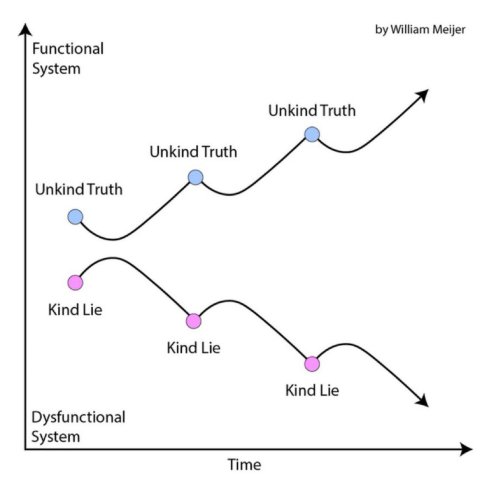
Most social lies do not begin as lies. They begin as little acts of politeness.
You laugh at a joke that was not funny. You say “no problem” when there was, in fact, a problem. You sit through a meeting where everyone knows the plan makes no sense, but nobody wants to be the person who slows the room down. Ordinary life requires tact. Not every uncomfortable truth needs to be hurled across the table the moment it appears.
But there is a difference between tact and required unreality.
Tact says we should not be needlessly cruel. Required unreality says we must say the false thing, affirm the false thing, organize institutions around the false thing, and treat anyone who refuses as morally suspect.
That difference matters because societies rarely drift away from truth in one dramatic leap. They drift through small accommodations. A phrase changes here. A courtesy becomes expected there. A workplace norm hardens into policy. A school form gets rewritten. A professional guideline quietly changes the question everyone is allowed to ask.
Then, one day, ordinary people look around and realize they are being asked to deny things they can see with their own eyes.
The debate over sex and gender is one of the clearest examples.
The first move was linguistic. “Sex observed at birth” became “sex assigned at birth.” Many people shrugged. It sounded harmless, maybe even compassionate. Why fight over wording? But the change was not neutral. “Observed” describes the recognition of a biological fact. “Assigned” suggests an administrative decision, something imposed, possibly mistaken, perhaps unjust.
No parent waits for a committee to assign sex. They see the baby. They know. The doctor observes. The parents understand. The paperwork follows reality; it does not create it.
But once “assigned” becomes normal, the ground has shifted. The old reality has not disappeared, but the language around it has been loosened. A fact starts to sound like an opinion. An observation starts to sound like an imposition. What was once obvious becomes something polite people are encouraged not to say too firmly.
Pronouns came next for many ordinary people. “What is the harm?” they were told. “It is just politeness.”
And in private life, adults can choose whatever courtesies they want. People use nicknames. People avoid sore spots. People soften language to keep peace with neighbours, coworkers, students, friends, and family. That is normal human life.
The difficulty begins when courtesy becomes compulsory and everyone is expected to speak as though sex has disappeared from the room.
A teacher pauses before saying “she.” A coworker catches himself mid-sentence. A parent sits through a school meeting and says nothing because every adult in the room knows what is being asked, and nobody wants to be first to break the spell. So people go along. They use words they do not quite believe. They tell themselves it is only a small thing.
“Those arguments matter. But before any of them can be had honestly, people must be allowed to say what they know is true.”
Small things train larger habits. Once people become accustomed to saying what they do not believe, the person who says, “wait, this is not accurate,” becomes the problem. Not the falsehood. Not the policy built on it. The person who interrupts the shared performance.
That is how a real slippery slope works. It is not that one concession magically causes the next. It is that each concession changes the moral conditions under which the next demand is judged.
If sex is “assigned,” and pronouns are only kindness, and refusing preferred language is cruelty, then female-only spaces start to look morally suspicious. The sign on the changing room may stay the same, but the rule underneath it changes. The word “women” remains on the door. What it means has been quietly edited.
That edit does not stay abstract. It reaches the sports team someone’s daughter trains with. It reaches shelters, prisons, changing rooms, rape-crisis services, and lesbian boundaries. All can be reframed as sites of exclusion. The question quietly changes from “Do women and girls have sex-based rights?” to “Why are you being unkind to this vulnerable person?”
None of this denies that some people experience genuine distress about their bodies. They do. The question is whether compassion requires everyone else to rewrite reality around that distress.
By then, the argument has already moved. Women are no longer asking to preserve boundaries rooted in sex. They are being asked to justify why those boundaries should exist at all.
That is not an abstract problem. It changes institutions. It changes policies. It changes what children are taught. It changes what professionals are allowed to say. It changes whether parents, teachers, doctors, athletes, and ordinary citizens are permitted to name reality without being accused of hatred.
The kind lie does not remain kind once people are punished for refusing it.
We can debate the details of medicine, sports, schools, safeguarding, and law. Those arguments matter. But before any of them can be had honestly, people must be allowed to say what they know is true.
Reality has a way of waiting. Bodies still exist. Sex still matters in medicine, sport, privacy, reproduction, vulnerability, and patterns of violence. Institutions can change their language, but language does not abolish the facts underneath it. Step away from truth for long enough and eventually reality supplies the correction.
Reality always bats last.
The point is not that every hard truth should be spoken harshly. Decency matters. So does compassion. But compassion detached from truth becomes something else. It becomes a demand that some people absorb real costs so everyone else can feel morally clean.
That is the part ordinary people need to notice. Every time they play along with a claim they know is not true, they are not merely being polite. They may be helping build the next rule, the next policy, the next institutional punishment for the person who finally says no.
A recent post from a Women’s Liberation Front activist should be read less as a complaint than as a warning about how institutions train dissenters to accept contempt as normal.
She describes years of opposing gender-identity legislation in California: travelling to Sacramento, meeting legislative offices, testifying at hearings, and trying to explain to ordinary people what the policies actually mean. Female locker rooms become mixed-sex spaces by administrative decree. Girls’ sports and girls’ boundaries become conditional. Distressed young women are placed on medical pathways that can permanently alter healthy bodies.
The remarkable part is not merely that lawmakers disagree with her. Disagreement is expected in politics. What stands out is the air of pre-judgment around the process. She writes that legislators’ offices treat these women with “barely contained disdain.” Public hearings fill with activists who regard any defence of female boundaries as proof of bigotry. The women objecting are not received as citizens raising serious concerns about privacy, safeguarding, fairness, or medical ethics. They are treated as a nuisance class: managed, endured, and socially disqualified before the argument begins.
A functioning democracy does not require lawmakers to agree with every citizen. It does require them to hear citizens as citizens. When women raise concerns about intimate spaces, parental knowledge, fair competition, or irreversible interventions on minors, the answer cannot simply be a sneer and a label. “Bigot” is not an argument. “Hate” is not a policy analysis. “Inclusion” does not magically settle every conflict between competing rights.
Institutional capture often works this way. It does not begin by winning every argument in public. It begins by deciding which arguments are permitted to count. After that, the ordinary political process becomes strangely theatrical. Hearings still happen. Citizens still line up to speak. Legislators still nod along with the solemn expressions of people performing democratic patience. But the conclusion has already been filed away. These women are not constituents with claims on representation. They are obstacles to be routed around.
“A functioning democracy does not require lawmakers to agree with every citizen. It does require them to hear citizens as citizens.”
California is an especially sharp example because its political culture is so one-sided on this issue. The institutions are not neutral referees; they have chosen a side, and women who object are expected to absorb that fact politely. Over time, this wears people down. The WoLF activist’s most revealing line is not the one about crazy legislation. It is the moment of recognition: going to Washington, D.C. reminded her how badly she had become accustomed to being treated in California.
That is what contempt does over time. It lowers your expectations. It trains you to think basic respect is a luxury. It teaches you that being ignored is normal, that being caricatured is normal, that being called hateful for stating sex-based concerns is the price of admission.
This is especially perverse when the dissenters are women defending women’s boundaries. Feminism once insisted that female privacy, bodily integrity, and protection from male entitlement mattered. Now women who make those arguments are often treated as embarrassing relics, reactionaries, or moral contaminants. The old feminist vocabulary survives, but the sex class it was built to defend has been quietly replaced by a more fashionable abstraction.
The inversion should be obvious by now. Women are told they must be compassionate while their own concerns are dismissed. Girls are told inclusion matters while fairness and privacy are negotiated away on their behalf. Parents are told to trust institutions that increasingly treat hesitation as a threat. Citizens are told democracy is sacred while lawmakers learn to ignore the public on issues where the public is far less progressive than the activist class.
“The hearings still happen. Citizens still line up to speak. But the conclusion has already been filed away.”
This is why the fight matters even when a particular bill is lost. Public opposition creates a record. It denies consensus. It tells other women they are not alone. It forces legislators to own what they are doing rather than hiding behind bureaucratic language and moral fog.
Eventually, legislators need to pay a political price for treating women this way. Not because disagreement is forbidden. Not because every feminist objection should automatically prevail. But because a political class that can dismiss women’s sex-based concerns with contempt has learned something dangerous about power: the right moral vocabulary can make ordinary citizens disappear.
Women cannot win a fight they are shamed out of entering. They cannot defend boundaries they are not allowed to name. They cannot rely on institutions that have already decided their objections are evidence of guilt.
The point is not that every battle will be won in Sacramento. Some will be lost. Maybe many. But silence is how capture becomes permanent. Visibility is how it starts to crack.

Institutional capture rarely arrives breathing fire. More often, it brings a binder, a microphone, and a schedule.
June is coming, which means the machinery will start again.
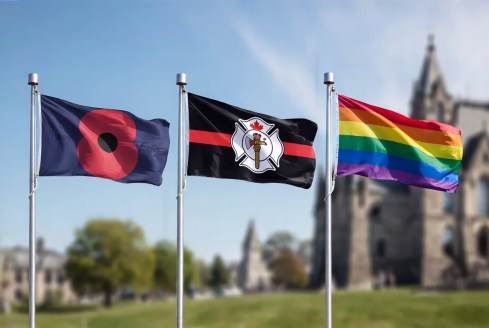
The flags. The emails. The school bulletin boards. The corporate logos. The municipal proclamations. The HR language. The social media badges. The rainbow email signatures. The familiar little suggestion that anyone who declines the ritual must be hiding some moral defect.
That is exactly why Pride needs civic proportion.
Not abolition. Not cruelty. Not some bitter campaign to drive gay and lesbian citizens back into silence. That would be wrong, and it would also miss the point. The question is not whether gay people should be treated with dignity. Of course they should. The question is whether equal citizenship requires a month of institutional performance, followed in Canada by what the federal government now openly calls Pride Season, running from June to September.
At some point, recognition became saturation.
That distinction matters. Visibility can have value. There are still young people who feel isolated, families that struggle to accept them, and countries where homosexuality remains criminalized. None of that is trivial. But a liberal society still has to distinguish between civic recognition and compulsory enthusiasm. It can protect minorities without turning public institutions into ideological billboards. It can permit parades, private celebration, voluntary corporate sponsorship, and public respect without making every workplace, school, and government office participate in a rolling moral pageant.
Veterans have Remembrance Day, with Veterans’ Week as a focused period of solemn national memory. Fallen firefighters are honoured through Firefighters’ National Memorial Day. Canadian peacekeepers are recognized on National Peacekeepers’ Day. These are not minor observances. They include people who served in wars, ran toward fire, responded to disaster, watched friends die, and carried burdens most citizens will never see.
Yet their recognition is bounded and it is not disrespect, but rather it is a demonstration of civic restraint.
Pride has not been restrained. It has expanded from a protest, to a celebration, to a month, to a season, to a branding cycle, to a school-calendar fixture, to a test of institutional obedience. The expansion is now so familiar that many people barely notice it. They only notice the consequences of objecting.
Decline the flag, and suspicion arrives. Question the school display, and someone starts measuring your moral temperature. Object to compelled language, and the labels come quickly: hateful, unsafe, bigoted, backward, not fit for polite company. This is how a movement that once asked for tolerance drifts into reputational discipline. Not by sending police to your door, but by making ordinary dissent socially expensive enough that most people decide silence is easier.
Surprisingly(?)this isn’t healthy pluralism or even good advocacy on a societal scale.
Every cause eventually faces a choice. It can keep expanding its demands forever, or it can settle into the ordinary dignity of citizenship. The first option keeps activists, consultants, committees, and bureaucracies busy. The second allows citizens to live together without every institution becoming a stage for moral performance.
And this critique does not apply only to one letter in the ever-expanding acronym. The problem is the machinery itself: the institutional expectation that citizens must affirm not only dignity and legal equality, but the whole ideological package attached to the celebration. That is where reasonable accommodation gives way to soft coercion.
The smarter move would be if the Pride organizations themselves stepped up and acknowledged their overreach.
“The better settlement is simple enough: one day of recognition, freely observed, and then the ordinary dignity of living together without a seasonal loyalty test.”
They could say: we have made our point. Gay and lesbian Canadians are not going anywhere. We are neighbours, friends, co-workers, artists, teachers, soldiers, parents, and citizens. We do not need four months of official reinforcement to prove we belong. Let Pride return to civic scale: a bounded public recognition, private celebration for those who want it, and no expectation that every institution must join the ritual.
That would be a sign of confidence, not retreat. A movement secure in its place does not need every bank logo recoloured, every school hallway decorated, or every employee nudged into public agreement. If the goal is equal citizenship, then the endgame cannot be permanent mobilization. It has to be ordinary civic life, with room for celebration, indifference, criticism, and refusal.
Let communities hold parades. Let businesses support Pride if they choose. Let citizens attend, ignore, criticize, or enjoy the day as free people. But public institutions should stop behaving as though full civic membership requires annual submission to a political liturgy.
The better settlement is simple enough: one day of recognition, freely observed, and then the ordinary dignity of living together without a seasonal loyalty test.
Canada’s Bill C-4 was sold as a targeted ban on abusive “conversion therapy.” That goal of ending coercive, shame-based attempts to “pray the gay away”is legitimate, and the harms from such practices are well documented. (Library of Parliament)
But C-4 didn’t stop at prohibiting coercion. It built contested premises about “gender identity” into the Criminal Code—then wrapped ordinary clinical caution in legal risk. For children, that’s not a symbolic problem. It’s a downstream harm problem.
1) C-4 hard-codes a contested concept into criminal scope
The Criminal Code definition of “conversion therapy” includes any “practice, treatment or service designed to… change a person’s gender identity to cisgender,” or “repress… a person’s non-cisgender gender identity.” (Department of Justice Canada)
That’s not the same category as sexual orientation. Whatever one’s politics, “gender identity” is not measured like blood pressure. In real child psychotherapy, you do differential diagnosis: you test hypotheses, you treat comorbidities, you watch patterns over time, you revisit interpretations.
C-4 makes one interpretive direction toward “cisgender”a uniquely danger to be seen as the “design” of therapy. (Department of Justice Canada)
2) The preamble signals something stronger than “don’t abuse people”
The Act’s preamble denounces “myths and stereotypes,” including “the myth that… cisgender gender identity… [and] gender expression that conforms to the sex assigned… are to be preferred over other… gender identities.” (Parliament of Canada)
Supporters will say this is a dignity claim: no one should be pressured to “be cis.” Fine. But when Parliament declares a core premise a “myth,” it doesn’t just condemn abuse it pressures institutions to treat skepticism as suspect.
In therapy, that matters, because the clinician’s job is not to recite a moral slogan. It’s to find the causal engine of distress in a specific child.
3) “Exploration” is permitted—until it looks like exploration with a destination
C-4 includes a “for greater certainty” carve-out for “exploration or development of an integrated personal identity… such as… gender transition,” provided the service is not “based on an assumption that a particular… gender identity… is to be preferred over another.” (Department of Justice Canada)
Here’s the problem: in actual clinical practice, the line between exploration and influence is not a clean statutory boundary.
A careful therapist might say:
- “Let’s treat anxiety/OCD first and see what remains.”
- “Let’s explore trauma and dissociation before we interpret identity claims.”
- “Let’s reduce online reinforcement and stabilize sleep, mood, and social stress.”
- “Let’s slow down—puberty is a confounder, not an oracle.”
That’s not “conversion.” That’s normal clinical sequencing.
But under C-4’s language, a motivated complainant (or risk-averse administrator) can reframe caution as an attempt to “repress” a non-cis identity, or as therapy “designed” to steer toward “cisgender.” (Department of Justice Canada)
Even if a prosecution is unlikely, the chilling effect doesn’t require convictions. It only requires enough ambiguity that clinicians and clinics decide it’s not worth the exposure.
4) This isn’t “college policy.” It’s Criminal Code territory.
Bill C-4 received Royal Assent on December 8, 2021 and came into force in January 2022. (Parliament of Canada)
It created Criminal Code offences around causing someone to undergo conversion therapy, promoting/advertising it, and profiting from it. (Parliament of Canada)
So when therapists ask, “Can I safely do exploratory work with this child without being accused of ‘conversion’?” they are not being melodramatic. They are doing what professionals do when lawmakers write broad definitions: they assume the worst plausible reading—and they self-censor.
5) Why this hits children hardest
Adults can absorb bad ideology and still have time to course-correct. Kids often can’t.
Children need therapy that is:
- exploratory (many hypotheses, not one script),
- developmentally sober (puberty changes the picture),
- comorbidity-first (anxiety, depression, autism traits, trauma, dissociation),
- family-systems aware (parents are usually the safety net, not “the enemy”),
- outcome-humble (no foreclosed conclusions).
C-4 subtly tilts the playing field: it makes “don’t be seen as steering away from trans identity” the safest institutional posture regardless of whether that posture serves the child in front of you.
6) Why this question is sharper now
After the February 10, 2026 Tumbler Ridge shootings, public attention has turned—again—to institutional failure chains: mental health, gatekeeping, warning signs, and what “care” actually means when a young person is unstable. The BC RCMP’s Feb 13 update refers to autopsies for “eight victims and the suspect” (nine deceased total), and notes ongoing review of prior interactions with the suspect. (RCMP)
A tragedy doesn’t “prove” a policy critique. But it does remove the luxury of pretending that scripts are the same thing as safeguards.
A better standard (without reviving abusive conversion practices)
If Parliament’s aim is to ban coercion and fraud, it can do so cleanly without criminalizing clinical caution.
A fix would explicitly protect:
- Open-ended psychotherapy for gender distress, including differential diagnosis and comorbidity treatment.
- Neutral therapeutic goals (reducing distress, improving functioning, strengthening self-acceptance) without predetermining identity outcomes.
- The clinician’s ability to discuss biological sex reality, uncertainty, and developmental pathways without that being treated as “preference” or “myth.” (Parliament of Canada)
- Bright-line prohibitions aimed at the actual evils: coercion, aversive techniques, confinement, threats, and misrepresentation.
Canada can still denounce abuse and defend evidence-based exploration. Kids deserve therapists unbound by ideology—not just ideology unbound by evidence.

References
- Bill C-4 — First Reading (House of Commons) — Nov 29, 2021
https://www.parl.ca/DocumentViewer/en/44-1/bill/C-4/first-reading
Source: (Parliament of Canada) - Bill C-4 — Third Reading (House of Commons) — Dec 1, 2021
https://www.parl.ca/DocumentViewer/en/44-1/bill/C-4/third-reading
Source: (Parliament of Canada) - Bill C-4 — Royal Assent (Chapter 24) — Dec 8, 2021
https://www.parl.ca/DocumentViewer/en/44-1/bill/C-4/royal-assent
Source: (Parliament of Canada)
Core legal text (Criminal Code, consolidated)
- Criminal Code — s. 320.101 (definition + exploration carve-out)
https://laws-lois.justice.gc.ca/eng/acts/c-46/section-320.101.html - Statutes of Canada 2021, c. 24 (Annual Statutes full text — includes preamble)
https://laws-lois.justice.gc.ca/eng/AnnualStatutes/2021_24/FullText.html
Official legislative record / metadata (timeline, status)
- LEGISinfo — Bill C-4 (44-1) (dates, stages, summary trail)
https://www.parl.ca/legisinfo/en/bill/44-1/c-4
Source: (Parliament of Canada)
Neutral institutional summary
- Library of Parliament — Legislative Summary (PDF)
https://publications.gc.ca/collections/collection_2022/bdp-lop/ls/YM32-3-441-C4-eng.pdf
Source: (Government of Canada Publications)
Government explainer / enforcement framing
- Justice Canada — “Conversion therapy” page (in-force date, offences overview)
https://www.justice.gc.ca/eng/rp-pr/jr/ct-tc/p1.html
Context reference used in the essay (Tumbler Ridge)
- RCMP — Tumbler Ridge investigative update (Feb 13, 2026)
https://rcmp.ca/en/bc/tumbler-ridge/news/2026/02/4350292
The recent ruling against Amy Hamm by the British Columbia College of Nurses and Midwives (BCCNM) is nothing short of a travesty, a glaring assault on free speech and common sense that should leave any reasonable person fuming. Hamm, a nurse and vocal advocate for women’s sex-based rights, was found guilty of “professional misconduct” in March 2025 for stating biological facts and expressing opinions critical of gender identity ideology. Specifically, the disciplinary panel zeroed in on a handful of her online statements—made while identifying as a nurse—deeming them “discriminatory and derogatory” toward transgender individuals. This isn’t just a punishment for Hamm; it’s a warning shot to every professional in Canada: step out of line with the prevailing ideology, and your career could be next. How dare a regulatory body, meant to ensure competence in healthcare, stretch its tentacles into policing personal beliefs expressed off-duty?
What’s particularly infuriating is the absurdity of the tribunal’s reasoning—or lack thereof. One so-called expert reportedly argued that being a woman is a “social identity category rather than a biological reality,” a statement so detached from science it’s laughable if it weren’t so dangerous. Hamm’s crime? Asserting that biological sex is real and matters, especially when it comes to women’s spaces and rights—a position grounded in observable fact, not hate. Yet, the panel chose to side with ideological fantasy over evidence, slapping Hamm with a guilty verdict for daring to speak her mind. This isn’t about protecting anyone; it’s about control, about silencing dissent under the guise of professionalism. The fact that her extensive Twitter posts, where she didn’t explicitly tie her nurse status, were spared only highlights the flimsy, cherry-picked nature of this witch hunt.
The implications of this ruling are chilling, and that’s putting it mildly. If a nurse can be professionally crucified for advocating for women’s rights and biological truth, what hope is there for free discourse in Canada? The BCCNM’s decision doesn’t just harm Hamm—it erodes the freedom of every regulated professional, from doctors to teachers, who now must tiptoe around controversial issues or risk their livelihoods. This is the kind of dystopian overreach that should spark outrage, not apathy. Hamm’s fight isn’t over—she’s hinted at appeals, potentially up to the Supreme Court—and thank goodness, because someone needs to stand up to this madness. We should all be rooting for her, not because we agree with every word she says, but because the principle at stake is too precious to let slip away without a fight.

Women are adult human females. In this UN poster we see one of the primary obfuscations of queer theory in action. It is the blurring of boundaries between adult human females and men who ‘identify’ as women. These two categories are not the same and have different needs and requirements in society.
UN women in this poster is actively erasing females and their particular struggle in society and the world. Hence, until UN Women can properly identify what a woman is and the particular problems women face as a sex class UN women should not be trusted and should be ignored until they decide to ground themselves again in the material reality we all share.











 bleatmop
 Mystro


 Dead Wild Roses
Your opinions…