
You are currently browsing the category archive for the ‘Alberta’ category.
“You typed it. Someone lived it.”
That is the ominous opening of an Edmonton Police Service campaign encouraging residents to report “online hate.” Perhaps this means threats, criminal harassment, incitement to violence or the wilful promotion of hatred—all matters in which the police may have a legitimate role.
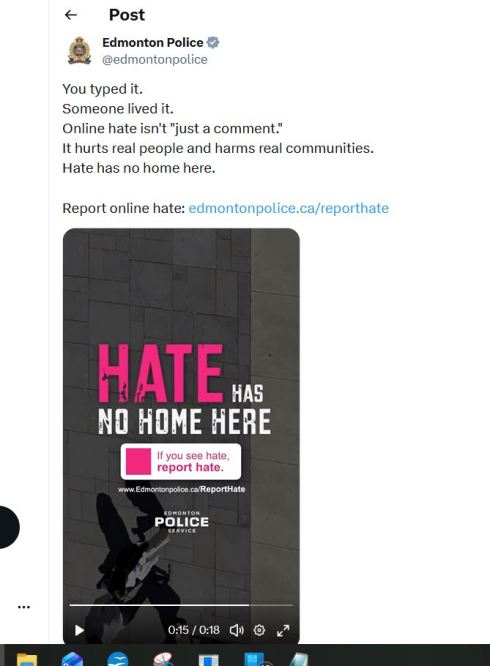
Follow the link, however, and the mandate becomes considerably broader.
EPS defines a “hate-motivated incident” as a non-criminal action motivated by bias, prejudice or hate. Its examples include insults, offensive jokes, slurs and racial comments. Reports receive a police file number, are reviewed by Hate Crime investigators and may result in contact from an investigator.
In other words, Edmonton police are inviting citizens to report one another for speech that the police themselves acknowledge may be entirely lawful.
There is a reasonable argument for recording certain non-criminal incidents. A slur painted on someone’s fence may precede vandalism or violence. A pattern of escalating behaviour may help police assess a later threat. Victims may also need information about services even when no charge is possible.
But those limited purposes do not justify a public campaign that deliberately blurs the boundary between crime and offence.
Canadian law sets a demanding threshold for criminal hate speech. Public incitement must be likely to cause a breach of the peace, while wilful promotion requires more than an ugly opinion or an offensive joke. The Supreme Court has described the legal definition of hatred as an “onerous and objective standard.” That high threshold exists because freedom of expression means very little if it protects only speech that authorities consider kind, constructive or socially beneficial.
“Hate has no home here” may be a civic aspiration, but it is not a legal standard. Hurt is real, yet hurt alone does not confer police jurisdiction.
When police encourage reports of lawful expression, they place the weight of the state behind ordinary social and political disputes. The resulting file may never produce a charge, but the knowledge that a joke, argument or unpopular opinion can reach a Hate Crime investigator is itself capable of chilling speech.
EPS should vigorously investigate threats, harassment, vandalism and criminal hate propaganda. It should also tell citizens clearly when reported conduct is not a police matter.
A free society must leave room for speech that is stupid, cruel and offensive. Such speech can be answered, condemned or ignored. It should not automatically become an entry in a police database.
The police exist to enforce the law—not to supervise Edmonton’s emotional climate.
References
- Edmonton Police Service, “Report a Hate Motivated Incident Online”:
https://www.edmontonpolice.ca/ContactEPS/ReportAHateMotivatedIncidentOnline - Edmonton Police Service, “Hate and Bias Crime”:
https://www.edmontonpolice.ca/CommunityPolicing/OrganizedCrime/HateBiasCrime - Criminal Code, section 319:
https://laws-lois.justice.gc.ca/eng/acts/c-46/section-319.html - Supreme Court of Canada, Hansman v. Neufeld, 2023 SCC 14:
https://decisions.scc-csc.ca/scc-csc/scc-csc/en/item/19911/index.do
One of the stranger features of the debate over gender identity is that women are still expected to apologize for noticing when policies affect them.
When male bodies enter female prisons, shelters, changing rooms or athletic categories, sex matters. When children are placed on a medical pathway with lifelong consequences, sex matters. When crime statistics, scholarships or political representation are organized by sex, definitions matter. Refusing to pretend otherwise is not hatred; it is the beginning of an honest discussion.
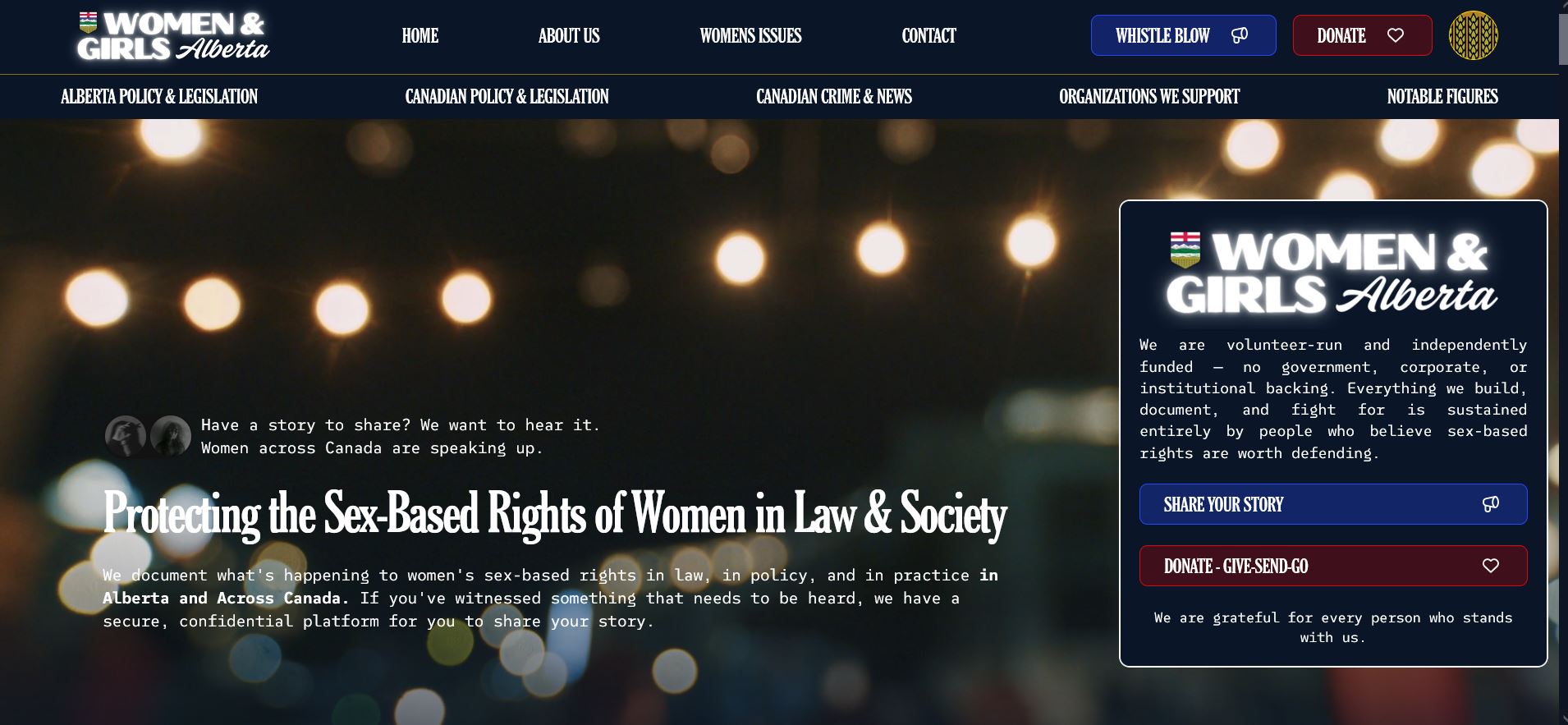
Women & Girls Alberta is an Alberta-based, women-led organization working to restore sex-based rights and protections in law, public policy and everyday life. Its platform reflects something I have argued repeatedly on this site: individual dignity does not require society to abandon material reality.
The organization focuses on the practical conflicts created when self-declared gender identity is allowed to override sex. These include women’s sports, prison safety, rape-crisis services, bodily privacy, lesbian boundaries, women’s scholarships, accurate crime statistics and single-sex spaces. Its issues section brings these concerns together rather than treating each controversy as an isolated incident.
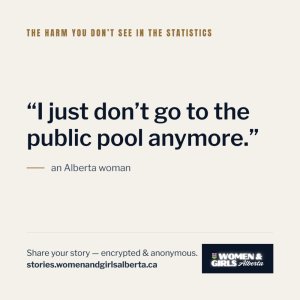 That matters because institutional change often occurs quietly. A definition changes inside a policy manual. A reporting category becomes unreliable. A woman raises a privacy or safeguarding concern and discovers that the institution has already decided which questions may be asked. By the time the public notices, the new rule is presented as settled practice rather than a political choice that should have been debated.
Women & Girls Alberta is doing more than issuing statements. The organization collects legislation, policy developments, documented cases and Canadian news concerning the erosion of sex-based protections. Its stated mandate includes providing sex-based policy analysis, supporting legislative clarity and creating opportunities for public discussion. Readers can examine its sources and arguments for themselves rather than being asked to accept a slogan.
Especially valuable is its confidential reporting platform, through which women can document experiences involving prisons, hospitals, shelters, schools, workplaces, sports and government programs. The organization says submissions can be made without an account or a name through a system built on the open-source GlobaLeaks platform, and it provides additional precautions for people concerned about professional retaliation or identification.
The point is not to declare every allegation true merely because it has been submitted. The point is to gather accounts, documents and recurring patterns that institutions may otherwise ignore. Evidence cannot be examined until people are permitted to report it.
The strongest argument from the other side should be acknowledged: transgender people are entitled to safety, civil treatment and protection from genuine discrimination. Nothing about defending women’s sex-based rights requires cruelty toward anyone. But compassion cannot mean that every competing interest disappears. Nor can one group’s desire for recognition automatically override another group’s privacy, safety, freedom of association or right to fair competition.
A pluralistic society must be capable of protecting individuals without demanding that women surrender the language needed to describe their bodies, their boundaries and their rights.
That is why I support the work of Women & Girls Alberta. It is giving women a place to speak, documenting policies that deserve public scrutiny and insisting that biological sex remains a legitimate and sometimes indispensable legal category.
Visit the Women & Girls Alberta website, read its platform, examine the evidence and share its work. Those who agree with its mission can also subscribe, contribute or help ensure that women who have something important to report know where they can be heard.
Women should not need permission to defend rights that exist because they are women.
The Alberta Medical Association and the Canadian Pediatric Society want Canadians to believe the debate over pediatric gender medicine is settled. It is not.
When Premier Danielle Smith announced restrictions on transgender medical interventions for minors, major medical bodies responded with the language of emergency. The Canadian Pediatric Society warned that Alberta’s policy would undermine the rights of transgender children and youth. The Alberta Medical Association’s pediatrics section argued that the government was targeting an already vulnerable population. The public message was clear enough: responsible doctors affirm; politicians interfere; children suffer.
 But that framing hides the central problem. There is no stable international medical consensus on pediatric transition. In fact, several European jurisdictions have moved in the opposite direction from Canada’s professional bodies, not because they have stopped caring about distressed children, but because they have begun applying more ordinary standards of evidence to extraordinary interventions.
That distinction matters. Puberty blockers and cross-sex hormones are not counselling, kindness, or protection from bullying. They are medical interventions into the development of physiologically healthy children and adolescents, often at an age when identity, sexuality, mental health, peer influence, family conflict, and neurodevelopmental conditions are still in motion. A serious medical institution should be able to say that without sounding frightened of its own profession.
Instead, Canadian medical institutions often speak as if caution itself is the danger.
The most revealing example is the suicide argument. Parents and voters have been told, sometimes openly and sometimes by implication, that restricting pediatric transition will kill children. The activist version is familiar: would you rather have a dead daughter or a trans son? The political version is not much better. Former Calgary mayor Naheed Nenshi told Premier Smith that “votes aren’t worth a few dead kids.”
That is not clinical reasoning. It is emotional coercion applied to frightened parents.
The evidence does not support the crude version of the claim. A 2024 Finnish register study in BMJ Mental Health examined more than 2,000 adolescents referred to gender identity services and compared them with more than 16,000 matched controls. The authors found that suicide deaths were rare, and that once psychiatric treatment history was accounted for, gender-referred youth did not show higher all-cause or suicide mortality than controls. The study does not say these young people are not distressed. It says the simple story — affirm or they die — is not evidence-based medicine.
That should change the conversation. Many adolescents presenting to gender clinics also carry depression, anxiety, autism, trauma histories, eating disorders, family instability, social isolation, or other serious mental-health burdens. If those burdens are treated as secondary to gender identity, medicine risks narrowing the diagnostic lens at exactly the moment it should be widening it.
This is one of the main lessons of the Cass Review in the United Kingdom. Cass did not recommend abandoning children with gender distress. It called for a more holistic model of care, better assessment, stronger evidence, and far more caution around medical pathways. NHS England subsequently stopped the routine prescription of puberty blockers for gender dysphoria in minors, moving them into a research setting rather than ordinary clinical use.
That is not a small update. It is a major warning to every country that imported the affirmative model and then treated dissent as bigotry.
The “pause button” metaphor has also aged badly. Puberty is not a decorative inconvenience. It is a central developmental process involving bones, brain maturation, sexual function, fertility, and identity formation. Cass specifically warned against assuming that drugs used for precocious puberty will have the same outcomes when used for children and adolescents with gender dysphoria. The medical context is different. The child is different. The purpose of the intervention is different. Pretending otherwise is not compassion; it is bad reasoning in therapeutic language.
The pathway concern is equally serious. If blockers were merely neutral time-buying devices, we would expect many children to pause, mature, and then step away from medicalization. But the available evidence shows high rates of progression from puberty blockers to cross-sex hormones. That does not prove every case is mishandled, and it does not prove no patient benefits. It does mean the intervention may help create the very path it claims merely to delay.
Other countries have noticed. France’s National Academy of Medicine urged “great medical caution” in treating gender-related distress in children and adolescents, citing vulnerability and the possibility of serious complications. The UK has moved puberty blockers away from routine use. Scotland paused new prescriptions for minors after the Cass Review. These are not fringe developments. They are evidence institutions pulling back after years of clinical momentum.
Canada’s professional bodies should be wrestling publicly with that reversal. Instead, they often sound as though the old consensus still exists.
“Institutional capture does not mean every doctor is corrupt. It means the institution has absorbed a political frame so deeply that it struggles to distinguish care from affirmation, caution from cruelty, and disagreement from harm.”
This is where the word “capture” becomes fair, but only if we are precise. Institutional capture does not mean every doctor is corrupt. It does not mean every pediatrician agrees with activists. It does not mean every child with gender distress is confused, lying, or socially influenced. It means the institution has absorbed a political frame so deeply that it struggles to distinguish care from affirmation, caution from cruelty, and disagreement from harm.
That is dangerous in any field. It is worse in pediatrics.
Children with gender distress deserve serious care. They deserve protection from bullying, family cruelty, humiliation, and ideological exploitation from every direction. They deserve psychological assessment, treatment for co-occurring mental-health problems, family involvement where safe, and adults who can tolerate uncertainty. The modern clinic population is also not the same as the older, smaller cohort of mostly childhood-onset cases; many services have seen a sharp rise in adolescent presentations, often with complex psychiatric and developmental profiles. A small number may continue to experience severe, persistent dysphoria into adulthood and may eventually choose medical transition. But that possibility does not justify allowing pediatric care to default into an affirmation-first pathway.
The honest position is not “do nothing.” The honest position is slow down, assess carefully, treat comorbidities, use exploratory psychological care rather than ideological confirmation, stop using suicide as a rhetorical weapon, and stop pretending that uncertain evidence becomes settled science because a professional association says so.
Medicine earns public trust when it disciplines itself. It loses that trust when it borrows the moral posture of activism and then demands deference as science.
The AMA and CPS still have a choice. They can defend vulnerable children by telling the whole truth: that distress is real, that cruelty is wrong, that some cases are complex, and that the evidence for routine medical transition in minors is weaker than Canadians have been led to believe. Or they can continue treating democratic oversight and parental caution as the real threat, while countries that reviewed the evidence more seriously move toward restraint.
“Medicine earns public trust when it disciplines itself. It loses that trust when it borrows the moral posture of activism and then demands deference as science.”
The issue is not whether vulnerable youth should be helped. They should.
The issue is whether Canadian medical institutions can still tell the difference between helping children and protecting an ideology from scrutiny.
Right now, the answer is not reassuring.
Alberta Premier Danielle Smith used her address at the Canada Strong and Free Network conference to frame her government’s recent legislative agenda as a direct challenge to what she called the “era of wokeism.”
The speech was not about one bill. It was a political inventory: professional regulation, classroom neutrality, parental rights, gender medicine for minors, female sport, and sexually explicit material in libraries. The through-line was institutional restraint. Schools, regulators, medical systems, and libraries should not become vehicles for ideological enforcement.
Smith pointed first to what supporters have called the “Jordan Peterson Law,” Alberta’s legislation aimed at professional regulators. The basic idea is that professional bodies should regulate competence and misconduct, not punish members for off-duty political or personal views unless those views clearly bear on professional conduct. Whatever one thinks of Peterson himself, the principle is larger than one man: licensing bodies are not supposed to become political conformity boards.
Education took up much of the speech. Alberta’s Bill 25, introduced March 31, 2026, is formally titled An Act to Remove Politics and Ideology from Classrooms and Amend the Education Act. The province says the bill is meant to keep classrooms neutral, impartial, and respectful of diverse viewpoints. It would require school authorities to avoid taking official positions on political, social, or ideological matters outside their education mandate, and would direct teachers to remain objective and present balanced perspectives.
That is the political nerve centre of the speech. For years, progressive activists have argued that schools cannot be neutral and must instead be actively “inclusive,” “anti-oppressive,” or “affirming.” Smith’s answer is that this logic has turned too many classrooms into ideological delivery systems. Her government’s position is that schools should teach students how to think, not quietly steer them toward approved political conclusions.
Smith also returned to Alberta’s laws on gender-related interventions for minors. The province’s Protecting Alberta’s Children Statutes Amendment Act invokes the notwithstanding clause to shield several measures from being struck down by courts. These include prohibitions on gender reassignment surgery for children under 18, restrictions on puberty blockers and hormone treatments for gender reassignment for children under 16, parental notice and consent rules around gender-related name and pronoun changes in schools, opt-in consent for teaching on gender identity, sexual orientation, or human sexuality, and rules limiting women’s and girls’ amateur competitive sports to those born female.
Supporters will call this child protection, parental rights, and fairness in female sport. Critics will call it state interference in the lives of transgender youth. That fight will not be settled by changing labels. It turns on deeper questions: what children can consent to, what parents are entitled to know, how strong the medical evidence is, and whether schools may keep consequential identity-related information from families.
Smith also addressed sexually explicit material in libraries. Alberta has proposed public-library measures aimed at limiting minors’ access to materials containing explicit visual depictions of sexual acts, while saying adults would retain access and that materials would not be removed from libraries. The government describes this as age-appropriate access control, not a book ban. Critics see it as censorship, especially given previous fights over school-library materials and LGBTQ-themed books.
The speech’s political purpose was obvious. Smith was not merely listing policies. She was tying them into a governing thesis: Alberta’s public institutions have drifted from their proper roles, and her government intends to pull them back.

That is the real argument underneath the “wokeism” language. Are schools, professional regulators, medical bodies, and libraries limited institutions with defined purposes? Or are they now expected to act as engines of progressive moral instruction?
Smith’s answer is blunt: no.
The word “wokeism” is not especially precise. It is a bucket term, and bucket terms can get sloppy fast. But in this case, it is pointing at something real: the steady conversion of public institutions into ideological enforcement systems, usually under softer language about safety, inclusion, equity, care, or professional standards.
Alberta’s new posture is simple: public institutions should serve the public under defined rules, not quietly reshape the public under activist supervision. That is the line Smith is trying to draw. The coming fight will be over whether Alberta is allowed to draw it.
We feel safe in places like Alberta for a simple reason. Not because the system is especially gentle, and not because people are unusually kind, but because we believe the rules will be enforced, reliably and without fear or favour.
That belief does most of the work. It sits quietly in the background of daily life, doing its job precisely because it rarely has to announce itself. You don’t need to know the Criminal Code in detail. You only need to trust that when someone breaks it in a serious way, the response will reduce the chance of it happening again.
When that belief weakens, the shift is subtle at first. It doesn’t arrive as a declaration. It shows up in patterns. Arrest, release, reoffend, repeat. People notice, not as legal experts, but as observers of outcomes. The conclusion they draw is not complicated: the system is no longer reliably containing those who break its rules.
That is where trust begins to erode.
In Canada, this question intersects with a specific and sensitive legal reality. Sentencing is not strictly uniform. Courts are required to consider the unique systemic and historical circumstances of Indigenous offenders through what are commonly called Gladue factors, originating in R v Gladue and reaffirmed in R v Ipeelee. These rulings direct judges to account for the effects of residential schools, displacement, and intergenerational trauma when determining an appropriate sentence.
The intent here is not trivial. Indigenous Canadians make up roughly 4 to 5 percent of the population, yet account for over 30 percent of those in custody, with incarceration rates approaching ten times that of non-Indigenous Canadians. A justice system that ignored that disparity entirely would risk perpetuating injustice under the banner of neutrality.
That is the strongest case for Gladue principles, and it deserves to be taken seriously.
“A system that adjusts sentencing to account for historical injustice may be justified in principle. But if those adjustments affect how long repeat offenders are incapacitated, the question is not ideological. It is practical: does the system reduce harm?”
But a justice system is not judged by intent alone. It is judged by outcomes, particularly where public safety is concerned. And those outcomes sit alongside another set of facts that are harder to keep in view.
Indigenous women experience violent victimization at more than double the national rate. They are killed at rates several times higher than non-Indigenous women. Much of this violence occurs within known social networks rather than as random acts, which places the question of repeat offending and system response directly at the centre of the issue.
At the same time, recidivism is not a marginal phenomenon. Data from Correctional Service Canada shows that a significant proportion of offenders reoffend after release, with rates notably higher among Indigenous offenders. That does not make reoffending inevitable. It does establish that risk is real, and that it clusters.
Placed together, these realities create a tension that cannot be resolved by appeal to intent alone. A system that adjusts sentencing to account for historical injustice may be justified in principle. But that same system operates in a world where victimization is not evenly distributed, and where recidivism is not negligible. If those adjustments meaningfully affect how long repeat offenders are incapacitated, then the question is not ideological. It is practical: does the system, in aggregate, reduce harm?
To ask that question is not to deny the moral foundation of the policy. It is to take it seriously enough to test it against reality.
This is where the conversation often breaks down. Raising the issue is treated as a signal of bias rather than a request for evaluation. But a high-trust society cannot function on selective clarity. It has to be able to hold two things in view at once: that historical injustice matters, and that the primary function of a justice system is to protect the public from repeat harm. These aims are not mutually exclusive. But neither are they automatically aligned.
If they come into tension, and in some cases they do, the answer cannot be to ignore the friction because it is uncomfortable. Nor can it be to retreat into abstract claims about equality that bypass real differences in circumstance. The harder task is to examine whether the current balance is working as intended.
None of this implies that Gladue principles should be abandoned, nor that historical context should be ignored. It implies something narrower, and more demanding. Any system that modifies sentencing must also ensure that high-risk, repeat offenders, regardless of background, are reliably identified and contained. If those goals cannot be reconciled in practice, then the framework requires adjustment, not rhetorical defense.
Because the cost of getting this wrong is not abstract. It is paid in the quiet erosion of trust, and in the lived reality of those most exposed to harm.
High-trust societies are not sustained by kindness alone. They are sustained by the belief that rules are enforced, that serious harm is contained, and that the system works in the direction of protection. When that belief weakens through patterns rather than proclamations, trust does not collapse all at once.
It erodes.
And once it erodes far enough, it does not matter how compassionate the system intended to be.
It will no longer be believed.

Glossary
Gladue Factors
Legal considerations requiring Canadian judges to account for the unique systemic and historical circumstances affecting Indigenous offenders when determining a sentence. These can include the legacy of residential schools, intergenerational trauma, and community conditions.
R v Gladue
A Supreme Court of Canada decision establishing that courts must consider the background and systemic factors affecting Indigenous offenders under section 718.2(e) of the Criminal Code.
R v Ipeelee
A follow-up Supreme Court decision reinforcing that Gladue principles must be applied in all cases involving Indigenous offenders and clarifying their importance in sentencing.
Recidivism
The tendency of a convicted individual to reoffend after being released from custody or completing a sentence.
High-Trust Society
A society in which individuals broadly believe that institutions, laws, and fellow citizens operate predictably and fairly, reducing the need for constant vigilance or defensive behavior.
References
Statistics Canada – Indigenous victimization and incarceration data
https://www150.statcan.gc.ca/n1/pub/85-002-x/2023001/article/00006-eng.htm
https://www150.statcan.gc.ca/n1/pub/85-002-x/2023001/article/00004-eng.htm
Correctional Service Canada – Recidivism data
https://www.canada.ca/en/correctional-service/corporate/library/research/emerging-results/19-02.html
Department of Justice Canada – Gladue background and application
https://www.justice.gc.ca/eng/rp-pr/jr/gladue/p2.html
National Inquiry into Missing and Murdered Indigenous Women and Girls – Final report and findings
https://www.mmiwg-ffada.ca/final-report/
R v Gladue – Full decision (CanLII)
https://www.canlii.org/en/ca/scc/doc/1999/1999canlii679/1999canlii679.html
R v Ipeelee – Full decision (CanLII)
https://www.canlii.org/en/ca/scc/doc/2012/2012scc13/2012scc13.html
The attack on Bill 25 has settled into a familiar script. Critics say it will make schools less welcoming, by which they mean that restricting ideological flag displays, limiting board activism, and requiring neutrality in certain forms of programming will make some students feel unseen or unwanted. It is an effective line because it hides a political claim inside the language of care. Nobody wants an unwelcoming school. The trick is that welcoming is being made to mean more than safety, decency, and respect.
A school should be safe, orderly, and humane. It should protect students from bullying, enforce standards of conduct, and make it possible for children to learn without fear or humiliation. What does not follow is the larger claim now being pushed by Bill 25’s opponents: that a public school must also visibly signal allegiance to a particular moral framework, and that if it stops doing so it has somehow become hostile.
“Protection is not the same as endorsement.”
That is the switch.
On the actual text, Bill 25 does not erase students, ban disagreement, or outlaw difficult topics. What it does is narrower, and more defensible, than its critics pretend. It pushes Alberta’s education law back toward institutional restraint. The bill revises parts of the Education Act’s language around school climate, requires courses and instructional materials to encourage a wide range of perspectives and foster critical thinking, says boards must refrain from taking political, social, or ideological positions unrelated to their duties, and requires certain non-approved programming to be impartial, fair, neutral, and free of personal bias. It also restricts school flags by default to the Canadian and Alberta flags, subject to later regulatory exceptions.
That is not a purge. It is a correction.
Now, the strongest version of the other side’s case is not hard to state. Some vulnerable students really do experience explicit symbols of affirmation as reassuring. Some will feel more at ease in an environment where support is made visible rather than merely promised in policy language. And because Bill 25 uses broad terms like “political, social or ideological” and refers to “common values and beliefs of Albertans,” it is fair to ask how those phrases will be applied in practice. A sloppy implementation could create confusion where schools need clarity.
Those are real concerns. They still do not settle the argument.
A public institution cannot make emotional reassurance the test for what it is allowed to endorse. The fact that some students feel comforted by visible institutional alignment does not mean the institution should align itself with a contested worldview. In a pluralistic public school, there will always be students who feel affirmed by one framework and alienated by another. The institution cannot solve that problem by choosing a side and calling the choice kindness. Its job is to protect students, maintain order, teach well, and show restraint in the use of its authority.
A public school is not a campaign office, a therapeutic identity space, or an activist workshop with a literacy block attached. It is a public institution. It belongs to families who do not agree with one another about politics, morality, religion, sex, identity, or the kind of society they want their children to inherit. Such an institution cannot remain trustworthy for long if it begins signaling that one contested framework has acquired official moral status.
This is why so much of the criticism of Bill 25 feels dishonest. It starts from a true premise and then quietly expands it. Some students are vulnerable. Fine. They deserve protection, dignity, and ordinary decency. But from that narrow duty of care, critics jump to a much broader demand: that the institution must visibly ratify a particular set of assumptions and display them as part of the school’s moral atmosphere. Protection becomes affirmation, affirmation becomes endorsement, and endorsement begins to drift into instruction.
“A school can protect a student without acting as a billboard for a worldview.”
That is the real dispute.
A teacher can treat every child with dignity without using classroom authority to suggest that contested beliefs about sex, identity, and society have already been settled beyond argument. A board can meet its legal obligations without issuing statements on every political controversy fashionable adults feel obliged to perform opinions about. Bill 25 does not solve all of this, but it does attempt to restore some institutional discipline where that discipline had plainly weakened.
As a teacher, that part is hard to ignore. I am not in the classroom to advertise my politics, recruit students into a moral sensibility, or drape school authority over my own preferred social vision and call the result compassion. I am there to teach. That means helping students read carefully, write clearly, listen seriously, and argue without slogans doing all the work for them. It also means knowing where my job ends.
That professional boundary now seems strangely difficult for some people to defend. They talk as though asking an institution to remain neutral is the same thing as demanding that individual students disappear. It is not. Bill 25 does not say students cannot exist as they are, think as they do, or discuss difficult questions. What it says, in substance, is that the institution itself should exercise more restraint in the positions it takes, the programming it allows outside the approved curriculum, and the symbolic alignment it displays as a public body.
That is a long way from the apocalyptic language being used against it.
None of this means the bill is perfect. It is not. The practical details will matter, and future regulations will matter even more. But arguing over those details is not the same as falsifying the centre.
And the centre is simple. A public school should not behave like an ideological camp that happens to issue report cards. It should teach students from many backgrounds under rules that are serious, fair, and publicly defensible. It should protect the vulnerable without demanding institutional allegiance to one faction’s beliefs. It should cultivate thought rather than posture, and trust rather than theatre.
The most dishonest move Bill 25’s opponents have made is to present neutrality as though it were hostility. That only works if one has already confused institutional discipline with emotional abandonment. Once every limit on symbolic activism is recast as an attack on children, no boundary remains. The institution becomes available for endless moral capture by whichever faction is best at translating its politics into therapeutic language.
That is not a school anyone should trust.
Bill 25 does not solve every problem in education. What it does do is move, however imperfectly, in the right direction. It treats the school as a public institution rather than a stage for institutional self-display. It reminds boards and educators that restraint is part of professionalism. It suggests, at long last, that children can be protected without making ideology the atmosphere everyone is expected to breathe.
That is not cruelty. It is maturity.

References
Bill 25 (official PDF):
Click to access 20251023_bill-025.pdf
Government of Alberta overview:
https://www.alberta.ca/removing-politics-and-ideology-from-alberta-classrooms
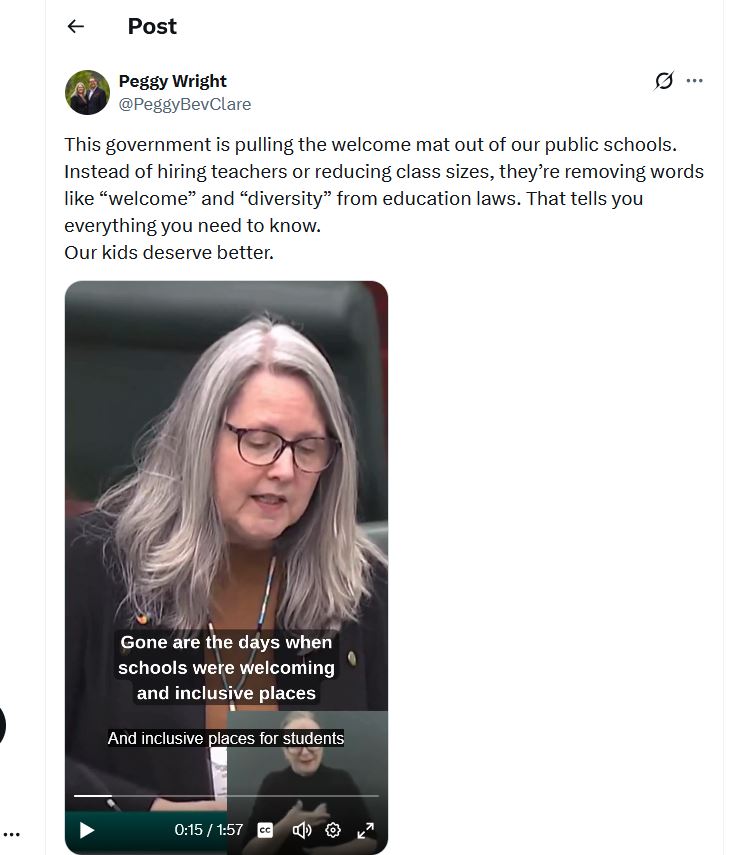
Posted by the NDP’s Peggy Wright on X.
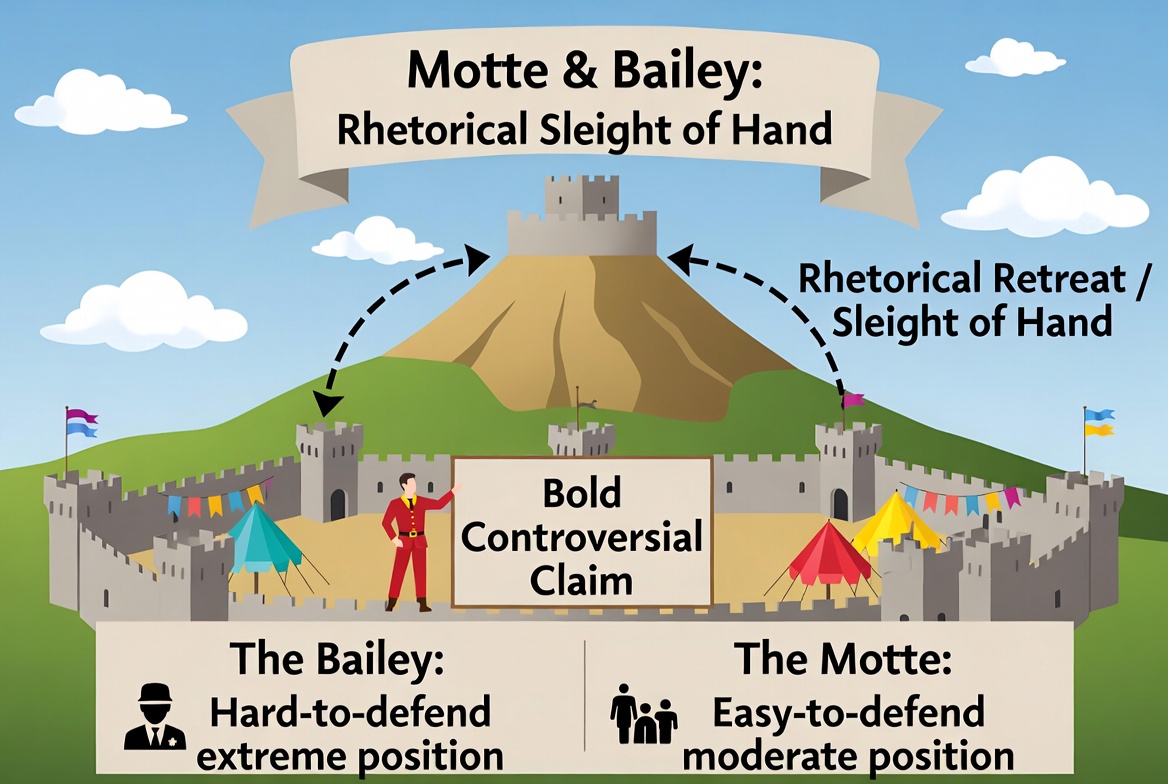
There is a recurring pattern in modern policy debates that most people sense but struggle to name. The argument presented to the public is not the policy that gets implemented. Instead, a broadly agreeable claim—something no reasonable person would oppose—is used to carry a far more specific and contested agenda into law. By the time the details become visible, the argument has already been won at the level that matters.
This is the structure known as the motte and bailey. The “motte” is the safe, defensible position: a statement so benign it feels almost churlish to resist. The “bailey” is the real position—the one with consequences, tradeoffs, and enforcement mechanisms. The move is simple. Sell the motte. Build the bailey. When challenged, retreat to the motte and accuse critics of attacking something obviously good.
You can see the pattern clearly in the recent dispute over education language. The public claim is that schools should be “welcoming,” “inclusive,” and respectful of “diversity.” No serious person objects to that in the abstract. But those terms are not operating as neutral descriptions. They have acquired specific policy meanings, often tied to particular ideological frameworks, institutional practices, and expectations placed on teachers and students. When legislation attempts to narrow or neutralize that language—shifting toward behavior-based standards like “safe and caring” environments grounded in responsibility and respect—the response is immediate: the government is “removing welcome,” attacking “diversity,” harming children. The motte is invoked as if it were the policy itself. The bailey disappears from view.
Watch the Move
In a recent legislative speech, MLA Peggy Wright provides a clean example of how this works in practice. She begins with a familiar image:
“Albertans put welcome mats in front of their doors. It means ‘come on in’ and we’re glad you are here.”
No disagreement is possible there. It is a moral and cultural baseline. But then the shift occurs. A change in statutory language becomes:
“the UCP is pulling up the welcome mat from all public schools.”
A metaphor replaces the policy. The audience is invited to react to exclusion rather than examine the legislation. The escalation continues:
“Gone are the days when schools were welcoming and inclusive places… celebrating diversity and uniqueness.”
At this point, the argument is no longer about wording. It is about intent, character, and harm. The key moment follows:
“the latest amendments… would strip words like ‘welcoming’ and ‘diversity’ from it.”
This is where the real question should be asked: does removing those words remove the underlying protections, or does it replace one framework of description with another? That question is never addressed. Instead, the speech returns immediately to moral framing:
“Diversity is a strength.”
In the abstract, yes. But the dispute is not over the abstract claim. It is over what “diversity” means in policy and practice. By collapsing the contested meaning into the harmless one, the argument avoids defending the actual implications. Criticism of the policy is recast as opposition to a universal good.
“The argument people agree to is not the policy that gets implemented.”
The most revealing line in the speech is this:
“Words are important… because they set the tone.”
That is true—and it explains the entire strategy.
This pattern isn’t random. It reflects a broader shift in how language is used in politics. Words like “diversity,” “inclusion,” and “safety” are no longer just descriptive. They function as instruments. If language helps shape how institutions operate and how people interpret reality, then controlling definitions becomes a form of power. Under that logic, you don’t need full public agreement on the details of a policy. You need agreement on the framing. Once that is secured, the content can expand behind it.
That helps explain why the motte and bailey is so effective. It allows advocates to operate on two levels at once. The public-facing level is morally attractive and broadly supported. The operational level is narrower, more contested, and often insulated from direct scrutiny. When the two are conflated, consent is manufactured. People believe they are endorsing a general principle when, in practice, they are enabling a specific program.
It works because most people are not trained to interrogate language this way. “Inclusion” sounds like inclusion. “Diversity” sounds like a mix of backgrounds and perspectives. “Safety” sounds like protection from harm. The terms carry moral weight before any definition is examined. By the time someone asks what they actually entail in practice, the rhetorical ground has already shifted. Opposition can be framed as hostility to the value itself rather than disagreement with its implementation.
The cost is not just confusion. It is the erosion of honest disagreement. If every critique of a policy can be recast as an attack on a universally accepted good, then meaningful debate becomes impossible. Language stops clarifying differences and starts concealing them. Institutions drift, not because the public has clearly chosen a direction, but because the terms of choice were never presented plainly.
This is why the technique matters. It is not just sharp rhetoric. It is a way of bypassing consent. If citizens cannot distinguish between the principle they are being asked to affirm and the policy that will follow from it, then they are no longer participating in a genuine democratic process. They are being managed through language.
If you think this reading is unfair, read the full remarks below and decide for yourself.
Appendix: Full Speech Transcript (April 2, 2026)
How to read this: Watch for the shift between general claims (“welcome,” “diversity”) and the specific policy being discussed. The argument depends on treating them as the same.
Full transcript of the video (Alberta Legislative Assembly session, ~1:57 long):
“Mr. Speaker, Albertans put welcome mats in front of their doors. It means ‘come on in’ and we’re glad you are here. And welcome to our house.But now the UCP is pulling up the welcome mat from all public schools.Gone are the days when schools were welcoming and inclusive places for students, celebrating diversity and uniqueness.That’s because the latest amendments to the Education Act would strip words like ‘welcoming’ and ‘diversity’ from it.This government combed through that bill and pulled the word ‘welcoming’ out eight times.Not satisfied with making our public schools less inviting — even as they function as important community hubs for many of our communities — then they went through and chopped the word ‘diversity’ out five times.Diversity is a strength.It used to say so in government policy, in legislation. But I guess not anymore.Words are important, Mr. Speaker, and that’s because they set the tone.When those in charge are threatened by words like diversity, welcome, and sense of belonging, there’s a problem. Because this is then about ideology and politics outside the classroom, not within.Instead of focusing on reducing class sizes, hiring teachers, and ensuring supports are there for all kids who need them, we get this distraction from a bill and government intent to narrow the frame so much that there is room for only one worldview: the UCP’s.And that’s the point.Straight out of the authoritarian playbook, Mr. Speaker.But, Mr. Speaker, our kids deserve that welcome mat back. I, for one, am extremely happy to let them know that they can expect it come next election, when it’s NDP in government and UCP — not our kids — who will find themselves unwelcome.”











 bleatmop
 Mystro
 The Arbourist


 Dead Wild Roses
Your opinions…